Saturday, 29 April 2017

Streap, Glen Finnan

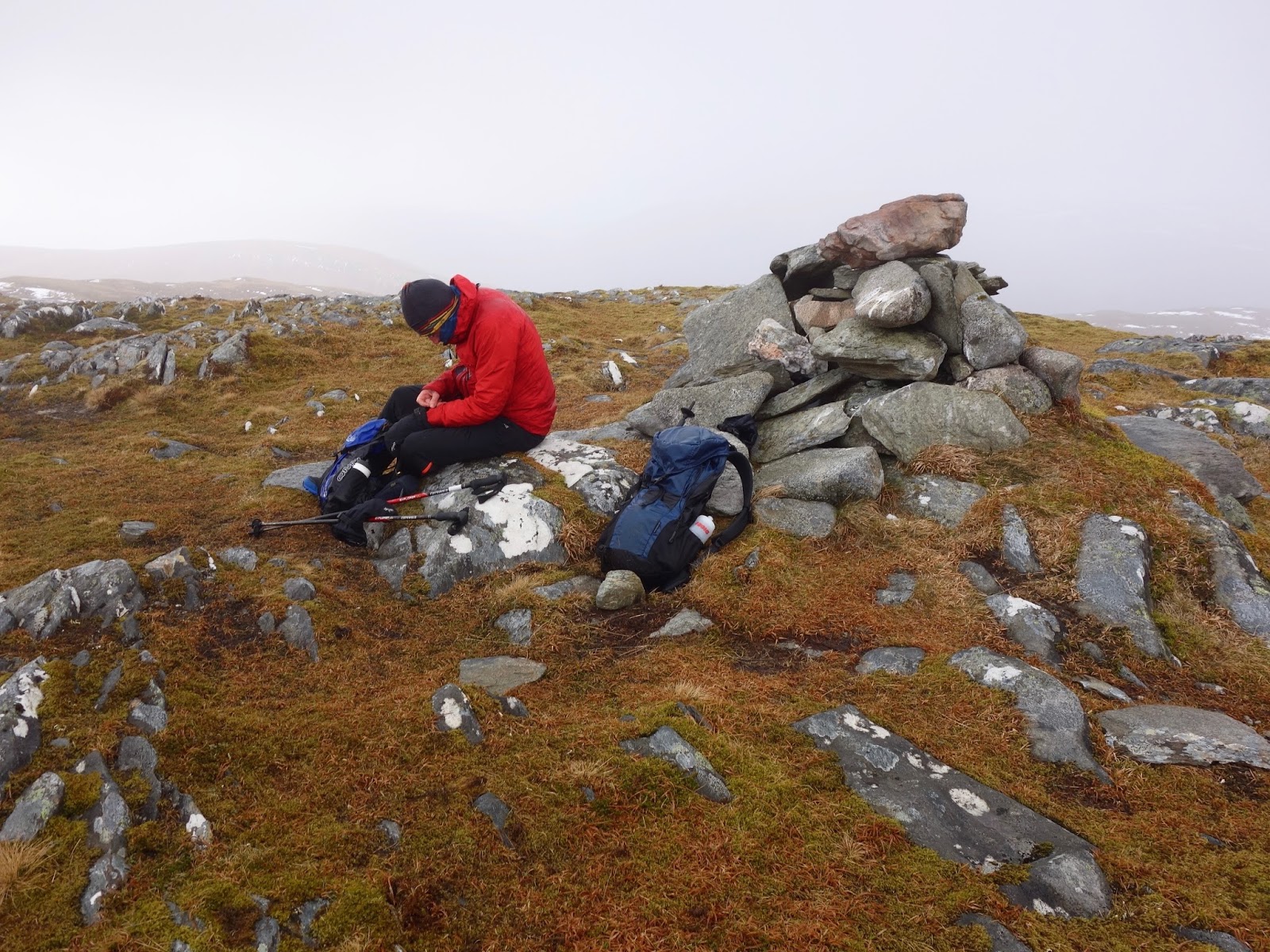
On summit of Streap, Loch Shiel behind

Friday, 28 April 2017

Ascent:                1407 metres
Distance:             18 kilometres
Time:                   8 hours 35mins

Stob Coir nan Cearc   887m   4hrs 35mins
Streap                         909m    5hrs 14mins 

After a night spent in 'Chase the Wild Goose' bunkhouse in Banavie, we were glad to be off for an early start. Streap is an inaccessible Corbett at the head of Glenfinnan. I have crossed its northern ridge on a couple of occasions on traverses from Gulvain to Sgurr Thuilm but never had the time to sample its steep summit. We started from the foot of Gleann Dubh Ligne on the trail through the conifer plantations. It was cool but bright and rain felt imminent. I had left my map in the car and made a bad mistake as we left the forest by a gate. A muddy path ascended to the southern ridge of Beinn an Tuim and we had climbed the first 100 metres before John pointed out that were heading too far south and it would add considerably to the route.

We decided to traverse round Being an Tuim, which seemed logical but ended with us spending a couple of hours negotiating our way through wet greasy rock bands, crossing numerous burns and scrambling up precarious outcrops. My feet had blistered in boots that I seldom wear and my waterproof trousers were slowing me down. I had put them on when the rain started but we just had a series of gentle showers.

We watched the morning steam train heading towards Glenfinnan, the inimitable sound of a Black Five hammering up the gradient from Loch Eil. When we reached the bealach before the sharp ascent of Stob Coire nan Cearc, we took the opportunity to eat an early lunch and reflect on the mistakes I had made on the ascent. From here on it was a fairly straightforward route over several tops before the final 70 metres of climbing up the arete to Streap. We arrived shortly after the cloud had enveloped the summit but during a drinks break we were treated to the curtain opening and reasonable views of the surrounding hills including the nearby Munro, Sgurr Thuilm, and Comhlaidh Streap, the twin peak of Streap which looks even more impressive.

We began the easy walk over the ridge to Comhlaidh Streap so that we could complete the horseshoe and we were treated to the best weather of the day. The rain was a gentle patter all day but not enough to wet us in the breeze. There is a long steep descent from this summit to the glen below, a 600-metre drop over relatively easy but steep grass and heathers. It was well drained so a quicker part of the day. Then the walkout down the corrie and into Gleann Dubh Ligne. We found a footbridge and passed the bothy, which had undergone extensive repairs after a fire and was looking splendid. We were back down just after 5pm. It had taken a couple of hours longer than expected but that was mainly down to my tendency to always head upwards instead of seeking the gentler but longer routes.


Ascent of Beinn an Tuim

Streap from Stob Coire nan Cearc

Stob Coire nan Cearc from Streap

Streap from Streap Comhlaidh
Gulvain from Streap Comhlaidh

North from Streap Comhlaidh

Looking back up Coire nan Cearc

Beinn Iaruinn and Carn Dearg, Glen Roy

Thursday 27 April 2017

Beinn Iaruinn        802m      1hr 31mins

Ascent:      701 metres
Distance:   7 kilometres
Total Time:         2 hours 45 minutes


Glen Roy has 4 corbetts, three of which go by the name of Carn Dearg. We had climbed the two at the head of the glen last year, and today was to be Beinn Iaruinn and the Carn Dearg at either side of the Glen. It is a slow drive up the glen, admiring the Parallel Roads that provide physical contours as relics from the ice age. We parked at the foot of Beinn Iaruinn and followed a steep path that leaves by the bridge. The weather looked threatening, and there was a stiff breeze to remind us that it is still April despite the plaintive cry of the cuckoos. Hills like this have few endearing features; it became a familiar plod up the dead bracken and brown heathers with rasping breath and wet feet to add to the dubious pleasure.

Arriving on the ridge gave us cloud-obscured views across Loch Lochy to Meall na Teanga and Ben Tee. The hillside of wind turbines beyond Invergarry was illuminated by shafts of sunlight, an accolade for green credentials. Cloud restricted the views in all other directions. At least I was able to put on my new waterproof jacket that I had bought over a year ago and never had to use in 30 outings in 2016. The walk over the ridge to the summit was over easy stony ground, and progress was easy despite the wind. We stopped briefly at the cairn before returning by much the same route. There was no wildlife and no incidents, but as a means of regaining hill fitness, it was a worthwhile outing. We drove a couple of miles further up the road and had a bite to eat before beginning the climb up Carn Dearg.

Start of Being Iaruinn ascent

Ben Tee and the wind farm to the northwest

Looking west to Meall na Teanga in the cloud

Summit of Being Iaruinn

Carn Dearg             834m     1hr 40mins

Ascent:      671 metres
Distance:   7 kilometres
Time:         2 hours 58 minutes


It is always a challenge to start the second walk of the day, and this was no exception. I had hoped that the brief interlude of sunshine might be a sign of a better afternoon. We crossed the wooden bridge, the bothy was closed, and a dead lamb was a reminder of the harsh environment in this remote glen. There is a 400-metre ascent up grass and heathers to make the higher slopes, which then curve around over a rain-soaked plateau and then up two more inclines to make the summit. The rains began in earnest and tested my jacket better than any testing tank as the wind hurled raindrops of all dimensions and even gave us some sleat on the summit. 

The views diminished, and our survival instincts told us to get down rather than hang about, so we made a return by the same route, not stopping until the primroses broke my step at the 300-metre contour; they never seem to go higher than this. The rain stopped as we finished, so we could change and begin the retreat from the glen and head to Corpach, where we hoped to find a bunkhouse for the night.


The bridge across to Carn Dearg

Glen Roy

John at summit

Summit view on Carn Dearg

Time to retreat

Thursday, 20 April 2017

Mrs May's Mayhem

Announcing the election
Well, that was a surprise said the massed rank of journalists who were agog at Mrs May's easter bunny present of another election. I had been thinking that there has never been such a dreadful government in my lifetime, nor such a rag-tag of opposition parties. I listened to the announcement as we made a 9-hour journey up the M1, M6 and M74 dicing with the roadworks and seeing how far we could drive without stopping at the service stations that harbour all that is wrong in Mrs May's disunited kingdom. We were glad to have friends and relatives who are close enough to the route to make some diversions for coffee breaks.

The only sensible comment on the day the election was announced was Professor John Curtice explaining the dangers as well as the advantages of calling an early election. It will be fought on the old boundaries that give the Tories no added advantage as the new boundaries would have done in 2020. Scotland, Northern Ireland and Wales are unlikely to change much, although the SNP may lose a few seats to other parties as opposition to Indyref 2 remains strong. Most Labour MPs have solid majorities that will be difficult for the Tories to win unless their lead is well over 10%. The Lib Dems are likely to regain some of the 49 seats they lost in the 2015 election. So Mrs May could end up without winning any more seats and in the process tarnish her stainless reputation for tough talking that she has acquired in the absence of any effective opposition either within or outwith her party. Her obfuscation on many issues should become apparent as the campaign takes on a life of its own.

I watched PMQs yesterday and then the start of the debate about calling the election. Mrs May was on fire, she treated her time at the despatch box like an exam. The phalanx of her middle-aged male MPs, chubby and smart in their dark suits, were fronted by a studied posse of female MPs. The Tory MPs were less smart in delivering their ingratiating questions designed to get a mention for their constituency and a pat on the back for the excellent work of the MP. Perfect material for their election leaflets.

All Labour opposition MPs had their questions ignored by Mrs May who simply challenged their loyalty to Jeremy Corbyn by quoting some derogatory remark that they had made about their leader in the last twenty months. Her research staff must have worked through the night to provide her with the insults that she released with a tally-ho flourish that delighted her benches. The PM clearly believes that question time is her chance to fire the questions. She did not deign to answer any herself. She was undoubtedly well versed in numerous briefs and quite turbocharged compared to Jeremy Corbyn who simply pedalled his prosaic questions with a plodding Sturmey-Archer efficiency. They lacked inspiration although the issues were more pertinent to what is happening to Britain in the ferment that Brexit has provided. Jeremy Corbyn's aversion to issuing personal insults is an endearing feature that Mrs May could follow. This could play well in the election.

After the election in all probability, she would be facing a far more coherent Labour opposition party whether led by a new leader or Jeremy Corbyn. And this is where her notion that she would have a united stand on Brexit following a Tory victory does not stand up to detailed scrutiny. Let's say the Lib Dems take 20 seats and have back Vince Cable and one or two other experienced MPs, the SNP will maybe lose MPs but, if Angus Robertson is returned, they provide a statesmanlike presence. The Greens may win a couple more seats giving the excellent Caroline Lucas a more powerful voice. The Labour Party have some experienced and talented MPs, if they are re-elected, who if willing to work as a team that could run rings around the insipid Tory cabinet.

It may be that the hidden reason for the election is that Mrs May is seeking to dispense with some of her cabinet. Andrea Leadsom, Liam Fox, Jeremy Hunt, Priti Patel, Liz Truss, Savid Javid and James Brokenshire are all out of their depth. Amber Rudd and Michael Fallon are her attack dogs, they have a steely gravitas that merely enhances their pomposity, and Boris means Boris, a liability waiting to happen. Mrs May does not have a creative team about her, they are mainly defensively inclined. Her team performed like those of Jose Mourinho: ruthless, boring and defensive who will bend the rules to win.

This was clear in question time as her cabinet laughed and clapped on order. The only occasion that Mrs May became agitated was when Yvette Cooper accused the PM of falsifying the truth in giving her reasons for having an election. Parliament and the House of Lords had voted by significant majorities for Article 50, which was contrary to what Mrs May had claimed. It was a reminder that Labour has some formidable parliamentarians even though many refuse to serve in the Corbyn shadow cabinet. When the more measured John McDonnell is not available, we have had to suffer the condescending intonations of Emily Thornberry and Diane Abbott speaking for Labour on the news bulletins.  They both display an irritating haughtiness that discourages any empathy with the Corbynistas. Thornberry is quick-witted but with a vindictive streak, Abbott seems to have lost the plot in recent appearances. It is reassuring to see that politicians can be recycled as Ed Miliband has shown by appearances on programmes like The Last Leg.

Even if there were a reduced number of Labour MPs, working in harness they would provide a re-elected Mrs May government with a far sterner test than she has had to cope with hitherto. If John Curtice is on the money, even an increase in the Tory majority would be far less effective against a revitalised Labour opposition front bench, whoever was their leader. Many MPs on the left of the party have refused to serve under Jeremy Corbyn over the last eight months. This self-imposed exile has been damaging to them and the party but has probably given them the determination after the election to work collectively to rescue the party from the train crash of recent years.

It is highly probable that a Labour front bench drawn from Yvette Cooper, Mary Creagh, Stella Creasy, Angela Eagle, Meg Hillier, Rebecca Long-Bailey, Lisa Nandy, Rachel Reeves, Hilary Benn, Dan Jarvis, Clive Lewis, Ed Miliband, Keir Starmer, Wes Streeting, Chukka Umunna, and Jon Crudas would have the knowledge and communication skills to seriously challenge Mrs May. There is also real experience in the upper house with Lords Blunkett, Darling, Falconer, Hain, Reid and Baronesses Blackstone and Chakrabarti amongst others. The real coup would be to make Baroness Bakewell the shadow minister for Culture and Media. She could reinvigorate the BBC as an institution that is once again objective and innovative. Under the threats from Osborne, Hunt and Whittingdale in recent years the BBC has become timid and an instrument of the government.

The other opposition parties would add substance and gravitas to progressive ideas through Caroline Lucas, Sir Vince Cable and some of the SNP.  The Commons would become a serious debating chamber with Mrs May's cabinet and her chubby backbenchers suffering political Mayhem.


Monday, 10 April 2017

Andermatt

That Red or Black moment
First run
Gemstock Cable car
Top of the Gemstock Black run
Rive Ursern through Andermatt

Village main street
Apartment Buildings, Andermatt Swiss Alps
Moguls at middle station
Empty pistes
Looking south to Italy
Matterhorn Gotthard Bahn
Devil's bridge and its upgrade
The first skiing for nine years brought back fond memories and aching quads. We had been invited to join our eldest daughter in a ski apartment in Andermatt. It was a good choice, we were staying in a new purpose built village adjacent to the old ski resort of Andermatt. It is reached by a cog railway that climbs steeply passing through tunnels and steep rock gorges that have protected the isolated location at 1440 metres through the centuries. It was the scene of battles in the Napoleonic wars with Russia and the enclosed mountain retreat now houses the bunkers for the Swiss government in the event of future wars.

As well as the cog railway that connects to Goschenen and from there on to Zurich, Andermatt is on the route of the Matterhorn - Gotthard Mountain Express route that links Zermatt to St Moritz by tunnelling and snaking through the Alps. The railway station is almost as busy as Clapham junction but with reliable, clean and empty seats on the numerous trains and the Alps as a backdrop. The frequency of the trains and the difficulty of road access means that the village is almost car free and this adds to the allure of Andermatt as a destination.

The new village is part of a massive investment by an Egyptian mogul that will provide 500 apartments, 28 chalets and 6 hotels to take advantage of the under used ski facilities as well as the network of cycle paths, walking routes and a new golf course. The scale of development is too much and too intrusive to my mind, but the commune voted for it to proceed in one of their regular plebicites that are the touchstone of local democracy. The partially built complex is already bringing more visitors with the year round facilities and the range of outdoor activities. This is benefitting local businesses and transforming the village from its traditional past. Hopefully the tranquillity of the alps will not be compromised by the scale of these developments but the days of no queues will become but fond memories assuming that the snowfields remain as climate change unhinges civilisation.

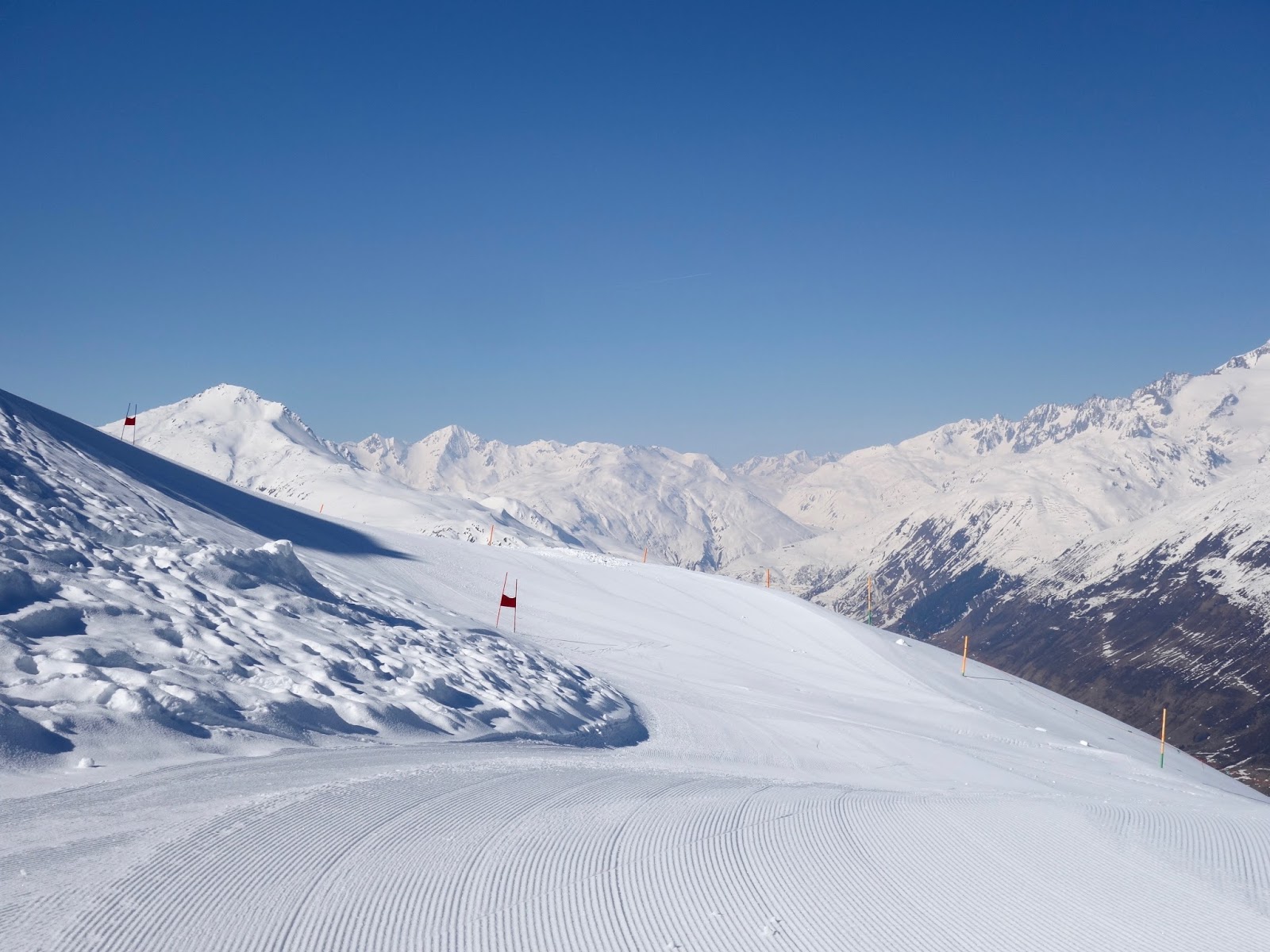
The snow had largely disappeared in the village in what has been the poorest ski season for 58 years in the Alps. Nevertheless we bought passes to ski the Gemstock mountain and were surprised at the extensive snowfields that remained above 2000 metres. Even on a Saturday it was largely free of skiers and lift queues were non existent for the the chairlift and tows as well as the cable car that went to the summit at 2955 metres. My hire skis were only 163cm long, I felt cheated having being brought up in an era when sking on less than 200cm was regarded as wimpish. It made little difference, my turns are still too tight on steep runs and I still don't like moguls.

That considered I was persuaded to take a couple of trips to the top station and to ski down the scarily steep black run named after Bernhard Russi, the locally born olympic ski champion in the 1970's. The sharp winds at the summit meant that there was no temptation to linger there. It was a day when the clouds threatened but sun block was needed. I had forgotten my sun block so a red face was the outcome. The black run proved less difficult than the so called Sun Track, a red run that also started from the summit. It was blasted by strong winds and had retained an icy surface to test our edges.

We were down by 3:30pm to enjoy a drink in the village and to plan the next day. Cloud and snow were forecast and so it proved. We walked down to the Devil's bridge in the Schollenen gorge where the Russians had tangled with Napoleon's troops. We returned to the village and then walked 10 kilometres uphill to the village of Realp along snow covered trails that twisted through the new golf course, alongside the crystal clear river and railway as it climbed to the Gotthard pass. The valley was littered with farms and linked by trails that intertwined with the railway and road. Realp was a sleepy sort of village that nevertheless had the staple ingredients of a Swiss village: station, church, clock and hotel. The Shetland pony grazing on hay seemed a little incongruous but so did the pair of llamas and a tour bus queuing for the train through the Gotthard pass.

The following day the sun appeared in a clear blue sky, the winds had stopped but so had the local bus to the cable car and it undermined our enthusiasm. After a long walk we finally ascended to the near perfect pistes that were empty of skiers. The cable car to the summit provides a 1000 metre descent. It proved possible to complete the run three times in the hour. The red run was perfect, the winds and ice had gone and the steep sections were interspersed with long schusses. I was beginning to find my ski legs although the lack of queues meant there was no respite so I returned to the village at 3pm, delighted to have avoided any falls and without any undue aches or pains.

The journey home the next day confirmed that the Swiss really know how to run state railways. All trains were on time, spotlessly clean, and there was a fully integrated timetable. We had three changes on the return to Zurich but all within minutes of each other and there is a simple and consistent ticket price that applies to all trains with connections to every part of the country. No need to book online in advance to get a fair price. Swiss railways had all the things that the privatised UK train operators fail completely to provide or achieve.

We had a couple of hours in Zurich, a clean and well ordered city that lacked the vibrancy of many European cities. The link to the airport is just 12 minutes on the frequent trains and the airport had no queues for check in, security, or boarding. The Swiss Air plane was new, spotless and served a good snack with a small bar of chocolate thrown in. Sadly we had to change at Brussels where we were brought back to the reality of budget airlines with Brussels Air giving a good impersonation of Ryanair.

Edinburgh airport was, as always, disorganised with a bus taking us from the landing stance to the other end of the airport and then the passengers having to walk back to the bus bays after the long march through customs and baggage. It must be a nightmare for older folk. In Switzerland we would have been in the centre of Zurich by the time we had negotiated the airport and walked to the shuttle bus stop strategically located beyond the tram stop to deter visitors from using the ludicrously expensive and painfully slow tram service to the city.

Friday, 24 March 2017

Garbh Bheinn, Loch Leven

Black Mount over Rannoch Moor
Stob Coire Sgoilte
Pap of Glencoe and Loch Leven from Torran nan Crann
Aonach Eagach to the south
Looking down on Stob Coire Sgoilte from the summit
The Mamores and Ben Nevis from the summit
Pap of Glencoe and Loch Leven from the summit
Aonach Eagach from Garbh Bheinn summit
Thursday, 23 March 2017

Ascent:      861 metres
Distance:   6 kilometres
Time:        4 hours 52 minutes

Garbh Bheinn      867m     2hrs 58mins


The winter has been mainly wet, and windy and the mountains are clothed in clouds; conditions that are not conducive to hillwalking. But neither has a lingering hamstring tear that has restricted my activities for the past 6 weeks. For the first time, I was subjected to kinesiology tape and ultrasound. I was told to give running a break with the result that my fitness deteriorated steadily.

At last, there was the promise of a clear day and there had been a big fall of snow at the start of the week. A day in the hills called. Garbh  Bheinn and Mam nan Gualainn at the opposite side of Loch Leven were the two nearest unclimbed corbetts and I had intended to climb them together in a day. Given my lack of activity this year and the dump of snow, I had doubts about whether they would be both doable.

It was cloudy as I left home at 7:30am and the A84 up to Crianlarich was infested with trunk road works with waits of over 10 minutes before trundling along behind a lead vehicle. I missed the 8:35am bus from Crianlarich so had to drive to Loch Leven. It was worth it for the views and the chance to take photos on Rannoch Moor and in Glencoe. I found the parking spot by the bridge on the B863 by Caolasnacon. I had camped here on a family holiday in 1965 and had ambitions to climb Garbh Bheinn, which looked magnificent from Torr a' Phloda, the small hill at the lochside. Unfortunately, family camping holidays were mainly spent setting up camp, breaking camp and travelling as far as we could between breakdowns in the 15-year-old Bedford van. There was no time for walks.

The skies were blue and the overnight frost was evaporating, there was a cool breeze but it felt warmer than I had expected. The path from the bridge climbs quite steeply and soon becomes a boggy track with the overnight ice breaking under my footfall. This was going to be a hard slog. After 500 metres of walking, I came to a path that climbed steeply to the ridge of Torran nan Crann above. From here the path follows the ridgeline, there were sections of solid ice that were beginning to melt and therefore doubly slippy. Eventually, the ridge drops slightly to a gap before the massive peak ahead.

It is Stob Coire Sgoilte, a symmetrical conical peak that hides the summit of Garbh Bheinn. It ascends from 375 metres to 800 metres, an unrelenting climb. There were footsteps from the day before and I followed them to the bottom of the climb. The walker had veered to the right, making a rising traverse, the footprints gave a clear trail in the soft snow that was 18 inches deep. I foolishly followed until at about 600 metres the trail finished, and the footsteps went down again. Whoever had attempted the route must have felt as I did and decided to give the hill a miss. I was resting every 20 metres or so of height gain, not something I normally entertain but exhaustion dictated frequent halts. I decided to continue on the rising traverse until reaching the rock and scree slopes that the snow had not settled on. The scree was loose and the rock was fractured. There was nothing for it but to persevere, the steepness requiring me to use my hands to balance on the scree and to pull up the shattered metamorphosed Eilde quartzite.

I had never ascended a hill so slowly and, by the time I reached 750 metres just below the bealach leading to the final slope to Garbh Bheinn, a rest break was required to take some food and drink to replenish my energy levels. The blue skies had given way to high white clouds but it was not cold and the breeze had remained just that despite the forecast for stronger winds. The final push to the summit was easier apart from a 2-metre drop down a vertical rock face onto a tricky icy gulley that I avoided by climbing upwards over more loose quartzite. The flattish summit was a bit disappointing and the weather had become colder with the views less spectacular than earlier in the day. It was almost 1pm and I had expected to be on my way down by noon. There was time for a few photos and more food before departing.

The route down was so much easier I simply followed a good path down the apex of the ridge from Stob Coire Sgoilte. It zigzagged through the occasional rock outcrops and the heather. Why had I not followed my instincts and ascended by this route instead of following the aborted route up the snow-covered scree slopes? The sky was brightening so I stopped for 10 minutes to soak in the views across to the Mamores and down to Loch Leven with the Pap of Glencoe looking splendid in its white raiment. I was down just before 3pm too tired to contemplate climbing Mam nan Gualainn so I drove home for an early bath as Eddie Waring used to say.

Monday, 13 March 2017

Indyref2


"Oh! What a tangled web we weave/When first we practice to deceive!"
Sir Walter Scott 

Well, that was a birthday present I could have done without. Just when you thought things couldn't get more confused and uncertain the First Minister, Nicola Sturgeon, has announced that there will be another independence vote, indyref2. By doing so she has made investment decisions less likely and released the handbrake on another downhill ride for the Scottish economy. I understand the reasons and share many of the frustrations that she cites including the unwillingness of the Westminster Government to entertain a less strident Brexit strategy. But is it really wise to have a repechage on an issue that has dominated Scottish politics for the last decade? It has been to the exclusion of using the now extensive powers of the Scottish Parliament to make progress on devolved matters. And let's face it there has been a significant deterioration of public services since 2008 most notably health and social care, education, police, and the complete range of community services from sports to libraries, arts, and local community facilities. All of which are devolved to the Scottish Parliament.

At the last referendum, there was an optimistic but unrealistic assumption that North Sea oil and gas would cover the substantial deficit between income and expenditure. That is no longer the case as can be seen from Government Expenditure and Revenue Scotland 2015-16, North sea oil and gas revenues peaked between 2006 and 2013 and are now in terminal decline with extraction dipping from 118.7 m tonnes to 66.9m tonnes in 2015.

The net deficit between income and expenditure from 2015 to 2016 was £14.8bn, a very significant 9.5% of the Scottish GDP.  This compares to the UK as a whole having a net deficit of 4.0% over the same period. Even whisky exports fell by 10% between 2012 and 2015. Scotland has not recovered from the last recession as well as other parts of the UK. The most recent evidence on education performance shows that Scotland is now lagging behind England as well as the majority of European countries in school performance. Threats to free schools from local authority control are not the answer. It is the failure of funding to keep pace with inflation, the loss of support services and the failure to train enough teachers as the baby boomer tranche of teachers retire that is at the heart of the problem.

Scotland's economy has stood still or regressed since 2008, this is partly a result of the financial crash, in which the activities of the Royal Bank of Scotland and the Bank of Scotland played a significant role. It is also because the Scottish Government has focused too much attention on blaming Westminster for all problems whilst failing to provide constructive leadership for the delivery of Scottish public services. The facts are unassailable from unemployment to GDP to average incomes to school performance to health services and housing investment.

Add this to the fact that the economic case for independence is now even less positive than 2014 and it can be seen that indyref2 will be another risky venture that will divert attention and resources away from the things that really matter.

The half-truths and lies that have emanated from both the first minister and prime minister do no credit to either Holyrood or Westminster. I find the dilemma particularly vexing. Whilst the UK government is possibly the worst in my lifetime with policies that contravene all that I hold dear, I believe that it is devolution to the most local level, councils or communities, that is vital to engage and activate citizens and local businesses in shaping future changes. Independence will work against this in a world that requires stronger global alliances to prevent obscene profit-taking by global companies. It is more extensive and independent local governance that is required to set priorities and deliver local services that respond to the needs of localities that the Scottish Parliament should realise is the better means to improve public services by engaging its communities.

The Scottish Government has been a centralising force and has certainly failed to reflect the ambitions that Donald Dewar promised when proposing and delivering the Scottish Parliament. His case for devolution was one of subsidiarity where decision-making was taken as close as possible to communities. He saw the Scottish Parliament devolving many of its powers to the local level not sucking up more from the localities. Instead, powers have gravitated to Edinburgh under successive first ministers. Police, colleges, economic development, health, education, roads, and transport have all been subjected to greater centralisation. 

What is increasingly evident is that centralisation and the emasculation of local governance have resulted in no commensurate improvement in the services. No surprise there, it is almost inevitable that central government is too remote to deliver services in the era of neo-liberal politics. The growth of inspection agencies at a time when the funding and powers of local governance are diminishing has been an own goal. Equally, the transfer of many services to external providers has been exploited for profit, and services have become commercial transactions without the supposed safeguard of competition for the citizens. 
The fundamental tenet of public service delivery is to serve and engage the citizen, this works best when there is a transparency and common understanding of the issues.

Saturday, 25 February 2017

British media write off Labour

British Rail, preferred to the private operators by the electorate

The number of journalists and political commentators writing off the Labour Party for a generation, if not forever, following the Copeland by-election result is a facile but typical groupthink. The electorate is totally fed up with all political parties at the national level, as is evidenced by the low turnouts in Copeland 51%, and Stoke Central, 38%. Labour under Jeremy Corbyn indeed looks unelectable in any general election, but none of the parties looks to be capturing the mood of the electorate in these troubled and uncertain times. The Tory voters are more loyal than Labour voters at present, but a dozen years ago, the Tories had been written off following the barren years under the dreadful leadership of Iain Duncan Smith and Michael Howard.

What no one has reported is that the ten largest cities in the UK: London, Birmingham, Manchester, Leeds, Liverpool, Sheffield, Glasgow, Edinburgh, Newcastle, and Bristol are all Labour-controlled, apart from Edinburgh, where Labour is the largest party under a proportional representation electoral system. They are, for the most part, running administrations that are valued by their citizens who discern the difference between local and national politics. Apart from Scotland, where there is an alternative left-of-centre party, the SNP, there does not seem to be a collapse of Labour at the local level that is assumed by the media.

This presumption reflects the fact that the national press gave up reporting on local government at the turn of the millennium when they greatly reduced the number of seasoned reporters of local government. Politics is ignored outside the bubble of Westminster and the devolved governments in Scotland and Wales. Yet as Simon Jenkins wrote last year, "Labour has some outstanding leaders", but that "it is a shame that they are all in the regions." It reflects my experience working with politicians, both councillors and MPs, at the local level. Thirty years ago, I was present when a rumbustious councillor, ambitious for an increase in his allowances, pleaded with the principled leader of the Council to be given the chair of a committee. He was told in no uncertain language that he would never be made a chair; local government services are far too important, and that if he wanted more remuneration, he should stand for parliament. 

He did and was elected in a job lot of Jimmies and Tommies that were elected to Parliament at the next general election. The moral of the story is that there is a sense of public duty that pervades local politicians (of all parties) who are drawn from a wider cross-section of society and have real responsibility for delivering services. These qualities are often absent among national politicians, many of whom have limited working experience outside politics, and are over-represented by academics, educationalists, lawyers, financiers and journalists. The large majority of MPs are not involved in decision-making and are prone to focusing on politically correct or salient issues that exercise the media and chattering classes, but are a lot less vital for most citizens. Some are just there for more salacious activities that Westminster is tapped into.

Politics is being redefined, not on class lines but by the electorate's values and perspectives on wider issues. These include the role of the state in delivering education, health, housing, care and infrastructure, which remains a dividing line between the parties. They also embrace the protection of the environment, climate change, social justice, community control, the unregulated power of global capitalism, and international issues that include aid and migration, as well as trade and defence. There is also the tranche of populist stances on immigration, human rights, nationalism and gender politics that are classless. The way that political parties provide clear direction on these issues will determine their future survival. They will have to convince an increasingly savvy electorate who are far more fickle than previous generations when it comes to party loyalties.

Mrs May has adopted an approach that appears to be unambiguous on the wicked issues of nuclear power, defence, tax, schools, austerity and Brexit. This plays well with a certain demographic - the older, financially secure and more nationalistic. It contrasts with the Corbyn-led Labour Party, which embraces ambiguity on some of these national issues and leaves the younger. less financially secure and more globally aware, uncertain of what the Labour Party stands for apart from equality and human rights. If the Labour Party could become more committed to its traditional values that embrace state-owned railways and infrastructure, locally accountable public services, social housing, more progressive taxation, regulation of the financial sector and a real commitment to tackling climate change, it could become a far more potent force than is currently assumed by the fickle media. This is unlikely to happen under Corbyn; some of his fantasy policies that are constantly amplified by the press will never be acceptable to the wider electorate.  


Friday, 24 February 2017

Rob Roy Way: Callander to Aberfoyle

Ben Ledi from Callander
Friday, 24 February 2017
15 kilometres
3 hours 10 minutes

A dry morning after storm Doris persuaded me to walk another section of the Rob Roy Way from Callander to Aberfoyle. I ran this route regularly in the 1980s when we lived in Glasgow and came out to see my in-laws on Sunday. I had also walked the route in the 1990s with two 11-year-olds who were raising money for a Leukaemia charity. The route has become more difficult since then with the growth of newly planted trees and today it was covered in deep wet snow over a path that was a part bog.

The walk began at the bridge over the River Teith in Callander and took me to the mini roundabout where the back road runs towards Loch Venachar. The old moss-covered stone walls and native woodland make it an attractive amble despite the flooding on the road and the row of caravans at Callander Holiday Park overlooking the road. I stopped at Gartchonzie bridge to watch the gushing Eas Gobhain below the weirs at the exit of the loch. At the outflow of Loch Venachar, there are benches that provide a fine view down the loch to the mountains, which were blasted with snow.

The early brightness of the day was turning grey before the rains arrived. A party of volunteers were litter picking and a massive sign had been erected to by the national park to proclaim the newly introduced 'no camping zone'. The Loch Lomond and Trossachs National Park have refused to allow new housing, introduced measures that restrict the right to roam and seem to be in hock to hotel owners and tourism chiefs, who are more focused on making money than giving folk the opportunity to enjoy and explore the splendours of the natural environment. John Muir would not have approved, he saw national parks as places for people to engage with the natural environment as well as protecting it from exploitation for profit.

At the east lodge, a car park has been constructed and a forestry track climbs steadily through the conifer plantations for about 3 kilometres. By the time I had reached 200 metres in height, the tracks were covered in wet snow. Passing the small lochan is the high point of the walk, thereafter the Rob Roy Way turns off the track and becomes a boggy narrow path through the forest with burns to cross, tree roots to negotiate. Quite a few trees had blown down in recent high winds and required some tricky diversions. The rain was threatening so I pushed on eventually leaving the forest for a 2-kilometre passage over open moorland with a path that had disappeared into the snow. I was the first walker coming across the Way since the snowfall on Wednesday evening, 36 hours ago.

My aim was the gate into the forest below the Menteirth hills, the snow was less deep here and it was the bogs that slowed me until I alighted onto the forestry track that leads down to Braeval. The path continues along the top of the Aberfoyle golf course, a place with superb views but not today. I dropped down through the golf course and arrived at the village below Dounans camp. I arrived home as the rain began and dosed in the afternoon.

Eas Gobhain below the weirs

Loch Venachar with Ben Venue

Looking north over Loch Venachar to Ben Ledi

The lochan at the top of the route

Slow going in the snow along the boggy path

Wednesday, 22 February 2017

Post-optimism


It has been a dreary start to the year, and trips to Glasgow, Dundee, Perth, Stirling, Falkirk, York, Wakefield, Carlisle and Brampton have made me realise how our urban centres are in serious decline, with empty shops, commercial buildings and the urban realm all looking in need of extensive repair. Only York has retained a sense of vibrancy, with its tourist attractions drawing visitors and generating significant spending from home and abroad on a bitterly cold February day.

Presumably, more affluent towns in the south are thriving. Certainly, during visits over the past couple of years to Oxford, Hemel Hempstead, Sevenoaks, Brighton and surrogate southern towns like Chester and Harrogate, I have been pleasantly surprised to find them exempt from the dilapidation that has afflicted northern towns and cities.

Towns in the Midlands and North already look like they are broken in the way the Remain camp are predicting after Brexit. The urban fabric is a mess: street furniture and signage are cluttered, broken, and dirty; pavements and roads are a tribute to the failure of the power, telecoms, and water providers to restore the public realm; and business premises show an ever-increasing number of vacant properties. Pubs, banks, independent shops and restaurants have closed; it is only charity shops, pound shops, fast food outlets, nail bars, tanning studios and betting shops that seem to be surviving, if not thriving. There are notices for the reduction of bus services and future shop closures. 

Travel agents are suggesting that we escape another depressing UK winter by filling Spanish hotels and cruise ships during their off seasons. It is cheaper than trying to heat homes and cope with cost of living increases. These symptoms of austerity and attempts to blame Europe for all the mistakes of the Cameron and May years, Brexit will simply confirm the sense of urban decline and accelerate the pending recession. People are looking sad. The years of austerity have broken Britain.

The rundown of our towns and villages is not surprising given the wage stagnation and benefits reductions of recent years. These have been exacerbated by the most severe cuts in public expenditure since the war, an ever-accelerating switch to online shopping, and a failure to regulate the street works effectively.

I have spoken to several local businesses in recent weeks, and they have all made the same comment. They need to know what is going to happen post-Brexit, and they all say that orders have slowed down. The uncertainty is beginning to strain their resources, and plans are being put on hold or abandoned. The 14 council directors that I have mentored this year are almost all dealing with reducing or closing services, disposing of premises and laying off staff. Only two or three are looking at developing new or improved services, and even then, there is no guarantee that funding for implementing the changes will be obtained. Experienced managers in their 50s are being retired with little evidence that their knowledge and experience will be replaced. Austerity is the mother of a failed economy.

I watched I, Daniel Blake, directed by Ken Loach and written by Paul Laverty; it reinforced the scale of social injustices that are being perpetrated by 6 years of austerity. Even in 2015, 29% of children were living in poverty, and 14% of pensioners were living on less than 60% of median incomes. These figures are increasing year on year. The post-truth announcements from the government focus on the record number of people employed and the FTSE 100 increases. But these fail to acknowledge that many jobs are part-time, non-permanent or self-employed, and they often lack pensions and sick pay.  The FTSE is soaring on the back of a £ that has depreciated by 20% or so. The UK has become a takeover target for global corporate companies, and other businesses are transferring operations into mainland Europe in anticipation of Brexit.

As a lifelong optimist, I am struggling to find the upside in all of this. Housebuilding is in further decline and unaffordable; the NHS is in meltdown; education expenditure in England is focused on free schools or academies rather than targeting the shortage of pupil places or much-needed investment in existing schools. Sustainable energy initiatives have been sacrificed on the altar of fracking and nuclear deals. The government are still 12% ahead in the opinion polls. It makes you wonder what other damage they can get away with without denting this lead. Peak Jeremy Corbyn has probably been reached;  his lack of leadership skills is manifest, and the Lib Dems are still recovering from their dalliance with the capricious Tories.

But even some Tories are now beginning to worry that 2018 could be the year when the public says enough is enough. The convergence of 10 years of austerity, heartless benefit reforms, the duplicity in dismantling the NHS, the lack of decent affordable housing and the pension deficit have conspired to create an "inequality of wealth that is grosser than any European country". This is what George Orwell had said in 1941 in his essay, ' The Lion and the Unicorn'. It is probably even more apposite today.

The fruits of three decades of neoliberal policies, coupled with the dystopian policies emerging in the United States and the loss of trade links following Brexit, could generate a perfect storm that sparks a groundswell of despair arising from the skewed affluence within the UK. There could be a showdown with the government if the electorate could find an alternative that they trusted. The calls for an early election may be tempting to Theresa May before the dogs of war within the Conservative Party begin to bite.

And 2018 is the Chinese year of the dog.

Tuesday, 21 February 2017

National Railway Museum

Rocket replica

A weekend near York for an extended family reunion provided the opportunity to visit the National Rail Museum at York. It is a fine facility and does much to generate tourism traffic for a city that is already well endowed with attractions from York Minster to the Viking centre, city walls and the shambles. York may lack scenery, located on the flat and frequently flooded Ouse, but it is well positioned on road and rail networks to attract visitors from most parts of the UK. It is a pity that the national museum was not located in Crewe, Doncaster, or Darlington all of which were formerly railway towns that would be more deserving and benefit more from rail tourism.

Nevertheless, it was chance to touch base with the steam locomotives and railway infrastructure that I spent three or four years inhaling between the ages of 9 and 13. I spent most Saturdays watching trains on the West Coast mainline and, during school holidays, I raided many engine sheds to cab locomotives and made visits to locomotive works in Horwich, Crewe, Gorton and Doncaster. My geography of the UK was largely gained by knowing travel times to towns on the rail network and my map reading skills honed by locating engine sheds. The names of the locomotives also provided most of my knowledge of countries, cities, Greek gods, kings and queens, castles and regiments along in each case with a 5 digit number.

There were lots of memories as I took my 3-year-old granddaughter onto the footplate of my favourite locomotive, a coronation class pacific - the Duchess of Hamilton (46229). She seemed interested and asked me how it worked; my impromptu description of being like a giant kettle on wheels was accepted but she knows how to humour me. It was the very same locomotive that my grandad had lifted me onto the footplate to be shown the controls by the friendly engine driver as it stopped at Preston whilst pulling a Glasgow bound express.

I was also 3 years old at the time and on the Saturday mornings when my grandad was not working he would ask what I wanted to do, the answer was obvious. The museum had on display the nameplate of another coronation class pacific, Queen Mary(46222), which was my final 'cop' of this class of locomotive when I was 11 years old. The target for all trainspotters was to complete all the 'semis', the name given to this most powerful of all the British locomotives. Happy days indeed.

Mallard, the fastest steam locomotive
The cab of a Coronation class pacific locomotive
Evening Star, the last steam locomotive built for British Railways
46222, my final Coronation class locomotive (semi)

Thursday, 2 February 2017

Is democracy trumped?

The last couple of weeks have seen some of the most bizarre gyrations in political posturing. Channel 4's Washington correspondent, Kylie Morris, confirms through her regular reporting that President Trump is just as bonkers as we had suspected from gasping at the indiscretions that he uttered and tweeted throughout the presidential campaign. Footage from the innards of American states like Indiana and Tennessee suggest that his supporters among the working classes are loving the way he is treating the Washington insiders with the same contempt as his apprentices. It will be interesting to see what they think in a year when their financial plight has been put on hold whilst taxes for the wealthy and corporation tax for companies are reduced. The Sioux tribe have already witnessed his contempt for struggling communities by his approval for the Dakota oil pipeline to be routed across their homelands with army engineers ordered to execute his decision.

His supporters are delighted with his daily brag that things are happening. Terrorists are being locked out; trade agreements are being torn up; companies, journalists, and world leaders are being insulted, ignored or demonised. He is using all the bullying tactics that have made him a gold plated dickhead and it seems to be working with the greedy, the weak and unprincipled companies and governments gushing their support. Witness the way that the republicans, car manufacturers and dependent states, including the UK, are happy to play his games.

China, the European Union and Mexico have called him out and after this morning's rant on the phone to the Australians PM, the equally intemperate Aussies could declare a 'fuck you mate' diplomacy. It is Russia, Israel and the UK that seem the most enamoured with the new President. They are all hanging their hat on him blessing some of their more risky ploys, as in the Ukraine, switching the US embassy to Jerusalem and leaving the EU. There will be deals to be struck in these and many more international agreements but, as he said twice, yes twice folk, it is America first.

Mrs May's ill timed rush to be the first world leader to hold his hand had seemed rash even to begin with. After the President's announcement of the exclusion of citizens from war torn countries and the PMs refusal to challenge this policy, the homage proved to be a diplomatic own goal. Meanwhile the more principled world leaders and demonstrators across many nations have been blowing the whistle on his conduct over immigration, climate change and his name calling of regimes and organisations that are multilateral. As his frenzied playlist of prejudices is further activated with little attempt to discover their wider impact, more countries, corporations and groups will challenge the legality and morality of his infringements of the constitution and international agreements.

In the midst of this there were some strange bedfellows joining the protests. Starbucks, never knowingly oversold, offered to hire 10,000 refugees worldwide and 2 million UK citizens have signed a parliamentary petition calling for the Queen to be absolved from hosting a state visit for President Trump. Senators are considering a fillibuster against some of his nominations for key posts; California is talking about leaving the union; and the National Park service has a twitter campaign objecting to the damage of national parks like Yellowstone and Grand Teton by oil pipelines approved by the President.

Contrary to what we are being told by some of the media, that populism is usurping liberal democracy, I wonder if it is unwittingly releasing a far more positive worldwide movement. The reaction to Trump's early examples of executive populism could be a powerful and inclusive networked democratic movement. One that sheds the elitism of representative democracy and encourages more collaboration between diverse local and global movements.  It may be that this cloud democracy will be able to overwhelm the narrow, selfish, tax evading, individualistic and nationalistic tendencies that trumpism exemplifies. Hopefully this will happen before the wannabe populists secure more footholds in other parts of the world.

I'm just looking forward to the smile on Kylie Morris's face on the day that Trump is vanquished.