Tuesday, 24 July 2018

Glasgow Redux

Woodlands tenements

We returned to Glasgow last month after 30 years of residing in the Trossachs. It was during the long heatwave that gave the city a continental feel. We are between the University and the decaying City Centre, close enough to the bustle of the West End and near enough to be on the motorway in two minutes. We are in a block of flats occupied mainly by thirty-somethings, next to a school that has been converted into good-quality accommodation for overseas students studying at the university. The noise of the city was a shock: traffic, music, bin collections, helicopters, ambulances, and motorbikes created a background hum well into the early hours, and the seagulls provided a disruptive dawn chorus as they feasted on discarded litter and garbage.

Initially, we were simply recovering from three weeks of dismantling, packing and moving from the family house and a massive decluttering of possessions. During the first week, I could not find my passport, and the HM Passport Office call centre was unhelpful, saying it would take over a week to replace it, even if I paid the premium rate. I ignored their negative advice and walked over to the Glasgow Passport office, where the friendly staff said they would do their best to get it sorted. They let me use their phone to contact the UK passport office to arrange an interview in Glasgow later in the day. They had created a slot for me to prevent obfuscation by the UK office. Then they arranged for printing to take place the next day.  I celebrated the next day by making a day trip to Skye on the early morning bus to climb a favourite mountain. I received a phone call whilst climbing Sgurr nan Gillean to tell me the passport was ready. Glaswegians really know how to help each other.

We went to France for a fortnight to relax, read, walk, swim and enjoy the peace and tranquillity of the limestone plateau in the Ardeche, a place that retains local traditions and is free from the commercialism of mass tourism. Since returning, we have witnessed the highs and lows of Glasgow life. Glasgow has always been a city of contrasts, but the sense is that it is more concerned about its image than its public services. This has been starkly evident with the upcoming European Games costing £91m. Tourism bosses claim it will be a bargain. This is not the view of those I have heard in the streets who complain about closed public services, rundown facilities and environment and the threat of more cuts in the pipeline. The price of tickets for the main events (swimming, cycling and gymnastics) will exclude the majority of residents whilst their bus routes are diverted, roads are closed, and investment is shifted to the vicinity of the venues.

I had lived in Glasgow between 1973 and 1987, a period of its existence when its post-war decline reached its nadir. Its regeneration began in 1976 with community developments, tenements rehabilitated, rail and underground lines modernised, and education and other services boosted. New industries, venues and new developments were directed to the city centre and inner urban areas. This was helped by large investments from European Funds. Glasgow was on the mend, but since the advent of the Scottish Parliament in 1999, Glasgow has been relegated to become de facto Scotland's, not the UK's second city.

Edinburgh has the Parliament, it now has the largest airport, and soon may have the football as well as the rugby national stadium. Glasgow has collected one-off events like the Garden Festival, City of Culture, Commonwealth Games and now a share of the European Games. Whilst these are celebrated with gusto by city leaders and the corporate sector, they seldom have lasting benefits for the indigenous population apart from a portfolio of event venues that have to be maintained and paid for. Glasgow has lost out on big investments like bridges, trams, parliaments, and the array of high-earning businesses that are located close to the seat of government. In this respect, it has not been well served by a municipal pride that believes it does things better than other localities. It doesn't, as any cursory glance at the Audit Scotland Performance reports would confirm. Sadly, Glasgow in its efforts to make financial savings over recent years, has outsourced too many services and allowed other services to wither away. It has also failed to work closely with its communities or the third sector.

My observations from the past couple of months living in Glasgow would highlight the plus points as:
  • a wide variety of cafes, bars, restaurants and shops that have emerged in some of the inner city areas like Finnieston
  • excellent bus services, running at high capacity, thanks in part to the over 60 Scottish entitlement card, which has opened opportunities for the elderly
  • an extensive range of museums and places of interest within walking distance
  • The friendliness and helpfulness of most people, epitomised by the passport office
  • a wide range  of events taking place in the parks and local halls, as well as the commercial venues
  • the superb architectural and industrial heritage of Victorian Glasgow, particularly the parks, docks and railways 
On the downside
  • The streets are dirty and full of litter, weeds, leftover asphalt and building materials
  • Sauchiehall Street and the surrounding roads have been closed following the School of Art fire, with disruption to shops
  • The appalling state of the back lanes is an embarrassment as summer tourists seek to get around the closed roads
  • The refuse collection and recycling service is twenty years out of date and contributes hugely to the litter problem
  • Glasgow sends 72% of its waste to landfill, three times as high as the best councils 
  • fire damage, as well as the fire at the School of Art, other fires have caused many adjacent buildings to be closed, with demolition taking an inordinate amount of time
  • Our telephone exchange has been out of use following a nearby fire, so we have been without internet or telephone connection for two months 
  • The failure to cater to cyclists and the terrible state of the pavements for pedestrians
  • The abundance of new flats for students is in marked contrast to the shortage of quality social housing for the local population
  • The council has closed all its public conveniences, resulting in the back lanes being used as public toilets
  • The collapse of retail establishments in the city centre has been created by the large number of out-of-town retail centres given planning permission by the Council at Silverburn, The Fort, The Forge, Great Western and in adjacent councils at Braehead and Clyde. The collapse of Sauchiehall Street, Union Street and the St Enoch's Centre has created vacant shops and foot-free streets lacking any specialist shops or attractions. 
  • Wealth disparity is endemic, with the homeless cheek by jowl with Range Rovers on the streets, expensive restaurants next to Poundland, and life expectancy 20% worse in the poorer communities
  • The public realm is in unremitting decline, from rotting lampposts to untended green space
With another couple of months to go, I hope to reflect further on the life and death of this Great British City.

Botanic Gardens

Lobey Dosser and Rank Bajin riding Elfie

Park Circus
The School of Art after the fire

Clyde skyline

Squinty Bridge

Finnieston Crane

Glasgow Hydro, Mosque and Park skyline

Wednesday, 18 July 2018

Boris Johnson RIP

On your bike mate

John Crace has absolutely nailed the posh establishment ex-Mayor of London, Brexit champion and ex-Foreign Secretary in tomorrow's newspaper. (see below) Let's hope there are no further resurrections from this vainglorious hypocrite. The acclamation of President Trump should help clinch that outcome but the  Tory party works in mysterious ways and its members seem fond of goons.

Saturday, 14 July 2018

Sgurr a' Ghreadaidh, the central Skye ridge

Sgurr na Banachdich in the cloud from the Glen Brittle campsite

Returning from a week in the Lake District, the Met Office was forecasting a couple of reasonable days on Skye. I was anxious to finish the Skye Ridge, leaving me with only Meall na Tarmachan, a fine but easy local mountain, to complete my fifth and final Munro round. Whilst there are many Munros that I will revisit, there are quite a few that I would gladly give a miss. I am not sure that I will be up for the Skye Ridge in 5 years. Although I have enjoyed scrambling and climbing on the ridge in recent weeks, I would probably require a rope and equipment on parts of the ridge, and that would spoil the sense of freedom and overcoming risk in the mountains.

As always, John and Keith were both keen to accompany me. Keith was also close to finishing his fifth round, including all the tops, to add to his three Corbett rounds, a Graham round, a dozen or more coast-to-coast walks and hundreds of mountain marathons and hill races. There can be few people who have walked more in Scotland. We delayed our trip for a day to avoid two rainy days that ended the month-long drought, and travelled up on Wednesday afternoon to the Glen Brittle campsite. We arrived after the rains had passed, and a warm breeze was keeping the midges at bay. It meant missing the World Cup semi-finals but England was never as good as the media believed, and it was no surprise to discover that they had lost 2-1 to Croatia.

Thursday, 12 July 2018

Ascent:       1327 metres
Distance:    14 kilometres
Time:          10 hours 58 minutes

Sgurr a' Mhadaidh                  918m      3hrs 30mins
Sgurr a' Ghreadaidh                973m      4hrs  49mins
south top                                 968m    
Sgurr Thormaid                       930m      6hrs 31mins
Sgurr nan Banachdich            965m       6hrs 55mins
Sron Bhuidhe                          960m      7hrs 38mins

The Skye ridge is generally seen as four sections: the two munros above Coir Ghrundda in the south; the three summits above Coire Lagan, including the highest Sgurr Alasdair and the Inaccessible Pinnacle; and the three peaks in the north, approached from Sligachan, including Sgurr nan Gillean. In the middle are three lesser-known peaks of Sgurr a' Mhadaidh, Sgurr a' Ghreadaidh and Sgurr nan Banachdich. The ridge wriggles between them over rough gabbro laced with basalt dykes. There are a couple of tricky scrambles exiting from An Dorus (the window) and between the twin summits of Sgurr a' Ghreadaidh, the exposure is quite breathtaking with massive drops into Coire Uisg on the east of the ridge.

We had driven to Skye with the expectation of good visibility after a couple of days of heavy rain, the first for over a month. Sadly, the cloud level remained down to 600 metres in the morning, so the ascent was less straightforward than on previous visits. We followed the obvious route to Coire An Dorus but then followed a rogue path up the steep cleft leading to Eag Dubh, the black cleft. Having realised our mistake, we lost 45 minutes contouring around to the north over steeply sloping slabs that were still wet from the previous day. When we eventually reached the Coire An Dorus, progress was quick, and the scramble up to the summit of Sgurr a' Mhadaidh provided good sport.

We had some food and drink before making the descent to An Dorus. We scrambled down about 50 metres west of the top of the gulley and redirected three other parties who had reached the steep face at the top of the gulley and found the climb unnerving. There is a steep pitch leading to the Sgurr a' Ghreadaidh ridge, but with good holds, it provided no real obstacle. Once on the ridge, the scrambling is enjoyable, although the sense of exposure is reduced by the lack of visibility. We peered down the deep cleft of Eag Dubh and realised that we would not have made it had we continued to climb this before realising our mistake.

I had been slightly apprehensive about Sgurr a' Ghradaidh's summit ridge, which is notoriously narrow. Its knife edge is a basalt handrail with a narrow ledge for feet. Below is the mighty abyss of Coire Uisg. It is not called the 'peak of anxiety' for nothing. We continued along to the south peak, the thick cloud inured us to the exposure. We took a long break for the rest of our food, feeling that we had overcome the most difficult obstacles of the day. The cloud came and went as we peered down the 130 metres of vicious descent to the bealach.

The descent was slow going,  Sgurr Thormaid and Sgurr na Banchdich loomed out of the cloud like impossible sentinels. By this time, we had become more relaxed, we were scrambling and delighted in 45 minutes of climbing on the grippy gabbro that was shredding our fingers. We climbed over the three teeth without realising it and back climbed down Sgurr Thormaid with our confidence rising. The final climb to Banachdich is up a twisting, loose scree path. We had completed the three Skye mountains and we lolled on the summit, another Munro round was virtually assured. A guide arrived with his two charges, who were feigning exhaustion, but they were going to descend via Coir' na Eich to the west.

We continued over the two south tops, one of which is a classified top and therefore an unmissable option for Keith, before eventually reaching Bealach Coire na Banachdich. The path descends from here and makes a long loop south before twisting and turning through numerous rock bands to the floor of the Coire. At last, the clouds were dissipating from the ridge and we enjoyed some sunshine as we walked out over the peat grasslands, passing the impressive waterfall and down to the Glen Brittle Memorial Hut. The farmers had been cutting and collecting the silage, and there was a convention of farm machinery in the fields. We met a farmer and her dogs and were told that the day had gone well and everything had been gathered in.

A breeze sprang up, and the evening sunshine provided a warm glow as we reached the campsite. It made the evening meal a midge-free feast as we sprawled on the dry grass reflecting on the day's adventure with a sound sleep guaranteed. Never have couscous, a pasta salad and apple pie washed down by several cups of green tea tasted so good. At last, the fifth round looks like it is in the bag. It will have taken almost ten years, more than twice as long as previous rounds, but it has been done at the same time as a nearly completed Corbett round, so perhaps there is an excuse other than age.

Starting the ascent to Coire Mhadaidh
Crossing the burn below An Dorus

An Dorus, the window

Descending Sgurr a' Mhadaidh

Eag Dubh

The summit of Sgurr a' Ghreadaidh in the clouds

Summit Blockheads

Sgurr a' Ghreadaidh ridge

On Sgurr a' Ghreadaidh ridge

Sgurr Thormaid and Sgurr na Banchdich

Sleeping pod on the ridge

Sgurr na Banachdich towards south top
Glen Brittle and Canna

Sgurr a' Ghreadaidh from Sgurr na Banachdich south top

Exiting Coire na Banachdich

Waterfall on the Allt Coire na Banachdich


Sunday, 8 July 2018

Langdale in Summer

Langdale Pikes from Elterwater
Ordnance, an art installation at Wainwright's Inn
We returned to Langdale last week for the 35th year. Thirty-five years earlier my parents had honeymooned here 9 months before I was born so it feels like home. We had a week of perfect weather as the summer of 2018 sampled the upside of global warming in North Britain. We adapted to the heat by rising early, walking before lunch and then finding somewhere to bake in the afternoon heat. The Britannia Inn at Elterwater or the swimming pool both gained more favour than sitting watching Wimbledon or the World Cup.

The beauty of Langdale is the chance to find perfect walks, runs or hillwalks from the doorstep. We walked over to Little Langdale where Slater's Bridge is a reminder of the industrial heritage of the slate mines. The tranquility of the valley is helped by a verdantly verged single track road leading to the Wrynose Pass. Little Langdale tarn and the Three Shires hotel provide solace and refreshment. We returned via the ever deepening Elterwater slate quarry, one of the few remaining sources of UK slate.

I climbed the ridge to Silver Howe and meandered along to Blea Rigg and the Langdale Pikes before descending the seriously steep staircase of rock from Stickle Tarn to the Dungeon Ghyll bar at the head of the valley. We had carried and cajoled three children under four including a three month old up this path in 1984. The walk was a reprise of my first solo hillwalk as a teenager and the Dungeon Ghyll was where I bought my first pint of beer in 1964.

We made the annual pilgrimage to Skelwith Bridge, where Chesters is a vegetarian cafe that provides tasty salads and the best chips in the UK according to Gregor. We went to Grasmere via High Close where I had my first Youth Hostel holiday romance in 1965. Ambleside is ten minutes away and provides an abundance of outdoor shops and the quite excellent Fellini's restaurant. There were trips to Keswick, Ullswater, and the always friendly Littletown farm cafe in Newlands. As always We spent an afternoon with another family whom we have met every year since 1984. Langdale has a dependable constancy that acts as a benchmark to reflect on life's journey.

Slater's Bridge, Little Langdale
Little Langdale Tarn
Elterwater Quarry
Langdale Pikes from slate quarry
Britannia Inn
Elterwater quarry and Chapel Stile from Silver Howe
Harrison Stickle from Blea Rigg
Stickle Tarn and Harrison Stickle
Langdale Pikes from Cumbria Way

Thursday, 5 July 2018

The Old Man of Coniston

The Old Man of Coniston from north
Thursday 5 July 2018

Ascent:        731 metres
Distance:     9.5 kilometres
Time:           3 hours

Brown Pike                         682m           57 mins
Buck Pike                           744m    1hr  10 mins
Dow Crag                           778m    1hr  22mins
Brim Fell                            796m    1hr  58mins
The Old Man of Coniston   803m    2hrs 10mins

The week of good weather kept giving so I made an early start to walk before the heat became too overbearing. I left Langdale at 7:35am and after a couple of false turns found the car park at the top of the road to Walna Scar above Coniston. I was walking by 8:10am. There were already half a dozen cars parked and at least a couple of overnight campers in the car park. With the morning sun behind me, I made good progress on the stony track that heads westwards towards Walna Scar. An elderly man on a fully specced mountain bike was fearlessly descending a stone staircase and gave me a cheery "bloody great morning".

After a couple of kilometres, the path to Goat's Water headed off to the north, there were three parties heading in that direction. I continued and used the good track to take me up to 600 metres. A geology student from Edge Hill was examining the rocks for her summer assignment and she told me some of the findings. I followed a narrow path to some old mine workings and gave myself a steep climb of 80 metres to reach the summit of Brown Pike. Had I continued on the Walna Scar track for another minute there would have been a perfect easy graded path to the summit. From here to Buck Pike and then on to Dow Crag was easy walking along the ridge with good views to the Scafell range and across Goat's Water to the Old Man. I stopped for a few minutes on Dow Crag to take some refreshment, not too long as the rocky summit was swarming with flies.

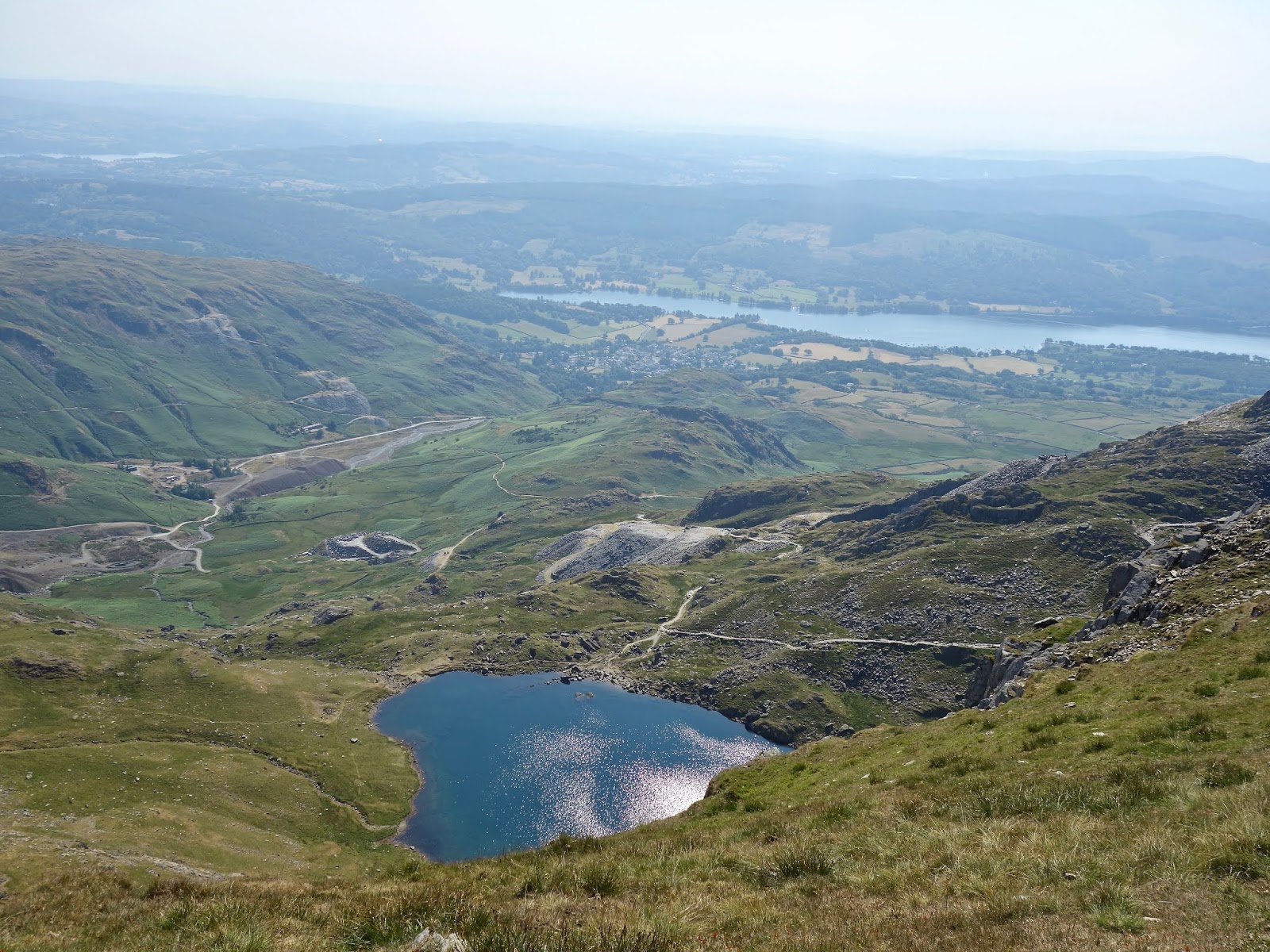
There is a 130-metre drop down a rocky ridge before the path begins to ascend to the Old Man. Halfway up the path, I cut to the left to climb the grass to the flattish summit of Brim Fell. Views to the nearby peaks of Swirl How and Grey Friar in the north and the mine workings around Low Water gave some character to the fairly mundane summit. It is an easy stroll up to the Old Man of Coniston and a dozen or so other walkers were rambling about also seeking to get their walks completed early. I descended a hundred metres down the main path  before turning south to follow an indistinct footpath to the massive disused quarry. There was a bit of route finding around the quarry before a good footpath down to the Walna Scar road.

Three runners were going past as I arrived and I joined them for the final kilometre to the car as I was trying to complete the round in 3 hours. Two older Canadians were on a week's hill running holiday in the Lakes accompanied by a guide from Ambleside. We spent 10 minutes talking hills and where to go in Scotland when they visit next week. I was back at Langdale by 11:30 am, well ahead of schedule.

Walna Scar Road and Brown Pike
Blind Tarn and Brown Pike from Buck Pike
Goat's Water and the Old Man
Dow Crag summit
Brim Fell summit
Low Water and Coniston from Brim Fell
Dow Crag from the Old Man
Low Water and Slate workings from the Old Man
Disused Slate Quarry south-east of the Old Man of Coniston

Monday, 2 July 2018

Newlands and Borrowdale

Skiddaw across Derwentwater
The thirty-fifth year in the Lakes was celebrated in perfect weather. We decided that early starts should be the norm and set off early on the Sunday for Buttermere with the chance for Gregor and I to climb Ard Crags and Knott Rigg before meeting the others in Buttermere. We had just parked at the drop off when a group of walkers appeared and the familiar figure of Mark gave us a cheery welcome. He was out with the Kendal Walking Club on their Sunday ramble. For the first time since I had been walking with him, he wasn't wearing a  pullover but it was tied around his waist. He told his club friends to carry on and he would catch them later. We followed ten minutes later having established that the club would be climbing the two hills we were climbing as the start of a walk around the Newlands skyline.

It was scorching as we made reasonable speed to catch the group up and tune into the irreverent patter that is evident in all groups. They had to wait for backmarkers on Ard Crags so we continued over to Knott Rigg, catching up on Mark's walking exploits since his departure from Scotland to the Lakes. He has now completed six Wainwright rounds since moving to Ambleside three years ago and walks most days. We had to meet Aileen and Debbi in Buttermere so dropped off Knott Rigg to the beck that runs down to the Lake. Our intention to climb Bannerdale Knotts was abandoned because of the searing heat. We had a drink and then drove over Honister pass to Borrowdale where we had drinks in the Lodore Falls Hotel that had recenty been extensively modernised and extended.

Gregor decided that he wished to jump off the footbridge into the river Derwent, something I had done from the old bridge in 1967. There was a small crowd with the same intent and, despite the lack of water in the streams, the river still had six feet of water to arrest the jump. Derwentwater and Skiddaw provided the classic Lakeland backdrop to this excursion. On days like this, the Lakes is the most hospitable of environments. We returned to Langdale to eat in Wainwright's pub, the very place where my life had started.

old acquaintances
Robinson and the Buttermere Fells
Heading for Knott Rigg
The descent to Buttermere
Wandope and Eel Crag from Newlands Hause

Bridge Jumping on the Derwent

Skiddaw