Tuesday, 11 August 2020

Aonach Shasuinn, Glen Affric

Glen Affric Pine

After lockdown, I began to consider how best to tackle the remaining Corbetts, my plan to finish them in April and May having been thwarted. I had a double problem: a lack of hill fitness and a knee that I had badly twisted when out running in May. It was much improved, but would it stand up a couple of days on pathless Corbetts when the vegetation was at its highest in August and after several weeks of rain? There is only the trying, and, spotting a couple of days of fine weather forecast for the north, I planned an attempt on the three remaining singleton Corbetts in Glen Affric and Strathfarrar.

I left at 6 am on a Sunday morning and made reasonable time up the A9, despite the 40mph restrictions for the section leaving Perth, where the dualling was taking place. There was little traffic, and I made it through Inverness before 9am and arrived at what I thought was the nearest car park at Chisholme Bridge, 10 miles beyond Cannich. The notice said car parking for hill walkers, so I dumped the car and began to walk westwards at 9:45am. I had been panicking because I had been told by several people that the highlands were packed with visitors and the parking areas were full of camper vans.

Sunday, 9 August 2020

Ascent:           926 metres
Distance:        23 kilometres
Time:              6 hours 55 minutes

Aonach Shasuinn       888m     3hrs 31mins

I realised after crossing the bridge a couple of hundred metres beyond the car park that the original car park was 2 miles ahead, but I had already changed and packed my rucksack, so I decided against returning to the car, a mistake because it meant an extra half hour walking at each end of the outing. The compensation was the glorious copses of birch and Scots pine sculpted against the azure blue sky with Sgurr na Lapaich's rugged profile behind. I reached the original car park, which was half empty and crossed the bridge over the river Affric and began the walk along the Affric Kintail Way on an excellent track above Loch Affric with superb views down to Affric Lodge.

Just after a new stone building, a hydro station, there is a narrow path to the left that is signposted to Cougie. It follows the Allt Garbh river, twisting and climbing its way through heathers, scots pines, bogs, rock bands and climbing steadily for a couple of kilometres until it arrives at the Cougie track. I turned right and lost some height before following the Allt Garbh until a new hydro water intake on the burn. It had taken almost two hours, and the real climbing had yet to start.

I took a sighting for the 873 metre north-west top of Aonach Shasuinn and spent the next hour and a half flogging my way through deep, deep heather. It was only when above 750 metres did the underfoot conditions improved. There were a couple of other walkers ahead tramping in the same general direction, and I eventually caught them as they stopped for a break. They must have been as surprised as I was to find anyone else daft enough to attempt this route on a day when the vegetation, insect life and high humidity conspired to make it such an antidote to climbing. As always, the summit made it worthwhile, a stony plateau with outstanding views in all directions. I spent ten minutes or so absorbing the views before making the simple jaunt across to the 888-metre summit, with the nearby stone shelter providing an excellent place to have some lunch.

I decided against a return by the ascent route and instead to follow the long ridge to Carn nan Coireachan Cruaidh and then over Cnap na Stri before dropping to the Cougie track. It was easy going along the ridge, but new planting below Cnap na Stri made the final couple of kilometres another exercise in perseverance. After this, even the Cougie path seemed like a GR highway. I marched back along the Affric Kintail Way and then the road to my distant car park.

The intention had been to see if I could fit in another walk in the early evening. My legs and feet were telling me not to bother. The answer came when I reached Cannich, parched from the day in the heat and desperate for a pint. It was only just gone 5pm, but I managed to spin it out for an hour or so by sitting outside for a fish tea. I set off on the road from Cannich to the Mullardoch dam to find a suitable camping place at Muchrachd below the start of the route up Sgorr na Diollaid. I found a track just before the bridge, and there was space for a tent on a grassed-over parking spot, but unfortunately, under the tree camouflage. The midges were in full mob mode, so I had little option other than an early night so that I could start the walk first thing in the morning.

Affric Lodge and Beinn na Lapaich

On the Affric to Kintail Way

Sgurr na Lapaich

The Cougie path, apparently

Aonach Shasuinn from the Cougie Path

Ascent route from the car park on Loch Beinn a' Mheadhoin

Ben Nevis from Aonach Shasuinn

Sgurr nan Ceathramhnan from Aonach Shasuinn

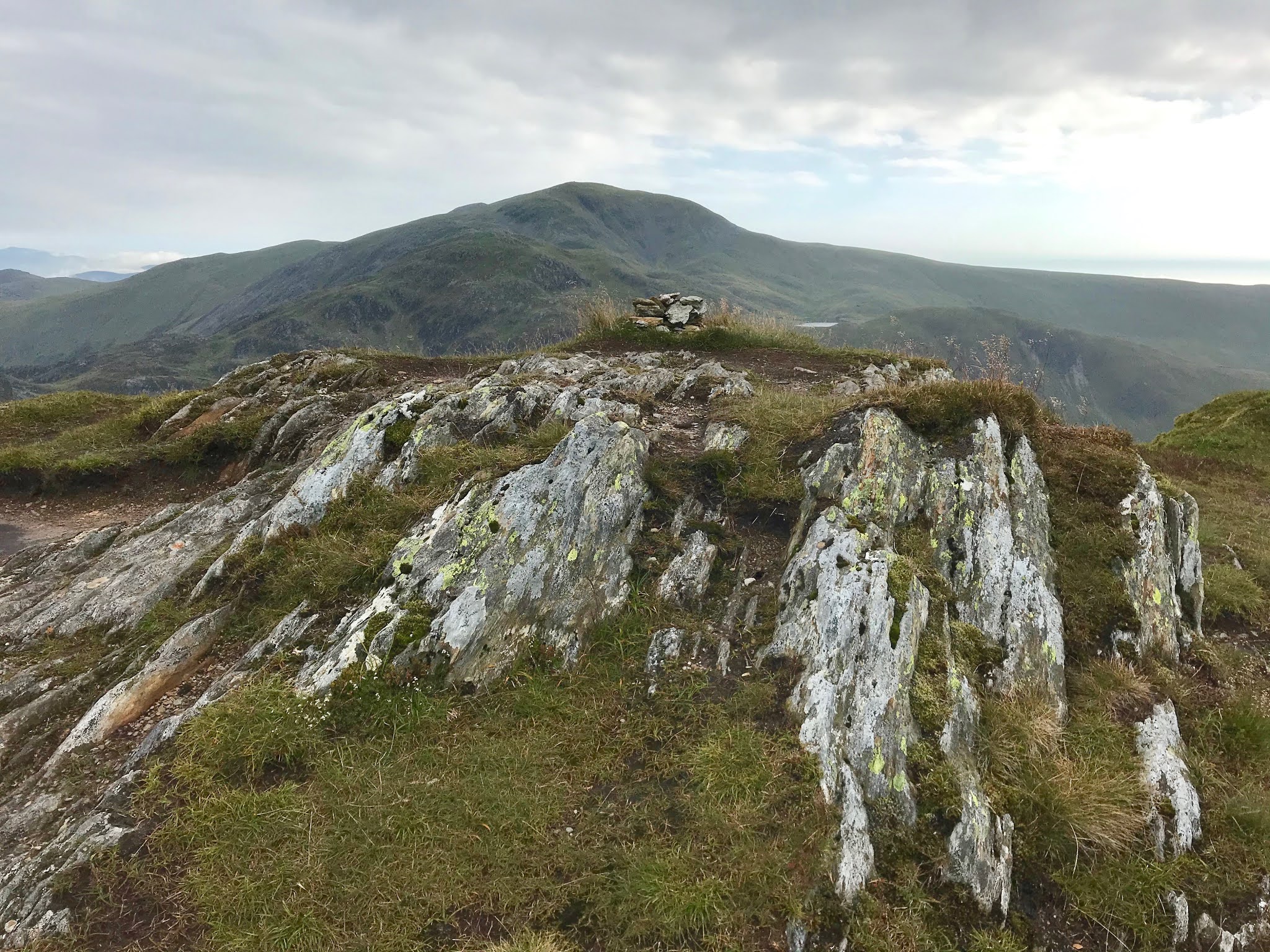
Aonach Shasuinn cairn

Aonach Shasuinn shelter for lunch

Carn Eighe range

Heading back on the Cougie Path

Scots Pine by Loch Beinn a' Mheadhoin


Tuesday, 4 August 2020

Mayar and Driesh


The Scorrie, Driesh from Glen Doll

Monday, 3 August 2020

Ascent:          873 metres
Distance:       15 kilometres
Time:             3 hours 49 minutes

Mayar            928m   1hr   50mins
Driesh            948m   2hrs 36mins

I had not expected to get out in the hills so soon after Friday's walk. First, I was asked if I would like to join John and his family to climb Ben Lui but the forecast was not too good and I thought it was maybe too long a walk for my knee that was giving some twinges of pain after Stuc a' Chroin. Gregor had then suggested we climb Mayar and Driesh, his last remaining Munros in the East. The weather was more promising and it would be an easier walk so we headed off to Glen Clova just after 7:00am. The roads were fairly quiet but it is a long haul up to Glen Clova to the car park at Glen Doll where there were already a dozen cars. We had arrived at 9:30am and on a cool breezy morning began the walk to Mayar via the ever inspiring Corrie Fee.

There were quite a few other walkers setting off as we began and passed the new Blair House that is being built by a local builder using sustainable local materials, with high energy efficiency and a loft designed to attract swifts, swallows and bats. After a couple of kilometres Jock's Road path leaves the Corrie Fee track, which eventually downsizes to a path through the conifer forest until it emerges at the start of the remarkable Corrie Fee. It is a heather clad drumlin field with the purple mounds set in the bright green grasses and a burn meandering up to the back of the corrie where a waterfall provides some fine sound and vision effects as the climb begins. 

Gregor agreed to take photos of a group of walkers and one of them shouted don't give him the camera, he looks like a runner and he might run off with it. If only they knew, and he is looking for a new camera! Gregor steamed ahead on the steeper slopes but took a diversion to see the waterfall close up. The path twists its way through the crags in the upper parts of the corrie and it is 800 metres before the gentler grassy slopes are reached that lead to the unspectacular summit of Mayar. Gregor had arrived 5 minutes before me and three other groups were there with the usual scattering of dogs.

It is an easy descent to the bealach between the two hills where the Kilbo path crosses from Glen Doll to Glen Prossen. The climb to Driesh is steeper at first with a gentler final kilometre to the large shelter at the summit. I had bivvied in the heather here on a fine June night in 2006, it had seemed idyllic and I had slept well. It was less appealing today as the rain clouds were gathering. We had a short shower during the return to the bealach from where we descended via the Kilbo path. It was the first time I had descended this way in seven visits to Driesh, I had normally continued down the Scorrie to Glen Doll, made long traverses over to Broad Cairn and Lochnagar or on one occasion returned to Glen Isla. 

We were down in good time and considered dropping in at the Glen Clova hotel but even the garden was full of lunchtime drinkers and the car park was full so we drove home via Glamis and Coupar Angus. Perth was awash with traffic and strangled by road repairs. Scotland seems to have been fully unlocked in recent weeks as the end of the summer holidays, cabin fever and a yearning to get out have converged. The fact it was a bank hoiday was probably the least important factor.


Gregor at the foot of Corrie Fee

The footpath through Corrie Fee


Looking back down on the Corrie Fee Drumlins

Mayar summit

Looking over to Driesh from Mayar

Lochnagar and other hills on the descent of Mayar

Driesh summit

On the Kilbo path back to Glen Doll

The new Blair House below The Scorrie, Driesh


Friday, 31 July 2020

Beinn Each and Stuc a' Chroin


Beinn Each, Stuc a'Chroin and Ben Vorlich from Thornhill

Friday, 31 July 2020

Beinn Each and Stuc a' Chroin

Ascent:      1140 metres
Distance:   13 kilometres
Time:         5 hours 45 minutes

Beinn Each         813m     1hr   33mins
Stuc a' Chroin     977m     3hrs  10mins

On any clear day, the view out of the kitchen window is of Stuc a' Chroin, its rugged profile beckoning. I have climbed it 8 times over the years, always with its partner Ben Vorlich until last year when icy conditions deterred us from continuing over to Stuc a' Chroin as we guided a novice walker down from Ben Vorlich. It was time to climb it from Loch Lubnaig via the outlying Corbett, Beinn Each, a route I had not taken since 1994. I had remembered the steepness of the ascent to Beinn Each but had forgotten the long, undulating traverse required to reach Stuc a' Chroin.

It was supposed to be the hottest day of the summer, so I left early, but with road work diversions around Callander, it was 8:15am before I set out on the walk from Ardchuillerie More. The house and its estate, previously owned by Jim Kerr of Simple Minds, were undergoing major landscaping work, with gateposts announcing the property's enhanced status. The initial kilometre is a steep, narrow path along a new deer fence, over a cascading burn, through some conifer plantations with several fallen trees until a forestry road is reached that climbs to the open ground with a good track leading to Glen Ample.

Near the summit of the path, a signpost points confidently to Beinn Each. It is narrow and through waist-high bracken; the ground was boggy from recent rain and at a gradient that encourages the occasional pause for breath and to take in the views. There was a bank of cloud lying in the glen and as height was gained the profiles of Stob Binnein and Ben More hove into view. Apart from a northerly dogleg at the top of some crags, the climb is unrelenting. I had thought of undercutting Beinn Each and climbing it on the return but decided to get it over with and find an easier descent route from Stuc a' Chroin. 

The winds that had been predicted had been as notable for their absence as the sun, but they provided a blast of warm air at the summit. I huddled down to plot the next stage, discovering that I had left my food at home and had just a litre of water to see me through. It was still well before 10:00am so I took 15 minutes to catch up on the news and enjoy the sense of isolation; there aren't many visitors to Beinn Each despite its close proximity to the cities, the path was definitely not well frequented.

It is a steep and tricky descent through the crags from the summit of Beinn Each as the faint path follows the old iron fence posts northwards over undulating intermediate crags towards the 735m top.  The path continues to follow the fence posts from here, dropping to 660 metres before climbing another 300 metres to the summit of Stuc a' Chroin. Although I was in no rush, my pace was slow. I arrived at the summit, and there were three other walkers. I had a chat with one about life in lockdown and our attempts to get back on the hills. By July I would normally have had 15 or so days in the mountains, but this was only my third visit to Munros or Corbetts all year. I found another rock to shelter behind for a drink and a break before beginning the descent. 

I followed the ascent route back to the 735m top from where I decided to take a direct route down to the Glen Ample track. It was rock-strewn at first but then mainly heather and bog grass for the 2-kilometre descent of 400 metres. It was hard on the feet, but time was becoming tight; I had intended to be home by 2pm to prepare for a 3pm meeting. The Glen Ample track climbed up to the watershed, and then I was able to up the pace for the final 3 kilometres back to the car. A young couple with a baby in a buggy were starting out on a walk and asked my advice on the difficulty of the path. I told them not to bother the steepness; tree roots, burns and fallen trees would make it impossible. I suggested alternative walks but they said that all the car parks and lay-bys were full. As I began the drive home, I understood what they meant; the whole of the central belt seemed to have been fooled by the weather forecast, the heatwave in the south was no more than a muggy day in Scotland but the countryside was heaving. There would be heavy downpours and electric storms by 6pm.


Beinn Each signpost

Looking west over Glen Ample towards Stob Binnein and Ben More

Glimpse of Stob Binnein and Ben More from Beinn Each

Stuc a' Chroin from Beinn Each

Stuc a' Chroin, the final 200 metres of climbing

Stuc a' Chroin summit looking north

Stuc a' Chroin random walkers

The track through Glen Ample

Beinn Each


Hail Our World Beating Panjandrum

European Excess Deaths over Previous Years

Well, after many spurious claims, Boris Johnson's Government has been crowned as 'world-beating' or at least European beating by his own Office of National Statistics for having the highest number of excess deaths during the first wave of the Covid pandemic. In the months until 29 May 2020. England had 7.55% more deaths compared to the previous five years, the second was Spain (6.65%) and the third was Scotland (5.11%). The PM had always said don't make comparisons until we have emerged from the pandemic. Presumably, when he announced the ending of lockdown and encouraged people to get back to work, shopping and eating out, it was in his addled mind that we were emerging from the pandemic.

However, fresh from the failures resulting from the government's slow responses, poor procurement, and confusing messages, we now appear to be teetering on the edge of another wave or series of spikes. Confusion and anger are again raging as 4 million people in the north of England on both sides of the Pennines have had a partial lockdown reinstated. Already government ministers are blaming the public for not following their higgledy-piggledy guidelines or the failure of Asian communities to keep to social distancing. What a bunch of hypocrites they have become. They claim that the scientific advisers are being listened to with more attention than hitherto but listening is not following. Getting this government to apologise and devise clear policies or messages is never going to replace their tendency to sloganise their response with more empty rhetoric.

In Scotland, we have been better led by the first minister who has had the stamina and determination to communicate effectively daily. She has also shown greater caution and the rate of infections rate has fallen dramatically, there have been no deaths for 12 days. It has helped that she has taken advice from the impressive Professor and Chair of Global Public Health at Edinburgh University, Devi Sridhar, who has usually been well ahead of the curve and prepared to call truth to power when advising appropriate actions. Despite this Scotland still emerges as the third-worst European country for excess deaths. This largely stems from the Health Minister, Jeane Freeman's obsessive focus on protecting the NHS whilst failing to understand or accept the consequential impact on the care sector. 

Scottish Government ministers have fared no better than Westminster in failing to engage councils in tackling Covid, this means that local intelligence in tracing the outbreaks is too dependent upon centralised systems and non-operational civil servants to second guess the transmission and protection of its citizens. The obvious delight of the Scottish Government in being better than England is not worth a hill of beans. 

With Boris Johnson as the Grand Panjandrum and his policy-light, slogan-rich ministers running the show, it is impossible not to perform better. Even the much-blamed UK scientific advisers are beginning to follow Devi Sridhar's example and calling time on the government's lack of veracity over its management of the pandemic.

Northern Towns levelled down even further

Sunday, 26 July 2020

Isle of Coll

Hogh Bay

Coll Hotel - New extension

With the end of the lockdown, we began to think about where could we go to escape for a few days. We had no intention of flying or taking a train so decided on the Isle of Coll, a staple destination for Aileen since she had family holidays there in the 1960s. The only place open was the hotel so we booked for 6 days on the assumption that the CalMac ferry would eventually begin to operate a timetable, albeit with social distancing. We had a few nervous days unable to obtain a booking until CalMac were allowed to reduce social distancing and increase the capacity of their boats. 

We caught the early boat on Sunday morning, which meant a 4:00 a.m. start from home to bypass the road closure at Callander and park at a friend's house in Oban. The long stay car park that we have used on previous trips to the isles no longer allows overnight parking. We were the only cyclists catching the ferry, although many of the vehicles were loaded with bikes, boats, boards and trailers. As well as small rucksacks and a couple of small panniers we had two holdalls and had asked if the hotel could pick up our luggage at the Arinagour pier. Alas, this didn't happen so we balanced them on the bikes and pushed and freewheeled to the hotel.

The hotel was extensively modernised last year with a new restaurant, bar and reception area abutting the old building which now houses 10 bedrooms. It was a fresh, sunny morning and after dumping our bags and having a coffee in the garden we set out for the beaches in the north. The fresh sea air filled our lungs and heightened our senses as we pedalled easily across the island and then climbed to Windy Gap. We freewheeled down the wild flower-infused asphalt to Torastan beach, crossing the machair and dumping our bikes in the dunes leading down to the empty clean sandy beach. After a full circuit of the beach on foot, we settled down for a leisurely lunch. It was only 14°C but felt comfortable and the views across to the small isles confirmed that this was a special place. 

Our time on the beach was limited by a heavy shower so we retreated to the nearby cemetery where Aileen recalled many of the people she had known during her holidays from their headstones. We were clad in full waterproofs for the return ride and, with the wind behind us, we seemed to freewheel most of the way back to Arinagour. After delighting our palates with a local seafood dinner, the first meal we had not prepared since February, we retired happily exhausted by the freedom of escaping lockdown. The dawn departure, cruising down the Sound of Mull, meeting people, cycling and walking had all reinvigorated our spirits.

And so the week continued, with 5 dry days out of six and three days with some sunshine as we cycled 15 to 20 miles every day. We walked across Feall Bay, Crossapol Bay, Hogh Bay, Cliad Bay, the Cornaig beaches, Struan Bay, Sorisdale Bay, climbed Ben Hogh and visited the RSPB site at Totronald. We were chased across the fields from Crossapol Bay to Feall Bay by a bull and six bullocks, although to be fair there had been a notice saying beware of the Bulls. We promenaded through the village every evening and visited the new Community Centre, An Cruidhe, that opened shortly after our last visit. We met and spoke to many of the islanders who seemed to have been largely unaffected by the lockdown apart from losing the mainstay of their economy, visitors. The cafe had closed, and the B&B and bunkhouse had yet to open so the number of visitors was less than usual.

The man who runs the half marathon was refurbishing the shop and told us he had cancelled this year's event. He had been impressed by last year's winning time, a new record in atrocious conditions. We told him that we knew the winner, Gregor. We met Shane, the basking shark operator and friend of Gregor, he had just started for the season taking groups out every day to swim alongside the sharks. We heard about the conflicts about wind turbines, the island had decided against a community scheme that would have attracted grants and instead, there were numerous private turbines on the outlying farms and properties. We were told that the weather patterns seemed to have changed in recent years with more northerly winds in spring bringing drier sunnier but cooler weather that was causing water supply difficulties. A friendly local couple invited us to join them in their 'sitooterie', a large shed on Main Street that overlooked the harbour and served drinks to friends.

The evening meals in the hotel were mainly a smorgasbord of local shellfish or catches of fresh mackerel. The beer garden wafted by the mellifluous sea air was well used on those evenings when the sun shone. We met someone from near home who was building a new house and he invited us out to see the building as plumbers from Oban were installing the underfloor heating system. The highlight was the nearby beach at Struan which provided another wonderful venue for a picnic lunch with Eigg and Rum for company. 

We left the island on an overcast Saturday, the ferry seemed fuller and social distancing seemed to have lost its imperative. We went on deck for the cruise down the Sound of Mull on a grey day. Arriving in Oban there were massive queues of vehicles heading out to the islands. The summer staycation was obviously in full flow, we were relieved to have managed to enjoy the quiet week at the end of lockdown. We found a place close to the ferry terminal to leave our bikes and luggage whilst I walked up the nearby hill to collect the car from Shane's drive and then load up the bikes. The roads from Oban to Tyndrum were nose-to-tail with traffic. If Nicola Sturgeon, the first minister, had seen this she would have confiscated everyone's ignition keys after apologising for how much she knows that this is difficult for everyone.


Dinner

acha House
Fuschia hedging for small birds

Totronald for the sound of Corncrakes

Feall Bay Machair

Feall Bay in full summer 

Gneiss Rock on Hogh Bay

Rock Pool

Croft ruin below Ben Hogh

Ben Hogh summit

An Cruidhe - the new Community Centre and Bunkhouse

 Sorisdale crofts

New house at Sorisdale

View of Rum from Sorisdale

Above Struan Beach, Aileen looking towards Rum

Eigg from Struan beach

Crossapol Cemetery

Arinagour cottages

Arinagour harbour

Yacht moorings at Arinagour

Cornaig beach and Rum

Bull at Cornaig

Cornaig beach

Machair at Cornaig


Rocks at Cornaig beach