Wednesday, 19 March 2025

Istanbul Modern Museum, Galatasaray and Egyptian Market

Bosphorus Days

By the third day, I was anxious to relax a little, so I headed for the Istanbul Modern Museum at Karakoy. The building is on the shores of the Bosphorus below Galatasaray, the affluent and bohemian sector of the city wedged between the Golden Horn and the Bosphorus. It was a good choice, the tram took me to the door, and I was more or less the first to enter. The large three-story building designed by Renzo Piano accentuated the x-axis, unlike the Shard. It looked out over the Bosphorus and was a berthing place for cruise ships. 

The first-floor exhibition spaces were given over to two exhibitions. The first was by a Japanese artist, Chiharu Shiota, who had installed the entire space with what looked like a red spider's web, which you could tunnel your way around, abandoned suitcases are randomly scattered betwixt the tunnels and are meant to provide memories of travelling 'between worlds'. I was staggered at the work involved in the installation and surprised when one of the curators told me that kilometres of carefully knotted red yarn had been erected in two weeks. It was a three-dimensional yarn bombing that you could sashay through in warped time and space.

Next up was a wonderful exhibition of 125 photographs by Turkish Photographer Izzet Keribar. They covered Istanbul from the 1950s to the 1980s, and also a staggering collection of photographs from his world travels. Several of these brought back strong memories of locations in India, Namibia, Cambodia, and Vietnam that Aileen and I had visited. There was also a superb photograph of the Lofoten Islands in Norway, a place Aileen always wanted to visit. We had planned a trip there just before COVID struck, an evocative non-memory.

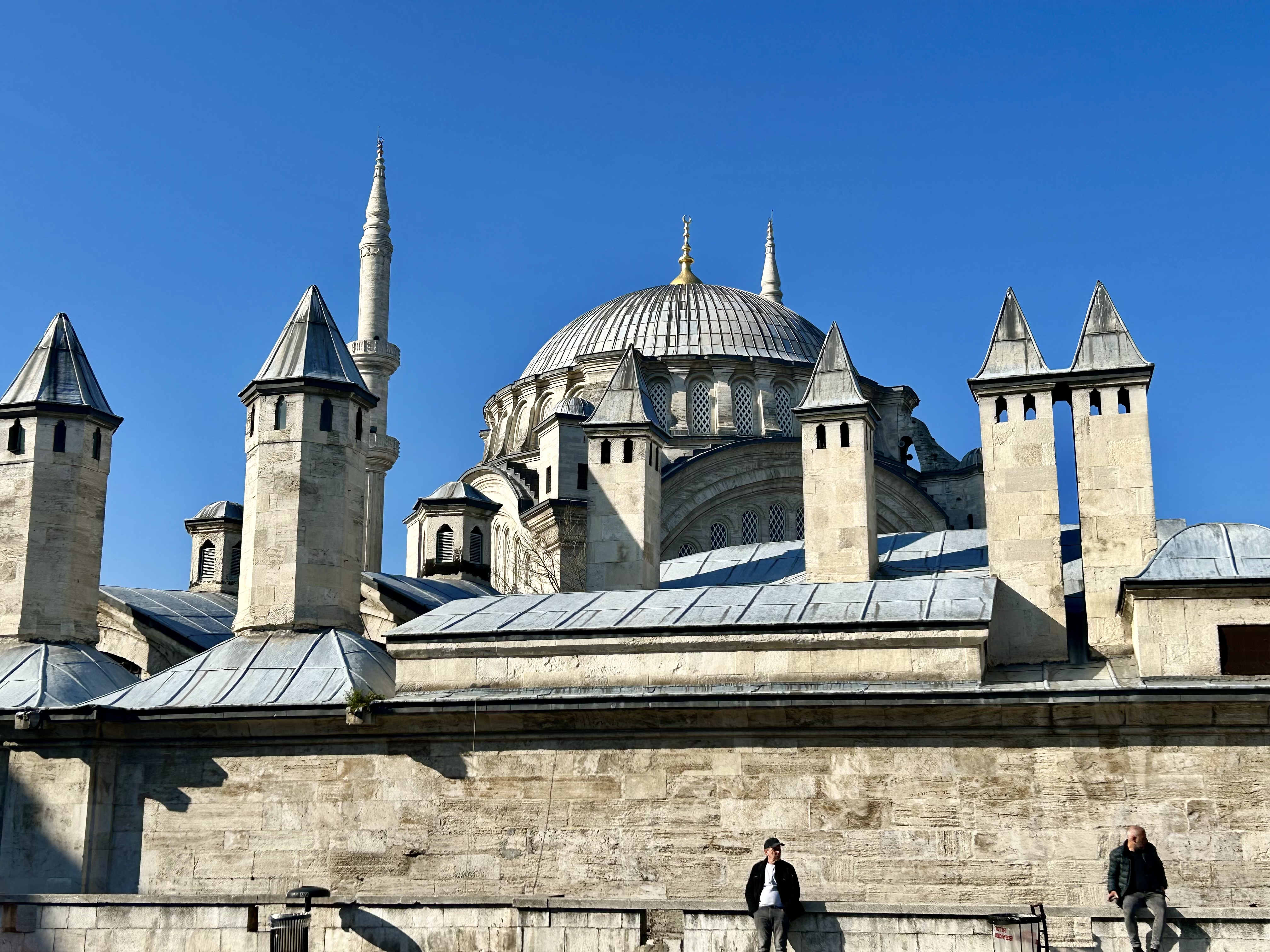
On the next floor was a selection of permanent exhibits of Turkish modern art installations called Floating Islands. They included large canvases, videos and spaces to 'turn off your mind, relax and float downstream'. (see video) After this, I climbed the stairs to the rooftop space that included a shallow pond crowded with sea birds. It gave a fine viewpoint over the Bosphorus and the nearby Nusretiye Mosque. Quite a few students were enjoying themselves, and beyond the roof pond, the buildings clawed their way up the hill to Galatasaray.  After a coffee and cake in the museum cafe, my compulsive inclination to climb hills kicked in and I began the lung-bursting ascent towards Istiklal Caddesi, the principal shopping street in Galatasaray and Istanbul.

As I reached Istikal Cad, I entered a stream of happy shoppers on a pedestrianised street that was definitely European, even Marks and Spencer and Decathlon were present. The only interruption to the swarms of shoppers was old tramcars that dinged and donged down the street every 10 minutes. I headed uphill towards Taksim Square, where the new Taksim Mosque, the Republic Monument and cavernous underground Metro Station are the attractions perched on the periphery of the massive public square. I was asked to take some photos of a young family from Iran. They were enthralled by Istanbul, and they had a global perspective, humanity and intelligence that rekindled my respect for Iranian people, first inspired by an Iranian colleague when at University.

I descended into the brutal concrete bowels of Galatasaray Taksim Metro station and hopped down to the next stop, Şişane. It overlooked the Golden Horn, and the streets provided a route to the waterfront and the Galata Bridge. Dozens of fishermen were dangling their lines into the Halic estuary, once renowned for sparkling with silver fish. Today, the sea has been polluted by years of diesel vessels, but still provides buckets of small, more brown than silver fish. My next objective was a long trip on the Bosphorus to the entrance of the Black Sea. My timing was bad, and there was only the short trip available, which I had already done by riding the ferries on Day 1. I jumped on the next ferry to Uskadar in Asia instead, a repeat excursion, but the glorious weather, seabirds and a pizza in a piazza made the trip worthwhile.  Nevertheless, I should probably have taken a ferry up the Golden Horn instead.

I arrived back at 5pm and visited the New Mosque before sauntering through the Egyptian (Spice) Bazaar. Like the Grand Bazaar, it was bustling with visitors from all corners of the world. Istanbul is the most visited city in the world. Each shop posted a couple of well-fed, grey-stubbled men hustling visitors to sample the delights of their store. I remembered the advice from the video Markets of Britain, "keep walking, keep walking". I did, to the tram and back to the hotel. I collected a beer and some food at a local store for an evening snack in the hotel. After another long day with another 25,000 steps and the invigoration of museums, mosques, ferries and bazaars, I could not be bothered running the gauntlet of the restaurant greeters.

Istanbul in 1950s

Ferries in Fifties

A collection of Izzet Keriber's photos from the 1950s

Izzet Keriber - Turkish Landscape

Izzet Kerriber - Roofscape

Keriber - Thai Girl

Keriber - Early Morning at Lofoten Islands - for Aileen


Galata Tower from the roof of Istanbul Modern

Nusretiye Mosque from Museum

Mosquescape across the Bosporus

Istikial Cad and Tram

Republic Monument, Taksim Square

Taksim Square

Fishing from the Galata Bridge

New Mosque, Eminonu

  Tomorrow Never Knows

Tuesday, 18 March 2025

Four Mosques and Bosphorus Ferries

Blue Mosque and Aya Sofya Grand Mosque from the Bosphorus

Day 1 - 10 March 2025

I slept fitfully; the hotel was comfortable but located close to the Sea of Marmara, about a mile away from Sultanahmet, the cultural centre of Istanbul, on the European side of the Bosphorus. It was an uphill climb through the tight streets of the workshops to get anywhere. Even Google Maps struggled to capture the tangled morphology of the city and told you nothing about the one-way systems, scooters and motorbikes on pavements that were also littered with commercial clutter. I headed uphill, trusting my sense of direction, but ended up at the gates of the University, about 30° west of where I had intended. It didn't matter; the streets were quiet on a Sunday morning, the skies were blue, the air was cool, and the buzz of excitement of a strange place was tantalising. 

I was close to the Beyazid Mosque, the oldest remaining mosque in Istanbul. It was beautifully preserved. I removed my trainers as I entered and marvelled at the splendour of the stonework, the symmetry of the building and its portico, courtyard, minarets, and muqarnas. There were only a few other visitors at this time of day. My Lonely Planet guidebook was short on detail, so as I left the mosque, I followed my nose and wandered into the surroundings of the Grand Bazaar. There were alleys of bookshops and a cornucopia of stalls selling everything; they were bereft of the tranquillity of the mosque. I was only half a kilometre from the Blue Mosque, so I crossed the tramline and headed over to the massive public squares at Sultanahmet as the crowds began to emerge for their Sunday outings. 

There was a queue for the Blue Mosque that had free entry and was bustling with people removing their shoes. After several circuits of the mosque, gawping at the spectacular ornate tiled pillars and cupolas, I began a conversation with a young woman who was there to explain Islam. She was a Moroccan student at the university and had an eloquence, worldly perspective and moral compass that were impressive and befitting of the splendour of the Blue Mosque. 

As I left, I was befriended by a man eager to show me his shop selling Turkish carpets. I had entertained the idea and accepted the invitation. After a coffee and cake and having seen about a dozen carpets that had been unfolded for me, I was asked which one I preferred. "Ah, you have excellent taste, sir. It is normally €8000, but as this is winter, you can have it for €5000, and that includes delivery charges to the UK." I shook my head. So what is your budget? he asked. I told him €1500, and after he said the best he could do was €4800, I was ushered out of the shop. The coffee and cake had been good, and I was pleased that the dollar had been replaced by the euro as the universal currency. That's Making Europe Great Again, Mega. Trump is certainly losing traction.

I meandered across the huge public square and followed an umbilical cord of a queue towards the Aya Sofya, the largest mosque that was undergoing extensive repairs. It was getting hot at midday. I decided to forego the queue and have a sail on the Bosphorus. I found the tram that ran down to the Galata Bridge and over to Kabatas, where, according to Lonely Planet, I could find a Bosphorus tour. My timing was bad, too late for the morning tour and too early for the late afternoon tour, so I caught a ferry across the Bosphorus to Uskador and then a second ferry halfway up the Bosphorus to Asiyan. It was the best way to travel: near-empty ferries for the price of a coffee.  

The cool morning had been transformed into a perfect spring day, cool enough to walk along the well-constructed foot and cycle pathway along the Bosphorus to the second massive bridge that takes the E80 motorway over the Bosphorus, which was busy with ocean-going tankers, grain and container ships. I caught the ferry back to Uskador and walked to the busy market area, where I had a late lunch at 4:30pm before taking a ferry back to Eminonu and a tram back to Yeniceriler, which was about a kilometre up the hill from my hotel. I managed 25,000 steps, two mosques, 4 ferries and two tram rides. Sore feet and tiredness made me forego an evening meal; it was 11pm in the UK. 

Beyazid Mosque

Blue Mosque from Sultan Ahmet Park

Cupola of the Blue Mosque

Interior of the Blue Mosque

More Blue Mosque

Hagia Sophia Grand Mosque


An influencer, presumably

Bosphorus Bridge

Turkish Navy Patrol

Besiktas


Uskudar

The New Mosque at Eminonu

Aya Sofya

Day 2

I made plans for the next day, I could visit the largest mosque, the Aya Sofya, and then the Topkapi Palace. I left early and walked along the wide walkway alongside the Sea of Marmara for a couple of kilometres. There were many vessels of all shapes and sizes resting in perfect calm waters. I crossed the busy Kennedy Expressway that skirts the coast to arrive at the entrance to the mosque. Even at 9:45am, the queue was a couple of hundred metres long. What I had not anticipated was an entrance fee of 2000 lire (£41) compared to 250 lire for Turkish Nationals. The mosque is the largest and most prominent in Istanbul. It started life as a church and was only converted to a mosque in 1453. It was being refurbished by the government and was a disappointment compared to other mosques that I visited. The entrance was by a switchback ramp to the upper galleries.  We were shown a few mosaics but kept moving and denied access to the inner narthex and nave. It took all of twenty-five minutes and left me feeling cheated. 

I walked along to the nearby Topkapi Palace, the entrance gardens were well kept, but again the price for tourists was 2000 lire and a similar, far cheaper rate for Turkish Nationals. After the experience of Aya Sofya, I decided to give it a miss, although it would have been a far better option. I walked down to the waterfront at Eminonu, found a bookshop serving coffee and relaxed for half an hour while deciding where to go next. A ferry to the Asian side of the Bosphorus tempted me, and both Kadikoy and Moda were townships that sounded like interesting places. 

The ferry trip was a wonderful treat on a day with cobalt blue skies. Kadakoy was a busy centre with a huge shopping and restaurant quarter adjacent to the ferry terminal. I walked the narrow pedestrianised shopping streets and explored some shops before deciding to extend my walk to Moda. It was a couple of kilometres away. It was a bustling neighbourhood occupied by luxury flats overlooking the Sea of Marmara. There are famous tea gardens that overlook the sea under shaded pine trees. I stopped for a cup of tea and to read up on the area. Moda is not far from the Fenerbahce Stadium, currently managed by Jose Mourinho, and I could imagine him living here, but he was on his way to Glasgow for a European game against Rangers. 

I ambled back to Kadakoy and enjoyed a golden hour ferry trip back to Eminonu, accompanied by dozens of seabirds who were giving spectacular aerial displays as they caught the bread being fed by the locals. I thought about spending time at the nearby New Mosque, but caught the tram to Cemberlitas to visit the Grand Bazaar. It was busy, and I was accosted by men in black jackets and grey stubble urging me to enter the shops. The adjacent streets were even busier with every type of shop roughly organised by the type of goods. I had run out of curiosity and dived back down the hill to my hotel, where I had an evening meal in a restaurant that had five waiters who looked like ageing bodyguards. My suspicion was probably confirmed when a large middle-aged man left the back rooms of the restaurant with an overdressed blond lady on his arm. I went back to the hotel to watch Liverpool v PSG, but forgot that we were three hours ahead and it wouldn't start until 11pm. Perhaps it was just as well.

Sea of Marmara in early morning haze

Fountain of Sultan Ahmet III at the entrance of Aya Sofya

Aya Sofya Nave and Dome

The tour consisted of a walk around the first-floor balconies and then out.

Mosaics in Aya Sofya

Entrance to Topkapi Palace

Galata Tower

Kadikoy Flower Stall

Moda - waterfront

Moda - tea gardens

Afternoon tea break

Ferry back from Kadikoy

The New Mosque at Eminonu

The New Mosque at Eminonu

The Grand Bazaar


Friday, 14 March 2025

Istanbul - 50 Years to get there

Blue Mosque from the Bosphorus

Fishing from the Galata Bridge
Colin Buchanan & Partners offered me a job in the mid-1970s to help prepare a Strategic Land Use and Transportation Plan for Istanbul. I was ready to go when the Scottish Office asked me to lead a team to do the same for the Strathclyde Region. I had no regrets about accepting the Scottish Office option; it galvanised my subsequent career path. I always wanted to visit Istanbul to see what I had missed, but life got in the way. Fifty years later, I finally got around to taking the plunge as a birthday treat.

The sun was shining, the flights were cheap, and I seized the day and booked at 3 days' notice. The flight times were good, and even Edinburgh Airport was unusually efficient. We left on schedule, and the Turkish Airlines flight was an upgrade on UK airlines. They were on schedule and well-managed. The seats, food, hospitality and in-flight entertainment were good. I watched The Outrun, based on a favourite book by Amy Liptrop about a young woman healing from alcohol and drug addiction in London by returning to the place she had grown up, Orkney.

The massive and over-designed Istanbul Airport was a statement of intent of Ottoman proportions. After landing, it took 15 minutes for the plane to circumnavigate the airport to the stand, and almost the same time to promenade along the lengthy walkways to passport control and baggage pick up. I can never understand the obsession with creating structures too big to function. It took another 10 minutes to walk from the airport to the M11 Metro station, buried deep underground. After figuring out the automatic ticketing machine and descending to the platform, I missed the train by 10 seconds. They are only every 20 minutes.

Turkey is 3 hours ahead of Greenwich Mean Time, and by the time I changed Metro lines at Gayrettepe and walked a good kilometre on a labyrinth of underground passageways to the M2 Metro so I could get a train to the nearest station to my hotel, it was 9pm.. It was a mile or so to the hotel at Kumkapi, and even on Google Maps, the dense network of narrow roads in the dark would make finding the hotel like finding a needle in a haystack, so I grabbed a taxi. The driver had no more idea of how to find the hotel than I did. After passing the Blue Mosque, which was twice the distance from the station than my hotel, I looked at the satnav directions on his phone and instructed him to turn back in the opposite direction to reach the hotel. I jumped out a couple of blocks away from the hotel rather than risking his extending the merry-go-round. Was he really lost or merely running up his meter? I gave him 200 lire (£5) for the fare on his meter and walked to my hotel.

It was 9:30pm in Istanbul and already Sunday in the UK. Time for bed, said Zebedee. Tomorrow was waiting.


Thursday, 6 March 2025

A New World Order?


The outdated dominion of the UN Security Council

It appears that the international post-war settlements are in turmoil as many of the outcomes and institutions are being consigned to the history stacks by the right-wing anti-democratic oligarchs that are surfing the tides of nationalism and populism. Trump has begun his second term with a series of proposals that have been described as unhinged. The United Nations, NATO and world trade agreements are under threat. Israel and Russia are being given United States support as they raze cities to the ground and ruthlessly kill thousands in Gaza and Ukraine, either with or without American weapons and intelligence. Climate action is being abandoned, and across the world, a roster of new Rogue States is being nurtured by Trump's disruptive playlist of malevolent trade deals, forced emigration and dumbed-down democracy. 

The term Rogue State has been previously applied to autocratic countries as an excuse for Imperialistic action, usually carried out by the United States, think Vietnam, Iraq, Afghanistan, or Libya and less overtly in North Korea, Syria, Sudan and Iran. However, many academics argue that countries responsible for violating international agreements are also considered Rogue States. This would make Russia, Israel and the United States strong nominees for this sobriquet.

The United States and Russia, as members of the Permanent Security Council, have the power of veto in the United Nations. This allows them to prevent resolutions that restrict their own interference in the affairs of sovereign states. Other nations have allowed this to happen because they were in the orbit of one of these powers. That could be about to change as the outcome of Trump's game of disruption and furtive alliance with Russia.  In the process, respect for the United States from those countries, which had been allies for eighty years, has diminished. It could result in the formation of new power blocks as influence ebbs away from an increasingly insular and self-serving USA. China is already exerting its influence in Africa and South America and courting the Asian Tiger economies. Europe has been slumbering, but it has a combined GDP that is almost equivalent to that of the United States. However, Europe has been less assertive in exploiting its power for what should be wider global objectives and values.

According to Eurostat, in 2021, China had the largest GDP with 18.9% of the world total. The USA and EU are neck and neck with 15.5% and 15.2%, respectively, followed by India with 7.2% and Russia with 3.8%. But add the UK with 2.3% and other non-EU countries like Norway, Switzerland and Iceland, and Europe has a similar GDP to China and five times that of Russia. If other sympathetic countries like Canada, Australia, Turkey and Japan were added to Europe, a new power block could be created with over 25% of the world's GDP.  By and large, they have supported the United States in the post-war era. Take them away, and the United States has lost both its economic and soft power. Under Trump‘s baleful influence, the United States is undoubtedly giving these countries a justification to transfer their allegiance to a more egalitarian union of nations. One that is not subservient to the self-interests of the USA. 

Eurostat: Comparison of the World's GDP

The disruptions that Trump claimed during his address to Congress after being inaugurated have confirmed that the USA is becoming an imperialist impostor, a Rogue State that has abandoned its allies. His belief that he can dictate terms to the rest of the world has been found wanting in Ukraine, Gaza, China and Canada. Europe is girding its loins to sever the umbilical cord to the United States; its combined GDP is four times that of Russia. China and India are the world's fastest-growing economies with the largest populations. The world order is changing, and hopefully, the primary purpose of the United Nations can be reestablished without the baleful influence of Trump's America using its veto to undermine these objectives, which are: 
  • to maintain international peace and security
  • to develop friendly relations among nations, 
  • to achieve international cooperation in solving global problems like poverty, disease, and human rights, and 
  • to serve as a centre for harmonising the actions of nations.