Thursday, 30 September 2021

Blah, blah, blah

Greta Thunberg addresses Youth Climate activists
When utterances from the UK government to counter the evidence of their mismanagement and failures are perfidiously issued and reported by the BBC, press and other media; the fourth estate is failing us. They have assumed that we, the public, are either gullible or have already factored in that truth from Boris Johnson's government is an alien concept. We have seen this time and again as the government have attempted to defer blame for the mistakes in dealing with the Covid pandemic. The supposed Brexit bonanza has become a torrid avalanche of broken promises and lost trade. Now we have the PM's revelation that we are 'world leading' in terms of tackling climate change. It is more absolute piffle from our great bumbling prime minister. 

"In the UK we’ve already cut our carbon emissions in half and we have all but eliminated coal from our energy mix", according to the PM. In reality, the government have made decision after decision that has undermined progress towards carbon reduction. It is all a ploy to generate false kudos (kudos is given by others not self-acclaimed) for the UK in the run-up to COP26 in Glasgow, the event that should and could be an opportunity for world leaders to show that they justify their credentials as leaders. It was rightly dismissed as more blah, blah, blah by a Swedish teenager who has had the temerity to challenge the double talk of the Goliaths of governments and global businesses alike with a studied disdain.

The omens are not good; world leaders are performing like puppets of the coal, oil and gas industries, who are using familiar tactics to undermine the scientific evidence of climate change. Aviation and shipping, two of the most damaging producers of carbon are given a free rein to expand with minimal taxation on their use of fossil fuels. Farming continues to use technologies and methods that are hostile to biodiversity, the building and construction industries are still focused more on profit than becoming net zero in carbon. 

In Britain, shoddy new housing with poor insulation, outmoded heating systems and minimal standards is an indecent assault on too many households. Households who are paying over the top prices for renting or buying properties that support a long tail of business middlemen from construction companies, landowners, landlords, estate agents and surveyors. They are all lined up to benefit from the inflationary spiral stoked by market shortages of property and low-interest rates.

It might sound cynical, but the carbon footprint of COP26, with 25,000 participants flying into Glasgow is probably only exceeded as a carbon footage event this year by the competition between global business tycoons (Elon Musk, Richard Branson, Geoff Bezos) as they race each other into space. The way things are going it will be the last frontier.

Once again it was Greta Thunberg who spelt out the imperative of COP26 and admonished the party-goers. “This is not some expensive, politically correct, green act of bunny hugging,” she said. Quite right.

In 2010 the UK had the chance to make an impact and Cameron's coalition government was initially very supportive but Chancellor Osborne reduced the support for many green projects and the May and Johnson governments have drawn back even more despite all the empty slogans suggesting otherwise. The list is endless but here are some examples.
  • Chancellor George Osborne never implemented the scheduled 1p fuel duty rise that had been introduced as a Green tax by the Brown government. Nor have his successors as Chancellor including Rishi Sunak. 
  • The feed-in tariff rate for solar panels has fallen from 41.3p p/kWh in 2010 to 3.41p/kWh in 2020. 
  • The Johnson government has scrapped the Green Homes grant scheme of £1.5bn for insulation just 6 months after its launch in 2020.
  • There have been no attempts to tackle carbon emissions from the aviation and shipping industries despite transport having the largest proportion of carbon emissions 27%, of which aviation and shipping are estimated to generate 3% each and largely escaping taxation to date.
  • And of course, the UK government seems keen to allow a new coal mine at Whitehaven in Cumbria and a new oilfield at Cambo off Shetland.
  • The Heathrow expansion is another massive castigation on the UK claims to be leading the world on climate change.
 COP26 was going to be a hard gig in any circumstances, and but for the wise decisions to promote solar and wind energy following the Climate Change Act 2008, the UK would be languishing even further behind its intention to reach zero carbon.


Tuesday, 28 September 2021

Broken Britain


According to numerous sources, the UK has become the laughing stock of the world as we have struggled to fight Covid, pretended that Brexit hasn't led to the collapse of many businesses and created shortages of food, materials and labour and at the same time forsaken our role in world affairs as witnessed by the cuts to International Development.

In the past two weeks, we have been hit by a fourfold increase in gas prices. Yet we have the lowest stored gas capacity of any European country, 9 terawatt-hours or 2% of annual demand, compared to 26 -37% in the four largest European countries. The UK adopted a "just-in-time" approach that has made us more susceptible to shortages and price escalation. The government and its regulators have also encouraged switching to 60 new energy companies. These companies still need to secure future supply at prices within the government's capping limits. Yet another government own goal with households and businesses left to fund the gap 

This week the crisis is at petrol filling stations as shortage of HGV drivers led to delayed deliveries. This was then made worse by the government saying there was no need to panic but most members of the public have previous experience that advice from Grant Shapps, the laid-back Minister of Transport, cannot be trusted, so they charged out to fill up. 

Meanwhile, the supermarkets, who have performed superbly through Covid, are now offering empty shelves of many products. A couple of weeks ago it was the lack of carbon dioxide owing to increased energy costs that meant a shortage of CO2 for the packaging of meat and fruit. Now we are faced with other products not arriving because of driver shortages. When the supermarkets and haulage industry tell us that Christmas is under threat, it sounds possible given all the other problems accumulating. All talk of resilience and strategy by the government seems to be no more than a quick extract from their playbook of excuses. This government knows not the cost of resilience nor the value of strategic planning.

Meanwhile, inflation levels are spiralling upwards. Building materials such as timber, glass, and steelwork have increased by 20-30%, the cost of eating out has risen by 10-20%, and rail fares are set to increase again as well as a drastic cut in the number of services. Add these inflationary factors to energy, vehicle (car prices have risen by 15.2% in a year), food, clothes and household appliances and we are in the midst of the most damaging bout of inflation since the late 1980s when Mrs Thatcher let things rip. Yet the word that no one in government or the opposition party will utter about these events is Brexit.

All of these events precede the COVID-19 consequences that are about to kick in. October marks the end of the furlough scheme for 1.6 million workers and the Universal Credit uplift of £20 for 6 million people. It is unlikely that the government can shift the opprobrium for the effect of the loss of these income streams to anyone but themselves, although they will try.

Olaf Scholz, the probable new Chancellor of Germany, explained our crisis to Channel 4 News better than any government minister has managed. In slightly hesitant but perfectly cogent English, he explained that many European countries including Germany and France as well as the UK have demographic profiles that mean there is a shortage of workers and an increasingly elderly population. The free movement of labour in the EU was designed to tackle this. Countries in the EU were also suffering a shortage of HGV drivers, care workers and agricultural workers but free movement allowed some cover from elsewhere in the EU. 

He added that those workers who had left the UK as a result of Brexit would be unlikely to return for short-term jobs (the UK government has offered only 3 months for HGV drivers or poultry farm workers) when there are other issues to be sorted out such as visas, housing, tax and other possible constraints. He said that the EU would try to help but the UK had known about these issues during Brexit negotiations and it was invidious of UK ministers to constantly blame the EU. 

Mairead McGuinness, an Irish EU Commissioner, explained the crisis in similar terms and spoke eloquently about the importance of protecting the people of Northern Ireland from the trade agreement arising from Brexit. There is increasing evidence that the EU appears more concerned about the impact of Brexit and other UK decisions on the people of the UK than the Westminster Government. 

Yes Minister was ahead of its time when it lampooned the incompetence of the UK government when faced with adversity. Still, there is little humour when the current state of the UK is beyond even the most vivid imagination of comedic scriptwriters. 


Thursday, 23 September 2021

Dunfermline


Dunfermline town hall from the graveyard

Autumnal days are here and I decided it was time to consider replacing an 8-year-old car and test drive an electric car.  The shortage of cars for test drives in the central belt also meant we had to travel to Dunfermline. I was impressed by the acceleration, the quietness and the comfort of the car but with a six-month waiting list and a price 62% higher than my last new car, the decision was made for me. I do far fewer miles nowadays and my present car is good for 55mpg and another couple of years, why add to the number of vehicles on the road.

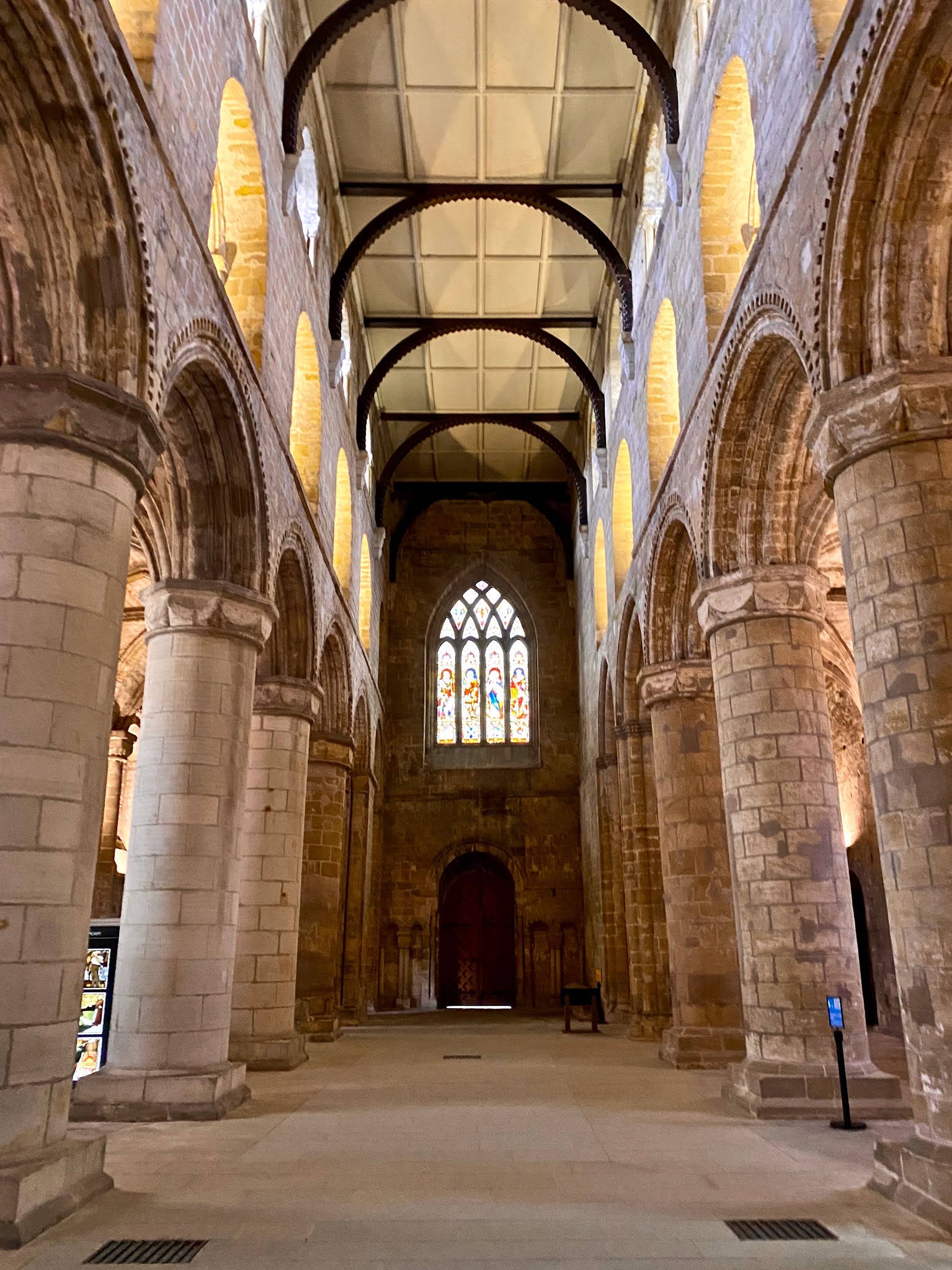
The trip gave us an opportunity to visit this former seat of the Scottish monarchs. Dunfermline had been one of the 4 original Royal Burghs, and also the home town of Aileen's parents. They had married in the Abbey so we started with a visit there. The Abbey was open with social distancing and the Historic Environment Scotland staff were very knowledgeable and helpful. An excellent exhibition of Scottish stained glass led us into the impressive Romanesque nave which leads into the rebuilt Parish church where Robert the Bruce was re-interred below the pulpit. The remains of the Palace are part of the town's walls to the south and west and provide a slightly forbidding gravitas to the town. 

Looking across the graveyard the town is dominated by the town hall, a gothic-inspired structure that is now used as a registry for weddings and for meetings of the area committee for Dunfermline by Fife Council. Aileen wondered whether her grandfather had been based here as the County Engineer between the wars. The modern Carnegie library and museum are also adjacent to the abbey and parish church and are a fine testament to this locally born global philanthropist. This part of the town exudes history in its fine stone buildings. What a contrast with the High Street, now decimated of independent shops and fitted out in the sad frontages of downmarket retail franchises, bookies, charity shops and gap sites. North of High Street, the clutter of ugly retail centres surrounded by car parks has dethroned this once fine Royal Burgh.

Dunfermline's location, superb heritage buildings and excellent parks should make it a desirable place to live. It is only 36 minutes over the Forth Rail Bridge to the centre of Edinburgh, one of the best rail journeys in Britain. The retrofitting of once vibrant towns like Dunfermline to accommodate the car and the frenzy of car-based retailing and business centres have ripped the heart out of these placesPerhaps these things will change as the long term effects of life after Covid begin to encourage more locally based lifestyles with far more people working from home and spending less time on needless travelling. It will hopefully provide a stimulus to the places that have endured the fallout from Scotland's Edinburgh centric investments of the past twenty years.  It will require a less centralist Scottish Government and the re-emergence of municipal endeavour and pride to facilitate this transformation.  The electric car may help but active travel initiatives and real community leadership will be just as important.

Town Hall

Abbot House in Maygate

Nave of the Abbey

Some of the stained glass exhibition

The refectory of the palace


Sunday, 19 September 2021

They think it's all over


The sheer vainglorious contempt for the European Union by the UK government is typified in the above charts. Although UK citizens can travel abroad if tested, many European countries are red-listed despite having far lower Covid rates than the UK. The second chart shows that many UK regions, mainly in Scotland, have amongst the highest COVID-19 rates in Europe. UK citizens who travel to countries they are permitted to visit are subject to testing and quarantine upon return if they are not vaccinated. It all seems part of the abuse of data that has been a feature of the last 18 months, when the UK government has attempted every trick to disguise the fact that it is back to having the highest number and proportion of Covid cases in Europe as was the position before the vaccines came to the rescue. 

If the vaccines are such a success, it is surprising that UK regions are back at the top of the list of countries with COVID-19. Israel is the country with the best vaccination rates and the highest ratio of COVID-19 cases. It is not that vaccines are not working; all the evidence shows the significant benefits of vaccines in reducing infections and the severity of cases. Is it that the government's relaxation of lockdown, encouragement to get out and support hospitality businesses, the opening up of mass events and because they think it's all over that have led to the surges? It may also be due to the unexplained slowing down of vaccinations. This is particularly apparent amongst the younger age groups who appear to be suffering the most from the recent upsurge in cases. We are almost back at the levels of January and February 2021, and in Scotland, the hospitals are at breaking point again.


I have some concerns about the figures published by the Scottish Government about vaccination rates. Public Health Scotland has published information on vaccination rates that show that vaccination rates are 100% for all the over-60 cohorts and 90% or over for the 40-49, 50-54 and 55-59-year-olds. Is this statistically possible? Given that there are significant numbers of frail elderly or people with medical conditions that make vaccination unlikely or not recommended, I think not. Anecdotally, I know of relatives and friends who have been called to be vaccinated by their local GP, who presumably ordered vaccines for them, but who then took the opportunity to get one earlier by attending one of the pop-up vaccination centres. There is a lot of previous evidence of health data being incorrect as a result of double-counting, for example, the population on GP lists in Health Board areas often exceeds the total population because people are registered with their original GP as well as a new GP when they move to a new community. As yet, no NHS spokesperson has explained how 100% of some cohorts of the population have been vaccinated nor has any journalist asked the question.


No one wants the current curtailment of freedoms to be tightened. However, the escalating rate of COVID-19, the constantly changing rules, and the visions of crowd scenes at major events are simply exacerbating the doubts of a large proportion of the population. They are stoically avoiding going out to public places and certainly not using trains and boats and planes, or for that matter, restaurants, sports facilities or workplaces. The chances of getting to see a GP, dentist, or hospital appointment are limited. We live in a different world, and until there is a sense that Covid spreading is under control, many people will resist the urge to exercise their fake freedom.

The abrogation of the UK government's responsibility is palpable. According to Nadra Ahmed of the National Care Association, 10-15% of carers are unvaccinated. Allowing UK citizens to travel abroad, despite having higher rates of infection than almost all European countries and a contact tracing system that remains seriously flawed, is mere Brexit arrogance. The UK government is gung-ho for free markets, prepared to heap the blame for spreading on other countries and unwilling to release some of the 540 million doses of vaccine to countries that are suffering the most as a result of a shortage of vaccines. This approach has been recommended by such luminaries as Professor Andrew Pollard and, more recently, by Professor Sarah Gilbert, who were both instrumental in creating the AstraZeneca vaccine and always saw it as a non-profit resource for global usage.  

At a time when the UK is supposed to be defining a new role for itself on the world stage, it is tragic that we are not using the soft power of vaccines, international aid and climate change as weapons for the global good. Instead, the government are signing up to strategic nuclear submarine pacts, getting ever tougher on immigrants and asylum seekers, allowing the fire sale of UK companies to hedge funds, and routinely abusing or blaming the EU. This is wrapped up in a Union Jack as a half-baked foreign policy. Add a foreign secretary, Liz Truss, who believes that free markets will sort out the mess and routinely is rude to her peers from other countries, and we truly are becoming a pariah nation.


Thursday, 2 September 2021

Beinn Dronaig

Bidein a' Choire Sheasgaich and Lurg Mhor from Beinn Dronaig

Wednesday, 1 September 202

Ascent:       1201 metres (605 metres cycling)
Distance:    34 kilometres   (25 kilometres cycling)
Time:          6 hours 12 minutes  (3hrs 18mins cycling)

Beinn Dronaig     797m 3 hrs 36 mins  (1hr 55mins cycling)

After a restless night in the Airbnb in Lochcarron, I set out for the short journey to Attadale. The day was absolutely perfect with just a slight breeze, more noticeable when cycling. I was the first visitor of the day and was cycling up the track past the Attadale Gardens before 9am. On the track to some cottages, I met the gamekeeper who asked if I was going up Beinn Dronaig, and if so, could I use the route up just before Loch Calavie as he would be stalking the other part of the hill tomorrow. It was a civil request and although I had intended this route anyway I had intended to descend westwards along the summit ridge, this would not be possible.

The climb up the rough gravel track was steeper than I remembered. I had once walked this route when climbing Bidein a' Choire Sheasgaich and Lurg Mhor with Mark during a crazy September weekend of Munro bashing and knew that it was a 3-hour walk at least to reach the start of the climb to the Munros. I spent the next half hour crossing the river, I had taken the wrong track and then pushed the bike up the steep hill. There is then a section of a kilometre or so that can be pedalled before the track ramps up again and climbs to a col at 350 metres. The long descent from here to the bridge over the Black Water allowed me to save some time despite quite a few stops for photos. I reached the track to Loch Calavie in less than two hours. It was time to dump the bike and walk up the rough path to the high point towards Loch Calavie. I began the steep climb up the lush, lumpy grassy slopes of Beinn Dronaig but not before filling my water bottle from the sparkling burn.

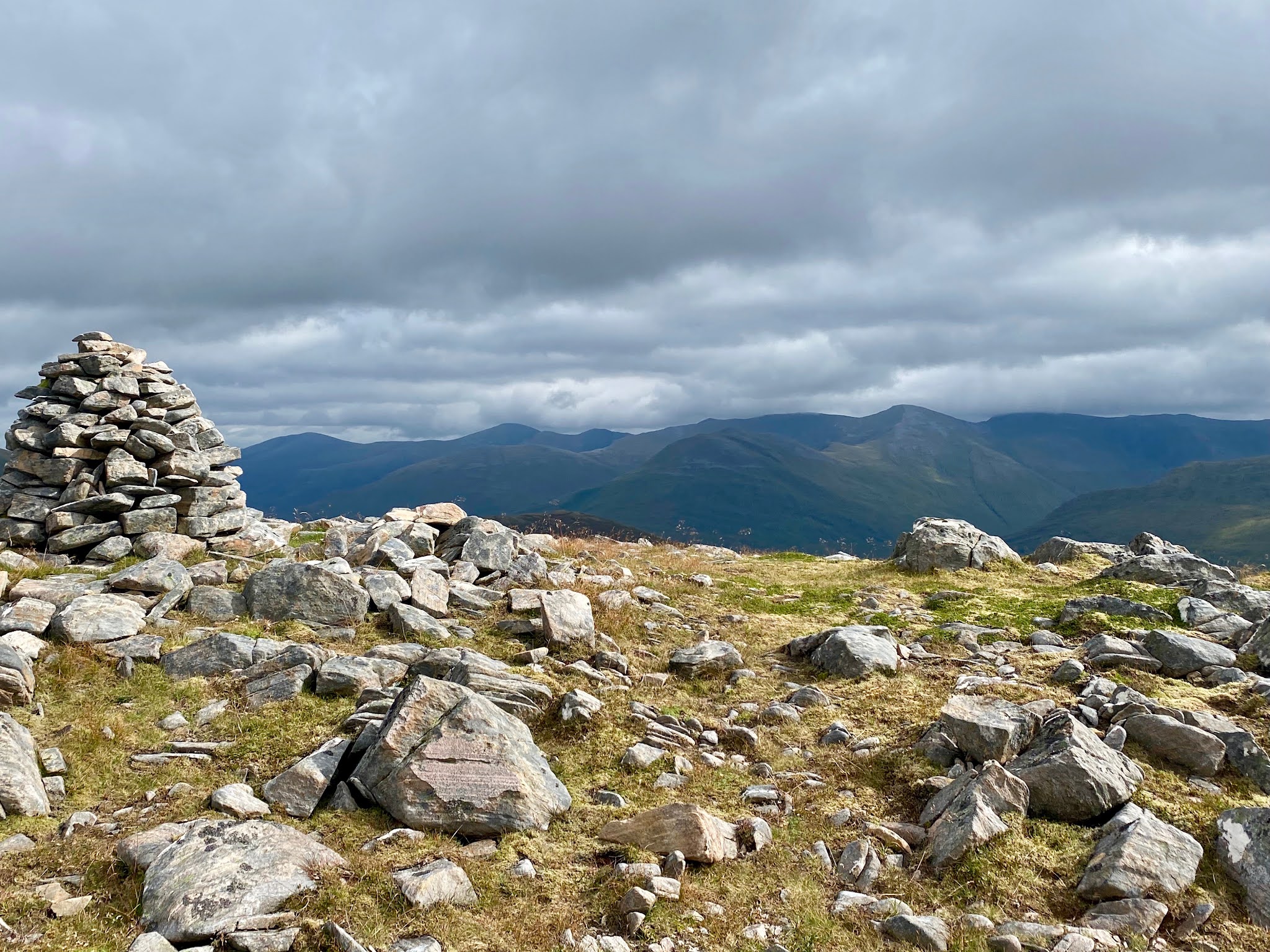
It was a relentless ascent, twisting between the rock bands, following some burns and eventually arriving on the glorious summit bejewelled with small lochans and providing scintillating views to the Torridons and over to the mesmeric peak of Bidein a' Choire Sheasgaich and Lurg Mhor, two of the most inaccessible Munros. I took half an hour on the summit, it was one of those days when I felt that the effort expended in getting to the summit had earned me some respite and what a spectacular setting. 

I had to decide the route down and chose to take a more direct line further to the east than the way I had climbed the hill, it would save me circling my way through the outcrops. The route worked well although I did have to scramble down a gulley between some rock outcrops at one stage. I was back on the track in 45 minutes and from there it was an easy walk back to the bike. There was a sense that I had done the difficult part of the day although there would be a 2-kilometre climb on the bike in the searing heat to reach the summit of the track to Attadale.

The cycling was easy going to the bridge over the Black Water and after an initial climb up a rough path back to the track, there was another section that could be cycled with ease. Thereafter, it was a long half-hour pushing the bike to the 350-metre col. I could have cycled some of it but the loose stony surface and the incline made it easier to keep walking. The brakes on my bike are not the best and, as I started the descent, I realised that they were not going to stop me on the steeper switchback sections of the descent. Thereafter some long sections of steady descent made for faster progress and I managed to average 22kph on the last 3 kilometres back to the car. It was 4pm and the temperature was 25°C as I began the long drive home. The traffic was light and I was in Fort William well before 6 pm. A chance to buy some beers for when I arrived home. Glencoe was again at its most magnificent in the evening light and I envied the microlight pilot who was skimming over Rannoch Moor.

It had been a full-on but successful two days, the weather had been almost perfect, and the cycling had been hard particularly for Beinn Dronaig. The climbs on both Aonach Buidhe and Beinn Dronaig required determination with no paths, lush summer vegetation, and steep slopes. In the circumstances, I had made better times than expected. I have only two Corbetts to complete the challenge I set myself on retiral: a round of the Munros and Corbetts to keep me fit and out of trouble. 

I have kept Beinn Dearg in the Torridons for the final Corbett. It had been included in Irvine Butterfield's marvellous book, the High Mountains of Britain and Ireland covering all the hills of 3000 feet. It was at the time classified as a Munro before the surveyors re-estimated its height to 2999 feet, although the OS still have it as a 914-metre summit. The pictures and description of Beinn Dearg were one of the reasons that I started to climb the Munros in 1989 and its completion would be a fine epitaph for 32 years of walking the Scottish Hills. Then I can relax a little; climb old favourites, support friends who want company for tricky walks, walk the lower level passes and maybe finish another round of Wainwright's in the Lake District - so much easier and not requiring long days and overnight camps. Yet it is the very remoteness of the Scottish Mountains combined with the weather that makes them such a perpetual challenge and reward, the agony and ecstasy are so finely paired.

The track up to Beinn Dronaig from Lochcarron

Lochcarron from the track

Lochcarron and Applecross Hills from the top of the track

Bidein a' Choire Sheasgaich and Lurg Mhor from track

Black Water Bridge

From Blackwater Bridge

By Beinn Dronaig Lodge and Bothy

The track back to Attadale

Sheasgaich and Lurg Mhor

High level pools


Torridons from Beinn Dronaig

Beinn Dronaig Lodge and Bothy


Tuesday, 31 August 2021

Aonach Buidhe

Aoach Buidhe summit

Tuesday, 31 August 2021

Ascent:      985 metres
Distance:   34 kilometres (25km by bike)
Time:         4hours 50 minutes

Aonach Buidhe    899m      2hrs 48mins


I normally look forward to climbing hills for the first time but I was unusually anxious about two of my last four Corbetts. Aonach Buidhe and Beinn Dronaig are quite close as the crow flies, a mere 6 kilometres. The terrain between them is pretty rough with 600 metres of descent, rivers to wade and I reckoned 55 kilometres including a 25-kilometre bike ride. It would have the sort of challenge that appealed in the past but time is less precious after retirement and with stamina on the wane.

I had been working on Monday, the first time in a couple of years, but spotting a couple of dry days in the northwest highlands, I decided to take the plunge. I thought about taking the tent but the midges would be at their most bothersome so I booked an Airbnb in Lochcarron so that I could shower and have a meal at the hotel. I had figured on 6 hours 30 minutes for Aonach Bhuide with the journey up to Killilan at the head of Loch Long adding a further 4 hours taking account of the slow procession of vehicles that are an inevitable feature of travel in this part of Scotland. 

I left home at 7:45am, the morning conditions were perfect with not a cloud seen before Fort William but the hills to the north of Fort William were lost in the clouds. I parked at the car park just shy of Killilan and assembled the bike quickly encouraged by swarms of midges. The first part of the cycle ride is along a well metalled private road but it deteriorates into a gravel track after a few kilometres and begins to climb slowly. I passed the path to the Glomach falls and promised myself to visit someday but not today, there was not much water in the river and time would be tight. I arrived at the small copse of trees by Iron Lodge within the hour after a few photo stops and pushing the bike up a couple of hills. There were four bikes already there but I had not seen a soul.

The route up is by the south ridge and I followed the footpath for a kilometre and stopped for some lunch before beginning the ferociously steep climb up long grass adorned with the odd boulder. Although it looks like a well-defined ridge on the map it is a broad ridge with variations in steepness once you get above 450 metres. Despite the cloud cover the heat made for lethargy as I slogged my way to the summit. I looked over to Beinn Dronaig, tomorrow's hill, and thought more of this to come. The views were good but the cloud cover meant that the clarity was not as good as I had hoped.

I decided to descend to the west, a steep drop keeping to the north of the burn. Again the long grass made for slow progress but at least the dry August meant that the normally boggy ground was not an added inconvenience. Reaching the footpath made for an easy couple of kilometres back to Iron Lodge. An elderly couple were unlocking their electric bikes from a signpost. The woman had just climbed An Cruachan, a very remote Graham requiring a 17-kilometre walk there and back from Iron Lodge. She had only two Grahams left to climb having already completed the Munros and Corbetts. Her husband accompanied her on the bike but had given up on the Grahams. We had a friendly chat before they set off back to Killilan. 

I unlocked the bike and had some food and drink before starting the cycle to Killilan. There were some uphill sections but it was mainly a speedy descent. I passed the couple before running into a couple of hundred sheep charging up the track, they saw me and turned to run back towards Killilan. The woman farmer was following in a truck and she hollered me to get off the road. I did by climbing up the bank and the sheep charged past at a gallop. The last couple of kilometres on the smooth road made for a fast ride despite the sheep droppings. 

I was back by 5pm and after loading the bike and speaking again to the couple who had arrived at their large motor home, I travelled along the narrow road alongside Loch Long that is dotted with new houses and on to Lochcarron to the Airbnb. An excellent meal in the Lochcarron Hotel set me up for an early night with the prospect of a tough day in the saddle tomorrow.

The track up Glen Elchaig

The route to the Glomach Falls

Loch na Leitreach

Looking down Glen Elchaig from start of Aonach Bhuidhe

Faochaig

Looking north to Torridons


Summit looking east

Faochaig and Sguman Coinntich on descent

Descent route to An Crom Allt

Iron Lodge


Tuesday, 17 August 2021

Devon: South Ham

South Pool

The first family holiday since Covid took us to South Devon. It was 556 miles made even more difficult by the closure of the M6 in Cheshire resulting in a 3-hour hold up and then various other delays as the summer traffic on the M5 backed up and brought us to standstills in Birmingham and North Somerset. We had wisely decided to spend a night in Somerset and the Devonshire Arms in Long Sutton provided the perfect place to rest up before the final 100 miles to South Pool. 

We arrived on Saturday lunchtime with other family members arriving at 4pm from London and 7pm from Glasgow. The narrow Devon roads, with high hedgerows and frequented by lots of high-end SUVs, only rarely driven by folk with any courtesy, made the last twenty miles more threatening than Covid. It was summer staycation in full swing with no quarter given. The tide was out but the local pub provided a chance to relax after the long drives whilst we waited for the Glasgow arrivals.

Over the next couple of days, we visited the local attractions: Kingsbrdge, Bigbury, Burgh Island, Bee Sands, Salcombe, and best of all the coastal walks. The weather was not the best but the real problem has been the narrow roads clotted with cars and jammed by oversized vehicles. Car parking has been almost impossible and on two occasions we simply had to abandon plans and find alternative destinations. 

The secluded beaches are fine if crowded but it has proved almost impossible to find anywhere to eat given the number of visitors. Devon has an enviable reputation as a holiday destination but I suspect it will suffer a decline next year as people reject holiday traffic jams and the rising costs of UK hotels and holiday lets and return to the better value and weather that Europe offers.

Cyder House

South Pool

Burgh Island from Bigbury beach


Bigbury on Sea

Burgh Island Trailer as the tide recedes

Burgh Island Hotel and Bigbury car park

Paddling back from Burgh Island

Salcombe


Friday, 23 July 2021

Buidhe Bheinn

Loch Hourn and Ladhar Bheinn  from the southwest top of Buidhe Beinn

There are some hills that you resent climbing. In this case, it was the surveyors who were to blame; they had reclassified Buidhe Bheinn as the Corbett rather than its twin peak, Sgurr a' Bhac Chaolais. I had climbed the latter three times during walks along the South Cluanie ridge. On the last of these occasions, I had camped just below the summit of Sgurr a' Bhac Chaolais and could easily have popped over to Buidhe Bheinn, before climbing Sgurr na Sgine and the Saddle on a glorious morning. I was back in Glenshiel by 11am and caught the morning bus back to Fort William, but it was a waste of a good day. 

With only five Corbetts left, I had decided to take advantage of the good weather for the week and take my bike to this area to climb Aonach Buidhe by Iron Lodge and Beinn Dronaig, deep in the Attadale Forest. My car developed a fault, and it was difficult to book a garage appointment, so I lost the 2 days I had planned. I decided to use the one day I had free to tackle Buidhe Bheinn. It was a 300-mile round trip with a 5am start so that I could be home for a meeting at 8pm. 

Wednesday, 21 July 2021

Ascent:       1659 metres
Distance:    23 kilometres
Time:          8 hours 14 minutes

Sgurr a' Bhac Chaolais       885m    2hrs 21mins
Buidhe Bhenn                   885m     3hrs 22mins
Buidhe Bheinn SW top      879m     3hrs 50mins
Sgurr na Sgine                  945m      6hrs 24mins
Sgurr na Sgine NW top      944m      6hrs 36mins
Faochag                             900m      7hrs 6mins

I packed the night before, the only weight in the rucksack being the 2 litres of water, the forecast was so positive that there was little need for any spare clothing apart from a waterproof. Sun cream, sunglasses and a peaked cap were the essentials and no chocolate because of the heat.

There was low cloud at 5am, and driving through Rannoch Moor required headlights in the murky morning gloom. Only as I began the descent into Glencoe did the visibility improve, but the clouds were still enveloping the mountains. There was little traffic at this time of day, so the journey was relatively quick, even Fort William was quiet before 7am. I arrived at Glenshiel by 8am and parked by the footpath that climbs precariously over to Glen Quoich. 

It was cool, the cloud level was down to 300 metres, and I was relieved that the ascent in these conditions would not be too exhausting. The normally wet boggy path to the Allt Mhalagain was almost dry, and the river crossing was an easy hop, step and jump before beginning on the narrow path that follows a burn as it twists its way to Bealach Duibh Leac. I was not walking well; maybe the lack of sleep or the three-hour drive had drained my energy. It took an hour to reach 400 metres, by which time I was sweating in the humid conditions. I had spotted a walker about ten minutes ahead, and he provided a target so that I could muster a reasonable pace to the bealach. I had almost caught him, but he went left towards the South Cluanie ridge, and I turned right to head up alongside the wall towards Sgurr a' Bhac Chaolais. 

The sun was now the sole occupant of the azure blue sky, but there was a light breeze to make walking conditions enjoyable. The views from the centre of OS sheet 33, my favourite map, were perfect. I had not intended to climb Sgurr a' Bhac Chaolais but it was too tempting, and it would provide me with a view of the surveyors' teasing alternative summit. To be fair, it is a fine summit with exceptional views in all directions. I stopped for my first drink, took some photos and dealt with some emails and messages. 

I was feeling fresh and frisky as I began the walk along the so-called ridge to Buidhe Bheinn. In practice, it is a series of rocky hills that straddle the arc of a circle that is dotted with several lochans. It's not a walk to speed along, although it took just an hour to the summit of Buidhe Bheinn, slightly ahead of my hoped-for time. This had consequences as I decided to walk over to the southwest top that bears the name of Buidhe Bheinn, but is 6 metres lower. It is a fine vantage point as I discovered when Loch Hourn and Knoydart were revealed in their naked sunbaked summer plumage. 

I tramped back over to Buidhe Bheinn, energy drained by the midday heat and filled up with water. I had hoped to climb Sgurr na Sgine and the Saddle, but the visit to the southwest top had taken over an hour with the photos and after a lunch stop at the summit, it was now almost 1pm. I decided that I would just climb Sgurr na Sgine and descend to Glenshiel via the steep path down Faochag. I made a bad route choice that I have made many times; instead of following the tops of the five hills between the two ends of the twin Corbetts, I undercut them and made for Bealach Toiteil. It saved some climbing but a long contour amongst the crags is never easy and hard on the feet. The consolation was a burn dispensing cool water and a herd of deer in Coire Reidh, who scattered as I entered their domain. I arrived at the bealach well exhausted from the heat. 

I did think about heading straight down to Glenshiel but my pride wouldn't let me, so I aimed for the wall south of Sgurr na Sgine, followed it until the end and then climbed the ramp to the summit. Surprisingly, the climb was not nearly as tiring as the previous contouring. I wasted little time at the summit, walked over to the nearby top and then followed the ridge around to the impressive Faochag. It is just not high enough to be a Munro and does not have a 500-foot drop to justify Corbett status. I knew from previous experience that the path down was relentlessly steep as it twisted and twirled through the rocks. I had chased Mark and Gregor down the path during a ridiculously quick 40-minute descent in 2005 on a day trip to climb the Saddle and Sgurr na Sgine.

Today, it took over an hour to make the descent; it is a path that I never want to descend again. My thoughts were echoed by another walker who had decided to give it a break about halfway down. I continued but each step was an assault on the feet and ankles, and my shoes had decided to transfer the agony to me. It was after 4:30pm. It took an age to change shoes, rehydrate, and prepare for the drive home. I stopped at Spean Bridge to buy a bottle of lime and lemon sparkling water to quench my thirst. The traffic was lighter than expected to Fort William, although a car towing a caravan pulled out in front of me adding at least 10 minutes to the journey home before it pulled off at Ballachulish. I arrived home in time to join at the start of the Zoom meeting that had been postponed by 15 minutes. Only four Corbetts to go.

Sgurr na Sgine and Faochag emerging from the morning cloud

Like so

Bealach Duibh Leac

Buidhe Bheinn from the bealach

Sgurr a' Bhac Chaolais

Sgurr na Sgine and the Saddle from Sgurra' Bhac Chaolais

Five Sisters

Ladhar Bheinn from Sgurr a' Bhac Chaolais

On the way to Buidhe Bheinn and Ladhar Bheinn

Looking back to Sgurr a' Bhac Chaolais

South Cluanie Ridge

Ladhar Bheinn from the Buidhe Bheinn ridge

Top of Buidhe Bheinn

Southwest top

Buidhe Bheinn and South Cluanie Ridge from sw top

Deer in Coire Reidh

Final ascent of Sgurr na Sgine

The Saddle from Sgurr na Sgine

South Cluanie Ridge from Sgurr na Sgine

Sgurra' Bhac Chaolais to Buidhe Bheinn

Five Sisters from Sgurr na Sgine