Showing posts with label London. Show all posts

Wednesday, 26 August 2026

London in the Time of Climate Change

From Primrose Hill
It was my first visit to London since February. Scotland had been washed clean by heavy overnight rain, but from Darlington down, the fields were drained of colour. It looked more like Spain with far too many settlements. The sun was out at King's Cross; a cooling breeze made it a pleasant welcome as I crossed to St Pancras for my local train. As I alighted, the heavens opened, and I had to retrieve my Gore-Tex jacket. I stopped under a shop sun canopy; the man next to me said, "At last". I figured he meant the rain and said: "You should have seen it in Scotland this morning". "Ah, so you've brought it with you" was the jovial reply. The rain hammered down for the 15-minute walk to my destination; my jeans had acted like blotting paper.

After the rains stopped, my daughter suggested a walk through the nearby cemetery and dinner at the local pizza cafe. We entered the cemetery at a new gate and walked for about a kilometre to the other end; the gates had been locked and padlocked. We walked back to the new gate, which also had been closed and the padlock was on, the stone walls were high and we pretended not to panic in front of the grandchildren. Then I noticed the padlock hadn't been locked. We escaped, and the pizzas tasted great, even better than they would have without the cemetery adventure.

The next day we were joined by Gregor; it was fresh and sunny, about 25°C, so we decided on a bus trip to Borough Market for lunch and a jaunt along the South Bank. The afternoon culminated with a humongous ice cream cone at Herne Hill Station. We sauntered back home; hot town, summer in the city, walking on the sidewalk, hotter than a match head. The day reminded me of 1967 when, wherever you were in that balmy summer, the airwaves reverberated to the Whiter Shade of Pale.

The next day we visited Whitstable, one of the more salubrious beach towns along the north Kent coast. I had two friends at University that had lived there, and it has always been an intention to visit. Greenwich to Manston is the longest stretch of the UK coast that I have never set foot on. It took over an hour on the train from south London. Whitstable was alive with day trippers; the emergency services and RNLI were giving displays of their equipment and sounding their sirens at the busy harbour. The main street was bustling with seaside shops. The grandchildren went fishing off the harbour walls for crabs and jellyfish whilst we sampled the local ales. Whitstable was slightly disappointing, confirming what an Irish woman from nearby Faversham had told me during my last visit to London. She had decided to move back from North Kent to Ireland. 

Sunday was a lazy day at home, although Gregor managed a long walk in Richmond Park followed by a 22-kilometre run back to Dulwich. The highlight was an Indian meal from Kricket Brixton, a restaurant that never fails to deliver. On Monday the grown-ups went back to work, leaving the children and retired folk to potter about. I decided on a pensioner's day haircut followed by a trip to Regent's Park, a place I had never visited. It was parched and a paler shade of brown. Unlike Dulwich College grounds, which were infinitely greener than their most distinguished alumni, the Royal Parks were not able to water their extensive lawns. The park was far larger than I had imagined and absorbed the lunchtime joggers, the foreign tourists and the well-heeled citizens of St John's Wood with ease. The boating Lake was awash with families and the cafes were busy. 

I decided to pop up Primrose Hill to get a view of the City; it was heaving with young people looking like a mob of Meerkats as they peered over London's impressive skyscape. I had never been to Camden Market, so I dropped down to the Regent's Canal and followed it to the Market. The canal was lined with houseboats and shaded by overhanging willow trees. A punt-like boat glided past with a violinist serenading her friends or customers who were splayed out on deck sunning themselves. 

Camden Market was a hotspot for young people and tourists. The offerings of market tat were outrageously priced, and this continued along the crowded Camden High Street, a contender for the worst shopping street I have ever trundled down. The bonus was to stumble on  Mornington Crescent Underground Station just across the road from the Lyttleton Arms. I had got there from Primrose Hill, a game winner! 

My London trip was almost over, although I was enticed into the massive Evans cycle shop at St Pancras and was almost seduced into buying a Checkpoint Gravel Bike at a 20% discount. The problem would be getting it back on the train. As always, the journey home the next day from King's Cross was on a fairly full train and five and a half hours sitting down is never good for your posture. I treated myself to an Ocean Pie from M&S and watched the Vuelta Mountain stage from Andorra on arriving home. 

Heading for Borough Market


South Bank vista

Whitstable Harbour

A meadow fit for climate change deniers

Regent's Park Boating Lake


Regent's Canal

Camden Market

Got there -the shrine to Humphrey


Sunday, 29 December 2024

Christmas in the Smoke

Royal Courts of Justice


For the past 43 years, I have been home at Christmas apart from two occasions when we took the family skiing to Wengen and Mottaret. This year my culinary skills were declared redundant and I ventured to London to spend Christmas with two of my children and their families. I arrived a few days early to gain some points for child-watching duties to allow some time out for busy parents. The next day I went foraging for some late presents in central London. I passed the Royal Courts of Justice where several mini-demonstrations were taking place and then succumbed to the attractions of Somerset House where the Impressionist Room in the Courtauld Institute was virtually free of other visitors. I could revel in the exhibits including some post-impressionist paintings by Roger Fry of the Bloomsbury Group. 

Shopping called and I drifted through Covent Garden and Soho and hit the crowds skedaddling along Oxford Street. I had some food at John Lewis and explored some Christmas offers before indulging myself by joining the Christmas throngs in Selfridges. Formula 1 cars mingled with Middle Eastern shoppers, who seemed non-plussed by prices as ridiculous as cryptocurrencies. I escaped and took a look at the M&S department store next door. Angela Rayner had created a stooshie by giving permission to demolish it, a listed building, but I tended to agree with her. 

It was time to buy something so I wiggled my way through Mayfair, pausing to look at the old American Embassy with the adjacent Grosvenor Square providing lots of space for demonstration, maybe the reason for the strange decision to relocate to Battersea. The bookshop in Piccadilly sated my shopping habits and I left with a good haul of books before heading back home. 

The next day, Simon had procured tickets for QPR v PNE, my first visit to Loftus Road and the first game I had seen for three years. I was pleasantly surprised by the intimate, ageing but comfortable stadium that had more atmosphere than many of the newer grounds that have been constructed in recent years. The sound system was at full volume and QPR's goalkeeper from the 1980s, Phil Parkes, was given legend status. He had been the player of the tournament year in 1986 to the chagrin of Stan Bowles who had a stand named after him and seats installed instead. It was the year that QPR had their best-ever season, coming second in the old First Division. The game was not the best and despite PNE taking an early lead, justice was served in the second half when QPR scored a couple of goals. I have my worries about whether PNE can avoid relegation but games in the championship have random results, anyone can beat anyone and everyone can lose to everyone.

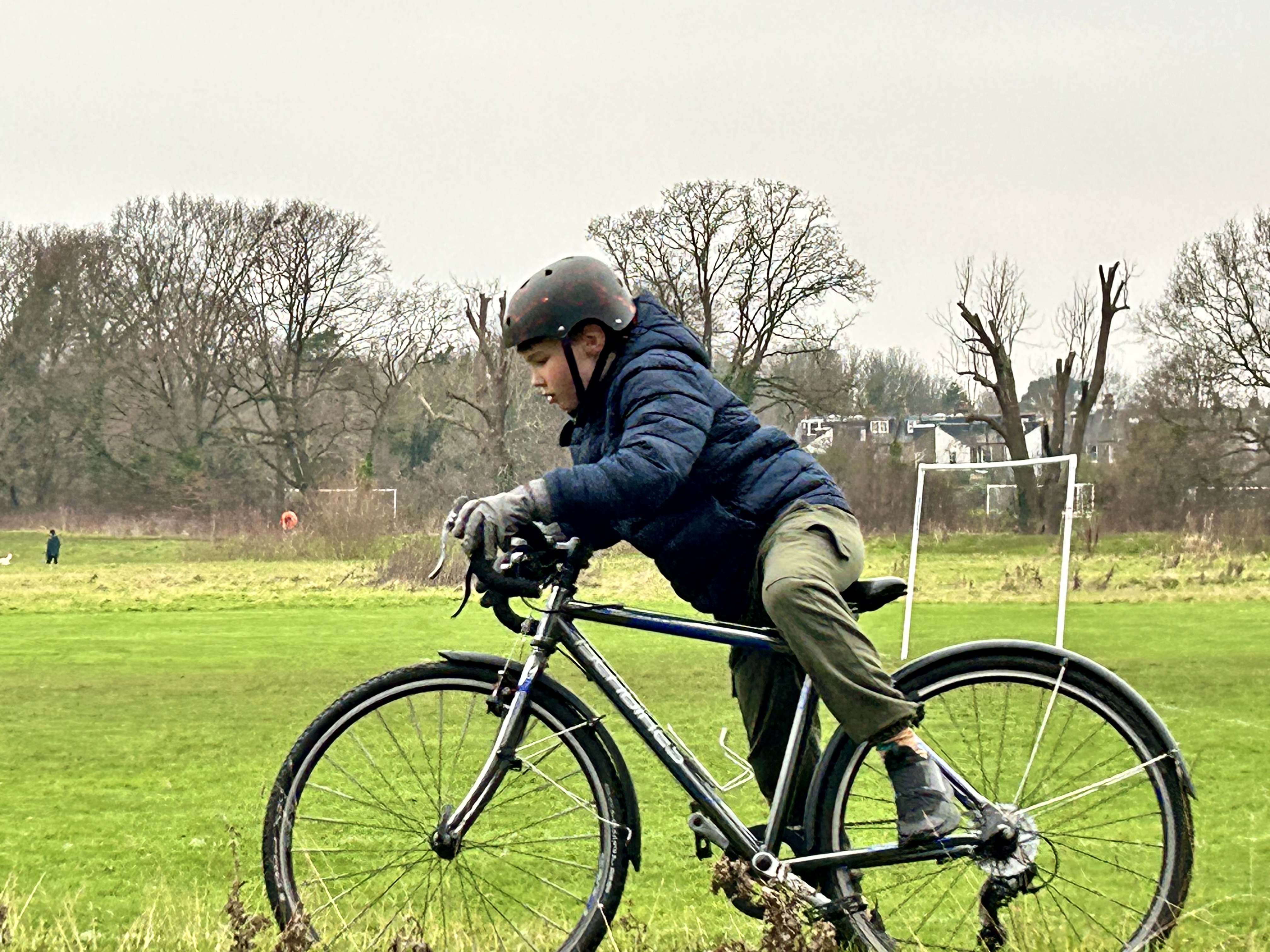
We nudged our way to Christmas day on raw cold days with visits to local attractions, the market in Herne Hill and walks around the local parks before the arrival of Gregor and Emily on Christmas Eve. They started Christmas day with the Park Run in Dulwich Park, it had its biggest-ever turnout with over a thousand runners including a couple of hundred Santa Clauses and parents running with a bigger fleet of baby buggies than in a Nursery Store. G came third but seemed content, he had not been training much and presents and bubbly were to come after a late breakfast. Meanwhile, my grandson was out pedalling the local bike trails. The excitement of a bike for Christmas is as timeless as ever,

Christmas Day morphed into Boxing Day, the day when everyone relaxes. We marched around the parks and woods, calling in for pub refreshments before eating remainders from the Christmas feast and dozing in front of the television.

We had the first slot for ice skating the next day. or Gliding as it is now termed in the sophistication of the former Battersea Power Station. The Thames was lost in a fog and I struggled to find my balance on my first foray on ice for 25 years. I used to be able to skate backwards but until my offspring escorted me for a few laps around the Glide circuit, I was dependent on staying near the boundary rail. It used to be the other way round as I pulled them around the rinks. I was told not to worry as I was the oldest person on the ice which was a double-edged insult. On my last circuit, before the siren went, progress had been made and I had my arm behind my back and leg aloft as if I was on Duddingston Loch. 

The final day of the visit was taken up by a visit to the National Trust house and gardens at Polesden Lacey in deepest Surrey. Several thousand others had the same idea but there is a 1,600-acre estate to walk around and we spent a couple of hours traipsing the walkways in the mature woodlands along the Mole Valley. The Tanner's Hatch Youth Hostel had been renovated and was being used for musical weekends. A carousel was pitched outside the house along with coffee and Greek food vans and the stables had been refurbished as a well-managed eatery. It suggested that the National Trust was more advanced in its thinking here than in many other properties that are moribund by comparison. 

My time was up as I caught the Sunday train back to Scotland. It was full to the gunnells with suitcases, buggies and baggy-eyed post-Christmas travellers. I was seated next to an elderly deaf woman who had led a remarkable life. She had taken up diving and mountaineering, where she met her deaf husband who had been a motorbike racer. As our conversations became more detailed, her Samsung phone was used so could read what I was saying and was able to respond immediately. She left the train at Newcastle to catch a local train to Northumberland to spend New Year with her daughter and family. There were no Sunday buses for the last leg home so for the first time since moving six years ago, I had to call a taxi to reach home alone for the New Year.

M&S on Oxford Street

Roger Fry, Post Impressionist -Blythburgh Estuary

Dulwich Park Run on Christmas Day

Bikes are not just for Christmas 

Formerly known as Ice Skating

Fog on the Thames, where the coal boats from the Tyne came in


Tuesday, 3 September 2024

Out and About in London

Thames from Blackfriars Station

Francis Crick Institute

Chinatown

Mo Mowlem in the National Portrait Gallery

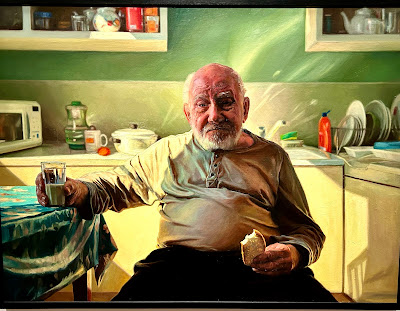
The Last Portrait by Sasha Sokolova in National Portrait Gallery 
\
Courtauld Institute - 

Van Gough's Presidential pose


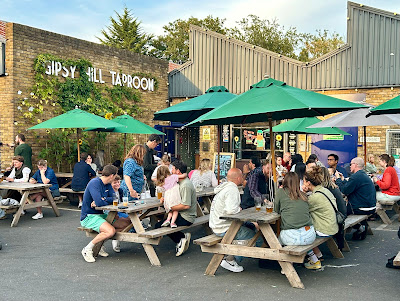
Local breweries are flourishing in London.

Three days after walking out and about in Paris, I was back in London and had some free time. I am no plongeur, but I decided to do the same in Central London. The days were perfect with the late August sunshine having lost its midsummer heat and humidity. I had walked 29,000 steps in Paris, and I managed 23,000 in London, where I spent more time visiting museums that were either built in the days of the old empire or erected as symbols of the new digital London. As in Paris, I had no preconceived plan but followed my instincts, taking in any scene or building that tickled my fancy. It was a good way to compare Europe's two great capital cities.

I caught a train to St Pancras, not from Paris but from Tulse Hill in South London. I chose St Pancras because it is one of my favourite buildings that was rescued from demolition by the Poet Laureate, Sir John Betjeman. The red brick Gothic Hotel that fronts the station was designed by the Victorian architect Sir George Gilbert Scott, and the massive cast iron vaulted roof was the largest in the world when it was built. St Pancras, like most of London's buildings, had suffered from smoke, fog and underinvestment after the war and, unlike Paris, demolition and replacement by commercial retail and office blocks were the modus operandi of developers. The outcomes were dire, and whilst there have been many remarkable buildings constructed in the past twenty or thirty years, London is a smorgasbord of architectural styles, whereas Paris has retained most of the buildings that Haussmann incorporated within the planned development of the core of the city in the nineteenth century. The lack of high-rise buildings makes Paris more uplifting than the chaotic mix of new and old and low and high buildings in London, on a street pattern that evolved over the centuries with no overriding design.

I visited one of the new buildings across the road from St Pancras, the Francis Crick Institute and looked at an exhibition of the workings of the brain. A massive foyer extended upwards with the innards of the lift system revealing a glass roof that flooded the building with light. The coffee was bland, unlike the cafe coffee in Paris, which is freshly ground, served quick and enjoyed slowly as you observe the street life. I continued to the British Library and joined so that I could look up a review for a robot mower in Which Magazine. After finding the right floor and section, I had to queue to make my request. Ten minutes later, I was told that they didn't have the recent edition I requested because they had not yet re-ordered the magazine twelve months after the cyber attack crashed the system. It was a different reason than Lambeth Library had given me the day before, when I had made the same request; they had not renewed membership of Which as part of their austerity savings. Still, I managed to have a good look around the library. 

I walked to Tottenham Court Road and the retail areas and pottered around some furniture shops before seeking somewhere to eat. The number of homeless people in tents and empty shop entrances was far higher than I had noticed before, and the homeless seemed a lot younger. The pubs were too McPuby, the sandwich bars were overcrowded, and the restaurants too expensive for lunch, so I drifted into John Lewis so I could have a look at some trail shoes and furniture and grab a quick meal and a sit-down. I have occasionally bumped into long-lost colleagues and friends here, so I always keep a sharp eye for people who may now be thirty or forty years older than our last acquaintance. It can be one of life's pleasures to meet someone from the distant past and discover the bones of their life's journey.

The afternoon began with a jaunt down Oxford Street and Regent Street. As I approached Trafalgar Square, I was tempted to spend some time in the National Portrait Gallery, a place that never disappoints. I was greatly taken by John Keane's portrait of Mo Mowlem and enjoyed the 2024 Portrait Annual Award exhibits. There is a people's award ao I voted for Aleksandra Sokolova's portrait of her elderly father, who had also been an artist. 

I meandered through Chinatown towards Covent Garden and called in at the hotel where Aileen and I had stayed for her 70th birthday on our last trip to London together. It had been a perfect weekend, and I wanted to recapture the memory. I had never managed to visit Somerset House, so I dropped down to the embankment and walked along past the solid sandstone buildings that were built in Victorian times. The traffic was heavy, although most of the cabs are electric nowadays. The bar outside Somerset House in full swing with lots of office workers taking a late lunch or swanning off early to steal a bit of the summer that had only just turned up. I walked through the courtyard where children were running through the fountains and found the entrance to the Courtauld Institute. I climbed the three flights of stairs to the Impressionist room and spent half an hour in a near-empty gallery admiring the fine collection. I was amused to see Van Gogh's self-impression of the Trump assassination attempt; the bandaging of the ear was far better than the Trumpian swab. 

It was time to head home, and I decided to travel from Blackfriars Station. Its platforms are on the bridge over the Thames and provide an amazing view of the city skyline and the boats on the Thames. On the train home and later as I relaxed with family in an outside bar attached to the local brewery, I tried to draw some reflections from my time out and about in Paris and London. 

The Thames is wider and murkier than the Seine, and it seems to divide the city into north and south. There are many bridges, but mainly for rail and traffic. Whereas the Seine seems to unite the right and left banks by numerous bridges, some of which have been pedestrianised and provide public spaces where people do yoga and other workouts. London's South Bank is an attraction in itself, but it seems a distant add-on to the central area, apart from where the Millennium pedestrian bridge links across to the Tate Modern.

Paris was more tranquil and quieter despite the wonderfully executed 2024 Olympic and Paralympic Games, but Paris is always empty of many of its residents in August. Paris seemed full of Americans and visitors from the rest of Europe. London was heaving with tourists at the end of the school holidays, with visitors from all over the globe, particularly from the developed Asian countries. Parisians seemed more laid back as they glided around their city with restful cafes and independent shops always on hand, Londoners seemed more on edge as they dodged the traffic, queued for lunch and shopped in the mainly franchised stores

London had many areas where mini campsites had grown for those sleeping rough. Paris seems different, although there were stories about shipping out rough sleepers for the duration of the Olympics.

London has a better range of museums, cultural and sports stadiums to visit, but Paris has the intimacy and charm of its cafe culture.

As a visitor, prices appeared cheaper in Paris for food, drink and clothing. Train fares are certainly a lot cheaper, but rail travel in both cities was working well. If you throw housing and other services into the equation, various studies have found that Paris is 15 -20% cheaper to live in than London. Housing and travel are the main areas of difference.

On architecture and urban design, Paris wins hands down, but the often eccentric new buildings in London have created a skyline of modern art, and the fine adaptations of old buildings like power stations and railway buildings (King's Cross) provide examples of less coherent but more imaginative buildings. Paris does this less often, and even the Pompidou Centre and the new Westfield shopping centre at Les Halles, which has 3 floors underground, do not break the symmetry of the city centre skyline.

In short, Paris slows you down, and London pumps you up. They are both successful world cities adapting in different ways to retain their primacy in countries of comparable size and lingering self-importance. In this respect, they have hollowed out the investment in other cities by their agglomeration of political, cultural, academic, financial and sporting activities. Other European capital cities do not have the same level of primacy, which is why Munich, Frankfurt, Barcelona, Milan and other non-capital cities provide alternative nodes for the economic well-being and equality in their countries. Devolution in the time of primacy is a necessary condition for sustainable development.


Wednesday, 4 October 2023

Oh, What a Mess

!
I had not intended to listen to or watch the Prime Minister's performance at the Conservative Party conference in Manchester. It was just difficult to avoid. I was driving back from Stirling, the radio was on and Rishi Sunak was delivering something at last even though it was only a speech. His predecessors had established a custom of focusing their key conference speech on the truth, Johnson junked it and Truss didn't trust it, she constructed a parallel narrative. Sunak was more subtle, he twisted the truths and claimed that he was the great redeemer, the game changer for long-term growth. When the PM said he wanted to increase funding to towns, not cities, I thought that perhaps we should have kept Stirling as a town, it would have saved lots of time and anguish back in 2002, but then I remembered that Sunak is swift on promises but slow on delivery.

The speech had obviously been rewritten many times and polished by his backroom truth fairies. The speech was meant to be a paean to his lovely government. I was more intrigued by the subplot, his polemic against most of the things the government had done or not done over the past thirteen years. Arriving home, I switched on the TV to continue the compulsive agony and to observe the syncopated clapping from the audience who were on their last warning to behave themselves. I realised that this was a seriously slick performance, a play that Joan Littlewood would have been proud to present, the script was split into many acts and laced with irony. He made sycophantic shouts for his disloyal cabinet colleagues Suella and Kemi and even named Ian Duncan-Smith. He then segued into a passage transferring blame for the failures during the 13 years of Conservative Governments. It was the EU, Jeremy Corbyn and Keir Starmer, devolved governments, Labour-run councils, environmentalists, and woke liberals that were responsible. The HS2 debacle was the fault of HS2 Ltd, a quango sponsored and funded by the government. He and the government were blameless. It was time for change for the long term and he was the person to make these changes. 

There were lots of policy changes he could have chosen to announce: housing, social care, climate change, school investment, benefits, reforming democracy, planning and building regulations. Little chance of that happening, "this is what I believe in and is what the country wants" he claimed: - smoking bans for young people, a new exam system, and abandoning HS2. I happen to agree with the latter decision but he could have done that several years ago when he was Chancellor and the costs were spiralling out of control and before construction began. Even eleven years ago this was a procurement tragedy waiting to happen.

The reasons for the escalation of costs and delays were obvious from the start. First, it should have started from the north where costs were less, and the tracks were in greatest need of upgrading to improve both the capacity and speed of trains. The huge difference in the train speeds and the age of rolling stock in the north compared to the southeast has been palpable and unacceptable for decades. Second, the massive compensation to land owners, building tunnels under the Home Counties to meet the outcry from Tory MPs, and the 4 miles of tunnelling under London to connect to Euston had never been properly costed. Third, the Finance and Construction contractors had cynically gamed the government procurement procedures. The government claims that HS2 is key to levelling up of the north were spurious. All the spending in the first ten years would be in the southeast to midlands section giving no immediate benefit to the north. This should have been called out from the start, the political leaders in northern cities were duped into supporting a scheme that was duplicitous and ultimately damaging to the prospects of improving rail travel for the many as opposed to the business elite. HS2 has been the vehicle for another dose of levelling down.

The future of HS2 will be part of the political battleground for the next twelve months. I would happily take the switch of funding to modernise and improve the capacity of the rail network in the north. Still, I would be sceptical about the PM's claims that all of the £36bn savings will be redirected to transport infrastructure schemes. I have no doubt that the savings will dwindle as claims for terminating contracts multiply and many of the list of schemes that Sunak recited to the conference had already been announced in previous programmes or will be too expensive to deliver. I would also ask the question of why bother continuing with the HS2 line from Euston to Birmingham? This is the part of HS2 where the most money is to be spent and where there is the minimum gain in speed. 

The UK is a small country and travelling at 300 kilometres per hour (186mph), the HS2 proposal does not justify the extra specification and cost of the track and trains to achieve this. Achieving an average speed of 200kph (125mph) would give a nonstop travel time from London to Manchester of 1 hour 36 minutes, reducing the existing fastest times by 30 minutes. If this more modest average speed for trains was extended to Scotland it would reduce the travel time from London to Edinburgh or Glasgow to 3 hours 30 minutes. This is well over an hour quicker than the fastest existing trains. It would be hard to justify travelling by air to London from any part of Britain other than from Aberdeen and Inverness in these circumstances. The quickest time from parking at Glasgow or Edinburgh airports to arriving in central London is about 5 hours including the painstaking rituals of airport security and this does not take account of the regular delays. Reducing air travel should be factored into the benefits of rail investment

Meanwhile, in much of the north, including the Manchester to Leeds and Sheffield routes, even achieving an average speed of 100 kph (60mph) would be a game changer. It is hard to argue against the priority of creating a modern and efficient rail infrastructure in the north. I would expect any detailed cost-benefit analysis would prove this to be a better value than an abridged HS2.

On the effectiveness of government, it is vital that we need a change after 13 years during which our public services have been trashed and infrastructure expenditure has been subject to multiple delays and overspends. I doubt Sunak will fare any better than his predecessors in achieving this. Remember he was the Chancellor who approved 'Eat out to help out', a Covid spreader that cost £846m, and Track and Trace that cost £37bn for a service that never delivered its objectives. He also approved £2.7bn that was spent on unusable PPE items, many of which stemmed from fast-track bids from friends of the government and then cost a further £737m to store them.  Rishi Sunak's CV suggests he should never be allowed any responsibility for the long term. A brighter future for Sunak and the country would be for him to call an election and escape the opprobrium that will continue to be heaped upon him by his party as well as the electorate.

Wednesday, 22 February 2023

Solo London

Memorial to Democratic Follies

My first time away from home since last July was to visit the grandchildren during the school holidays. London without Aileen was going to be hard. On our many visits to London over the past fifteen years, it was like being on holiday, we would be together most of the time, with our daughters and the grandchildren or visiting museums, parks, buildings and shops. We would take advantage of cinemas and musical events as well as the multitude of restaurants serving food from all parts of the world. It was different from being at home where we would often be doing things separately whether at work, maintaining the house and garden, watching TV, reading, meeting old colleagues and local friends or book groups, going to French classes, climbing hills, running and blogging.

On my first morning in London Eva and I visited the South Bank with the grandchildren. We entered by the Albert Embankment below the Westminster Bridge. A memorial to the 200,000 people who died of Covid and a reminder of the slow and erratic response to the pandemic by Boris Johnson's government of flibbertigibbets. Across the river, a gleaming Big Ben put to shame the drab and empty Houses of Parliament, a monument to follies committed in recent years. It had hosted four consecutive failed governments that have been the source of the UK's sad demise in the social, economic and environmental structure in recent years.  

The Southbank was mobbed with thousands of other families during the school half-term, a ritual that favours the businesses more than the customers. The crowds included phalanxes of French schoolchildren taking advantage of the devalued £ and feeding the revitalisation of London's tourist businesses. The former Greater London Council County Hall has become a vessel for several dodgy-looking tourist attractions alongside the London Eye. Even the cultural activities we witnessed in the Southbank Centre seemed stale but then beatboxing was never my thing. We returned home and I went cycling with Simon and Kit hurtling over speed bumps and checking out the new play equipment at the Brixton Windmill.

Later in the week, we visited the Lego and dinosaur exhibition at the Horniman Museum with other friends. We made a trip to the impressive new shopping centre that has been squeezed into the Battersea Power Station. The £9bn investment, on a similar level to that at King's Cross, is astounding with the adjacent high-rise flats costing £millions. The whole complex is a different world, the play equipment was at another level. The highlight for me was the sheer scale of the brick-built power station, its battery of 1950s dials in the control room now part of a restaurant. Two nimble fitness instructors were teaching youngsters to use LED hula hoops. £5 for each youngster and about twenty in a class that lasted about fifteen minutes. When I did a similar job as a teenager at discos run by my father, it was free and lasted about 45 minutes, but we didn't have LED hula hoops. My father bought some hosepipes and we stapled eight-foot lengths into a hoop using some dowelling, those were the days when inventive manufacturing was a home industry.

The only thing missing from the refurbished Power Station was a pig flying above the chimneys. The Pink Floyd album, Animals, used the pig as a symbol of people with wealth and power who manipulate the rest of society and encourage them to be viciously competitive and cutthroat, so the pigs can remain powerful. The developers who repurposed Battersea Power Station have taken this Orwellian fantasy literally with pricing policies that are set at a level to keep the proletariat at bay.

On the last day with children back at school and adults working, I headed for the Olympic Village in Stratford. It had been on my list of visits for years but involved three tube changes and Aileeen was not really interested. The great plans for after use of the site had become a bit of an albatross for the government and consequently, things had been allowed to drift. Boris Johnson's promises rarely come to fruition. And so it proved, the Westfield shopping Centre has none of the razzamatazz of the original Westfield or Battersea. The much-vaunted Zaha Hadid-designed Aquatic Centre is not weathering well with the timber slats looking as if they have a limited life and the landscaping is in terminal decline. The Olympic stadium has been repurposed as West Ham's home ground at a cost to the tax payer of £323m, with West Ham contributing a mere £15m. The stadium has been sadly downgraded and is surrounded by fast food outlets and shipping containers. It has been graffitied with claret and blue signage that demeans the original stadium. A tour costs £20 or £45 with a West Ham legend, unfortunately Julian Dicks was not on duty. Instead I got talking to a group from Murphy Scaffolding who were having a training day in the facilities, they offered me the chance to sneak in with them. Unfortunately, I would not have convinced the doorman as I was too slim, too old and lacked an Essex accent to pass as a scaffolder.

On the way back to Stratford station I was pleased to see that there was a significant development taking place with new buildings under construction for a cultural quarter including the University of the Arts London College of Fashion, the BBC Symphony Orchestra, Sadler's Wells, and the V&A. Quite a lineup and, hopefully, it will help ensure that the landscaping around the Olympic village is brought back to a reasonable standard. I looked for a place to eat but nothing appealed so I returned to Bond Street on the new Elizabeth line. The over-engineering of the platforms and stations explained why Crossrail had greatly exceeded its budget, £20bn compared to the original estimate of £14.6bn. Bond Street Station alone cost £570m, five times its estimated cost. No wonder there is no cash left for upgrading the rail lines and rolling stock between the northern cities.

I alighted onto Bond Street and was pleased to spot John Lewis across the road. It is one of the few remaining department stores that seem to provide everything including a good cafe for some lunch. I had not been in a shop other than a supermarket since last July so enjoyed the chance to browse on a quiet Monday. I was even enticed into the in-house travel agent where the adviser recommended a holiday in Argentina and Chile, Japan or Costa Rica. On hearing that I would be travelling alone having lost my wife she asked if she could give me a cuddle. Customer care is never knowingly undersold at JL!

The next day I returned home, I had paid £10 extra for a flexible ticket but I had inadvertently booked a train from Euston to Stirling. I had forgotten and taken the tube to King's Cross, which is the usual station for the journey, but by the flexible ticket, I could catch an earlier and faster train that got me to Stirling an hour earlier. There was time to buy some food before the bus home but even better I bumped into an old neighbour. She offered me a lift home and brought me up to date on the news from our old village. I thought it might be difficult returning to an empty house but I felt pleased to be returning home.

Covid Memorial Wall on the Albert Embankment

Battersea Power Station

Statutory Citroen Food Truck in Battersea Power Station

Aquatic Centre has lost its pizzazz

The Olympic Stadium: downsized and debased by West Ham

Wednesday, 30 March 2022

London Post Covid

St Paul's from the Millenium Bridge
City of London from the South Bank

It is 28 months since we last visited London, where our daughters and grandchildren live. We followed the Covid rules and, like many, have been reluctant to travel by train or plane since the start of the pandemic. It was a big birthday for two of the family, so we booked train tickets to London and a series of events to celebrate Aileen's 70th. As the time approached, we became increasingly concerned. The rate of infections in Scotland had reached its highest ever level, one in eleven Scots had COVID-19, including our son, who had to delay his trip from Glasgow until he had tested negative for two days.

The trip on the nationalised LNER service was a complete success in comparison with many previous journeys on the appalling Virgin Trains, whose franchise was terminated before the pandemic. The new Azuma trains were both comfortable and kept to time. London was enjoying a spring heatwave, and it was uplifting on arrival to spend a couple of hours in the early evening soaking up the atmosphere as the streets were thronged with people socialising and shopping after work. 

We had booked to go to the theatre and walked from Covent Garden along the embankments to the Globe Theatre on the South Bank. It was a bit of a crush on the benches, but most of the audience were wearing masks, and it was the first live event we had attended since 2019. The walk back to the hotel in Covent Garden was over the Millennium Bridge, and we passed dozens of bars where people had cascaded outside to drink and enjoy the balmy evening. Rickshaws were cruising along the Strand with inebriated girls singing along to the amplified music. We had a late meal at Mildreds , and it was midnight before we made it back to the hotel.

The next day was a big one, and after breakfast in a nearby cafe, we sauntered through the streets of London to the British Museum. The queue for entry was over 30 minutes, so we abandoned that idea and enjoyed walking the streets, looking at some shops, having a coffee and then 30 minutes at the National Gallery. We had booked tickets for Swan Lake at the Opera House, so we met our daughter there for lunch and settled down for a 3-hour performance. I only fell asleep once. Then an Uber back to our daughter's to share a birthday cake with the grandchildren.

Saturday was a chance for a lazy walk around Brockwell Park. On the way back, we happened upon a vast motorbike rally where Hell's Angels and fellow hordes of bearded, tattooed motorcyclists revved their Harley-Davidsons and other heavy metal bikes through red traffic lights, ignoring the Met Police outriders who were attempting but totally failing to supervise the ride. The convoy of motorbikes held up the traffic and pedestrians for about 15 minutes,  during which several thousand motorbikes were giving two fingers to the fuel crisis and the local population. The horns were blaring and cars inching out, but were halted by a red-haired biker chick in her fifties who stood her ground and prevented anyone from crossing the convoy by hurling offensive language at them. What was needed was Cerys Matthews to assuage the road rage with some emollient advice like "You could be taking it easy on yourselves." As an act of collective crime, it was an illustration of why mob rule, whether by bikers or oligarchs, is part of the underlying culture in the Smoke. I could find no reporting of the event in the press or media the next day. Perhaps the London Fourth Estate are no more competent than the Met Police in coping with rampant self-indulgence.

We took the tube to Oxford Circus to reach the Rovi, Ottolenghi's latest restaurant in Fitzrovia, for a late lunch. The whole family was together for the first time in five years, and everyone seemed to enjoy the occasion. It was repeated the next day when we visited Richmond on another glorious March day and had lunch at our daughter's flat after a walk along the banks of the Thames. We took the grandchildren for a walk in Richmond Park, and all behaved like children; the release from Covid was infectious. 

The weather had stayed sunny and warm for the whole weekend and extended to the following day, when I took an opportunity to charge around Brixton to get a feel of what had changed during the past couple of years. New flats, new offices, new businesses, new street art and a new primary school confirmed that Brixton is still attracting investment and people. Gentrification was apparent with the railway arches undergoing the switch from starter businesses to trendy eateries. The journey home on the train later in the day was relaxing. It was what we needed after four days with more social activities with other people than we had managed in pretty well the entire two years of COVID.


National Gallery

Swan Lake at the Oprea House

Motobike rally in Brixton - "don't the **** try to cross"

This went on for 15 minutes

Thames at Richmond

Playing in Richmond Park

Brixton street art

Brixton brickwork respect for Chadwick Boseman

Gentrification of the Brixton railway arches


Thursday, 25 April 2019

RHS Wisley and other Parks

Entrance Terrace and the Laboratory Building
It was a very late Easter and the forecasts were for the hottest on record. We travelled to London to visit the family by train. It was the first time since the east coast mainline had been restored to a public operator following Virgin defaulting on the £2bn in franchise payments. LNER ran on schedule using the old rolling stock and on the return journey, they even offered free tickets to ticket holders who had booked onward journeys from Edinburgh on cancelled Scotrail services. Something that Virgin had refused to do on a previous journey when they had failed to keep to scheduled times. Let us hope that is the last of Virgin on the railways, as well as refusing to honour pension entitlements for staff, they have operated overpriced ticket scams, the trains they leased lack legroom, the seats are not aligned to the windows and the toilets talk at you. 

We made a successful visit to the Royal Horticultural Society Wisley Gardens in Surrey on Good Friday when it was the hottest place in the UK. It is an inaccessible attraction by public transport, and we needed to order an Uber taxi service for the final 4 miles from the West Byfleet station. Apparently, the crowds were as busy as anyone could remember but the gardens absorbed everyone with ease and the whole experience was on a par with Kew Gardens, although without the aircraft noise.

The 100-hectare site is bounded by the river Wey and located in the rich fertile soil of the Thames basin. It had everything from rock gardens, vegetable and fruit gardens with the biggest collection of rhubarb species, a magnificent collection of coniferous trees in lawned areas, glasshouses, several cafes and numerous events for children. You can spend hours just walking through the well tended sections and then there is the opportunity to buy plants from the incredibly well-stocked garden centre. The children found lots of things to attract their attention and expend their energy. The only problem was getting a taxi back to the station. We seemed to be the only visitors who were dependent on public transport and the shuttle buses to the car park were the only concession to their customers. The train back to London and then the bus meant it took almost 2 hours for the 30-mile journey.

Clapham Common was in festival mode with thousands of young people playing games and drinking on a glorious summer-like evening. The weather continued over the rest of the weekend but we restricted ourselves to more local attractions in Dulwich and Brockwell parks so that the children could use their bikes and scooters. An Easter egg hunt was arranged on Easter Monday and it was a treat to see about 15 children between the age of 3 and 8 running at a pace to find eggs after reading the clues. It reminded me that as a boy I spent every Easter Monday in Avenham Park, Preston where we had Pace Egg races down the slopes of the park that was located on the scarp slope to the River Ribble. The eggs were hardboiled and often inedible because they had been smashed and the paint and colouring had been absorbed, today it was pristine chocolate eggs that were smashed and eaten.

I was delighted to see that the local primary school in Brixton had adopted the daily mile by marking out a track around the playground and encouraging children to run fourteen laps to achieve their daily mile. A simple but effective activity introduced by St Ninian's Primary School in Stirling and now embedded throughout the UK. It is a perfect example of how innovation is best achieved through local endeavours rather than centralised diktaks.

Treescapes

And Tiger came too

Entrance

Glasshouse

Forest

Rockery

Water features

Dulwich playpark

Learning to ride

Pace Egg racing in Avenham Park, Preston

The Daily Mile - 14 laps of the school playground