Showing posts with label Spain. Show all posts

Monday, 13 November 2017

Toledo

Alcatraz from the river

Tiles in Santa Cruz

El Transparente, a skylight to bring shafts of sunlight into the cathedral

Dome of San Blas chapel in the cathedral

Cathedral of Toledo

Moorish buildings

Alcatraz

After 4 days of walking the streets and parks of Madrid, we decided to take a train to Toledo. It is a mere 32 minutes away on the impressive high-speed train run by the state-owned Renfe Operadora. The popularity of the trip was apparent when we found that all the morning trains were fully booked. We had to kill two hours before the midday train left. This is no problem in Madrid, the Parque del Buen Restoril is across the road from the Ashoka station and on a bright Saturday morning it was throbbing with people of all ages doing all sorts of fun things in the park from cycling, and roller skating to skulling with all types of informal games being played by groups of families and friends. Several street bands were playing, the solo saxophones were purring and the hawkers were selling.

We returned to the station with 10 minutes to spare but all travellers for any train had to be security screened so we spent 15 minutes queuing and then running to catch our train. Dozens of others had been caught out as well so the train was held up for twenty minutes to allow the security channels to be cleared. As the train eased southwards we witnessed the ever-expanding developments on the outskirts of Madrid. It was blighted with lots of commercial developments, housing schemes, new roads, and pylons and beyond the city, the yellowish plain of Spain was mainly lacking any rain. Toledo arrived quickly, and the impressive Moorish inspired railway station echoes the architecture of the ancient city built on the hill. We had a mile or so to walk, crossing the bridge over the river and then climbing numerous flights of the steps to the fortress-like pyramid of buildings.

Toledo is known as the Imperial City and was the capital of Hispania following the end of the Roman empire. It is now a World Heritage Site and like all such tourist meccas, was buzzing with weekend visitors. We visited the Museum of Santa Cruz with its collection of El Greco paintings and after a drink in one of the many plazas, we headed to the magnificent gothic cathedral of Toledo. The diversity of architectural styles, as well as the influence of different religions, meant it required a couple of hours to absorb the many splendours. We walked around the densely developed streets before s navigating across to Alcatraz, now a military museum.

We retreated to a nearby terrace for a drink and to watch the sun sink below the horizon before sauntering back to the station. Toledo had been worth the visit but like so many tourist haunts the ambience was too hurried and manic to absorb the full impact of its history. 

Madrid

Plaza Mayor
Madrid is a city that I have struggled with. Spain's Royal City with its strong connotations with Franco and the Spanish Civil War ruled it out of any visits before his death in 1975 and the establishment of a constitution in 1978. However, the lack of vitamin D as the autumn months served a monotonous regime of dull days made me search for some respite. Everyone else had the same idea the Canaries were booked up. Madrid was cheap, probably because of the Catalan conflict and the arrest of the Catalan government by the Madrid based government.  I booked and we arrived at a good hotel in Justicia, a mile or so north of the centre.

The flight to Madrid brought us over the Sierra de Guadarrama, north of Madrid where a massive monument had been erected to the fallen in the civil war. The monument in the Valley of the Fallen includes a basilica, an abbey, a 150-metre high cross on a granite tor and Franco's tomb. The flight passed above it and in the perfectly clear Spanish skies, we observed the empty landscapes that surround it and are avoided by the large majority of the Spanish population as they seek to eliminate the memory of Franco and the devastation of the civil war. I was rereading The Ghosts of Spain by Giles Tremlett, a book that chronicles the reconciliation of Spain in the years after Franco.

Valley of the Fallen
For five days we languished in the museums, parks, plazas, and streets and even managed a day trip to Toledo. It was a great success, with cool sunny days, friendly people, good food and drink and a place that rewards just walking the streets from morning until dusk at 5:30pm. We covered miles without ever having to think hard about what to do next. Stop, have a drink and some tapas, move on to the next attraction, and repeat.

It was helpful having our European Health Insurance cards with our dates of birth, I'm not sure if these will exist post-Brexit, but as older European citizens it gave us either free or reduced entrance fees to the three great museums of Art. We began on the first evening in the Prado, exploring the Velasquez and Goya's. The next day took us to the Musee Nacional de Arte Reina Sofia with its modern art collection including Picasso's Guernica that was attracting crowds of students throughout our visit but we returned to it on three occasions to be mesmerised by Picasso's imagination.

Guernica
In many ways, the most enjoyable museum was the Musee Thyssen Bornemisza. It had an exhibition of Picasso and Lautrec showing the close relationship of the work of the two artists who had captured bohemian life in Paris at the turn of the century. But the whole gallery flowed with its eclectic mix of twentieth-century artists. Particularly striking was Lucien Freud's Last Portrait as we spent a couple of hours in the relaxed ambience of this excellent museum.

Last Portrait by Lucien Freud
As always in large cities, I was captivated by the Plazas. In Madrid, they seemed to follow the design principles recognised by Camillo Sitte in his book The Art of Building Cities, a book that still resonates in my memory forty-odd years since it was part of the core syllabus of a post-graduate course. The height and shape of the buildings, the closure of the space by buildings, the human scale and the diversity of the buildings in both function and design are all components of a successful plaza. The Plazas in Madrid seem to function well with pedestrians milling about at all hours, there are places to sit or stand and observe, civic art, and a palette of materials that traduces the visitor.

Only on a Sunday did things break down when it seemed the whole of Madrid congregated at El Rastro, the flea market. The highlight was the numerous street bands playing with a verve that lifted spirits. None more so than Jingle Django, a street band who gave a rendition of 'I am a Walrus' that brought folk flocking from the crowded street market.

Parque del Buen Retiro, the main civic park, became a regular haunt that we visited on three or four occasions. Superbly designed and maintained it contained all the attractions that a park should have in a major city; it heaved with locals engaging in every activity. Runners, cyclists, skateboarders, wheelchairs and pushchairs, musicians, artists, dog walkers, rowers, scullers, book huts, cafeterias and botanic gardens; it had them all and a joyous atmosphere. We were deeply moved by an installation by  Doris Salcedo in the Palacio de Cristal that was in memory of all those who had lost their lives trying to cross the Mediterranean to a new life in Europe. Their names were displayed in palimpsests on the floor.

I managed a run in the park on Sunday morning and returning to the hotel I had to cross the ring road that had been closed for a major road race between the two great football stadiums: the Bernabeu and the newly opened Estadio Metropolitano. There were 12,000 runners mostly attired in Real Madrid or Atletico Madrid tops. I joined in as a means of crossing the road but enjoyed the bands playing along the route and the camaraderie so much that I joined the throng and ran with them for a mile or so before stepping off at the other side of the road and returning to the hotel. It epitomised Madrid, a city that raises your engagement. It had provided sunshine, friendly locals, wonderful museums, a built environment to enjoy and a history that should be an antidote to oligarchical tendencies everywhere.

San Francisco El Grande

Dome of San Francisco El Grande

Residential buildings in Chueca

Young and Old playing in Bueno Retiro Park

And the band began to play

From the Crystal Palace, Park Buen Retiro

Crystal Palace in Buen Retiro

Palimpsest, the names of those drowned making their way to Europe

Skyscape in Park Buen Retiro

Fun and Sun in November - Buen Retiro

Jeronimos Apartments by the Prado

Plaza de la Armeria

Plaza de Santa Ana

One of the many excellent street bands

El Rastro Sunday flea market

Jingle Django singing I am a Walrus, 

Street Art

Time to leave


Monday, 11 April 2011

Granada

Alhambra and the Sierra Nevada 

The journey from Cordoba to Granada was via two towns: Baena at the centre of the olive growing region and Alcala la Real. The weather was improving but it still lacked the sharpness of light that we had enjoyed in Seville. The rolling countryside was decorated with olive groves and the distant landscapes gave way to the hazy blue profile of the Sierra Nevada which was capped with snow. Sitting in a plaza in Alcala we had the best of Spain: fresh orange juice and a tapas of mushroom and olives before a final half-hour drive into Granada. 

Granada is a city protected by a huge ring road which eventually flung us with centripetal force into the traffic-crammed centre. After some time negotiating the one-way traffic schemes, we found an underground car park to store the car for three days. We walked the final kilometre, dragging our suitcases, airport style, to our hotel which was conveniently hidden beneath the looming Alhambra Palace and adjacent to Plaza Nueva.

At an altitude of 750 metres, Grenada was cooler than the plain but the plazas were busy and provided numerous tourist-focused shops, bars and restaurants. Unlike Seville, which is a real working city,  Granada seemed to be dominated by tourism generated by the presence of the Alhambra. It attracts 3 million visitors a year and tickets have to be booked in advance.  We decided to take the 9am slot on our second day so we could spend day one getting to know the city.  We walked through the Albayzin which is across the river Darro from the Alhambra, a place of shady plazas and a lot less frenetic than the commercial centre. Afterwards, we returned to the centre and visited the Gothic Cathedral which seemed austere and dull after the splendours of the Mezquita in Cordoba. We were staying at the excellent hotel casa 1800, which had recently opened and provided afternoon teas, newspapers and a glorious patio to relax in after the exertions of walking all day.

Despite being there on the same day as the PM David Cameron, we saw nothing of him or his retinue of bodyguards. He had travelled by Ryanair as an empty gesture to populism. Taking a party of ten or so officials on Ryanair must have cost a fortune what with Sam's baggage and all the charges for the use of credit cards. I wonder if he hummed dam busters on takeoff?

The visit to the Alhambra was a real highlight with superb Muslim architecture and detailing in the palaces.  The moulded stucco walls, water features, and carved lions (which were on show but being restored) made for an irresistible visit.  The bonus was a superb exhibition of Escher's drawings in the Palacio of Carlos V.  He had visited the Alhambra at the start of his career in 1922 and many of his drawings were influenced by the Muslim architecture and geometric decor. Equally impressive was the Generalife - the architect's garden - adjacent to the Alhambra and the site of the summer palace with judicious planting and more water features as well as an open-air concert area. 

In the evening we ate at a quality restaurant in Albaysin and our table gave a balcony view overlooking the floodlit Alhambra opposite.  The food as everywhere in Andalusia was first class and the entire visit to Seville, Cordoba and Granada in March had been a great success. Unlike the PM, we did not have the threat of a Ryanair flight home to disturb our penultimate day. 

We travelled back the next day via the Alpujarra in the Sierra Nevada National Park with its attractive villages nestling on the side of the mountainous terrain. In the afternoon we visited Nerja, a large but well-maintained and attractive beach resort. Quite a few Brits were sunbathing and it was certainly warmer than Blackpool in July.  We stayed for our last night in an excellent independent hotel high above Malaga so we could catch an early morning flight. 

After a swim in the outdoor pool and another fine meal completed the spring break, I had a long conversation with a Canadian website designer who was working on the hotel's website. She explained the damage that Trip Advisor and other hotel booking websites were having on the independent hotels. Most disturbing was that they were skimming up to 50% of the payment for late bookings. Her advice if you wanted to support local facilities instead of chain hotels, was to search by specific location rather than country or region.  She alleged that the chain hotels that operated in Malaga indulged in damaging reviews of their local competitors as well as submitting excellent reviews of their own facilities to improve their ratings on Trip Advisor. The next morning we were off early but the road network to the airport was badly signposted, I was doing laps of the town to find the right exit and we only just arrived in time to make the flight home.

A better class of Graffiti 

And a better class of cat

Columns with fine detailing

Court of the Myrtles, Nasrid Palace

Muqarnas vaulting in Palacio de Comares

Tiling in the Nasri Palace

Escher exhibition  - geometric figures inspired by the Alhambra

Generalife gardens looking over to the Alhambra

Alpujarra below the Sierra Nevada

Nerja

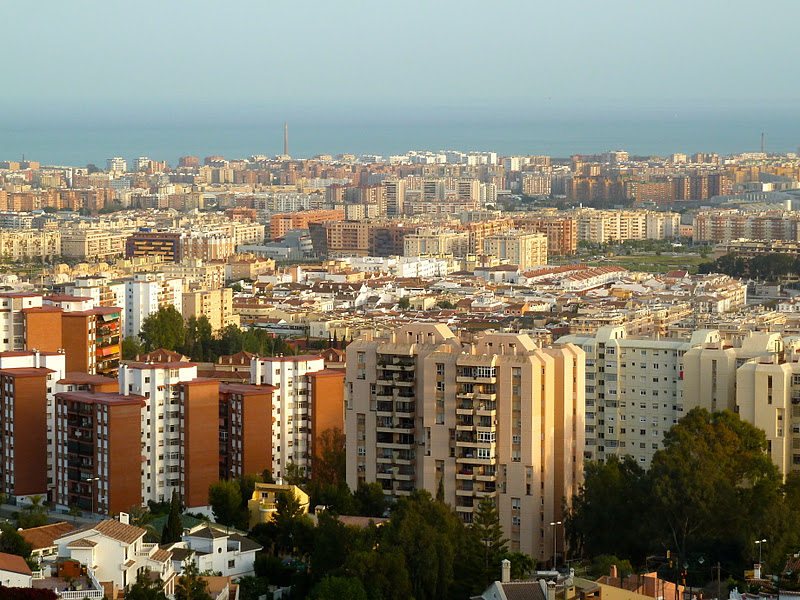
Malaga


Sunday, 10 April 2011

Cordoba

Mezquita - the Great Mosque

We drove from Seville to Cordoba on a Saturday morning for the second stage of our Andalucian tour.  The exit from Seville was no easier than the arrival had been and we did a lap of the city before hitting the Urbana Norte and road to Cordoba. By perchance we were able to pass the amazing bridges and modern architecture that are the legacy of Expo 1992. It made us realise that public transport is definitely the way to travel to and from Seville. 

We stopped at the sleepy town of Almodovar during the journey, which allowed us to see a Moorish fort and have a drink in a local cafe where serious dominoes were being played. Cordoba was not far and we were there in the early afternoon, finding accommodation in a small family-run hotel near the city centre. We dropped our bags and took to the streets and we were instantly captivated by the narrow pedestrianised area of Juderia.

Tapas and sherry in a small wine bar seemed a good way to start the excursion and for the next three hours, we walked around fascinating areas around the Mezquita. We returned to the city centre which was dominated by chain stores and lacked the charm of Seville. An evening meal in a rooftop restaurant in Juderia was a perfect end to the day and the only downside was the arrival of rain and head cold which meant a restless night. The next morning looked like any Sunday morning in the UK, with wet streets and people staying indoors.  We had the place to ourselves and after breakfast, we went to the equestrian show in the Royal Stables.  It was surprisingly entertaining but as we left the heavens opened and for the first time since arriving in Andalusia we retired to the hotel to read.

Despite being a World Heritage Site and contender for the European City of Culture, Cordoba lacked the vitality and edge that was so evident in Seville but an evening meal in a bar near the university confirmed the impression that this was a safe and pleasant place to live or to study.  We visited a Moroccan tea house late in the evening and walked back at midnight through the empty rainswept streets.  The next morning we visited the Mezquita first thing and were amongst the first visitors, it was a strange experience to find a cathedral erected in the middle of the massive impressive Mosque.  This was our lasting impression of Cordoba before we headed south through the impressive countryside before the Sierra Nevada and then Grenada hove into view.

Cathedral in the Mosque

Juderia


Ole

Andalusian Equestrian Show in the Royal Stables


Saturday, 9 April 2011

Seville

Seville - streets decorated with orange trees and infused with their blossom 

I am of that generation that put Spain off-limits, and until this trip, I had never been to mainland Spain unless Catalonia is included.  My father had spent 5 years in the Eighth Army fighting fascism and regarded Spain as unfinished business with Franco still operating as a dictator until 1975.  As a result, we never went to Spain during the 1960s, nor indeed to any other country because we could not afford to, but if we could, Spain would have been at the bottom of the list. It is curious how these memories came back to me when we arranged at the last minute to spend 8 days in Andalucia. When I went to Catalonia about 9 years ago, I was inspired by Orwell's 'Homage to Catalonia' and by positive memories of the 1992 Olympic Games in Barcelona.

Arriving at Malaga without a map was a mistake that I seldom make and the car hire people did not provide one either.  We decided to take the coastal road along the Costa del Sol before heading through the mountains to Seville.  Despite all the tour brochures that I had studiously avoided over the years, I had not anticipated the 'Touropolis' that unfurled as we shuffled our way into Torremolinos and made for the nearest bookshop.  I needed a map; it was an excuse to spend half an hour in this mecca of the package holiday.  Breakfasts were in full swing, the sun was glistening on the lotioned foreheads of the Brit pack, but the streets were clean and tidy and the sea was empty of bathers - it was still March. 

Back on the road, I travelled through Benalmadena, Fuengirola and several other resorts before carefully circumnavigating Marbella. I had no intentions of engaging with the Russian mafia, East End gangsters, Saudi Arabian millionaires or the drug cartels importing from Morocco. Malaga looked like 'Florida on the Med' and, according to the guidebook, was built on corruption, property speculation and right-wing politics. We headed into the hills and quickly climbed to 1000 metres in the Serrania de Ronda and then descended through the dazzling countryside to Ronda itself.

Ronda is a town built and protected by a steep river gorge.  It looks out over the lavishly coloured landscapes that regale the traveller at this time of the year.  We had a perfect lunch in a plaza near the town hall, with fresh orange juice, olives and gazpacho soup and coffee. At the end of the meal, the astute waitress informed us that the police would be booking parked cars in five minutes and bid us on our way- the first of many hospitable acts during our stay.  

The drive to Seville was over roads that progressively became straighter, wider and more densely trafficked as we neared Seville. Negotiating our way to the city centre and the Barrio of Santa Cruz, the pedestrianised zone, was a game of snakes and ladders until we eventually dumped the car in an underground car park for three days and walked the last few hundred metres to our apartment.  The train would have been a more appropriate transport from the airport to Seville, but we would have missed the once-in-a-lifetime chance to pass through Torremolinos and the chance to bypass Marbella.

Within half an hour of arriving in Seville, we had found a local bar and beer and tapas were taken in a sun-kissed plaza. They revived our spirits and made the excursion along the Costa seem a distant nightmare.  We meandered around the pedestrianised streets, enjoying the relaxed atmosphere and the independent shops showing their goods in resplendent displays. The centre was free of the standardised chain stores that have made shopping in Britain such a 'to be avoided pastime'.  We enjoyed the choir of happy noise emerging from Plaza del Salvador, where thousands of young Spaniards meet and talk and drink and behave.  Seville was a place to relax and enjoy the hospitality and atmosphere of a real city.

The next day was glorious, and it reached 28°C. Following a long walk around the superb public realm, admiring the quiet trams, the quality of the pavements, open spaces, street furniture and open-air entertainment, we visited the cathedral and had a leisurely lunch in the sort of cafe that is still a rarity in Britain. We visited the bull ring, which hosted a wonderful collection of paintings, including Goya line drawings of bullfighting. The city had clearly benefited from Felipe Gonzales's time as Prime Minister with fast trains, an Expo world fair and some humdinger bridges.  We walked along the esplanades alongside the Rio Guadalquivir and enjoyed the easy pace of life that infected the city.  

In the evening, after early drinks, it was off to see Flamenco dance, guitar and song in the museum and then we had a late meal as most Spaniards do.  The following day saw us visit the Alcazar Palace with its breathtaking gardens and patios, we took a siesta, sunbathed on the apartment roof and just allowed ourselves to float in the current of life that makes Seville tick.  Unlike the Costas, Seville has been nurtured as a modern city, respecting its history but exploiting quality urban design and providing a totally people-friendly environment.  I would happily return to this city, but not in the searing heat of summer.

Serrania de Ronda

Ronda landscapes and dayglo colours

Seville Cathedral 

View from Giralda

Plaza de Toros

Toros

Flamenco Guitar

Flamenco Dancing

Plaza Salvador - Seville's civilised meet market

Cathedral and Giralda

Alcazar ceiling