Showing posts with label United States. Show all posts

Wednesday, 17 June 2026

Four Score Years and then?


The days of our years are threescore years and ten; and if by reason of strength they be fourscore years, ... their strength, labour and sorrow... is soon cut off, and we fly away. Psalm 90:10 KJV

FIFA Peace Prize: Art of the Deal
The self-appointed boss of the world reached four score years at the weekend by reason of some shady deals. He celebrated his birthday, whilst commemorating, or should that be demeaning, the 250th birthday of the United States with cage fighting on the White House Lawn with invites to his acolytes and accomplices.

He then flew to the G7 summit in France, where he claimed credit for stopping the war he started with Iran and re-opening the Straits of Hormuz to world shipping and signing a Memorandum of Understanding with Iran in the Palace of Versailles. His ego, as ever, was floating on the helium of trash-talking and his boast of another Peace deal was posted with his usual metronomic contradictions on Truth Social. 

Destitution

Since taking up his second term of office, he has reduced the United States' contribution to United Nations Aid from $14.1billion to $3.38billion. and withdrawn funding to 66 international organisations. At home, the Institute for Policy Studies estimates that through his Big Ugly Bill, he has made cuts of $73billion to Medicaid and heating and food support for low-income families, children and the homeless.

War

His expenditure on the wars he has executed in Venezuela and Iran has led to a 42% increase in war spending to $1.5 trillion. There have been no new aid bills to support Ukraine since he began his second term as President. $127 billion had been provided until then, but since there has been just a $ 20 billion loan for European NATO members to procure and provide American weapons to Ukraine. Since 2023, Israel has also received $16.3 billion in direct military aid for the war in Gaza. The underlying principle of most military aid is that it should be used to procure weapons, equipment and training from American firms or the stockpile of US weapons. Arguably, the American arms manufacturers are the largest beneficiaries of the Big Ugly Bill.

Peace

A Peace Prize was gifted to the President by FIFA president Gianni Infantino for making the world a safer place. A consolation for not receiving the Nobel Peace Prize from those woke Scandinavians. They had realised that there was not much peace breaking out in the countries where the 47th President of the USA had done deals. Ukraine, Gaza, Iran, Lebanon, Venezuela, Syria, Somalia, and Yemen were still in active conflict, and Cuba and Greenland were in the waiting room for his next tranche of peacemaking.

We can only hope that Psalm 90:10 comes to pass. And then?

Signing the Iran Peace Deal in the Palace of  Versailles


Monday, 29 September 2025

United States versus Europe

Dream On

I am not a great follower of golf; it takes too much time, doesn't provide much cardio exercise and it was too expensive when I spent a couple of years playing in the 1970s before the family arrived. However, I watched the current Ryder Cup event in the United States with a genuine excitement. The European golfers, drawn from Scandinavian countries, Britain, Ireland, Spain, and Austria, trounced the American team and their aggressively loud supporters, particularly on day one when President Trump was there to celebrate American greatness.

The 15 -13 result for the Europeans reflected the different attributes of the two teams. In the foursomes and four-ball matches, where team spirit counts, the European team established an 11.5 to 4.5 lead. In the individual matches, the Americans' thirst for hero status brought them back as they achieved an 8.5 to 3.5 victory.  Since the Europeans first became involved in the Ryder Cup in 1979, they have established a 13 to 9 victory over the Americans.

It made me reflect that my generation of baby boomers has grown up in a world where America was regarded as the top dog in everything - GDP, weapons, wealth, philanthropy, aeroplanes, consumer products, income levels, and new technology. And all of this was celebrated by a film industry that infiltrated and entertained the world and created the American dream. This year, the United States has lost much of this respect as it has cut international aid, withdrawn from international bodies, vetoed peacekeeping proposals at the United Nations, introduced arbitrary trade tariffs, threatened to take over some countries and failed to end conflicts in Gaza and Ukraine. The retreat of the USA into isolation and its withdrawal from international bodies has tarnished its reputation across the world. It should prompt a wider examination of whether Europe has been living on a misinformed assumption that the United States is any longer all-powerful. 

If we thought of Europe as federations of states, which they increasingly are, and draw comparisons with the United States, the perceived power and dominance of the USA would be far less convincing than it was in the latter half of the last century. Here are some useful comparisons.


The United States has a population of 347.275 million 
Europe has a population of 744,398 million, excluding Turkey

The United States had a GDP of $30,507 trillion in 2024
Europe had a GDP of $25,323tn trillion in 2024

As a matter of comparison, China had a GDP of $19,231 trillion and Russia $2076 trillion

If we look at the performance at the last Olympic Games in 2024, the medal table would read:

                               Gold.         Silver    Bronze

Europe                     119            121        151

United States             40             44           42

Europe, with twice the population, won three times as many medals

Or take Tennis, a sport that the United States dominated in the last century

Grand Slam winners since 2000

                            Men.    Women

Europe                  88          41
United States          6          38

And in the world's most popular sport, football, the United States is a mere minnow at the men's game, only notable for hosting the event three times, including next year.  Conversely, the women are the most successful team, winning the World Cup 4 times since its inception.

What does this tell us? Well, we have probably been duped into believing the United States always calls the shots and that we should do its bidding. When FDR Roosevelt was in his pomp, driving forward progress and seeking to establish an international order, this was a justifiable stance, particularly for Europe. Times have changed. Make Europe Great Again. (Mega)

Europe wins Ryder Cup again (13-9)

Monday, 25 August 2025

Time to reset the United Nations

When we hear the Foreign Secretary, David Lammy, say he is horrified about what is happening in Gaza, we realise that the UK is a busted flush. He has been uttering similar sentiments for quite a while, but he has not even had the temerity to stop the sale of weapons to Israel or to call out the Israeli Government for genocide. Unlike the former Supreme Court Judge, Lord Sumption, who made a methodical justification of Genocide in Gaza or the International Association of Genocide Scholars, who state that the death of 65,000 people during the 22-month-long war meets the legal definition laid out in the UN Convention on genocide. This follows similar statements by two Israeli human rights organisations.

Meanwhile, the United Nations Relief and Works Agency, which has 15,000 staff in Palestine, has been prevented from providing humanitarian aid to Gaza, including medicines, since the second of March 2025. The Secretary General of the United Nations, Antonio Gutierrez, has made it clear that Israel is acting beyond its powers and that this is the first occasion that any country has suspended operations of the United Nations organisations. This raises the wider question about how the United Nations is able to make decisions and how it is perceived in the world in 2025. Things have changed dramatically since the arrival of Donald Trump as the President for his second term. He clearly has no time for the United Nations and has made it evident that he is the supreme power in determining what action should be taken in the world's trouble spots. 

This is made possible by the constitution of the United Nations, which established a Supreme Council with the United States, Russia, Great Britain, France and China as the permanent members.. They have veto rights to prevent UN actions. This may have been appropriate at the end of the Second World War when the United Nations was formed, but with 193 countries signed up to the United Nations charter (see below) and the growth of member nations over the years, the question has to be asked: why do these five countries have the ability to prevent actions from being taken? This has been to Israel's benefit, which is a member of the United Nations and receives unbridled support from the United States. Unlike Palestine, which has been refused entry, its delegates are allowed only as observers. The United States is now refusing to let them enter the country, which is the administrative HQ of the UN. 

This is the second occasion that the United States has scuppered a worldwide peacekeeping organisation. Previously, it was largely responsible for the demise of the League of Nations, which was established in 1919 by the Treaty of Versailles following the First World War. Woodrow Wilson, President of the United States, was a key player in its formation but failed to gain ratification from the Republicans in the Senate. The thirty-two nations that joined the League of Nations, which was headquartered in Geneva, depended on member states to provide peacekeeping forces. These were difficult to mobilise without the resources of the United States,. Great Britain and France, the other leading nations in it’s creation were struggling to recover from the Great War. As a result, the League of Nations was unable to prevent the violation of its rules by fascist regimes in Japan and Italy, which invaded Manchuria and Ethiopia, respectively. Hitler's Germany invaded over twenty countries, and the  USSR invaded Finland.  The major powers did not have the inclination to challenge these violations and instead began to rearm as the  Second World War became inevitable.

It would appear that President Trump has no desire for the United States to facilitate action by the United Nations and has used its veto with increasing impunity. It has withdrawn from the World Health Organisation, the UN Human Rights Council, the UN Educational, Scientific and Cultural Organisation (UNESCO) and reduced foreign aid to UN agencies on the assertion that they are not in the United States' national interest.

Equally, Russia and China have used their veto to prevent UN interventions in countries that could be considered their satellites. Great Britain and France are there for their historical reasons, and until recently have tended to support the United States' lead. The United Nations has not reviewed its charter since 1973, since when the world has changed dramatically. There are currently 61 active conflicts, the most since 1946 and over 60,000 peacekeepers are deployed from 115 member states. In light of current conflicts in Gaza and Ukraine and the withdrawal of involvement by the United States, several questions must be asked:

  • Why is the United Nations still located in the United States, a country that is shameless in protecting its own self interest ? 
  • Should it not be located in a more neutral and stable country, which is less concerned about its own power and more concerned about securing peace across the world? 
  • Why should five countries have a veto? 
  • Should it not be for the Security Council, currently 15 countries, to pass motions with a two-thirds majority?
  • Should the composition of the Security Council be expanded to ten permanent members, with the additional 5 representations coming from South America, Africa, the Middle East, Asia and Oceania? Together with ten rotating members, this would create a Security Council of 20 members, none with a veto.
  • Is there any reason to exclude Palestine from membership?

The Purposes of the United Nations are:
  1. To maintain international peace and security, and to that end: to take effective collective measures for the prevention and removal of threats to the peace, and for the suppression of acts of aggression or other breaches of the peace, and to bring about by peaceful means, and in conformity with the principles of justice and international law, adjustment or settlement of international disputes or situations which might lead to a breach of the peace;
  2. To develop friendly relations among nations based on respect for the principle of equal rights and self-determination of peoples, and to take other appropriate measures to strengthen universal peace;
  3. To achieve international co-operation in solving international problems of an economic, social, cultural, or humanitarian character, and in promoting and encouraging respect for human rights and for fundamental freedoms for all without distinction as to race, sex, language, or religion; and
  4. To be a centre for harmonising the actions of nations in the attainment of these common ends.

Wednesday, 7 May 2025

A Really Useful Idiot


"Give me your tired, your poor and huddled masses, and find a haven, banishing all fear.
"
Trumpism started with the Tea Party.

American hegemony had gone too far. They had been the de facto winners of the Second World War. Roosevelt had provided the supplies and equipment, the Doughboys came to the rescue of a fractious Europe and Marshall Aid was supplied for its rebuilding. The USA halted the spread of communism beyond East Germany and in Asia and the Americas, with some notable exceptions. They became the home base of global institutions, including the United Nations, NATO, the World Bank, and the IMF. They consolidated and celebrated their influence with nuclear weapons, movies, advertisements, fins on their automobiles, skyscrapers, junk food and damaging chemicals. They were doused in dollars, oil and bumper crops. The wealthy became wealthier, and ambitious migrants from Europe, Asia and the Americas boosted their talent pool. 

The rest of the world lapped up the fairy story. It allowed the USA to exploit the natural resources of other nations and take over their companies. American products, from planes and weapons to fast food, fizzy drinks and domestic appliances, were foisted on the world along with a glamorous narrative of a nation too good to be true. The United States were not colonialist in pursuit of an empire; that was old hat, they were buying their way into exploiting the resources and the economic growth of what they regarded as their domain, the free world.

They had their comeuppance in Korea, Vietnam, and parts of Central and South America, and this created a scintilla of doubt amongst the radicalised young in the 1960s and 1970s. But the USA was high on self-belief and had charismatic political and business leaders who assumed global leadership, never more so than when Gorbachov ceded the freedom of the Soviet republics and the creation of democracies in new nations that were former republics.

Things turned sticky in the Middle East as oil-rich autocratic nations began to exercise their wealth, and George Bush, father and son, took military action in Iraq and Afghanistan. It didn't end well, and they had harangued other Western countries to reluctantly support the invasions. The patina of American power began to lose its sheen, but the USA still retained its reputation as the alpha country in the free world. Trump 1.0 muddled through with the MAGA base kept in check by the grown-ups in the administration. However, the rehearsal had convinced Trump that he did not need advisers or seasoned politicians; what he needed were amateurs and fellow travellers to parody a government while he played out his fantasies and took corruption to the next level. The fact that 75 million voters had endorsed his second term gave him the power to follow his fundamental instincts.

His second coming started with a momentum that was meant to shock and awe the rest of the world. Previous policies and agreements were shredded, diplomacy was derided, felons were released from jail, and tariffs were hiked to levels that left the rest of the world wincing and pleading for clemency. He acted as if he was all-powerful, and world leaders responded accordingly. But some leaders baulked at the idiocy of Trump's gameplay, which had gone too far. Canada and Mexico challenged him. They were supported by their angry citizens and businesses, who boycotted American goods. This mood was echoed and copied around the world as Trump threatened to take over Greenland and Panama, make Canada the 51st state, rename the Gulf of Mexico, suggest the USA should take over Gaza for real estate development, humiliate President Zelensky, give license to Vice President Vance to insult Europe and the Pope on his death bed, withdraw from the Climate Change agreement and no longer provide refuge for immigrants who now fear being banished to distant lands. The United States has forsaken the Statue of Liberty's Call as "a place of hope, beyond compare."  

The worm had turned. Canada's Prime Ministers Trudeau and then Mark Carney both called him out. China did not flinch and retaliated with equally severe tariffs on American goods. The American Finance sector was faithful to Mammon, and the Bond market collapsed. Harvard University sued Trump over his withdrawal of research funding. Elon Musk, Trump's Tonto, had had enough; his businesses were in freefall, and he had become a derided figure of fun as he closed down government departments and agencies with the deftness of a SpaceX rocket exploding on takeoff. Trump had taken the red pill and was still in Wonderland."All persons more than a mile high to leave the court" seemed a suitable epitaph for Musk's time in government.

The shackles that had bound Western nations to the USA in its pomp were broken. Elections in Canada and Australia returned anti-Trump candidates, who months earlier had been facing defeat. China took a long-term view and began trade negotiations with other countries that had been hammered by Trump's Tariff proposals. The European Union was united in its opposition to Trump, who, never one to admit mistakes, was beginning to row back on his proposals, claiming they were part of his deal-making strategy. 

The disruption that Trump had inflicted on the world had backfired; the umbilical cord to the USA had been severed. We are moving to a New World Order. Trump has been a Really Useful Idiot.

Chevrolet Impala with Fins - functionally useless

Musk and Tesla - vanquished tropes

Tuesday, 15 April 2025

Blue Origin

Blue Origin's Magnificent Seven Up

As if 2025 hadn't caused enough damage to the global commonweal, we have witnessed another utterly bizarre world event. Seven starry-eyed celebrities popped up into the higher layers of the atmosphere in a Jeff Bezos Blue Origin capsule fired from his Texas launchpad to claim that they were astronauts. It was like watching a social media revamp of Monsieur Hulot's Holiday. Unfortuanately, the dialogue of the hapless seven lacked either the intelligence or self awareness to make it a parody. M. Hulot created chaos by opening the hotel door to let in a stiff breeze, it was pity that the Jeff''s Angels didn't open the capsule door to get a better view of the moon and become the first space asylum seekers.

Blue Origin is an Amazon funded space tourism project that costs at least £150,000 for the ten-minute ride to 100km above the Earth and back. About the same time as you get on the Star Wars Hyperspace ride at Eurodisney, but without the queue. The impact of Blue Origin flights on the ozone layer by the creation of Nitrous Oxide in the atmosphere and the release of water vapour in the upper atmosphere is hugely damaging to mother Earth. But Bezos is a rocket billionaire, a philistine philanthropist who is fulfilling the destructive powers of Amazon.

The Bonzo Dog Doo-dah Band sent up the space race so much better and cheaper in 1968 with their only hit single, "I'm the Urban Spaceman," on the Liberty label. They saw it as a Dadaist prank, a reference to the Apollo rocket launches. They even claimed the hit record was produced by Apollo C. Vermouth although it was produced by Paul McCartney. It was a spoof on the vacuous consumerism and space obsession in the summer of love. Even the lyrics say that the urban spaceman doesn't exist in real life. Unlike the urban spaceman, these celebrity wannabees exist, and with an elevated sense of entitlement. Letting them spaff their wealth and accelerate climate change on a glorified fairground ride is an Amazon Crime, yet another reason I am glad to have junked Amazon Prime.


Saturday, 19 October 2024

Podcasts: The Rest is Politics US


Two years ago, podcasts were an unknown medium to me. Today, I listen to more podcasts than I watch television. I began with the odd football podcast then discovered specialist ones that covered topics on the environment, politics and world affairs. These subjects are only cursorily dealt with by news programmes that are bloated with the affairs of celebrities. I then discovered the-rest-is-politics with Rory Stewart and Alistair Campbell, two political thinkers who have an incredible knowledge of the world as well as UK politics. They also tap into their network of contacts of eminent leaders from politics to AI for in-depth interviews on the leading podcast. Although Campbell and Stewart had been at the heart of the Blair/Brown and Cameron/May governments respectively, they paired up and discovered that they agreed on many issues, and if not they would disagree agreeably. What a game changer from the Punch and Judy politics served by Parliament and fired at us by many of our newspapers and much of our social media.

I have just listened to the latest episode of the sister podcast by Katty Kay and Anthony Scaramucci, the rest is politics US, which captivated my interest. As always it provides a ringside commentary on the flaws, fantasies and fortunes of the two polar opposite candidates in the American Presidential Election. It pitches an intelligent, humane black woman against a rich, misogynist, non-apologist white man. Despite Scaramucci being a lifelong Republican, and Kay being brought up in the BBC balanced reporting code, there is no doubt which of the candidates they don't want to win. They have just completed a UK tour of Birmingham, Glasgow, Cardiff and London debating the issues and answering questions. They attracted an audience of 13,000 at an event in the O2 arena in London.  They are a compelling listen and have deep insights into the American Presidential election campaign. It was a stroke of genius to bring these two exceptional characters together. 

Katty Kay with her cut-glass English accent and Swiss citizenship has lived and worked in the United States for 30 years as a journalist with the BBC but with far more strings to her impressive career. Her knowledge and network of contacts in American politics are wide and close to the candidates. She curates and reports their comments in an articulate and disciplined manner. She has encyclopedic inside knowledge of the election process having covered the last six Presidential elections. 

Anthony Scaramucci is a financier who famously became Donald Trump's Director of Communications when he became president but lasted only 10 days before resigning in despair at Trump's self-absorbed chaotic style of governing. Scaramucci comes from a New York Italian background and has a colourful way with words. His analysis is strewn with a zinging vocabulary and a minestrone of metaphors. It ensures a lively dialogue with the word-perfect explanations of Katty Kay. Their chemistry is potent, Scaramucci is clearly enthralled by Kay's intelligence and posh English breeding. Like Rory Stewart and Alistair Campbell, who invited them to do the US version of 'the rest is politics', they listen to each other's views and have adopted the maxim to disagree agreeably, which is not that often.

They also know how to engage and ensnare their audiences. Scaramucci confesses that the weeklong tour of UK cities was the most flattering and inspiring thing he had ever done in his rollercoaster of a career. Katty Kay was greatly touched by the enthusiasm of UK audiences and their granular knowledge of American Politics. As the day of reckoning approaches, this is the podcast to listen to. It is much better informed and entertaining than the alternative podcasts focusing on the American Presidential Election. The News Agents podcast with ex-BBC presenters, Emily Mattis and  John Sopel, and the BBC Americast podcast with the BBC ex and present Washington correspondents, Justin Webb and Sarah Smith were my goto ways of keeping abreast with American podcasts but they seem a bit lame by comparison.

Katty Kay is on the ball when she describes the election as causing global trepidation. Polls are predicting that Trump is 16% ahead of Harris with American men. I'm with the women and Katty and Anthony but Trump may have tuned into the zeitgeist of the American voters.


Monday, 15 February 2021

To Impeach or Not Impeach

The Rise and Fall of American Presidents

The people -- the people -- are the rightful masters of both congresses, and courts -- not to overthrow the constitution, but to overthrow the men who pervert it. Abraham Lincoln

The impeachment trial in the American Senate had been playing out all week and, when I heard on the lunchtime news that a decision was imminent, I switched over to CNN to watch the vote on the impeachment of former President Trump. I had not seen much of the trial over the previous four days and wanted to see how the Senate conducted itself in taking such a momentous decision. Here was the chance to follow another of Lincoln's maxims. 'The ballot is stronger than the bullet.'

It was expected that the Senate would fail to get a two-thirds majority to impeach the President and therefore reject the evidence of the attack on Congress by the MAGA mob. I was surprised therefore to find that the Senate had voted to subpoena witnesses following a CNN report that a Republican Senator, Jaime Herrera Beutler, had released details of a heated conversation between the former President and the Republican Minority Leader, Kevin McCarthy. McCarthy had called then-President Trump on 6 January and asked him to call off the riot. Trump had replied that it was Antifa that had breached the Capitol and then contradicted himself by saying "Well. Kevin, I guess that these people are more upset about the election than you are." It seemed very likely that if Senator Beutler gave evidence the Republican Leader would have to confirm or otherwise the veracity of her description of events.

After a 2 hour break for negotiations between the parties to decide how to proceed, it was a travesty that the Democrats merely agreed to put this statement on record. They did not insist on hearing from any witnesses. The Presiding Officer, Senator Patrick Leahy, who had taken on the responsibility of chairing the trial after the Chief Justice declined to preside because Trump was no longer president, was perplexed and confused by the procedures. The five clerks advising him were like headless chickens and seemed unable to provide him with clear advice. The Democratic party managers had decided to throw in the towel rather than pursue a series of witness interrogations? These would undoubtedly have put Kevin McCarthy in the unenviable position of having to authenticate his conversation with ex-President Trump on 6 January.

Why was this, were they really so determined to get away on their week's holiday - apparently planes were already booked for the exodus? The other reason speculated was that it would take too much time to call and prepare witnesses and this would disrupt the Senate when it needed to focus on President Biden's agenda to get America moving again. Whatever had been the reason, it certainly wasn't a determination to unearth the real facts, admittedly a rare commodity in the time of Trump. 

The final act was to hear the summing up of the trial. The Democrat's Lead Manager, Jamie Rankin, and his team argued that Trump had incited the insurrection and had failed to care about the safety of Senators as was evident in the former President's words to Kevin McCarthy. Michael van der Veen made a preposterous defence, arguing that nothing Trump said "could ever be construed as encouraging or sanctioning an insurrection," and that it was part of an "unhinged pursuit of a long-standing political vendetta against Trump."

The vote for guilty was 57 to 43, well short of the two-thirds majority required for impeachment. Minority leader, Mitch McConnell, who had voted against impeachment then made a speech that accused former President Trump of "a disgraceful dereliction of duty." "There is no question that President Trump is practically and morally responsible for the events of that day." Too late Mitch, you had already hitched your wagon to the opposite view. The whole episode in the Senate seemed mired in hypocrisy. Here is the evidence of why the self-proclaimed "great" American Constitution has not been copied by any other democratic nation. 

It was left to Republican Senators Bill Cassidy and Susan Collins to remind fellow Senators that "the Constitution is more important than any one person" and that Trump had "incited an insurrection with the purpose of preventing the transfer of power from occurring." Abraham Lincoln would have approved of their summary but he would have been very disappointed in the decision of the Senate to deny the people the real facts.

I am a firm believer in the people. If given the truth, they can be depended upon to meet any national crisis. The great point is to bring them the real facts. 
"I think Abraham Lincoln said that" Bob Dylan

Sunday, 31 May 2020

American Carnage


Twin City carnage
"This American carnage stops right here and stops right now." Donald Trump Inauguration Speech, 20 January 2017.

Fake news is what he would call it if delivered by any other commentator but as the stench of the fires and fury following the Minneapolis murder percolate through the United States, there is that moment when the citizens of America can finally say, "Gotcha".

Like many others, I had doubted that someone with such a loose understanding of ethics and so lacking in humanity or empathy as Donald Trump could survive more than two years. I also hoped that the damage he wreaked might be possible to rectify, although not by Vice President Mike Pence. The United States still had a reputation as "the land of the free", although its failure to address inequalities, the dominant force of its global corporations, its interference in foreign affairs, and the sale of weapons to autocratic regimes were all corroding the goodwill from many nations. Trump's time in office has simply turbo charged these characteristics and the increasingly dysfunctional constitution has made America not 'Great Again' but generated an antipathy from citizens around the world as well as undermining global institutions such as the United Nations, the World Health Organisation and the Intergovernmental Panel on Climate Change.

In the years since Trump's election, I have been gratified by that noblest of gestures by many Americans that I have met in the UK or when on holiday in France and Italy. They have apologised for their President and spoken with a refreshing frankness about the rancour that exists in their beloved country. I feel privileged to have enjoyed its remarkable landscapes and witnessed the scale of human endeavour in the States but it is not somewhere that I would contemplate visiting again as it trashes its environment, violates the dignity of many of its citizens, encourages more firearms and worships Mammon, whilst hiding behind a mask of Christianity.

As ever, the hope for some restitution lies in the good sense of many of its states, cities and counties when they are empowered to act independently from the behemoths of the American Constitution. Many of them have shown an understanding of Coronavirus that eludes the warped mindset of the President and his followers. In the past we have been assured that the American Constitution would provide the checks on the power of the President; that myth has been exploded by President Trump. It is time to eliminate the stranglehold of Corporate America and their lobbyists who have furloughed democracy by bankrolling the elections of the President, Congress and Senate. This charade of sponsored federal elections demeans and diminishes the democratic rights of its citizens.

Apocalypse Now in Minneapolis

Thursday, 18 September 2014

New York

Alice in Wonderland sculpture in Central Park

Central Park Reservoir looking east to Manhattan

View from the Staten Island Ferry

World Trade Center

Memorial Plaza at the World Trade Center

High Line Apartments

Scaffolding Art

Brooklyn Bridge

UN building from the Empire State Building


Chrysler Building

Cezanne cut-outs

Bryant Park

Times Square

These two were arrested shortly afterwards

Central Sation
After three weeks on the road, New York was to be our time to relax before the flight home, but that is not easily done in New York. Even getting from Newark Airport to the hotel took two and a half hours on the hotel bus, which was a travesty of integrated transport. Then the perfectly located hotel on Sixth Avenue charged prices that we would have expected to include the internet and a decent breakfast, but these were additional items.

There is no sense in describing all our activities in New York; we charged around places we had not visited previously and doubled up on the Museum of Modern Art and the Empire State Building. The highlights were the free ferry to Staten Island with its superb views of the Manhattan skyline, the community-managed High Line walkway through the former meatpacking district on the Lower West Side, and the Jeff Koons Retrospective exhibition at the Whitney Museum of American Art. We had walks, and I had morning runs around Central Park and breakfast at a local Greek diner on Sixth Avenue. We admired the rectangular solidity of Central Station and visited Lower Manhattan. The scene of the 9/11 tragedy was overpowering.

We had a long conversation about the pending Scottish Independence referendum with an Italian/Brazilian who was now resident in New York. He couldn't understand the purpose of the vote, as Scotland and the UK were perceived as mutually integrated by the rest of the world. He admonished us for defending the right to a ballot and said it would be hugely damaging for Scotland, the UK and the world if there were to be a Yes vote. This opinion was echoed by several other Americans we spoke to during our trip.

Like everyone else who visits New York, we found the prices high and relaxation difficult. The magic of the first visit in 1996 with our children was no longer there. We walked miles, as the taxis were slower than walking; they were the reason for and the victims of gridlock. They had to do twice the distance to stand still, as Alice might have told them, owing to the one-way systems. New York is a game designed to make everything seem bigger, slower and more expensive than it really is. No wonder Donald Trump has his tower there.

I calculated based on our trip that you could get two weeks in Wyoming, and that included the hire of a car and 1500 miles, for the price of 4 days in New York. The guy in the Apple Store who sold me an iPad agreed, but he was waiting for his wife to retire before they decamped to Wyoming. He reckoned that he could get all the entertainment stuff he wanted online or from the memories of a life spent in the city, and what he really wanted was the physical and mental stimulation of the great outdoors. We agreed, and he managed to save me $100 on the iPad that I was going to buy. It was 8:30am on a Sunday morning; he said it would buy us lunch, and he was just about right.

Much as I enjoy visiting cities, the numbing effect of New York airports and transport systems, the lack of courtesy in diners and public attractions like the Guggenheim museum, together with the high tariffs for everything, would not persuade me to rush back to New York. This, even though we never managed to visit the superb Metropolitan Museum or obtain tickets for any of the shows we had wanted to see.

Wednesday, 17 September 2014

Colorado


Mesa Verde, cliff dwellings

Mesa Verde


Leaving Mesa Verde as the storm rolls in

Backlit by lightning

Micro Brewery in Durango

Downtown Durango

Letting off steam in Silverton

Durango train steam into Silverton

Well, you're the lucky one, we all wanted to be engine drivers

Silverton 

The Rockies from the Million Dollar Highway to Ouray

Garden of the Gods, Colorado Springs

Surely Banksie hasn't got this far, Colorado City

I persuaded a gullible Texan to help me topple the balancing rock

Came across this fellah on my morning run
Our Arts and Crafts B&B near Manitou Springs
Colorado is probably the state I had most wanted to visit on the road trip. It has it all: the Rockies with four national parks, skiing at Aspen, Vail, and Breckenridge, and it has the most active lifestyle in the USA with the commensurate healthiest population. The entire state is above 1000 metres, so an ideal environment for aerobic training. All this and a reputation for some of the best microbreweries and a fairly radical take on life. But after a couple of weeks in Utah and Wyoming, it seemed like an anti-climax returning to Colorado. A state which enjoys 300 days of sunshine a year, but was overcast and rainy for the five days we were there. We did not have a chance to witness the Rockies, which were lost in the clouds.  It still provided a grand tour and, if anything, increased my resolve for a more leisurely visit.

After leaving Moab, we headed south-east uncertain about our next destination. We had no accommodation booked and had decided to play it by ear. Should we drive to Arizona and visit Monument Valley and the Grand Canyon, which we visited a dozen years ago, or make for Mesa Verde instead? After breakfast in Moab, we decided that we would head down to the Needles section of Canyonlands and then maybe drive towards Four Corners, where the states of Utah, Colorado, Arizona and New Mexico meet. But on reflection, there would be nothing there but an intersection of lines of latitude and longitude on a map. Heavy storms were predicted for Arizona, so we decided to aim for Durango, on the basis that Bob Dylan had sung about it, and it seemed to have a lot of accommodation.

We emerged from Canyonlands as the heavens opened, and I took the forest road which climbed up to 10,000ft. It was like driving through a waterfall with no other vehicle on the roads and a soundtrack of whooshing wipers behind the distant claps of thunder. Eventually, we dropped down to Monticello, where we stopped for some gas and to buy coffee to calm our nerves. The road from here had more familiar landscapes of rolling countryside; no dramatic red sandstone cliffs or mountains, just small-town America. The road across to Cortez was bean-growing country with well-cultivated fields and long vistas into gentle landscapes.

Time was not on our side as we pulled up in Cortez at 4:30pm, I realised that it would be pushing it to visit Mesa Verde National Park, but the alternative would mean a return trip back from Durango of 90 miles if we left it until tomorrow. Fortunately, the Tourist office had lots of good advice, and they provided a map and highlighted all the points to stop on a 3-hour trip around the park. We then had a 40-minute drive to reach the park and a good 25 miles to the cliff dwellings, which are the central attraction. Mesa Verde translates into English as "green table", which is a good description, but there are some deep gorges that provide the sites for the cliff dwellings.

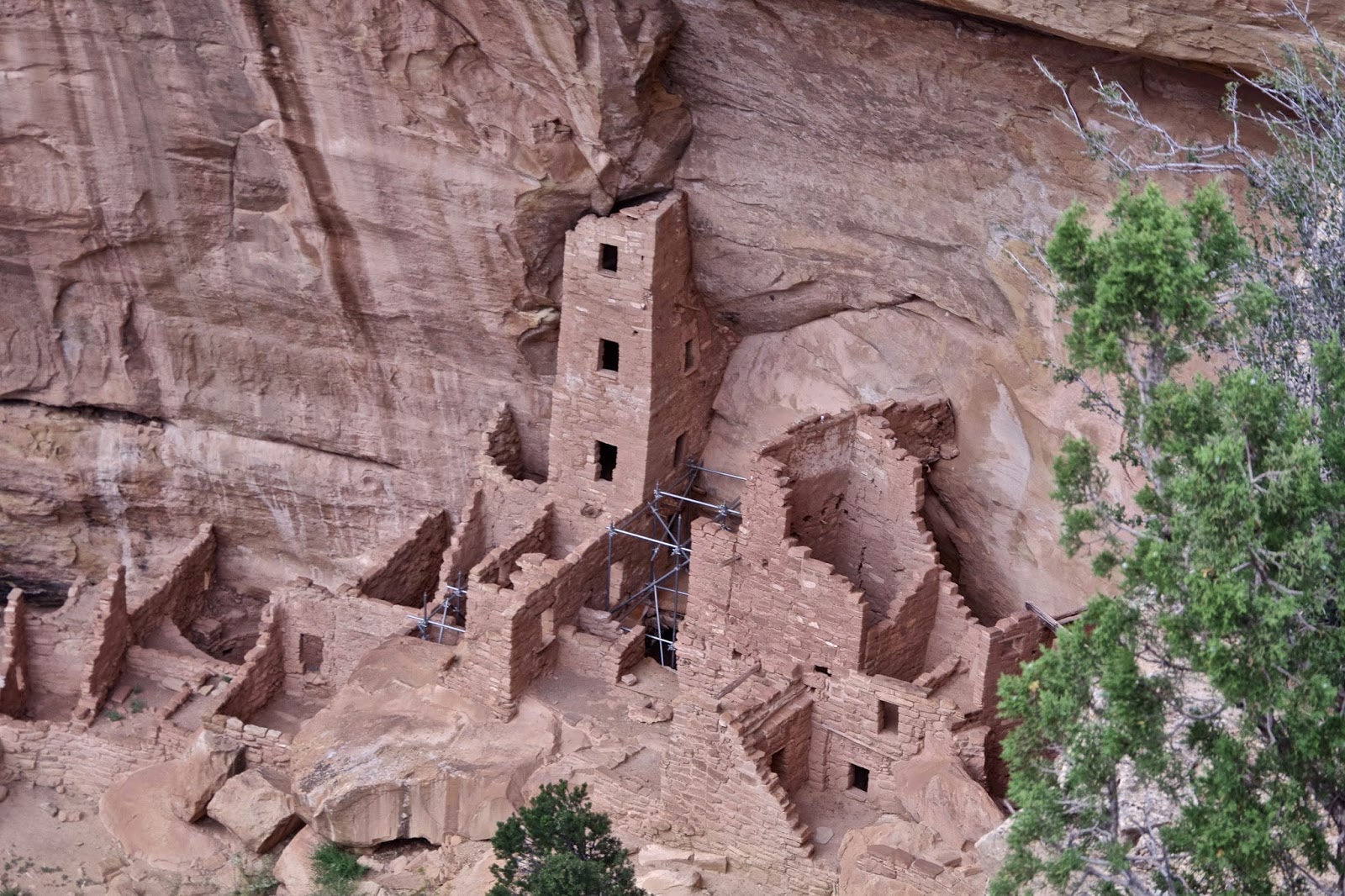
The climb up to the Mesa Verde plateau was like visiting a lost continent. We managed to take in all the important stop-offs; the advice from the tourist office had been apt and concise. Mesa Verde National Park is a UNESCO World Heritage Site. It is the largest archaeological preserve in the United States and was designated in 1906 by President Theodore Roosevelt to protect some of the best-preserved cliff dwellings in the world. It is small as National Parks go at just 81 square miles, but features numerous ruins of dwellings and villages built by the ancient Pueblo people or Anasazi. There are over 4000 archaeological sites and over 600 cliff dwellings.

The Anasazi inhabited Mesa Verde between 600 and 1300 AD. They were mainly subsistence farmers, growing crops on nearby plateaus or mesas. Their primary crop was corn, but the men were also hunters, which supplemented their food supply. By the year 750AD the people were building mesa-top villages made of adobe, and in the late 1190s, they began to build the cliff dwellings for which Mesa Verde is famous. These are structures built within caves and under outcroppings in cliffs - including Cliff Palace, the largest cliff dwelling in the USA. The mesa is now extensively forested and seems to have a microclimate of its own.

As we headed back, the skies darkened and we watched a thunderstorm pass to the north, the skies heaving and sparking with alarming power. We dropped down to the plain and drove the last 40 miles to Durango. For the first time on the trip, we were lost. I had driven pretty well to the hotel using the street grid as a guide, but we asked directions from a local and were sent across the river in a flow of traffic that included a psychopath in a truck behind me. He wanted to exceed the speed limit and for me to do the same. He cut me up, and we had angry words that detracted from the generally good experience of driving in the States. We had to retrace our steps to find the hotel, which was smack in the centre of the town, pretty well where we had been before being misdirected.

It was after 9pm as we headed out to find some food. A nearby diner Steamworks Brewing doubled as a bar and microbrewery and served good food and excellent craft beers. I got into a conversation about the beers, the blackboard gave the date of brewing, the alcoholic strength, the bitterness and darkness of each brew. I asked for an explanation of this system of classification and then chose the beer that would be nearest to my preferred style; the rules worked, and I enjoyed a pint of Third Eye pale ale. As we were about to leave at 11pm, the manager invited us to visit the brewery located in the heart of the throbbing establishment. It was strange to tour the facilities and hear about the source of barley and hops inside the glass walls that were surrounded by a large bar/diner. Over a hundred customers were enjoying the products of the brewery as they cheered on the Sunday night American football game that was being broadcast live.

By dint of taking in Mesa Verde the day before, we had some spare time and spent a couple of hours in the morning strolling around the vibrant town centre of Durango. It is a university and tourist town, so it has retained a semblance of prosperity that is missing in most town centres. We had been awakened in the hotel by the whistle of a steam train leaving for the excursion to Silverton, a steep climb into the heart of the Rockies. We decided to take the same route and were surprised at the elevation reached, 10,970ft, by the road over the Coal Bank and Molas passes. Aileen had her eyes closed as we climbed ever upwards on the highway with drops of 1500 feet on the passenger side and massive juggernauts coming down the hill and threatening our road space. The descent into Silverton was equally traumatic and prompted us to take a break in what is a semi-derelict tourist town.
As we arrived, the second steam train of the day was pulling in, and the couple of hundred passengers tumbled out to explore this former mining town that looked like a stage set for the Wild West. We made a tour of the remaining shops, had a coffee and filled up with gas before tackling the next stage of the highway through the Rockies. I asked at the gas station whether the road was as steep as the road from Durango, which had frightened my wife.  They laughed and explained that this was the really scary section and suggested that I blindfold Aileen for the next section. I didn't pass on this information, and a few miles up the road, she hunkered down and closed her eyes whilst we travelled ever upwards to a height of 11,018ft over the Red Mountain Pass. It was in the cloud, and it did have a dangerous feel about it, but fortunately, there was little other traffic on the road, which also goes under the moniker of the million-dollar highway.

The small town of Ouray had a touristy feel to it, and we stopped for a late lunch. Thereafter, the roads became less spectacular, and we travelled through Montrose towards Gunnison, where, after several hours of steady rain, we decided to call it a day. We found a hotel and a restaurant that served a wholesome meal for $12 and also had some good beers on draft. It was heaving with students and locals taking advantage of the cheap meal night, and gave the impression that in small-town America, living costs have outstripped wages since the recession.

The next day, we had decided to get to somewhere near Colorado Springs and visit the Garden of the Gods or take the cable car up Pikes Peak. Unfortunately, the weather remained bleak, but we found a spectacular Arts and Crafts B&B and then had the afternoon to explore the Garden of the Gods. In the evening, we found an exceptional Italian restaurant before retiring to an empty house with features and facilities that were quite outstanding. 

We had to plan for our final day and decided to travel to Denver via the Castle Rock Outlet Centre. As always with these places, you can waste a lot of time, but we hardly looked at shops during the road trip. We continued the journey in the late afternoon and immediately became entwined in the 5-lane rush hour traffic jam heading to Denver. It took us an hour and a half to complete the 35 miles to the airport hotel. Our magnificent circular road trip in the west was over; we had covered over 3000 miles, and after a final night, we dumped the car at the airport and caught a flight to New York on 9/11. It seemed that flights were less full than usual on this date. We were reminded that our daughter was flying back from the States after a summer vacation as a student on this date in 2003 and had been held up in Washington by the attacks. 


Monday, 8 September 2014

Utah, Canyonlands and Arches NP - the movie locations

Colorado Canyon near Fisher Tower

Looking down on Vernal from Flaming Gorge

Untah tribal lands

Interstate 20 at Crescent Junction

Moab

La Sal Mountains from Arches NP

Balanced Rock, Arches NP

Balanced Rock and Balanced Harleys in Arches NP


South Window, Arches NP

Lost in Arches NP

The organ, Arches NP

Walking up Park Avenue, Arches NP

Looking back down Park Avenue in Arches NP

Looking through Mesa Arch towards La Sal mountains, Canyonlands NP

Tourist

Walking out to Murphy's Point

Murphy's Point, Island in the Sky, Canyonlands NP

Canyonland's NP near the Upheaval Dome

Stillwater Canyon, Canyonlands NP

Shafer's Trail, Canyonlands NP

Landscape Arch in Devil's Garden, Arches NP

Devil's Garden Trail, Arches NP

Fin Canyon in Devil's Garden, Arches NP

Diamond Window, Devil's Garden

Fin Canyon on Primitive Trail, Arches NP

Chipmunk  on the primitive trail

Fin Canyon

Three Gossips, Courthouse Towers, Arches NP

Newspaper Rock Historic Monument, Petroglyphs, Needles section, Canyonlands

North and South Six Shooter Peaks, Canyonlands Needles section

Driving into the Needles section of Canyonlands NP


Big Spring Canyon, Canyonlands NP

The Needles, Canyonlands NP

Utah contains the most remarkable and mesmerising landscapes but it is a state full of contradictions. As we arrived from the Flaming Gorge in Wyoming, we descended into the land of red sandstone. But the north of Utah is ravaged by mineral workings and the journey from Vernal via Roosevelt to Duchnesse was a highway from hell as we diced with massive oil tankers replete with matching trailers on a carriageway that exhibited all the bleak roadside decorative effects that define the USA. Massive signs for real estate, seedy motels, commercial premises spreading like cancer along the arterial highways, a clutter of scrap vehicles and equipment, a lack of grass and trees, an absence of any pedestrian infrastructure and a wirescape that shows no respect for Utah's magnificent bare red or grey landscapes.

We had driven 300 miles when we reached Duchnesse and decided to book into a motel. It was clean and new but when we asked for places to eat in Duchnesse, the County town, we were told the nearby pizza place was not very good, nor was the Chinese takeaway but there was a bar in the centre that served hot food. We went off to find it but rapidly retreated when we were confronted by a bank of one-armed bandits, men in stetsons and plates of food that could feed villages. We retreated to the cafe next door which was frequented by more men in Stetsons who shouted at their kids and wives and a menu that was high on calories and low on unprocessed foods. We escaped with the consolation that it had been cheap and returned to the motel to watch the adverts on TV which were occasionally interrupted by a programme.

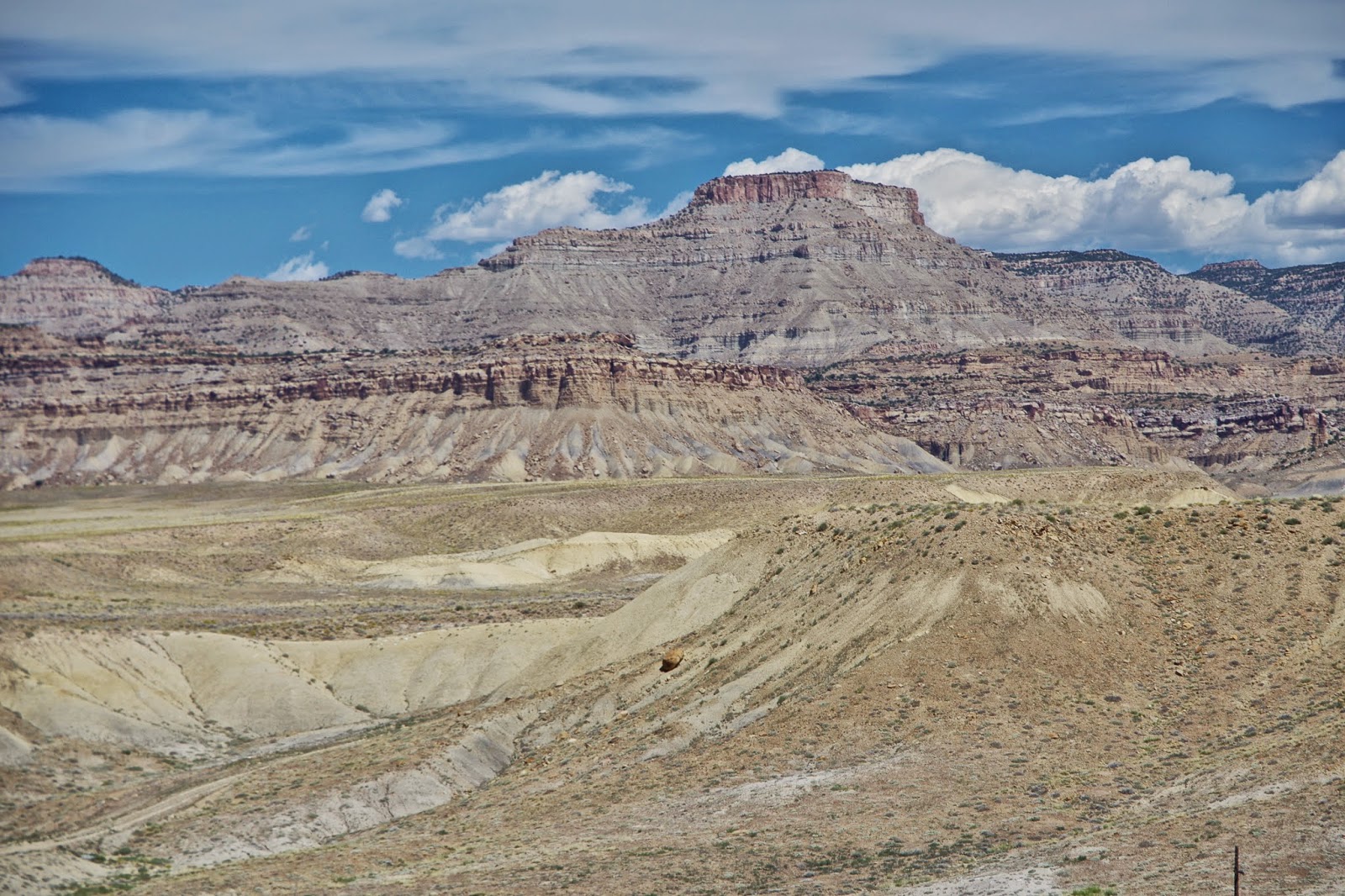
The next day we headed up the scenic Indian Canyon on the 91 highway but we were once again tangling with the oil tankers on switchback roads that climbed to 9114ft.  We descended back to the plain passing a massive coal-burning power station and railways that told you that the earth was being extensively plundered. The town of Price held no attractions apart from observing the extraction and transport of minerals by rail and road. It was a drab and desolate mining country so we headed across the most tedious part of the route yet to Interstate 20 at Green River. We drew off the highway at Crescent Junction and took in the views of the Untah and Ouray Tribal lands to the north before continuing the journey south on the 191 to Moab. After the airfield the classic Utah landscapes beckoned, and we were confronted by massive red cliffs and monumental rockscapes, many of them familiar from a lifetime of browsing movies.

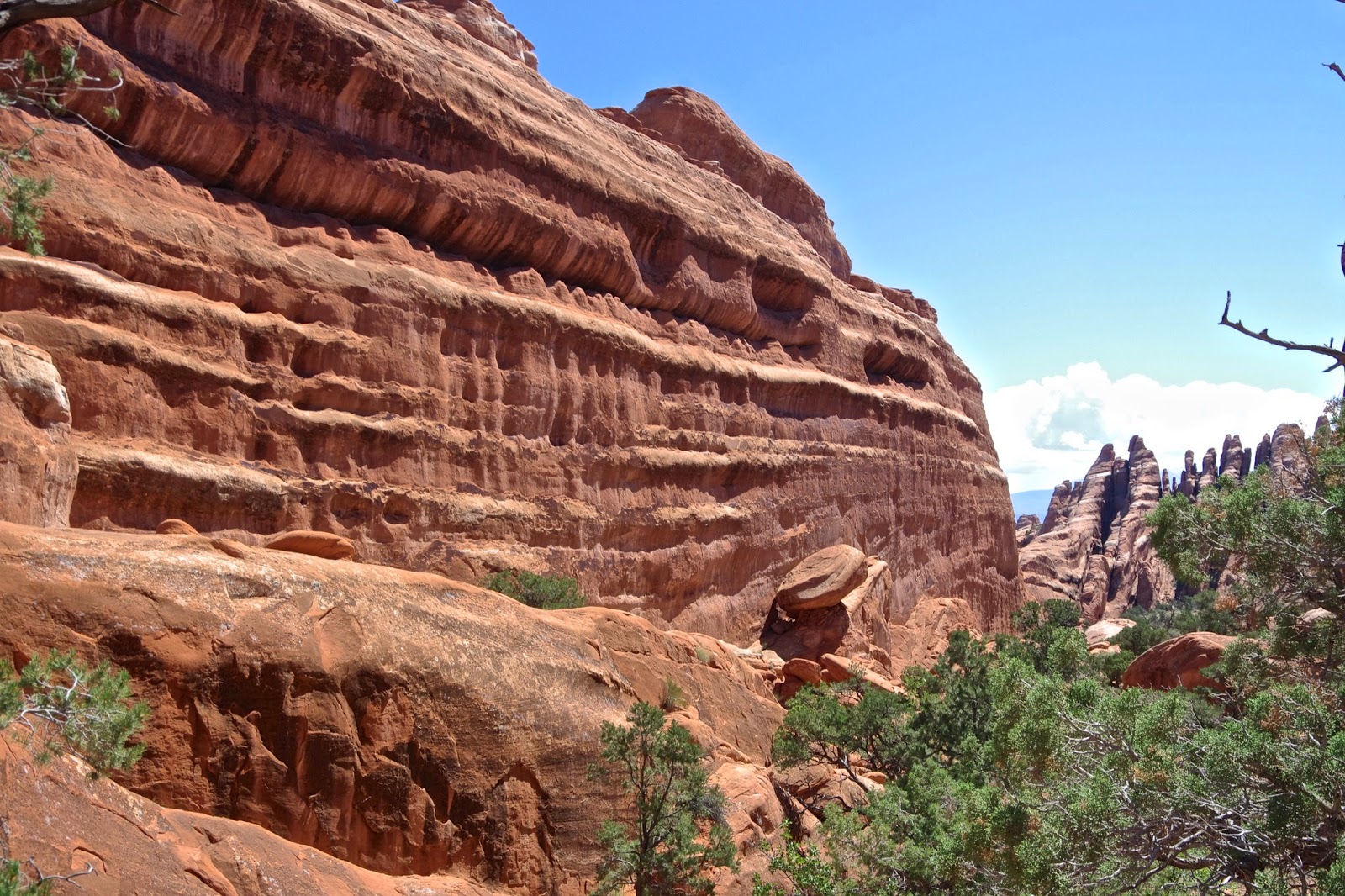
Moab is a tourist oasis and was fairly quiet in the late summer season. We had a light lunch in a vegetarian cafe before booking in at the hotel. Moab was to be our longest stop on the trip - 3 nights -  so that we could explore Canyonlands and Arches National Parks and enjoy some late summer heat. But we seemed dogged by Scottish weather, the pristine sunshine of the morning had given way to cloudy skies as we headed for Arches National Park. The quite staggering assembly of red sandstone arches and monuments did not have the wow factor that we were to witness a couple of days later on a return visit. Arches is a relatively small NP and after driving into the heart of the park we had a couple of walks around the Balanced Rock and Windows sections. On the return, we walked along the dry canyon floor of Park Avenue, a quite awe-inspiring dry river bed between massive rock architecture. The street was empty and it seemed a perfect end to the day.

The next day we had reserved for Canyonlands. It is split into three districts around the confluence of the Green and Colorado rivers and we headed for the northern section which is known as 'Island in the Sky'. It was 25 miles from Moab on empty roads. We were surprised on a perfect morning to be more or less the first to arrive at 8am. We decided to miss Dead Horse Point and drive to the highlights beyond the park entrance. We started at Mesa Arch and the views of the Colorado River canyon and La Sal mountains alone made the visit worthwhile. We were ahead of the crowds and had most of the sites to ourselves. We drove on to the Grand Viewpoint Overlook before walking out in the morning heat to Murphy's Point which gives stunning vistas to the Green River snaking its way through Stillwater Canyon. A superb walk and on our return we came across a racer snake as it emerged from a crack in the red sandstone pavement we were crossing.

We continued to the Green River Overlook and then the Upheaval Dome, a feature so complex that even geologists cannot explain its formation. Is it a meteorite crater or a dissolved salt dome? Whatever it made for good walking and we clambered to the far end of the walk. All the other walkers that made the trip were French or German and it did strike us that Americans seldom stray too far from their cars. A lady from Michigan had excused herself from the extra mile by saying that she had to get back for her dog which was gently baking in the car. We had overdosed on sandstone, sun and snakes by 3pm so headed back to Moab for ice cream but not before visiting the Schafer Canyon Overlook and the trail that sweeps down to the lower plateau and Colorado River.

In the evening we dined at a fine Japanese restaurant, Sabaku Sushi, and it served the best food yet. We met an amateur astronomer on the street and he invited us to view the moon through his telescope - it provided a remarkable view of the moon's craters, although we were a bit taken back when he asked for a dollar. Everything has a price in Utah apart from the landscapes, they are free unless they hold minerals in which case they are devastated.

The next morning brought sunshine and we headed back to Arches NP to seek out the more remote corners and eventually to take a long walk in the Devil's Garden. It was a spectacular outing and after visiting all the arches we decided to complete a 7-mile walk on the primitive trail that follows miniature stone cairns over and through fins of sandstone with some tricky scrambling involved. We completed this in the heat of the day and returned to Moab thoroughly spent from the exertions. However, a swim in the pool revived us sufficiently to explore the Colorado River east of Moab by a drive of 25 miles upriver to Fisher's Tower.

In the evening light, it was a glorious excursion and continued what had become a tour of the shooting locations for hundreds of movies including the Rio Grande, The Comancheros, Indiana Jones and the Last Crusade, Thelma and Louise, Con-air, Geronimo, Star Trek and 127 hours. We were fully sated with the scenery so had our final meal at the Twisted Sistas cafe, another good choice although it must be stated that Moab also has its share of dreadful eating places.

We left early the next morning and headed to the Needles section of Canyonlands NP, 70 miles south of Moab. The long road into the Needles from the I65 passed some remarkable scenery with early carvings on the rock, some inselbergs as well as the more famous needles themselves. We were time-limited as we wanted to visit Mesa Verde in the late afternoon before driving on to the accommodation in Durango that we had just booked. So we returned early in the afternoon choosing to take the forest trail route over another high pass to Monticello. The threatened electric storm had arrived and for the second time on the trip, it was a hard rain that was gonna to fall. We stopped for coffee at a gas station in Monticello to recover from the storm and then drove through the heart of the bean-growing district to Cortez in Colorado en route to Mesa Verde.

North Window, Arches NP