Saturday, 25 December 2010

Christmas Day


Inchmahome Priory Church

Standing on the cracks in the middle of the lake

Sibling affection

Looking west as the afternoon light fades

Snow on the Lake in the late afternoon

Grannie & Gregor

The day started with a visit to the neighbours to fill two water jerry cans, the temperature was -9°C and there was no sign of the frozen outside waterpipe delivering any Christmas cheer. After breakfast, Aileen, Amy, Gregor and I walked across the frozen Lake of Menteith to Inchmahome Island. After four days of brilliant clear days, there was some cloud cover but the experience of walking on the frozen lake was none the worse for it.  The odd skaters were out but the lake was bereft of similar morning adventurers. It was a memorable way to start Christmas Day.

We returned home to open presents with Grannie Ellie, who had enjoyed a lie-in. Amy went skiing in the garden, a bit of a comedown from her normal off-piste ski adventures before we went to the Lake Hotel, where we had managed to obtain a late booking for a relaxed Christmas lunch. 

This was the first time we had eaten out at Christmas and all because there was no water to prepare and cook a meal at home.  We had a table with a view of the lake, one of the best of viewpoints on any day, but even more so as the light conditions went through their full winter repertoire.  Then, as the light faded, we returned home to make various phone calls and Skype link-ups, followed by Christmas naps, more water foraging, a simple supper and, surprisingly, no alcohol. It was strange not to have Eva at home at Christmas but I suppose this is how it is as your children begin the next phase of their lives.

Tuesday, 21 December 2010

Lake of Menteith - the Perfect Day


View from the Lake

Three rinks already, bring on the bonspiel

Hotel and Church but really testing depth of field


Bootonsnow font

Following ice skates over the blue forgotten lake

Ice magic

It was -12°C this morning, the water was frozen in the taps, but the skies were blue for the winter solstice.  In January, I had what I thought was a once-in-a-lifetime experience of walking across the only Lake in Scotland.  Then a neighbour told me that there had been curling on the Lake of Menteith the previous day. This became the only objective for today. I decided to test my new camera on images of snow and ice.

I went into the Lake Hotel and spoke to the manager, he told me there was 6 inches of ice measured yesterday. They had prepared 3 curling rinks, and there would be another inch or so of ice today. However, going out on the frozen lake would be my risk alone.  Other people were admiring the scene, but no one else was braving the walk onto the ice. I stepped out, slightly nervous at first, but telling myself that if it could handle twenty or so curlers yesterday, I should have no problem.  My new camera diverted my attention as I set off towards the centre of the lake, taking photos in all directions and then returning by sliding, scribing my name in the snow for a photo and then walking through the frozen reeds.  It was just perfect, not a whiff of wind, hooloovoo blue skies and a layer of fresh powder snow to give some grip on the ice.  I had been privileged to have the beauty and serenity of the lake to myself.  As I was nearing the shore, a photographer, having observed my safe return whilst standing on the jetty, came out to join me on the ice.  "The Perfect Day", he said, and so it was.

Saturday, 11 December 2010

Fethaland

Fethaland Haaf Station

After the wintry weather of the last week, the snow had largely melted, and the forecast was for good visibility with showers, northerly wind, and moderate temperatures, which sounded pretty good for Shetland in December.  So Saturday was devoted to driving to North Roe at the far north of the mainland and walking to Fethaland, the peninsula that was once the home to a fishing haaf station. 

I started the walk from Isbister as the morning showers abated and headed east for the coast. A large tanker was heading out of Sullom Voe, and I tried to keep pace with it. It seemed very low in the water;  I could certainly not see the plimsoll line. For the next hour, I meandered up and down over an undulating coastal path. The ground was like a giant sponge after the snows and rains of the past week.  The sea provided the soundtrack and an occasional nozzle of spray from a couple of Geos to accompany the walk until I eventually arrived at the old fishing station.

Surprisingly, the skies lightened, and it was moderately bright when I reached the Haaf Station and its assembly of former lodges, which housed crews of up to 60 sixareens.  Fethaland is an island beyond, but is joined by a rocky causeway. There were dozens of sheep grazing on the fat land (Fethaland).  The cliffs dropped away steeply to the west and, as the sun made a brief foray, the so-called yellow cliffs lived up to their name. The wind suddenly got up, and I retreated gingerly from the edge of the cliffs. The footing was extremely difficult, and I was being blown along on nature's skateboard.  The sun gave way to a blackened sky and all light diminished; the automatic lighthouse began flashing at me. I checked my watch; it was 12:00 , but it could as easily have been midnight as noon.  

It was time to return, as I had reached the furthest point north.  With snow, then hail, and then rain at my back , I slid back to the causeway and found a ruin to shelter in; there was no roof, but it was dry because the rain was horizontal. A tomato sandwich and an apple provided some sustenance for the return over the track via the Upper Loch of Setter. I watched out for red-throated divers and was surprised when two 4x4s towing trailers full of sheep passed me.  The place was heaving with sheep already and every few metres I seemed to disturb another rabbit.  If I were a sea eagle, this is where I would make home.  As I returned to the car, the rain gave way to more 'between weathers'.  

Driving back, I enjoyed the wintry landscapes, the primary school had its eco flag flying, but already half of it had been stripped off by the strong winds.  A large trawler was moored at Colla Firth, which is presumably the most northerly fishing station still operating.  Further south, Ronas Hill, the highest point on Shetland, came into view, and the remnants of last week's weather were all around: frozen lochs, banks of snow, and air cleaner and fresher than any deodorant.  

When I arrived back in Brae, I decided to drive out to Muckle Roe and drop in on Diane and Geoff, friends of a friend. They gave me a warm Shetland welcome, and I learned more about the rich community life and enjoyed a slice of birthday cake with my new Shetland friends.  Then back via Voe and Weisdale with a stop at Alistair's house for coffee and a catch-up. It was well dark when I left to drive back to Lerwick, but still not 5pm. The lesson of days like today is to go out and make your day; all the ingredients are available on Shetland to be enriched, educated, and stimulated.  As T.S. Elliot wrote, 'each venture is a new beginning, a raid on the inarticulate ..'
On the coastal path to Fethaland with a tanker leaving Sullom Voe

Geo
Fishing Station

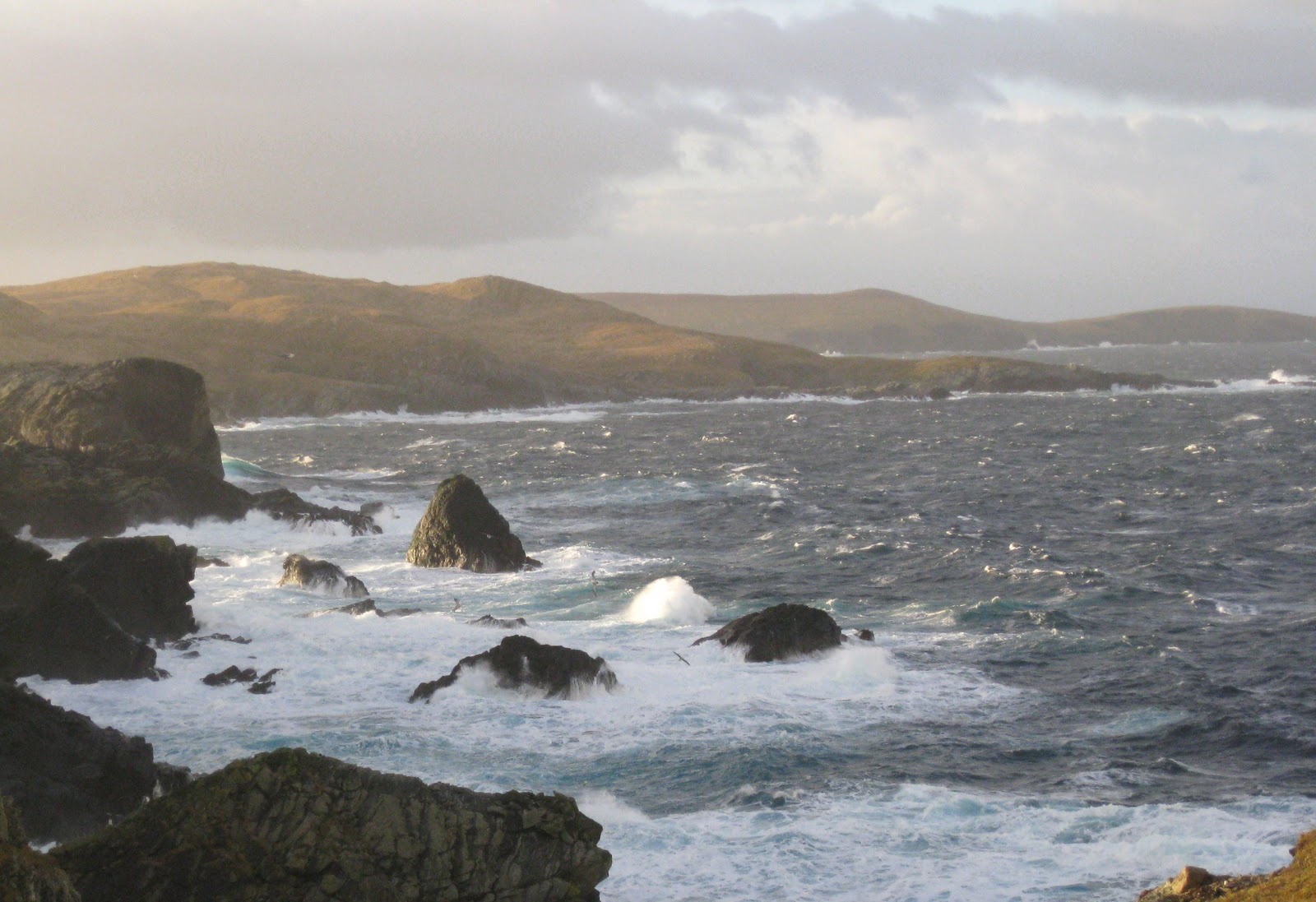
Yellow Cliffs and Ramna Stacks

Looking south from the lighthouse

sheep galore

North Roe Primary flies its eco-flag

Trawler at Colla Firth
Ronas Hill beyond the frozen loch


Thursday, 9 December 2010

Coalition Creep

It is evident that over the last few months, the coalition has been leading a charmed life, although Nick Clegg may not agree. The economy has continued to recover and as the dollar and euro come under pressure, the pound appears to be performing well.  Jobs have marginally increased and the scale of job losses in the public sector seems to be smaller than originally predicted. What is missing from this headline analysis is that it takes time for most government decisions to work their way into the system - six to twelve months is the minimum time for the spending decisions to impact on the economy.

The coalition policies were not set out until June in the budget statement and are still being brought to bear on the unsuspecting public. Public expenditure cuts will not begin to seriously bite until next April and the slowdown in the economy will only begin to take effect when the many capital projects bestowed by the last government in Alistair Darling's final Keynesian flourish are completed.  With food and fuel inflation now accelerating, disposable income falling as pay is frozen and VAT increases about to take effect there will be a belated slowdown in the economy. The goodwill that attends all new governments will have begun to tarnish and the opposition may have a more cogent story to tell than they have achieved so far whilst they have been indisposed by leadership elections and the systematic media trashing of Gordon Brown's tenure at Number 10.

The student protests this week have prompted many other groups to join the clammer of opposition to the coalition's policy of downsizing.  In twelve months we will have a better idea of what the coalition policies are achieving.  Sadly, I suspect it will mean higher unemployment, more young people out of work, a stagnant housing market, no growth and the possibility of a double-dip recession.  No doubt there will be another tranche of money for the London Olympics and further inducements for schools to opt out and when things get bad the Prime Minister will set foot on the foreign stage in search of glory. Oh, and the disarray in Europe will be blamed for the prolonged recession.

Monday, 6 December 2010

Snow Day Afternoon


Dig this, snowmen are for wimps

Snow Afternoon

Day before the snow morning, birch tree handy
 We were up before 6am to travel to Edinburgh airport, the forecast of light snow was wrong on both counts: it was dark and the snow flakes were like giant cornflakes and accumulating fast.  We spent 15 minutes clearing the drive and packing the car for an adventure.  Normally it takes about an hour to the airport but we started with 2 hours in hand.  The first 10 minutes were like a Fawlty Towers episode as the car slid and twisted itself down the drive wedged between two rows of snow shovelings. I had an urge to beat it with the nearest birch tree but eventually we coaxed it out. I dug another trench across the road to allow us to reverse out and we started the journey.  For the first time in a week there had been no gritter so we were driving on 6 or 7cm of new snow.  Once some momentum was gained it was possible to ease along at 25mph.  There was hardly any other traffic as we  headed towards the Lake of Menteith and then Thornhill. The car angled its way up some gradients in an extended trot but momentum was not lost. 

As we arrived in Thornhill a Peugeot was on the final incline but skidding on the spot looking every bit as elegant as Anne Widdicombe doing the rumba.  We halted at the foot of the hill, I got out and pushed the Peugeot up the last section and then, with the surface nicely polished, we made two or three attempts to follow but to no avail.  As if by magic two giant tractors appeared, the drivers informed us that all the roads into Stirling were neither gritted nor ploughed and that the trunk road and motorway to Edinburgh were even more dangerous and the airport was closed anyway.  I did not rise to the jibe that the Council was bloody useless.  With the aid of three farmers and a man in a 4x4 we turned the car on the spot, the snow in this instance acting as a lazy susan, and retreated home.

True enough Edinburgh airport was closed and, according to the websites Glasgow was open, so I asked for my flight to be switched. I had given up on the prospect of getting very far in a rear wheel drive car so I tried to order a taxi only to be told that the road was blocked and that Glasgow was in gridlock.  Shortly afterwards I heard that Glasgow airport had closed as well but getting any sense out of any of the travel, airline, airport or council websites today was harder than finding wikileaks.  I phoned Kaye and, in the unflappable and happy way of someone who is 7 months pregnant, she transferred me onto tomorrow's flight from Glasgow. 

It was finally a snow day with a free afternoon.  It made me realise how all our energies are focused on defeating the snow and very little ever gets done on a snow day.  So bearing this in mind I had a snooze, sorted out some papers, put another two rolls of insulation in the loft and tidied up my e mails.  The snow finally stopped and there was chance for another bit of snow clearing before the light faded at 3:30pm.  With weather and winter conditions like this it is no wonder that the buoyant economies are in places like India with warmer climes and the west, according to Gordon Brown in today's paper, is in terminal decline unless it unleashes another dose of Keynesian economics.

Monday, 29 November 2010

Snow in November


Yesterday we had the biggest dump of snow since moving here 20 years ago, it was about 40cm deep by late evening.  Gregor had taken 10 hours to get from Aberdeen to Perth, which was as far as he could get. He ended up sleeping in the mini under a duvet that he bought at the 24/7 Tesco supermarket.  The next morning very little was moving,  the garden birds had moved in under the car which was a virtual snow cave.  Several trees had lost branches under the weight of the snow. 

When I arrived at the co-op to buy a paper and some milk I was told I was the only one daft enough to come out looking for a paper.  The post office was to receive no mail for the first time in the memory of Ros, the postmistress, and she has been there 25 years at least.   There was slow progress on the roads which had been ploughed but the virgin snow pavements were impassable. 

We dug out the drive and eventually managed to drive over to Loch Venachar to take provisions to Granny, who was in good spirits.  We saw two buzzards feasting on road kills and two pheasants sheltering in a roadside bush looking like baubles on a Christmas tree.  Travelling back we watched the sunset over the Lake of Menteith and I made a surprisingly good curry from the contents of the fridge.  Winter!


Lake of Menteith

Creag Mhor from the play park

Baillie Nichol Jarvie


Saturday, 27 November 2010

Jarl and back to the Trees

Jarl Squad member
As  I left Shetland yesterday I bumped into a scary-looking man who was visiting the offices, he was a member of the Jarl squad preparing for Up Helly Aa in January. I managed to get a photo just before starting the long trek home. The journey was quite a trial with a snowstorm on the road to Sumburgh airport, and delays in the incoming planes, which had to circle whilst the runways were cleared. Then we were held for an hour on the plane whilst the wings were de-iced twice. Finally, there was the uncertainty of whether the plane could get sufficient traction on the runway for take-off.  It is not often I feel totally frazzled about travelling but this was one such occasion.

The snow followed me home and this morning a one-inch layer of snow had been welded onto the pavements, this was not windblown powder snow like Shetland but wind-blasted moist snow. There were blue skies although by noon the temperature was still below freezing. I decided to go for one of my favourite walks out of the back gate of the garden through the oak woods and into the Forestry Commission plantations leading to Lime Craig.

After the bleak winter landscapes of Shetland, it was good to be back amongst the trees which were plastered with snow and the dappled light of the early afternoon made it a glorious excursion. The views from the summit were as good as last winter and I lingered on the summit enjoying the splendid panorama. Much as I have grown to admire the bare slopes, big skies and ever-visible seas whilst in Shetland over the past few weeks, there is a joyous familiarity about being back in the land of trees.

Trees blasted by snow from the east

Birch and Oak below Craig Mhor

Spruce below Lime Craig

View from Lime Craig to the north-west. Stobbinnein and Ben More

Thursday, 25 November 2010

Bleak is Beautiful

Gulberwick at Dawn

8 am

Despite the imminent winter solstice in the Northern Isles, it is light by 7.15 a.m. and quite light by 8 a.m. This morning the storms of last night had left a layer of snow to lighten up the grey sky.  It was bleak but inspiring and we are promised 'a moderate day', a glorious understatement that is frequently used as a welcoming line in Shetland. I managed to cajole my Toyota hire car up to the main road from the village up the ungritted icy road for a long day at work. 

In the evening, I drove my colleague, Brian, to Whiteness for an evening meal with Alistair and his family. It was well after midnight before we left, there had been much alcohol on offer but knowing the road conditions and from previous experience of visiting Alistair I had limited myself to just a beer. I drove us home as the snowfall accumulated. It was touch and go whether we managed to get up the hill from Whiteness to Tingwall and there was no other traffic on the roads in the early hours. 

The road down to Gulberwick was a veritable toboggan run and the car began to slide on the steep snow-covered icy descent, I somehow managed to brake sufficiently delicately to sideslip around the bends on the descent, We had to abandon the car at the start of the final uphill road to the house, it was far too icy. Brian was complimentary about my driving, unlike the family who think I am too slow.  It was undoubtedly more luck than skill that we made it back to the house. Every day and night is a glorious venture into the unknown in Shetland.

Saturday, 20 November 2010

Muckle Flugga

Muckle Flugga lighthouse

After 4 days of gales with no ferries, the supermarkets were empty but the weekend brought still and clear weather. There was only one objective on a day like this - to visit the Northern Isles. I persuaded Nigel to join me on the outing as he was staying in Shetland over the weekend for the first time. The superbly engineered and maintained roads were empty apart from a Porsche that passed us doing the wrong side of 100mph on the way to Sullom Voe. It was a rare but indulgent symbol of the explicit wealth that exists on the back of oil. We caught the ferry to Yell, a service that is so good that a free internet hotspot is provided in the parking area. The well-equipped ferry ripped across the sound in 15 minutes with just half a dozen vehicles on board. It had a passenger lounge and cleanliness that would shame CalMac. The Sound was calm and Yell was illuminated by the low morning sun which was squeezing through the thin cloud layer.

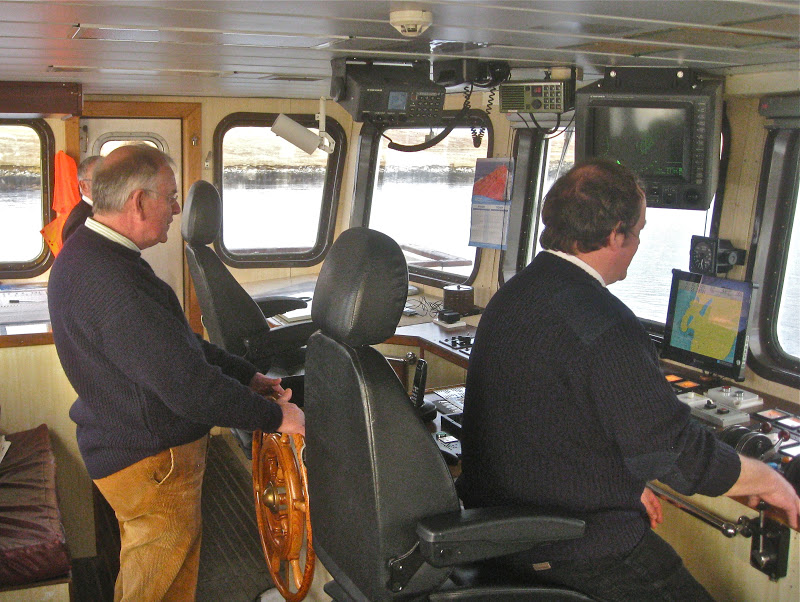
We were asked by one of the crew as we disembarked whether were we going on to Unst. On replying yes, he said he would phone the ferry 17 miles away and ask it to wait for us. This courtesy was extended when we arrived and rolled onto the Unst ferry, it is a free service to Britain's most northerly island. We were invited by the skipper to join him on the Bridge and Nigel was allowed to take the wheel. On this calmest of days, it seemed a dream job. We enjoyed the 10 minutes of banter before arriving at Belmont for the final leg of the journey. It was another 10 miles on well-constructed roads to reach Hermaness, the most northerly peninsula of land, which is a National Nature Reserve and breeding ground for Great Skuas on the peat moorlands and Puffins on the cliffs to the west.

We walked up the hill on a well-marked path with occasional sections of boardwalk through the peat bogs to the high point at 207 metres and looked down on Muckle Flugga lighthouse. Nigel was dressed in formal shoes and a raincoat, looking every inch the city gent. I sent photos of him to his family, he was Britain's most northerly citizen as he inhaled the wildness of the views and the cacophony of sound from the crashing of the sea and the birds. The summit is precariously perched on the top of a series of sea stacks that at a latitude of 60 51' are the end of the road even for the innovative Shetland engineers. Although only 1:30 p.m.,, the light was beginning to fade. I walked up to the end of the peninsula and dropped down to the edge of the cliffs which are about 100 metres high and then walked back along a sheep path looking at the nesting sites for 25,000 Puffins. And then a climb back over the Hermaness moor, where the Great Skuas would dive-bomb me in the springtime, and then I skipped around the peat bogs from where the highest hill on Unst, Saxa Vord loomed into view. It is the location of a Radar station and is also famous for having recorded the strongest wind in Britain 177mph.

There was time for one more excursion so we drove through Haroldswick to Nor Wick Bay, host to the most northerly post box and bus shelter. Seven years ago the government withdrew the RAF Saxa Vordbase from here and many jobs and people went with it. A large new building at Valsgarth intrigued us so we stopped half expecting to find Britain's most northerly leisure centre but it was the former RAF base.  

A large friendly man came out for a chat, he was re-equipping part of the building as a microbrewery. It may sound a strange venture but Sonny Priest had been the fireman at the base and converted his hobby into a successful business - the Valhalla brewery - and he was now expanding into bigger premises. Sonny would be an ideal guest on the Simpsons and Homer would be able to extol the virtues of Old Scatness and White Wife, two of the six varieties of beer that I sampled last week. Sonny had won the contract to supply the Tall Ships Race next year and was selling his beers to much of Europe and most recently to British Columbia. I joked about him brewing up something special like a 'Muckle Flugga Force Ten' for the Tall Ships event and he humoured me before returning to continue the fit-out of his new premises. 

By this time it was 3:45 and almost dark, time to get back to the ferry. We arrived just as the ferry was about to leave Belmont but on seeing our headlights they dropped the ramp again and opened the gate to guide us onto the ferry. I had another 10 minutes on the bridge surveying the sound, watching the docking manoeuvres and learning more about this remarkable community from people who are content and happy in the remote stark beauty and friendship of the Northern Isles.
Hermanness Bird Reserve walkway

Sound of Yell

Captain Fantastic takes the wheel

Unst ahoy

Hermaness cliffs - Puffins galore(in spring)

Hermaness looking south from the cliff path


Looking towards the Radar station on Saxa Vord from Hermaness Moor

North Wick


Friday, 12 November 2010

Forever Changes


One of my favourite albums from the late 1960s was Forever Changes by the West Coast group Love.  They were more melodic but less raucous and rhythmic than the Doors, their stable mates on the Elektra record label.  Love provided my soundtrack on Wednesday morning before my iPod froze literally during an early morning run.  By this time I was already buoyed into my stride pattern and enjoying crunching through the ice puddles on the gravel tracks.  It had frozen hard overnight and a blanket of cloud had sealed in the frost along the river valleys.

When the music stopped during my favourite track Alone Again Or, the sound of silence was stunning. Then I heard the slow beating of wings as the Lemahamish Buzzard skimmed over me dipping its wings just a few metres over my head, I had not seen it for over a month and it was one of my imaginary friends - I was not Alone Again.  I had the chance to listen to Alone Again Or this morning when Ian MacMillan, the Barnsley Bard, requested it on Desert Island discs.  He also played John Cage's 4'33'' but all I could hear was the crackle of the transmission - it sounds far better live in the forest.

Thursday, 4 November 2010

Fasten your belts for the CSR

The Comprehensive Spending Review (CSR) has confirmed much of what we already knew about George Osborne and his cronies.  Whilst the newspapers gave us their traditional tunes, the analysis from independent think tanks has been comprehensive.  Phillip Hammond, the Transport Minister and smoothest of cabinet communicators, was put up on Question Time and was forensically dismembered by Caroline Lucas, leader of the Green Party, Polly Toynbee and some very savvy members of the audience.  It is now game on.

We all realise that the deficit must be reduced and that this will require some significant reduction in public expenditure but what George Osborne has proposed will have devastating consequences not only on students, the young unemployed, those on housing benefit but also mothers who do not work and many people enjoying what are widely acknowledged as very good health services at present.  Beneath or lost in all the coalition posturing about fairness are four fundamental contradictions of policy direction. These will be at the heart of political debate over the next four years.


The first contradiction is about Economic Activity.  There will be a sharp increase in the length of working life of people. This follows a steady decline in the working life in the post war period as the school leaving age was raised from 14 to 16 and people retired earlier.  In future as a result of the CSR and its implementation there will be fewer young people going to University or Further Education at one end of the working life and people, but women in particular, will need to work longer as the pension age rises to 66.  The employed will need to make pension contributions for a longer period and redress the pension fund deficits in both the public and private sectors.  But at the same time up to 500,000 public sector workers will be laid off, many on early retirement which will require organisations to divert scarce resources to prop up pension funds instead of delivering services.   And there could be an equally large number of job losses in the private sector as public sector capital spending is reduced by a third and there is far less contracted work in everything from home care and nursing to IT and construction.   More people need to work longer but less work is available.

The second contradiction stems from the artificial construct of public and private sector enmity which the coalition and parts of the press are eager to perpetuate.  We need to work together,  The cutting of legal aid today will damage the poor but also take out £300m from the law profession, which is not a bad thing in itself but it is an own goal against the private sector. If the public sector spends 43% of the GDP and employs only 5million or 16% of the workforce the majority of public spending must support the private sector - construction, consultants, security, IT, catering, agency staff etc.  These are all far more vulnerable to cuts by councils, the NHS, government agencies and quangos than teachers, police, social workers, nurses and doctors to name but some frontline services. The private sector will be equally damaged by the public expenditure cuts and unable to fill the jobs gap.

The third contradiction concerns consumer expenditure. If there are wage freezes, a requirement to invest more on pensions, an increase in VAT, rapidly increasing fuel and food costs then there is less for households to spend on the extras in life like holidays, meals out, leisure activities, home improvements and private education, university tuition, health and community care.  Surely this will prevent the compensating growth in these sectors of the economy which will add to the hefty reductions earmarked for defence spending, construction projects, arts, culture and sport. There will be a tightening of consumer spending with consequences for many private service industries including those in education and health.

The fourth contradiction  is the assault on mutual respect which is at the heart of good governance.  Governments are never popular, although Blair achieved it for a time between 1997 and 2000 by tuning into the public's aspirations for quality and choice.  Tough decisions are accepted as part of the deal on democracy that underpins society but they require a semblence of justice and an understanding by government that there are limits to the scale of change that will be accepted.  By upsetting the police, the armed forces, the health and education sectors as well as squeezing the poor the coalition is removing the carapace of protection that it needs to survive.  Small businesses are already fearing the backlash of VAT rises and dodgy order books and big business is making the usual threats to bale out unless their profits and bonuses are allowed to continue.  The government will have as enemies all those who stand to lose out by its changes and these are looking like a substantial majority.

These contradictions may not all arise but it seems to me that sufficient of them will and the coalition will need to turn if it wants to see out the next four years.

Tuesday, 2 November 2010

Shetland makes 'Top Ten Places in the World to Visit'

Hooloovoo House
The wind had blown hard all day and the sea had lost its cobalt tint and simply reflected the deep grey of the scudding clouds. My colleague Nigel and I left the office at 5:30pm, the last out, as usual, the night sky was so dark that full-beam headlights were needed to pick our way through the downpour as we left Lerwick.

Lonely Planet had published their list of the top ten places to visit in the world and Shetland was included in the list with the justification that it was"fiercely independent and the last wild place in the UK". We had driven over to the Scalloway Hotel for an evening meal and we had a discussion with the owner about the accolade. He was proud of the recognition even though he doubted whether Shetland could cope with any more tourists and vice versa.

We called in at Tesco on the way to our rented house in Gulberwick to collect some food and our daily bottle of wine. The rain was lashing down so hard that the doorway of the supermarket had collected a small crowd waiting for the rain to abate so they could run a few metres to their cars without being wiped out. I struck up a conversation with the man standing next to me who was watching my colleague and me with a forensic interest. I asked, "So what do you think of this place being the sixth-best place in the world to visit?"   He chuckled and said he could think of worse places but was not sure that the tourists would find that Shetland had the capacity to look after them in the style that they probably expected. Uncanny how similar to what the owner of the Scalloway hotel had said. Shetland doesn't do bullshit.

The most regular visitors to Shetland in recent years, apart from the wildlife enthusiasts, have been the Inspection Agencies who obviously recognise what an excellent place Shetland is and have got into the habit of coming back each summer to check this.  They may find accommodation difficult to find next year.  I asked the man next to me what he did - a Police Inspector - and I got the impression he had already figured out what Nigel and I were doing on the islands, there are no secrets.