Saturday, 20 April 2013

Loch Ossian round

Ascent of Carn Dearg. Loch Ossian, Ben Nevis and Grey Corries in distance

Bridge of Orchy as the train arrives
Beinn na Lap from flank of Carn Dearg
Sgor Ghaibhre and Ben Alder from Carn Dearg
Corrour Lodge: Andrew Gormley's Hear and Hear  
Ascent of burn from Loch Ossian to Beinn na Lap 
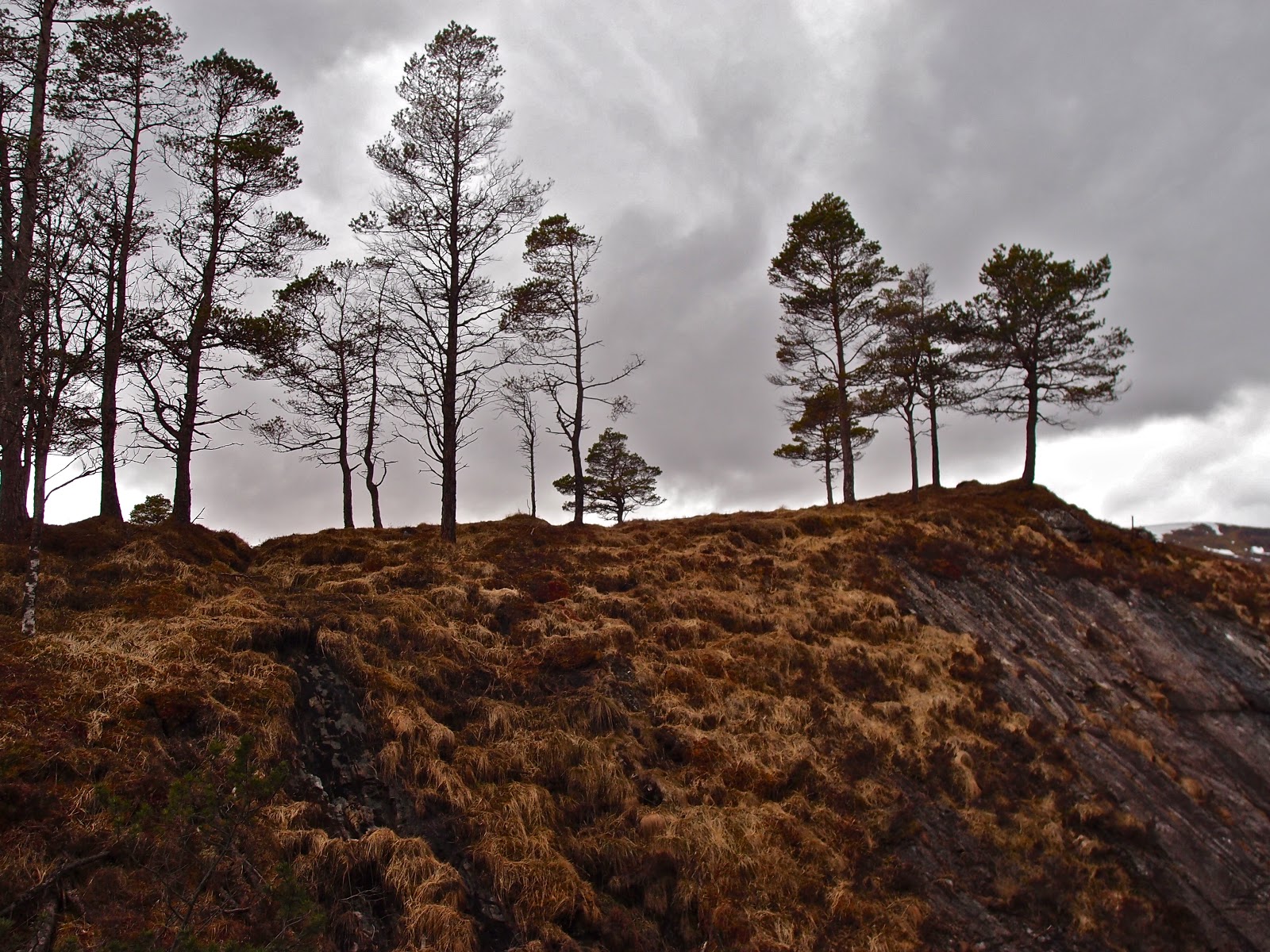
 The tree line below Beinn na Lap
Sgor Ghaibhre and Carn Dearg from Beinn na Lap
Ossian Youth Hostel and Pine islands on Loch Ossian

Ascent:          1445 metres
Distance:        24 kilometres
Time:             6 hours 29 minutes

Carn Dearg          941m       1hr 40mins
Sgor Ghaibhre     955m       2hrs 30mins
Beinn na Lap       935m       5hrs 23mins

As a day out in the Scottish hills the Loch Ossian round has it all. A train ride across Rannoch Moor before being deposited at Corrour, Britian's most remote and highest railway station. Three remote and tough hills and distant vistas to Glencoe, the Mamores and Grey Corries.  The pyramidal Schiehallion is an ever present sentinel and Ben Alder forms a barrier to the east. The forecast was fine, the day was dull, the walk was on the wild side.

We had only decided to walk late of Friday evening and I had suggested the Loch Ossian round before checking the train times. We had 7 hours between arriving and catching the 6:25pm train back to Bridge of Orchy. Irvine Butterfield had indicated the walk took between 7 hours and 11 hours in his excellent book 'The High Mountains of Britain and Ireland'. I knew from many of his other walks that the lower estimate gave no respite. When I had done the round 15 years ago my time was 6hrs 56mins, although it was in December and I had descended Beinn na Lap in the dark. I tried to allay the fears of Gregor and John, who did not relish missing the last train, by setting a schedule for the round and giving us an opt out, if necessary, after the first two hills. But I knew full well that we would probably go for it anyway.

The train journey was a happy half hour: the conductor teased me about my rail pass, the trolley lady provided humour and hospitality as she explained she was finishing her shift when she got back to Fort William. She had started at 6am and she had arranged a surprise 65th birthday party for her husband so the trolley would not be going to Mallaig today. The train was full of walkers drooling at the wild and uncompromising wilderness of Rannoch Moor. The carriages provided the type of clickety clack beat that is beyond the melody of modern trains. The journey is worth it for the views and rail staff alone.

Arriving at Corrour we wasted no time and set out at a strong pace for Loch Ossian and from there the path that cuts south of Loch Ossian and under Meall na Lice and onto the road to the isles path. At 520 metres we left the path and started the long climb up the west flank of Carn Dearg. There were patches of snow and the going through the deep heathers was tough until we reached the spur at 750 metres from where there is a faint path through the short grass that curves round to the summit of Carn Dearg with its fine cairn. The views back to the west were clear but the skies looked ominously grey over Ben Nevis and the Grey Corries. Ahead was the drop to the bealach before the long climb to Stob Ghaibhre. It was festooned with fingers of wet snow and beyond was the Ben Alder plateau looking moody and drab. We had a bite to eat on Carn Dearg and, as we were well ahead of schedule, we were more relaxed on the descent down the snow to the bealach but the pace did not slacken as we climbed the 240 metres to the summit of Stob Ghaibhre.

We made it in quick time but did not stop as there was no protection from the cold west wind.  We decided to descend to the shelter of the loch. We cut under the Sgor Choinnich, the adjacent top, and schussed down the fingers of snow before contouring round the hill and descending to where a track emerged from the forest. There was a dam to cross and then a walk through the forest to the superbly restored cottages and farm buildings at Corrour Estate.

We walked past the expensive Corrour Lodge hotel that sits overlooking the eastern extremity of Loch Ossian and is well protected by high railings and occupied by top of the range 4x4 vehicles. A statue by Andrew Gormley similar to those on Crosby beach looks out over the loch. Loch Ossian is another place and the statue here is named Hear and Hear.  John Stirling Maxwell, the pioneer of conifer plantations on peat, had bequeathed some fine specimen trees planted in 1892 as well as a wide variety of rhododendrons along the shores of the loch. He went on to be a founder member of the Forestry Commission, President of the National Trust and champion of green places in cities, most notably for Pollock Grounds in Glasgow.

I had previously ascended Beinn na Lap from Strath Ossian but on this occasion we walked along the north shore of Loch Ossian for a mile or so until we reached a path ascending through the plantation alongside a sparkling mountain stream. We stopped first to finish our food, we had 3 hours left before the train and were still 15 minutes ahead of schedule despite some playful behaviour at the dam and dallying to look at the Corrour developments.

It was a good decision, the path took us up a gorge which was spectacular before we emerged onto the open hillside which presented us with a boggy tract as we headed directly for the summit. As the gradient increased the ground conditions improved, with rock bands, snow patches, grass and lichens replacing the bog. We hit the summit at 5pm as a couple of ravens circled the cairn. There was still time for a break and to catch some photos. The day had become darker and rain was imminent with Ben Nevis and the Mamores already cloaked in cloud.

We descended along the ridge to the west at first and then started a long but easy traverse towards the track at the end of the loch as the heavens opened and gave us an early shower. It took 40 minutes to reach the track and from there another 15 minutes to reach the station . To our surprise a restaurant had opened in the former station house but with only twenty minutes until the train there was no time for any food or drink. About 25 walkers were gathered in the shelter and the train appeared spot on time to whisk us back from the magic of Loch Ossian and what had been another enjoyable circumnavigation of Ossian's furtive munros.

Friday, 19 April 2013

Bheinn Bhuidhe

Summit looking south-east to Ben Lomond and Arrochar Alps

Friday, 19 April 2013

Ascent:          1010m
Distance:        8km walk, 16km cycle
Time:             4 hours  19 minutes

m  Beinn Bhuidhe    946m      2hrs 27mins (including 29mins cycle)

At last a fine day after the rain and wind of the last couple of weeks. The nearest unclimbed Munro was Beinn Bhuidhe at the head of Loch Fyne, a shy hill hiding behind a long ridge. There is a long trek of 8 kilometres along the private road before the climbing begins from Inverchorachan cottage, a derelict house at the end of the track. I had taken the bike to speed the trip and avoid the long walk in and out on the road. A new bar/cafe had appeared at the first farm but there was no sign of it being open, however, it had opened as I was returning mid-afternoon. Further along the road I became embroiled in a peloton of Highland cattle with half a dozen calves. Apart from this, it was a pleasant cycle, climbing just 100 metres over the 8km.

I dumped the bike behind the cottage as I have done on three previous trips and began the steep climb up a well-used path that follows the burn up to a large corrie which is capped by a spectacular waterfall at 500 metres. The climb has a couple of exposed sections over wet rock. I was a bit slow after a run the night before but I kept an even pace until the flatter sections at 650metres where I halted for a drink and some food and watched as a herd of deer dispersed. I had camped here late on a Friday evening after work on my last visit and climbed the hill first thing the next morning before going to Mull to climb Ben More and then spending the Sunday on Iona.

The snow of recent weeks was disappearing fast and I had to select a route to climb the last 200 metres to the long ridge of Beinn Bhuidhe. I chose the deep gulley to the east and after a bit of scrambling up rocky sections, I arrived at the long southwest to northeast ridge about a kilometre to the northeast of the summit. The view from below is deceptive with the summit at the extreme left of the photo. The hill was more yellow than green as the name implies and today it had no other visitors. The views were clear in all directions and it was warm enough to sit in the sun and admire the panorama.

I tidied up the cairn before eating an orange, sending a photo to a friend in Shetland and then returning via the ramp shown to the left of the photo. It was a more sensible route and the descent was made at a good pace. The going on the return was very boggy across the southeast flank of the hill, alongside and then down the steep path. The cycle out was into a stiff breeze blowing up Loch Fyne but the afternoon sun was warm and sparkling on the river which was compensation enough. I was back at the car as planned for 3:30pm and home for 4:45pm despite the never-ending road works on the Rest and Be Thankful and the heavy docile weekend traffic along Loch Lomond. 


Highland calves in Glen Fynne
The waterfall above Inverchorachan cottage

View northeast to Ben More and Stobbinnein

Stac a Churn, west of the summit

Take the ramp to the far left below the hidden summit


Sunday, 7 April 2013

Senior Moment(s)


For Tova

Senior moments are often used to describe those times we forget or act with less acuity than used to be the case. Such as when you forget to get off the bus at the right stop, forget to bring back that celebratory glass of whisky that you had poured yourself, or as a friend recently told me put the phone into the sink instead of her empty coffee cup. My worst senior moment was when, shortly after my 60th birthday, I ordered the pensioner's special £5 pub lunch after a long morning walk in the mountains; two other members of the family tucked into a filling lunch whilst I was given a portion that would have failed to satisfy an anorexic child, and then I had to pay for it all.

These sort of senior moments happen more frequently than they used to and are the source of gentle teasing but there are also some very good things to offset these moments. My wallet now contains an entitlement card which gives me free bus travel, a senior railcard and my winter heating allowance pays for about three weeks of heating costs. But most of all I now know the value of time but not the cost of it.

It was a joy to watch Joan Bakewell on 'Have I got News for You' last night, she provided an exemplar of senior humour and wit that even Ian Hyslop could not help enjoying.  She showed us that senior moments can also be wise, full of empathy, justice, courage, fun and fulfilment. She proved that old lives matter, they could even become the new black.

I woke up early this morning and texted my daughter to tell her that today would be the day. I then went for a run wearing just shorts and a T-shirt for the first time all year as the spring sunshine wiped away the overnight frost. The daffodils were out at last and the snowdrops were finally fading after the coldest March on record. I then converted some of my old film camera lenses to fit a digital camera that I had just bought and tested them in the midday sun and was pleased with the results.

But the greatest of all senior moments is when you become a grandparent, endowing another generation with enduring love. The bodings were good as Eva went to the hospital late afternoon and our granddaughter was born at 1:50am. Now, where did I leave that glass of whisky?

Tova 


Saturday, 30 March 2013

Breakfast at Lime Craig

Cruach Ardrain, Stob Binnein and Ben More

Ben Lomond

Ben Ledi

Nine o' clock shadow
After two weeks of bitterly cold east winds, snow flurries and mammals still in hibernation, easter Saturday brought sunshine, still air, hard frozen ground and bird life making whoopee. I was inspired to run up Lime Craig to take in the views, this despite tired legs from five days running this week, . It was a slow plod, 300 metres of ascent and a round circuit of 11 kilometres is a big ask before breakfast. There was some snow left at the top but the general snow level on the hills seemed to be at about 600 metres.

On the descent I came head to head with the competitors in a mountain bike event, the first customers were zinging along the zip wires at Go Ape and the village was all puffed up with visitors. Now for breakfast.

Thursday, 28 March 2013

Slums, Dogs, Billionaires


Danny Boyle was interviewed last night on the Culture Show by Mark Kermode. Ostensibly, it was about his new film Trance, but it was more of a profile of a life less ordinary. Not only is he a prolific filmmaker and national treasure, but he was also the artistic director of the Olympic spectacular opening ceremony. The programme prompted lots of thoughts. Why can someone so grounded in northern reality turn the harsh realities of ordinary lives into fantasies? And why are the coalition government equally adept at translating their policy fantasies into harsh realities for ordinary folk?

The answer was probably hinted at when Boyle, brought up a catholic and at one time destined for the priesthood, described himself as "a very flexible, malleable atheist, not an agnostic". Someone whose spirituality and faith are authentic but doused in the school of life. Someone who is genuinely interested in people and their circumstances and wants to convey them so that society understands the power and frailty of the human condition. Speaking about the Olympic opening ceremony, he attributed its success to the volunteers from the NHS and elsewhere. He explained that when asked to direct the ceremony in June 2010, many people were certain it would be a disaster. But he thought he was qualified to give it a shot. He lived in the area, probably had enough authority to force through his ideas, and most of all trusted the cast of volunteers. It was mutually inspiring, and he realised that "it might not be shite."

The programme followed several news items over the past few days that could be seen as the coalition's attempt to reprise Slumdog Millionaire with their own twist of fate. We had Ian Duncan Smith telling the poor, the downtrodden and the disabled that they would lose their benefits if they under-occupied houses. An extra bedroom is often required for storage in the tiny properties and future slums currently being built in many of our towns and cities. Duncan Smith believes it justifies issuing warrants to move tenants to properties with fewer rooms for those in rented accommodation. Yet it is an inescapable fact that the greatest level of under-occupancy, measured by either rooms or square metres, is by our wealthy retired, single-person and two-person households and by second homeowners.

Compare the average household size in Kensington and Chelsea (2.02 persons per house), where houses are well endowed with space and rooms and the population is declining, with rapidly growing Newham, the location of the Olympic village. It has not only the highest level of poverty but also the highest average household size, 3.01 persons per house. Needless to say, houses here have fewer rooms and are smaller. Yet Council Tax payments for band H properties, large detached houses or apartments, often five or six times as large and gurgling with water-based devices, are only twice that of a shoebox-sized, one-bathroom and two-bedroom rented house occupied by Duncan Smith's victims. The unfairness is palpable and exacerbated by the tax evasion tendencies of many of the wealthy occupants of the larger properties.  To make matters worse, the new planning legislation introduced by Eric Pickles has been doctored to allow more new private houses to be built on greenfield sites. This will make it less likely that run-down inner-city housing will be redeveloped with a proportion of social housing. The outcome will be a further increase in overcrowding and confining more people to live in the coalition's slums.

Next, we heard of the tragic death of a young girl in Lancashire, only 10 miles from Boyle's home town of Radcliffe. She was savaged by five dogs, including a couple of Staffordshire Bull Terriers. The government had failed to take any action on proposals to change the law surrounding dangerous dogs, which were put forward by the select committee following several similar incidents in recent years. The select committee recommended extending the law to include dogs on private property and the introduction of dog control notices, which are used in Scotland. A dangerous dog tax would make far more sense than the bedroom tax.

Early in the week, one of the UK's many wealthy billionaire Russian citizens was found dead, following several unsuccessful assassination attempts. London has more billionaires than any city in the world, and Boris Berezovsky was one of those who had been found guilty of fraud and embezzlement in Russia, as well as supporting Boris Yeltsin.  He bought his way into the UK in a way that the asylum seekers could never achieve. An interesting twist on the way that scroungers and strivers are often classified the wrong way around. But then the coalition has never deviated from its underlying principle of allowing power and money to hold sway in the lottery of life.

All of these events occurred after we were told that the government had agreed to spend £150m on adapting the Olympic stadium to accommodate West Ham United, who will have to find £15m, or half the price of Andy Carroll.  The legacy of the Olympics is that Britain's 68th richest man, David Sullivan, worth £500m, acquired by owning half the porn industry in Britain and convicted of living off immoral earnings, gets £150m of government funding. Meanwhile, funding for sports across the country has been drastically cut, and local sports clubs are struggling to meet the interests of youngsters inspired by the Olympics. Stadiums such as the athletic track in Sheffield are closing. The government truly live in a trance.

This week's stories alone should make us think about someone like Danny becoming champion of the world, or at least PM; it might just stop the government's decisions from being shite.

Wednesday, 13 March 2013

Buchaille Etive Mor

Buchaille Etive Mor
This is a mountain for special days and this was my first day as a bona fide pensioner. After the recent snows and with the continuance of cold northerly winds, I guessed that the Buchaille would be in good condition for a winter climb. I had been saving it for a summer's day but this was my nearest unclimbed Munro, there were no avalanche warnings and my crampons were getting rusty and needed a polish.

Wednesday, 13 March 2013

Ascent:     1205 metres
Distance:  14 kilometres
Time:        6 hours 58 minutes
m  Stob Dearg              1022m        2hrs 36mins
t    Stob na Doire          1011m        3hrs 37mins
t    Stob Coire Altrium    941m        4hrs 28mins
m  Stob na Broige          956m         4hrs 49mins 

Coire na Tulaich
Stob na Doire
Bidean nam Bian from Stob na Broige

Ben Starav and Loch Etive from Stob na Broige

John on Stob na Broige

It was a reasonably early start at 7:45am and after collecting John from Blairgarry, we parked and walked from Altnafeadh on the A82 by 9:40am. This was my sixth visit to this inspirational mountain and I knew from previous visits that whilst Stob Dearg may provide the iconic view to passing traffic, once you reach the ridge it is the most tedious ascent of the four peaks that make for a splendid ridge walk. Getting to the ridge is a different matter and would require some winter walking skills on a day when it was below freezing at road level and the snow and ice looked to be welded onto the upper reaches of the mountain.

We crossed the wooden bridge and walked into Coire na Tulaich. Looking at the head wall plastered with snow we decided to climb the buttress to the right but after ten minutes we came across pillows of ice. We contoured back round to the corrie and followed the path until it too became impassable with ice. It was time for crampons and ice axes. There was a party of four well ahead and they were roping up for the steep section leading to the col at the head of the corrie. From 600 metres we were climbing the snow slopes which were becoming ever steeper, we veered to the right to avoid the roped party but seemed to have inadvertently selected the steepest gully.

The snow was hard and in places, the sun of yesterday had converted it to boiler plates of ice. We were climbing on adrenaline, hoping that our ice axe skills would hold us if we lost our footing, at least there were no cliffs at the foot of the slope, just a jumble of rocks. The final 75 metres of the climb are at an angle of 45 degrees but each step was getting us nearer the ridge. It was an immense sense of relief as we hauled ourselves onto the col after 40 minutes of kicking our crampons and planting our ice axes into the snow and ice.

The walk over to Stob Dearg from the col is a steady plod; there is no sense that you are climbing one of the finest-looking mountains in Scotland and the final flatter section drags out for 400 metres before the cairn. We were there for midday. The cold northerly breeze which had been absent in the corrie soon cooled us down and after some food and coffee, we put on extra layers for the walk along the ridge. Stob na Doire looked very inviting with a finely sculpted ridge of snow and it seemed massive compared to Stob na Broige and its top beyond. The sun made some intermittent appearances although a layer of dark cloud was massing over the Mamores to the north. Despite the steepness of the ascent, it was an easier climb but crampons were still needed for the frequent icy sections. At the top of Coire na Doire we looked back and saw the party of four who had eventually made the climb up the corrie and looked to be heading across the ridge towards Stob na Doire.

We headed down the steep descent, carefully threading the rocks and ice bands to reach the col below Stob Coire Altrium. Above here there was thick snow all the way to the top which arcs around in a perfect crescent. The cornice was collapsing in places so we kept our distance, a lesson we had learnt the hard way on Meall na Teanga many years ago when John had fallen 75 metres through the cornice but landed in soft snow. The walk across to the Munro of Stob na Broige is a comparatively easy section with tantalising views down Glen Etive with the massive presence of Bidean nam Bian and all its satellites forming the views to the west.

We had completed the traverse of the ridge and after a few photos, we returned to the col below Stob Coire Altrium and found a route down the snowfields to Lairig Gartain. There was still a lot of ice down to 600 metres. Below this, there were several herds of deer grazing and we crossed the frozen river Coupall without getting wet feet. I reminded John of a previous walk when I had descended directly from Stob na Broige to the Lairig Gartain on the way to climbing Buchaille Etive Beag, a brutal descent that should be avoided at all costs. John reminded me that we had also made that descent in 1991 and he thought I would have known better than repeat the mistake.

The walkout is on a good footpath alongside the river Coupall; we made good time as it started to snow or whatever you call micro hail. The thought of reaching the A82 was unusually appealing although the last kilometre of walking alongside the road made me angry at the littering habits of the motorist. Maybe it is just my prejudice but coke bottles and cigarette packets seemed to predominate. We were back at the car by 5 p.m. after a classic winter outing and the birthday boy was back home at 6:30 p.m.

Bidean, Buchaille Etive Beag and Mamores from Stob na Broige

Monday, 11 March 2013

Running: play for pensioners

The reason
Running up the hill
Early morning art

Trails galore

Homeward Bound
The pavements were glazed, the trails were white, the buzzards were circling, the last of the oak leaves were rustling in the breeze and the sky was devoid of grey. It was my last run before I become a fully fledged pensioner. Tomorrow I hope to be in the mountains and then I'll be running out of time not running to get a time.

It had started as a typical morning run but the sheer beauty of the day made me reflective. Thirty years ago I had started running seriously. A two mile fast loop around Queen's Park in Glasgow, usually after 9pm after the children were in bed and the tea had been digested. Every run was an attempt to get a personal best. By June, I had completed my first half marathon and by September a marathon as well. Thirty years, 25,000 miles, 120 races and 45 pairs of running shoes later (15 of which still loiter in the depths of a wardrobe) I am still going and still largely injury free.

I am no longer training for anything and often wonder why I am still pushing myself in the morning. It is a habit and addictive, and unlike so many other things that we do, there is really no need to bother. But it is a form of adult playing, you make up the rules as you go along and finish when you like. Breakfast is more enjoyable, I have communed with the wildlife, passed the time of day with dog walkers and cyclists and bought the newspaper. The day has been launched, my senses are stimulated and if I fall asleep later I have an excuse. 

Sunday, 24 February 2013

Torrin, Skye

Bla Bheinn from Strath Suardal  
Bla Bheinn and Garb bheinn from Loch Slappin

Rum
Last cottage at Suisnish, Rum behind

Suisnish forest

Red Cuillin from Loch Slappin

 Wool at Camas Malag beach

Beinn Sgriol from Isle Ornsay

24 February, 2013

With the prospect of yet another glorious day as the high pressure settled over the north-west of Scotland, we thought about a trip to Raasay, one of the few islands yet to be visited and home of the great poet Sorley MacLean. We met a couple who lived there and were told that there was only one ferry on Sunday and that the hotel and cafes were closed. We should have gone but a relaxed breakfast meant that we were too late for the only ferry so we drove across the bridge to Skye and drove down to Torrin. 

The Strathaird estate is now owned by the John Muir Trust, previously it had been owned and developed by Ian Anderson of Jethro Tull. It contains the spectacular peaks of Bla Bheinn and Garbh Bheinn but we headed for Loch Slappin to the beach at Camas Malag where I had camped the last time I climbed Bla Bheinn. I was tempted to repeat the climb on such a perfect day, my last two outings on Bla Bheinn have been in dire weather, but days like this with Aileen are special, Bla Bheinn can wait.

Our objective was one of the villages, Suisnish, razed to the ground during the Highland clearances. The walk along a good track alongside Loch Slappin allowed us to be mesmerised by the views - Bla Bheinn, Rhum and the mountains of the Cuillin ridge revealed themselves peak by peak as we distanced from Camas Malag. Suisnish was reached and after visiting the ruins of the old shielings, we had a break by the last remaining shepherd's cottage, which had been occupied until 1960. It was a superb location as was the site of the old village facing the sea and the sun to the southwest, an aspect that also guaranteed prevailing winds. Over 300 people were evacuated to make way for sheep and boats set sail from Sleat for Australia and Nova Scotia. Many died in transit and Sorley MacLean, a tireless chronicler of injustice and poverty, captures the devastation in his poem Hallaig.

If it doesn't, I'll go to Hallaig, 
To the sabbath of the dead, 
Down to where each departed 
Generation has gathered.
Hallaig is where they survive, 
All the MacLeans and MacLeads 
Who were there in the time of Mac Gille Chaluim: 
The dead have been seen alive,
......
And coming back from Clachan 
And Suisnish, their land of the living, 
Still lightsome and unheartbroken, 
Their stories only beginning.

On the return walk, we met an elderly farmer on his quad bike taking feed for the healthy-looking sheep.   The beach at Camas Malag was attracting the afternoon walkers. It was still only 3pm so we drove around to Isle Ornsay where a fine hotel, a relic of the 1950s including its clientele and attitudes, is immaculately maintained and sits overlooking Loch Hourn. Isle Ornsay is a safe anchorage for yachts to moor during the passage through the Inner Sound and we had both stayed here during sailing trips in the late 1970s.

There has been a lot of recent housebuilding with new houses vying for views over the fabulous Loch Hourn where Beinn Sgriol and Ladhar Bheinn provide the pillars of a skyline that has few peers, even in this part of the world. The Inner Sound is home to sea eagles and otters making this a wonderful corner of Skye - off the beaten track but only 15 minutes from the Skye Bridge. Some locals told me that the finest short walk was over the Skye Bridge and certainly as we drove over as the evening light faded it seemed that they might be right, numerous locals were promenading over the bridge with that glint of disbelief that views like this inspire. A walk for future visits.


Shieldaig

Shieldaig
Loch Shieldaig

Liathach across Loch Torridon

Junction of the Applecross new road

Torridons from Shieldaig peninsular
Looking North across Loch Shieldaig
Looking across Inner Sound to Skye

Skye from north of Applecross

Raasay and Skye

Skye from Bealach na Ba
Shieldaig is one of those places that imprints an indelible image in the memory; a line of white cottages facing the loch where Shieldaig island showboats its stand of Scots Pine. In 1970 I spent 3 days camping at the free campsite by the war memorial when working as a student and carrying out a survey for the new road to Applecross. It is also one of Aileen's favourite places, she had stayed on the same campsite with some French friends whilst studying at Edinburgh. Since then I have passed through a dozen or so times on my way to and from the Torridons and Aileen is always keen to visit if we are in Wester Ross. There is a friendly shop and hotel that serves local seafood. It has hardly changed in forty years, even the campsite remains although the school/community has acquired a tennis court, football pitch and outdoor swimming pool.

Today we walked from the war memorial, past the primary school northwards to the Shieldaig peninsular. The trail follows the coast past old shielings and then towards an open moor that overlooks Upper Loch Torridon. The walk provides a promenade facing the greatest of all Scottish mountains: the Torridons. It was magical and kept us occupied for a couple of hours; following the coast, climbing the highest point and then dawdling back reluctant to leave such a glorious place. We had a late snack lunch in the Shieldaig Hotel before setting out again to extract every moment and view from this remarkable day.

We followed the new coast road to Applecross that I had helped survey and I was galvanised into photographic action every time that Raasay and Skye hove into view. A coffee at the splendid Applecross Hotel and then over Bealach na Ba, stopping for me to run to the summit of the nearby Corbett and to leave the bealach just as the sun was finally extinguished by the Skye ridge. Some day.

Saturday, 23 February 2013

Sgurr an Airgid

Sgurr an Airgid
Ben Attow

Five Sisters from Sgurr an Airgid

Loch Duich and Causeway

Friday, 23 February 2013
Ascent:      880 metres
Distance:   10 kilometres
Time:        3 hours 12 minutes
c   Sgurr an Airgid   842m        1hr 55mins

The day after the perfect day is always an anticlimax. I had planned to climb the Applecross corbetts but a blanket of grey cloud and the need to be down by 3pm to meet Aileen who was arriving by bus made me think again. Several people had mentioned that Sgurr an Airgid was an impressive hill and it was nearer the bus route. It gave me a chance to have a leisurely breakfast and read a bit before setting out. The view of the five sisters as I drove along Loch Duich set the pulse racing. I parked by the cemetery just a couple of hundred metres along the Strath Croe road and as I set out a farmer stopped and pointed to the nearby gate saying that the stalker's path was up there and not to follow the guidebooks that sent you a mile up the road and you then had to double back. 

He was right and I was soon climbing at the steady gradient designed for ponies on a long traverse that ran to the northeast. The path faded once or twice before becoming a series of zig-zags and crossing a deer fence at 300 metres. Beyond the path continues to a col at about 600 metres. My instincts told me to cut off and head westwards at about 530 metres and it was a wise decision, there was a grassy ramp before reaching the parallel ridges that take you to the summit plateau. I took the southerly and less used route so that I could enjoy the views of Beinn Sgriol and Skye. It became quite rocky and then there were fingers of rock-hard snow leading to the summit. I met a couple from Plockton who were descending and we had a long conversation during which we were regaled by an eagle swooping across the summit plateau.

I had lots of time so I put on a jacket and sat at the summit for about twenty minutes whilst I had lunch and perused the map. The descent was quick using the snow shutes and then the excellent path and I was down by just after 2pm. I had an hour and a half to kill before the bus arrived. I visited the attractive village of Balmacara and then did a bit of beachcombing before meeting Aileen. We drove over to the timeless village of Duirinish, where highland cattle graze on the common land that the road passes along, and then crossed the railway and found a new coastal walk at Port an-eorna where we watched the light fade and the sunset over Loch Alsh.

All days have their rewards that can assault any of the senses. Yesterday had been about the sight, sound and feeling in the mountains; today was about touch and taste. Aileen had arrived and we retired to the Inn at Plockton which provided us with an exquisite meal of fresh local seafood to go with a glass of wine and a local beer. 

Five Sisters