Tuesday, 30 April 2013

Stob an Aonach Mhoir and Beinn Mholach

Ben Alder and Beinn Bheoil from Stob an Aonach Mhoir
Road to Corrievarkie

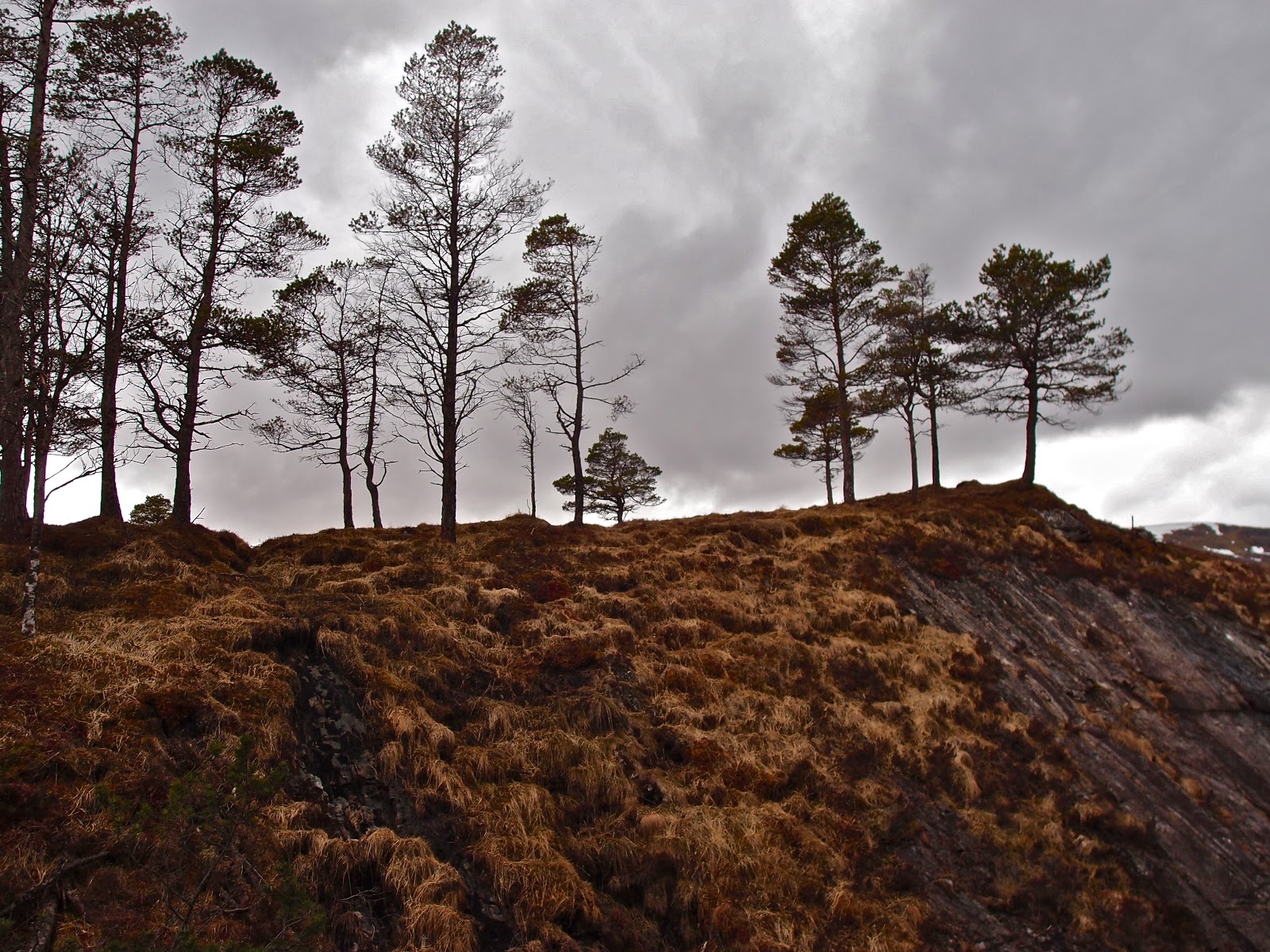
Uphill shadows

Carn Dearg and Sgor Ghaibhre to Ben Alder

Loch Ericht and Rannoch from Stob an Aonach Mhoir

Loch Ericht and the Fara from Stob an Aonach Mhoir


Three cairns on Beinn Mholach

Beinn Mholach from Beinn Bhoidheach

Schiehallion across Loch Rannoch
Ascent:         1320 metres
Distance:      22 kilometre cycle, 19 kilometre walk
Time:            6 hours 35 minutes

c   Stob an Aonach Mhoir      855m      2hr 2mins 
u   Glas Mheal Mor                830m      3hrs 15mins
c   Beinn Mholach                  841m      4hrs 25mins

These two corbetts have been niggling me for the past year, could they be done together and if so from where?  It is probably quicker to drive up the A9 and start from Dalnaspidal Lodge but Loch Rannoch is a much more scenic approach and avoids the dreaded A9. The forecasts were showing a brief respite from the showers and wind that have been battering us for the last few days. I was up at 6:30am and away by 7:30am after loading the bike for the two hour drive to Bridge of Ericht at the western end of Loch Rannoch. It was cool but the wind had abated and the blue skies had a whiteness to them which suggested some fickle weather later in the day. I arrived at the Bridge of Ericht surprised to see the gate missing on the private road to Corrievarkie. The man in the adjacent cottage told me there was no problem in parking or cycling up the road which was metalled and a better surface than many local roads.

The gradient was steady although it rises from 200 metres to 600 metres over the 11 kilometres to the start of the walk. The views were ever changing with the white capped hills from Carn Dearg to Ben Alder provided a panorama of many previous adventures. After leaving the forest where a giant steel pipe crossed the river below, there was another gate and then the Loch Ericht dam came into view. After the turn off to the dam the road curves to the right and steepens again but it was all perfectly rideable. I was a bit surprised to find a vehicle parked a couple of kilometres further along. Judging by the gear on the seats, a walker had obviously taken advantage of the open gate and saved themselves a few hours. I abandoned the bike and started the walk at a point just south of Stob an Aonach Mhoir where the road begins its final ascent before dropping to Corrievarkie House.

I figured that I would climb Stob an Aonach Mhoir first whilst the blue skies prevailed and then cut across to Glas Mheal Mor  en route for Beinn Mholach. It meant walking another 400 metres or so up the road but then I headed onto the hillside climbing almost due north for the first hill. The ground was boggy and flutes of wet snow slowed progress as each step involved sinking into the wet snow. My goretex running shoes were not much of a defence in these conditions. I watched in awe as a couple of mountain hares, still in their winter whites, accelerated up the hill as I approached. I was thinking that this is good eagle territory. I made for a rock scarp just below the summit and on climbing it came face to face with a golden eagle no more than 30 metres away. It had flown and was several hundred metres away before I retrieved and fired the camera.

The ascent may be a bit of a plod up undistinguished slopes but like all corbetts there is always something good.  Here it was the view, one of the very best. Loch Ericht was a rich cobalt blue and across were Beinn Beoil with its splendid corrie yoked together as one with Ben Alder, both hills resplendent in their dazzling white caps.  The views up and down Loch Ericht were equally stunning, I loitered for a while, eating an early lunch and rotating my head mesmerised by the views and watching out for the return of the eagle.

The descent was quick and easy. I crossed the road about 800 metres north of where I had left the bike. It was tricky going over the peat hags and burns swollen with snowmelt that made for difficult walking. I headed roughly for the shoulder of Glas Mheal Mor and as I started to climb a herd of 50 or 60 deer scarpered southwards. There was a large snowfield which I tramped through and then, still feeling frisky, I decided to climb the extra 50 metres or so to Glas Mheal Mor. It is the dominant hill from the north west but unclassified in the annals of Scottish hills which are based upon the minimum drop of 150 metre rule rather than any sense of relative importance.

The route across to Beinn Mholach was tedious with lots of peat hags as I traversed under Beinn Bhoidheach. The burns were all covered in snow and crossing them was a game of chance. Finally 200 metres of climbing eastwards to the summit of Beinn Mholach and there seemed no redeeming features. Until reaching the summit, what a magnificent cairn! It is superbly constructed and set next to a forlorn looking trig point with the daddy of all cairns, Schiehallion, looking on from the south east.

If the walk up Beinn Mholach was tedious the descent was worse, I went to the south of Beinn Bhoidheach, which was mistake, and then had to cross 3 kilometres of peat bogs and snow fields to get back to the bike, it seemed interminable. The day had been clouding over and a wind had sprung up from the south west.

The cycle out was mainly downhill but against the wind with several climbs as well. On the descents my eyes were watering and I tried to avoid using the brakes which worked until the bend with the road to the dam when I had to decide between a ditch and the brakes and the brakes won. The last few kilometres flew by helped by some lapwings practising their manoeuvres and peewitting to each other. I hurtled down the final section and despite stops, the ride out had taken only 35minutes. On the journey home I was mesmerised by the views of Loch Rannoch, watched over by the magnificent Schiehallion. It looked like a giant toblerone but maybe I had not taken enough food for the day. It rained as I drove back through Fortingal and along Loch Tay, I had judged the day perfectly.


Saturday, 27 April 2013

Bute: a full day

Mount Stuart House
In the days of integrated transport

Wemyss Bay, a splendid Victorian station

Spring rising in Mount Stuart

Mountstuart from the east

Looking over the Clyde to Largs

Mountstuart grounds
Rhododendrons and Almond blossom in the wee garden

Mountstuart coastal walk

Goat Fell on Arran from Scalpsie on Bute

Rothesay sea views

Rothesay with Arran peaks behind
Some days take on a life of their own, and today was one of those. The early morning sun was unusual, and I suggested a day on the coast rather than going for a run or heading for the hills. We decided to go to Bute and visit Mount Stuart House, the restored ancestral home of the Marquess of Bute. It was only opened to the public in 1993 as an attempt to arrest the decline in visitor numbers to Rothesay, which had occurred in the 1980s as Scotland fell on hard times and foreign holidays diverted expenditure away from Scotland's traditional holiday resorts on the Clyde.

I had visited Bute often in the 1970s, either 'going doon the watter' on the Waverley paddle steamer, catching a train to Wemyss Bay and hiring a bike to cycle around the island or sailing into Rothesay to collect one of the crew for a weekend sailing event on the Clyde. Alas, I had not been to Rothesay for over thirty years. I had never visited Mount Stuart before, despite its growing reputation as one of Scotland's finest buildings. 

Mount Stuart House is 5 miles south of Rothesay and sits in well-tended grounds that look over the Clyde estuary to the east. It is an absolutely exquisite neo-Gothic building constructed with the finest Italian marble and Dumfries red sandstone, fitted out with English oak and containing an art collection that would be the envy of most national art galleries. The house replaced one that had been razed to the ground in 1877. It was conceived by the third Marquess of Bute (1847 - 1900). He was an antiquarian, scholar, polymath, linguist, philanthropist and architectural patron. He commissioned Sir Robert Rowand Anderson to prepare plans for this second Mount Stuart in 1879.

Construction began in 1880 with a jetty and horse-drawn rail track constructed first to bring in the stone, marble and timbers. It was built by a massive assembly of British craftsmen. They continued until 1912, well after the death of the third Marquess. Shortly afterwards, it became a field hospital during the Great War. It was the first house to be designed to use electricity, it had central heating, a marble swimming pool and contained four chapels. No expense was spared; this level of investment was only possible because of the huge wealth of the Bute family, who, through several generations of canny marriages, owned large parts of Sussex, South Wales, Bedfordshire and Dumfries as well as the Island of Bute. 

It was a mightily impressive and informative tour of the house, and the pleasure continued during a five-mile walk around the grounds and gardens and then back along the beach. The sea was benign, and all plant life seemed to be bursting with scent and colour. It was 4pm, and there was time to drive around the island, admiring the soaring peaks on Arran, the rich grazing lands, which support llamas and alpacas as well as sheep and cattle, and the glorious beaches. We returned to the faded charm of Rothesay, which is littered with fine Victorian and Edwardian villas and hotels. It was quiet, and the buzz of yesteryear had disappeared along with the day-trippers. The reward was a good fish supper from the Sqab Lobster cabin on the seafront, eaten in one of the shelters. I tried to visit the magnificent Victorian urinals on the harbour, but they had closed early.

The evening ferry back to Wemyss Bay allowed us a full appreciation of the Clyde estuary. We took the less travelled coast road past the Clock lighthouse, through Gourock and West Greenock with their splendid houses sparkling in the evening light. Then, we went through the depressing town centre and former industrial sites that were home to shipbuilding and sugar refineries, but now support Tesco and other unattractive retail activities that could be anywhere. The roundabout by the town hall is an exemplar of everything that is wrong about town centre redevelopment: people and buildings sacrificed to vehicles. But, amidst all of this carnage and post-industrial developer tat, the views across the Clyde towards the Cowal peninsula reminded us that the rich industrial heritage that had flourished in the first half of the twentieth century was matched by some of Scotland's best coastal landscapes.

Victorian Urinals in Rothesay - pissing heaven

Friday, 26 April 2013

Baroness Thatcher: Zeitgeist or Mammon?

Well, that's one perspective

We have been exposed to the life and times of Mrs Thatcher incessantly for the past week, and the funeral has taken place. Her ability to ensure diametrically opposed views has never been in doubt, nor has the impact she made on life in Britain in the 1980s. Living and working in Scotland, it was easy to blame her for the collapse of traditional industries and the deepening social malaise that ravaged the country.

It would not be totally fair to attribute the economic decline to her government; industries were already collapsing, and a new direction was needed, but not the one she took. Throughout her period in office, Scotland was in the doldrums, as were several other regions in the UK that had hosted traditional manufacturing industries. The recovery of the economy in Scotland, as with much of the north of England, took a lot longer than in the southeast of England. It did not materialise in Scotland until the late 1990s after public services were given a reprieve following the 1997 election. This period of sustained growth and improvement lasted until 2008, when the testosterone-charged financial sector dumped the UK into a double recession. 

On the spread of social malaise, Mrs Thatcher's government was totally culpable: high unemployment, underinvestment in education, health and the public infrastructure, increasing crime and growing inequalities were all a consequence of her doctrinaire government's decisions.

The main question about the Thatcher legacy is whether there really was a revitalisation of the UK economy and, if so, whether it could have been achieved by a less doctrinaire approach with a greater focus on Scotland, Wales, Northern Ireland and the regions of England other than London and the southeast. One that worked with the grain of the Scottish work ethic and its sense of community rather than one which endorsed free markets, outsourced or privatised public services and encouraged the making of money rather than tangible assets.

There are lots of ways to consider her impact but there are some common themes that emerge whichever way you look at them.

The GDP of the UK stagnated during her premiership. In practice, it plummeted during the first three or four years and slowly recovered during the "loads of money" phase before dipping again. At the end of her period of office, our manufacturing sector had been reduced to just 15% of the economy. Britain, unlike Germany, Italy or France, puts a little premium on safeguarding our key manufacturing industries. Mercedes, Bosch, Fiat, Indesit and Renault have survived and thrived as have the key public infrastructure organisations in other parts of Europe. In direct contrast, Britain under Thatcher vested its trust in the markets and serving Mammon. Instead of reversing this aggressive neoliberalism, the heirs of Thatcher's economic policy- Major, Blair and Brown- were all culpable of continuing to place their trust in the financial markets and outsourcing services.  

Contrast that with Germany or Italy, where more consultative industrial relations saw the maintenance or growth in manufacturing by investing in productivity. Germany nurtured its manufacturing industries and made it Europe's strongest economy today. In Britain, many of the industries that were sacrificed were state-owned. They needed new investment to improve productivity but selling them off was more of a doctrinaire fire sale with little attempt to secure long-term investment from bidding companies that were often seeking to break up the business and sell off the disposable assets. They had little commitment to securing the future of the industries or the communities that were dependent on them.

Her government was far less active in the encouragement of research, design and innovation, which are the drivers of a more sustainable economy. Instead, there was a far greater emphasis on marketing and selling, wheeling and dealing, sponsoring and leveraging. Enterprise requires confidence, and the consumer confidence index ended up at the end of her premiership pretty much where it started at -25%, after a sharp but short-lived peak amid the Lawson inflationary years of 1988-89. And despite the extravagant increase in the wealth of many citizens, the UK had a slower rise in living standards per capita than either France or Italy, and we lagged 17% behind that of Germany by 1990.

The sale of Council Housing, which allowed over a million households to transfer to owner-occupation, is often cited as her most popular policy.  For those tenants who lived in a desirable area and had long tenancies, this was the case. But for many other tenants, the policy denied them a transfer to a better house and retained them in residual and unloved estates. For future needy tenants, particularly the young and the mobile workforce, it consigned them to a poorly regulated private rented sector or to staying at home. Council housing became more stigmatised, and social polarisation intensified. Social rented housing made up 34% of the UK housing stock in 1979 but dropped to 26% in 1990. Social housebuilding declined by 70% over the Thatcher years.

There was a commensurate rise in owner-occupation from 55% to 66%. But even private house building rates dropped by 20% during her premiership to 203,000 in 1990.  House prices rose by 61% in real terms, spurred on by the shortages that were becoming manifest. So whilst the cost of housing was rising, the construction sector was in decline. It was the estate agents, banks, surveyors and private landlords who benefited. In other words, the middlemen made huge gains from the vastly increased expenditure on housing, which was inflated by the unsustainable but ready access to credit.

Our public services of Education, Health, Transport, and Water were starved of investment, and this created a mood of disillusionment from the long-suffering parents, patients, and customers, as well as the increasingly maligned public sector workforces. They were being softened up for privatisation, followed in the 1990s for water, rail, waste collection and disposal, residential homes, airports, road and building maintenance, and numerous other functions. Many public services were transferred to what often became private monopolies. The long-established links and mainly effective links between local small and medium-sized businesses and local public services were lost, whilst costs from the large nationwide contractors and their financiers were ratcheted up

Crime soared along with the increase in unemployment, and many cities were ravaged by riots. Stable communities that had grown up around the extraction or utilisation of natural resources became ghost towns as profits and jobs migrated to the southeast.

On the world stage, she did holler for Britain, and the victory in the Falklands gave her a reputation for ruthlessness which restored Britain's status as an aggressive power not yet willing or having the nous to find a new role in the world order.  This was less a victory than a relapse that prevented Britain from taking a lead in fighting apartheid, tackling world poverty or safeguarding the environment. Was it sustainable or sensible for Britain to continue to spend the third-highest proportion of its GDP on defence, after the USA and Russia?

So Mrs Thatcher may have been a conviction politician. She raised the profile of the UK abroad by playing her cards with an assurance that was not always prudent or likely to win friends. But at home, the growing social polarisation, the failure to invest in public services or to trust localities and the encouragement of a culture of untrammelled wealth for the middlemen made her the mother of a two-nation Toryism who was blind to any alternative strategy.

Her government did free some entrepreneurial activities, but she brought discord where there was once partnership between the public and private sectors, and havoc where there had once been harmony. She created a license for private finance to rip into public sector budgets and to take an ever-increasing share of increasingly ring-fenced budgets. The losers were local businesses, taxpayers and the recipients of services who were now funding the middlemen as well as those who delivered services. The middlemen behaved like a post-industrial nation of shopkeepers as they milked their customers not once but twice, first on fees and then on annual charges.

She gambled away North Sea oil and allowed the financial sector to play footsie with our pensions. The hope and aspirations of more affluent households might have been realised through share issues, housing inflation, easy credit and tax reductions. Conversely, many millions more were unable to afford to get on the ladder of prosperity stoked up by share issues, rampant inflation and deregulation. Growing inequality, outsourcing and the decline of public services rather than the restoration of the glory days were her undisputable legacies.

So, as we watch her once disloyal and rumbustious cabinet of 1990, who removed her from office, engage in an extravagant bout of sycophantic sophistry about her achievements, those who were the victims of the era have remembered the damage her policies inflicted on their lives. It may have appeared unseemly and callous behaviour when they protested before and during the funeral, but they were not for turning. They had seen no good or greatness emanating from the Iron Lady; their views were based on an annuity of authentic anger. It was a more honest response than the gratuitous praise heaped on her by her cabinet and fellow travellers.

Nil Magnum Nisi Bonum

Saturday, 20 April 2013

Loch Ossian round

Ascent of Carn Dearg. Loch Ossian, Ben Nevis and Grey Corries in distance

Bridge of Orchy as the train arrives
Beinn na Lap from flank of Carn Dearg
Sgor Ghaibhre and Ben Alder from Carn Dearg
Corrour Lodge: Andrew Gormley's Hear and Hear  
Ascent of burn from Loch Ossian to Beinn na Lap 
 The tree line below Beinn na Lap
Sgor Ghaibhre and Carn Dearg from Beinn na Lap
Ossian Youth Hostel and Pine islands on Loch Ossian

Ascent:          1445 metres
Distance:        24 kilometres
Time:             6 hours 29 minutes

Carn Dearg          941m       1hr 40mins
Sgor Ghaibhre     955m       2hrs 30mins
Beinn na Lap       935m       5hrs 23mins

As a day out in the Scottish hills the Loch Ossian round has it all. A train ride across Rannoch Moor before being deposited at Corrour, Britian's most remote and highest railway station. Three remote and tough hills and distant vistas to Glencoe, the Mamores and Grey Corries.  The pyramidal Schiehallion is an ever present sentinel and Ben Alder forms a barrier to the east. The forecast was fine, the day was dull, the walk was on the wild side.

We had only decided to walk late of Friday evening and I had suggested the Loch Ossian round before checking the train times. We had 7 hours between arriving and catching the 6:25pm train back to Bridge of Orchy. Irvine Butterfield had indicated the walk took between 7 hours and 11 hours in his excellent book 'The High Mountains of Britain and Ireland'. I knew from many of his other walks that the lower estimate gave no respite. When I had done the round 15 years ago my time was 6hrs 56mins, although it was in December and I had descended Beinn na Lap in the dark. I tried to allay the fears of Gregor and John, who did not relish missing the last train, by setting a schedule for the round and giving us an opt out, if necessary, after the first two hills. But I knew full well that we would probably go for it anyway.

The train journey was a happy half hour: the conductor teased me about my rail pass, the trolley lady provided humour and hospitality as she explained she was finishing her shift when she got back to Fort William. She had started at 6am and she had arranged a surprise 65th birthday party for her husband so the trolley would not be going to Mallaig today. The train was full of walkers drooling at the wild and uncompromising wilderness of Rannoch Moor. The carriages provided the type of clickety clack beat that is beyond the melody of modern trains. The journey is worth it for the views and rail staff alone.

Arriving at Corrour we wasted no time and set out at a strong pace for Loch Ossian and from there the path that cuts south of Loch Ossian and under Meall na Lice and onto the road to the isles path. At 520 metres we left the path and started the long climb up the west flank of Carn Dearg. There were patches of snow and the going through the deep heathers was tough until we reached the spur at 750 metres from where there is a faint path through the short grass that curves round to the summit of Carn Dearg with its fine cairn. The views back to the west were clear but the skies looked ominously grey over Ben Nevis and the Grey Corries. Ahead was the drop to the bealach before the long climb to Stob Ghaibhre. It was festooned with fingers of wet snow and beyond was the Ben Alder plateau looking moody and drab. We had a bite to eat on Carn Dearg and, as we were well ahead of schedule, we were more relaxed on the descent down the snow to the bealach but the pace did not slacken as we climbed the 240 metres to the summit of Stob Ghaibhre.

We made it in quick time but did not stop as there was no protection from the cold west wind.  We decided to descend to the shelter of the loch. We cut under the Sgor Choinnich, the adjacent top, and schussed down the fingers of snow before contouring round the hill and descending to where a track emerged from the forest. There was a dam to cross and then a walk through the forest to the superbly restored cottages and farm buildings at Corrour Estate.

We walked past the expensive Corrour Lodge hotel that sits overlooking the eastern extremity of Loch Ossian and is well protected by high railings and occupied by top of the range 4x4 vehicles. A statue by Andrew Gormley similar to those on Crosby beach looks out over the loch. Loch Ossian is another place and the statue here is named Hear and Hear.  John Stirling Maxwell, the pioneer of conifer plantations on peat, had bequeathed some fine specimen trees planted in 1892 as well as a wide variety of rhododendrons along the shores of the loch. He went on to be a founder member of the Forestry Commission, President of the National Trust and champion of green places in cities, most notably for Pollock Grounds in Glasgow.

I had previously ascended Beinn na Lap from Strath Ossian but on this occasion we walked along the north shore of Loch Ossian for a mile or so until we reached a path ascending through the plantation alongside a sparkling mountain stream. We stopped first to finish our food, we had 3 hours left before the train and were still 15 minutes ahead of schedule despite some playful behaviour at the dam and dallying to look at the Corrour developments.

It was a good decision, the path took us up a gorge which was spectacular before we emerged onto the open hillside which presented us with a boggy tract as we headed directly for the summit. As the gradient increased the ground conditions improved, with rock bands, snow patches, grass and lichens replacing the bog. We hit the summit at 5pm as a couple of ravens circled the cairn. There was still time for a break and to catch some photos. The day had become darker and rain was imminent with Ben Nevis and the Mamores already cloaked in cloud.

We descended along the ridge to the west at first and then started a long but easy traverse towards the track at the end of the loch as the heavens opened and gave us an early shower. It took 40 minutes to reach the track and from there another 15 minutes to reach the station . To our surprise a restaurant had opened in the former station house but with only twenty minutes until the train there was no time for any food or drink. About 25 walkers were gathered in the shelter and the train appeared spot on time to whisk us back from the magic of Loch Ossian and what had been another enjoyable circumnavigation of Ossian's furtive munros.

Friday, 19 April 2013

Bheinn Bhuidhe

Summit looking south-east to Ben Lomond and Arrochar Alps

Friday, 19 April 2013

Ascent:          1010m
Distance:        8km walk, 16km cycle
Time:             4 hours  19 minutes

m  Beinn Bhuidhe    946m      2hrs 27mins (including 29mins cycle)

At last a fine day after the rain and wind of the last couple of weeks. The nearest unclimbed Munro was Beinn Bhuidhe at the head of Loch Fyne, a shy hill hiding behind a long ridge. There is a long trek of 8 kilometres along the private road before the climbing begins from Inverchorachan cottage, a derelict house at the end of the track. I had taken the bike to speed the trip and avoid the long walk in and out on the road. A new bar/cafe had appeared at the first farm but there was no sign of it being open, however, it had opened as I was returning mid-afternoon. Further along the road I became embroiled in a peloton of Highland cattle with half a dozen calves. Apart from this, it was a pleasant cycle, climbing just 100 metres over the 8km.

I dumped the bike behind the cottage as I have done on three previous trips and began the steep climb up a well-used path that follows the burn up to a large corrie which is capped by a spectacular waterfall at 500 metres. The climb has a couple of exposed sections over wet rock. I was a bit slow after a run the night before but I kept an even pace until the flatter sections at 650metres where I halted for a drink and some food and watched as a herd of deer dispersed. I had camped here late on a Friday evening after work on my last visit and climbed the hill first thing the next morning before going to Mull to climb Ben More and then spending the Sunday on Iona.

The snow of recent weeks was disappearing fast and I had to select a route to climb the last 200 metres to the long ridge of Beinn Bhuidhe. I chose the deep gulley to the east and after a bit of scrambling up rocky sections, I arrived at the long southwest to northeast ridge about a kilometre to the northeast of the summit. The view from below is deceptive with the summit at the extreme left of the photo. The hill was more yellow than green as the name implies and today it had no other visitors. The views were clear in all directions and it was warm enough to sit in the sun and admire the panorama.

I tidied up the cairn before eating an orange, sending a photo to a friend in Shetland and then returning via the ramp shown to the left of the photo. It was a more sensible route and the descent was made at a good pace. The going on the return was very boggy across the southeast flank of the hill, alongside and then down the steep path. The cycle out was into a stiff breeze blowing up Loch Fyne but the afternoon sun was warm and sparkling on the river which was compensation enough. I was back at the car as planned for 3:30pm and home for 4:45pm despite the never-ending road works on the Rest and Be Thankful and the heavy docile weekend traffic along Loch Lomond. 


Highland calves in Glen Fynne
The waterfall above Inverchorachan cottage

View northeast to Ben More and Stobbinnein

Stac a Churn, west of the summit

Take the ramp to the far left below the hidden summit


Sunday, 7 April 2013

Senior Moment(s)


For Tova

Senior moments are often used to describe those times we forget or act with less acuity than used to be the case. Such as when you forget to get off the bus at the right stop, forget to bring back that celebratory glass of whisky that you had poured yourself, or as a friend recently told me put the phone into the sink instead of her empty coffee cup. My worst senior moment was when, shortly after my 60th birthday, I ordered the pensioner's special £5 pub lunch after a long morning walk in the mountains; two other members of the family tucked into a filling lunch whilst I was given a portion that would have failed to satisfy an anorexic child, and then I had to pay for it all.

These sort of senior moments happen more frequently than they used to and are the source of gentle teasing but there are also some very good things to offset these moments. My wallet now contains an entitlement card which gives me free bus travel, a senior railcard and my winter heating allowance pays for about three weeks of heating costs. But most of all I now know the value of time but not the cost of it.

It was a joy to watch Joan Bakewell on 'Have I got News for You' last night, she provided an exemplar of senior humour and wit that even Ian Hyslop could not help enjoying.  She showed us that senior moments can also be wise, full of empathy, justice, courage, fun and fulfilment. She proved that old lives matter, they could even become the new black.

I woke up early this morning and texted my daughter to tell her that today would be the day. I then went for a run wearing just shorts and a T-shirt for the first time all year as the spring sunshine wiped away the overnight frost. The daffodils were out at last and the snowdrops were finally fading after the coldest March on record. I then converted some of my old film camera lenses to fit a digital camera that I had just bought and tested them in the midday sun and was pleased with the results.

But the greatest of all senior moments is when you become a grandparent, endowing another generation with enduring love. The bodings were good as Eva went to the hospital late afternoon and our granddaughter was born at 1:50am. Now, where did I leave that glass of whisky?

Tova 


Saturday, 30 March 2013

Breakfast at Lime Craig

Cruach Ardrain, Stob Binnein and Ben More

Ben Lomond

Ben Ledi

Nine o' clock shadow
After two weeks of bitterly cold east winds, snow flurries and mammals still in hibernation, easter Saturday brought sunshine, still air, hard frozen ground and bird life making whoopee. I was inspired to run up Lime Craig to take in the views, this despite tired legs from five days running this week, . It was a slow plod, 300 metres of ascent and a round circuit of 11 kilometres is a big ask before breakfast. There was some snow left at the top but the general snow level on the hills seemed to be at about 600 metres.

On the descent I came head to head with the competitors in a mountain bike event, the first customers were zinging along the zip wires at Go Ape and the village was all puffed up with visitors. Now for breakfast.

Thursday, 28 March 2013

Slums, Dogs, Billionaires


Danny Boyle was interviewed last night on the Culture Show by Mark Kermode. Ostensibly, this was about his new film Trance, although it was more a profile of a life less ordinary. Not only is he a prolific film-maker and national treasure, but he was also the artistic director of the Olympic spectacular opening ceremony. The programme prompted lots of thoughts. Why is someone so grounded in northern reality able to make the harsh realities of ordinary lives into fantasies? And why are the coalition government equally adept at translating their policy fantasies into harsh realities for ordinary folk?

The answer was probably hinted at when Boyle, brought up a catholic and at one time destined for the priesthood, described himself as "a very flexible, malleable atheist, not an agnostic". Someone whose spirituality and faith are authentic but doused in the school of life. Someone who is genuinely interested in people and their circumstances and wants to convey them so that society understands the power and frailty of the human condition. Speaking about the Olympic opening ceremony, he attributed its success to the volunteers from the NHS and elsewhere. He explained that when asked to direct the ceremony in June 2010, many people were certain it would be a disaster. But he thought he was qualified to give it a shot. He lived in the area, probably had enough authority to force through his ideas, and most of all trusted the cast of volunteers. It was mutually inspiring and he realised that "it might not be shite."

The programme followed several news items over the past few days that could be seen as the coalition's attempt to reprise Slumdog Millionaire with their own twist of fate. We had Ian Duncan Smith telling the poor, the downtrodden and the disabled that they would lose their benefits if they under-occupied houses. An extra bedroom is often required for storage in the tiny properties and future slums currently being built in many of our towns and cities. Duncan Smith believes it justifies issuing warrants to move tenants to properties with fewer rooms for those in rented accommodation. Yet it is an inescapable fact that the greatest level of under-occupancy, measured by either rooms or square metres, is by our wealthy retired, single-person and two-person households and by second homeowners.

Compare the average household size in Kensington and Chelsea (2.02 persons per house), where houses are well endowed with space and rooms, and the population is declining, with rapidly growing Newham, the location of the Olympic village. It has not only the highest level of poverty but also the highest average household size, 3.01 persons per house. Needless to say, houses here have fewer rooms and are smaller. Yet Council Tax payments for band H properties, large detached houses or apartments, often five or six times as large and gurgling with water-based devices, are only twice that of a shoebox-sized, one-bathroom and two-bedroom rented house occupied by Duncan Smith's victims. The unfairness is palpable and exacerbated by the tax evasion tendencies of many of the wealthy occupants of the larger properties.  To make matters worse, the new planning legislation introduced by Eric Pickles has been doctored to allow more new private houses to be built on greenfield sites. This will make it less likely that run-down inner city housing will be redeveloped with a proportion of social housing. The outcome will be a further increase in overcrowding and confining more people to live in the coalition's slums.

Next, we heard of the tragic death of a young girl in Lancashire, only 10 miles from Boyle's home town of Radcliffe. She was savaged by five dogs, including a couple of Staffordshire Bull Terriers. The government had failed to take any action on proposals to change the law surrounding dangerous dogs, which were put forward by the select committee following several similar incidents in recent years. The select committee recommended extending the law to include dogs on private property and the introduction of dog control notices, which are used in Scotland. A dangerous dog tax would make far more sense than the bedroom tax.

Early in the week, one of the UK's many wealthy billionaire Russian citizens was found dead, following several unsuccessful assassination attempts. London has more billionaires than any city in the world, and Boris Berezovsky was one of those who had been found guilty of fraud and embezzlement in Russia, as well as supporting Boris Yeltsin.  He bought his way into the UK in a way that the asylum seekers could never achieve. An interesting twist on the way that scroungers and strivers are often classified the wrong way around. But then the coalition has never deviated from its underlying principle of allowing power and money to hold sway in the lottery of life.

All of these events occurred after we were told that the government had agreed to spend £150m on adapting the Olympic stadium to accommodate West Ham United, who will have to find £15m, or half the price of Andy Carroll.  The legacy of the Olympics is that Britain's 68th richest man, worth £500m acquired from owning half the porn industry in Britain and convicted of living off immoral earnings, gets £150m of government funding. Meanwhile, funding for sports across the country has been drastically cut, and local sports clubs are struggling to meet the interests of youngsters inspired by the Olympics. Stadiums such as the athletic track in Sheffield are closing. The government truly live in a trance.

This week's stories alone should make us think about someone like Danny becoming champion of the world, or at least PM; it might just stop the government's decisions being shite.

Wednesday, 13 March 2013

Buchaille Etive Mor

Buchaille Etive Mor
This is a mountain for special days and this was my first day as a bona fide pensioner. After the recent snows and with the continuance of cold northerly winds, I guessed that the Buchaille would be in good condition for a winter climb. I had been saving it for a summer's day but this was my nearest unclimbed Munro, there were no avalanche warnings and my crampons were getting rusty and needed a polish.

Wednesday, 13 March 2013

Ascent:     1205 metres
Distance:  14 kilometres
Time:        6 hours 58 minutes
m  Stob Dearg              1022m        2hrs 36mins
t    Stob na Doire          1011m        3hrs 37mins
t    Stob Coire Altrium    941m        4hrs 28mins
m  Stob na Broige          956m         4hrs 49mins 

Coire na Tulaich
Stob na Doire
Bidean nam Bian from Stob na Broige

Ben Starav and Loch Etive from Stob na Broige

John on Stob na Broige

It was a reasonably early start at 7:45am and after collecting John from Blairgarry, we parked and walked from Altnafeadh on the A82 by 9:40am. This was my sixth visit to this inspirational mountain and I knew from previous visits that whilst Stob Dearg may provide the iconic view to passing traffic, once you reach the ridge it is the most tedious ascent of the four peaks that make for a splendid ridge walk. Getting to the ridge is a different matter and would require some winter walking skills on a day when it was below freezing at road level and the snow and ice looked to be welded onto the upper reaches of the mountain.

We crossed the wooden bridge and walked into Coire na Tulaich. Looking at the head wall plastered with snow we decided to climb the buttress to the right but after ten minutes we came across pillows of ice. We contoured back round to the corrie and followed the path until it too became impassable with ice. It was time for crampons and ice axes. There was a party of four well ahead and they were roping up for the steep section leading to the col at the head of the corrie. From 600 metres we were climbing the snow slopes which were becoming ever steeper, we veered to the right to avoid the roped party but seemed to have inadvertently selected the steepest gully.

The snow was hard and in places, the sun of yesterday had converted it to boiler plates of ice. We were climbing on adrenaline, hoping that our ice axe skills would hold us if we lost our footing, at least there were no cliffs at the foot of the slope, just a jumble of rocks. The final 75 metres of the climb are at an angle of 45 degrees but each step was getting us nearer the ridge. It was an immense sense of relief as we hauled ourselves onto the col after 40 minutes of kicking our crampons and planting our ice axes into the snow and ice.

The walk over to Stob Dearg from the col is a steady plod; there is no sense that you are climbing one of the finest-looking mountains in Scotland and the final flatter section drags out for 400 metres before the cairn. We were there for midday. The cold northerly breeze which had been absent in the corrie soon cooled us down and after some food and coffee, we put on extra layers for the walk along the ridge. Stob na Doire looked very inviting with a finely sculpted ridge of snow and it seemed massive compared to Stob na Broige and its top beyond. The sun made some intermittent appearances although a layer of dark cloud was massing over the Mamores to the north. Despite the steepness of the ascent, it was an easier climb but crampons were still needed for the frequent icy sections. At the top of Coire na Doire we looked back and saw the party of four who had eventually made the climb up the corrie and looked to be heading across the ridge towards Stob na Doire.

We headed down the steep descent, carefully threading the rocks and ice bands to reach the col below Stob Coire Altrium. Above here there was thick snow all the way to the top which arcs around in a perfect crescent. The cornice was collapsing in places so we kept our distance, a lesson we had learnt the hard way on Meall na Teanga many years ago when John had fallen 75 metres through the cornice but landed in soft snow. The walk across to the Munro of Stob na Broige is a comparatively easy section with tantalising views down Glen Etive with the massive presence of Bidean nam Bian and all its satellites forming the views to the west.

We had completed the traverse of the ridge and after a few photos, we returned to the col below Stob Coire Altrium and found a route down the snowfields to Lairig Gartain. There was still a lot of ice down to 600 metres. Below this, there were several herds of deer grazing and we crossed the frozen river Coupall without getting wet feet. I reminded John of a previous walk when I had descended directly from Stob na Broige to the Lairig Gartain on the way to climbing Buchaille Etive Beag, a brutal descent that should be avoided at all costs. John reminded me that we had also made that descent in 1991 and he thought I would have known better than repeat the mistake.

The walkout is on a good footpath alongside the river Coupall; we made good time as it started to snow or whatever you call micro hail. The thought of reaching the A82 was unusually appealing although the last kilometre of walking alongside the road made me angry at the littering habits of the motorist. Maybe it is just my prejudice but coke bottles and cigarette packets seemed to predominate. We were back at the car by 5 p.m. after a classic winter outing and the birthday boy was back home at 6:30 p.m.

Bidean, Buchaille Etive Beag and Mamores from Stob na Broige