Tuesday, 4 July 2017

Sheffield Pike, Ullswater

Ullswater from Sheffield Pike

Monday, 3 July 2017

Ascent:         753 metres
Distance:     9 kilometres
Time:           2 hours 36 minutes

Glenridding Dodd     434m          24mins
Sheffield Pike            680m          59mins
Hartside                     756m   1hr 39mins


The joy of walking in the Lake District after long hard days in the Scottish hills is always appreciated. We had visitors for the first two days of Langdale so walks were on the flat but Monday morning brought a chance to escape to the fells. It was raining as we left at 9am but the forecast promised that it would be dry later in the day. We had more visitors arriving at 1pm so we had decided to drive to Glenridding for a short outing to climb its Dodd and Sheffield Pike. These two were part of Gregor's remaining Wainwrights, he has only a couple of larger groups of hills and they are in the nether regions so it is an exercise of tidying up hills one by one.

We parked on the Greenside road to the former lead mine and found the narrow steep path that begins just before a row of slate cottages. It is a relentless incline up the rake on a grassy path though the deep bracken but we were feeling fresh and soon standing on the summit admiring the long view of Ullswater to the north east. Apparently this was a favourite viewpoint of the Victorians. The path has languished since then and is unusually untrampled for the Lake District.

We returned to the top of the rake and began the longer climb up the craggy ridge towards Sheffield Pike. There is a flatter section over boggy ground before the final rise to the summit. We met a couple of older walkers at the untidy cairn and exchanged banter before Gregor sauntered off to get a better photo of Ullswater. He provided the focus for me to get an even better shot of Ullswater from the summit. We had made excellent time so I suggested that we attempt Hartside, another of Gregor's remaining hills. Although it would add an extra 4 kilometres and 200 metres of climbing we could still make it back for 1pm.

There is a hundred metre to drop to a col before a steady climb to Glencoyne Head and then a traverse along a boggy path to the distant ridge of Hartside. It would not rank in the top 200 of Wainwright's  list of 214 hills that he had defined without any guiding rules about the minimum cent between hills. We wasted no time at the mere bump of a summit and returned to the col from where we took the route down to the former lead mines through bog, rock bands and disused tips. We passed a second group of teenage girls who were labouring up the path with packs that would demoralise them for future walking. We reached the lead mine cottages and buildings before noon.

I was reminded of reading a book by the late Brian Redhead, the presenter of the Today programme until 1992. He had been evacuated from Newcastle to here during the war and wrote about his love of the Lake District. He described his role as chair of the friends of national parks as being "not ours but ours to look after" for the benefit of future generations; a fine sentiment that should be enshrined in other public appointments.

He would have been pleased at the refurbishment of the buildings of the lead mine and the nearby Youth Hostel. Walkers of all ages and nationalities were sampling the delights of Greenside as shafts of midday sun began to light the skies and green the hills. We were back at the car by 12:15pm and in Langdale 10 minutes ahead of our deadline. A good morning's walk to sustain us for an afternoon stroll in the valley.

On Glenridding Dodd towards Ullswater

Helvellyn

Lead Mines

Greenside

Glenridding

Wednesday, 21 June 2017

Fannaichs

Sgurr nan Clach Geala summit towards Sgurr nan Each

Monday/Tuesday, 19/20 June 2017

Ascent:       2720 metres
Distance:    38 kilometres
Time:          13 hours 21 minutes

An Coileachan                       923m      2hrs 51mins    
*Meall Gorm S.E. top           922m      3hrs 33mins
Meall Gorm                           949m      3hrs 50mins
*Meall nam Peithireen           974m      4hrs 21mins
Being Liath Mhor Fannaich   954m      5hrs 15mins
Sgurr Mor                             1110m     6hrs   8mins
*Carn na Criche                     961m     6hrs 44mins
Meall a' Chrasgaidh               934m     7hrs 28mins    
Overnight camp                     847m     7hrs 51mins
Sgurr nan Clach Geala          1093m    8hrs 25mins
Sgurr nan Each                       923m     9hrs  8mins

* top

At last, a sortie into the munros, the first this year, although I have climbed a dozen or so corbetts as I approach their compleation. All my remaining 25 munros, apart from Tarmachan, are in the far north or on Skye. The Fannaichs were the last remaining group of hills; all the rest, other than Skye, are singletons. I had been waiting for a weather window in what has so far been a terrible June. It was to be wet on Monday, but clearing mid-afternoon. Tuesday morning was to be dry but with fog at the start of the day. It would be possible to climb them with an overnight camp on the ridge, which is my favourite way of walking the longer ridges. It has provided some wonderful outings and rich pickings during this round of munros. During overnight camping walks, I have bagged big hauls of munros at South Cluanie (9), Five Sisters and Four Brothers (8), Knoydart (3 and 4) Cairngorms (9 and 6), Glen Afric and Mullardoch (9), Seana Braigh and Beinn Dearg (5), Fisherfield (5) and Lochnagar (7).

If I made an early start from the tent on Tuesday, I could also be back to meet a long-standing academic friend from Warwick University who was working in Scotland for a couple of days. The trip was on. The 190-mile journey north was in mainly dry weather, and I was inured to the frustrations of the A9. There were no stops until 1pm at the friendly transport refreshment bar at Tarvie, north of Contin. A cup of tea and a chat with the motorcyclists who were starting the North Coast 500-mile drive put me in the mood for the walk, even though the rain clouds were hovering over the Fannaichs. I parked at the end of Loch Glascarnoch, and after some friendly banter with three young Singapore tourists who were enjoying a twelve-day holiday in Scotland, I was walking by 1:30pm.

I had climbed the seven Fannaichs from the Loch Fannaich side on one occasion but knew from other visits into the eastern Fannaichs that the route to An Coileachan was long, typically 3 hours, and unforgiving through the boggy ground with a steep final climb to the ridge. A light rain prevailed for an hour or so, but I found the good track through the plantation to a bridge over the Abhainn a' Ghiuthais Li, which was in spate from the summer rains of recent days. I continued on the track for a while before realising that it was not going to turn back to the second bridge, so I had to drop down 60 metres to the bridge across the burn. I could find no path after crossing the bridge, so I made a beeline for Loch Gorm and eventually found a faint path running above it to the start of the steep north flank of An Coileachan. I made good progress to Bealach Ban, where I dumped my rucksack before attacking the final 150-metre climb to the summit. For the first time since the start of the walk, the sun had made an appearance. I was 15 minutes ahead of my schedule.

The views had cleared over the past hour, and as I began the long walk along the ridge, it felt as if I had made a good call. I could see the whole of the ridge ahead, with Sgurr Mor looking like a bright green volcano. Beinn Liath Mhor Fannaich was a long diversion away from the main ridge. There was a strong westerly wind blowing into my face, although it did not slow progress. There were no other walkers out and about. The moorland birds and the occasional herd of deer were the only company.

It is easy walking over to Meall Gorm, there is a top the same height as An Coileachan and then a long flat ridge to the highest point. It is another pleasant stroll to Meall nam Peithireen, which nestles under the armpit of Sgurr Mor. I followed the path that traverses under Sgurr Mor to the ridge leading out to Beinn Liath Mhor, where I dumped my rucksack and had a short break for food and drink before starting the 3 kilometres out and back route. I followed the path that took me to the opposite side of Beinn Liath Mhor, a mistake, and then had to climb the slabs from the opposite side of the hill to the summit.

I found a more direct descent down the slabs, and the walk back was fairly swift. I collected my rucksack before climbing the final 150 metres to the rather desolate and untidy summit cairn on Sgurr Mor. I spent 10 minutes or so at the summit admiring the moody evening skies with rain clouds coming in from the west and shafts of light picking out bright enclaves of green along the ridges. It was getting quite cold, so I added a jacket for the descent. It was over rough, broken rock and probably the slowest section of the walk despite going downhill. The climb up to the outlying top of Carn na Criche was on a winding grassy path.

From the summit, I began to search for a camp spot. It looked as if there might be running water near the top of the steep slopes above the crags leading down to Loch Mhadaidh. After some searching, I found a relatively flat patch, never easy in the hills, and pitched the tent. I had not brought a stove, so it was a few cold potatoes and chicken before venturing out at 9:30pm to climb Meall a' Chrasgaidh. Dozens of deer scattered from the skyline as I climbed the hill. It was no more than a 185-metre climb, and the return trip was achieved in 45 minutes, including some time for taking in the views from the summit. Unfortunately, there was no glorious sunset, just overlapping clumps of grey clouds, but the rain held off.

It was a chilly night, but the tent was pitched in the lee of the slope to avoid the wind. I was woken by the morning light and the plaintive cry of golden plovers at 4:00am. It had rained and the boggy ground had seeped water into the tent, but I managed to doze for another couple of hours, waking at 6:45am. I had intended to be walking by 7am, so it was a quick cold breakfast -  jam sandwich, some cereal biscuits and a banana. There was a thick fog, and visibility was down to about 100 metres. I was walking by 7:10am, compass ready to guide me to the lochan at the foot of the slope to Sgurr nan Clach Geala. I was fortunate that the low cloud began to disperse, and the mountain loomed out of the cloud ahead. It is a steep haul, and I found the path that strikes up the sharp edge and then follows the ridgeline. I had once described the route into a dictation machine as I climbed. It was the only time my PA never managed to produce a word-perfect script, my poor Gaelic pronunciation and panting making that impossible and convincing her that I really was slightly mad.

I reached the summit in less than half an hour from the tent, not bad for 290 metres of climbing in claggy conditions. The 300-metre descent to the bealach leading to Sgurr nan Each was slowed by poor visibility and being unable to see any hill ahead. Had I taken the wrong route? I had left the map in the tent, so my compass was of little use. I persevered as the path seemed to know where it was going. As I neared the bealach, the shapely profile of Sgurr nan Each appeared ahead. I had lost a few minutes, but it is an easy ascent to the fine summit ridge that overlooks Loch Fannaich. I had seen three golden eagles here on a previous visit with my son, but today it was a lonely outpost. I doubt there was anyone within 5 miles.

I was still on schedule, but could have done without the return up the 300 metres to Sgurr nan Clach Geala. As it happened, the morning energy rush got me up in 25 minutes. I lingered at the summit, an untidy small cairn and a broken trig point are not really adequate appreciation for this most imposing of summits. The descent to the broad bealach was accompanied by the melodic tweets of the plovers, and a couple of chicks ran away as I disturbed their home ground. A large erratic boulder acted as a lodestone to find the tent and pointed the way up Meall a' Chrasgaidh. I was pleased that I had knocked that off last night. I had achieved my intention to be back at the tent by 10:00am. It took about 15 minutes to drop the tent, pack and root out any remaining food from my rucksack.

The descent was far from relaxing. Below the tent were slippy rock terraces, so I had to veer to the northwest and follow a burn down to Loch a' Mhadaidh. Loose rock, boggy ground and numerous streams called for concentration. I found a reasonable route across the undulating ground to the north of the Loch and saw two walkers heading in my direction. I figured that they were probably on a path. They were, but they warned me that the path came and went. I was able to follow it for about 3 kilometres until reaching a stalker's track. It was another 6 kilometres back to the car. Easy walking, although I felt some concern for a Belgian couple who were clutching a badly written guidebook for a walk to Sgurr Mor. I had just descended most of the route, and I would not wish the descent, let alone the ascent, on anyone. I thought of warning them off, but they seemed happy and the forecast was good, so I wished them well.

The final 3 kilometres of the walk were along the A835 through the Dirrie More. I tried hitching for the first kilometre, but the traffic was moving too fast, I made the car by 1pm, spot on time. It took 15 minutes to change and prepare for the journey home. I was pretty well naked when a large Mercedes SUV containing a noisy American family turned up. Sod them, I was here first. Unlike the three young people from Singapore that I had enjoyed talking to yesterday, who were fascinated by the scenery and asked questions about the area and places to visit, the Americans just bawled at each other, ignored the views, gawked at me changing, and revved the engine and ditched some Coke cans before they continued their drive along the tourist trail.

I wished the dollar would collapse against the pound to deter this sort of gratuitous tourism. Whilst I am at it, the Scottish Tourist Board (STB) have scored an own goal by promoting the North Coast 500, it is littered with similar witless tourists, camper vans are everywhere, cyclists are being subject to road rage, the B&Bs and campsite are full in Scotland's great wilderness.  It is ever more difficult to obtain a decent meal as the hordes of tourists have cleared the kitchens by the time that walkers get down from the hills and seek some nourishment for their exertions. This extra demand has sent prices soaring and made wild camping the only guaranteed way of being able to climb the hills when the weather is kind. No doubt the STB will claim a great marketing success and that they have leveraged in £millions of extra business, but it's the exchange rate, stupid. It brings in foreign visitors and prevents UK residents from travelling abroad. For the last 28 years, I have made regular hillwalking trips to the north of Scotland. I am less inclined to bother in the future.

I made it down to Bridge of Allan to meet up with Professor Bennington, who seemed unsurprised that I was just returning from climbing 7 munros for a 5pm meeting. Conversation was as intense as always as we dissected the tragedy of Brexit, the government and Jeremy Corbyn's incompetence.
     
Abhainn a' Ghiuthais Li in spate

From An Coileachan looking over Loch Gorm to Beinn Liath Mhor Fannaich

Looking along Fannaich ridge from An Coileachan
An Coileachan summit
On the slopes of An Coileachan
Sgurr Mor from Meall nam Peithireen
Loch Broom and Assynt hills from Sgurr Mor
Sgurr nan Each and Sgurr nan Clach Geala from Sgurr Mor
Sgurr nan Each summit looking over Loch Fannaich
Sgurr nan Each from Sgurr nan Clach Geala
Meall a' Chrasgaidh and giant erratic

Heading down to the Dirrie More and Loch Droma

Sunday, 18 June 2017

Times they are a changing

The binary outcome of neoliberalism

The uncertainty and sense of continuous decline that has beset the UK from 7 years of austerity, a never-ending Brexit and wage stagnation has been emphasised by the recent general election and other events far more swiftly than I could ever imagine. There is a palpable sense that 'enough is enough. Mrs May's phrase about terrorism has been turned onto her government or, more precisely, the values that have guided her government's abject failure to recognise the reduction in the standard of living for those dependent on public services. The impact of austerity finally has come home to roost, as have the gross inequalities that have soaked the poor to sustain the rich.

Add the seismic fallout from the Grenfell Tower fire to the mix and we have the ingredients for a perfect storm of political change. The fires of neo-liberal economic forces released by Thatcher and tolerated or encouraged by every subsequent prime minister have almost burnt out. Osborne and Cameron used austerity to destroy and devalue public services and to reduce regulation and standards. The shocking outcome of Grenfell Tower reminds the public that regulation is there to protect citizens and is not just red tape as government ministers have been fond of telling us.

The importance of communities in coping with tragedies has been emphasised by their unremitted support for the victims of the fire. People of all faiths, ethnicities and statuses have worked side by side whilst both local and central governments have failed to provide leadership or meet their obligations to legislate and implement regulations. The people have shown that there is more that unites them than divides them. This is taken for granted by most of the younger generation but has extended across all age ranges.

Importantly and maybe for the first time, social media has trounced the media moguls in shifting public opinion. So we have lift off. Where it will take us is the great unknown but at last, the shackles of unfairness in wealth, taxation, rights, respect and representative democracy will no longer be able to be glossed over by the press and media. 

The UK undoubtedly needs to develop a codified constitution that provides a contract between politicians, businesses and citizens. It must value equality, co-operation and engagement across both local and global stages. The time is also ripe for local governance to be enshrined in the constitution that develops a federal form of governance, devolving power from  Westminster to the devolved nations and the English regions and embedding local government in the constitution. The vitality and innovation available at these levels of governance must no longer be subject to the vagaries and whims of an ossified parliament.

Saturday, 10 June 2017

The 2017 May/Corbyn Election

Loser
Winner
The Michael Portillo moment in this week's general election was not in the early hours of the morning but at 10pm as Big Ben chimed in and David Dimbleby announced the BBC/ITV/Sky exit poll results presented by the irrepressible Professor John Curtice. It predicted no overall control and as the evening progressed its accuracy was remarkable. A 20% lead for Mrs May and her merry men had been reduced to 2% and her assumed landslide had become a dependency on the Democratic (Ulster) Unionist Party. Peter Kellner, the ex-YouGov boss, spent the next hour debunking the exit poll, but John Curtice prevailed as he always does, he is the doyen of psephologists.

The commentariat has spent the two days since trying to explain their abject failure to understand the mood of the country and why their predictions were trashed by the electorate. Some journalists have even apologised to Jeremy Corbyn for dismissing him as a stop-gap leader, as have some Labour politicians such as Jack Straw. Other Labour politicians, notably Chris Leslie, find it hard to take; they were plotting the next leadership challenge. Meanwhile, the 'strong and stable' Mrs May has been written off by her party and by much of the media. Chief Corbyn hater, Laura Kuenssberg, now tells us that one of her many senior Tory chums has told her that number 10 is in chaos and Mrs May's days are numbered. How she can continue as the BBC chief political correspondent is beyond comprehension. Her days should be just as numbered as those of Mrs May as Prime Minister

In the maelstrom of uncertainty following the election, we must give some credit to Lord Ashcroft, the Tory Party funder and tax exile, for sharing the detailed results of his private exit poll that provides detailed demographic information for the Conservatives. His opinion polls before election day consistently pointed to a substantial Tory majority. His final poll taken on the day before polling predicted a 76-seat majority for the Tories but then almost all the pollsters were predicting a comfortable Tory majority. But Ashcroft's exit poll gave similar accurate results to the BBC/ITV/Sky exit poll. The results from his exit poll of 14,000 voters confirm that it was the young that made the result so different than expected. It will be interesting to observe how Brexit proceeds now, given that the younger electorate rejects it as much as they have disdain for Mrs May and her cohorts.

Exit Poll of 14,000 voters by Lord Ashcroft

The young not only turned out but they voted Labour. Jeremy Corbyn became the British Bernie Saunders, a cult figure who may have lost but looks as if he has won. He has won respect as an authentic, principled politician who sticks to his beliefs. He lost the election well with a 9% swing to Labour from 2015. He has secured his position as leader, which is probably unfortunate because he lacks the qualities of a leader and will now expect to lead the Labour Party into the next election, which could be a big mistake. Theresa May won badly and has only a tenuous grip on being the leader of the Conservatives. The Conservative party do fratricide routinely and the only question seems to be who can they find to be the next victim after Mrs May, and when will it happen.

Given the demographics of the Tory core voters, they may need to call an early election before their core vote snuffs it, and they probably will after ditching Mrs May. Lord Ashcroft's polling includes me in the cohort that votes Tory - an over-65 male, AB, living in Scotland. I am certain that my vote will continue to screw up his polling predictions based on my demographic profile.


Thursday, 8 June 2017

Mam na Gualainn

Looking southwest from the summit
Wednesday, 7 June 2017

Ascent:      807 metres
Distance:   7 kilometres
Time:         2 hours 44 minutes

Mam nan Gualainn       790m        1hr 40mins

I had travelled around from Loch Eil via the Corran ferry to avoid the inevitable traffic queues that now engulf Fort William. It also meant I could enjoy the drive along the west side of Loch Linnhe that I had not made before. At the ferry terminal, I met and enjoyed a conversation with a group of young female cyclists who were based in Verbier in Switzerland. They were enjoying their summer break from the ski resort by cycling around the west coast of Scotland. They had a mother to provide vehicle backup, rode 60 to 70 miles a day and dined on lobster and scallops by staying at hotels. They were all ecstatic about their ride from Mull and had the hyper-happy air of those high on exercise and having witnessed the best of Scottish west coast scenery.

The ferry took its time and the charges had risen steeply since my two visits here last year. The short drive to Loch Leven was complicated by trying to find the start of the path up to Mam na Gualainn. At the third attempt, I found a lay-by just beyond Callert House that was the start of the path. To make sure I walked back a couple of hundred metres to start at the path signed to Fort William. It was not well used and steep as well as boggy after the recent rains. The sun had finally taken hold of the day and the strong winds of earlier had dropped so there were pleasant conditions for the walk. The path was marked by road markers and I climbed steadily to 446 metres at the bealach between Mam nan Gualainn and the adjacent Graham, Tom Meadhoin.

It was warm and the climbing on the steep ground was tiring after the earlier walk but once I left the path and struck up alongside a burn leading to the western ridge of Mam na Gualainn I made better time. I stopped to fill up on water and reached the summit at 6 p.m. What a spectacular place! The Vanessa trig point overlooked the Glencoe hills to the south and there was a long view to Kinlochleven, the Blackwater reservoir and Schiehallion that captured the glorious tapestry of the Scottish highlands.

I stayed awhile taking photos and reflecting on the way Corbetts often seem to be better viewpoints than the higher Munros. The views across towards Glencoe village and Bidean nam Bian were stunning, I could have lingered for hours on such a beautiful spot but as always the thought of food and a beer when I arrived home was too tempting. I made a direct descent down a good path along the ridge and then down a steeper gulley to join the main path at about 400 metres. The views across Loch Leven were truly inspiring and I began to think about the likely outcome of the general election. It has been a remarkable campaign and I just hoped that the offer of more austerity allied to a hard Brexit would be crushed tomorrow. I have witnessed a remarkable upsurge in social media comments by younger friends and just maybe the Maybot may struggle to get her bigger majority.

At the lay-by a camper van was parked next to me and the occupant, a lone male who had just retired and was spending 12 weeks touring Scotland and hoping to climb 74 Corbetts asked me about the route. I told him to go up now it was only 7 p.m. and there were another three and a half hours of light. Tomorrow would be wet. Our conversation drifted to the election as I changed my shoes for the drive home and I told him that I thought Mrs May's government was the worst in my lifetime. "What even worse than Gordon Brown" was his retort. By this stage the midges were biting so I wished him well as I recalled how the right-wing press had defenestrated Gordon Brown in the same way as they were attacking Jeremy Corbyn but this time social media was at least providing more balance.

Approaching the summit from the west ridge

Mamores and Ben Nevis in the cloud

Loch Leven and Glencoe village

Kinlochleven, Blackwater Reservoir and Schiehallion

Glencoe

Stob Coire A' Chearcaill


Summit from the east ridge

Wednesday 7 June 2017

Ascent:        883 metres
Distance:     13 kilometres
Time:           4 hours 4 minutes

Stob Coire A' Chearcaill     770m    2 hrs 26mins  

General election week and the forecast was that Wednesday would be the only day of the week with the prospect of good visibility although maybe an odd shower as well. I decided to attempt the two remaining corbetts nearest to home. It is still over 100 miles to Glenfinnan but Stob Coire A' Chearcaill was a 5 to 6-hour walk according to the Walk Highland website and Mam na Gualainn should be possible in 3 hours. The forecast was to get better late in the day so I decided to leave Mam na Gualainn for the afternoon and early evening.

I drove up to Fort William with the usual delays in the town and then out towards Glenfinnan before turning onto the A861 that follows the southern shore of Loch Oil to the scattered settlement of Blaich. There was supposed to be a hill track from here but I only had a poor-quality map downloaded from the computer. It was too imprecise to discover where the track started. I made a couple of sorties up and down the road and eventually parked near the foot of a track. Unfortunately, it disappeared after a hundred metres and I decided to continue up the rough ground ahead rather than search for the right track, I had already wasted half an hour.

It was a bad decision and the next hour was spent climbing five fences and negotiating my way up course grass and heather with several boggy sections after the recent heavy rains. There was a strong north-westerly wind blowing into my face.  I eventually reached the ridge at 480 metres and immediately the walking became easy - short grass, wet lichens, and the plaintive cry of golden plovers in the cotton grass.

There were still three kilometres to be walked along the ridge but the views were opening up and eventually, the sharp prow of Stob Coire A' Chearcaill appeared as I reached the hill of Blaich, one of the eastern tops on the ridge. I reached the summit by 1pm, a large pile of stones and a trig point sitting on a fairly flat summit. There were good views to the west where the shapely hills of Ardgour provided a scalloped skyline. Ben Nevis was the massive presence to the east but it was capped in the cloud. After some food I began the descent, it was so much easier with the wind behind me and Ben Nevis beckoning me from the east. I found a cairn that stood at the start of a good track that led down to Blaich on the A861. It was a quick and easy descent - 25 minutes to cover what had taken almost an hour and a half on the ascent.

I decided to drive around to the Corran ferry rather than back to Glenfinnan and through Fort William. It was a scenic drive on a single-track road on what had become a sunny afternoon. Whilst waiting for the ferry I chatted with a group of women cyclists who were on a 5-day cycling holiday accompanied by one of their mothers in a backup van. They were not slumming it, staying in good hotels and eating well between their 50 -60 mile days.

Loch Eil from the ridge
Looking east towards Ben Nevis and Mamores
Ardgour hills from the summit
The eastern ridge
Ben Nevis between cloud and cotton grass

Wednesday, 7 June 2017

Reasons to diss Mrs May

Many Theresas have been born who found for themselves no epic life wherein there was a constant unfolding of far-resonant action; perhaps only a life of mistakes, the offspring of a certain spiritual grandeur ill-matched with the meanness of opportunity; perhaps a tragic failure which found no sacred poet and sank unwept into oblivion.”

Excerpt From: George Eliot. “Middlemarch.”

The election campaign has been a bit of a surprise. Mrs May has lost her lustre of Boedicia and become either Margot from The Good Life or an icy psychopath like Claire Underwood. Her ratings have plummeted faster than an Alton Towers ride. Meanwhile, Jeremy Corbyn has performed better than anyone expected in what has become a Presidential-style election that has also seen UKIP and the Lib Dems slip backwards and return to two-party politics, apart from Scotland, where the SNP have passed their zenith. Ruth Davidson and Nicola Sturgeon are losing respect as they squabble like participants in the Game of Thrones.

Mrs May and Jeremy Corbyn have become the story. Whilst the shenanigans in the Labour Party over the past decade have seriously dented its electability, the manifesto at least offers some hope and is far less damaging than another period of austerity and the inept negotiation over Brexit by Mrs May. The Tory antipathy towards social justice, public investment, ethical foreign policies and environmental protection has also activated the ire of large sections of the electorate. Mrs May has chosen and then led the most incompetent conservative cabinet of my lifetime. Here are just some of the reasons why Mrs May does not deserve to be given an extended innings in number 10. It will take doubts about Jeremy Corbyn's leadership, or lack of it, for her to survive. 
  • She obfuscates on almost all issues, refusing to answer detailed questions while claiming to be strong. She cannot be trusted to act in a principled way and seems to relish criticising others or releasing her attack dogs, Michael Fallon and Amber Rudd, on opponents.
  • Her Brexit team is seriously flawed, focused on generalities and making naive assumptions, with no one apparently concerned about the details. She has a track record of eschewing collaboration and giving in to pressure from external interests such as business and the President of the US. Conversely, Keir Starmer is more of an anorak about detail and has a distinguished career in negotiations.
  • Benefit caps, disability benefit reductions, and her proposals for social care show she neither understands nor cares about the living conditions of millions who are not even managing.
  • Press regulation: The Tories will drop part 2 of the Leveson report into the culture and ethics of the press. The press has set up its own press complaints watchdog, IPSO, that is chaired by Paul Dacre, the Mail editor. It is as useless as a chocolate fireguard, as we saw in yesterday's papers. (see below for example) 

  • In all likelihood, Rupert Murdoch would be allowed to buy Sky despite a parliamentary committee stating that the Murdochs were not 'fit and proper' to take over Sky after their phone hacking exploits.
  • Her decisions to invest the vast majority of railway funding on HS2 radiating from London and to proceed with Hinckley Point nuclear power station, built by a French/ Chinese partnership that is far more costly than sustainable energy alternatives, are just two examples of flawed decision-making when she was put under pressure by business interests.
  • Giving the go-ahead to a third runway at Heathrow, resulting in air and noise pollution levels in London exceeding any reasonable standards, is another example of caving in to pressure.
  • The NHS reorganisation under Cameron's government was neither a manifesto commitment nor a success. Then allowing the baleful Jeremy Hunt to continue as Health Secretary and privatise or outsource health services whilst underfunding the core services has been a palpable act of vandalism on the health of the nation.
  • Her failure to support environmental action on air pollution or support sustainable energy, such as solar, tidal and wind, whilst encouraging fracking is a measure of her discernible lack of concern for the environment.
  • Schools: her focus on grammar schools and academies at the same time as taking funding away and raising class sizes in state schools, many of which are grossly overcrowded, does not smack of any real commitment to those families just about managing.
  • Her record on housing is no better than her predecessor's, with the resulting drop in new housebuilding, homelessness soaring and hopelessness amongst many younger potential buyers who have been squeezed out by the buy-to-let market.
  • Her relationship with President Trump is an embarrassment to the UK, Europe and those who cherish global action on climate change, fair trade and support for global institutions such as the UN.
  • She was the Home Secretary who abandoned identity cards, cut prison funding, created a hostile environment for immigrants and reduced funding for local community policing. She has overseen a demoralisation of public services in services for which she was the responsible minister.
  • Evasiveness: She speaks in a series of crafted soundbites that are designed to disguise the hard realities of policy, and then uses the verb 'to enable' to give her the freedom to act as she pleases.
  • etc., etc.
In her own favourite words, she will 'ensure' that hard times are gonna fall.

Wednesday, 31 May 2017

Mrs May not

I was amused by the spoof news item 'Elections off', says May.' It sums up the election campaign over the last week as the PM has seemed to shun any responsibility for the unravelling of the campaign whilst making the election about herself rather than the Conservative party. She has refused to engage in any debate, avoided answering any questions during interviews, not allowed most of her cabinet to share responsibility for the campaign and adopted a vindictive and nasty tone about her opponents, particularly Jeremy Corbyn.

She was rattled by questions from the public in the Sky/Channel 4 'Battle for Number 10' debate. The audience laughed at her claim that the Labour policies do not add up when she hadn't even costed her own policies. They also gave her a hard time about elderly care,  the NHS and education. She was visibly shaken by Jeremy Paxman's accusation that she was "a blowhard who collapses at the first sign of gunfire." It had some substance after her change of decisions on care for the elderly, calling an election, tax on the self employed, not to mention Brexit. She does not seem very strong or stable preferring to obfuscate and seems unwilling to spell out her policies or their cost in any detail. 'Trust me I'm Theresa' isn't cutting the mustard anymore.

Owing to the unwillingness of Labour MPs to take shadow ministerial posts, Corbyn has had to take Lion's share of responsibility for the Labour campaign. The shadow cabinet he is left with are largely inexperienced and untested and only John McDonnell and the supercilious Emily Thornberry appear to be trusted after Diane Abbott's sleepy abacus disaster over Police funding. Nevertheless, Corbyn has been the perfect antidote to Mrs May. He does not indulge in personal insults, he focuses on the issues. He has principles that are sincerely held over many years, even though they are not shared by many of his colleagues, and there is a modesty about his integrity. He does not claim to be strong and stable but he has been far less chaotic than Mrs May. If he does not know an answer he does not obfuscate, he apologises and says he will come back on that. His handling of questions from the public and the other Jeremy (Paxman)was assured and unruffled. He seems to be strong and stable.

Suddenly the presumption of a landslide Tory victory needs to be reassessed. The awakening of the younger generation using social media to challenge Mrs May may just trigger a greater likelihood of the young to vote and, just maybe, there could be an election shock in the offing.

It is an election to provide a government and that means a team of people who have the competence to steer the UK through troubled waters. Not just Brexit and the need to establish a trusting relationship with the EU but reinvigorating an economy that is fragile, tackling environmental and climate change issues that must be addressed sooner not later. There is an imperative for taking positive action for greater social justice, providing more and better housing as well as funding schools for all children, not just those in academies or grammar schools. NHS and social care must become better managed as well as funded. And it is vital that the centralising tendency of central government must be reversed, giving power and responsibility for spend and taxation to localities.

The Tory cabinet before the election was one of the weakest I can remember and operated in a defensive mode that echoes Mrs May's preferred style of governance. The dilemma if the Tories were not to win an overall majority is who of the Labour MPs would be asked or willing to serve in a Corbyn led government. And will other parties be prepared to work with Labour to provide a more progressive government? It is not the sort of possibility that was being contemplated a few weeks ago but it is beginning to appear an option. Mrs May may have inadvertently prompted this by her aversion to answering questions, excluding others from the campaign and her habit of obfuscating at the first sign of gunfire. Even if she does win, her reputation as a latter-day Boadicea unshackling us from Europe has been shredded by the election that she probably wishes she had never called. If her gamble is perceived to have failed, the Tories will not hang around too long before replacing her with someone who will really make a mess of things.

Lakeland weekend

The Brothers Hodge
Holehird gardens

The rock garden at Holehird

Crinkle Crags and Bowfell from Lingmoor Fell.

It was the May weekend and I drove down to Oxenholme station to collect Aileen, she had been looking after the grandchildren for a few days. I had been clearing the garage and sorting the garden for putting the house up for sale. We had been invited to spend the weekend with her three male cousins and their wives in the Lake District. The family connections stemmed from a brother and sister growing up in Dunfermline in the pre-war years. The cousins were sons of a Scottish doctor who had practised in Morecambe. They had become a businessman, an accountant and a policeman and were all now retired and scattered across England. It would be chance to hear stories of post-war lives during the social and economic changes of our generation.

The heatwave had meant the Virgin train from Euston was late for whatever reason the Virgin random excuse generator had thrown up. No surprise there, apparently the air conditioning had not been working and Virgin had to give out free water bottles to the passengers who were wilting in the heat on the crowded train. Typical Virgin, water is a lot cheaper than having to compensate the passengers who had paid premium rates for the bank holiday travel. When the train finally arrived in the late afternoon heat we scurried across to Hartley's, the local ice cream vendor in the station yard, and treated ourselves before the short journey to Newby Bridge,

I did not know what to expect from the weekend but had been warned that no-one would want to be dragged off on a fell walk. This largely defeats the purpose of going to the Lakes in my mind. We celebrated our wedding anniversary with a bottle of Prosecco, ate a three-course meal and listened to the brothers who berated each other in what is sometimes called brotherly love. Their wives seemed nonplussed by the display and I was soon made the victim of their taunts. I took this as a compliment for a while but eventually was compelled to let rip at Daily Mail readers, Brexit voters, the Police, accountants and greedy businesses. They were good sports and I enjoyed challenging a captive audience who privately, if not publicly, could identify the accuracy of my comments.

The next morning we decided to visit a the Holehird Gardens near Troutbeck. I was not looking forward to it but it turned out to be a magical place run by the Lakeland Horticultural Society. There were superb views over Windermere and to the Langdales. A tarn provided the backdrop for some photos of the family grouping before we retired to the Mortal Man in Troutbeck for a pint and a lunch in the thunderstorm. In the afternoon we had a coffee in the recently refurbished Swan Hotel at Newby Bridge that sits alongside the river Brathay and I walked up Summer House Knott above Lakeside at the foot of Lake Windermere. 

The following day took us to Elterwater where the main party enjoyed the walk alongside Great Langdale Beck and Elterwater to Skelwith Bridge and back. I managed to persuade Eric to walk up Lingmoor Fell and we were treated to some fine views over the fells. We met the others for a pint in the Britannia Inn, a place that makes any day feel special. We sauntered round Hawkshead where I was tempted to buy a seascape from the gallery by the Spanish artist, Marc Estave. I wished I had and when I looked at the gallery online the following week it had been sold.

Marc Esteve seascape
The next day we visited an old friend from Preston whom I had climbed, cycled, gone drinking and on holiday with during student days. He had settled in Ulverston after a career in teaching and then as a special needs adviser. He was still looking healthy and fit; he climbs, cycles and had lost none of his down to earth and egalitarian values that were acquired growing up in a small terraced house adjacent to the greyhound track. We reminisced about shooting at the electric hare with an air rifle from his sister's bedroom as the dogs chased it round the track. We managed to hit it one day and the hare stopped, the dogs were flummoxed and all bets were off. Happy days.

The long weekend ended with a lunch near Kendal, Eric's daughter had driven up from Manchester with her two young children and we heard snippets of life from the next generation. The diaspora had colonised different locations in Yorkshire, Lancashire, London, Norfolk, the Scottish Borders, Stirling, Sheffield, Edinburgh, Cambridge, Norwich, Manchester, Glasgow, Aviemore, France and Hungary; their jobs were just as diverse. We had enjoyed listening to the lives of the Hodge baby boomers. The cousins had shared stories and memories of their common ancestry and everyone listened with rapt attention.


Wednesday, 10 May 2017

Duke of Edinburgh's Award: How to ration roaming

Travelling light on Duke of Edinburgh's Award
As spring moves towards summer the forest trails in the Queen Elizabeth Forest Park are swollen with the annual pilgrimage of young people plodding along to obtain their Duke of Edinburgh's Award (DofE). It is a good place for groups to walk. The heavily forested trails require some map reading skills, there is plenty of good scenery, lots of wildlife and it's not too far from the populous central belt of Scotland. There are various campsites available within the newly designated camping management zones established by the National Park authority as it seeks to restrict wild camping in the National Park. This is unfortunate as the protocols of wild camping are exactly the sort of skills that young people should be encouraged to learn as part of their expeditions. It is wild camping that really inspires a love of the great outdoors and inculcates the desire to explore. 

I despair of the way that the DofE supervises the walks for young people. This morning a leader was instructing a group of teenage girls at the start of their walk as I ran past them, it was a litany of don'ts. The youngsters all looked as if they would happily give up on the spot, this was not an instruction to enjoy themselves. A couple of miles further into the run I passed another group of 8 or 9 struggling to carry 60 - 70 litre rucksacks with tents strapped onto the top or bottom of the sacks and various cans of drinks tied onto other straps. As a way of deterring youngsters from enjoying the freedom of walking this must be the optimal experience.

Leaders of the Duke of Edinburgh's award should not be loading their charges with such heavy loads. I was so concerned that I halted my run to ask the youngsters why they were carrying so much stuff. They said it was on the list of things to take. All of them said they were struggling to carry their sacks and seemed to regard the event as a rite of passage. It is not as though they travel long distances or do much climbing on these events. Competitors in Mountain Marathon events carry all the food and equipment for the high mountains and an overnight camp in 20-litre rucksacks. I normally use a 36-litre rucksack for a couple of night's backpacking in the Scottish hills and a 58-litre rucksack was sufficient for a 13-day traverse of the GR20 in Corsica. Not since the 1980s when the equipment was much heavier than today have I used rucksacks as large as those recommended for the Duke of Edinburgh's Award.

The equipment list is the full Monty version of the rule that you should always wear boots in the hills. Thirty years ago this was the norm and I was admonished on several occasions for wearing trainers. Yet modern trail shoes are far more appropriate in spring, summer and early autumn. Saving 2lbs of extra weight on your feet speeds progress and reduces fatigue. Similarly carrying 15-20lbs rather than 30-40lbs on a DofE expedition would lighten the load and lift the spirits of the walkers. Even the Duke of Edinburgh in his dotage would approve of this. The DofE need to re-examine the DofE expedition list and make it more appropriate for enjoying the outdoors rather than supporting their sponsors, the outdoor retailers, increase their sales. In doing so create they are creating a cadre of reluctant sherpas rather than nurturing the curiosity of young people to enjoy the outdoors.

Monday, 8 May 2017

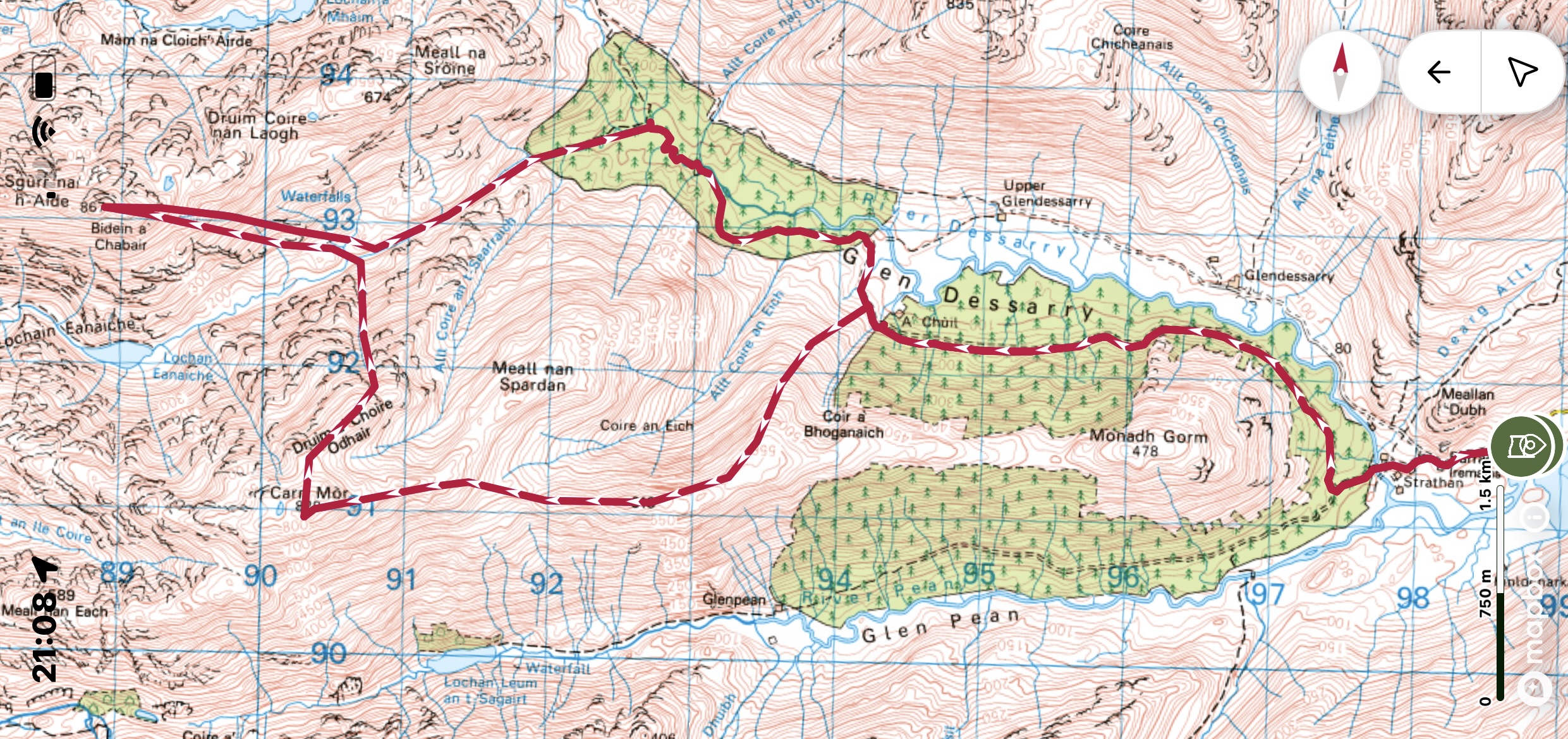
Carn Mor & Bidean a' Chabair, Glen Dessarry

Carn Mor from east ridge
Friday 5 May 2017

Ascent:    1920 metres
Distance:  22 kilometres
Time:        10 hours 34 minutes

Carn Mor                829m    2hrs 26mins
Bidean a' Chabair   867m    5hrs 41mins


We parked at Strathan and walked in to the A' Chuil bothy in Glendessary. It was being refurbished but we were going to camp in any case and we walked another 400 metres before finding a suitable site. As always it was impossible to find a flat patch of ground but the dry soft grass provided a comfortable mattress. It was another sun-basked morning and we managed to get away before 8am, climbing straight up from the tents to the 5 kilometre long east ridge leading to Carn Mor. The first 550 metres of ascent was a stiff climb, I took the left ridge and John and Keith went up the right ridge and once on the broad summit ridge the vistas opened up. We were treated to that rare event in this part of the world, a sunny day with the cool easterly wind making it pleasant for walking and ensuring excellent visibility. We took a longish break at the summit, which we reached just after 10am. Three retired seasoned walkers with over 6000 munros climbed between us, we deserved a rest, so many outings in the past had been during long days when time was the essence and weather conditions not conducive to stopping.

The OS map does not provide the best of detail in these remote parts but we found a feasible route down the north east ridge and then by following a burn that dropped steeply to the glen below. We had lost almost all our height and had another longish break at the burn whilst we topped up our water bottles and viewed the grassy ramps leading to the summit ridge of Bidean a' Chabair. Keith started at his usual steady pace and made the summit 10 minutes before John and I. We passed an elderly couple on their descent near the summit, they were staying at Strathan in a camper van and had watched us arrive the night before. They were envious that we were about to complete our second Corbett of the day and described themselves as 'one a day walkers'. Bidean a' Chabair was about the limit of their range and they had cycled up Glendessary for the first 5 kilometres.

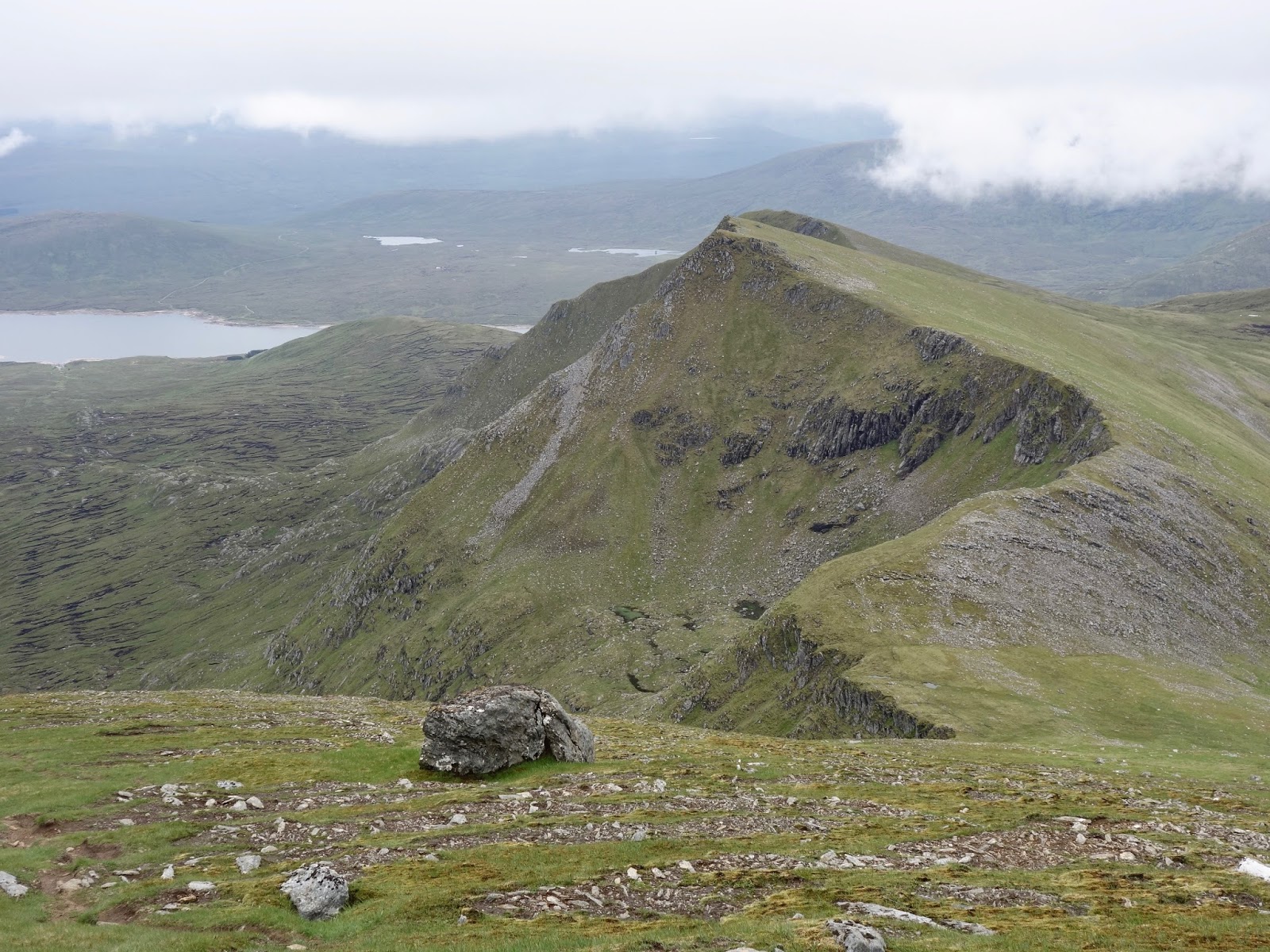
The final 100 metres of ascent was a delightful walk through a group of small lochans with a steepish scramble to the splendid rocky summit. With Knoydart to the north and Rum and Skye to the north west, we were spoilt for views and this was further extended when an eagle appeared over the twin summit of Sgurr na h-Aide. We had hoped to be here by 2pm but had made it with some time to spare so we celebrated with a good half hour stop. John and Keith were getting close to finishing their round of Corbetts, or third round in the case of Keith. They had a palpable sense of being 'nearly there' as this was possibly the most remote Corbett.

Our descent was by a series of grassy ramps back to where we had started the climb and then we had a 2 kilometre walk along a glorious sinuous valley that bisects the two corbetts. There was a steep final climb before dropping to the edge of the conifer plantation and the trail back to Strathan. We entered the forest through a broken gate and followed a boggy path alongside a burn for a kilometre until we reached the river. The dry weather meant an easy crossing of the river to reach the track on the other side that continues through the forest for a couple of kilometres until it emerges near the A Chuil bothy. We met a young German walker heading towards Inverie, he was ecstatic about the conditions and the fact that we had left our tents whilst we went for the walk without any fear of any theft. He loved the values of collective honesty and the freedom of the Scottish wild places. We persuaded him to take a diversion up Sgurr na Ciche in the morning as he said that he was ahead of schedule and had time to spare and looked to have the energy to tackle the best of the Knoydart munros.

We packed the tents and walked back the final 5 kilometres to Strathan along the good track. It was a perfect evening although still chilly in the easterly breeze. We met several walkers heading into Knoydart for the weekend and reached the cars before 7pm. The drive out along Loch Arkaig was, as usual, both frustrating and slow but the drive home was in the best of May conditions. The views of the grey corries and then Glencoe were quite sublime but hunger drove us on so there were no stops for photos.

Loch Arkaig in late evening
Setting off for A' Chuil bothy in the evening
Loch Morar and Rum from Carn Mor
Carn Mor ridge
Descending from Carn Mor
Approaching Bidean a' Chabair summit
Loch Nevis from Bidean a' Chabair
Sgurr na Ciche and Garbh Chioch Mor from Bidean
Job done on Bidean summit


Me descending Bidean, Sgurr na Ciche behind
Strathan on the walk out