
Aileen's birthday today, she would have been 72. Missing You. x
 |
| Stuc a' Chroin and Ben Vorlich |
 |
| Loch Venachar and Ben Ledi |
 |
| Ben Lomond capped in snow |
 |
| Ben Ledi |
 |
It's that time of the year when the fifty or so crows nest in the half-dozen ash trees along the burn at the side of the house. They spend early March partnering up and building nests, there appear to be more crows than ever this year and the windy conditions have made construction difficult as the fragile trees sway wickedly and branches snap.
It was lunchtime and it sounded like someone was banging about upstairs or on the roof, I went to look but the sounds had stopped and there was certainly no one around. I had some lunch whilst watching the 1 o'clock news when a phone call made me mute the TV. The sounds had started again and came from the wood-burning flue pipe near the ceiling. It must be a bird, the sounds were like the beating of wings. It had already descended down the 6-inch twin-walled flue pipe through a couple of bends in the attic and the bedroom. I could tell from the sound of wings flapping on the side that it was a bigger bird than a chaffinch, robin or a great tit and assumed it must be a thrush or a blackbird. I opened the wood burner to create a draft and hopefully encourage the bird to take the plunge but it was either stuck or not wanting to drop into the unknown. I decided to try later.
I spent the afternoon in the garden with a friend who came to visit with her young children. It was almost 6pm when I returned to the room and from the sounds I knew that the bird had made it halfway down the flue but I could not entice it any further by tapping on the side. I decided to watch Aftersun, the award-winning 2022 film that my daughter had been involved in commissioning. It lasted 1 hour and 41 minutes during which the trapped bird was slowly descending the flue pipe and arriving at a holding position above the stove. I now figured that the bird must be the size of a jackdaw or a magpie. I paused the film, unless I disassembled the firebrick linings of the stove the bird would not survive and decompose in the flue. A YouTube video was useful and after 15 minutes of tricky manipulation I had all the fire linings out but the torch showed that there was a bar across the bottom of the flue and the bird had stopped moving. I closed the door in the room, left the door of the stove open and opened the window so that if the bird managed to extricate itself there was an escape route to the rain-washed world outside.
The film was restarted and every so often the bird would make another attempt, I aimed the torch at the stove and this prompted more movement. The tension in the room matched the tension in the film as Paul Mercat and Frankie Corio act out the emotional anguish of estranged father and daughter. It was after 11pm before the film was finished and the credits read. I decided that I could do no more to release the bird so put in a small dish of water and some blueberries, just in case, before closing the door on the stove, the window and the room door and retiring to bed.
At 3:30am I was awakened by the wind and went downstairs for a glass of water. I looked in the room to see if anything had happened. It had, there was a large crow trapped in the glass-fronted stove. I opened the window and having seen the size of the crow's beak, put on the fire gauntlets to lift out the bird. I opened the stove to grab the bird but no such luck, the crow was out and crashing from one end of the room to another, swishing past my head every couple of seconds, this was Hitchcockian.
After it finally found a perch on the curtain rail I escaped to the kitchen and dining room in the hope that the bird would find the open window. It didn't, so I opened the patio doors of the dining area, the wind and rain were making whoopee. I stood at the back of the kitchen area in the dark and put the lights on by the patio doors. I opened the door to the other room and after a few minutes, the crow came crashing out, felt the cool air from outside and disappeared into the night. The sense of satisfaction and relief was immense, I could clear up in the morning.
 |
| Crow Trap top door |
 |
| Gloria Gaynor's greatest hit? |
Listening to the Today Programme this morning, I was surprised that even the assertive presenter Amol Rajan was flummoxed by the apparently reasonable and emollient phrases of Michael Gove. It was a live example of Gove’s innate ability to convince his colleagues and wider audiences, even the sceptics. He is the political version of the number 42.
It is becoming a common trope of journalists and commentators to rank the past five prime ministers, all of whom would be in the relegation zone of post-war prime ministers. They were seduced by Gove’s calm reasoning and they gave him various cabinet portfolios to play with. The exception was Liz Truss, Gove had endorsed Rishi Sunak for PM and Truss didn’t take prisoners. Since May 2010, Gove has spent more years in the cabinet than any other MP. He is the master of survival. He had probably figured that Truss would not last long and sure enough, after 49 days of trashing the country, she was terminated. He would probably like to think the damage done in the days he wasn’t in office would prove that his sage guidance to the cabinet during his 14 years would be his enduring legacy, the halcyon days of the Cam-Sun governments.
Gove was resurrected and appointed Sunak’s Minister for Levelling Up, Housing and Communities and the Minister for Intergovernmental Relations. He is the true Svengali of the Tory party, able to sweet talk other members of the party into taking what he presents as a modern reformist agenda and for others to take the fall when the policies fail to deliver. He managed to inveigle his way into key cabinet positions with four prime ministers and in the process managed to damage public services in a way that will take many decades to repair. Of course, he would never accept this. He averts any responsibility by referring to the failure of others or events dear boy and just occasionally gives a grovelling apology to prove that he is human and can make mistakes.
His duplicity is legendary, it is in his DNA. Witness his betrayal of Boris Johnson on two occasions, although that could be construed as good judgment, but on both occasions it was after the damage had been done. Most recently during the Covid Inquiry, he criticised his government by saying that he thought the lockdown was far too late and that “we are fucking up as a government...and the whole situation is worse than you think”. At the same time, he was responsible as Minister for the cabinet office for setting up the PPE fast track for Ministers' friends and we know what damage that did.
Whilst Education Minister in 2010, he abandoned the ‘Building Schools for the Future’ initiative which had been set up by the previous Labour Government and over 600 state schools lost out on capital building projects that were ready to roll so he could create Academies. He scrapped the social housing regulator leaving tenants no longer protected. He played the key role in arguing for the UK to leave the European Union, ditching his friend David Cameron in the process and providing the intellectual heft for Boris Johnson to jump aboard the Brexit Express. So began the four years of Parliamentary chaos over Brexit. This also led to three prime ministers resigning whilst getting Brexit wrong.
But Michael Gove had this enormous ability to survive when all others drop by the wayside. He has a tendency to appeal to the Conservative Party as a reformer and someone in touch with the zeitgeist. He is one nation, two nation, right-wing, progressive, zero carbon, or whatever other faction makes sense at any given time. His claim to be a reformer contradicts his underlying philosophical beliefs that people must be free to make money but that there must be redemption for lesser mortals. They have always been key values of the Conservative Party.
Even watching him run, with the gait of an errant pony, could not better illustrate his tendency to wander. When we come to revisit the wasted years when the UK lost respect and influence, the five Prime Ministers will be in the dock. Johnson or Truss will be nominated as the worst Prime Minister and Gove will be remembered as a latter day Rasputin.
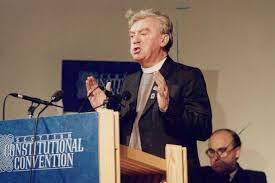 |
| Canon Kenyon Wright delivering the call for devolution |
 |
| Dundee Clown |
They're ignoring the Brexit debacle
Covid was not their job
They paid their friends instead
The house speaker
They've got him in a trance
Democracy is in meltdown
Westminster is full of clowns
Boris is sowing seeds of his prowess
Liz just left a mess
St Theresa does not want to be elected
Lord Dave has been resurrected
George Osborne's great salvation,
Austerity, has wasted the nation
The bankers were blameless
All Gordon's fault said Osborne
Never a greater lie
Vince Cable called him Mr Bean
Tony believed that Iraq had nukes
Just another lie
John Major has disowned the Tories
Democracy is in Meltdown
Westminster is full of clowns
George Galloway will fit in fine
He's going to the carnival
On Desolation Row
With apologies to Bob Dylan
 |
| Bassenthwaite from Binsey |
 |
| Ling Fell from Sale Fell |
 |
| Broom Fell from Sale Fell |
 |
| Embleton from Ling Fell |
 |
| Sale Fell from Ling Fell |
 |
| Ling Fell and Skiddaw in the cloud |
 |
| Skiddaw from Binsey |
 |
| Keswick skyscape |

The day had broken with grey fells outlined against a greying sky. The forecast was not auspicious, just terrible, even for the Lake District. We had decided to climb four smaller hills near Loweswater, some of the least visited hills in the far northwest of the Lake District. We had never abandoned planned walks and we saw no reason to change the habit of the past thirty-five years of hillwalking days.
It was a thirty-minute drive over Whinlater Pass to Loweswater. The rain that was steady as we left Keswick had become full flow by the time we parked at the Maggie's Bridge empty car park. Even putting on boots and waterproofs was an act of pre-soaking. Keith had his two phones with route maps safely encased in waterproof cases so I left my phone and maps in the car. Within minutes of starting water was seeping through my recently reproofed jacket and into my gloves.
We reached Watergate Farm on Loweswater and found a path that ran steeply through the afforested Holme Wood and eventually brought us out at Holme Beck. We were now exposed to the full force of the wind-driven rain as we began to climb the pathless east ridge of Burnbank Fell. It captured all the ingredients that can make hillwalking such an exercise in advanced purgatory. Water running down the cuffs of my jacket had filled my gloves, a cold finger bath for all ten digits. Water had penetrated my jacket and all three layers of Merino vest and thin fleece tops, my shoulders were shivering but at least I didn't have to faff about looking at map and compass, Keith was doing that as we plodded on unaware of anything in the poor visibility..
Burnbank Fell was where some fence posts met, what was Wainwright playing at by describing this as a hill worthy of carrying his name? We took some bearings for the next hill, Blake Fell, we were on the summit ridge now and could follow the fence which occasionally would shift direction by a few degrees. Keith decided the weather was too bad to be bothered collecting a Birkett top at Sharp Knott. We knew this meant it was really bad, he never misses a top no matter what their classification in the lexicon of hill lists. The wind seemed to have shifted so it could continue to hit us in the face. This is where we decided that our fourth hill of the day, Hen Comb, should be deleted from the planned route. I could pick it up in more clement conditions with another three hills.
That left us with another kilometre and a half to Gavel Fell and the rain kept coming. Keith stopped to add another waterproof over his existing four layers. There was no need to stop for drinks, you could lick the rain running down your face. Reaching Gavel Fell was the highlight of the day, if only because we were about to descend from the wind and horizontal rain. We followed a fence down to the bridleway and stopped by the gate, the rain had abated and it was a chance to empty my gloves of water, take a drink and attempt a conversation. It was only 25 minutes from the car park and we charged down the short grassy track, minds bent on a hot shower and respite from one of the wettest and windiest days I have encountered. Keswick was pleasantly dull and dry.
 |
| Watergate Farm, Loweswater |
 |
| Blencathra from Doddick Fell |
 |
| Ascent by Doddick Fell |
 |
| Blencathra in cloud |
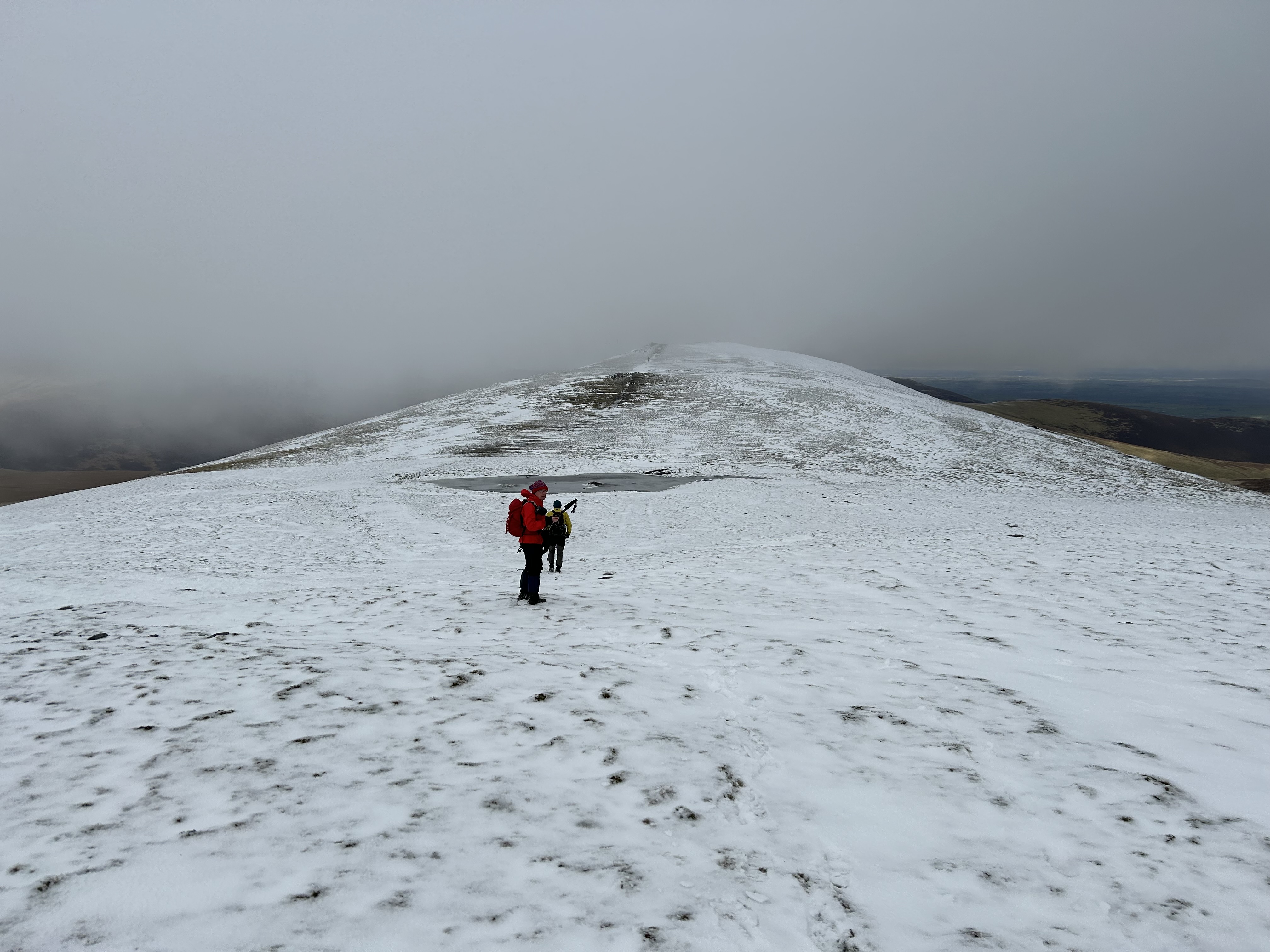 |
| Heading to Atkinson Pike |
 |
| Looking back from Mungrisdale Common |
 |
| Mungrisdale Common |
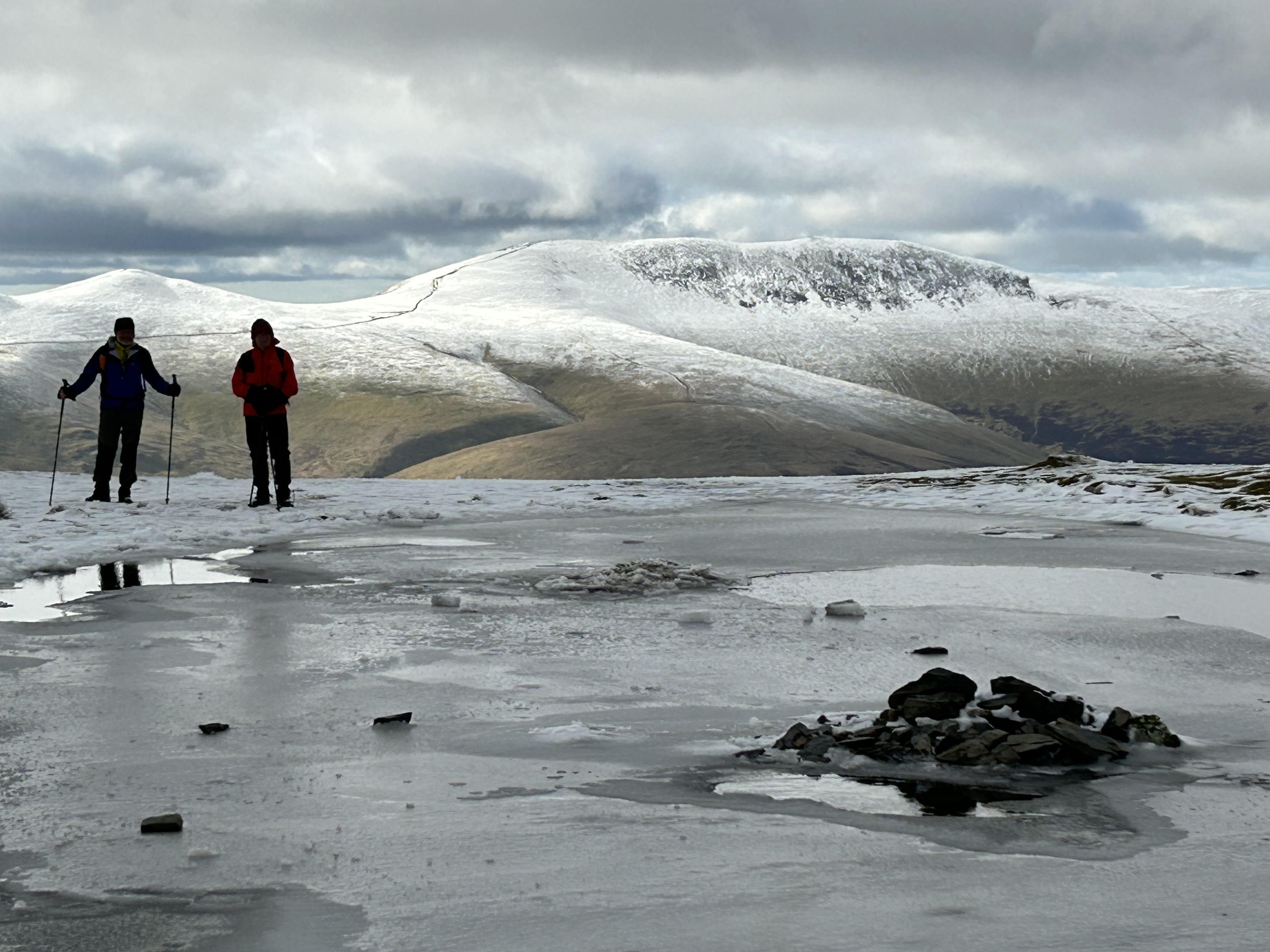 |
| Skiddaw from Blencathra |
 |
| Blencathra from Scales Fell |

The number of UK students going to English Universities increased by 19,135 in the five years from 2019 to 2024, a 4.85% increase. The number of International students from outside the EU increased by 15,000 or 34.8% over this period but this was more than offset by a reduction of 20,000 students from the EU countries meaning a net reduction of 5000 students from overseas. Many of the International students are now enrolled on one-year induction courses rather than degree courses that most European students had previously enrolled for.
It could be argued that Universities, by charging higher fees than had been possible before when EU students had paid the same fees as UK students, had found a way to fund more UK students. However, in the process, they have dumbed down the entrance requirements and qualifications on offer to International students and opened an alternative route for in-migration. This is not a narrative that we will hear from either government ministers or the universities. 'Follow the Money' is the silent motto for them both. Their moral compass is calibrated to attract students from Southeast Asia and the Middle East, just like funding for most of the government's infrastructure investment.
 |
| Entrance to the Burrell |
The Burrell Collection Museum opened in Glasgow's Pollok Grounds in 1983. We lived nearby and it became a regular haunt for taking our young children out or for Aileen to visit during the week whilst the children were at playgroups and nursery. When combined with the walks in the wonderful woodlands that it overlooked through its expansive glass curtain and its open-plan cafe it was an ideal place to take our weekend visitors. Our children learnt to ride their bikes on the newly laid tracks that now provide access to the expensive car park. I ran through Pollok Grounds two or three times a week on my way home from work and then again at the weekend.
Sir William Burrell was the son of a Glasgow shipping owner who became a successful businessman when he took over his father's business. He was also an art aficionado and Glasgow councillor. His bequest of the collection made in 1944, which he insisted also belonged to Lady Constance, his wife, was to the city of Glasgow. It included the funding for a new building to house the collection in a location with no pollution and ideally within 4 miles of Killearn in Stirling. It took many years trying to satisfy these conditions before the Glasgow city fathers agreed on a site on the grounds of Pollok House, which was gifted by its late owner Sir John Maxwell-Stirling, founder member of the National Trust for Scotland. It was less than 4 miles from, not Killearn, but Glasgow City Centre.
The Burrell Collection of 9000 items includes Chinese art, 200 tapestries, French Impressionist paintings including Degas, Cezanne and Manet, paintings by the Glasgow Boys, Egyptian stone carvings and Greek vases and ceramics. It is an eclectic collection made possible by the immense wealth from selling his cargo ships during the Great War. Burrell employed agents throughout Europe to scour for artefacts that he was interested in. He was a shrewd collector and struck hard bargains in the 1930s and 1940s when a worldwide depression and wars had driven down competition for art collections. This included portals from Hornby Castle in Yorkshire that Burrell bought from Randolph Hearst, the American newspaper magnate, who had bought them for a castle he owned in Wales before his wealth had been depleted by the Great Depression.
The museum closed in 2016 for an extensive refit that cost £16m and took 6 years to complete, partly because of Covid. It was opened by King Charles, one of his earliest engagements after ascending the throne in 2022. Aileen and I had been looking forward to its reopening for a couple of years and it was one of her wishes after coming home from the hospital but sadly she was unable to travel. I took myself there today, a wet Monday when I thought it would be quiet. I was the first in at 10:00 a.m., and twenty minutes later as I wandered around an empty downstairs gallery, the attendant told me she had never known the museum with so few visitors. I had always loved the spaces and light in the building and today I was free to enjoy the collection without the noise and intrusion of other visitors or supervising three energetic and curious children. It gave me time to reflect on how one man could afford and collect so many artefacts from so many parts of the world. Seeing Rodin's statue also got me thinking about how philanthropy used to work for the benefit of local communities in the days before moonshots.
I spent the first hour absorbing the exhibits and then joined a guided tour of some of the highlights, most of which I had already admired without having to listen to the reciting of dates and well-rehearsed stories of the volunteer guide. Nevertheless, there were some interesting asides. It was 1 pm before I left for a quick walk around the North Wood in the rain. It had been a good way to spend the morning and revisit one of our favourite places in Glasgow, the Burrell was the Art Fund Museum of the Year, 2023.
 |
| Warwick Vase in the foyer |
 |
| Ming Dynasty, Figure of Luodon set against the North Wood |
 |
| Boudin: Atmospheric Skies |
 |
| Cezanne; Chateau de Medan |
 |
| Manet: Women drinking Beer |
 |
| Tapestry Fight between aHeron and Falcon |
 |
| One of many Iranian Tapestries |
 |
| A Corridor Gallery |
 |
| Rodin: The Thinker |
 |
| St Pancras |
 |
| The Thames at Chiswick |
 |
| Mayfair toys |
 |
| Hedonism in Mayfair? Who'd have thought |
 |
| Ten |

 |
| Thames from Blackfriars Station |
 |
| Crossing the River Tweed at Berwick |

