Showing posts with label India. Show all posts

Wednesday, 9 December 2009

Jaipur

Park Regis Hotel, Jaipur
We departed from Delhi at first light, travelling on the overcrowded Indian railways at a leisurely speed. The timetable was meticulously kept to, and the seating and ticketing arrangements were organised with an empire-like care and attention to detail.  It took over an hour to escape the trackside slums that followed the railway out of Delhi. The towns we passed through were littered with debris from passing trains and town garbage. Even at first light, it was being raked over by dozens of children.

Just before we arrived at Jaipur, we passed a train that had overturned the day before, killing 6 passengers and injuring 25 more. Given the huge dependency on rail travel in India and the fact that the trains are so crowded, it is inevitable that occasional accidents will occur. Still, the sight of the crash made us feel very vulnerable, as did the feral monkeys that screamed at us as we alighted the train at Jaipur and crossed the footbridge, which was clearly their territory.

Jaipur was an altogether more relaxed city than Delhi. We were transported by a fleet of tuk-tuks to a three-star hotel that was more akin to a hostel. After tea and some fruit, we were free to explore the city. It was buzzing with bikes and motorbikes, and it was not far from the market area where we roamed randomly, staggered at the range of goods on offer from textiles to building materials. It felt safe, and the visit over the next two days allowed us to establish a rhythm of life and to visit some quite spectacular locations.

An early morning start saw us visit the Red Fort, a quite magnificent building on the edge of town. A procession of Elephants was carrying tourists in the luxury category. We were inspired by the buildings and then back in the City by the Museums. In the afternoon, we were free from our guide and able to explore the markets and enjoy the chaotic activities and generally welcoming response as we explored the inner parts of the city.


Train crash on the Delhi to Jaipur route
Tuk tuk rank
A smiling taxi driver!
Into the markets
The boss
Veg Art
Colour me saffron
Crash helmets but only for men
Wired for free
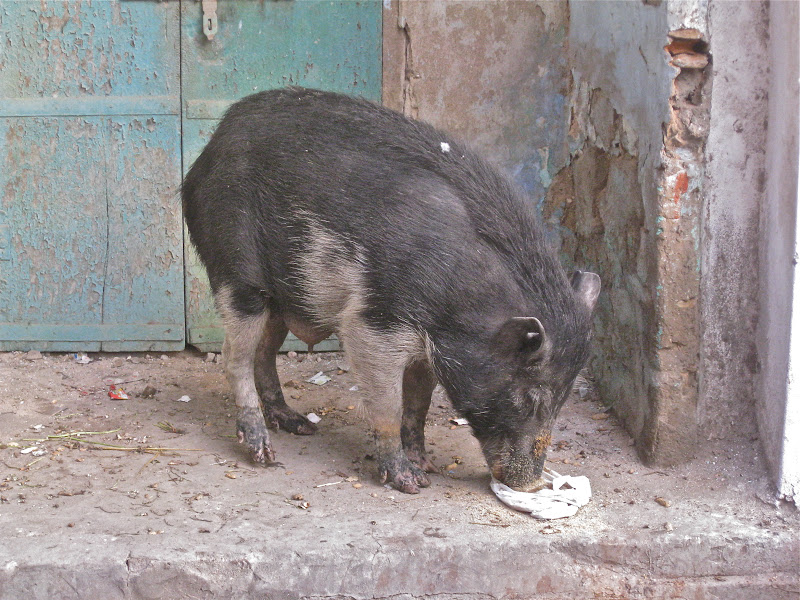
Urban Boar
Casual vacancy
Morning commute
Red Fort
Inside the Red Fort
Ceiling in Red Fort
Procession of tourists to the Red Fort

Gardens at the Red Fort
Add caption

Museum
One size fits all
Colourful travel chaos

India in 15 seconds

Tuk tuk rank in Jaipur
Guide in rickshaw
Competing for road space
Granny's don't need helmets
Mobile
Holy Cow

Children begging

A tour of India sears into the senses like nothing else. It is easy to pick out highlights like the Taj Mahal or the Ganges but they do not capture the essence of the country. Conversely the sheer exhilaration of travelling in a rickshaw or tuk tuk across a road roundabout takes 15 seconds and dozens of images of India are woven into this scary tapestry of travel. The roads in the cities are tracts of asphalt that dissolve into dirt and maybe a pavement. Lane discipline is chaotic and approaching a roundabout brings no deceleration or fear of traffic coming from the right. India, in theory, drives on the left and roundabouts are tackled clockwise.

So you are in a tuk tuk, a three wheeled chariot which has seating for two passengers but seldom carries less than 4 and whole families of 6 or 7 are often arranged in and on the vehicles. Traffic moves at no more than 10 mph, dictated by the speed of the rickshaws. A smorgasbord of other vehicles comply with the velocity of the slowest. Motor scooters - where white haired grannies bravely sit side saddle in their brightly coloured saris behind crash helmeted males; cars with vintages and dents going back thirty or more years, trucks garishly painted with favourite Hindu gods on their sides and buses which are grossly overcrowded. The odd Police 4WD or Ambulance is compelled to travel at the same speed, they cannot go any faster than the torrent of traffic in which they float. The sound of bicycle bells, horns, noisy engines, and shouting drivers is interspersed with the odd moo from a cow, usually facing the oncoming traffic and grazing on the excrement that is veneered across the road surface. Children of 5 or 6 year old tout their younger siblings as they beg at the passing vehicles. Then, about 15 seconds later the centrifugal force of the roundabout disgorges you onto an exit road where goats are on sale, young boys are changing gearboxes on scooters and motor bikes. Global brands of drinks and electrical appliances are advertised on huge wooden hoardings as if emerging from the roundabout has loosened the grip of your wallet.

Milton Friedman would have been suitably convinced that this is a victory for the free market. There is no discernable regulation, everyone is in it for themselves and they seem to survive. For the disciplined European it feels more like a fairground ride than a part of the journey. You are convinced that you are about to crash or run over someone but the collective sang froid of the drivers is laced with a deep humanity that respects all other users, even the Police. The crescendo of horns and noise suggests that the traffic is chaotic. But it is organised not on a principle of size, or caste of vehicle but by a human collective that respects diversity and ensures that everyone is given equity in the movement stakes. Roundabouts are a moving tribute to socialism. There is only one traffic master and that is the cow.

Monday, 7 December 2009

Delhi

India Gate
Our Hotel was somewhere along here

Evening promenading in the smog at India Gate

Night shift at Delhi Station 

An early start for the rail journey to Jaipur

Retirement had allowed us to travel more widely than during my working years, when I had generally restricted myself to two weeks for an annual holiday. In this time span, the thought of long-haul air travel had little attraction. After retirement, my initial attempt to walk the GR20 in Corsica in September 2009 was postponed because of severe storm warnings. We decided that a 3-week trip to India and Nepal would have to satisfy my wanderlust for this year.

An old work colleague who had travelled widely warned me that nothing prepares you for the poverty and overcrowding in India. We had worked together for many years in Glasgow and spent a lot of time supporting and developing projects in poor communities, but she was right. Arriving at Delhi airport and travelling to the centre of Delhi in a taxi almost as old as myself was a devastating experience. It took an hour and a half, and the taxi driver was unable to find the hotel in the narrow back streets of Delhi. The pungent odours of street food, stray animals, polluting vehicles and the steamy heat were an assault on all the senses as we wended our way through the pavement vendors to the hotel that hardly merited its 2 stars.

I had booked us onto a small group tour of northern India and Nepal, and the hotel was an inauspicious start. We rested for a couple of hours before a meeting with the guide at another nearby hotel that had none of the faded charms of the Raj. The rest of the group were mainly in their late twenties and early thirties, so we were the oldsters of the group. Normally, this would not have worried me, but I had damaged my back through heavy work refitting a patio a couple of days before leaving, which restricted my movement and gave me severe back pain that prevented me from sleeping.

In the evening, we had our initial briefing and went to the India Gate. The civic splendour of the site at Rajpath in the centre of Delhi provides a green lung in the densely populated city. Thousands of local people were promenading in the twilight, and it had all the pomp of a ceremonial setting. We walked to the nearby new underground station with modern trains that marked Delhi as ambitious. city. We emerged in the heart of Delhi and were taken to a restaurant for the first of what became twenty or so consecutive curries.  The noise and smells, as well as the visible street poverty, contrasted markedly with the vibrant hotels, restaurants and shops. We returned to our hotel by the modern underground in the hope of catching some sleep. With the noise from the chaos in the street and my back pain that proved impossible.

We were up at 4am the next day to catch a train to Jaipur. Although a very early start, we were not displeased to be leaving the noise, dirt and smells of Delhi. The train station, even at this hour, was bustling with travellers. The next hour saw us emerge from Delhi through concentric bands of slums with dogs and children playing and scavenging on heaps of rubbish. Further along the track, we passed the previous day's train crash near Jaipur, the train for Delhi had been derailed, killing 6 passengers and injuring 21. This holiday was not for the faint-hearted.