Monday, 29 November 2010

Snow in November


Yesterday we had the biggest dump of snow since moving here 20 years ago, it was about 40cm deep by late evening.  Gregor had taken 10 hours to get from Aberdeen to Perth, which was as far as he could get. He ended up sleeping in the mini under a duvet that he bought at the 24/7 Tesco supermarket.  The next morning very little was moving,  the garden birds had moved in under the car which was a virtual snow cave.  Several trees had lost branches under the weight of the snow. 

When I arrived at the co-op to buy a paper and some milk I was told I was the only one daft enough to come out looking for a paper.  The post office was to receive no mail for the first time in the memory of Ros, the postmistress, and she has been there 25 years at least.   There was slow progress on the roads which had been ploughed but the virgin snow pavements were impassable. 

We dug out the drive and eventually managed to drive over to Loch Venachar to take provisions to Granny, who was in good spirits.  We saw two buzzards feasting on road kills and two pheasants sheltering in a roadside bush looking like baubles on a Christmas tree.  Travelling back we watched the sunset over the Lake of Menteith and I made a surprisingly good curry from the contents of the fridge.  Winter!


Lake of Menteith

Creag Mhor from the play park

Baillie Nichol Jarvie


Saturday, 27 November 2010

Jarl and back to the Trees

Jarl Squad member
As  I left Shetland yesterday I bumped into a scary-looking man who was visiting the offices, he was a member of the Jarl squad preparing for Up Helly Aa in January. I managed to get a photo just before starting the long trek home. The journey was quite a trial with a snowstorm on the road to Sumburgh airport, and delays in the incoming planes, which had to circle whilst the runways were cleared. Then we were held for an hour on the plane whilst the wings were de-iced twice. Finally, there was the uncertainty of whether the plane could get sufficient traction on the runway for take-off.  It is not often I feel totally frazzled about travelling but this was one such occasion.

The snow followed me home and this morning a one-inch layer of snow had been welded onto the pavements, this was not windblown powder snow like Shetland but wind-blasted moist snow. There were blue skies although by noon the temperature was still below freezing. I decided to go for one of my favourite walks out of the back gate of the garden through the oak woods and into the Forestry Commission plantations leading to Lime Craig.

After the bleak winter landscapes of Shetland, it was good to be back amongst the trees which were plastered with snow and the dappled light of the early afternoon made it a glorious excursion. The views from the summit were as good as last winter and I lingered on the summit enjoying the splendid panorama. Much as I have grown to admire the bare slopes, big skies and ever-visible seas whilst in Shetland over the past few weeks, there is a joyous familiarity about being back in the land of trees.

Trees blasted by snow from the east

Birch and Oak below Craig Mhor

Spruce below Lime Craig

View from Lime Craig to the north-west. Stobbinnein and Ben More

Thursday, 25 November 2010

Bleak is Beautiful

Gulberwick at Dawn

8 am

Despite the imminent winter solstice in the Northern Isles, it is light by 7.15 a.m. and quite light by 8 a.m. This morning the storms of last night had left a layer of snow to lighten up the grey sky.  It was bleak but inspiring and we are promised 'a moderate day', a glorious understatement that is frequently used as a welcoming line in Shetland. I managed to cajole my Toyota hire car up to the main road from the village up the ungritted icy road for a long day at work. 

In the evening, I drove my colleague, Brian, to Whiteness for an evening meal with Alistair and his family. It was well after midnight before we left, there had been much alcohol on offer but knowing the road conditions and from previous experience of visiting Alistair I had limited myself to just a beer. I drove us home as the snowfall accumulated. It was touch and go whether we managed to get up the hill from Whiteness to Tingwall and there was no other traffic on the roads in the early hours. 

The road down to Gulberwick was a veritable toboggan run and the car began to slide on the steep snow-covered icy descent, I somehow managed to brake sufficiently delicately to sideslip around the bends on the descent, We had to abandon the car at the start of the final uphill road to the house, it was far too icy. Brian was complimentary about my driving, unlike the family who think I am too slow.  It was undoubtedly more luck than skill that we made it back to the house. Every day and night is a glorious venture into the unknown in Shetland.

Saturday, 20 November 2010

Muckle Flugga

Muckle Flugga lighthouse

After 4 days of gales with no ferries, the supermarkets were empty but the weekend brought still and clear weather. There was only one objective on a day like this - to visit the Northern Isles. I persuaded Nigel to join me on the outing as he was staying in Shetland over the weekend for the first time. The superbly engineered and maintained roads were empty apart from a Porsche that passed us doing the wrong side of 100mph on the way to Sullom Voe. It was a rare but indulgent symbol of the explicit wealth that exists on the back of oil. We caught the ferry to Yell, a service that is so good that a free internet hotspot is provided in the parking area. The well-equipped ferry ripped across the sound in 15 minutes with just half a dozen vehicles on board. It had a passenger lounge and cleanliness that would shame CalMac. The Sound was calm and Yell was illuminated by the low morning sun which was squeezing through the thin cloud layer.

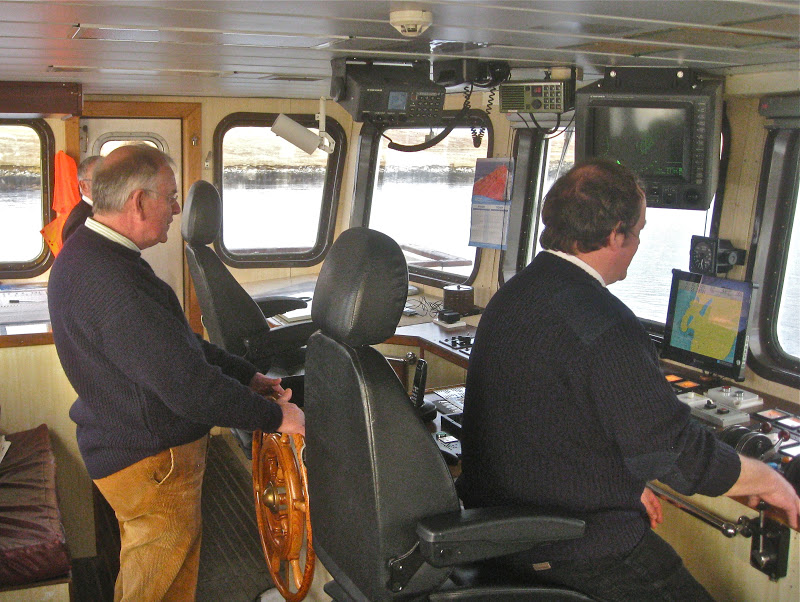
We were asked by one of the crew as we disembarked whether were we going on to Unst. On replying yes, he said he would phone the ferry 17 miles away and ask it to wait for us. This courtesy was extended when we arrived and rolled onto the Unst ferry, it is a free service to Britain's most northerly island. We were invited by the skipper to join him on the Bridge and Nigel was allowed to take the wheel. On this calmest of days, it seemed a dream job. We enjoyed the 10 minutes of banter before arriving at Belmont for the final leg of the journey. It was another 10 miles on well-constructed roads to reach Hermaness, the most northerly peninsula of land, which is a National Nature Reserve and breeding ground for Great Skuas on the peat moorlands and Puffins on the cliffs to the west.

We walked up the hill on a well-marked path with occasional sections of boardwalk through the peat bogs to the high point at 207 metres and looked down on Muckle Flugga lighthouse. Nigel was dressed in formal shoes and a raincoat, looking every inch the city gent. I sent photos of him to his family, he was Britain's most northerly citizen as he inhaled the wildness of the views and the cacophony of sound from the crashing of the sea and the birds. The summit is precariously perched on the top of a series of sea stacks that at a latitude of 60 51' are the end of the road even for the innovative Shetland engineers. Although only 1:30 p.m.,, the light was beginning to fade. I walked up to the end of the peninsula and dropped down to the edge of the cliffs which are about 100 metres high and then walked back along a sheep path looking at the nesting sites for 25,000 Puffins. And then a climb back over the Hermaness moor, where the Great Skuas would dive-bomb me in the springtime, and then I skipped around the peat bogs from where the highest hill on Unst, Saxa Vord loomed into view. It is the location of a Radar station and is also famous for having recorded the strongest wind in Britain 177mph.

There was time for one more excursion so we drove through Haroldswick to Nor Wick Bay, host to the most northerly post box and bus shelter. Seven years ago the government withdrew the RAF Saxa Vordbase from here and many jobs and people went with it. A large new building at Valsgarth intrigued us so we stopped half expecting to find Britain's most northerly leisure centre but it was the former RAF base.  

A large friendly man came out for a chat, he was re-equipping part of the building as a microbrewery. It may sound a strange venture but Sonny Priest had been the fireman at the base and converted his hobby into a successful business - the Valhalla brewery - and he was now expanding into bigger premises. Sonny would be an ideal guest on the Simpsons and Homer would be able to extol the virtues of Old Scatness and White Wife, two of the six varieties of beer that I sampled last week. Sonny had won the contract to supply the Tall Ships Race next year and was selling his beers to much of Europe and most recently to British Columbia. I joked about him brewing up something special like a 'Muckle Flugga Force Ten' for the Tall Ships event and he humoured me before returning to continue the fit-out of his new premises. 

By this time it was 3:45 and almost dark, time to get back to the ferry. We arrived just as the ferry was about to leave Belmont but on seeing our headlights they dropped the ramp again and opened the gate to guide us onto the ferry. I had another 10 minutes on the bridge surveying the sound, watching the docking manoeuvres and learning more about this remarkable community from people who are content and happy in the remote stark beauty and friendship of the Northern Isles.
Hermanness Bird Reserve walkway

Sound of Yell

Captain Fantastic takes the wheel

Unst ahoy

Hermaness cliffs - Puffins galore(in spring)

Hermaness looking south from the cliff path


Looking towards the Radar station on Saxa Vord from Hermaness Moor

North Wick


Friday, 12 November 2010

Forever Changes


One of my favourite albums from the late 1960s was Forever Changes by the West Coast group Love.  They were more melodic but less raucous and rhythmic than the Doors, their stable mates on the Elektra record label.  Love provided my soundtrack on Wednesday morning before my iPod froze literally during an early morning run.  By this time I was already buoyed into my stride pattern and enjoying crunching through the ice puddles on the gravel tracks.  It had frozen hard overnight and a blanket of cloud had sealed in the frost along the river valleys.

When the music stopped during my favourite track Alone Again Or, the sound of silence was stunning. Then I heard the slow beating of wings as the Lemahamish Buzzard skimmed over me dipping its wings just a few metres over my head, I had not seen it for over a month and it was one of my imaginary friends - I was not Alone Again.  I had the chance to listen to Alone Again Or this morning when Ian MacMillan, the Barnsley Bard, requested it on Desert Island discs.  He also played John Cage's 4'33'' but all I could hear was the crackle of the transmission - it sounds far better live in the forest.

Thursday, 4 November 2010

Fasten your belts for the CSR

The Comprehensive Spending Review (CSR) has confirmed much of what we already knew about George Osborne and his cronies.  Whilst the newspapers gave us their traditional tunes, the analysis from independent think tanks has been comprehensive.  Phillip Hammond, the Transport Minister and smoothest of cabinet communicators, was put up on Question Time and was forensically dismembered by Caroline Lucas, leader of the Green Party, Polly Toynbee and some very savvy members of the audience.  It is now game on.

We all realise that the deficit must be reduced and that this will require some significant reduction in public expenditure but what George Osborne has proposed will have devastating consequences not only on students, the young unemployed, those on housing benefit but also mothers who do not work and many people enjoying what are widely acknowledged as very good health services at present.  Beneath or lost in all the coalition posturing about fairness are four fundamental contradictions of policy direction. These will be at the heart of political debate over the next four years.


The first contradiction is about Economic Activity.  There will be a sharp increase in the length of working life of people. This follows a steady decline in the working life in the post war period as the school leaving age was raised from 14 to 16 and people retired earlier.  In future as a result of the CSR and its implementation there will be fewer young people going to University or Further Education at one end of the working life and people, but women in particular, will need to work longer as the pension age rises to 66.  The employed will need to make pension contributions for a longer period and redress the pension fund deficits in both the public and private sectors.  But at the same time up to 500,000 public sector workers will be laid off, many on early retirement which will require organisations to divert scarce resources to prop up pension funds instead of delivering services.   And there could be an equally large number of job losses in the private sector as public sector capital spending is reduced by a third and there is far less contracted work in everything from home care and nursing to IT and construction.   More people need to work longer but less work is available.

The second contradiction stems from the artificial construct of public and private sector enmity which the coalition and parts of the press are eager to perpetuate.  We need to work together,  The cutting of legal aid today will damage the poor but also take out £300m from the law profession, which is not a bad thing in itself but it is an own goal against the private sector. If the public sector spends 43% of the GDP and employs only 5million or 16% of the workforce the majority of public spending must support the private sector - construction, consultants, security, IT, catering, agency staff etc.  These are all far more vulnerable to cuts by councils, the NHS, government agencies and quangos than teachers, police, social workers, nurses and doctors to name but some frontline services. The private sector will be equally damaged by the public expenditure cuts and unable to fill the jobs gap.

The third contradiction concerns consumer expenditure. If there are wage freezes, a requirement to invest more on pensions, an increase in VAT, rapidly increasing fuel and food costs then there is less for households to spend on the extras in life like holidays, meals out, leisure activities, home improvements and private education, university tuition, health and community care.  Surely this will prevent the compensating growth in these sectors of the economy which will add to the hefty reductions earmarked for defence spending, construction projects, arts, culture and sport. There will be a tightening of consumer spending with consequences for many private service industries including those in education and health.

The fourth contradiction  is the assault on mutual respect which is at the heart of good governance.  Governments are never popular, although Blair achieved it for a time between 1997 and 2000 by tuning into the public's aspirations for quality and choice.  Tough decisions are accepted as part of the deal on democracy that underpins society but they require a semblence of justice and an understanding by government that there are limits to the scale of change that will be accepted.  By upsetting the police, the armed forces, the health and education sectors as well as squeezing the poor the coalition is removing the carapace of protection that it needs to survive.  Small businesses are already fearing the backlash of VAT rises and dodgy order books and big business is making the usual threats to bale out unless their profits and bonuses are allowed to continue.  The government will have as enemies all those who stand to lose out by its changes and these are looking like a substantial majority.

These contradictions may not all arise but it seems to me that sufficient of them will and the coalition will need to turn if it wants to see out the next four years.

Tuesday, 2 November 2010

Shetland makes 'Top Ten Places in the World to Visit'

Hooloovoo House
The wind had blown hard all day and the sea had lost its cobalt tint and simply reflected the deep grey of the scudding clouds. My colleague Nigel and I left the office at 5:30pm, the last out, as usual, the night sky was so dark that full-beam headlights were needed to pick our way through the downpour as we left Lerwick.

Lonely Planet had published their list of the top ten places to visit in the world and Shetland was included in the list with the justification that it was"fiercely independent and the last wild place in the UK". We had driven over to the Scalloway Hotel for an evening meal and we had a discussion with the owner about the accolade. He was proud of the recognition even though he doubted whether Shetland could cope with any more tourists and vice versa.

We called in at Tesco on the way to our rented house in Gulberwick to collect some food and our daily bottle of wine. The rain was lashing down so hard that the doorway of the supermarket had collected a small crowd waiting for the rain to abate so they could run a few metres to their cars without being wiped out. I struck up a conversation with the man standing next to me who was watching my colleague and me with a forensic interest. I asked, "So what do you think of this place being the sixth-best place in the world to visit?"   He chuckled and said he could think of worse places but was not sure that the tourists would find that Shetland had the capacity to look after them in the style that they probably expected. Uncanny how similar to what the owner of the Scalloway hotel had said. Shetland doesn't do bullshit.

The most regular visitors to Shetland in recent years, apart from the wildlife enthusiasts, have been the Inspection Agencies who obviously recognise what an excellent place Shetland is and have got into the habit of coming back each summer to check this.  They may find accommodation difficult to find next year.  I asked the man next to me what he did - a Police Inspector - and I got the impression he had already figured out what Nigel and I were doing on the islands, there are no secrets.

Saturday, 30 October 2010

Esha Ness

Villains of Ure, the cliffs that is

Calder's Geo

Esha Ness coast

Villains of Ure again

Latent Electricity

Holes of Scraada
Shelter is not easy to come by
Stenness

Stenness

A passing rainbow

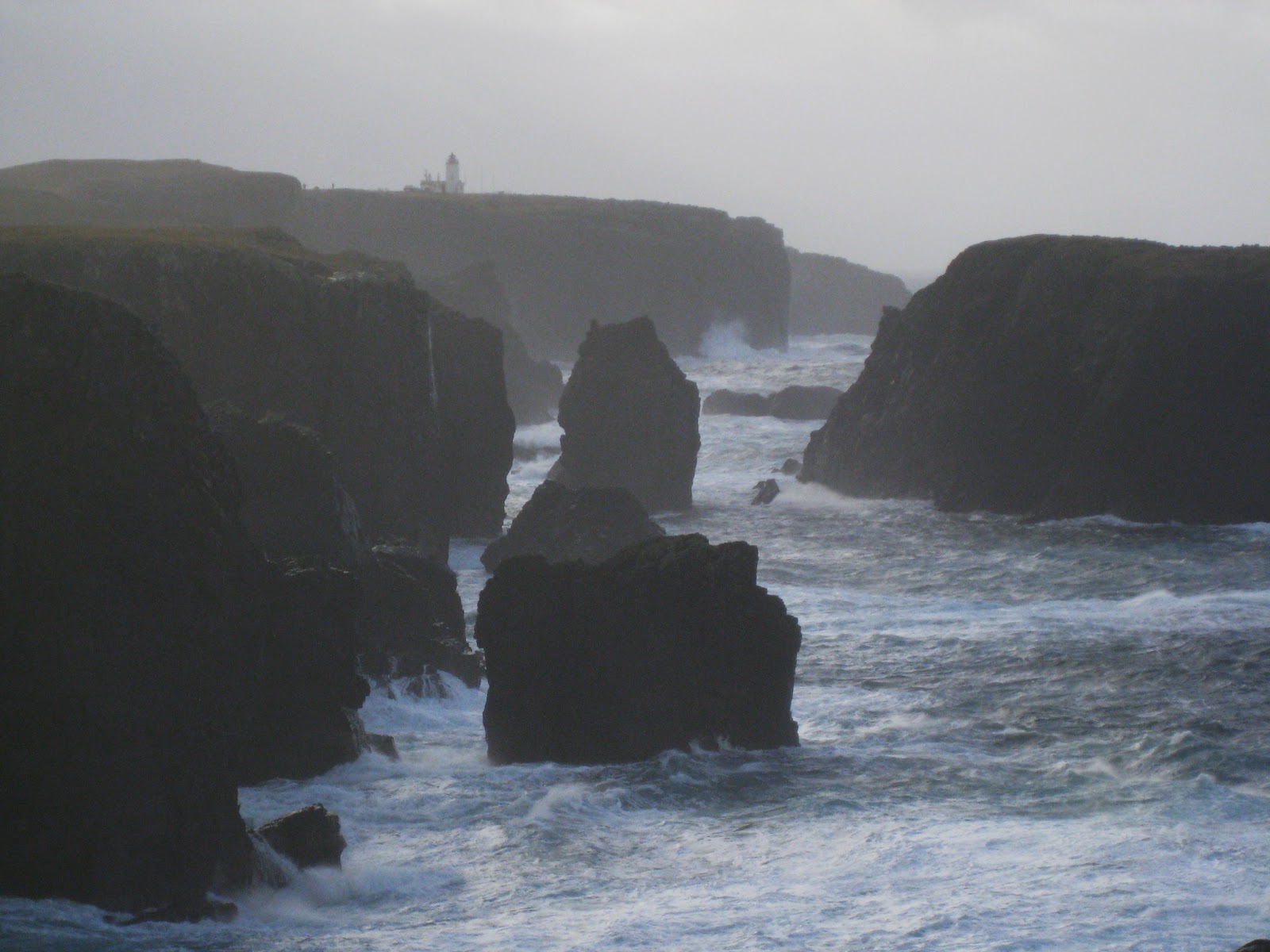
Esha Ness is claimed to be Britain's most dramatic coastal scenery and on a day when a Force 8 was passing through I was told by locals that it was not the best day to visit. This was just the challenge I needed, dramatic scenery is usually enhanced by wild weather. I had three attempts at parking the car; on the first  it was almost impossible to open the door, the second almost took the door off its hinges. The wind was accompanied by a power shower that Mira could never emulate. Fully clad in Goretex I eventually emerged, got soaked and walked with the wind at my back along the sea ravaged coastline. 

The Calder Geo by the Esha Ness lighthouse is an enormous cleft in the cliffs with the sea charging in making the Severn bore seem just that. The sea was in turmoil and as the sun flickered on and off the Villains of Ure hove into view. They are the residual rocks following the erosion of the cliffs. This is a geologists playground with all types of volcanic rock providing hard rock that is still being devastated under the constant attack by the sea.

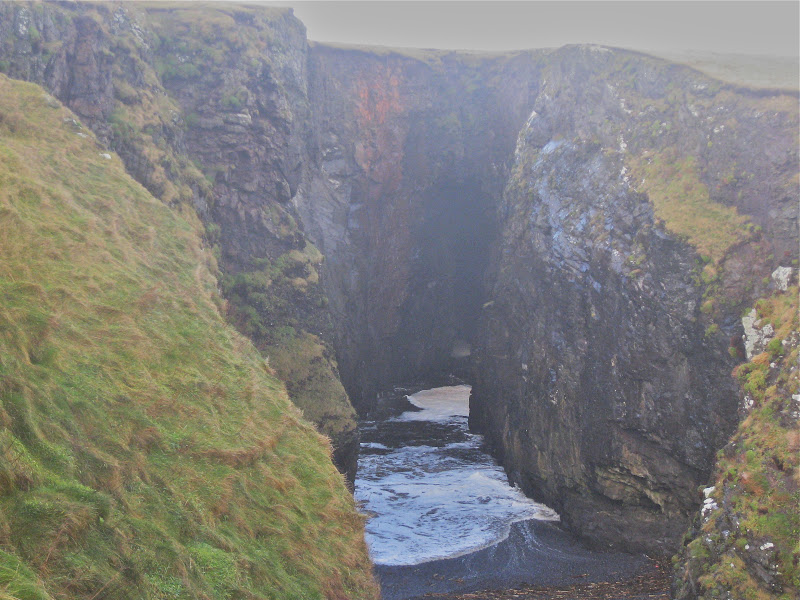
Hardy sheep were mainly sheltering behind walls and shelters but one flock hurried across and harassed me to turn off the wind.  Rabbits and sea birds occasionally took off when they saw me coming but quickly returned to their places of shelter. When I reached the Head of Stanshi I found a wall to shelter behind but then I had to begin the walk back and face the wind head-on. I was immediately assaulted by rain, hail and seafoam in globules as large as cricket balls. So I headed away from the cliff edge and happened upon the holes of Scraada, a subterranean sea passage, that shoots the sea up an inlet on a day such as this. It was watching the earth's crust transform on fast forward.

I went round to the nearby beach at Stenness which was a fishing station from where sixareens, open wooden rowing boats for six men, were rowed out 60 or 70 miles to the fishing grounds at the edge of the continental shelf. Stenness is now scoured for agates and other precious stones. About twelve seals kept me company swimming about 10 metres away as I beachcombed and dodged the occasional big wave and the passing showers by the simple expedient of putting my hood up.  Perhaps I should revisit Esha Ness on a good day but stripped of its wildness would it be so lightsome.

Seal friends

I had spent 3 hours in the wind and rain and I was damp but happy so I returned to Lerwick via Sullom Voe and I managed to catch the last half hour in the new Lerwick museum before closing time.  There is a quite superb collection of exhibits in an awesome new building by the harbour which tells the history of the isles. After a ten minute discussion with the curator, I was asked to the opening of the lace exhibition this evening.  I had to pass up the opportunity as I had a dinner appointment but I will be back to learn more about the history of these amazing communities, the buildings, the fishing and the local produce.


First Year of Blogging

It was exactly a year ago that I started a blog, mainly to share news and pictures with my son as he circumnavigated the world.  My intention was to do about 4 blogs a month, and it was restricted to the extended family. I have since deleted some of the early blogs, though I was pleased to see I had managed 60 in a year.  In April, I opened the Blog to anyone, partly because I was writing about wider issues or about activities involving others, and I wanted to share the content with them.

The content has changed, originally it was about my activities in post-retirement mode, but then I started blogging about politics as the election approached and then some profiles of friends and ancestors.  In June, I spent a couple of weeks trekking the GR20, Europe's best high-level mountain walk. I had kept timings and taken pictures and had promised to share them with otherfrom France, Austria and the Netherlands whom we had met on the GR20. I realised that the best way to do this was to make a blog post of the walk. That in turn made me realise that I could keep a record of all my hill walking trips on the blog and add photos to the log, which until now I had recorded as Word documents that lay dormant. 

In June, an update of the Blogger software provided an analytics tool which allowed me to see which blogs were being visited.  The number of hits per month had increased from 265 in June to 635 in September. There have been over 2000 hits since the analytics became available. 79% of the audience were from the UK, with 7% in the USA, 3% in Canada, 2% in France, Italy and the Netherlands and double figures of hits from  Russia, China, Slovenia, and Denmark. The greatest of all benefits was having easy access to my hill walking log, complete with photos, to stir the memories.


By far the most visited has been the GR20 blog which usually reaches a double figure of hits everyday and scores 36% of all visits .  Eva's wedding comes next and then, somewhat surprisingly, the one on my Grandad. The blogs of hill walks usually achieve more than 30 hits.  Politics are less popular although the ones on News International, Waltzer Economy and Strange Days have been well read.  Travel logs and everyday outings, GR20 excepted, are the least visited but many of these were early blogs and were not openly available when first published. 


So what next, well I will probably continue.  I was told by an old acquaintance whom I bumped into earlier this week that they had started with the most recent and had systematically worked backwards and had really enjoyed the politics.  Conversely another political friend said her favourite was Little People. 

I have also registered a website which I intend to use to download my hillwalking files, partly as a response to the large number of hits on the few I have put on the blog.  I have over 450 logs of all my munro outings over twenty years with spreadsheets that tell the timings, length of walk, ascent and the routes which may sound dry but are very useful to like minded anoraks. Some of these are on an old applemac and others on various memory sticks. If I can find them and download them, match them with the thousands of old photos that I am slowly scanning in I will be able to provide at least 4 illustrated trips up every munro in Scotland.  The problem at the moment is that I am back to working 50 hours a week so I may lack the time to do these things but its the end of summer time tonight so who knows.

Saturday, 23 October 2010

Mallorca


Miro in the permanent exhibition at the railway station, Soller
More Joan Miro

Palma Cathedral - second largest in Europe
Orient in the Serra de Tramuntana

Cap de Formentera
Badia de Pollenca
s'Illeta

Coast north of Port de Soller

Puig Major, highest mountain and site of USA Radar Station

Pollenca and another cycle race, the island is a cyclist's paradise

Soller Market
And the walking is pretty good too, Soller and Port de Soller from Serra de Alfabia

Picasso pottery in Soller museum
I had agreed to an extensive period of work in Shetland and we decided to take a holiday before I started. Aileen was keen to go somewhere warm and there was not much on offer. Much as we enjoy visiting Mediterranean islands, Mallorca had never been in my sights until someone bought me a walking guide to Majorca last Christmas. Maybe it was hearing about Magaluf and English breakfasts or just seeing those checking in for Palma at various airports. So with some trepidation, I made a late booking, even by my standards, to take a couple of weeks there in October. Apart from the weather which was much the same as Scotland but with thunderstorms, it exceeded our expectations.  There was a common courtesy, good quality of accommodation and food and the scenery was quite outstanding and, being October, it had fewer visitors so it was possible to get about with ease.

We stayed the first night in a Finca high in the Serra de Tramuntana mountains and enjoyed the instinctive customer focus, fine food and stunning location.  Several people had highlighted it as their special retreat on Trip Advisor and we could appreciate why.  Then on to Pollenca, a pleasant working town close to the beaches but a good base for touring.  After the first day when reading and swimming competed for time, the rains set in and we were limited to visiting places and testing the local restaurants which were universally good but quite expensive as were most things on the island compared to the UK.  It was a remarkably relaxing place, even dawn seemed to be late with the cockerels crowing at 9am.

Trips to Arta, Formentor, Inca and Palma were made to save the mountains for week 2 when we moved to Fornalutz.  Palma was clean, busy but easy-paced, full of street art and surprises as the townscape revealed its treasures.   The cathedral was immense, the second tallest in Europe with flying buttresses and pillars so slim that structural engineers, if asked, would want scaffolding to be erected.  Instead, they brought in Gaudi to modernise the interior which he did in his inimitable style.

The seascapes along the road to Formentor were quite amazing and for once I could enjoy the scenery as I was not driving.  I had not managed to replace a stolen driving license in time; apparently, someone is hiring cars in France using my old license which disappeared from my passport at CDG airport on the way back from Corsica in June. At the end of a road which had more switchbacks than hatchbacks was the old lighthouse, a place for a snack and with spectacular coastal perspectives.

By the end of the week, we were ready to seek new locations and we headed into the Serre de Tramuntana mountains on switchback roads following a cycle race until we arrived at Lluc, a monastery in the mountains. And then over the highest roads and under Puig Major where the United States has constructed a massive radar station at the top and excluded the public from enjoying what would be the star attraction of the island.  We arrived at Fornalutz, a village in the heart of the mountains but just a couple of miles walk from Soller and its Port.

Soller is a superbly located town with great facilities and a sense of place. It was first inhabited by the French but now hosts many Brits and Germans. The Soller railway station hosted exhibitions of the paintings of Miro and the pottery of Picasso, a free gallery which rewarded us with a couple of hours of amazement at a place on a human scale which seemed at one with the works on display. We left the exhibition elated whereas the big museum often leaves you jaded after tramping around collections which are too large and leave you feeling that you have missed the essence of the art.

The poor weather continued until a massive thunderstorm cleared the air.  We visited Deia where the celebrities hang out and Valdemossa where Chopin wrote many of his works. We managed 3 days of walking in the high mountains and along the beautiful coast.  The terrain was tough with limestone ridges fluted by water with the clints and grikes of the Karst topography requiring sure footwork.  There is an alternative to the high tops, the  GR221 which provides a 7-day walk through the mountains and utilises superb limestone paths constructed over many generations.   But it is overrun by large groups of German happy wanderers singing,  "Valderee Valderah ha ha ha ha ha"  as they click their walking poles and swing their knapsacks on their way to the next refuge.

So altogether Mallorca proved a safe, well-organised, civilised, tourist-friendly island which could serve as an example to most British tourist haunts. It probably lacks the edginess of other islands but I can understand why it is full of domiciled British and German citizens.

Monday, 4 October 2010

Shetland

Lerwick Harbour

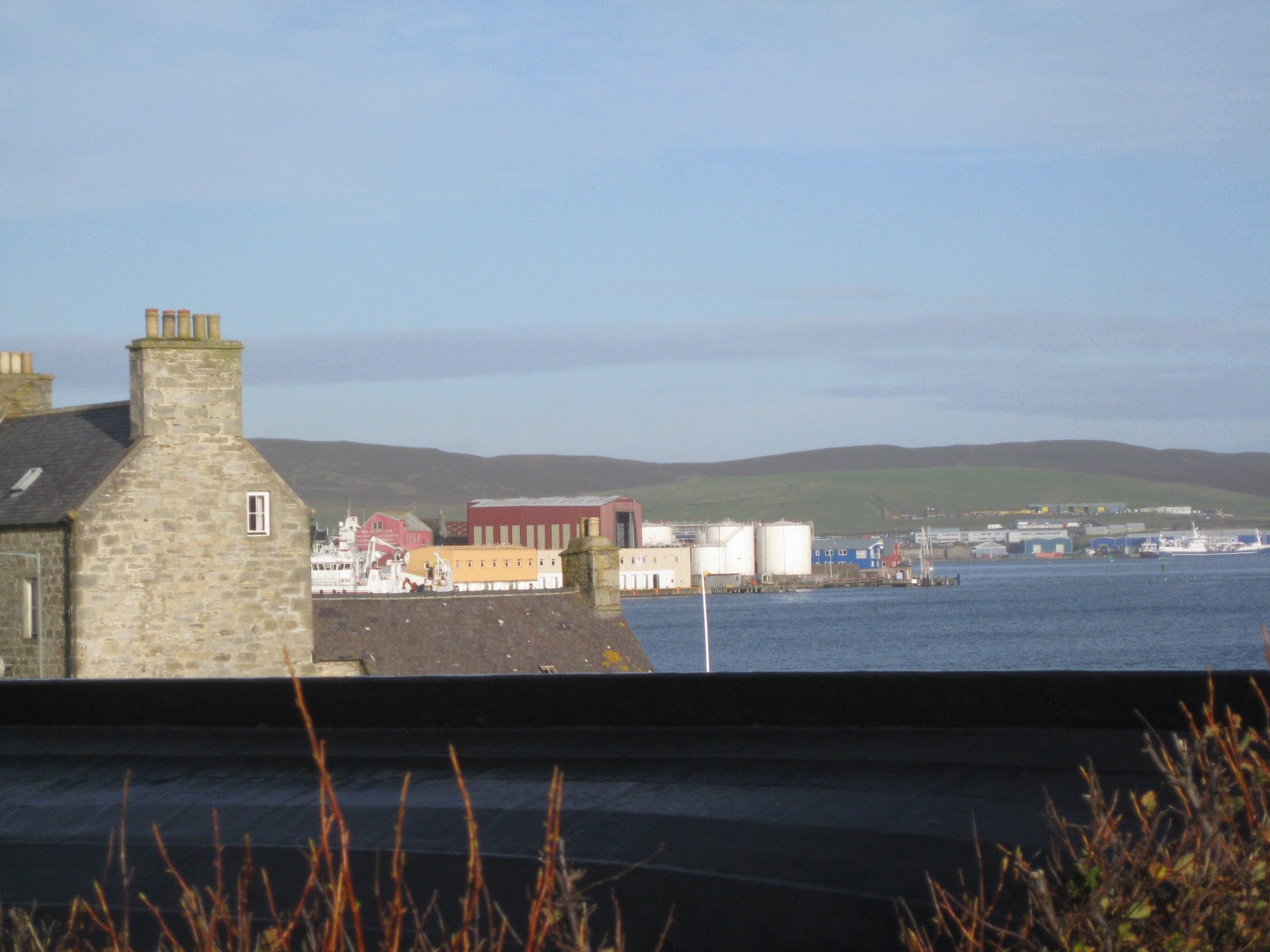
My first trip to Shetland and I arrived at Sumburgh in the late afternoon on Sunday. Shetland was tinted by a colour palette of greys and accompanied by episodes of rain and a fresh wind.  But being 60 degrees north means that there is a constant refreshment of the weather. Early the next morning the landscape was washed clean and the green hills and grey stone of Lerwick were squeezed between two bands of bright blue. I walked for over an hour before breakfast and was completely captivated by the townscape of Lerwick nestling on the Bressay Sound and almost surrounded by the sea. I met an elderly couple walking around the Knab and they were made up when I told them how privileged they were to have this as their morning walk. The cemetery is executed to perfection with a view across the Bressay Sound to die for.

Although autumn the town was quietly cosmopolitan with people of many nationalities working in the thriving industries of oil, marine engineering, fishing and tourism. In the hotel, an Indian businessman was meeting with a Russian and an American to discuss aeronautical equipment. The waitress was from Kazakhstan and several Scandinavians were passing through. The worldwide network of business that emanates from Shetland seems almost as important to the thriving economy as the natural resources that abound in the North Sea. 

I was spending a couple of days meeting with a colleague who had been asked to manage the Council after it had been found to failing by the Accounts Commission. He wanted me to assist in looking at the underlying causes of its financial and structural difficulties. I met the senior Councillors and began to examine the fairly incriminating evidence that had been issued by the Accounts Commission. There were a lot of issues that needed resolving and after several sessions exploring these, I was asked if I would be prepared to spend a few months helping to address the issues. In effect, I would be riding shotgun for my colleague. 

I returned home to mull over the proposition, a winter in Shetland was not exactly what I had in mind after retiring but the short time I had spent there had whetted my appetite for doing what I always enjoyed most about work, the chance to diagnose problems and find solutions that improved an organisation for the benefit of its communities. And the chance to explore some wild landscapes whilst working with wildsome but friendly people.
Commercial Street


Town Hall

South Lerwick from the Knab

Lerwick Cemetery

Lerwick over an upturned boat