Thursday, 9 April 2015

Election Wars

Fat Cats on exodus to tax havens

 PM realises that Michael Gove's legacy is failing

There she blows - the Miliband deterrent

The 2015 General Election is beginning to become a real fight between strongly divergent political parties after the years when parties converged on neo-liberal economics and the privatisation of public services The Labour Party promised to scrap tax privileges for the non-doms and to increase the higher rate of tax whilst eliminating zero hour contracts and increasing the minimum wage is shifting the polls.

Even the Telegraph acknowledges that Labour is now 2% ahead in the polls whilst at the same time defending the tax concessions for non-doms and offshore tax havens such as those of its owners, the Barclay Brothers. The press probably realises that they don't have the influence of yesteryear as voters are increasingly forming opinions from social media. The Tories have also realised that their preferred issues of tax and spend are not cutting it with the electorate so they have tacked away to create a new front on defence. The scurrilous story about Miliband being untrustworthy because he had the temerity to stand against his older brother to win the Labour leadership is the nadir of the campaign so far. According to the Tory attack dog Michael Fallon, the Defence secretary, Trident would be sacrificed by Labour in creating a deal with the SNP.  To add insult to the story the Telegraph also claims that President Putin wants Ed Miliband as PM.

No doubt there is a lot more nonsense to come, the Tories had expected to open a 4% or 5% lead over Labour by this stage of the campaign as they targeted Miliband, blamed the banking crisis on the previous government and claimed only they could be trusted with the economy. Instead, it is Cameron who is branded as a coward for not participating in a debate against Milliband, stalling the economic recovery and being out of touch with the impact of his Education and Health reforms; even the schoolgirl in the picture above seems to get this.

The PM needs to calm down and realise that the last five years have not only led to a far slower economic recovery than was being achieved by Chancellor Darling but also that sacrificing public services is not very popular with the majority of the population. It is hoped that the other parties will resist the temptation to indulge in personal abuse.  After the shameful tactics of today, the Tories have won their status as the nasty party but that could become an advantage in these crazed days.


Tuesday, 31 March 2015

Amsterdam

Black bikes and canals the colour of washing water
Tourism boats
Wheeling home
Not all bikes are black
Amsterdam Central Station
NEMO Science museum 
The threatened swan by Jan Asselijn, Rijksmuseum
Japanese temple guardian in the Rijksmuseum
Rembrandt's Night Watchmen in bronze, Rembrandt Square
A walk along the Prinsengracht canal 
Web of tram wires
Nursery commuter
Vondel Park near the museums
"Holland is not only the Europe of the counting-house, but the sea, the sea that leads to Cipango and those islands where men die happy and insane. I like its people, swarming on the pavements, wedged into their little space of houses and water, encircled by mists, cold earth and a sea that steams like damp washing." Albert Camus, The Fall


And so it did for four days, although the cold winds kept the mist at bay as the city delayed the onset of spring. The damp air hung over the canals and made the cyclists pedal faster to keep warm. Our intention had been to visit the museums and absorb the soundtrack of a city that is almost free of carbon emitting vehicles. It was not a relaxing place to walk about with the silent approach of trams and cycles converging on us gave us the collywobbles as we crossed junctions and bridges. Everywhere the bikes were a sign of the egalitarian nature of the city. Children in seats, older ladies in smart clothes, students, and office workers mingled easily. There was an almost total absence of sporty bikes; black bikes with high handlebars, baskets and toddler trailers made the cyclists the land bound equivalent of the swans as they endlessly drifted past.

This was a first visit to the city and it had been prompted by weeks of wet miserable weather at home. We should have gone somewhere warmer but there were few flights available at three days notice. Central station is the hub of the city but like many stations it is cheerless and we were glad that we had chosen to stay at the edge of the canals in Leidsplein. It was close to the park and museums and on the tram routes.The trip was studded with visits to the pride of museums that litter Amsterdam: Van Gogh museum, the Rijksmuseum, Anne Frank's House, the Shipping museum, and Rembrandt's House. Van Gogh being the standout, although we probably learnt most about Amsterdam and the history of the Netherlands at the Shipping Museum. The museums provided destinations for us to traverse across the central areas and become familiar with the canals, the coffee shops and the multi cultured nature of this seafaring city. We decided against using the trams and just walked. We met some Americans from Boston in a coffee shop and spent a rainy lunchtime debating the state of the world.  We were so wet later that day we retreated to a picture house to dry out.

Dutch food is not something to drool over but we managed to find a traditional Indonesian restaurant and a good Italian restaurant amidst the dairy, pork and pastry fare on offer.  The Dutch people we encountered were courteous and kind, although one shopkeeper gave vent to her feelings about wealthy Russian,  Indian and Chinese tourists - they were rude, arrogant and not to be trusted. Amsterdam is a city that has been a melting pot for centuries and people are judged on the way they behave not the size of their wallets or their race.

In the flower market

Thursday, 26 March 2015

East Coast Trains

East Coast trains - reliable and profitable

It was a sad day to see the demise of East Coast trains on the Inverness, Edinburgh to London route. Over recent years I have travelled to London by this line on a regular basis and I have been pleasantly surprised by the reliability of the service and the excellent customer care. It has been a far better service than the West Coast mainline in recent years as I discovered on those occasions when it was necessary to travel from Glasgow. The rolling stock is certainly in need of upgrading but East Coast trains could not be expected to invest in an upgrade when franchising was to take place and the government excluded the publicly owned East Coast trains from bidding. Virgin Trains won the bid and now controls both the west and east coast routes from Scotland to London. If privatisation was supposed to provide better service through competition then that justification has been jettisoned as well as the ability of publicly-owned railways to bid for franchises. These doctrinaire policies of the government are part of a wider intent to undermine public services when the experience across Europe is that a mixed economy better protects the citizens from exploitation by private companies or the failure to invest in state-owned companies.

Since the line was nationalised following the financial failure of National Express it has outperformed all other train services and is currently returning more money back to the state than any other operator. An East Coast spokesman said: "We always believed that a return of this franchise to the private sector was inevitable. Since we took over in 2009, we have repaid more than £640m to the taxpayer, achieved record-breaking customer satisfaction and the best performance on the route since records began in 1999." Virgin, on taking over the route, removed the through train from Inverness to London so we have switched to flying to London rather than paying the increased Virgin ticket prices for a journey that takes half an hour longer, involves another change of train and far more crowded trains from Edinburgh.

Unlike the Virgin's West Coast mainline, which is often overcrowded - I have had to stand or sit in the corridors on several occasions- East Coast staff always tried to ensure that everyone was seated. When trains were cancelled because of gales a couple of years ago, East Coast allowed passengers to travel at no extra cost the following day. It seemed the right thing to do but Scotrail and Virgin did not take the same view,  an example of a public service provider putting the customer before profit. 

UK rail fares are now the highest in the world whilst the network is far less efficient than the state-owned European railways. It is perhaps surprising in these circumstances that passenger numbers have vastly increased. This is mainly because commuting has continued to grow as fewer people are able to afford to move house nearer to their work when they change jobs and the motorway network for long-distance journeys is log jammed.

It is a sad indictment of rail privatisation that there has been so little improvement in services although underinvestment by Network Rail has been a major contributor to the reliability of trains. The government seems keener to bankroll HS2 and the vast cost of London's Crossrail projects than to improve the existing nationwide network. The rolling stock has been replaced by the private operators through subsidised leasing arrangements but mainly in the south-east and on the busiest inter-city lines. Meanwhile, passengers in much of the north of England continue to rattle along in 40-year-old rolling stock or older still in places like Lincolnshire and the Pennines. Every rail journey on the state-owned railways of mainland Europe reminds you of how trains in the UK are expensive, crowded and in many instances unreliable.


Friday, 20 March 2015

Mount Battock

The route up is by the lower track and Mount Battock top right

Mount Buttock is not quite as boring as it looks

Frog, one of dozens
Looking back down the ascent route from Mount Battock

Mount Battock summit paraphernalia

Looking east during the descent
New track up to Hill of Saughs

Thursday, 19 March 2015
Ascent:     720 metres
Distance:  14 kilometres
Time:        3hours 35 minutes

c  Mount Battock     775m   1hr 56mins


I had to travel to Aberdeen for some work on Thursday evening and Friday so I left early to give myself some much-needed exercise and the chance to climb the most easterly Corbett. Mount Battock lies north of Glen Esk, a glorious Angus Glen that abounds in Scotland's wildlife. I drove into Edzell at 11:27am, exactly the time that Eva was born thirty-odd years ago, so stopped and sent her a text to coincide with her birth minute. Then up Glen Esk, which looked a bit bedraggled and faded on a dull March day. The mosses and lichens were a vibrant green carpet beneath the pines, birches, and beech hedging that lined the road. A pheasant's revolt had me breaking around every corner as they scampered across the road, there was no other traffic. I found a parking spot over the bridge at Milden. It was occupied by a new VW camper van with blacked-out windows and a bike rack. Undoubtedly the owner was up the hill and I suspected that they were on a mission to climb the hills by mountain bike.

The walk would mainly be along Land Rover tracks and it looked as if it would stay dry so I left my crampons and ice axe behind, the snow on the summits looked only patchy. I set out up the road from Milden to Mill of Aucheen and, after passing the mill, I headed for a holiday cottage and then along a track that took me to the Burn of Turret. From here a track climbs all the way to the Western Cairn of Mount Battock. After passing a couple of dead rats, the range and volume of wildlife exploded; this part of the world is well endowed with game and echoes to the sound of gunshot in season. There were dozens of rabbits burrowing in the sandy banks of the burn, then lapwings circling and calling on the moors. I watched a badger make its way along the other side of the burn. By the time I left the burn and the track began to climb, there were dozens of grouse whirring and squawking as they took to the air as I passed. The track was littered with gun cartridges.

On the upper slopes of Mount Een patches of heather were being burnt and plumes of smoke rose vertically in the still air.  The track to Mount Battock skirts around the base of Allrey Hill, I resisted the temptation to follow the more prominent track that climbs steeply to the summit and presumably gives access to the dozens of shooting butts that litter these hills. After crossing the Black Burn I came across a pool of water that was alive with a cavalcade of frogs, they all scattered and burrowed below the moss covering the pool as I approached. Above a stable, at 500 metres the track steepened and more shooting butts were scattered every 30 or 40 metres along the track. A lone hen harrier was patrolling the skies and no doubt seeking red grouse. Several white mountain hares scooted up the hill, their coats in stark contrast with the brown/grey heathers making them easy prey for birds of prey.

Only the last kilometre from the western cairn to the summit is free of gravel tracks and even on this section, there were muddied wheel marks from quad bikes and the tracks of a mountain bike that looked fresh. I emerged on the flattish summit, which was decorated with a couple of shelter cairns, a trig point and a stile. The views were just wavy lines of rounded hills dissected with tracks running to their summits. Given that I had done very little exercise in the last month, I was pleased to have made it in less than two hours so rewarded myself with a 10-minute break for some water, tomatoes and nuts.

I decided to take a different route back and crossed the stile to head over to the Hill of Saughs. There was a faint path but it was mainly bashing through the heathers and schussing down a couple of patches of hard snow. From the Hill of Saughs, there is another newish track of orange/pink gravel that descends to the Hill of Turret. How do they afford to construct so many hill tracks that only serve the shooting butts? I forded the Burn of Turret and then another kilometre down the track recrossed it by a footbridge to take a path down the eastern bank that led down to the headkeeper's cottage in Milden. The VW van had disappeared.

It had been a good recovery walk although my right leg was aching from the effort of some decent exercise. I drove through Fettercairn and then onto Aberdeen by the A90. It took 40 minutes to reach the outskirts of Aberdeen and then the same again to get to the Bridge of Dee, despite the decline of oil Aberdeen was still humming with expensive cars and Friday evening shoppers. 

Thursday, 5 March 2015

Breaking Bad: the fiction of the Coalition


Hubris
Bluster
I was flabbergasted at Chancellor Osborne's performance yesterday as he welcomed the IFS report on how living standards had changed since the Great Recession of 2007-09. The report provides even more evidence that we have been misled by the claims of the Coalition Government that things are getting better. Nevertheless, the Chancellor welcomed the IFS report and argued that it was a"milestone" in the UK's economic recovery and that "inequality has fallen." Does he live in a parallel universe or is he just breaking bad?

Osborne spoke on the Today programme in his measured style and kept the normally forensic and acerbic John Humphries at arm's length. He has a self-assured hubris that has been honed to spin yarns, big yarns. He has a far better grasp of the statistics and facts that he abuses than the PM, David Cameron, who merely blusters and harangues interviewers or opponents at the onset of any challenge. The PM's panic-induced responses are based upon scanty knowledge and often have to be refuted by Number 10 a few days later. No wonder he is desperately seeking an escape route from any pre-election televised debate. Listening to either of them, hubris or bluster, there is a common theme: Britain is dismantling its public services and the well-being of the many is being sacrificed to the benefit of wealthy citizens, large corporations and foreign investors.

What the IFS research said was that:
  • Median income levels are now at about the level of 2007-08 but still 2% below their 2009/10 peak. 
  • Living standards have risen more slowly than in previous recessions. Household income fell by 4.0% from its peak in 2009 to its trough in 2012, driven by falls in both employment and workers’ pay. 
  • Since then, employment has recovered strongly (mainly through self-employed, part-time work and zero-hour contracts) but real pay has not. 
  • This is consistent with the absence of any productivity growth since 2011. 
  • The coalition (through Ian Duncan Smith) has implemented a large package of tax and benefit measures, taking money away from households. 
  • The slow recovery in household incomes has been just 1.8% in total between 2011 and 2015. Remarkably slow in contrast to the first three years of recovery in the early 1980s and early 1990s, median income grew by 9.2% and 5.1% respectively. 
  • Consumption of non-durables (things such as food and fuel) was 3.8% lower in 2014 than in 2008. At the same point after the 1980s and 1990s recessions, it was 14.4% and 6.4% above pre-recession levels, respectively. 
  • Low-income families have faced higher-than-average inflation since 2007–08. They were hit harder by rising food and energy prices and benefited less from falling mortgage interest rates. 
  • Median income among those aged 60 and over is 1.8% higher in 2014–15 than in 2007–08, compared with a 2.5% fall for those aged 31–59 and a 7.6% fall for those aged 22–30. 
So unpacking all of this perhaps the PM and Chancellor should explain why:
  • GDP per capita is still 5.6% lower in 2014 than it was in 2008.
  • The national debt has grown every year since 2008 from 43% to 90% of GDP in 2014.
  • Councils have been clobbered with an 8.8% cut in real resources for 2015-16, taking the cuts to over 30% during the coalition years. 
  • Eric Pickles and the Chancellor blame the Councils for cuts to roads, nurseries, libraries, sports etc. "It is up to Councils to decide their priorities"? The coalition has delegated opprobrium whilst claiming the kudos for any resources that they have stealthily ring-fenced.
  • Companies have avoided or evaded paying £35bn a year in taxes, according to the Public Accounts Committee.
  • Leveson has been quietly ignored, and the press is still self-managing its malpractices.
  • UK assets continue to be sold, from Northern Rock, Lloyds, the Post Office, the Tote (now Betfred), East Coast Trains and now Eurostar to the Canadian teacher's pension fund? (The tide has turned, and the vast majority of the electorate, 67%, want the railways renationalised.)
  • Geographic inequality across the UK, measured by income or house prices, has widened with the London and South-East bubble diverting recovery from other regions.
  • This has been further escalated by the pernicious redistribution of public expenditure grants this year from run-down urban areas (-3.8%) to the leafy shires (-0.6%).
  • In England, up to a third of all pupils in major cities do not get into the school of their choice. Is it that academy schools operate selection policies now that they are independent from local education authorities? At least Scotland is exempt from this Education lottery and the creation of autonomous and unregulated schools; it is blighted by an ill-thought-out 'Curriculum for Excellence'.
  • Cameron pledged that the NHS was safe in our hands and would be subject to "No more tiresome, meddlesome, top-down restructures. So why impose a destabilising top-down change that made NHS governance opaque and complex, with many more services commissioned from private health providers? It cost £3bn, and 90,000 staff were made to reapply for jobs in the new structures of the NHS. 
  • The promised savings have not materialised, and the reforms have created chaos from GP waiting times to bed shortages and declining performance. 
  • Jeremy Hunt, fresh from attempting to allow Rupert Murdoch to take over BSkyB, and who replaced the damaged Andrew Lansley as Health Secretary, seems to revel in every problem that emerges in the Health Service. Is it because he wrote in 2007 that "The NHS is a 60-year-old mistake"?
  • Housebuilding has declined despite the desperate shortage of social housing and new housing suitable for younger buyers and older buyers, who could release family homes, and has stalled.  Osborne has directed resources at mortgage support via the banks, thus revamping the housing price boom rather than incentivising house building and encouraging the building of social housing. 
  • Promises to reform the constitution and electoral processes were cynically assigned to a cul-de-sac and a no-win referendum by the Tory Party within the coalition?
The questions could go on, but the gist is clear: the UK's much-vaunted public services from the NHS, universities, schools and institutions have been salami-sliced and flogged to the friends of the coalition. Councils have been squeezed mercilessly, with consequent long-term damage to local services as well as the small local enterprises that depend upon councils for contracts. Councils, along with the DWP, have been made the executioners of the welfare state and treated with contempt by Cameron, Osborne, Gove, Pickles, Duncan Smith and fellow travellers. This should not play well on the day of reckoning.

Cameron and Osborne know that they are mistrusted by a sizeable majority of the electorate. Why should we when they have perpetuated so many decisions that have reduced the well-being of young people, families with young children and the most vulnerable? We are not all in it together; those who were at the epicentre of the banking crisis are still flouting tax laws, offshore private equity funds are wiping out small local businesses and designing new money-making scams against the "hard-working" taxpayers and holding the most vulnerable to ransom. 

If the PM is not prepared to debate his record, there is a precedent for substituting an inanimate object (tub of lard) on the lectern. Perhaps a beetroot would best represent his embarrassment for probably being the worst post-war prime minister (but there is even worse to come). He has savaged the public service legacies of not just Attlee but also his idol, Harold McMillan, who, as a one-nation Tory, understood the need for housing and quality public services as the foundation for a more just society and a growing economy.

Sunday, 22 February 2015

Orkney, it's my 'Ba


St Magnus Cathedral

Winner of the 2015 New Year 'Ba game
Any visit to Orkney is always an enlightening experience and I was hopeful of perhaps catching the northern lights. I have been fortunate to make half a dozen business trips since my first visit in 1993 and on a couple of occasions I have taken some holidays to travel around the islands. My reading for the last couple of days has been the Italian Chapel, the story of the bond of friendship between the Italian prisoner's of war and the island folk that endures through a chapel in refurbished Nissen huts erected and decorated by Italian craftsmen. It reminded me of the common courtesy and egalitarianism that underpins the rich community life on the islands.

The flight from Edinburgh was in one of the 14 Loganair Saab 340 turbo prop planes that serve the Scottish islands. Despite the age of the planes, now more than 20 years old, the pilots and stewards always make you feel secure, despite the often turbulent conditions. The pilots regard the planes as machines to practise their skills and the routes they fly have the worst weather in Britain. The New Zealand captain on my flight had a voice that could have been a 1950's BBC announcer, it oozed reassurance and trust. The steward asked me to take the emergency door seat next to her and we were able to chat throughout the flight, I gained the impression that Loganair was a good employer that inspired loyalty from its aircrews. With a strong tailwind we arrived 15 minutes ahead of schedule, I walked off the plane to the taxi rank and reached my B&B before the estimated landing time.

I immediately dumped my bag and sauntered past the magnificent St Magnus cathedral and down to the harbour area to find somewhere serving fresh fish. Helgi's is a fine bar next to the Kirkwall Hotel and it served day fresh haddock. By chance the draft beer was Scapa, which I had first encountered at the Ayrshire Real Ale festival last year and voted for as my favourite beer. I had assumed that Highland brewing company was Inverness based but it is a local Orkney brewery. Scapa is brewed with German hops and its marketing tag line is 'goes down better than the German Fleet'.

I met an economic consultant whom I had heard of and we had another couple of rounds of beer whilst discussing the importance of localism in driving successful economies and sharing views about the extreme centralisation of public services by the Scottish Government. From planning decisions, ring fenced budgets, nhs, police, further education to scottish enterprise, it has been garnering control from the local level.The very opposite of what Donald Dewar had intended at the onset of the Scottish Parliament. His vision had been devolving not just from Westminster to Holyrood but to the most local level possible. The bar had filled for what appeared to be a ladies quiz night so we had to curtail our discussions and walk back through the empty narrow streets that are the location for the annual 'Ba game between the men of Kirkwall. They are divided into uppies and doonies, originally this referred to where they were born, but nowadays it is more often where they or their families live.

My B&B was run by the winner of the Kirkwall 'Ba game at the New Year, he was chosen by the acclaim of his team as the outstanding player. He showed me the trophy, a 'Ba that is about the size of a football but three times as heavy. Not that much throwing takes place, the game is 5 hours of packing down along the narrow streets between the cathedral and the harbour. When the doonies win, as they did on this occasion, the game requires the 'Ba to be thrown into the sea at the harbour. The winner usually follows. Kirkwall can be a wild place.

After a full day's work during which I learnt more about the state of Orkney than government inspectors could ever do in a month, I was given a lift to the airport. I spent the next three hours waiting for the final flight, the aircraft was being repaired in Edinburgh. It is not the first time I have been delayed by repairs to the aircraft  on trips to Orkney and Shetland. As we finally landed at Edinburgh and emerged from the vast and ugly maze that Edinburgh airport has become, a fellow passenger explained that he had been on the same plane in the morning and there had been a terrible smell from the engine, I was pleased that I heard this at the end of the flight.

Then just the crazy walk from airport building to the shuttle bus, passing the original bus stops, through the taxi ranks and multi story car parks to reach the new bus terminal. We had walked a good kilometre from alighting the aircraft.  I expressed my concern about the length of the walk for disabled/elderly folk to the bus driver. He totally agreed saying that it was the decision of airport management so that shuttle buses did not get any closer to the terminal than the Edinburgh trams or cars in the expensive car park. The bus waited a while and another fellow passenger eventually puffed his way onto the bus, he had been sitting across from me on the plane.  He explained that he had Parkinson's and was now finding Edinburgh airport a nightmare and major barrier to his work trips.  The ill conceived transport interchanges, circuitous routes to the gates and the time consuming problems in its new security hall have converted Edinburgh from a very good regional airport to a botched attempt at becoming an international airport.

St Magnus

Saturday, 7 February 2015

Beinn Chuirn


Beinn Chuirn from the Cononish track
Looking east to Ben More and Stob Binnein
Beinn Oss from Beinn Chuirn
The ascent of Beinn Chuirn
Summit view - Hills of the North, Rejoice

Me and my shadow on the descent ridge
Cononish river
Ben Lui and Beinn Chuirn across the Cononish as the clouds spill in
Ben Lui
Friday, 6 February 2015
Distance: 15 kilometres
Ascent:    740 metres
Time:      4hours 35 minutes

Beinn Chuirn      880 m       2hrs 39mins

At last a start on the hills in 2015 and what a day. After a couple of weeks struggling to walk let alone run after twisting my back, I had managed a couple of runs and felt I was on the mend. The high pressure had held all week and the wind and clouds from the earlier part of the week had been seen off. it was February at its very best.  Beinn Chuirn was my nearest remaining corbett, the hill that hosts the Tyndrum gold mine. It is a good 5 kilometre walk in along the track to Connonish and from here a path runs to the foot of Ben Lui. Beinn Chuirn is the large mass to the north with a 500 metre drop between the two hills. It has eluded me on the five occasions when I had completed the 4 munros in the Ben Lui group. I always had an excuse for not continuing to Beinn Chuirn; short winter days, leading a Water Aid group, walking with friends or just couldn't be bothered. I had put it on hold it as a hill for a lazy day; well that was certainly not the case today.

Although I made a late start it was still -2.5°C as I turned into the car park that resembled a skating rink  at Dalrigh just before Tyndrum. I had been warned that it was mighty cold on the summits so I wore an extra layer in addition to my normal winter clothing of a merino base layer and wool pullover beneath a soft-shell jacket. My crampons and ice axe were packed in expectation that they would be necessary. As always when leaving Dalrigh I had to consult the map to find the right track but once past the church house I began to stride out.

The track was covered in a layer of hard frozen snow that had been polished by vehicle tracks. My scarpa boots seemed to give a reasonable grip and I made the 5 kilometres to Cononish in an hour and then continued towards Ben Lui for another kilometre before leaving the track to make a rising traverse of the southern slopes of Beinn Chuirn. It had seemed the obvious line to take but the deep soft snow made it an arduous ascent. Each step was a venture into the next potential snow hole. After just 100 metres of ascent, I decided to have an early snack, the air was still and a few nuts and a tangerine followed by a coffee provide some sustenance. I retrieved my walking pole from the rucksack to help progress through the snow and it made all the difference.

The slopes were still steep but the more exposed slopes had been cleared of snow by the wind and I used these ramps to reach the shoulder of the hill at 600 metres. The snow here was hard and crusty and it provided easy going to cross the frozen burn and then begin the last 250 metres of climb to the summit. The views to Ben Lui were directly into the sun but Ben More and Stob Binnein provided a profile of snow blasted mountains to the east and the Breadalbane hills to the north looked resplendent basking in the early afternoon sun. It was still tiring although I was walking at a decent pace now that the soft snow had been left behind. Beinn Chuirn is a high corbett at 880 metres and it certainly seemed so as I toiled up the slopes.

It was just after 2pm when I reached the summit, half an hour later than I had hoped but the air was still and it was no discomfort to take a seat and admire the amazing vistas in all directions. The cloud was gathering at a lower level to the south west but everywhere else was a winter wonderland. I had grabbed an old pair of sunglasses from the car and they were needed to disperse the glare from the snow. I finished the flask of coffee, nibbled more nuts and began the descent.

What had taken well almost an hour and a half to ascend was descended in less than half that time, despite stopping for photos. I looked for the long snow sections to skate down and on only on a couple of occasions did I fall into snow holes. Back on the path above Cononish, the snow had begun to freeze hard as the sun dipped behind Ben Lui. Clouds began to spill into the valley floor, which was much colder than the hills that were still bathed in late afternoon sunshine.

I charged through Cononish using my walking pole to prevent any slips on the lethal icy sections caused by vehicles. The river Cononish at the side of the track had an icy blue tinge and there was no-one panning for gold. I became clammy as the heat generated from the effort of walking was chilled by the falling temperature. It was not the sort of day to pause.  The walk out from Cononish took under an hour and, as I sat changing my boots at the rear of the car, a police car circled the car park checking for any vandalism or break ins. My car had been broken into not far from here six years ago on another February day. I was home by 5pm convinced not for the first time that February is the best month of the year to walk in the hills on these freezing days of high pressure.

Sunday, 25 January 2015

Sunday afternoon

Lime Craig from Creag Mhor

Loch Ard and Ben Lomond

Balquidder Munros

Campsies and the Forth and Ettrick Valleys

Ben Venue

Heather, imposible even in the snow

The snowfall had become a regular occurrence over several nights but it had never caused any disruption on the roads. By Sunday the winds had gone and I decided to take advantage of the afternoon sun and climb the hill behind the house. It normally takes about half an hour, it is steep but only 400 metres of climbing. It was not that easy today, once above 200 metres the snow was soft and deep and tiring, each step a foray into an unknown abyss and on several occasions I was thigh deep in soft snow. Although the temperature was just about freezing, I was working up a good sweat and it was a relief to reach the summit.

The views were tremendous in all directions as the sun was getting lower in the sky. I set off down and met my neighbours on the route up, they were following my body prints and thanked me for making a trail for them. I let gravity take over on the descent and had several spills in the snow. I didn't think anything of it at the time, just another short and enjoyable outing, but a week later I am still struggling with a sore back and finding walking quite painful, my first run for a week today did not do me any favours either.

Friday, 16 January 2015

Snow Trails

Braeval footbridge
Lemmahamish river bank trail
Up the Fairy Knowe
The depths of the forest alongside Park Burn
Lochan Spling loop
Homeward Bound
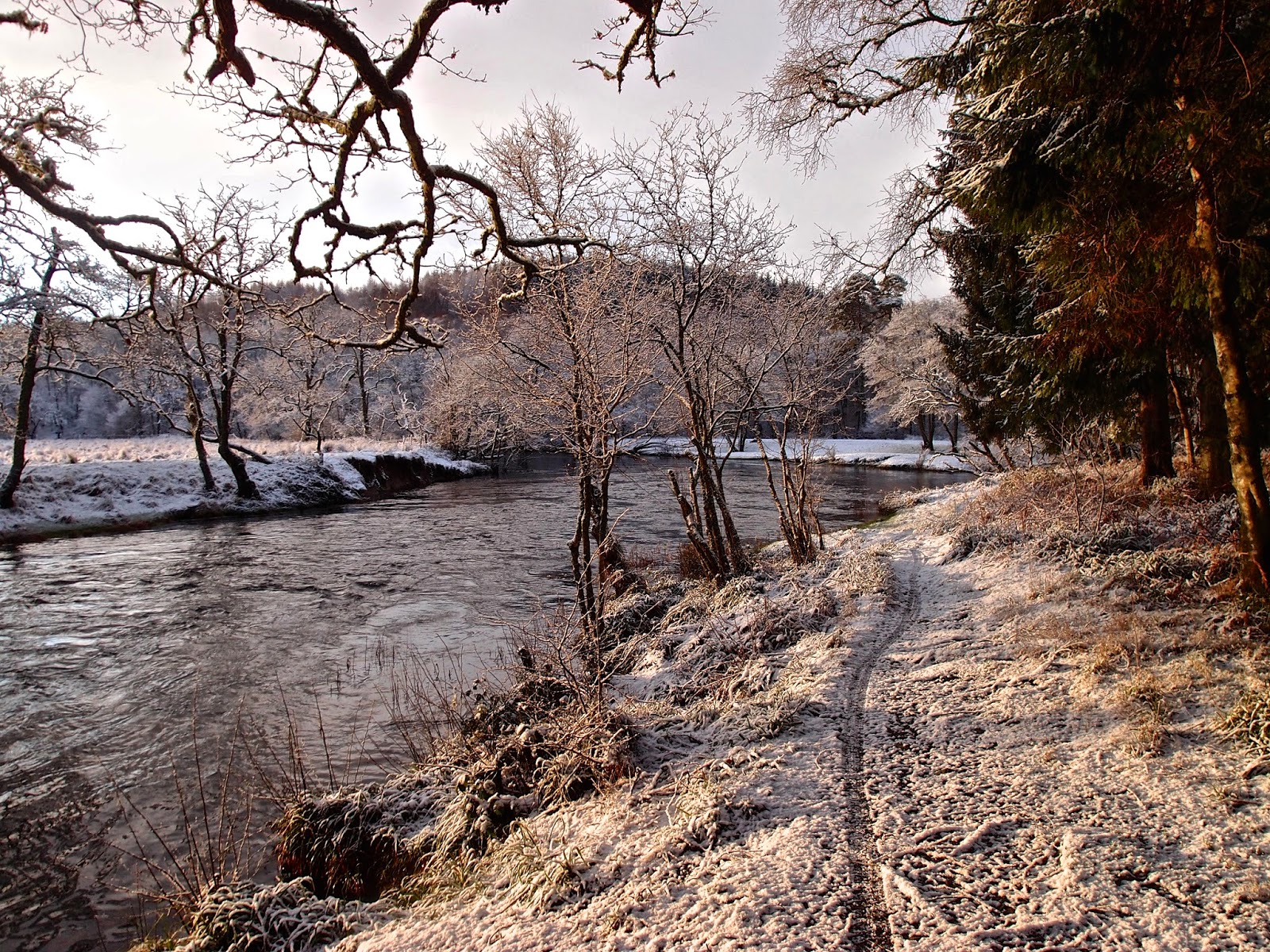
After a week or so of gales, dark days and wet snow, we were visited by good winter today. The overnight  freeze of the wet lingering slush was sprinkled with powder snow. The winds had abated and the skies were moody rather than mean. My running had been spasmodic over the past week; high stepping through wet snow or leaning into fierce winds are not the exercise of choice. Today was different, the shoes purchased into the powder and crunchy ice below, it was cold but without the damp and windchill of late; I was soon into a snow friendly rhythm. The only other marks in the snow were of two mountain bikes and a lot of animals. I had little difficulty convincing myself to add a couple of kilometres to my regular 9km route.

The river was swollen, the birches had been blasted by snow and there was an eerie silence even along the river bank. After running along the river to Lemmahamish I doubled back over the Fairy Knowe. I was breaking virgin snow at last but the steady climb was blockaded by a vast oak tree that had been blown down in the gales. It provided me with a tricky obstacle to negotiate; two young roe deer danced away in a reprise of a babycham advert as I clambered over the tree. It brought some fun and sparkle into the run. After this there was just a long easy run along trails that were untouched by humans until I reached the junction at Lochan Spling where I turned for home, happy that I had enjoyed a run for the first time in weeks even though it had taken 20% longer than normal.