Saturday, 16 July 2016

Tour de France 2016

The Peleton with Sky Team leading pass through Redessan on Stage 12
After watching the Tour de France grand depart in Yorkshire in 2014, I had wanted to see the race on French soil and this year it was passing close to where we were staying in the Ardeche. The stage from Montpellier to Mont Ventoux had me thinking we should make our way to Mont Ventoux and watch the agony and ecstasy of the climb to the summit. The mistral was blowing and the route was truncated to save the riders battling with 100kph winds in addition to the over excitable crowds. We decided to watch it cross the Bouches du Rhone at Remussen instead.

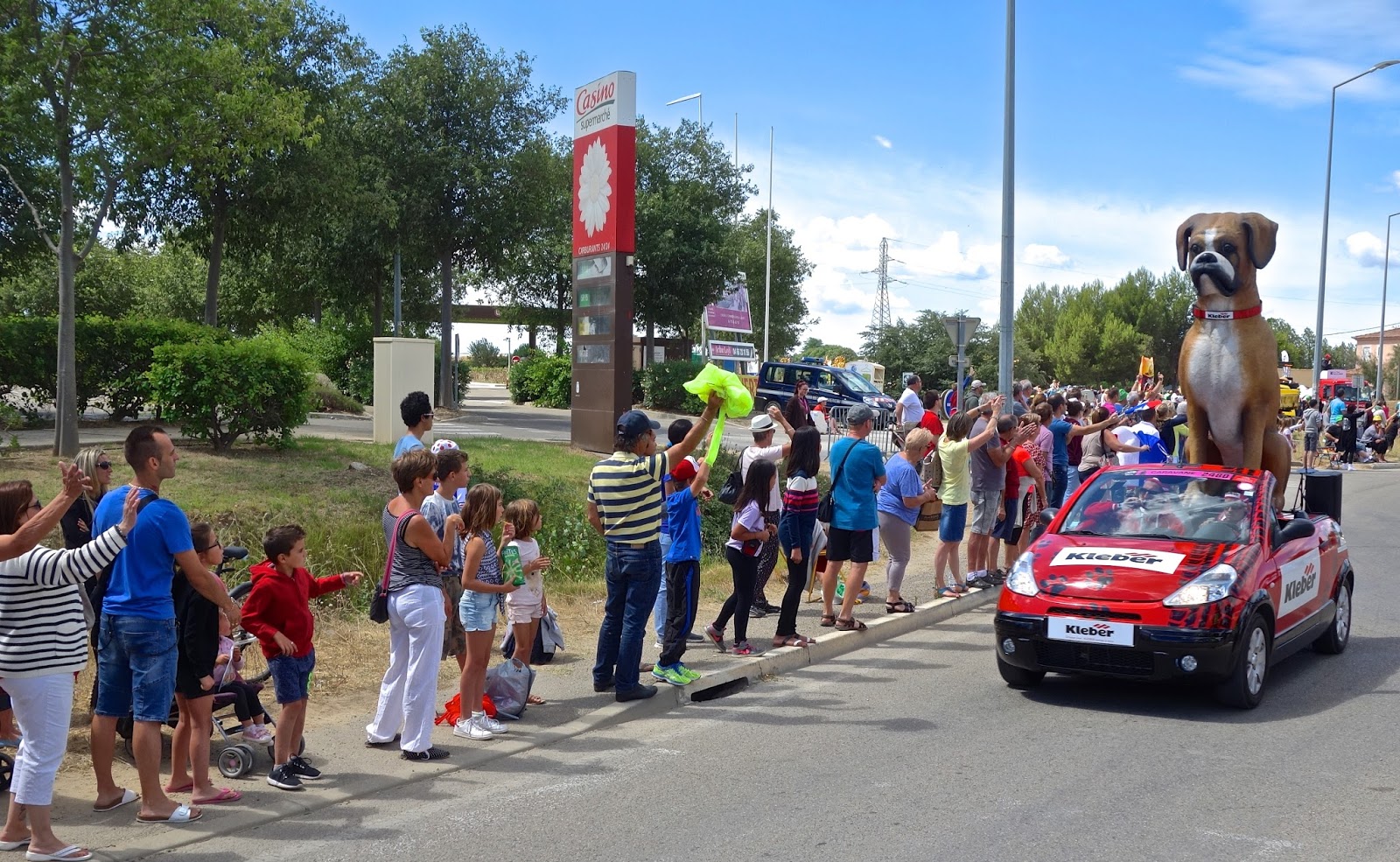
It was a good decision we managed to park 400 metres away from the route. There was a supermarket handy to buy some lunch after the caravan had passed through dispensing gifts from the sponsors. It takes the caravan a good 25 minutes to pass and provides a level of silliness that is almost British. The crowds had made a day of it with bands, fancy dress, picnics and noisy instruments. A party atmosphere built up as the anticipation of the cyclists arriving although it was not as infectious as it had been in Yorkshire but the weather was better.

The caravan consists of over a hundred vehicles blaring out music and travelling at a fair dash. They are accompanied by motor cycle outriders and gendarmes but the mood is one of friendship and theatre. There is about an hour and a half to wait before the riders arrive. In this case a leading group of a dozen or so riders were followed ten minutes later by the peleton that was being led by the Sky team with Chris Froome to the fore. There were numerous motor bikes and support vehicles as well as 6 helicopters filming the race.  The peleton of 150 riders flew past in less than 30 seconds and was followed by a procession of team cars loaded with spare bikes, mechanics, team managers, medical staff and a final sweep of gendarmes. For a supposedly green sport the carbon footprint of the tour is massive, it must consume a large proportion of the Qatari oil production.

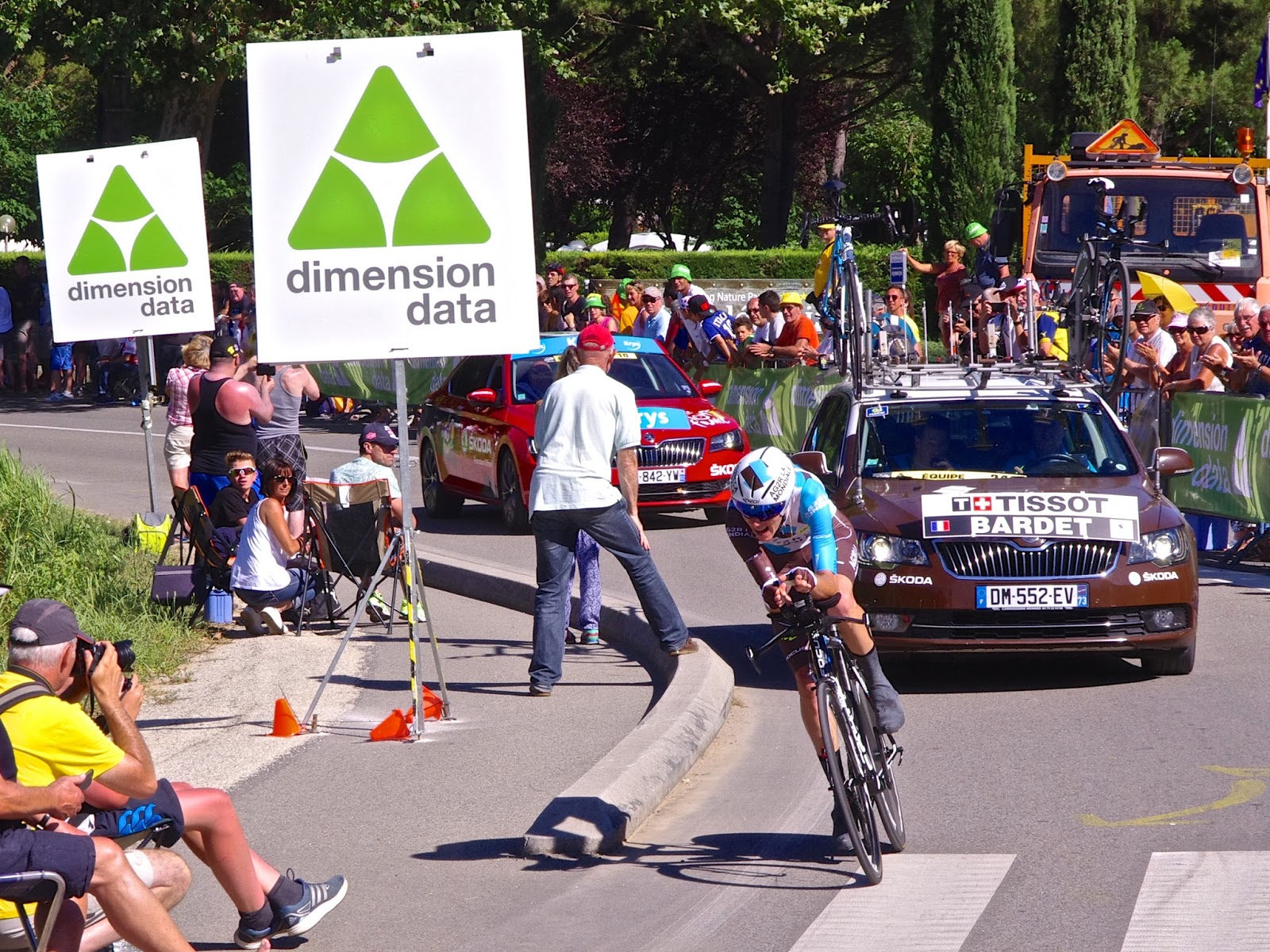
The next day was the time trial running the length of the Ardeche gorge and finishing by the recently opened Chauvet Cave. The stage had almost been cancelled following the atrocities in Nice the night before and there was a subdued atmosphere compared to the previous day. President Hollande had promised a heavier police presence although the gendarmerie seemed fairly relaxed about the security and spectators were able to funnel the riders as they began the final 6 kilometres of climbing to the finish. I spent a couple of hours watching the lead riders come through and observing the vicarious activities of the spectators. I met a Danish girl who told me that her father and boyfriend had walked a return trip of 25 kilometres the previous day from their parking spot to reach the route up Mont Ventoux and had not returned until well after midnight. It made me feel a bit happier about opting out of doing the same.

Once again I was staggered by the support for each of the 180 or so riders. Each one proceeded by a motorbike and followed by a car and then a motley assembly of race officials, cameramen and gendarmes going through on motor bikes. There was the usual circus of hawkers and fast food outlets along the route as well as families with camping chairs and sizeable picnics. Chris Froome set the second fastest time and was clocked doing 110kph as he descended to the Ardeche gorge from the plateau. I have long believed that this form of cycling must be the toughest of all sports, particularly as the vast majority of riders are domestiques for their team leaders and have little hope of glory. The Sky team are not very popular in France owing to their tendency to control the race by their disciplined professionalism in following team orders. If only other British sports had managers as capable as Dave Brailsford.


Taking it easy before the climbs at the end of the day
And then the train of support vehicles
The caravan of silly things comes first
And spectators join in the fun
It was too hot for the penguins
Ardeche, Stage 13 time trial with a heavy police presence
Local hero watches from an adjacent field
Geraint Thomas on a charge
Fabio Aru beginning the climb at Vallon Pont d'Arc
Top French rider, Romain Bardet


Monday, 11 July 2016

Petite Autane

Petite Autane from Chabottes
Sunday, 10 July 2016
Ascent:    1300 metres
Distance: 10 kilometres
Tim          4 hours 5 minutes


Petite Autane    2516m     2hrs 15mins

From our chambres d'hôtes nestled above the Champsaur Valley in the Parc des Ecrins we had a magnificent view of Petite Autane, a 2500-metre peak above the ski resort of St-Leger. I immediately logged it as an objective and thought that it could be climbed in 4 hours or so. That was before I realised that it is a 1300-metre climb including a scramble up a steep rocky ridge to the summit. After the first three days of superb walking and climbing in the Alps at the head of the Drac Valley, our last day in the Champsaur provided a chance to climb Petite Autane in the early part of the day before the threatened thunderstorms moved in.

Jean, the owner of La Grange, had been a hill runner but seemed to me to be spending too much time running his new business and I asked if he would like to join me. He declined, it was Sunday and he had to clean the rooms, but suggested that one of his sons might want to make the climb. Adrian was 17, multi-lingual, tres sportive and had quite a lot of experience walking in the Alps. We made the 15-minute drive to St-Leger and began the walk from a meadow at the foot of the ski area, ascending by a series of tracks and then using the pistes through the forested lower slopes. There were herds of cattle grazing and a group of teenagers roared past us on their motor scrambling bikes just before we reached the start of the limestone ridge.

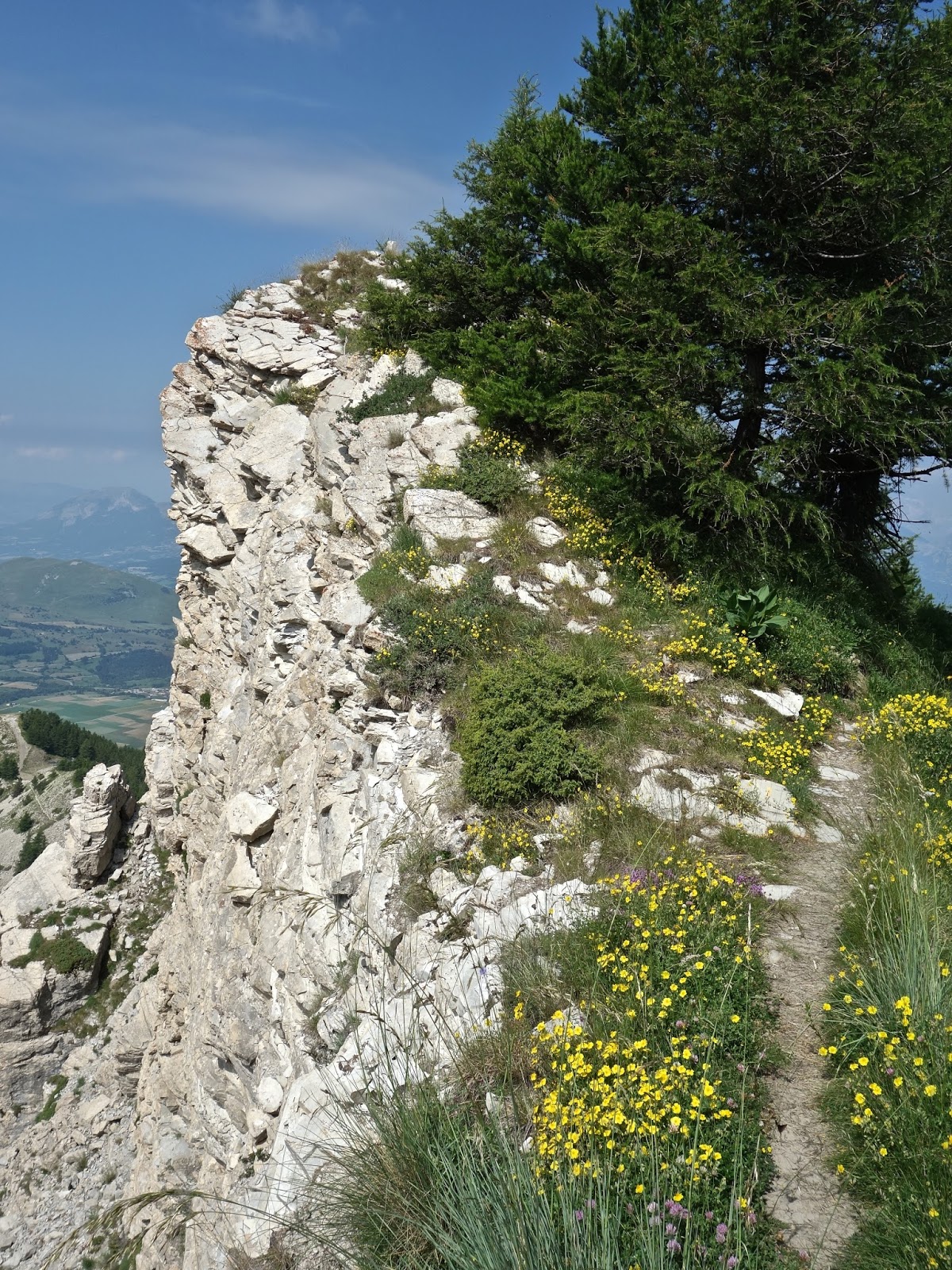
Adrian had climbed the mountain a couple of months earlier but had been unable to make the second and higher peak which was still covered in ice and snow and he had not taken crampons. I estimated that we should make the summit by noon, we had started walking at 9:45am. Adrian was less optimistic. Initially, the ridge was gentle with a narrow path wriggling its way along the narrow ridge festooned with alpine flowers. At 2100 metres the steep climb began, it was a loose rock with sections of scrambling, exposed but nothing too difficult. We paused once to watch 6 eagles as they skimmed along the ridge and then circled above us in the thermals. We had a discussion about what type of eagles and Adrian thought that they were 'aigles' or golden eagles in English but I was less sure, their wings were lightly coloured compared to those in Scotland, but Adrian was right when we checked later. A mountain runner passed us on his descent and another couple were resting near the summit. Despite the heat, the lack of humidity meant that walking was easy in just trainers, shorts and a T-shirt and there was no need for more than a wind shirt, water and a bit of fruit in the rucksack.

We made it by noon and gave ourselves 10 minutes to take in the views. The higher peaks to the north and east were already covered in clouds and there was a distant crack of thunder. A parapenter glided above the ridge and waved before looping around and being sucked upwards by the thermals. We descended by the same route, making reasonable time down the loose rock along the ridge and then descending down the pistes and summer meadows to the car.

By 2:30pm I was sitting with a 75cl bottle of local beer after a swim in the pool. I could easily get used to summers in the Alps. Climbing 1300 metres in perfect visibility and low humidity and getting back to base by 2pm is an awful lot easier on the eye and the body than an 8 or 9-hour slog around a couple of Scottish hills with a high likelihood of rain, wind, poor visibility before a 2-hour drive home. But I did miss the midges.

The path up the ridge

Alpine flowers, are a fine substitute for boggy ground

At the summit

Company at the summit

Show off

Alpine garden of flowers

Petite Autane from Ancelle

Ready to go with Adrian

Saturday, 9 July 2016

Parc National des Ecrins

Peaks of Parc des Ecrins
At last a summer in the Alps. Why they have eluded me for so long is a bit of a mystery. I have visited them a dozen or so times in winter but never managed a summer in the Alps. Before the family arrived, it was too expensive and the Greek islands were too beguiling. Holidays with children were usually on Scottish islands with the occasional visit to Brittany. And having shed the children, we have usually travelled outside the summer months to avoid the crowds and the commensurate prices.

We had decided to visit our usual retreat in the Ardèche in July this year rather than in June or September, so we could watch the Tour de France pass through. We usually combine this visit with a tour around another part of France, secure in the knowledge that we have a perfect place to relax after the travelling through other departments. I researched where in the Alps might be the most interesting location for a week of walking and climbing away from the maddening crowds. French friends from Vienne had always spoken positively about the Parc National des Ecrins. It is endowed with spectacular scenery but without the concentration of ski resorts and blighted slopes found in the Savoie Alps.

I found accommodation in the Drac Valley to the south-west of the Parc d'Ecrins and less than a 3-hour drive from Lyon, including a chance to see Grenoble. Our chambres d'hôtes, La Grange des Ecrins, lived up to its excellent reviews. Run by someone who had abandoned corporate life in China for the peace and tranquillity of the Ecrins, where his ancestors had lived. At the head of the valley, the ski resort of Orcieres Merlette gave chairlift access to the higher Alps, but there were dozens of other tracks along glorious valleys into the Alps. There are over 100 peaks of over 3000 metres and 700 kilometres of marked trails in the Ecrins. There are packs of wolves and large Pyrenean mountain dogs that protect the sheep that graze in the higher Alps. Summer was running late, and it meant that we were fortunate to see the quite staggering display of alpine flowers in the meadows and among the screes and rock bands. They were displaying their brightest hues after recent rains.

On our first day, we were recommended to take a minor road around the foot of the Alps. We found recently cut meadows where groups of children were playing with a gusto and freedom that was reminiscent of childhood in our time, and numerous paragliders were swooping beneath the blue skies against the backdrop of exquisite-looking peaks. We parked at the ancient mountain village of Papric and walked through the enchanting assemblage of wooden houses as the church bells rang out for midday. We walked through the flower-abundant meadows and up the valley to the chapel and waterfall before stopping for a lunch of cheese, fruit and water. I continued to climb a nearby peak, passing a shepherdess who was looking after a large herd of sheep assisted by four large mountain dogs. There had been warnings that they were fiercely protective of the sheep, but on a hot afternoon, they gave me no trouble. She lived in a mountain hut that I passed as I continued the climb, and another large dog came to check me out. I must have passed the test, and on my return half an hour later the dog didn't even get to his feet as I passed the front of the house.

I finally caught up with Aileen in the village; she had meandered down after lunch, captivated by the flowers and scenery. Twenty minutes later we were back at La Grange for a swim and a beer. There was a British family there, and in a fairly typical fashion, we soon discovered that the mother was Angela Mudge's sister. Angela lived near us, and I went running with a running group that she had set up. The rest of the guests were French who were content with less active pursuits. We had the sense that the owner wanted to attract a more diverse clientele than had been the mainstay of La Grange before he took it over last year. The four-course evening meal was a fusion of French and Chinese cuisine prepared by his Chinese wife and served with local wines, a liqueur (Genopi) and local cheeses.

We found a similar walk on the next day, and then on day three took a chairlift from Orciere to a group of lakes at 2400 metres. After walking up to the highest lake and having some lunch, I left Aileen and climbed up a rough path still holding patches of snow to a col with stupendous views over vertical inclined rock faces and then negotiated loose rock dotted with alpine flowers to reach a peak of 3100 metres. It was a perfect afternoon, and the vast panorama of peaks in the Ecrins was lined up for inspection; they could keep me happy for years. I was down at the cafe at the top of the ski lift by 3:30pm, inhaling the clean dry air, shifting a beer, admiring the mountains all around and asking myself why I had waited so long before spending summertime in the Alps.

La Grange des Ecrins

Our first foray into the Alps -
Source of the Drac river above Prapic

Grazing sheep at 2100 metres

Shepherdess and dog

The Alps above Prapic

L'Aiguille de la Dibona

Gentian by Grand Lac des Estaris

Grand Lac des Estaris


Crête du Martinette from Col de Freissinières

Le Sirac and Pointe de Chabourneou

Pointe Des Estaris


Monday, 4 July 2016

David Cameron RIP

Another whopper
And so another prime minister exits number 10, barely 12 months after his unexpected triumph in the 2015 general election. He was not the architect of his victory but the lucky recipient of negative campaigning against his opponents, which was influenced by a popular press that was mendacious in its dismissal of Clegg and Miliband. The Labour Party self-destructed under the pincer movement of the media, a rampant SNP and a failure to conjure a vision of economic competence.

Mr Cameron has never doubted his own ability and sought to inveigle his way into the good books of the electorate by being a ubiquitous presence on news bulletins with his ability to ad-lib confidently on the headline events of the day. He also gave time to his ministers for them to understand their briefs, he did not have the tendency to shuffle his cabinet. On many issues, he would give off-the-cuff responses or promises that were often impossible to deliver. He was comfortable being the front man for the government, a PM at ease with his own greatness. He left the heavy lifting and dirty work to his accomplices: George Osborne and Michael Gove; they were responsible for the careless whispering.

Prime Minister David Cameron built up an impressive bucket list of failures: housebuilding crashed, benefits slashed, Libya smashed, Lib Dems dished, democracy dashed, press complaints and press officers sacked, economy cracked, sustainable energy fracked, bankers stashed, fairness trashed, and his inheritance cashed but not taxed. His ever-ready rhetoric changed by the day and had to be frequently amended or twisted by his communication team a few days after his utterances.

I happened upon the Anthony Seldon and Peter Snow biography of David Cameron, Cameron at 10, in a bookshop last week and was tempted to buy it. I have read political biographies of most post-war prime ministers in recent years, but I stopped myself, fearing that it might influence my intuitive opinions of this apparently charming but ruthless man. Over his 6 years as PM, he has harmed the well-being of a majority of UK citizens, who have suffered the consequences of his loose and austere vision for public services.

At the start of the year, I reflected on whether David Cameron was possibly the worst post-war Prime Minister. This followed his announcement of the referendum on the EU and his claim that he had negotiated a groundbreaking deal for the UK to remain in the European Union. It was a bogus claim that set the scene for an unnecessary referendum that was designed primarily to keep the Tory Eurosceptics in their place. His strategy failed utterly through his lack of diligence, and he scuttled his premiership in the sure knowledge that it would be an onerous and thankless task to negotiate an exit from the EU. It would require attention to detail, which has never been his strong suit.

I will read a biography of Attlee and consider the major achievements of each PM, their success or otherwise in elections, their mistakes, their leadership qualities and communication skills before I finally rank Cameron in the hall of fame of post-war prime ministers. In the meantime, I would simply conclude that he has been a great disappointment, and the damage of his tenure to the majority of UK citizens has been on a par with Mrs Thatcher. He has also damaged the reputation of the UK as a global player, in contrast to Mrs Thatcher, who, whatever her impact on less affluent communities in Britain, did gain respect on the world stage.


Friday, 1 July 2016

Orrest Head

Looking north to the Helvellyn Range

We had visited the Wainwright exhibition: A Love Letter to the Lakeland Fells in the Keswick Museum early in the week. It had reminded me of the day I had first climbed Orrest Head overlooking Windermere as an 11 year old on a school trip. It was a mesmerising moment with the horizon to the north and west peppered with shapely mountains. I have spent a lot of time since climbing all of these fells but only been back to Orrest Head on a couple of occasions. So on another rain threatened day in a week of downpours that provided some normality in a week of political chaos I suggested that we revisit Orrest Head and be reminded of its inspirational qualities. Instead of the usual route from Windermere we started from Causeway Farm to the north of the hill. We threaded our way through some deciduous woodlands on a muddy path towards Common Farm and then climbed up the short cropped grassland that was decorated with walls, stiles and sheep.

The walk was perfect and once again the views were a revelation. Windermere could be observed in its full sinuous length and the Langdale Pikes even popped out of the cloud for a time. Orrest Head had been the place where Wainwright had fallen in love with the Lakes. He was not alone, today the bare summit was awash with a party of teenage school girls taking selfies, a couple of townies, some Japanese tourists capturing the views with heavy Canon cameras, and a most joyous Indian family laughing with happiness at the spectacular views.

We were all taken by the words below that Wainwright had used to capture the epiphany that has lost none of its impact on the generations that have followed in his footsteps.

And the truth is Wainwright was right

The route up Orrest Head from the north
Nearly there
Windermere town and lake
Townie
Windermere and Langdale Pikes

Lingmoor Fell


Crinkle Crags and Bowfell from Lingmoor Summit

Thursday, 30 June 2016
Ascent:       498 metres
Distance:    8 kilometres
Time:          2 hours 29 minutes

Lingmoor Fell      504m     1hr 42mins    

Our week in Langdale had been less of a holiday and more of an epilogue for the UK as we knew it. The referendum decision to leave the EU had unleashed a backlash of frenzied markets, political turmoil and catatonic stupor. The European football championships led to the early departure of the England team for the 20th time in 50 years, which at least provided some semblance of stability. This despite them being the highest paid, and supposedly best prepared, as measured by the cost of their accommodation and support team. The weather was dominated by heavy rain and I was out of action owing to a back injury sustained when rebuilding a stone wall last week.

It was day 5 before I finally ventured into the hills and I chose the nearest one to our accommodation.  Lingmoor Fell is an easy but enjoyable walk from Elterwater although it is ten years since I last visited the summit. I have run up and down it in less than an hour in past years but I had no desire to put too much strain on my back by running today. I met a young couple with their 3-month-old baby as I began the walk along the south side of the Great Langdale Beck. I had known the father and held him as a 2-month-old baby during our first year in Langdale and seen him most years since. He is now where we were when we started the journey into family life. Their joy at their offspring was infectious and as I left them to continue their walk and began the climb beyond the slate quarry I had forgotten about the politics of despair that had filled the week so far. We had passed the baton of responsibility to the next generation if only we had not burdened them with the collective selfishness of our generation.

I caught up with another walker as we climbed above the quarry and we fell into friendly conversation. As the gradient increased he told me of his requirement to not let his heart rate exceed 147 bpm owing to a heart condition. It meant we made steady progress with interludes to stop and talk. Les was an Emeritus Professor of Psychology and he spoke about the book he was writing on Jean Piaget and developmental epistemology. Its focus was on the origin of knowledge through its development from infancy to adolescence recognising the child as a knower. As a recent grandparent I can certainly go along with this, try arguing with a three-year-old.

The ascent seemed easy with the gently rising path leading to a gate worn smooth from many hands, a steeper section through the sprouting bracken and then a lovely undulating walk along a wall that defines the ridge to the summit. We related anecdotes from our days in the Lakeland fells as only baby boomers can, we had graduated from the analogue days of heavy boots,  cloth maps and anoraks to lightweight gear and GPS watches. Wainwright and Jos Naylor were referenced, and favourite walks were remembered. We discussed the Kendal mountain festival and finally broached the subject of the UK and the EU. We both knew each other well enough by this time to know that we would be in agreement on this. We were so deeply immersed in conversation that it was not until the summit that I began to take in the panorama of Lakeland's views. Les said that Lingmoor Fell was one of his favourite outings as we parted company at the summit. He was making a day of it and walking over the hill to Side Pike, I was heading back down for a lunch break.

The day was dry but the skies were cloudy and there was a pleasant breeze that made for easy walking. The descent was fairly quick, as I passed a woman sitting on a bench she invited me to take a seat. I declined saying that I was hoping to get down for the 1 o'clock news to hear what the latest outcome of the EU vote had thrown up as the UK was in meltdown. Her reply was perfect, "England may rot but the Lake District will always be here." I ventured into the quarry to observe the sheer scale of extraction that had taken place. Burlington Slate is not a cheap material and has been forsaken for cheaper imports from Spain and elsewhere. But the green-grey slate is such a fundamental part of the Lakeland landscape from farms, houses, footpaths and walls that it is vital to secure the future of quarries such as this. Despite the despoliation of the landscape, the quarry is well hidden from the valley with the hillside clothed in oak woodland.

After some lunch we began a second walk, this time around the base of Lingmoor Fell and along the Cumbrian Way. We passed the Baysbrown campsite where we had camped when the children were very young. More recently the London bombers had stayed here when training for their onslaught in 2005. We walked on the levee alongside the Great Langdale Beck, its clear water polishing the green-grey slate of the river bed, until reaching the meadow land below the Lansdale Pikes. The return to Chapel Stile on the footpath passed the route signs for the Ultimate Trail Challenge at the weekend. A 110km ultra run might have tempted me twenty years ago but now I am just pleased that there are an increasing number of people prepared to rise to the challenge and enjoy the heartland of the lakes. We headed for the Britannia Inn and I sampled some Jennings Bitter to celebrate the day.

1500ft above sea level and walls built with skills that were hard-honed 

Langdale Pikes without the picture box trappings 
Post Brexit England - a glimpse of things to come
Elterwater Quarry
Oak Howe Barn from the Cumbria Way
Great Langdale Beck

Langdale Pikes across the meadow

Great Langdale Beck at Elterwater