Sunday, 11 April 2021

No Sunday Paper

Ben Ledi

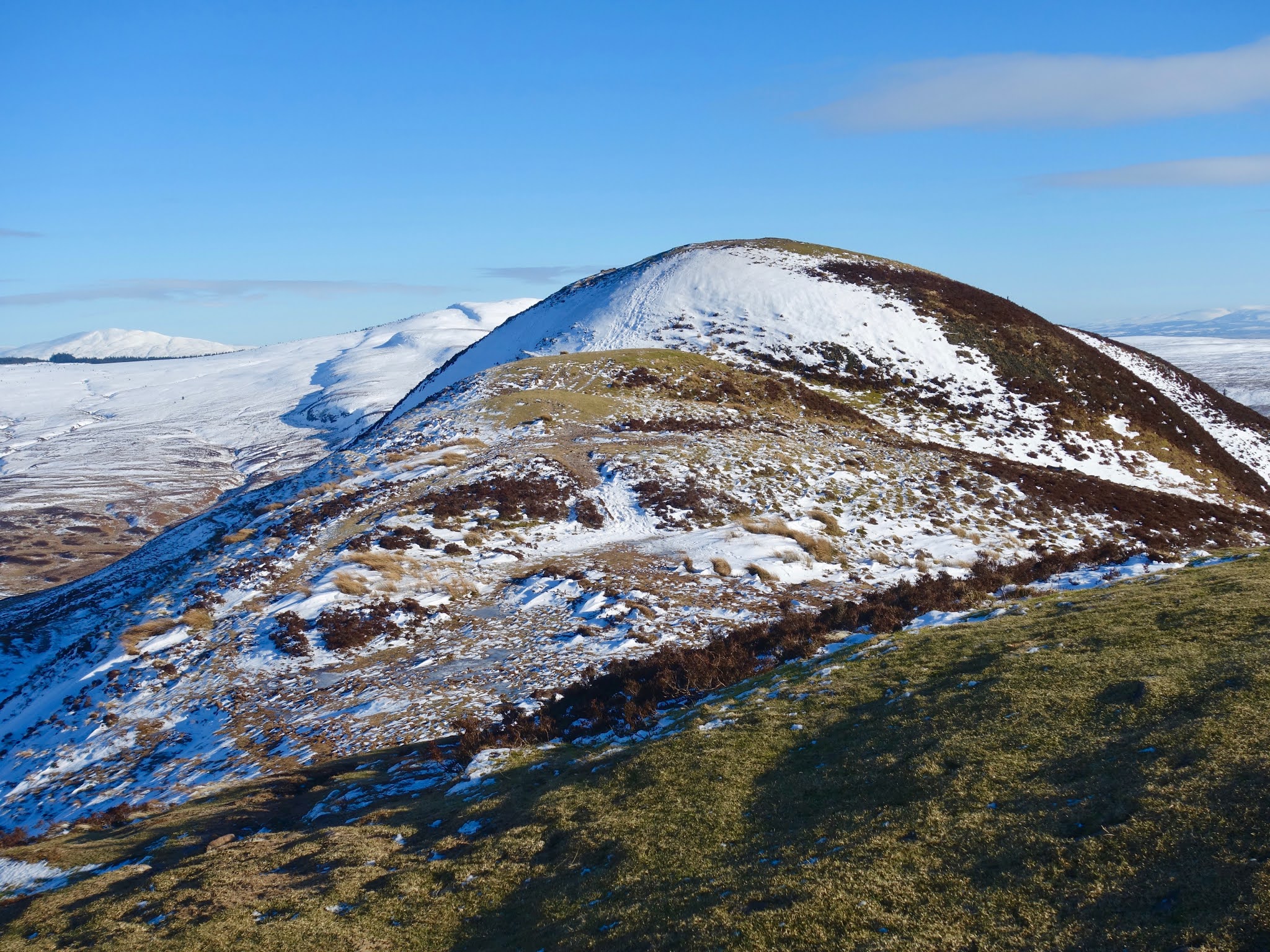
Sunday is normally the only day I buy a newspaper nowadays. After two days of the news and with virtually all TV programmes focused on the life of the Duke of Edinburgh and having scanned the papers online, I decided against wading through more of the same. I would give the Sunday paper a miss and go for a walk instead. It was well below freezing for the third morning running and there was not of a whiff of cloud so I drove the 4 miles north and climbed Ben Gullipen. 

I must have been disillusioned by the overload of news because for the first time since lockdown, I took some earphones and listened to an old playlist. There was no one else on the hill, highly unusual given that the clarity of the views was as good as I could remember. The upper part of the track was frozen hard but the morning sun gave an illusion of warmth despite the sub-freezing air temperature. 

I made it up in under 30 minutes, pottered around for ten minutes before starting the trek down, running most of the way. Two couples were full of smiles as they headed up. On days like this, Ben Gullipen is a good alternative to Lime Craig. Did I miss the Sunday Paper? No, not really, for the first time in years I can hardly be bothered with the news it is so depressing with Brexit, Covid, a tedious election campaign in Scotland and yet more corruption scandals in government, the UK is really going to the dogs. It is too depressing to pay money to read about all these blunders and the squabbles about the arrangements for  the Duke's funeral.

Loch Venachar

Stuc a' Chroin and Ben Vorlich

Frozen hard


Saturday, 3 April 2021

Sgiath Chuil & Meall Glas

Sgiath Chuil from Auchessan


Friday, 2 April 2021

Ascent:      1335 metres
Distance:   15 kilometres
Time:         6 hours 14 minutes

Sgiath Chuil             921m      2hrs 20mins
Meall a' Churain      917m      2hrs 42mins
Beinn Cheathaich    937m      3hrs 55mins
Meall Glas               969m      4hrs 21mins


Good Friday has always been a day for walking. It had been inculcated by my grandparents, when a ride on a Ribble Bus to Longridge Fell and a picnic of ham rolls, a boiled egg and some Longridge Pop (water) was the annual outing. Today, the hard overnight frost promised a gloriously clear morning. I was away by 7:45am although the roadworks on the A85 slowed progress and it was almost 9am before I started walking. I had planned to climb Sgiath Chuil and Meall Glas, two munros that are within the Council area. These hills are always tough with few paths and much boggy ground whether climbing from Glen Dochart, as today or Glen Lochay. 

I had last climbed them on 30 December 2008 from Glen Lochay with Gregor. It was grey, cold and wet and my feet were giving me some pain. It was in the good old days when you could phone the Doctor and get an immediate appointment. I did exactly that on returning home in the late afternoon and got an appointment at 5pm. The Doctor could find no obvious reason for the feet problem but discovered that I had atrial fibrillation and put me on medication. I was fairly devastated and it was the day that I finally decided to retire before it was too late to do the things I wanted to do on retirement.

The guidebooks said 7 to 9 hours and the last visit had taken 5 hours 30 minutes, I thought that 6 hours should suffice as I needed to be home by 4pm. I found a parking space at the start of the narrow road to Auchessan. It was below freezing but the views were stunning. I crossed the river Dochart, flowing full with a morning mist hanging over the upstream loch. The scattered houses at Auchessan were quiet and the farm boasted a cornucopia of old machinery as I passed through and began the walk up the track and then the path that climbed steadily alongside the magnificent Allt Riobain. The path squelched constantly after recent rains and I was glad that I had put some gaiters on. It took just over an hour to reach the dam at 490 metres. The sun had started to give the day some heat so I removed my jacket and had a brief stop for water and a snack. The next 450 metres were just a long slog up to the summit of Sgiath Chuil. Considering how long it had been since a long walk, I kept going without any stops and reached the summit on my planned schedule.

Its rocky summit provides a fine viewpoint over Glen Dochart and the massive Ben More but over the last half hour the sky had clouded over and I was exposed in the strong northerly breeze. Time to put on the jacket, hat and gloves. I found some shelter, took a few photos and had a drink before starting the easy traverse across to the nearby top of Meall a' Churain. Walking into the teeth of the wind was a reminder of how quickly conditions change on the hills. 

Next was the 300-metre drop down exceedingly steep slopes to the bealach between the two Munro tops. I took a direct route and whilst enjoying the activities of a couple of ptarmigan, I happened upon some crags that had to be circumnavigated. It would have been easier to take a less steep descent from Sgiath Chuil. It was a relief to reach the peat hags at the bealach. I had figured out an ascent route to Beinn Cheathaich using a few snow patches as waypoints and I proceeded steadily until the last 100 metres when I decided to head directly for the summit rather than take my original planned route to the north ridge which had a snow cornice that I decided to give a miss.

Beinn Cheathaich may only be a Munro top but it has a presence and a trig point. From here it is a couple of kilometres along a ridge with a few dips before the final climb to Meall Glas. About halfway along I met a German woman, the only other walker of the day. She had ascended Meall Glas up the steepish and ultra boggy land to the south and was desperate to find a path for her descent. I described the route off Sgiath Chuil with the boggy but picturesque path and she seemed relieved, although less so with the 300-metre steep climb to Sgiath Chuil.

There are fine views to be had from Meall Glas although Ben More was now in the cloud and the excellent visibility of the morning had lapsed. I took 15 minutes for some food, finished my water and plotted a descent route. I found a good line through the crags and the only bother was the boggy ground, it seemed endless and there were no obvious paths until I got down to about 500 metres. A narrow path appeared and I began to follow it as it followed one of the steep-sided burns, I lost my footing on a steeper section and somersaulted down the bank. As I stood up I could feel a searing pain in my adductor muscle, my trousers and jacket were soaked from the bog and I still had 3 kilometres to walk back. Fortunately, as I began to walk the pain subsided but I slowed my pace until reaching the track that served another dam at about 350 metres. 

I was down just after 3pm and after discarding wet boots and jacket began the drive back on the A85. There were two long delays for roadworks, one that looked like a wall construction near Lix Toll and the other to stop a landslip in Glen Ogle. The traffic was far heavier with lots of motorhomes, motorbikes, and open-topped cars. A McLaren sports car zipped past going at a speed nearer to 100mph than the speed limit. Altogether it had been a great day to reacquaint with the Munros although I wished that my grandparents could have come along with a picnic.

River Dochart at Auchessan

Start of the track from Auchessan

Allt Glas below Meall Glas

Meall Glas and Beinn Cheathaich from Allt Glas

Dam below Beinn Cheathaich

Sgiath Chuil summit looking south to Ben Vorlich

Glen Dochart and Ben More from Sgiath Chuil

Meall Glas and Beinn Cheathaich from Sgiath Chuil

Sgiath Chuil from Beinn Cheathaich

Meall Glas and Creag Mhor from Beinn Cheathaich

Creag Mhor from Meall Glas

Meall Glas cairn

Beinn Cheathaich and Sgiath Chuil from Meall Glas 


Friday, 26 March 2021

Leckie


Leckie estate top left below Gargunnock hills

Birthday Photo

Bridge over troubled waters

Snowdrops and wild garlic

After over 30 walks up Lime Craig this year and accompanying me on sorties to local micro hills, Aileen decided that her birthday walk on a cold and windy day should be less aerobic and not involve any climbing. The view to the Gargunnock hills from the house reminded us that the Leckie estate is a place of interest when it is not the shooting season for pheasants, partridge or grouse. It had belonged to the Younger family (Brewing and the former Secretary of State for Scotland) for many years but has since been sold twice in the last five years. 

The estate comprises a curious hotchpotch of landscapes with the bedrock of red sandstone carved by fast flowing burns, old estate plantations of massive and damaged deciduous trees, new ugly coniferous forests, and the remnants of old mills, sawmills and bridges lost in the vegetation but acting as reminders of the grandeur of Victorian estates. The undergrowth of the older plantations is lush with a carpet of snowdrops, wild garlic and patches of daffodils. An area of rhododendrons has been cleared over the winter and adds to the desolation.

We did a long loop around the tracks and paths. Gregor had been running there earlier in the week and felt that he was being chased by an animal at one point, presumably a deer but who knows what lurks in estates like this that are hoaching with game birds. We walked back via Watson House, now divided into flats, and along the beech avenue back to Gargunnock. The next stop was the Woodhouse for a cake to celebrate the birthday. There were none available so for the second year running I made a Victoria Sponge, successfully, although the strawberry and cream filling would have been annihilated on bake off for taste and presentation. 

Tomorrow I will be back to climb Lime Craig for the 44th time this year, its views are the best value in the vicinity from a mere 300 metre ascent.

Lime Craig


Monday, 22 March 2021

National Anthems

Soweto Gospel Choir - Nkosi Sikelei l'Afrika

We were blowing ideas and nonsense during a Friday night Zoom meet-up during lockdown when the subject of national anthems strayed into the conversation. What was the best and what would we like to see as Scotland's national anthem to replace the dirge that is Flower of Scotland. Our homework for the next week was to make nominations for both categories. The entries included Scotland the Brave, which along with the Flower of Scotland, is often used as the assumed Scottish anthem instead of God Save the Queen. 

The general feeling seemed to be that glorified patriotism, the sentiment "Wha's Like Us? Gey few and they're aw deid" was perhaps no longer the image that Scotland should be promoting. Something more self-effacing and humorous would be better. Hence my colleagues nominated Michael Mara's Hermless and Harry Lauder's offering A Wee Deoch and Doris.

We invited an independent former colleague to judge the suggestions and I was delighted that my nomination, Gerry Rafferty's Get it Right Next Time was chosen. There is no triumphalism here, just the reality of life. It sums up the mistakes of the Scottish Parliament as it steals power from local communities and centralises decision-making.

Out on the street I was talkin' to a man
He said "there's so much of this life of mine that I don't understand"
You shouldn't worry I said that ain't no crime
Cause if you get it wrong you'll get it right next time, next time.....

You gotta grow, you gotta learn by your mistakes
You gotta die a little everyday just to try to stay awake
When you believe there's no mountain you can climb
And if you get it wrong you'll get it right next time, next time.


Next time you-hum


As for the best anthem, well that's easy: It's Nkosi Sikele L'Africa, the South African anthem that is sung in all the main languages and in many ways has brought together a divided nation. Other nominations were France, Italy and Russia as well as a reference to Billy Connelly's choice, Berwick Green, the Archer's theme tune.

Wednesday, 10 March 2021

Peak Sunak


Half-price on me, anyone?

It was yet another budget day and Rishi Sunak had progressively leaked most of it in advance. He is promoting himself as the most intelligent man in the cabinet, not an impressive accolade, and has been exploiting social media to sustain this image. His Instagram and Twitter accounts have even adopted a new font for his signature.

Unlike his predecessors, George Osborne, Philip Hammond and Sajid Javid, who had been scrooge-like in their custodianship of public services. Rishi Sunak was forced to splash the cash when dealing with Covid and declared he would do whatever it takes to address the pandemic. Covid spending has already exceeded £400bn and is still rising. He presented several mini budgets as the grip of Covid tightened, ran up the largest debts in the post-war period of £355bn, and became the most popular chancellor since Dennis Healey.

However, his star began to wane when his Eat Out to Help Out scheme in August 2020 produced indigestion amongst the Sage group. It cost £849m, undermined the public health messaging and was found to have been a major reason for the second wave of the pandemic in October 2020. 

He failed to provide furlough and income support for 3 million self-employed during the first year of the pandemic. His cavalier funding for PPE contracts that were let to companies recommended by Tory MPs and exempt from tendering processes, the phone app that never worked, and the Test and Trace initiative that was centralised instead of using established public health teams have all been hugely expensive failures that have diminished his stature.

These ill-considered spending sprees were then contrasted with his unwillingness to fund more than a 1% rise for nurses and his continued reduction of council funding, which includes education and community care. His latest budget heralded £1bn for Town Funds, supposedly part of the government's levelling up Initiative. Detailed analysis by various think tanks discovered that 39 of the 45 towns receiving grants were to Tory-controlled constituencies, including Richmond, Rishi Sunak's own constituency and Newark, the Community Minister, Robert Jenrick's constituency. It is a Rishi mystery how Cheadle, Bournemouth and Southport qualified for the Town's fund? His levelling-up claims have been seen as yet another example of how economical he is with the truth. 

His proposal to introduce eight low-tax freeports is a reprise of Mrs Thatcher's previous attempt to introduce them as part of the package of deregulation. They proved largely ineffective and merely shuffled trade away from existing ports so that even David Cameron's government abandoned them in 2012. 

His funding of Test and Trace will go down as one of the greatest financial scandals in the history of any UK government, although the responsibility for this will be shunted to the Health Secretary Matt Hancock and Test and Trace's serially incompetent leader, Dido Harding. But it was the Treasury under Rishi Sunak who authorised spending this avalanche of public money with minimal accountability and who is now reaping the consequences as he levels back on public spending.

His polished ingratiating persona has become tarnished even amongst the Tory right-wing supporters. They have realised that he is no magician, just another oleaginous accomplice to the prime minister. His latest budget has simply extended the inequalities that have been the enduring outcome of the austerity years. Levelling down is not just for Covid but the years that follow. Rishi Sunak's belief in Freeports, Brexit, Hedge Funds and the power of his social media presence is not going to change anything.

Vince Cable, when addressing Gordon Brown at PM questions, as his reputation was collapsing, asked whether "The house has noticed the prime minister's remarkable transformation in the past few weeks - from Stalin to Mr Bean." A similar putdown for Rishi Sunak might go something like, "the chancellor has become less like Kevin Spacey and more like, well, Kevin Spacey". I suspect there will soon be far more chancellors than Denis Healey ahead of him in the popularity stakes.


Friday, 5 March 2021

Eck v Nic

Control and Command

What a palaver! The past and present first ministers of Scotland, Alex Salmond and Nicola Sturgeon, are playing a game of poker with their reputations for chips. Holyrood is the stage and the first ministers are merely players; they have their exits and their entrances.

I watched live on the BBC a fair chunk of the eight-hour interrogation of Nicola Sturgeon by the Scottish Parliament Committee on the Scottish Government's Handling of Harassment Complaints. The first minister's ability to present detailed arguments and recall events is both impressive and legendary, although she uses far too many conditional clauses for my liking. She also tends to apologise when things have not gone well and claims to empathise with whoever is suffering as a result of the issue under discussion. It plays well compared to the UK government ministers' unwillingness to acknowledge any of their mistakes, but she overplays her hand on this.

She did not miss the opportunity to play her apologies and raise Alex Salmond on his dubious claims of being found not guilty of any abuse or his failure to offer any apology to the women who had raised the complaints. 

The purpose of the Committee was to establish how the Scottish Government had failed to conduct the inquiry into Alex Salmond's alleged harassment of women with due propriety. It has always been acknowledged that the senior civil servant originally asked to carry out the inquiry knew the complainants and was therefore unsuitable for the task. The focus of the interrogation was on when the first minister first knew about the complaints and what actions she had taken. The crux of the issue became whether she had lied about first hearing about Alec Salmond's indiscretions with 9 women on Maundy Thursday or Easter Monday. 

According to the provocateur and acting leader of the Tories, Ruth Davidson, this was a resigning offence, and the first minister should resign for forgetting that she had heard this on Maundy Thursday. As an act of political grandstanding, it truly takes the Easter egg, but then Ruth Davidson and Nicola Sturgeon have always been doughty street fighters, both incapable of not having the last word.. 

Not since the Scottish play has Scotland witnessed such bloodletting as the feud between Alex Salmond and Nicola Sturgeon. These two formidable politicians have exercised Command (Salmond) and Control (Sturgeon) leadership for the past 14 years. They have stooped to nothing when it comes to ridding their governments of those who do not follow their direction of travel. Unlike Boris Johnson, the SNP leaders have no hesitation in sacking ministers, MPs or MSPs as Joanna Cherry, Neale Harvey, Margaret Ferrier or Derek McKay could testify over the past year. And woe betides any of the Scottish agencies, Health Boards or Councils who gainsay their authority.

With the Scottish Parliament election looming in May, my guess is that the Inquiry will dribble on and then fade away. Holyrood has a tendency to dispatch incomprehensible subjects into the ether. Already, the result of the election has been assumed to be a shoo-in for the SNP and, therefore, the start of another saga of calling for a second independence referendum. The result is becoming less certain as the two most recognised faces of the SNP slug it out. This is likely to be exacerbated by the loss of many of the more experienced and competent SNP MSPs like Mike Russell, Bruce Crawford, Roseanne Cunningham and Stewart Stevenson, who are standing down. So are several able younger women MSPs, such as Aileen Campbell and Gail Ross. This will deplete the SNP of political nous and make them even more dependent on the first minister. There are not many of the current MSPs who have shown any great capacity to govern. The consolation, for the SNP, if not Scotland, is that the same comment could be made of the other parties. 

What most concerns me about this is the loss of the proper scrutiny of Scotland's real issues: the lack of an industrial strategy, the decline and prevarication about the future life of the oil industry, the lacklustre performance of schools, the appalling failure of care homes and the centralisation of public services. Localism has been exorcised by the monoculture of the Scottish Government; all subsidiarity stops with the Scottish Government. Holyrood has allowed its internal squabbles and regular fights with Westminster to dominate politics in Scotland for too long. It is time for politicians to focus on the real issues that will determine whether or not Scotland emerges from Covid with a realistic vision for the future.

Thursday, 18 February 2021

The Curious Case of Jagging Variations


The slow start and variable speed of vaccinations in Scotland have been the subject of many questions during the First Minister's daily update on the Cover pandemic. She has normally blamed the slower rate than the rest of the UK by stressing that Scotland had focused on the Care Homes first. Whilst this has undoubtedly been better than England, it has not picked up the Care Homes for the Disabled including those for young people and it is certainly not at the 99.5% claimed by the First Minister, even medical experts acknowledge that it is difficult to get higher than 90%. The Scottish Government and media have also given great plaudits to the mass vaccination centres such as the Louisa Jordan centre at the SECC in Glasgow and others that have come on stream in Edinburgh and Aberdeen. 

The above table tells a different tale. It is the smaller Health Board areas that have performed considerably better. The health boards covering the three Island groups together with Dumfries and Galloway, Ayrshire, Borders and Highland all mainly serve sparsely populated rural communities. They depend on GPs and medical centres to deliver vaccinations with few additional facilities brought into play. They have managed to average 37% vaccination levels. 

The remaining 8 health boards covering the cities and major urban centres have commissioned larger buildings such as football stadia as well as hosting the mass vaccination centres. They have averaged a vaccination rate of 26.3%. This is almost 30% less than achieved by the rural health boards. So why is all the kudos going to the mass vaccination centres, is it because these are the visible evidence of Scottish Government intervention? After all, Louisa Jordan cost £70m and has a £2.4m contract for security with G4S. The GPs and local medical centres are not in the game of seeking glory, they are using existing facilities and it would appear that they are a lot better organised and efficient in delivering services and at the community level where patients have to travel less and are vaccinated by familiar faces. Now that achieves efficacy, efficiency and effectiveness and is sustainable, as we see every year when the flu vaccinations are rolled out.

Monday, 15 February 2021

Jagging for Victory


You would think from the headlines of the past couple of days that the UK had achieved the impossible. 15 million Covid vaccinations in 10 weeks! The PM and  Matt Hancock have been lapping up the kudos, wearing white coats and wide smiles as if they had personally administered the vaccines. Eventually, one of their promises has been realised and it was almost world-beating, only Israel and the United Arab Emirates were further ahead. But is it really such an achievement?

During the 2019/2020 winter before the lockdown, GP practices administered the vast majority of 15.3 million vaccinations to their patients: those over 65, those in clinical at-risk groups, pregnant women, and some children, whilst hospitals vaccinated some healthcare workers. The vaccinations usually take place from early October to early November in advance of winter flu, let's say over 5 weeks. They are carried out by community-based medical staff alongside all the other duties they perform with no fuss or celebration. Patients usually just pop into their local medical centre, or if housebound, they might be visited by a GP or one of the nurses at home. It makes you realise and appreciate the effectiveness of the NHS community-based GP practices.

The Covid vaccinations have benefitted from new vaccination centres, hospital vaccinations, drive-in centres, pharmacies and the army. Retired doctors and nurses were recruited to augment the operation. So when, as the weekend approached, we were told the target of 15 million vaccinations would be reached

By Friday soon, or Saturday noon
With Boris Johnson, Matt Hancock, Kate Bingham,
Chris Whitty, Simon Stevens, Dido Harding, 
Jonathan van tam as well as
Old Uncle Tom Cobley and all,

We were meant to be amazed.

And what have they done, well 15 million vaccinations in 10 weeks? The GPs were twice as fast with no need for patients to travel to distant centres, vaccines administered by medics you know and without any significant reduction to other services. And no need for Uncle Tom Cobley and all. Like so many government initiatives during the time of COVID, new initiatives emanating from central government have been more about them wanting to take control. Local practitioners have been sacrificed and the costs of responding to COVID have grown unnecessarily

To Impeach or Not Impeach

The Rise and Fall of American Presidents

The people -- the people -- are the rightful masters of both congresses, and courts -- not to overthrow the constitution, but to overthrow the men who pervert it. Abraham Lincoln

The impeachment trial in the American Senate had been playing out all week and, when I heard on the lunchtime news that a decision was imminent, I switched over to CNN to watch the vote on the impeachment of former President Trump. I had not seen much of the trial over the previous four days and wanted to see how the Senate conducted itself in taking such a momentous decision. Here was the chance to follow another of Lincoln's maxims. 'The ballot is stronger than the bullet.'

It was expected that the Senate would fail to get a two-thirds majority to impeach the President and therefore reject the evidence of the attack on Congress by the MAGA mob. I was surprised therefore to find that the Senate had voted to subpoena witnesses following a CNN report that a Republican Senator, Jaime Herrera Beutler, had released details of a heated conversation between the former President and the Republican Minority Leader, Kevin McCarthy. McCarthy had called then-President Trump on 6 January and asked him to call off the riot. Trump had replied that it was Antifa that had breached the Capitol and then contradicted himself by saying "Well. Kevin, I guess that these people are more upset about the election than you are." It seemed very likely that if Senator Beutler gave evidence the Republican Leader would have to confirm or otherwise the veracity of her description of events.

After a 2 hour break for negotiations between the parties to decide how to proceed, it was a travesty that the Democrats merely agreed to put this statement on record. They did not insist on hearing from any witnesses. The Presiding Officer, Senator Patrick Leahy, who had taken on the responsibility of chairing the trial after the Chief Justice declined to preside because Trump was no longer president, was perplexed and confused by the procedures. The five clerks advising him were like headless chickens and seemed unable to provide him with clear advice. The Democratic party managers had decided to throw in the towel rather than pursue a series of witness interrogations? These would undoubtedly have put Kevin McCarthy in the unenviable position of having to authenticate his conversation with ex-President Trump on 6 January.

Why was this, were they really so determined to get away on their week's holiday - apparently planes were already booked for the exodus? The other reason speculated was that it would take too much time to call and prepare witnesses and this would disrupt the Senate when it needed to focus on President Biden's agenda to get America moving again. Whatever had been the reason, it certainly wasn't a determination to unearth the real facts, admittedly a rare commodity in the time of Trump. 

The final act was to hear the summing up of the trial. The Democrat's Lead Manager, Jamie Rankin, and his team argued that Trump had incited the insurrection and had failed to care about the safety of Senators as was evident in the former President's words to Kevin McCarthy. Michael van der Veen made a preposterous defence, arguing that nothing Trump said "could ever be construed as encouraging or sanctioning an insurrection," and that it was part of an "unhinged pursuit of a long-standing political vendetta against Trump."

The vote for guilty was 57 to 43, well short of the two-thirds majority required for impeachment. Minority leader, Mitch McConnell, who had voted against impeachment then made a speech that accused former President Trump of "a disgraceful dereliction of duty." "There is no question that President Trump is practically and morally responsible for the events of that day." Too late Mitch, you had already hitched your wagon to the opposite view. The whole episode in the Senate seemed mired in hypocrisy. Here is the evidence of why the self-proclaimed "great" American Constitution has not been copied by any other democratic nation. 

It was left to Republican Senators Bill Cassidy and Susan Collins to remind fellow Senators that "the Constitution is more important than any one person" and that Trump had "incited an insurrection with the purpose of preventing the transfer of power from occurring." Abraham Lincoln would have approved of their summary but he would have been very disappointed in the decision of the Senate to deny the people the real facts.

I am a firm believer in the people. If given the truth, they can be depended upon to meet any national crisis. The great point is to bring them the real facts. 
"I think Abraham Lincoln said that" Bob Dylan

Saturday, 13 February 2021

Conic Hill

Conic Hill summit

11 February 2021

Ascent: 380 metres
Distance: 4 kilometres
Time: 1hr 21mins

Conic Hill          361m      42mins

Conic Hill on the shores of Loch Lomond is one of those popular micro hills that attract crowds from the Central belt at the weekends and during school lockdowns. It is perfect for families on sunny days when parents and children can compete for moans on the ascent or treats on the summit. Today was different, the overnight temperature had dropped to the lowest since 2010. Despite the bright sunshine, it was a finger-numbing -4°C as I arrived at the almost empty car park just before 10 a.m. There was only a Mountain Rescue vehicle that looked as if it had arrived shortly before me. It is almost 9 years to the day since I last climbed the hill during the first leg of a three-day walk of the West Highland Way.

The well-made paths through the forest at the start of the walk were covered in soft powder snow but after passing through the gate onto the open hillside, the strong north-easterly wind had cleared the powder snow from the path. There were patches of ice, easily negotiable, and the flights of steps were generally clear. It became more tricky alighting onto the grassy slopes above where the burn had overflowed and created a bit of an ice rink. The West Highland Way path climbs to the north of Conic Hill and it alternates between hard dry gravel and sections of ice requiring some careful footwork. I continued to the east and highest end of the series of peaks that make Conic Hill and climbed the last 50 metres up a steep snow slope until emerging on the pudding stone of the summit. Conic Hill is on the Highland Boundary fault and capped by this rock.

It was bitterly cold in the northeasterly but the views in all directions were sublime, The man from the Mountain Rescue had been about ten minutes ahead of me but he had ventured off, presumably making his way back by the series of diminishing peaks to the south-west. It seemed like a good idea and I decided to descend in that direction. Each of several mini ascents was easygoing, the wind had blown away the snow. Each descent was down a steep slope of hard snow, any slip would result in a rapid slide down and I had no axe or crampons but it was the landing pit of puddingstone that worried me. 

The route meanders down a grassy slope to join the main path at the top of the steps. I had met no one so far and on Conic Hill that is rare. Three tough-looking young men in outdoor work clothes, with no hats or gloves, were coming up the steps and having a laugh. I explained the route and hoped they had a good day. When I arrived back at the car park there was a white van advertising plastering and roughcasting.  The workers had obviously found it too cold to be mixing concrete or plaster and had given themselves a deserved outing on Conic Hill, I would guess that they had no difficulty.

Approaching the West Highland Way path

Across Loch Lomond to the Glen Luss hills

Ben Lomond

Conic Hill with Gualann behind

Loch Lomond islands on Highland boundary fault

The descending tops of Conic Hill


Conic Hill 361m 42mins


Wednesday, 10 February 2021

Day 322: Jags


Tuesday, 9 February 2021

After the first lockdown on 23 March 2020, we were told that the pandemic would not be over until a vaccine arrived and that this would not be before 2021. Unusually, progress was quicker than expected and the first vaccines became available in December 2020. By virtue of age, I was in the first four groups to be eligible for vaccination, after the NHS staff, care home staff and residents and over 80s. Today was the day for our first dose and we headed for the Medical Centre that has been closed all year owing to Covid. Any consultations have been largely restricted to telephone calls or NHS 24. The two practice nurses were on duty with the GP and a couple of the practice staff in attendance to supervise the vaccination of 200 baby boomers who were rattled through safely at 3-minute intervals. 

The imperative of being on time and an overnight fall of snow had meant that I had been harried into leaving home early, the mercury was still falling under the now clear skies. We arrived 25 minutes ahead of our appointed time so I took a 15-minute walk around the snowscaped paths in the village to kill some time and to compensate for the loss of my normal morning walk that was discouraged immediately after a vaccination.  

Linda is the practice nurse whom I have seen regularly for the past ten years. She is meticulous in everything she does. When I was prescribed warfarin after being diagnosed with atrial fibrillation, I had to visit her every week to monitor my blood count. We had become good friends as we announced new grandchildren and shared stories. It took the full three minutes as Linda repeated all the dos and don'ts of the AstraZeneca vaccine and gave me the dates for the second dose in 12 weeks; the GPs were playing by the government guidance. I discovered that the practice was only doing vaccinations one day a week and that they were already ahead of schedule. Like many others, we were disappointed that it was the AstraZeneca vaccine; the published results of its efficacy are far below those of the Pfizer and Moderna vaccines. Questions about its suitability for the over 65s and questionable protection against the South African variant have not enhanced its popularity, but most GPs do not have the storage facilities for the Pfizer vaccine that seems to have been largely used for health workers and those visiting the massive vaccination centres in the big cities..

The First Minister's persistent claim that Scotland was behind the rest of the UK in its vaccination rates because it was focusing on care homes first sounds like a lame excuse. The Medical Centre probably could have vaccinated its entire practice list by now if it had been allowed, and the vaccines had been made available earlier to the GP practices instead of being restricted to hospitals and vaccination centres in the early weeks. Meanwhile, HC - One, the largest care home organisation in the UK and owner of many of the Scottish Care Homes that had the highest number of Covid deaths, has said that 40% of its staff have yet to be vaccinated. Other care home providers have indicated that up to 20% of staff were refusing to be vaccinated. These figures do question the First Minister's much-repeated claim that Scotland had vaccinated 99.5% of those in care homes. I doubt it. It is worrying, apart from the unacceptable failure to protect care homes, I had largely trusted the First Minister in her handling of the pandemic, but there is a tetchy defensiveness about some of her recent announcements.

We returned home, and I joined four former colleagues to record a Zoom video for posterity on a website we have created to capture our experiences at the sharp end of local democracy. It was the fifteenth in a series of recordings, but we were unhappy with the outcome. We decided we would have another go at it next week. We had a paper published in the Herald last week on the need to reconsider holding the Scottish Parliament election on 6 May and discussed what else we should do on this score.

I decided to continue my prescribed rest by watching politics live, one of the best current affairs programmes, chaired with great perspicacity and efficiency by Jo Coburn. What a contrast with the ponderous, heavy-handed pomposity of her predecessor, Andrew Neil, the Paisley pitbull. She creates an informality and a stage for courteous debate between politicians of all persuasions, journalists and an occasional celebrity. Today we had the straight-talking sense of David Blunkett with two new Tory MPs and the excellent political editor of the Mirror, Pippa Crerar. They were joined briefly by Joanna Lumley, who is trying to save the seabed from the explosion of wartime bombs when creating shelves for offshore wind turbines. The first rule of a debate with a national treasure is that you don't argue with them; even David Blunkett observed this obligation. 

By 3pm, I was getting frisky and with no repercussions from the vaccine, I took off for a quick walk up Lime Craig, my 20th visit this year. It was unusually quiet, the underfoot conditions were perfect with powder snow covering the frozen and in places icy base. The air was still and cold, ideal for thinking through how I would present my thoughts on producing a place plan for the community. Two of us had been asked to take a lead on this, and we were reporting back to a Zoom meeting of the Community Trust in the evening. When I returned home, I phoned Joyce, my colleague on this venture,  and we decided how to make the presentation. 

After watching the Scottish news and the start of the Channel 4 news, I joined the Zoom meeting. Conversations are strangely muted as you wait for others to arrive, and there are always those who are really muted and have to be hand-signalled in. Our 45-minute slot expanded to an hour and a half as the Trustees got caught in a circular discussion about procedures. I think we eventually reached a decision but the balance of governance between control, transparency, ownership and action is always a precarious one.

And then there was just time to catch up on the night's football matches, the news, and to watch Newsnight on the first day of the Trump impeachment trial in the Senate.


Thursday, 4 February 2021

Austerity, Centralisation and Entitlement: the real Covid spreaders

As the press and media begin to celebrate the speed of the vaccination roll-out, there has been a marked decline in the reporting of the mistakes in the response to Covid-19 and the damage caused to people and businesses. Every day there are new stories spun about the wonderful progress being made to escape the confinement of Covid in the UK but little reporting of the actions taken by those countries that have managed the pandemic successfully. The government's long-held mantra that we shall have an inquiry later, once we have dealt with the present crisis, is barely mentioned by the government as they edge towards a reprise of an old war slogan "vaccinating for victory".

The evidence, however, is already in the public domain provided by those who have been closest to advising and watching the governments response. Two articles published in the last couple of weeks cover most of this ground. The BMJ view on the UK's poor record on Covid-19 is a failure of policy learning together with Professor Devi Sridhar's opinion piece, Five ways the government could have avoided 100,000 Covid deaths, are well-crafted summaries of what any inquiry will find. The UK has the highest number of Covid deaths in Europe whichever way you count it. No matter how quickly the vaccines are rolled out, they will not compensate for lives lost, the damage to children's education, the bankrupt businesses and the impact on mental and physical health. The scaling back of community medical and dental services and soaring hospital waiting lists have resulted in thousands of excess deaths over and above the direct result of Covid.

So whilst these are evident truths about how the UK got it wrong, it is not very apparent that the lessons have been learnt or that all the advice, whether it is partly, sage or time related has been heeded. What is less understood is how some underlying values have underpinned a decision-making regime that has been responsible for the failures. There are three prevailing government stances that have hindered the effective response to Covid-19: austerity, centralised decision making and the sense of entitlement that government ministers intrinsically support. These have been the real Covid spreaders.

Nine years of austerity had run down the NHS with fewer hospital beds and diminished community health provision, Councils had been starved of cash for community care and government investment in contingency planning was halted. Hence the warehouses full of outdated PPE, care homes that could not recruit staff and too few hospital beds to cope with a pandemic. What was called macho economics during George Osborne's time as Chancellor or "there is no money tree" by Theresa May had decimated public services and created a pool of outsourcing providers whose familiarity with their customers was incidental rather than fundamental. All the evidence shows that austerity has had the greatest impact on the poorest families and the ethnic minority communities and it is no surprise that they have been the most serious victims of Covid. 

Rishi Sunak, the new Chancellor in the time of Covid, earned high kudos as he turned on the funding for furloughing of staff, increasing universal credit and other measures. It wiped out the alleged benefits of George Osborne's austerity measures at a stroke but also provided some big wins for those businesses with an eye for the chance. Because of his desire to fire up the economy in the summer with every encouragement to the public to support the hospitality sector and travel industry, including the eat out to help out initiative, we were soon seeing second and third waves of Covid that have proved more enduring and costly in the winter months. Peak Sunak was reached in August, he is no longer the gilded member of a tarnished cabinet.

The second reason was the centralisation of decision making by the prime minister and his advisers . There was an absurd unwillingness of the UK government to mobilise and involve the devolved nations, regions and Councils in the planning or the delivery of responses to the pandemic was palpable as it struggled to take necessary but difficult decisions about lockdown or travel restraint. Even parliament was given a minimal and belated role in the scrutiny of decisions as the PM and his coterie of favoured ministers justified their inaction or spurious procurement practices behind the excuse that we are following the science. The UK's response was totally centralised with the BBC dragooned into a plot of mock transparency. 

The government was unwilling to engage Directors of Public Health or involve Councils to deliver Test and Trace. Top-down decisions on supporting care homes, travel, school closures, and business restrictions could all have benefitted from local knowledge. The simple expedient of trusting those who know their customers and localities to deliver the services was whitewashed as the government turned to its friends, the business savvy top feeders. They were given the chance to influence the shape of the response and then to pick up government contracts that were excluded from any objective tendering process. These decisions have been hugely costly to lives and the nation's finances as is most apparent in outsourcing, the Covid-19 windfall and £25.7bn according to the NAO on the Test and Trace programme.

The third reason for the government's devastating failure in responding to the pandemic is the presumption that entitlement allows certain groups and businesses to be exempt from the measures imposed on the general public. The entitlement is endemic in networks of the moneyed and privately educated elite that control the power in the highly polarised structure of society in the UK. As most of us obeyed the instructions to stay at home, only allowed ourselves an hour of exercise within walking distance of home and with no testing available, there were others whose lifestyles seemed untouched. Business people travelling abroad, royalty travelling between their various houses, celebrities jetting off to the sun, and premier football teams getting unrestricted testing and winter training camps in the Middle East. The most shameful example of exceptionalism was the failure of the PM and his cohorts to observe the guidelines as exemplified by Dominic Cumming's much-maligned trip to Durham. It merely confirmed that the government's exceptionalism has been also been a Covid spreader and that we should know our place.