Wednesday, 29 October 2014

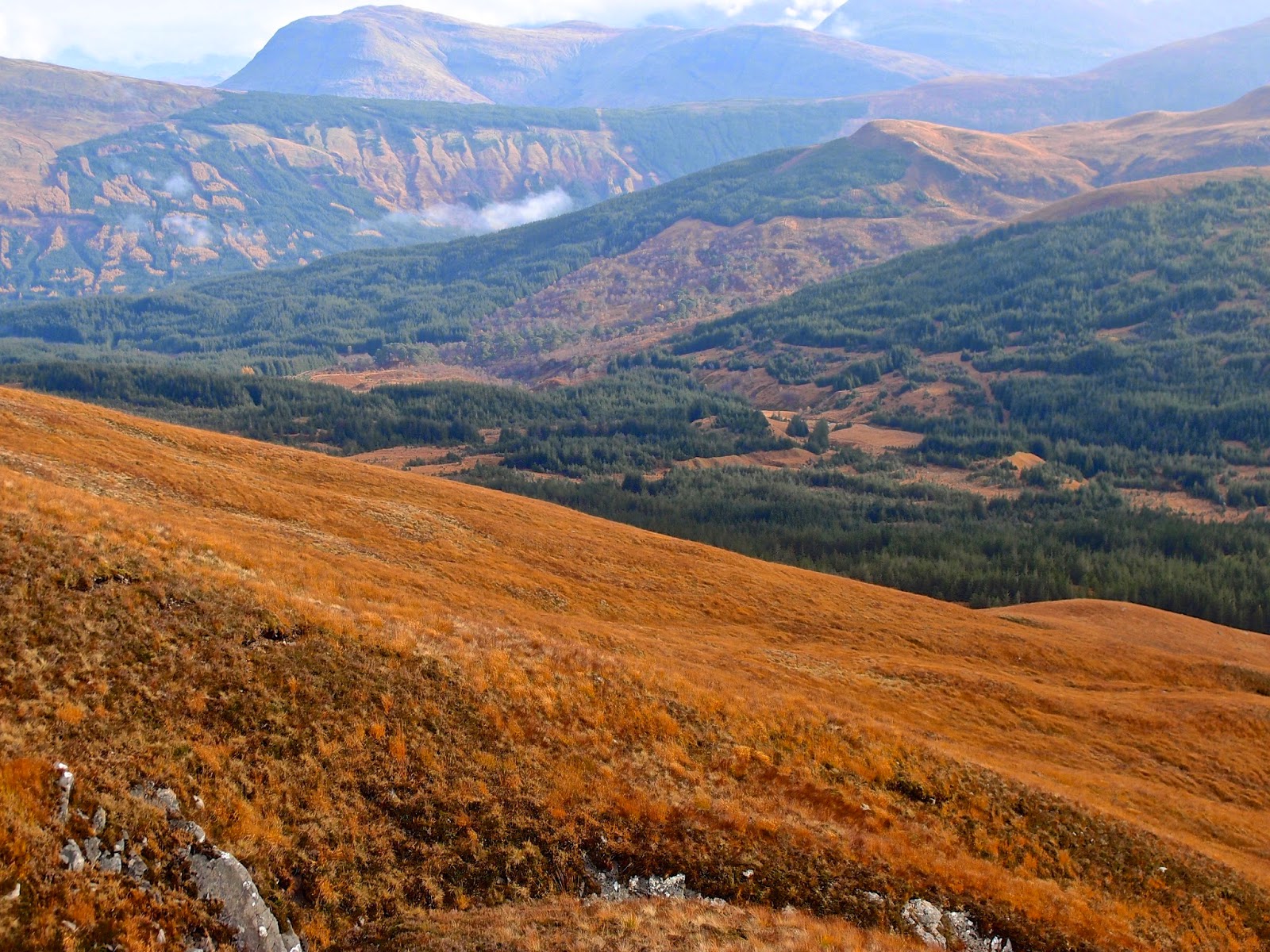
Beinn Mhic-Mhonaidh

River Orchy falls at Eas Urchaidh
River Orchy at Eas Urchaidh
Beinn Mhic-Mhonaidh from south
Summit ridge and cairn of Beinn Mhic-Mhonaidh from south-west
Looking south west towards Beinn Eunaich
Looking East to ascent route and Beinn Chuirn

Wednesday, 29 October 2014

Ascent:      805 metres
Distance:     14 kilometres
Time:            4 hours 31 minutes

c    Beinn Mhic-Mhonaidh       796m        2hrs 39mins

It had been quite a while since I had been on the hills and a stubborn cold had restricted my activities and ebullience over the last week. I normally shake them off with a run or a decent walk and for the first time in a week, it was to be a dry day. Mark had recently retired and we agreed to climb Beinn Mhic-Mhonaidh, a shy Corbett in Glen Orchy. It is hidden beyond the forestry plantations that dominate this beautiful glen in Argyll. For whatever reason, I had never ventured down the glen before despite it being little more than an hour away from home. After the recent rains, the river Orchy was in spate and provided a wonderful spectacle as we travelled down the glen from Bridge of Orchy. I parked by the bridge at Eas Urchaidh and we were enthralled by the waterfalls just upriver from the bridge.

The guidebooks and walk guides had been disparaging about the walk-in, describing tough river crossings over the Allt Broighleachan and a boggy track through the forest. Mark confirmed these fears from his previous experience of the hill and we had just suffered three days of torrential rain that had closed several local roads through landslips. In practice, it was a good trail up to a meadow at 2 kilometres and a bridge here led to another less distinct trail leading westwards and crossing a couple of burns. We managed to get across these with dry feet and arrived at the stile by the remnants of shielings at Airigh Chailleach. From here there is little alternative but to slog up the steep south-east face of the long ridge of Beinn Mhic-Mhonaidh - 600 metres of unrelenting boggy grassy slopes. The damp conditions made defying gravity more of a trial than usual as did my cold. Normally I would put my head down and slog up the slopes but today I needed some breaks to stop, talk and relieve the tedium and aching legs.

Visibility was not as good as we had hoped with the surrounding hills coated in thin mists. Once on the southwest end of the ridge, it was a pleasant stroll to the significant summit cairn. There was little wind and it had been a hard sweat on the ascent but I soon cooled down whilst eating some lunch. We continued along the summit ridge to the lochan just north of the summit. Unfortunately, it was also bathed in mist, before turning south and heading down the challenging gradient of tussocky grass and bogs back to the shielings. I was drained of energy as we clambered the stile and began the final 5 kilometres down the trails through the plantations to the River Orchy and car park.

The highlight of the walk back was the sighting of a medium-sized dark brown mammal which could have been a polecat. It was the colour of a fox but about 40cm long, it crossed the track about 25 metres ahead of us and disappeared into the grassland adjoining the burn. The image below is a good likeness and apparently, Polecats have been seen in Argyll in recent years. Arriving at the bridge we were confronted with more non-native mammals in the shape of 30 or so young people viewing the waterfalls during the English school holidays.

Polecat

Craft Beers

My favourite under-age tipple

American Craft Beer Classification Chart in Durango

Durango Brewery, Colorado
One of the most welcome developments in recent years has been the emergence of microbreweries in most parts of the UK and, as I discovered last month, with equal vigour in the States. They provide a staggering array of alternative ales to the big brewers. The same big brewers who had decimated the local breweries in the 70's and 80's. The big four: Scottish and Newcastle, Ind Coupe, Watneys and Allied had replaced local beers with homogenised corporate products that were heavily marketed and lacked any distinctiveness. They duped a generation to drink lager and keg beers with brand names that bore no relationship to place or reason. They then tied pub landlords into selling their beers and drove many independent pubs into bankruptcy.

The only opposition came from CAMRA (Campaign for Real Ale) but in the 1970s it was mainly a protest organisation campaigning against the takeover, and inevitable closure, of town breweries. My favourite beers as an 18-year-old were Dutton's (Blackburn) and Mansfield Bitter both of which disappeared at the hands of the big four. CAMRA also promoted the ever-decreasing number of pubs that sold real ale. Microbreweries were perceived as uneconomical businesses for cranks and obsessives.

My beer drinking diminished from the 1970s as drink and drive legislation, family life, and a desire to keep fit for competitive running all conspired with the tasteless offerings from the big brewers to restrict my beer drinking to the occasional social event. I would occasionally discover a remaining brewery when on holiday. Hartleys of Ulverston before it was taken over, Jennings of Cockermouth, Timothy Taylor's in Yorkshire and Thwaites in Lancashire all made a trip to the pub worthwhile and some of these beers travelled to real ale pubs in the cities.

How very different things are today and not just in Britain. The recent holiday in the States was notable for the universal availability of craft beers, most communities were served by several microbreweries. What was really helpful in the States was the referencing systems for beers that measured the colour, bitterness and specific gravity of beers.
  • The Standard Reference Method (SRM)is a system breweries use to measure the colour intensity, or darkness, of a beer. 
  • The International Bittering Units Scale, (IBU) rates the relative bitterness of beer. The bitterness of beer is provided by compounds from hops used during brewing. 
  • Alcohol by volume (abv) measures the specific gravity and is the same as in the UK 
Accordingly, the American beer drinker has a set of measures that allows the drinker to choose beer by some known parameters. It worked well and over three weeks I found myself selecting beers not just according to the locality, the nearer the better, but also to some standards that matched my preferences. The blackboard in the Durango Brewery enabled me to select a Third Eye Pale Ale and it was the perfect choice.

A couple of weeks later a friend invited me to the Ayrshire Beer Festival and along with 3000 others, including quite a high proportion of males and females in their twenties, we sampled some of the 150 real ales on sale from all parts of Scotland and England. The event is run by CAMRA volunteers and held in the Council offices in Troon. The beer was gushing from 11:00am until 11:00pm over three days. I managed 4 sessions and sampled about 10 beers. Each day you could vote for your favourite beer. Highland Brewing's Scapa Special and Mobberley Ales RoadRunner were my choices and I have already been thanked and invited to drop in at the breweries when next in the areas. Localism is reviving beer drinking, once again conjuring up the reality that small is beautiful.


Tuesday, 28 October 2014

Benign Floods

Goldcrest seeking refuge from the rains

Loch MacGregor
Loch MacGregor and Ben Lomond
Forth in full flow
Waterfall at the Trossachs Lodge
I was surprised to find a Goldcrest in the porch, it was seeking refuge from the non stop rains that had persisted for 48 hours. The Goldcrest  is the smallest British bird and could fit in a match box according to my bird book when I was a child. This fact had stuck in my mind ever since and now was the chance to test it but all we had was a box of Cooks Matches and you could get a blackbird in there with a bit of folding. We enticed the Goldcrest out of the porch and it took refuge from the downpour in the adjacent evergreen tree along with a couple of dozen other birds.

The next morning the floods had arrived but not before the children had got to school and then the rains abated and we were treated to a benign flood. The river had not risen to the extent that the roads were impassable but I was distraught when I discovered that there is now proposed a £12m flood protection scheme designed to cope with the 100 year flood. All that is needed for most years is a levee for about 200 metres that could be created by a man in a JCB in a couple of days. There would be no days lost from school, the traffic would get through and the consultants would not get their estimated £825,000 fee. What we need is a bit of common sense, the Aberfoyle and Loch Ard flood scheme is the local equivalent of HS2, a bonanza for the engineering companies and at a cost that will preclude any development taking place for many more years.

The positive take on this flood was that the 'set aside' fields were covered with a sheet of water, the ducks arrived and we had acquired a prime loch side view. I grabbed the camera and took an afternoon stroll around the new waterscapes, made friends with the lady with the bike and the greyhound and wandered up to the David Marshall lodge to see the waterfall. It had never looked as good and there were still plenty of families on the October holidays enjoying the walks in the forest. If floods could be made as benign as this, there would be no unnecessary school closures, no stream of vehicles trapped in the village and it could all be done for a fraction of the Rolls Royce solution that consultants seem to regard as de rigour when seeking to win public investment contracts. Or as a consultant reader of this blog pointed out, the client (the local Council) could be a whole lot smarter in specifying the brief so that the consultant's proposals could be both affordable and appropriate.


Saturday, 25 October 2014

Jack Bruce

Jack Bruce with Ginger Baker (left0 and Eric Clapton (right)

The announcement by his family of the death of rock legend Jack Bruce at the age of 71 will be mourned by the thousands who were privileged to have seen and heard him play. It finally extinguished my hope to see Cream play live again. I had the great fortune as a student to to see Cream play live shortly after their formation at a gig in the Sheffield Student's Union. It was memorable for the truly amazing music performed with Jack Bruce on base guitar and vocals. He had written most of their material with Pete Brown, a Liverpool beat poet. Cream may have had a short life but they were the outstanding rock/blues group of the era. The event resonates in the memory as probably the best concert that I ever witnessed and that includes two Jimi Hendrix gigs and a stupendous Pink Floyd concert.

Ginger Baker dissolved in sweat as he played Toad, giving us a 15 minute drum solo. Eric Clapton played spine tingling riffs throughout the set in a way that only he could perform. But the abiding vibes are of the rhythm of Jack Bruce's base playing and his haunting vocals. NSU and I Feel Free had been their hit singles and were greeted with raucous cheers but they performed most of their first album, 'Fresh Cream'. The highlights were Jack Bruce's playing and vocals on I Feel Free and Spoonful which was similar to this live version from 1968. Even the light show captured on this video reflects the mood of the time. Listen to this with a spliff and after 5 pints of Mansfield bitter and you will be back in the summer of love. And I have probably listened to this version of Sunshine of Your Love more than any other track. After a hard 4 days climbing 18 munro, I even cleared the clientele at the now burnt down Achnasheen Hotel in 1992  by playing this at full volume on the then new CD jukebox, although I had mistakenly played Hermann and the Hermits immediately beforehand.

In the late 1990's I heard that Jack Bruce lived locally and had rehearsed in hotel function room in Bannockburn. I made contact to see if he could be persuaded to perform at Stirling Castle esplanade for the Millennium celebrations. I was delighted to get a reply to the effect that he would be delighted but that Ginger was very difficult to pin down and Clapton was tentatively scheduled to perform in Wiltshire.  I had tried and was frankly surprised to get such a positive response. They did eventually come together for some concerts in London and New York in 2005.  The CD of the 2005 Albert Hall concerts is good but I enjoyed my Cream fresh and I'm So Glad that I saw them when they were sitting at the top of the world in 1967.

Jack Bruce also wrote some wise lyrics about Politicians in 1968, he was ahead of the curve in this take on them too.

I'm a political man and I practice what I preach.
I support the left, though I'm leaning, leaning to the right.
But I'm not there when it's coming to a fight.

Hey now baby, get into my big black car.
I just want to show you what my politics are.

Tuesday, 30 September 2014

Obsessive running

107:  a chip off the old block
Another year older and another PW(personal worst): 46:56 in the Trossachs 10km trail race. I had won this race in its previous incarnation in 1990 after coming second the year before to Peter Cartwright, a subsequent over-50 World mile champion.. The route has changed a bit over the years; it carves round the forest with four or five short, sharp hills, lots of tight bends and a fair bit of debris from timber operations. My only intent this time was to help the local charity, Rainbow Valley and to see if I could match my time of 8 years ago when I last did the race. I was within a minute of my 2006 time and pleased that Gregor (107) managed to come third for the second time despite a training regime of football and only running once a week.

My preparation had not been conducive to a good time, as I had just returned from 3 weeks in the States. The only runs I had managed whilst there were an early morning run in Yellowstone and a couple of runs in Central Park before arriving home on 17 September. I needed to run 85 miles by the end of the month if I was to achieve my monthly target of 100 miles. Apart from a couple of months when away on holiday or once with a torn muscle, I have managed this target every month since January 2012. It provides a sense of achievement during the lazy days of retirement and keeps me healthy, although my feet are suffering from a lifetime's abuse from energy-sapping activities.

The obsessive running gene kicked in as soon as I returned from the States. I had the cardio-vascular benefit from two and a half weeks at 7000 feet above sea level in the high plains of Wyoming, Utah and Colorado. I went out every day on getting home, twice in one day, and achieved my highest weekly mileage (62 miles) for twenty years.

These runs included a 6-mile run with the running group on the first wet and dark evening of autumn. I had neglected to take a head torch with me, but the other four who turned out were all properly equipped and took some tricky paths in the forest. There were lots of tree roots, steps, switchbacks, protruding rocks and occasional deep grass to trip over. I had to play follow the leader and fell behind the others; only the sound of Colin's heavy footsteps and an occasional flash of disappearing head torches kept me on track. The three women in the group had escaped; their beams of light were 300 metres in front as I gingerly jogged out of the forest. As we hit the road with some street lighting, my competitive instinct was aroused, and I managed a 6:30-mile to catch them before the village.

The following three days involved another 34 miles of running, so my muscles were still aching as I lined up at the start of the 10km trail race. I decided to run within myself and kept a steady pace all the way around. As usual, I lost some places between 2 and 5 kilometres, but then made up some places before the finish and even managed a steady sprint past a couple of runners.  I began to think about where I could have saved time, but this just confirmed that even in my mid sixties, I still have all the symptoms of an obsessive runner. On reflection, this is not a bad thing, and the sense of well-being was tangible as I completed my running log whilst enjoying a beer, chicken jalfrezi and watching the football.


Thursday, 18 September 2014

New York

Alice in Wonderland sculpture in Central Park

Central Park Reservoir looking east to Manhattan

View from the Staten Island Ferry

World Trade Center

Memorial Plaza at the World Trade Center

High Line Apartments

Scaffolding Art

Brooklyn Bridge

UN building from the Empire State Building


Chrysler Building

Cezanne cut-outs

Bryant Park

Times Square

These two were arrested shortly afterwards

Central Sation
After three weeks on the road, New York was to be our time to relax before the flight home, but that is not easily done in New York. Even getting from Newark Airport to the hotel took two and a half hours on the hotel bus, which was a travesty of integrated transport. Then the perfectly located hotel on Sixth Avenue charged prices that we would have expected to include the internet and a decent breakfast, but these were additional items.

There is no sense in describing all our activities in New York; we charged around places we had not visited previously and doubled up on the Museum of Modern Art and the Empire State Building. The highlights were the free ferry to Staten Island with its superb views of the Manhattan skyline, the community-managed High Line walkway through the former meatpacking district on the Lower West Side, and the Jeff Koons Retrospective exhibition at the Whitney Museum of American Art. We had walks, and I had morning runs around Central Park and breakfast at a local Greek diner on Sixth Avenue. We admired the rectangular solidity of Central Station and visited Lower Manhattan. The scene of the 9/11 tragedy was overpowering.

We had a long conversation about the pending Scottish Independence referendum with an Italian/Brazilian who was now resident in New York. He couldn't understand the purpose of the vote, as Scotland and the UK were perceived as mutually integrated by the rest of the world. He admonished us for defending the right to a ballot and said it would be hugely damaging for Scotland, the UK and the world if there were to be a Yes vote. This opinion was echoed by several other Americans we spoke to during our trip.

Like everyone else who visits New York, we found the prices high and relaxation difficult. The magic of the first visit in 1996 with our children was no longer there. We walked miles, as the taxis were slower than walking; they were the reason for and the victims of gridlock. They had to do twice the distance to stand still, as Alice might have told them, owing to the one-way systems. New York is a game designed to make everything seem bigger, slower and more expensive than it really is. No wonder Donald Trump has his tower there.

I calculated based on our trip that you could get two weeks in Wyoming, and that included the hire of a car and 1500 miles, for the price of 4 days in New York. The guy in the Apple Store who sold me an iPad agreed, but he was waiting for his wife to retire before they decamped to Wyoming. He reckoned that he could get all the entertainment stuff he wanted online or from the memories of a life spent in the city, and what he really wanted was the physical and mental stimulation of the great outdoors. We agreed, and he managed to save me $100 on the iPad that I was going to buy. It was 8:30am on a Sunday morning; he said it would buy us lunch, and he was just about right.

Much as I enjoy visiting cities, the numbing effect of New York airports and transport systems, the lack of courtesy in diners and public attractions like the Guggenheim museum, together with the high tariffs for everything, would not persuade me to rush back to New York. This, even though we never managed to visit the superb Metropolitan Museum or obtain tickets for any of the shows we had wanted to see.

Wednesday, 17 September 2014

Colorado


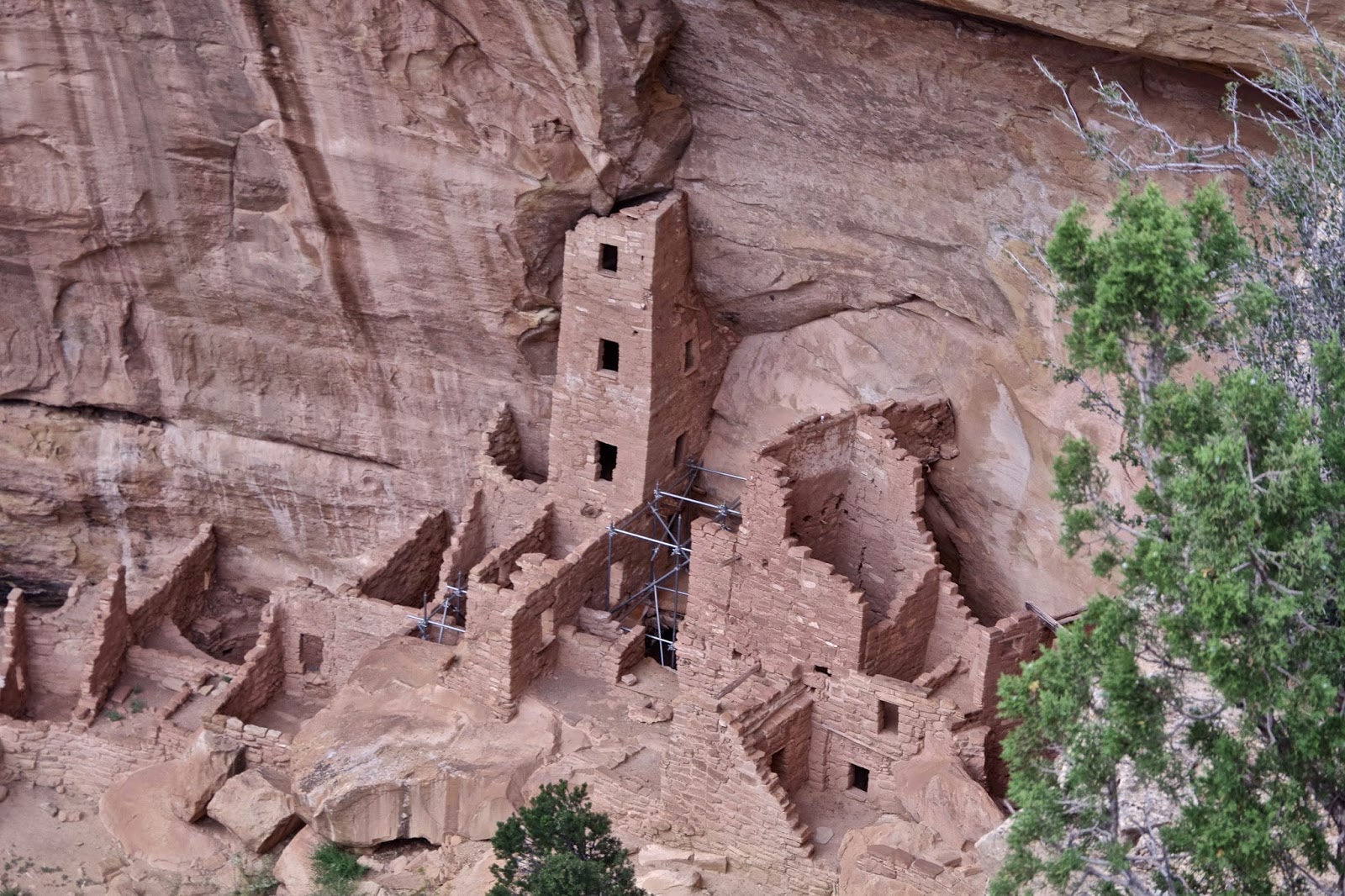
Mesa Verde, cliff dwellings

Mesa Verde


Leaving Mesa Verde as the storm rolls in

Backlit by lightning

Micro Brewery in Durango

Downtown Durango

Letting off steam in Silverton

Durango train steam into Silverton

Well, you're the lucky one, we all wanted to be engine drivers

Silverton 

The Rockies from the Million Dollar Highway to Ouray

Garden of the Gods, Colorado Springs

Surely Banksie hasn't got this far, Colorado City

I persuaded a gullible Texan to help me topple the balancing rock

Came across this fellah on my morning run
Our Arts and Crafts B&B near Manitou Springs
Colorado is probably the state I had most wanted to visit on the road trip. It has it all: the Rockies with four national parks, skiing at Aspen, Vail, and Breckenridge, and it has the most active lifestyle in the USA with the commensurate healthiest population. The entire state is above 1000 metres, so an ideal environment for aerobic training. All this and a reputation for some of the best microbreweries and a fairly radical take on life. But after a couple of weeks in Utah and Wyoming, it seemed like an anti-climax returning to Colorado. A state which enjoys 300 days of sunshine a year, but was overcast and rainy for the five days we were there. We did not have a chance to witness the Rockies, which were lost in the clouds.  It still provided a grand tour and, if anything, increased my resolve for a more leisurely visit.

After leaving Moab, we headed south-east uncertain about our next destination. We had no accommodation booked and had decided to play it by ear. Should we drive to Arizona and visit Monument Valley and the Grand Canyon, which we visited a dozen years ago, or make for Mesa Verde instead? After breakfast in Moab, we decided that we would head down to the Needles section of Canyonlands and then maybe drive towards Four Corners, where the states of Utah, Colorado, Arizona and New Mexico meet. But on reflection, there would be nothing there but an intersection of lines of latitude and longitude on a map. Heavy storms were predicted for Arizona, so we decided to aim for Durango, on the basis that Bob Dylan had sung about it, and it seemed to have a lot of accommodation.

We emerged from Canyonlands as the heavens opened, and I took the forest road which climbed up to 10,000ft. It was like driving through a waterfall with no other vehicle on the roads and a soundtrack of whooshing wipers behind the distant claps of thunder. Eventually, we dropped down to Monticello, where we stopped for some gas and to buy coffee to calm our nerves. The road from here had more familiar landscapes of rolling countryside; no dramatic red sandstone cliffs or mountains, just small-town America. The road across to Cortez was bean-growing country with well-cultivated fields and long vistas into gentle landscapes.

Time was not on our side as we pulled up in Cortez at 4:30pm, I realised that it would be pushing it to visit Mesa Verde National Park, but the alternative would mean a return trip back from Durango of 90 miles if we left it until tomorrow. Fortunately, the Tourist office had lots of good advice, and they provided a map and highlighted all the points to stop on a 3-hour trip around the park. We then had a 40-minute drive to reach the park and a good 25 miles to the cliff dwellings, which are the central attraction. Mesa Verde translates into English as "green table", which is a good description, but there are some deep gorges that provide the sites for the cliff dwellings.

The climb up to the Mesa Verde plateau was like visiting a lost continent. We managed to take in all the important stop-offs; the advice from the tourist office had been apt and concise. Mesa Verde National Park is a UNESCO World Heritage Site. It is the largest archaeological preserve in the United States and was designated in 1906 by President Theodore Roosevelt to protect some of the best-preserved cliff dwellings in the world. It is small as National Parks go at just 81 square miles, but features numerous ruins of dwellings and villages built by the ancient Pueblo people or Anasazi. There are over 4000 archaeological sites and over 600 cliff dwellings.

The Anasazi inhabited Mesa Verde between 600 and 1300 AD. They were mainly subsistence farmers, growing crops on nearby plateaus or mesas. Their primary crop was corn, but the men were also hunters, which supplemented their food supply. By the year 750AD the people were building mesa-top villages made of adobe, and in the late 1190s, they began to build the cliff dwellings for which Mesa Verde is famous. These are structures built within caves and under outcroppings in cliffs - including Cliff Palace, the largest cliff dwelling in the USA. The mesa is now extensively forested and seems to have a microclimate of its own.

As we headed back, the skies darkened and we watched a thunderstorm pass to the north, the skies heaving and sparking with alarming power. We dropped down to the plain and drove the last 40 miles to Durango. For the first time on the trip, we were lost. I had driven pretty well to the hotel using the street grid as a guide, but we asked directions from a local and were sent across the river in a flow of traffic that included a psychopath in a truck behind me. He wanted to exceed the speed limit and for me to do the same. He cut me up, and we had angry words that detracted from the generally good experience of driving in the States. We had to retrace our steps to find the hotel, which was smack in the centre of the town, pretty well where we had been before being misdirected.

It was after 9pm as we headed out to find some food. A nearby diner Steamworks Brewing doubled as a bar and microbrewery and served good food and excellent craft beers. I got into a conversation about the beers, the blackboard gave the date of brewing, the alcoholic strength, the bitterness and darkness of each brew. I asked for an explanation of this system of classification and then chose the beer that would be nearest to my preferred style; the rules worked, and I enjoyed a pint of Third Eye pale ale. As we were about to leave at 11pm, the manager invited us to visit the brewery located in the heart of the throbbing establishment. It was strange to tour the facilities and hear about the source of barley and hops inside the glass walls that were surrounded by a large bar/diner. Over a hundred customers were enjoying the products of the brewery as they cheered on the Sunday night American football game that was being broadcast live.

By dint of taking in Mesa Verde the day before, we had some spare time and spent a couple of hours in the morning strolling around the vibrant town centre of Durango. It is a university and tourist town, so it has retained a semblance of prosperity that is missing in most town centres. We had been awakened in the hotel by the whistle of a steam train leaving for the excursion to Silverton, a steep climb into the heart of the Rockies. We decided to take the same route and were surprised at the elevation reached, 10,970ft, by the road over the Coal Bank and Molas passes. Aileen had her eyes closed as we climbed ever upwards on the highway with drops of 1500 feet on the passenger side and massive juggernauts coming down the hill and threatening our road space. The descent into Silverton was equally traumatic and prompted us to take a break in what is a semi-derelict tourist town.
As we arrived, the second steam train of the day was pulling in, and the couple of hundred passengers tumbled out to explore this former mining town that looked like a stage set for the Wild West. We made a tour of the remaining shops, had a coffee and filled up with gas before tackling the next stage of the highway through the Rockies. I asked at the gas station whether the road was as steep as the road from Durango, which had frightened my wife.  They laughed and explained that this was the really scary section and suggested that I blindfold Aileen for the next section. I didn't pass on this information, and a few miles up the road, she hunkered down and closed her eyes whilst we travelled ever upwards to a height of 11,018ft over the Red Mountain Pass. It was in the cloud, and it did have a dangerous feel about it, but fortunately, there was little other traffic on the road, which also goes under the moniker of the million-dollar highway.

The small town of Ouray had a touristy feel to it, and we stopped for a late lunch. Thereafter, the roads became less spectacular, and we travelled through Montrose towards Gunnison, where, after several hours of steady rain, we decided to call it a day. We found a hotel and a restaurant that served a wholesome meal for $12 and also had some good beers on draft. It was heaving with students and locals taking advantage of the cheap meal night, and gave the impression that in small-town America, living costs have outstripped wages since the recession.

The next day, we had decided to get to somewhere near Colorado Springs and visit the Garden of the Gods or take the cable car up Pikes Peak. Unfortunately, the weather remained bleak, but we found a spectacular Arts and Crafts B&B and then had the afternoon to explore the Garden of the Gods. In the evening, we found an exceptional Italian restaurant before retiring to an empty house with features and facilities that were quite outstanding. 

We had to plan for our final day and decided to travel to Denver via the Castle Rock Outlet Centre. As always with these places, you can waste a lot of time, but we hardly looked at shops during the road trip. We continued the journey in the late afternoon and immediately became entwined in the 5-lane rush hour traffic jam heading to Denver. It took us an hour and a half to complete the 35 miles to the airport hotel. Our magnificent circular road trip in the west was over; we had covered over 3000 miles, and after a final night, we dumped the car at the airport and caught a flight to New York on 9/11. It seemed that flights were less full than usual on this date. We were reminded that our daughter was flying back from the States after a summer vacation as a student on this date in 2003 and had been held up in Washington by the attacks.