Saturday, 30 January 2016

The life and death of Birmingham's suburbs

Bournville, when Birmingham was booming and Cadbury was philanthropic
Bournville, still an example of 'good' suburbs
Birmingham suburbs today - fuzzy cartopia
Halesowen shopping centre
Smethwick town hall
Amber Tavern in Quinton

I made a rare visit to the West Midlands to visit my father's brother who had been diagnosed with terminal cancer. It made me reflect on people and places and how lifestyles have changed dramatically since the war. I managed four long conversations with my uncle over 2 days and we covered everything from childhood in the war years, the importance of apprenticeships, inventive engineering, families and photography. In between visits to the newly opened and well functioning NHS palliative care centre, the remainder of the two days I used to explore the tapestry of urban growth and decay in the West Birmingham suburbs of Dudley, Smethwick, Halesowen and Quinton. They are not places that I know well, they are a black hole in my knowledge of the geography of England.

I had attended conferences in Birmingham and Warwick Universities and seen the odd football match at the Hawthorns. But the West Midlands has been mainly a region to pass by on the M6 or pass through on the train at New Street station. Birmingham city centre has benefitted from densification and some higher quality residential and commercial developments but Birmingham's once salubrious suburbs seem to be in decline. New flats and commercial developments less a tribute to architecture and more a dirge to the ascendency of land surveyors and accountants as the scourge of design. Planners have ceded the control of the built environment to the road engineers and the commercial pressures that are dictated more by the price and availability of land than any attempt to safeguard or enhance the functioning of the urban morphology.

The aspirational suburbs of the inter war years: solid brick built semi detached houses with gardens and splendid tree lined roads have faded as gardens have been converted to parking lots, roads have been widened, trees removed whilst incongruous commercial developments have disturbed the synergy of urban design. Large hypermarkets are dotted about served by vast roundabouts. The M5 cuts an ugly swathe of noise and pollution as it strides through the suburbs on stilts. In these circumstances it is perhaps no surprise that pedestrians and cyclists are notable for their absence.

People don't seem to live in the urban environment, they pass through it clad in vehicles or buses. The high car ownership and crowded roads suggest that there is some wealth but the shopping centres tell you otherwise. The skilled workers from the manufacturing sector are a diminishing breed and the warehousing, retail and third sector jobs that sustain the social care sector do not provide the same level of salary or work benefits or, just as importantly, the self esteem that comes with a skilled occupation.

I visited the centre of Halesowen, it epitomised the worst combination of a new shopping mall bolted onto a pedestrianised high street. The high street was occupied primarily by charity shops, many advertising their January sales. The new shopping centre was occupied by low end retailers, when Greggs and Savers occupy prime space in a centre you know that its rental rates are in sharp decline. Getting to the centre from the nearby car park was an exercise in dodging the traffic and avoiding the puddles. No wonder the majority of the population go to the drive-in soulless large supermarkets that are the epicentres for suburban life. Their monopolised tedium excludes the spirit of community and adventure and offers little scope for retail therapy.

In the evening I did find a splendid 1930's pub on Hagley road that provided a locally brewed beer and fillet steak dinner for £6.90 in an attractive clean lounge with the league cup semi final showing on 3 large flat screen TVs. It was quite full for a Wednesday evening despite the competition from dozens of ethnic restaurants in the vicinity. I walked back to my rather faded hotel in the pouring rain and passed dozens of small restaurants, all appearing empty of customers suggesting that the local economy was not as strong or buoyant as the car ownership implied.

These suburbs were not thriving and the occasional block of new flats gave no indication that housing conditions were improving. The highest common factor was a parking space; any distinctive or sympathetic urban design was absent. Unlike the splendid garden city developments at Bournville by Cadbury that have been preserved by a trust, the pride and confidence that epitomised the 1930's suburbs had been eradicated as gardens were converted to parking spaces and the successive trends in house improvement created a motley collection of sub prime properties.

The West Midlands is not alone in this respect, most of our conurbations and cities have suffered from similar shoddy new commercial developments, poor quality new housing and an over enthusiasm to cater for the car. We have lost the sense of the built environment being for people. Walking and enjoying the high streets, the parks, the gardens and maintaining places to meet in a convivial urban environment seems to be a casualty as our urban areas have been retro fitted to keep the traffic moving. Jane Jacobs had it right about the decline of American cities in the 1960's and her diagnosis is just as apposite when looking at the decline of our city suburbs today.

Thursday, 14 January 2016

Running Frozen in Time

Along the Duchray Water
Round to  Lochan a' Ghleannain
A frozen Lochan a' Ghleannain 
Loch Ard
Looking across Loch Ard from Rob Roy's Cave
Running Nirvana
Ben Lomond in the distance

At last a day to celebrate winter. The snow of yesterday evening had been welded to the ground by an overnight frost and whilst at first light the mists concealed the winter snowscape, by late morning the panorama of sculpted white mountains was magnified by the still crisp air. I had an impulsive urge to get out and run.

It was still below freezing and the thin cover of snow on the hard frozen ground had a crunch that made it ideal for running. I decided to take the track up by the Duchray Water and beyond the newly converted cottage the trail was virgin snow apart from the deer, squirrel and fox prints. Despite the early afternoon sun it was still freezing and it was hard to generate any speed but this was a day to absorb the surroundings and to hell with the time. I rounded Lochan a' Gheannain and came across three people and a dog enjoying a picnic on a table overlooking the lochan, they hollered me a greeting to the effect that aren't we the lucky ones. The uphill section that follows had deeper snow and was followed by a longer downhill section to the shores of Loch Ard. I followed the recently opened loop to Rob Roy's cave, a narrow undulating path with views that make you intensely happy, it is running nirvana.

And then just three kilometres running alongside the loch feeling the sun dip and the temperature drop even further. I had covered 12 kilometres and it had taken well over an hour but time is a meaningless measure on days like this. I had the photographs to remember that winter days are the very best for running, walking and enjoying the great outdoors. The memory of this run is now frozen in time online. 

Sunday, 3 January 2016

M6, my life on the tarmac

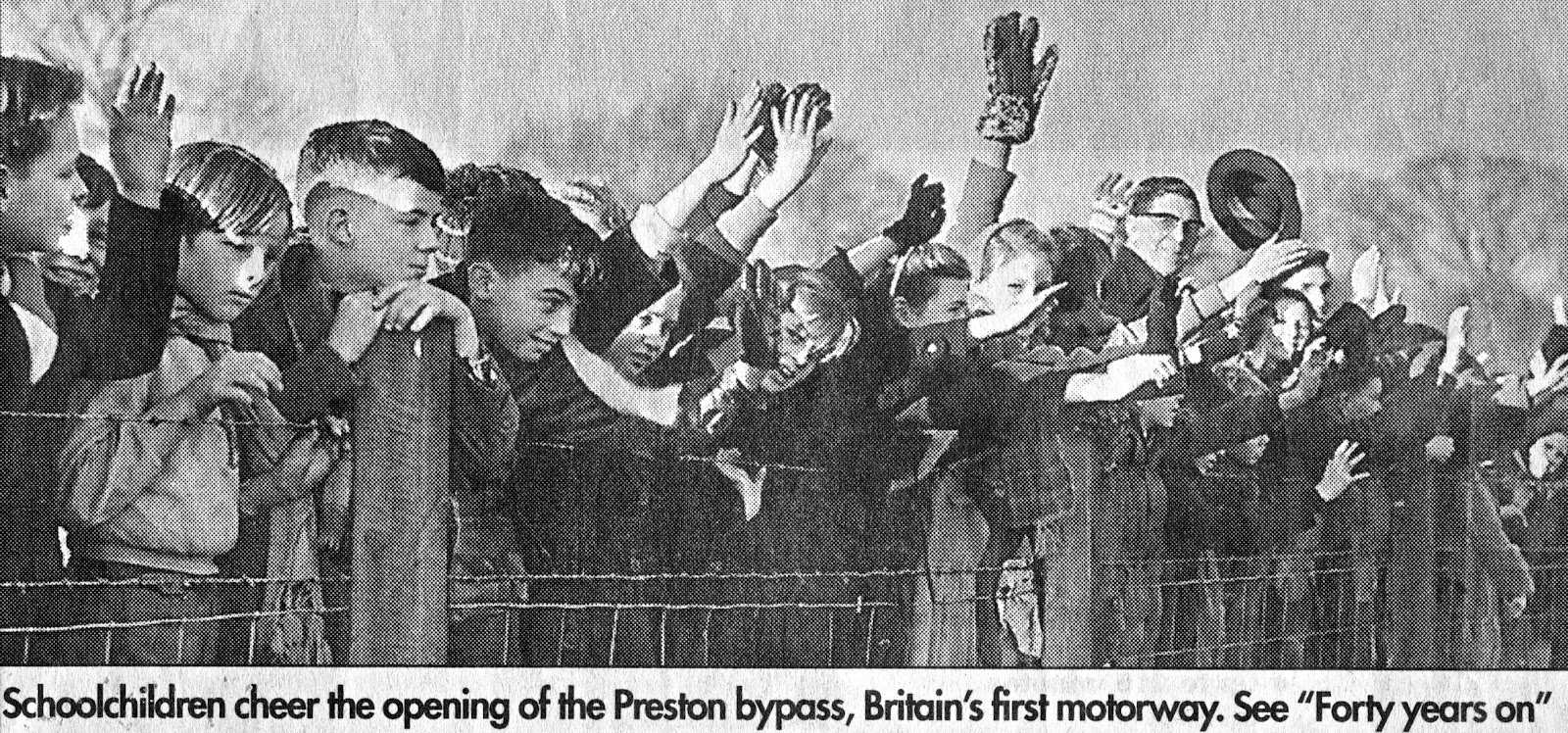
That's me leaning on the post as PM Harold MacMillan drives past

PM cortege on the return trip on the opening of Preston By-pass

Driving north on the M6 in the post-Christmas traffic congestion prompted me to reflect on the thousand hours and more that I have spent on this seductive but damnable 230-mile long tarmac strip. The first section of motorway in Britain, the Preston By-pass, opened on 5 December 1958 and became the M6 as the tarmac spread north to Gretna and south to Rugby.

The M6 passed within a mile of where I lived and two classes from our primary school were frog marched to the nearby park to witness the opening of the Preston By-pass. It was opened by the Prime Minister, Harold MacMillan, who drove past in what looked like a funeral cortege. Mr Wilson, our headteacher (waving his hat in the photograph), thought it would be something we would always remember. He was right, it was a cold damp day and Brian Nixon had got to stand next to Valerie Lee. It also meant that I could no longer cycle down the unopened motorway to go fishing in the River Ribble at Samlesbury. Freewheeling down the pristine, well-graded tarmac slope to the river carrying a fishing rod and tackle on a bike with dodgy brakes was dangerously exciting and we once reached 39mph, according to the odometer on my friend's bike.

An alternative activity over the next few months was to watch the traffic on the new motorway in the hope of spotting rare cars. There was no speed limit on the motorway and, as it was then the longest stretch of dual carriageway in the country, it was used as a test track for new models. The highlight one evening was watching a shortly to be launched E type Jaguar in British Racing Green speeding past at well over 120mph on the near-empty road. The following spring the by-pass became a mecca for open-top car enthusiasts - Austin Healeys, Triumph TR3s and MG Midgets speeding at full throttle along the motorway with scarves flailing from the passenger seats Isadora Duncan style. There were many breakdowns, usually involving lots of steam and waving of arms, the hard shoulders were yet to be introduced so the broken down sports cars were colourful hazards (all sports cars seemed to red, green or blue) on the carriageway.

My first journeys on the M6 were trips to the Lake District when the family including grandparents and favourite Aunts crowded into a hire car at weekends. I was mesmerised by the bridge at Scorton that had been designed and engineered in sympathy with the rolling landscapes on the edge of the Forest of Bowland. It was in stark contrast to most of the bridges on the M6, which looked as if they had been bought as a job lot from a catalogue. Trips north on the M6 became more frequent as a teenager when friends acquired cars and we went walking and climbing to the Lake District during school and university holidays.

When I left school the M6 had been opened up between Birmingham and the Lake District and I began to take advantage of the Samlesbury intersection to make hitchhiking trips around the country. It was the quickest and cheapest way to travel and it opened up my knowledge of distant places as well as the cast of characters that inhabited Britain. I was bought meals and drinks by friendly drivers, delivered to my final destinations and even taken home by one lorry driver to meet his daughter. Most of my journeys were south to North Wales, London and South Wales to go climbing, visit friends or university field trips.

Oxford became my next regular destination when I lived there for a year or so. By this time I was the owner of two Morris Minors, don't ask, bought for £40 and £30 respectively. I travelled over 40,000 miles in them and much of it on M6 journeys to the Lake District, Liverpool, the Cotswolds and then Oxford. On moving to Oxford, I broke down near Stone and was towed off to a local garage to have a new distributor fitted. Hurtling along behind the breakdown truck at 60mph separated by a 15-foot chain and with brakes that were barely any better than those on my bike was one of those truly life-threatening events. Each time the truck slowed down the tow chain slackened and I feared a mighty crash. I pumped the brakes and was relieved to have a proper steel bumper. Surprisingly the car and driver survived although I was berated by my girlfriend on arrival at our rented accommodation 4 hours later than promised. I would not have arrived at all had I not used the M6 and a night in Staffordshire has never really appealed to me.

On another occasion travelling back from Oxford I picked up a hitchhiker at Birmingham only to discover after a few minutes conversation that it was my best friend from when we were 3 and 4 years old. He lived across the street from my grandparents, where we lived at the time. I had not seen him for a dozen years and he was now an accountant at a London Bank. We reminisced about our early years and both remembered that on a rare hot day we had sat in the cobbled street, there was no traffic other than the milk float in the morning, and popped the tar bubbles that miraculously appeared between the cobbles in the heat of the day. It was presumably my first brush with tar and both of us had to be scrubbed clean with substances that would be banned today. We were forbidden to play together or to touch the tar ever again. Thank goodness for bubble wrap, the clean alternative to tar bubbles for today's children and, ahem, adults.

Although my Morris Minors could barely reach 60mph, it was a quicker journey up the M6 from Birmingham in the 1970s than in the Christmas rush of 2015 and there was no M6 toll road to avoid Spaghetti junction in those days.

My relationship with the M6 changed after 1973 since when it has been the journey south from Gretna five or six times a year as I visited my family, the Lake District or occasionally drove south for holidays in Cornwall. Journeys to London and the south stopped in the 1980s when train times and then flights became a quicker and often cheaper way to travel south. Only recently have I taken to travelling down the M6 to London a couple of times a year to visit family and grandchildren in London. The only reasons are that we can deliver spare furniture and other items, visit interesting places and call in on old friends en route.

The M6 had made such a difference to journeys when it opened, no queues for the swing bridge at Runcorn when travelling south (although it was a lot more fun and occasionally quicker than crossing the Thelwall viaduct) or mile-long traffic jams on the A6 to the Lakes. The changes have been remarkable to the M6 as well: hard shoulders, crash barriers, speed distance chevrons, from 2 lanes to 4 lanes, from empty roads to nose to tail jams. Lane closures are now an everyday feature and accidents cause major blockages that prevent ambulances and rescue vehicles from reaching the incidents. The only thing that has remained the same is the detestable service stations. The quality of food and prices still generate angst and frustration by encapsulating all that's worst about Britain's obsessive overdependence on franchised retail and service operators.

Scorton Bridge
As it is today, forever and ever
The M6 junction at Birmingham
Isadora Duncan style

Wednesday, 30 December 2015

Storm Frank floods Aberfoyle

Forth floods Aberfoyle from the flank of Creag Mor
Main Street Grand Canal
Police Scotland without a motorbike??
Water junction
Land Rover delusions
Another one bites the dust

Well, that was an eventful morning. After a night of Storm Frank, formerly known as torrential rain, the flood levels had reached their highest levels by mid-morning, and still, the cars tried to get through. A timber lorry hauled out a car that was bobbing about between the hedgerows and towed it to the road opposite the Baillie where it was then dunked again as the river levels continued to invade the village. Then a brand new Range Rover Evoque was driven at speed into the deepest part of the flood before it began to float and then waltzed around in the swirling floodwater by the old post house. I have seldom seen such a carefree or careless, you decide, exhibition of driving.

We entertained a young couple from Aberdeen who had sensibly decided to wait for the floods to recede and needed a restroom. They are hoping to attempt to return home later but they may have to wait a few hours, or maybe days, before they can escape. Meanwhile, they have left their car in the drive and we have escorted them through the woods to beyond the floods where they can catch a lift back to Forest Hills to spend time with their family.

The views looking down from Creag Mor showed that Aberfoyle had acquired a couple of new 'Frankwater' lochs on either side of Manse Road. The main street was flooded, and bags were being dispensed as part of the usual belated and often pointless but nevertheless ritual celebration of flooding. Richard wore his waders to get through to buy his paper but even the co-op was closed so no crossword only cross words. The flood damage to the shops and Forth Inn could be substantial and expensive to rectify as was the case following the Aberfoyle Deluge three years ago. Maybe the Woollen Mill will be having a genuine flood sale!

Meanwhile, we are still waiting for the go-ahead for the ever-so-expensive flood prevention measures. They could have been constructed years ago (2002-2003) but for the onerous and time-consuming bidding process set up by the Scottish Government to evaluate proposals for grant assistance. The outcome of the Scottish Government's obsessive control of capital spending has been an over-ambitious and the costly designed scheme by consultants, who alone cost far more than the total cost of the council's original scheme in of c £300k. As soon as government funding is set aside for any development, it attracts a queue of financiers, construction companies, and engineering consultants eager to play for high stakes in the complex bureaucratic process that is endemic with centralised government funding regimes. £12m is a high cost for the Aberfoyle flood prevention measures and with Dumfries and Aberdeenshire now propelled to the front of the queue following Storm Frank, it may be a long time for any approval, if at all.

And so it came to pass, the Scottish Government published its National FloodRisk Management Plan on 11 January 2016. It contains 42 schemes costing £235m and there is no mention of the Trossachs or Aberfoyle although elsewhere in the three-part report it acknowledges that the annual cost of flood damage in Aberfoyle is up to £500,000, not nearly enough to justify £12m on the cost-benefit analysis. Sadly this takes no account of the lost days of education and this must be running at 3 or 4 days a year for the 90 children. There was another day lost to flooding on 26 January that made the national news when the Fire and Rescue team sent out a boat to belatedly retrieve the children from school, they had already escaped by the path through the woods behind the school but some teachers were floated through the village to waiting taxis. The days when professional staff lived in their communities are long gone, their commuting must contribute considerably to climate change.

Storm Frank enforces parking restrictions

Beinn Dearg, Glen Artney

Beinn Dearg from the south
Mor Bheinn and Ben Halton from Sron na Maoile
Deer on slopes of Sron na Maoile
Looking south to Campsies
Looking towards Sron nan Broighleag from Sron na Maoile
Descent of Beinn Dearg


Sron na Maoile on descent from Beinn Dearg
Tuesday, 29 December 2015
Ascent:      870 metres
Distance:   14 kilometres
Time;         4 hours 20 minutes

Beinn Dearg     706m       2hrs  48mins


All my remaining munros and corbetts are more than a 2-hour drive away, and, at this time of the year, when daylight hours barely make 8 hours, it makes walking an exercise in stumbling along with a head torch as well as lots of night driving. I have done little walking over the past two and a half months, so I needed something nearer and less time-consuming. Fortunately, I had received a copy of the new SMC guide to Grahams and Donalds for Christmas. It is a fine addition to the Scottish hill walking publications. And more to the point, it has provided me with dozens of hills within a 2-hour drive to while away those short winter days.

Gregor had phoned and suggested a day out on the hills on Tuesday, the only half-decent day according to the forecasts. It meant driving back from London on Monday, and although I had originally intended to have a stopover in Lancashire or Yorkshire, the flooding there made it a hazardous option. We left Brixton at 9am and drove through an empty London, making the M1 in little over half an hour. We stopped in Hemel Hempstead to visit old friends, but thereafter the drive up the M1 and M6 was an exercise in extreme patience, not my strong suit, with long queues of family full cars making their way home from Christmas visits. It was 10pm before we reached home, and Gregor was arriving at 9am, and had left it to me to find a suitable walk. The new book was the perfect assistant, and I decided to head for Glen Artney and climb Beinn Dearg, a hill at the head of a 7-kilometre-long ridge. The forecast was for a dry, windy day before the onset of Storm Frank.

As always, it took time for us to sort out some gear and have a drink before setting out at 10am. Glen Artney is approached from the east on a long single-track road from south of Comrie. The glen was basking in bleak midwinter, all colours banished from the landscape, even the red squirrel that scurried across the road had a mousy look about it. The few isolated houses were looking grim, gripped to earth by the grey skies. We parked opposite the church in a generous car park that had two cars in it. We walked back along the road to the former schoolhouse, climbed the locked gate and dropped down a steep track to the river, where a concrete bridge carried us over the raging currents. A track peels round to the left and passes a finely constructed stone barn beyond which there is a wooden gate leading to a large bog. The track continued but became impassable as the mud became inches deep.

We headed up the slopes towards the southern top of Sron na Maoile. The going could only be described as mind-numbingly rough, with long flattened grass lying on root beds balanced on drainage channels. It continued like this for about 300 metres of ascent before the slopes became steeper but easier underfoot. I knew it would be difficult because of my long layoff, but I managed a steady pace. We saw a lone walker on the top of the ridge, and he started heading down towards us. We must have disturbed a herd of deer, and for about five minutes they raced through the gap between us. I estimated about 160 head of deer, by far the largest herd I had ever seen. Reaching the top of Sron na Maoile revealed a long, curving and undulating ridge that terminated at Beinn Dearg. It looked a long way in the grey winter light, and the views were less than inspiring, although a shaft of light fell briefly on the Braes of Doune wind farm and the Campsies were visible through a gap in the hills.

There was a faint path scored into the grass and heather that meandered round towards the next hill on the ridge, Sron nam Broighleag. The wind was becoming quite strong from the south-west and slowed progress in places, although it was generally pushing us along. Several smaller herds of deer played hide and seek with us as we followed the roller coaster of a ridge. There were even more drops and climbs leading to Stuc na Cabaig, the next high point on the ridge. There has been some talk that this is higher than Beinn Dearg, so I was careful in taking its height on my altimeter. It registered exactly the same as Beinn Dearg, but that was another two kilometres away, involving even more descent and ascent.

We found some shelter below the summit of Beinn Dearg, which has no discernible cairn, where we drank a flask of coffee before setting off on the descent. Any notion of continuing to cross the Allt Glas and climb Mor Bheinn, another Graham, was ruled out by the diminishing daylight; it was already 2pm. The route down was fairly obvious along the southern ridge of Beinn Dearg and then across the interminable leg-sapping boggy grassland before crossing the Allt Coire Choire in spate. Despite the wet boggy ground, I still had dry feet in my boots, Gregor was in a pair of trainers, and by this time his feet were well and truly wrinkled.

We found our way back to the track beside the barn and dropped down to the bridge. The climb back up to the road was steeper than I had hoped but we were soon back at the car and talking to the man in the next car who had climbed the adjacent corbett, Meall na Fearna. The real treat came next, a mere 50-minute drive to reach home by 4:30pm, it was barely dark.


Friday, 18 December 2015

Orkney: Green and top of the class


Saab 340 at Kirkwall
Bleak Midwinter
Electric buses for the 10 minute airport shuttle
December Red Admiral in Office
St Magnus cathedral

Dusk at 3:15pm


My last work trip of the year was to Orkney, the day it was declared the best place to live in Scotland for the third year running according to the Lloyds bank, although I do have some doubts about the methodology. The unpredictability of the flights to the islands persuaded me to fly early in the day. Unfortunately the closure of the Forth Road bridge had diverted all the Fife vehicles onto the M9 from via the Clackmannanshire bridge. It meant that traffic was reduced to a crawl at times and I was relieved that I had started extra early to arrive at Edinburgh airport in time for the flight. 

It was on time and flying conditions were pretty reasonable although the cloud cover prevented me enjoying the slice of geography that lies beneath the flight path. The Saab 340 plane with its distinctive engine whine and the rattles from almost 30 years service has a charm that veils its age but its reliability is now in question and there seem no obvious replacements for this plane, which was designed to cope with cross winds, but has not been built since 1999.

Kirkwall airport is a haven of peace compared to most airports and I was soon on the Orkney Green all electric bus to the centre of Kirkwall and my B&B. I called into the Council offices to discuss my brief for the following day and was surprised to discover a red admiral butterfly flitting round the customer centre. Apparently this has happened for the last couple of years and with the December temperature at 13ºC there was a summer feel right down to the steady soft rain, however by 2pm the foreboding darkness suggested otherwise. 

I prepared for my session in the afternoon and then went to see Alistair in the evening. It was great to catch up with his family. It has been four years since I had spent the best part of a year in Shetland and our conversations were multi layered as we reprised and fast forwarded our lives. A hearty meal in a nearby hotel followed and I was well lubricated as I travelled back to Kirkwall by taxi. I discussed the reasons why Orkney was top place to live with the taxi driver and the local folk I came into contact with. The consensus was that it was about people, communities, good quality of services and absence of rapacious commercial practices. Then there was lots of space, freedom from restrictions, excellent local produce and no shortage of housing or jobs.

The next day was the hard reality of discussing with a group of senior managers how to cope with the Scottish budget, which had grabbed another 4% from the Council coffers. The Scottish Government had elected to implement the austerity measures handed down from Westminster and not to use their new powers to alleviate the damage to local services. How many lost jobs would this mean, what facilities would need to close and how could they square strategic decisions with the natural desire of local councillors to protect their services? 

It is the problem everywhere that I have been this year and I despair at the time and effort that goes into the liquidation of local services instead of focusing on how to inspire and deliver new and better services and identify new sources of investment. At least Orkney has access to new funding streams from marine activities, tourism and green activities that seem to be universally embraced by its communities. Chancellor Osborne has performed the most devious trick of allowing more freedoms for localities but only within a straight jacket that squeezes harder each year. The issue in Scotland is whether and when this will be unlaced by the Scottish Government as they realise that financial accountability is devolved and cannot totally be blamed on Westminster.

Wednesday, 16 December 2015

Identity Cards: private gain public loss

French IdentityCard

Polish Identity Card

Canadian ID Card

Egyptian ID Card

I like to travel light at all times. Only two keys - house and car, one small wallet with minimal loose change. The real heft in my wallet is the pack of plastic cards. When I was asked for my co op card yesterday, it was a struggle to find it amongst 12 cards in my wallet. Two bank cards and a credit card, driving license, blood donor card, entitlement card for free bus travel, mountaineering council card, rail card, oyster card, Screwfix card and Nectar card. What a palaver, and you should see Aileen's cards - there are well over 20 with a big shuffle of all the store cards.

Almost all of these cards are a means of sharing our identity with banks, stores, companies and some government agencies. Is it any surprise that we are besieged with promotional e-mails and harangued by cold-calling companies who have gained our details from private financial or store companies? Clearly, our personal data is being sold on, and it makes me question how much trust we should have in the organisations that I have provided with my identity data.

Yet it is a curious fact in Britain that we refuse to have a national identity card that would be invaluable in tackling so many issues, from gun crime to insurance scams. I understand the arguments for privacy and civil liberties, but should these take precedence over the need for a universal identity card based on a unique citizen reference number? It would provide a consistent record of our citizens that could be used to share information between different agencies, such as the police, health, education and social work, but under strict control by information protocols. Such a scheme, proposed by David Blunkett, was rejected by the Liberal Democrats and Conservatives in the 2010 coalition government and has been rejected by the SNP government in Scotland. The Lib Dems boasted about saving money, but £292m had already been spent on its introduction by the previous Labour government.

The only comprehensive records are the NHS ki numbers and these are far from perfect. Many patients, particularly students and mobile young adults, are logged into different GP practices. It explains why, according to NHS records, there are always more patients than people. The same could not be said about the electorate, people do not register out of either apathy or because they regard it as an intrusion that may lead to tax demands and like National Insurance numbers, they are only for adults. No wonder there are several million people disenfranchised. 

A national identity card, such as that developed in most European countries, and many countries around the world are introducing them, could overcome the current difficulties at a stroke. It could replace a driving license, be required for voting, payroll purposes, access to the NHS, and provide age identification. If address information was included, it could be used as an entitlement card for local services or to obtain discounts from local retailers and hospitality businesses. It would also help with immigration control and the exploitation of illegal immigrants by rogue employers. We should not let the fear of privacy from our moribund governments in Westminster and Holyrood scupper the many benefits that could accrue to citizens and government departments, and agencies. 

Unfortunately, our governments are wedded to allowing their numerous departments and agencies to collect dozens of data sets that are incomplete, incapable of being linked up and seldom maintained with the integrity that is required for the effective management of services. In Scotland, we have a lightweight entitlement card that is mainly used for free bus travel for the elderly and disabled, and to give access to services for young people. It is far from universal, and it has to be applied for by citizens. It could do so much more, but the Scottish Government have not dared to make it universal and extend its use to voting, or the NHS; perhaps they are waiting for Westminster?, The picture of George Orwell as Winston Smith in the promotional material is a hint that, like Winston Smith, we may never catch up.

If we are to get there one day, we need to disrupt the timidness of our outdated democratic institutions and the fourth estate. It means tackling the British disease of hiding behind reviews, inquiries and an uncoded constitution that strangles progress.

Scotland's Access Card

Saturday, 12 December 2015

A Hard Day's Night in the Monaliadhs

Tramping across from Geal Charn to Carn Dearg
Sunday, 2 December 2007

Ascent:     1285 metres
Distance:  31 kilometres
Time:        10 hours 43 minutes

Geal Charn             926m     2hrs  5mins
Carn Dearg             945m     5hrs  30mins  
Carn Sgulain          920m      7hrs 31mins
A' Chailleach         930m       8hrs 19mins  

This post is taken from my logbook of the fourth round of Munros, one of the Big Walks that I intend to add to the blog posts.

As it goes, this wasn't one of the longest in terms of distance or time, but for sheer determination in strenuous conditions, it ranks amongst the hardest of days. Nearing the end of the fourth round of Munros, I was exploiting every opportunity to fit in walks and hills when it would be easy to find an excuse for staying at home. The Monalaidhs are not the most exciting hills and they are a good distance away requiring a long winter trip up the A9.  If you attempt to climb all four with daylight hours at their minimum in December, they have to be an A to B walk. How I persuaded John and Mark to join me, an unrepentant Munro basher, on this folly I don't know. They both described it as one of the daftest walks yet in a year of strong competition but their sense of adventure prevented them from refusing.

We needed two cars so I persuaded John to drive up from the Borders and I drove Mark up. We were to meet at the car park at the end of Glen Road above Newtonmore at 8:00am, which meant leaving home at 5:30am to pick up Mark and drive up a near-empty A9.  John was late, unusual for him, so he
transferred his gear into my car and I drove the 20 miles to Garva Bridge for the start of the Geal Charn climb. We started shortly after 9:00am and walked west to east. John's car was left at the foot of the A' Chailleach path so he would be able to drive us back to collect my car at Garva Bridge once we had completed the walk. Even Eddie Stobbart would have had problems with the logistics of this outing. 

Conditions were quite benign at the start of the walk, there was little wind but visibility was not good and the tops were clad in cloud. I was struggling in the early part of the ascent with a heavy cold. John and Mark were forcing the pace up the two-foot-wide bog that doubles as a path. There was little sympathy for me, after all, I had dreamt up the crazy walk. Mark told John to let me suffer because I would probably be pushing the pace in 5 or 6 hours once I had got into my stride. It was warm work with poor views and the prospect of a very long cold day.

By 700 metres we had reached the fresh snow level and walking became even more difficult. As we reached the large cairn of Geal Charn we were treated to some shafts of sunlight but it was only fleeting. As we began the ever-so-long traverse across to the next hill, Carn Dearg, we realised that this would be quite a difficult walk. We had to make tracks in the snow that was over a foot deep with deeper pockets from wind-blown snow. I used my cold as an excuse to follow the tracks that Mark made over the next 3 hours. We had some food at the top of Carn Dearg but wasted little time as the winter light was already fading. We knew that we would be descending in the dark and, ideally, wanted to reach A’ Chailleach before the last light of the day.

We didn’t even stop to put on head torches for the long undulating leg to the inconspicuous summit of Carn Sgulain. The snow was less deep on the south flank of the ridge and we made more rapid progress than during the leg to Carn Dearg. It was almost 5pm and dark as we reached Carn Sgulain and again we stopped only briefly to drink and eat before the descent down a steep snow bank and then a tramp back up more deep snow to reach the cairn at A' Chailleach. I was beginning to feel frisky and took the lead in the dark as John and Mark both found it hard to distinguish features whilst wearing glasses. The double jeopardy of night and snow concealing the ground conditions.

I found some earlier footprints that helped as they confirmed my compass readings leading to A’ Chailleach. At the summit, it was pitch dark but the cloud cover had vanished and we could see lights in the glen below. I found a reasonable route to the river down the snow slopes and then through the heather-clad muddy slopes. Surprisingly we managed to cross without too much difficulty using our walking poles. They are always worth taking for river crossings in the dark, but they have also been useful in keeping our balance through the deep snow all day. The sense of achievement as we eased our way down the track for the last mile was evident and the jocular remarks about my stupidity in devising the walk began to lighten our mood. We made a quick getaway in John’s car to Garva Bridge where we picked up my car. The drive home was quiet on the A9 and I made it home by 10pm. 


I had now completed 260 Munros in just over three years and it left me with just 24 to complete a fourth Munro round. I could begin to believe that a finish was possible in the spring and that I could, with a few more unusual combinations of hills, achieve the round in 80 days. 2007 had been a splendid year on the hills although my running mileage had plummeted as work was now regularly taking 70 hours a week with the Council struggling to come to terms with coalition working and multi-member wards

At the summit of Geal Charn

Where are the Huskies when you need them

'Cold and crisp but not very even' ground conditions

Thursday, 10 December 2015

Reprise of the Tartan Tories

In the 1970s, the SNP emerged as a significant political force, and today's popular mythology would have us believe that they were a left-of-centre, progressive party. This may have been because of  Margo MacDonald, the poster girl for the SNP, who fought and won the Govan by-election. She was a genuine champion of social justice. The party embraced a wide cross-section of political views, and the leadership during the 1980s was right of centre, led by Gordon Wilson. Many SNP Councillors and MPs were fairly right-wing local businessmen from the northeast who abhorred any form of socialist enterprise. There were others in this first flush of SNP growth, such as George Reid, who has been an excellent presiding officer of the Scottish Parliament, and Margaret Bain, who were far more progressive.

In recent years, the SNP has embraced a lurch to the left, and Nicola Sturgeon is certainly genuine in her commitment to social justice. Alex Salmond was more AC/DC depending on who he spoke to and whom he wanted to denigrate. The vast army of voters who switched to the SNP at the last general election came from the left, dismayed at the Labour Party with its drift to the centre under Blair and Brown and the absence of any effective Scottish leadership or direction since the loss of titans like Donald Dewar, John Smith, Robin Cook and Alastair Darling. The mediocre performance of the Lab/Lib government up to 2007, as well as disenchantment with Blair's Iraq adventure, was a key reason that the SNP took power in the Scottish Parliament.

The SNP have been very skilful since becoming the government in 2007 at pillorying Labour for the economic recession, their failure to effectively challenge the Tories on austerity and their support for Trident. This played well with the electorate, as did the constant refrain that Scotland's increasingly fragile public services were the result of Westminster's control of tax and spending. Well, that no longer applies, and there was the opportunity from the onset of the Scottish government to augment tax by 3p in the pound. Now that these powers have been transferred to the Scottish Government, there is no longer any excuse for failing to protect services, given the SNP's proclaimed priority.

It could be the tipping point for the SNP as they seek to be returned to power in the Scottish election next May. They decided in the Scottish budget not to deviate from the UK tax rates or to allow Councils to raise Council tax to offset the massive cuts they have already made and which will cut even deeper next year. It is time for the SNP to decide whether they are prepared to invest in services or simply continue to shadow the policies of George Osborne. The day of reckoning is approaching, and after eight and a half years of SNP rule, that has been sustained largely by criticism of the tribal politics at Westminster. They now have to be accountable. Clearly, they are frightened of deviating from the UK too much. After all, oil prices are down from the $110 that they predicted before the independence referendum to $40, whisky sales are falling, and tourism has had a mixed year as visitors from England have thought again about visiting a country that seems to have turned its back on the UK.