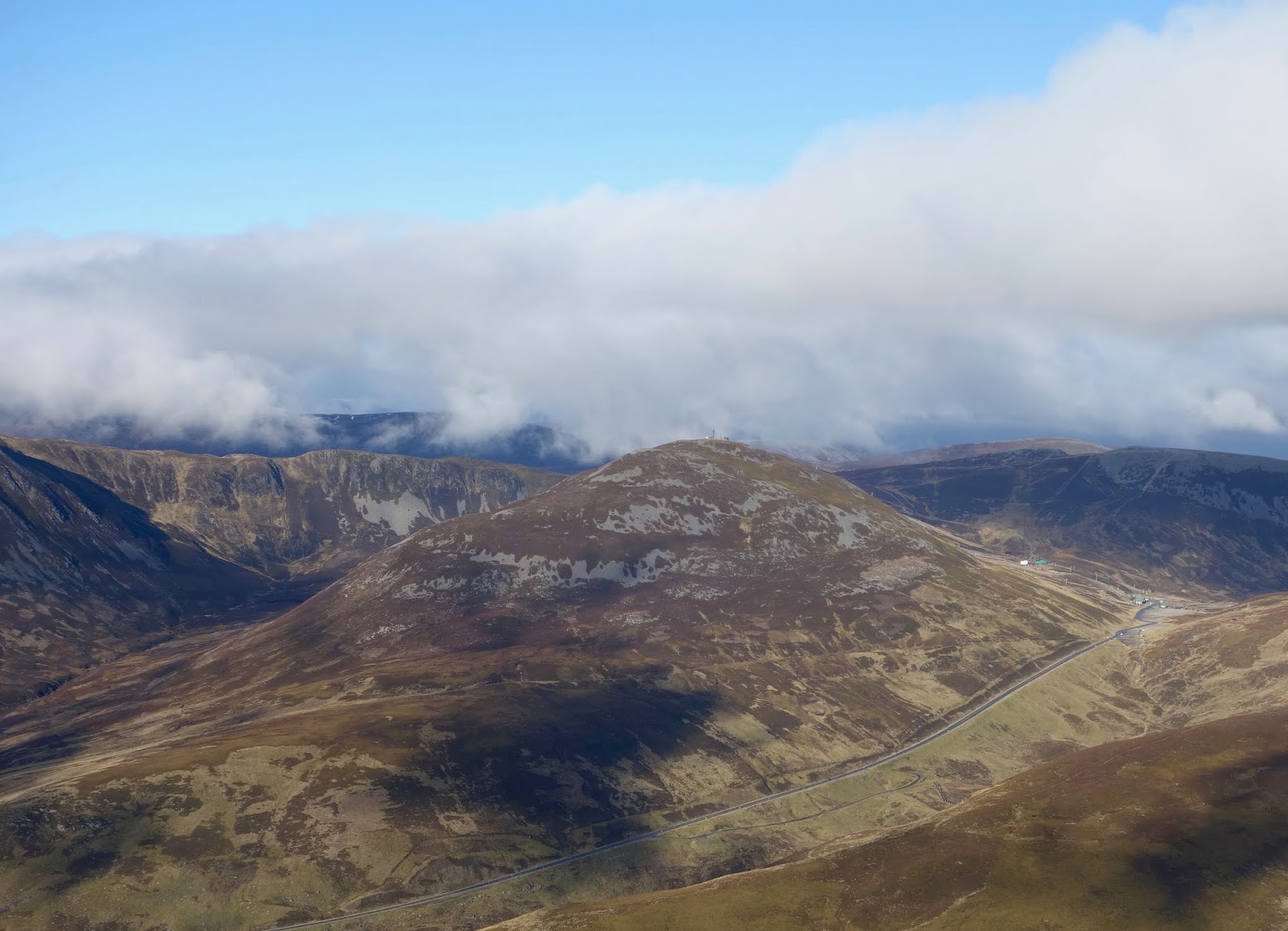
Monday, 11 November 2019

Loch Lubnaig


It was -4°C as we set out for a pre-arranged run from Kilmahog to Loch Lubnaig. Hat and gloves were needed although we both had stuck to shorts. Gregor was intending to do 16 miles with a run to the far end and back. I had not been running for the last couple of months so felt 7 miles would be plenty and I could stop on the way back to saunter alongside the Leny Falls, which would be in full flow after recent rains. It is a steady incline for the first three miles up to the Stank, where the route up Ben Ledi starts. The metalled path was not too slippy despite the hard frost, the recent fall of oak leaves had been welded onto the surface of the path by Jack Frost.

I found the run surprisingly easy and I was delighted to see a large group of walkers including young children about to start the climb to Ben Ledi. This is what days like this should be used for. I continued to the holiday cabins at the foot of Loch Lubnaig and took some photos by the Loch. I had ascended 130 metres so the run back was a downhill doddle. I headed off from the path and through the birch and oak woods to get a close look at the Leny Falls. The river Teith was turbulent until the end of the narrow section below the falls when it became a placid wide river outlined by the crisp autumnal colours of the native forest.

It was just a mile back to Kilmahog where I had to wait twenty minutes in the car for Gregor to return. I felt elated even though the slow pace of the run had been insufficient to release many endorphins, maybe it was listening to Pienaar's Politics on the radio and the chocolate mini roll to engage my taste buds. Gregor meanwhile had managed to get another three crowns on Strava and seemed content given that he was suffering from a nasty cough.

Ben Ledi
Loch Lubnaig
Leny Falls
Below the falls
Turbulent Teith
Placid Teith

Saturday, 9 November 2019

John Gray


Councillor John Gray
I was at a memorial service for John Gray last night. He had been a long-serving councillor in North Kelvin in Glasgow for 42 years and had qualities that made him immune to the criticisms normally levelled at our elected representatives. There were over 100 friends and colleagues at Maryhill Community Central Halls to celebrate John's life of serving his community with modesty, honesty and results.

Amongst his many achievements were proposing the motion to stop the building of the Maryhill Expressway that would have demolished much of the community that he represented. He was instrumental in the creation of Maryhill Community Central Halls in a former methodist church. He always represented the area where he grew up and lived for most of his life, although as an electrician he had worked in Liverpool for a time. 

He championed services and support for ethnic minority communities and the homeless in Glasgow. He was active in running youth groups and youth exchanges and developing opportunities for local young people. He chaired numerous committees as a Councillor and campaigned vigorously on issues like low pay and poverty. He chaired Adoption Committees and is reputed to have placed more children in homes in Glasgow than has been achieved anywhere else in the UK. John had been adopted as a child and it was the son of his stepbrother who organised the evening to reflect on John's life.

I had been asked to give my appreciation of John from the perspective of a council officer. There were five more friends and colleagues who spoke about John's life and others who made spontaneous contributions on the night. Bob Winter had been Director of Social Work in Glasgow and later the Provost of Glasgow, he had known John since they were teenagers; Maria Fyffe, the local MP; Colin Williams, the former Director of Glasgow Council of Voluntary Service, John Rodgerson of the Queen's Cross Housing Association and Helen Crawford, a close friend who had helped care for John in his final years. In many ways, it felt like a farewell rally of the Glasgow Labour Party and fellow travellers from a period when the party dominated Glasgow politics. In the 1970s, '80s and '90s the party regularly gained over 60% of the popular vote and took 70 - 80% of all the seats on the Council. All of the speakers concurred that John had excelled as an elected representative because of his deep roots in the community, his essential humanity, honesty and determination to achieve positive outcomes for his constituents and community. 

My contribution has been copied below.

"Unlike many of you here tonight, I knew John for only a limited period of his life when he was a Councillor for Woodside in Strathclyde Region Council between 1975 and 1996. Although when I read Danny Crawford's excellent obituary in The Herald, I realised that I had first met him during the 1974 general elections. I had not long arrived in Glasgow and became involved with the Glasgow News, a radical news sheet based loosely on the West Highland Free Press. It was written and distribured mainly in the West End with Brian Barr, the producer of BBC's Brass Tacks and Jean Barr, of the Worker's Education Association very active in its production. The Labour Party was a bit too mainstream so I was not a party member.  Nevertheless, I had always helped at elections - canvassing and running committee rooms -  and getting rid of Ted Heath's government was a no brainer. Between 1970 -1974 it had trashed Royal Commissions on Local Government, the Land Commission as well as the economy.  I turned up at Kelvingrove Labour Party offices to lend my support for Neil Carmichael who was an effective MP, whom I knew from my work on the West Central Scotland Plan.

A well organised, no-nonsense agent after checking that I understood the manifesto and main policy areas wasted no time in dispatching me to canvas and leaflet for the Neil Carmichael. The agent was, of course, John Gray and over the next few weeks, he had me stomping up and down the stairs of tenements from White Street to Willowbank Street in Woodlands. It was February and the cold, dark evenings were not amenable to electioneering. This was repeated later in the year in October when Harold Wilson called the second election of the year to achieve a working majority.

A year later John was one of the 103 Councillors elected to Strathclyde Region Council, the largest local authority in the UK with over 100,000 employees. It was dominated by Labour and became increasingly so in the next four elections as Thatcherite policies denuded Scotland of Tories. The Tartan Tories, as the SNP were referred to in those days following their decision to vote with the Tories in a no-confidence motion on the Callaghan government in 1979, never took off in Strathclyde, they were a party largely focused in the northeast of Scotland.

I worked with John closely for sixteen years, mainly on the Social Strategy and Community Development. John was one of over 400 councillors from all political parties in 5 local authorities that I have worked with during my career. John was a bit different, a bit special. In the main, most councillors were committed to their wards, hard-working and respective of officers but there were always the bad guys as well. They were in it for personal gain, power and naked ambition.

Councillors have common traits and idiosyncrasies and can be grouped according to some of these characteristics. There were:

Hard-bitten trade union leaders who stamped their authority and could give you a hard time. They were a clubbable bunch and they kept clear unless they wanted something done when they could become very paly or very nasty.

Women who were active in the voluntary sector and their communities. They batted for their organisations and constituents. They were challenging but usually politely so.

Battle-hardened workers who had worked in shipbuilding, the railways, the mines or manufacturing. They had often been the victims of bad management. They wanted a fairer society and could be ruthless in the pursuit of this.

Business people who thought that their well-honed business skills could be applied to make Councils more efficient. Their rhetoric usually over-hyped their competence. They were surprised at the vast range and extent of public services, it was beyond their ken. The competent ones realised the need for extra services for those with special needs or for deprived communities. Others wanted simple solutions like contracting out.

Academics, who had the time, oratory and self-importance but sometimes lacked the day-to-day common touch and pragmatism. 

But worst of all there were the young politicos, anxious to make a career of politics and regarding the Council as an apprenticeship for greater rewards in the future. They have grown in numbers, and malevolence, in recent years.

And then there was John. There was no artifice about him. He had values that were instinctive, well-founded, timeless and embedded. We would call them social justice today but they were about basic humanity, fairness, understanding and resolution. 

He was in many ways the glue that held together the disparate bunch of outstanding politicians who led Strathclyde and made the Social Strategy its fundamental principle. We had the oratory of Geoff Shaw, a church of Scotland minister, the strong and stable leadership of Dick Stewart, the class politics of Albert Long, chair of Social Work, the academic philosophising for social justice of Ronald Young and the communitarianism of Tony Worthington. They were all big beasts displaying commitment and drive but also quasi-religious self-belief that sometimes hindered progress.

John was more diffident but gained kudos and trust from all these leaders for his pragmatism and integrity. He knew that the Social Strategy was not just about geographic communities, although he was instrumental in the redevelopment of Maryhill and the work of the Housing Association. He actively helped local youth groups, homelessness organisations, adoption committees, and children in care. He was a totally committed champion and advocate for ethnic minority groups, many of whom lived in his ward. 

He was respected and liked by fellow councillors from all political parties. He was a taciturn but commanding figure when chairing meetings. No grandstanding, no-nonsense and he gave time to all his fellow councillors. He was liked and respected by officers from all departments as well as the voluntary bodies he served on for his principles, consistency and easy demeanour. He was reliable, always turned up on time and always read his papers. He was there to help people from all backgrounds and he was more interested in resolving issues than debating them willy-nilly. He represented all his constituents with an unstinting dedication. It was only fitting that his majority increased from 699 with 49% of the vote when first elected in 1974 to 3000 with 58% of the vote by the end of the 1980s. A politician who grows in popularity over time is as rare as a hen’s teeth.

John was also a man ahead of his time when it comes to lifestyle, ethics and sustainability. Every day was a dress down day for John. He lived in the area he represented and was primarily concerned about helping his electorate with their problems irrespective of their age, sex, creed, ethnicity, sexuality or political persuasion. He walked to the Council buildings every day, then he walked to the Arlington or the Woodside Inn to meet friends, and to Firhill to watch Partick Thistle. He even marched his fellow councillors to evaluate community projects in Glasgow much to the chagrin of many of these councillors who preferred to travel by the council's cars. He had a carbon footprint that most modern politicians would lie for. Like so many things about John he didn't do it for effect, it was just common sense.

We now live in an era when the standing of our politicians is at an all-time low ebb. They take expensive trips abroad, favour friends and lovers, claim for personal services, equip their houses, fill their wardrobes, use social media to slag off opponents, cheat and lie with impunity. It is easy to go along with this generalisation. But then you think about John, he was a tribune for fairness. He was rooted in his community and true to his values that were instinctive.

I loved the story from Danny’s obituary about John meeting Clem Attlee, the PM who made life so much better for most of us here this evening. John was a great fan of Clem and as a young man, he was nominated by the Labour Party to sit next to him at a meal in the Central Hotel when Clem visited Glasgow. When Clem leant over to say something to John, he was expecting some gems of wisdom. “They do a great fish tea here!” said Clem. A masterful opener in the art of conversation that John would remember as much more relevant and honest than much of the waffle that he witnessed in the council chamber. Clem Attlee had the same values as John. They both stand as the very best examples of delivering a type of socialism that has made a huge difference in people's lives

Last year I lent my copy of John Bew’s excellent biography of Clem Attlee to a friend who had grown up in these parts and is here this evening. When he finished the book, his wife told me he had been in tears “Why do we not have politicians like this today?” I think most of us here this evening probably feel exactly the same when we remember John. His honesty and modesty were a given but they concealed a politician who operated at full voltage and delivered truth to power.

Wednesday, 30 October 2019

Glenshee East


Glenshee ski area from Creag Leacach
Monday, 29 October 2019

Ascent:      952 metres
Distance:   16 kilometres
Time:         5 hours 16mins

Creag Leacach         987m     1hr   7mins 
Glas Maol               1068m    1hr   59mins
Cairn of Claise        1064m   3hrs  12mins
Carn an Tuirc           1019m  4hrs  2mins

A cold spell had brought some dry clear days on the cusp of winter so I arranged with John to go to Glenshee to climb a couple of munros that he needed to visit now that he has climbed the In Pinn and believes a fourth-round compleation is a possibility. I suggested we add a couple of adjacent munros to make it a more satisfying day. We had agreed to meet at Guildtown, south of Blairgowrie at 8am. This would allow John to make a 6:00am start to get round Edinburgh before the traffic was completely clogged. It was not to be, he spent an hour on the ring road to the bridges, meanwhile, it took me almost half an hour to get through the Broxden roundabout and Perth. It was 8:45am before John arrived and after 10:00am by the time we arrived at the Glenshee ski car park and prepared for the walk.

It had been a hard frost and de-icing the car had taken some time but perfect blue skies persisted until the final 5 miles with clouds hanging over the hills we were due to climb. There are a number of tracks that lead up to the ugly assembly of ski tows below Glas Maol but they speeded the ascent.  We found a narrow path that contoured from Meall Odhar below Glas Maol and onto the long ridge adorned by a fine wall that leads to Creag Leacach. The clouds were dispersing and it was an enjoyable walk with Beinn a' Ghlo draped in snow to the west and the ever visible Schiehallion a distant grey pyramid to the south-west. The final section to the summit requires the passage over several rocky humps where we saw several hares with their coats changing to white in anticipation of the snows, last year the November snowfalls were the only time that gave snow cover in Glenshee and skiing was virtually non existent. There was a cold wind and even stopping for 5 minutes at the summit brought on the shivers, we were not dressed for winter and needed to get moving again. 

Glas Maol is a great grassy hump and required reversing the walk back from Creag Leacach for a couple of kilometres. We were then faced with a steady plod to its summit cairn, which is made invisible by the convex slope until the last 100 metres. We met a walker who had been ahead of us, he had climbed the hills via Glen Isla. When he heard that we had been here before he began to ask numerous questions about hill walking, he had only recently started and was already captivated but unsure of what he needed to know. When the subject got onto ticks, John began a long explanation and then another walker arrived who was equally loquacious about the blighters so it became a tickathon. I decided to take a seat in the shelter and have some of my lunch, John eventually joined me. We did not linger long, the cold was once again seeping into us and movement was required.

We continued the walk by heading north down the long grassy north slopes of Glas Maol before hitting a track that meandered through an almost level area of peat before climbing towards Cairn of Claise. The wind had dropped and we made good time arriving as the sporadic sun was closed out by cloud. It was warmer without the wind so we had a relaxed lunch break in the knowledge that we would be down by 4pm, this would allow us to miss the traffic in Perth and Edinburgh. The walk across to Carn an Tuirc involves very little descent and even less climbing. It is a promenade across spongy moss, heather and grass and, for the final incline to the summit, a stony path across to an untidy cairn. It is not one of Scotland's grander peaks.

We were joined on the summit by a couple from Ballymena in Ireland. After several conversations at the summit and as we began the descent by following them to the north to find the path back to the A93, we walked out together. They took all their holidays in Scotland and he had climbed the munros 3 times in 15 years. They had an old camper van and thought it was the best thing they had done, selling motorbikes and boats to buy the van. They had a Border Collie that was perfectly behaved and could find the route off any mountain by reversing the route up. They had parked at the end of the path as they had been out to Tom Buidhe and Tolmount and kindly offered us a lift up to the ski car park where we were parked. It had been a splendid day despite the weather being less promising than had been predicted.


Ski lifts on Glas Maol
Creag Leacach
Ski area from Creag Leacach
West to Beinn a' Ghlo from Creag Leacach ridge

John writing his log on Creag Leacach
Descending Creag Leacach toward Glas Maol
Maol Glas summit
Cairn of Claise summit looking back to Glas Maol
Carn an Tuirc from the descent
Allt Garbh chairs


Monday, 28 October 2019

Gowan Hill, Stirling

Wallace Monument and Ochils from Gowan Hill
Gowan Hill is one of those places that is a hidden overlook, sitting just a kilometre north of Stirling's city centre. It provides the most wonderful panoramic views of the Forth Valley, the Southern Highlands, the Ochils and the Wallace Monument. When working it was my favourite haunt if I had half an hour over lunch to escape from meetings and communications overload. There are paths from the City Centre and Castle via Lower Bridge Street and Crofthead Road respectively that climb through the wild parkland to Gowan Hill. It is surprisingly unvisited and on most days you get a viewpoint to yourself. It would appear from the litter around the benches that the area is used for drinking sessions in the evening.

I had a meeting in Stirling and left my car to have some tyres fitted at the Back O' Hill Road. I climbed Gowan Hill by a long steep ramp of stone steps across from the large Sainsbury Store. It was a perfect Autumn day and with fifteen minutes to spare I visited the Beheading Stone where King James 1 disposed of his enemies. There are two cannons directed towards the Wallace Monument. As expected there was no one else on Gowan Hill.

The visibility was excellent. The views of Ben Vorlich and Stuc a' Chroin were quite stunning in the morning light and made me wish I had gone climbing instead. Then I began to examine the urban topography of Raploch and its surroundings. I recalled the gestation of all the developments that have taken place over the past twenty five years. Sainsburys, the new Community Campus, Castle Business Park, the Park and Ride facility, the new Back O' Hill road, and several new housing schemes have transformed the area between the Hill and the River Forth. It was a trip down memory lane because they all have complex back stories that was a large part of my working life. Several of the businesses that had taken premises in the business park and now seem to be well established were also the outcome of tricky negotiations.

Beheading Stone
Raploch and Cornton
Raploch
Wallace Monument and Dumyat Hill
Stuc a' Chroin and Ben Vorlich and Braes of Doune Wind Farm

Sunday, 27 October 2019

Lomond Hills, Fife

Approaching East Lomond
The Lomond Hills in Fife have passed me by on numerous occasions when travelling to meetings or events in St Andrews or Fife House, Glenrothes. I had always promised to stop and run them at the end of the day, but time and work conspired against it. I had been looking for a decent spell of weather in the far north, but nothing was doing. I noticed that Sunday was fine in Fife, so I decided to make an excursion to climb them. Gregor agreed to come along, and he would run them along with Bishop's Hill, and the shore path around Loch Leven to give him a 25-kilometre run to Milnathort, where I would collect him. 

It was the day the clocks went back,  always a special day for the hills.  It was the weekend of the Karrimor International Mountain Marathons, which I had competed in on 13 occasions between 1976 and 1998 and the Snowdon Marathon that I ran in 1988. The extra hour meant that we could make a lazy start and still be walking or running by 9am from the Craigmead car park that sits on the saddle between West and East Lomond. There were only four cars there when we arrived. It was barely above freezing as we started out on a crystal clear morning with blue skies and a strong northerly breeze.

Sunday 27 October 2019

Lomond Hills

Ascent:     526 metres
Distance:  11 kilometres
Time:        2 hours 14 minutes

East Lomond     434m        23mins
West Lomond    522m        1hr 33mins

We decided to take in East Lomond Hill first so that Gregor could continue from West Lomond Hill to Bishop's Hill and then drop down to Loch Leven and follow the trail to Milnathort. The ice on the rocks on the initial section of the path was thawing, and the first kilometre of the path was an easy pull before the final 100 metres of ascent to the summit on a grassy path. Gregor passed me on his descent at this point, the last I would see of him until Milnathort. The wind at the summit was not welcoming, but it was trumped by the glorious patchwork field pattern of Fife, displaying all its autumnal shades. I spent a few minutes inhaling the air and the views before descending by the same route. I passed another 3 walkers and 2 runners on their ascent.

I had intended to collect my rucksack at the car park for the ascent of West Lomond. There was no need for it in these conditions, so I stopped for some water before continuing on the longer of the two walks.  The path makes it an easy ascent, initially over short grass and then a wide stony path that climbs at a gentle gradient. The final 110 metres is a stiff climb, and there is an option of a direct ascent up a steep, slightly muddy path, or a half circuit of the hill at a more relaxing gradient. I chose the former, and it proved no bother; I was walking well. The summit has a trig point on a stony base that seems to be eroding rapidly. The sun was higher in the sky, and the views were not as clear as earlier in the day, although Fife was dressed in its Sunday best. The Forth estuary provided a shimmering silver boundary to the south, punctuated by Inchkeith, a perfect isosceles triangle. 

There had been few other walkers on the ascent, but on the return to the car park, the number of people exercising was impressive. I counted 29 women, 25 men, 12 dogs walking up the hill, along with a lone runner and 6 mountain bikers. It confirmed the impression that I have had in recent years that there are as many women as men now enjoying the great outdoors and that mountain bikes make a mess of hill paths. I have no qualms about mountain bikes on tracks and hard trails, but too many paths on the hills are being badly eroded by bikes. The car park at Craigmead was full as people began their walks. It was just after 11:00 a.m., and my exercise was over. I drove back to Milnathort and arrived within minutes of Gregor. We had made the best use of the morning, and we could now look forward to the Liverpool game. 

 G Descending East Lomond
East Lomond summit
Ballo Reservoir and West Lomond from East Lomond
West Lomond from East Lomond 
West Lomond ahead
West Lomond
Fife from West Lomond Hill
West Lomond and Loch Leven
Path from West Lomond
East Lomond from West Lomond path


Wednesday, 23 October 2019

Restoring Local Democracy in Scotland

This is an article produced for the Mercat Group and first published in the Municipal Journal on 15 October 2019.

The Royal Commission on Local Government in Scotland, usually called the Wheatley Report, identified a twofold purpose for local government: 

“It exists to supply public services locally, on such scale and of such character as the nature of each service requires, and to provide local government. That means that services are in a real sense locally controlled. It is implicit that local authorities should, to some degree, provide a means for self-expression of local communities.” 

Following Wheatley, the 1975 reorganisation meant the vast majority of public services were provided by 53 district, 9 regional and 3 island councils. There was widespread understanding that councils were the lead authority for public service provision and the future planning and development in the locality. Local government became a powerful driver of change, as evidenced by the regeneration of urban areas, economic and transport initiatives, housing improvement, social inclusion programmes and through the extensive use of European Structural and Social Funds. Scottish newspapers and media reporting were focused on the activities and decisions of local government. Its leaders were better known than most MPs and had parity with government ministers at the Scottish Office. 

By the 1980s, the Thatcher government determined that regional councils were too powerful and that ambiguities in the two-tier system resulted in tension and conflict. The government had abolished the GLC and Metropolitan Counties in 1986, and Scotland was deemed to be next. The community charge was piloted in Scotland in 1989 but was abandoned after poll tax riots and a million Scots refusing to pay. It was the harbinger of the end of Mrs Thatcher’s premiership, but not in policy. John Major called Strathclyde Regional Council a monstrosity at the Tory Party conference in 1992 and announced another local government reorganisation, ostensibly about eliminating a tier of local government and remote leadership. The reality, evidenced in the parliamentary process, was that it was about centralising democracy and carving out councils that had a chance of electing Councils of the same persuasion as the government. 

The Government also revealed its intent to reduce public expenditure by shifting the balance of power from local to central government. The 1996 reorganisation replaced the two-tier system with unitary councils. It reduced the number of councils from 65 to 32, with 400 fewer elected representatives. It also removed several functions from local government by creating Scottish-wide bodies and establishing joint boards for functions including police, fire and assessors. 

The 32 Councils have made some significant developments, not least in renewing the school estate that had been allowed to crumble, driving forward recycling and environmental issues, and promoting community engagement. They also radically reshaped structures by collapsing the tiers of management and amalgamating departments into services that better matched the needs of users rather than by professional disciplines. 

Scotland’s Councils are generally larger, with an average population of 167,000, than most European countries, but are served by fewer councillors. The new unitary councils suffered significant budget cuts as services were transferred to government agencies or contracted out. Since the advent of the Scottish Parliament in 1999, many funding streams have been ring-fenced and aligned to Scottish Parliament priorities. A panoply of inspection regimes has been created and restricting the room for Councils to set local priorities. 

In 1999, the Scottish Parliament was created to devolve power from Westminster to Holyrood. Its architect, Donald Dewar, stated that devolution was to be continued from the Scottish Parliament to the local level. In practice, devolution delivered powers to Holyrood but failed to extend the principle of subsidiarity to local government. Despite various commitments to ‘a parity of esteem’ between central and local government and enshrining the principle of subsidiarity, the Scottish Government has sucked up power and responsibilities from the local level. This was a finding of the Christie Commission in 2011. 

“The public service system is often fragmented, complex and opaque, hampering the joint working between organisations, which we consider to be essential. As a whole, the system is ‘top down’ and unresponsive to the needs of individuals and communities. It lacks accountability and is often characterised by a short-termism that makes it difficult to prioritise preventative approaches.” 

Since the 1996 reorganisation and the advent of the Scottish Parliament, there has been a steady erosion of local democracy through the transfer of power to unelected bodies and agencies. They cover different and inconsistent geographic areas that make the coordination of the delivery of local services ever more difficult. There is no legal requirement for the non-elected bodies to cooperate with councils. Community Planning was established as a vehicle to enable partnership working for localities, but the active participation of many non-elected bodies has been difficult, so reducing or nullification of local democratic leadership. 

This loss of democratic control has been further eroded as Councils set up Arms Length External Organisations (ALEOs) to run many services, usually for tax-effective reasons. A report by Audit Scotland identified 130 ALEOs, spending £1.3bn per annum. Added to the 39 Executive non-departmental bodies, 5 public corporations including Scottish Water and the Crown Estates, 8 Executive agencies and a phalanx of commissioners, ombudsmen and regulators, Scotland has created a highly complex and centralised network of public services. There is 

a danger of strangling local democracy. Councils are no longer the trusted custodians of public services; they are merely one of the players. 

The Scottish Parliament imposed a council tax freeze from 2008 until 2017, following the banking crisis and the recession that followed. This further reduced the competence of Councils to make decisions in the best interest of their communities. Councils were left to make hard decisions on closing or reducing services. The Scottish Government, operating within tight budgetary control from Westminster, could pass the difficult decisions and the opprobrium onto councils. Conversely, they took the kudos for new initiatives with ring-fenced budgets. 

Twenty years after the creation of the Scottish Parliament, Councils are less powerful; they lack financial responsibility for much of their funding and expenditure. Trust has been lost as they have been hollowed out by the transfer of services and having less democratic control of services that are jointly managed or run by ALEOs. Management capacity and experienced employees have been lost, and leadership diluted as centralisation of functions and non-executive bodies have grown in influence. Many employees have become demotivated as they strive to cover for lost posts with diminished resources. Management is overly focused on striving for savings, meeting external performance targets and preparing for and responding to inspections. There is less scope or capacity for innovation to tackle local priorities, which was a key feature of local democracy. This includes the support of local community and voluntary initiatives, the latent capacity of which is further curtailed by the reduction of other funding streams. 

In the next article, we will reflect on the achievements of councils and the importance of their understanding and connections with their communities and businesses. It will be timely as the Scottish Government is considering whether to sign the European Charter of Local Self-Government. The Charter has many merits (Box 2), but these would be greatly amplified if it were to be included in a written constitution for Scotland. Local Government would be embedded in the constitution, and Scotland would recharge local democracy to provide a resurgence of local innovation and to harness the energy of its communities. These have been stifled by the events leading to and subsequent to the 1996 reorganisation.  

The European Charter of Local Self-Government, which was introduced in 1985, has been ratified by all other European countries.

The Charter commits the Parties to applying basic rules guaranteeing the political, administrative and financial independence of local authorities. It provides that the principle of local self-government shall be recognised in domestic legislation and, where practicable, in the constitution. Local authorities are to be elected in universal suffrage. 

Local authorities, acting within the limits of the law, are to be able to regulate and manage public affairs under their own responsibility in the interests of the local population. Consequently, the Charter considers that public responsibilities should be exercised preferably by the authorities closest to the citizens, the higher level being considered only when the coordination or discharge of duties is impossible or less efficient at the level immediately below. 

To this end, it sets out the principles concerning the protection of local authority boundaries, the existence of adequate administrative structures and resources for the tasks of local authorities, the conditions under which responsibilities at the local level are exercised, administrative supervision of local authorities' activities, financial resources of local authorities and legal protection of local self-government.


Monday, 21 October 2019

Stronend

Stronend view to Ben Lomond and Arrochar Alps

Sunday 20 October 2019

Ascent:      410 metres
Distance:   10 kilometres
Time:         3 hours 12 mins
Stronend   511m    2hrs 25mins


Stronend is the highest point in the Eastern Campsies and visible from the house. It was time that I climbed it as it is a Marilyn as well. Gregor had run up it a month ago and said the panoramic views from Stronend of the mountains spanning from Ben Lomond to Ben Vorlich were quite stunning. However, the route from Kippen via the Boquan burn required crossing 3 kilometres of an upland peat moor on a not very reliable boggy path. He was right on both counts.

It was the sort of autumn morning that beseeches you to get out and as Gregor was going to Glasgow I got him to drop me off near Garrique Farm on the backroad to Fintry. There is an excellent track that climbs steadily alongside the Boquan burn until it breaches the continuous line of crags at the Spout of Ballochleam. The views to the north are sublime from here with the mixed woodlands and Flanders Moss rising into the highlands beyond the boundary fault. There have been several new plantations of woodland that are passed on the ascent that have been funded by the EU. As you arrive at the gate at the top of the track there is a helpful sign explaining the importance of the upland moor for carbon capture and giving a list of the bird species to be found on this hostile upland environment. 

A track continues to the Ling Hill wind farm that had 25 or so turbines whirring at a good generation speed in the strong northerly wind. I entered the boggy ground on what was the relatively unused track and headed alongside the Boquan burn for a while until the depth of the sphagnum moss and the boggy ground was impairing progress to such an extent that I decided, wrongly, to head south to reach higher ground. I had thought that this would give easier conditions but it became 45 minutes of battle with heather and sphagnum moss. It was an extreme workout for my ankles and thighs as I fell half a dozen times into the channels of bog that meandered between the tussocks of deep vegetation. I began to think that the two black kites that were circling above were awaiting my final collapse.

At last, I reached the summit plateau by the 482m spot height and from there it was an easier walk to the large block of stones at the summit. The views were all that had been promised and I spent 10 minutes or so enjoying the panorama to the north-west as I examined the map on my phone. I decided that I would try to find a route off to the west and drop down to Fintry. I was pleasantly surprised to find a notch in the crags to descend to the flank of the hill that is called Skiddaw on the OS map.

I phoned to arrange my lift home from Fintry not Kippen before following a wall that had a faint path running alongside. It curved round to the west and steepened so I decided to head straight down to the road and became trapped in a long slope of prickly gorse bushes. It required me to search out gloves before I could extricate myself from the nasty stuff. I negotiated a ditch and fence and descended through a forested area scattering some roe deer before reaching the lush grazings than ran down to the road. The descent had certainly been a lot quicker than would have been a return by the ascent route. It had also provided a fine traverse to admire the setting of the village of Fintry and observe the scarp slope of the western Campsies. On balance, the outing had been worth it but I doubt if there are any regulars for this hill.

Looking west over Kippen Moor to Ben Lomond
Ballochleam and Ben Vorlich to the north
Boquan burn cutting through the moor
Ling Hill Wind Farm from the moor
Stronend summit
Ben Venue, Ben More and Ben Ledi from Stronend
Ben Lomond from Skiddaw
West to the Campsies and Earl's Seat
Stronend showing descent route by the nick in the crags

Fintry


Monday, 7 October 2019

Puglia: Lecce and Gallipoli

Gallipoli

Whilst we were in Puglia, we made visits to the two main towns of the south, Lecce and Gallipoli. Lecce has both a Serie A football team and a reputation as the Florence of the south. This is superbly covered in the Never Ending Voyage travel guide. We spent several hours in the town during our journey to our Pajare in Specchia. Lecce is a busy university town, although most of the students and many school pupils were demonstrating in the historic centre for Action on Climate Change. We were impressed by their commitment until we saw the plastic bags and bottles that had been disposed of on the streets after the fast-food outlets had been scavenged. The medieval town was contained within walls with a massive and impressively carved gateway. The Roman amphitheatre was being improved and surrounded by scaffolding, but otherwise, the town captivated us with its narrow streets, piazzas, churches and friendly ambience. There was little traffic within the centre, and pedestrians ruled. Even at the end of the season, tourists were being pursued by hawkers whose persistence in selling bags and clothing was distracting.

We were still an hour away from Specchia, where we were to stay for the next five days, so we spent the afternoon absorbing the atmosphere of Lecce. We had a late lunch and met a vocal American lady and her husband. She had worked for the federal government and was very disparaging about her president. They were on a long holiday to escape the daily embarrassment of his tweets and irredeemable lack of statesmanship. She hoped that impeachment hearings would have started when they returned home to North Carolina, which had voted for Trump in 2016. She was a Europhile and couldn't believe why the UK wanted to sacrifice membership of the EU for a trade deal with the USA. "We sure as hell will take advantage of your predicament" was her take on this.

We had a day trip to Gallipoli later in the week. It was quiet at the end of the season, and we parked close to the bridge that links the original walled city to the modern town. We walked around the perimeter of the city along the high protective sea walls. I had octopus for lunch, which was a mistake. We visited the cathedral and bought an ice cream cone that was the largest ever; it was a slow day for sales. Returning past the new harbour built for pleasure craft, we were reminded that this had been the largest port in Italy for olive exports.

The modern town seemed prosperous compared to other small towns in the region, but lacked the atmosphere of the original city, so we began the journey back to base. There is a good 6 miles of sandy beaches to the south of the town but we decided to drive on to Torre Mozza, where we spent a couple of hours on the beach as the sun sank over the Ionian Sea. I managed a leisurely swim before returning to our Pajare.

LecceTriumphal Arch

Lecce Roman Amphitheatre

Piazza del Duomo

Add caption

Lecce Cathedral in Piazza del Duomo

Baroque sculptured interior of Lecce Cathedral
Gallipoli harbour
Gallipoli fortificatiobs