Friday, 27 January 2017

Choose Life

I watched the original Trainspotting film last night and heard the revamped monologue from T2 Trainspotting in the trailer for the new film.

Choose life
Choose Facebook, Twitter, Instagram and hope that someone, somewhere cares
Choose looking up old flames, wishing you’d done it all differently
And choose watching history repeat itself
Choose your future
Choose reality TV, slut shaming, revenge porn
Choose a zero hour contract, a two hour journey to work
And choose the same for your kids, only worse, and smother the pain with an unknown dose of an unknown drug made in somebody’s kitchen
And then… take a deep breath
You’re an addict, so be addicted
Just be addicted to something else
Choose the ones you love
Choose your future
Choose life”


I chose life this morning and it was stunning, really stunning!

Loch Ard trails


Saturday, 21 January 2017

Obama on Trump: epoch, period or comma?

mbled guests, the great, the good, and the bad,
I watched the whole of the Presidential inauguration ceremony and, like many others, I was struck by the contrast between the magnanimity and graciousness of the Obamas as they slipped away and the insidious, barbed comments and barely concealed arrogance of President Trump. The way they greeted the attendees could not have provided a sharper contrast in style.

The Obamas even had an infectious friendship with George and Laura Bush as well as the Clintons that looked genuine. Barack Obama spoke to the guests as he entered and left the proceedings. Meanwhile, Donald Trump patted them on the back whilst turning away. Melanie Trump wore Ralph Lauren, and Michelle Obama wore her emotions. The half-empty streets down Pennsylvanian Avenue were not just because of the rain. They were the hard-core Trump supporters, but only a third of the numbers at Obama's inauguration in 2009, according to Washington Metro ticket sales and the New York Times. Although Trump's Press secretary, Sean Spicer, claimed Trump had attracted “the largest audience ever to witness an inauguration” revealing that facts will be fiction under Trump,

As he bade farewell to his staff before leaving by helicopter, Obama told them: "Our democracy is not the buildings." "It's you, being willing to listen to each other and argue with each other and come together and knock on doors and make phone calls and treat people with respect. And that doesn't end; this is just a little pit stop." “This is not a period,” he said. “This is a comma in the continuing story of building America.” 

I just hope that the Trump presidency is a comma; the prospect of Humpty Trumpty sitting on his wall before his great fall has the sort of resonance that is appealing. When it happens, I hope that all of the GOP's men will not rush to put him together again.

Friday, 13 January 2017

Winter Blast

Ben Lomond at the end of Main Street

Several followers of the blog from more distant lands have said that they enjoy the chance to observe conditions in this part of Scotland. So here are some shots from earlier today. The winter has been quite benign so far and this was the first fall of snow in the village. There was an inch or so yesterday but it froze hard overnight to provide good conditions for a morning walk up Lime Craig.

Banks of the Forth

Lime Craig path from Dounans

Craig Mor and Ben Venue from Lime Craig

Flanders Moss and Campsie Hills from Lime Craig

Ben Ledi from Lime Craig

Ben Lomond from house

Wednesday, 11 January 2017

Glasgow: Big is not Beautiful

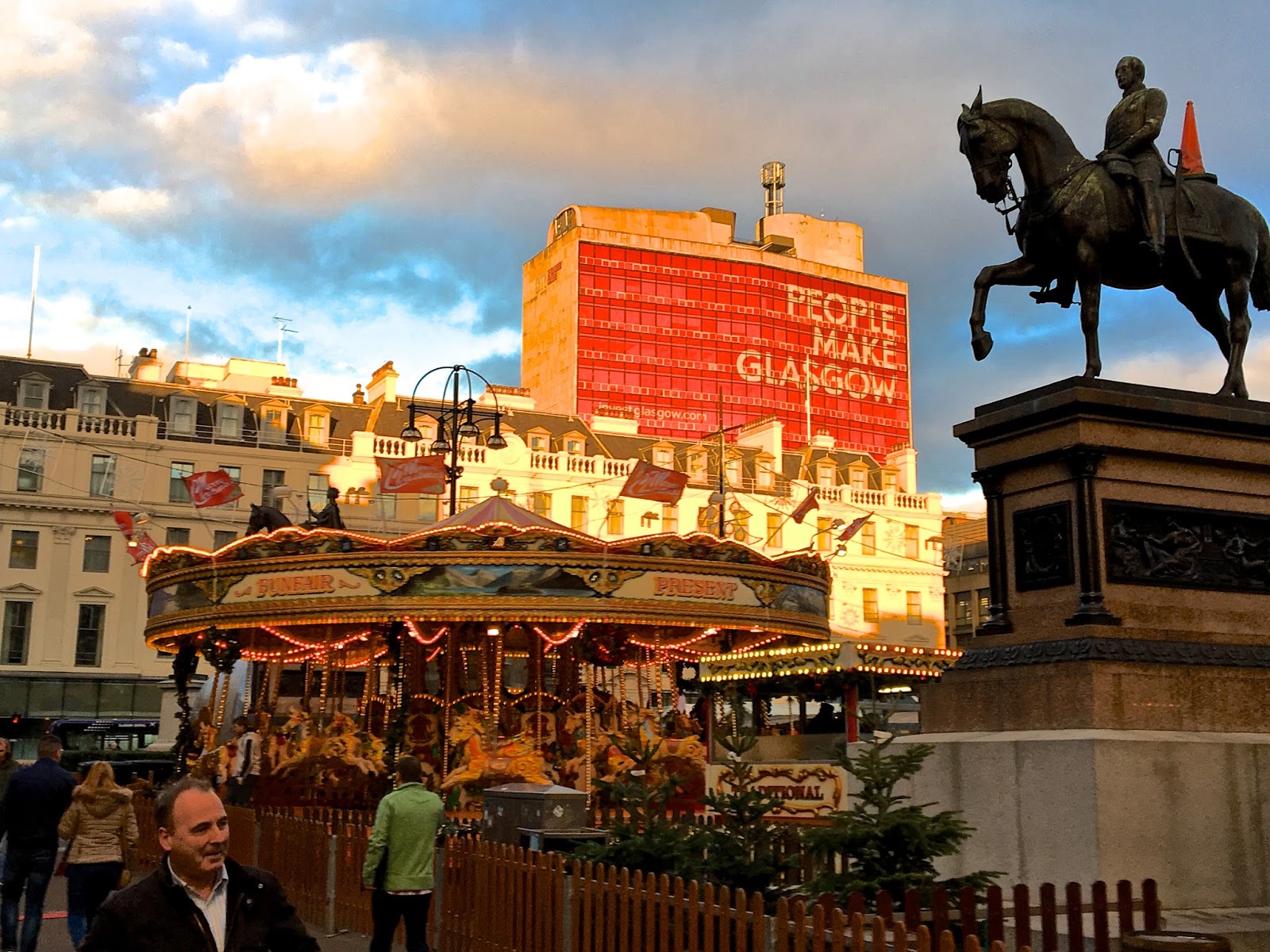
George Square, below the former College of Building and Printing

India Street and the former Strathclyde Regional Council HQ, RIP

I first footed Glasgow for 2017 yesterday. It was a depressing experience with empty shops reaching parts of the city that previous recessions couldn't reach. Much of Sauchiehall Street is struggling as a prime retail street with another huge gap where BHS was located; the cancer of vacant units is spreading eastwards. The St Enoch Shopping Centre has lost its vitality with empty units, low-rental businesses and little foot traffic despite the sales continuing. Even Buchanan Street was bereft of people at lunchtime. More people were sitting on the pavement with dogs and blankets than there was footfall on many shopping streets. An older man was giving licks to his drum kit in Sauchiehall Street in the rain. He had an amplified backing tape that included a vocalist switched to full volume. He had created a no-walk zone for passing shoppers. If it were not Glasgow, it would have been incongruous.

I made a tour of old haunts: Argyll Street pedestrian area was empty, and Union Street is cluttered with charity shops and pound shops. The older specialist shops have mainly disappeared. The School of Art is still being rebuilt after the fire. The Glasgow Film Theatre seemed to be the only functioning business in what is now the fag end of Sauchiehall Street. Glasgow has closed its public toilets, so John Lewis proved useful. It was busy, maybe the toilets are the new marketing advantage in this former city of retailing.

My old offices in India Street, where I had spent 13 years, were demolished last year, and the gaping space is showing no signs of imminent development. The Scotrail train service was an almost defunct reminder of the blue trains. The old rolling stock was neither clean nor comfortable, and progressed at a crawl compared to city trains elsewhere in the UK. The alternative of driving into the city centre is no longer a realistic option. Glasgow's car parking charges are priced to deter both commuters and shoppers; the on-street parking contractor must pay a bonus for tickets issued, and even a few minutes' delay is guaranteed a fine. Most of the public conveniences have closed, and the back lanes are dotted with men staring at walls.

The sign on the now defunct College of Printing and Building is a large hoarding proclaiming that "People make Glasgow". January may be dank and dull, and not the best time to observe a city centre, but people will have a massive task to make Glasgow flourish again. The progress in the late 1970's and 1980's was groundbreaking and happened at a pace. There was another period around the millennium when things picked up before the Scottish Parliament began to control local matters through budgets and inspection. The decline since the 2008 banking crisis shows no signs of abating. Even the affluent suburbs of Bearsden, Bishopbriggs, and Giffnock are beginning to look tired, and prices are tumbling as the city continues to lose out to Edinburgh. Only the West End seems to be thriving with the university, museums and young entrepreneurs with independent businesses providing an oasis of growth.

The massive new Queen Elizabeth Hospital, which opened in 2015, costing £842m, with all the ongoing costs that result from PPP procurement, is one of the largest hospital complexes in Europe, but is in meltdown. The latest problems of waiting times and poor elderly care, the Red Cross recruited to take patients home, have now resulted in a squad of NHS staff from England being appointed to help resolve the 'super-sized but not very efficient or effective' dilemma.

Glasgow's obsession with size and the city centre has become an endemic problem in recent years. Big projects may make headlines, but they are often a false economy; they divert attention away from the real needs of communities. The ribbons of new housing developments along the river are trapped between the river and the expressway and have replicated the mistakes of the peripheral schemes, with few shops or facilities. Community involvement seems to have been given short shrift as the City Council and the Scottish Government have pursued iconic, expensive and symbolic buildings.

Developers are always willing to take the profit on these types of development without taking responsibility for the wider environment or facilities. It is a glaekit policy. The urban fabric is worn out and needs urgent attention, the city centre is too spread out for the era of online shopping, and it lacks the charm or facilities to encourage repeat visits. I say this with some despair, having lived and worked in Glasgow for twenty years and believing in the 1980's that the city had turned the corner. Yes, people make Glasgow, but there is a need for some leadership to create more integrated and hospitable buildings and neighbourhoods than have been apparent in the last decade. Glasgow has not only been neglected by the shift of public and private investment to Edinburgh but by its City Fathers, who are equally obsessed by Big Projects. Thinking big means going local.
Charing Cross Station - nae charm and freezing cold

Thursday, 22 December 2016

Post-truth team of the year

Post-truth luminaries
Podium finish for this figure of fun
"That was the year that was, it's over let it go," sang Millicent Martin in the days when satire was in its infancy and post-truth was still half a lifetime away.

2016 has shattered many hopes and created a sense of despair about the deceptions that have been heaped on the British public. I was reminded this morning when Minister for Culture, Karen Bradley, was avoiding questions from John Humphries and making false claims about the rollout of super-fast broadband. The media inquisitors are just as adept at employing post-truth accusations as the politicians and corporate elite are at reciting post-truth idioms to evade them.

It made me reflect on the major culprits who have made post-truth such a construct of choice for our politicians, media types and corporate elite. There are so many contenders in what has been a bumper year for the post-truth artists formerly known as liars. Here is my post-truth team of 2016.

1. Nigel Farage, is always a strong contender for his ability to stay calm when delivering unreasonable, unsubstantiated hateful remarks. He tops the list for his appalling sleight on Jo Cox's husband - "he would know more about extremists than me" after the Berlin massacre earlier this week.
2. Liam Fox for not knowing the price or the value of anything.
3. (Sir) Philip Green for his avarice, arrogance and brashness as he screwed up UK retail businesses and then blamed...
4. Dominic Chappell, a serial bankrupt, for behaving as we expect hedge funders to behave by bankrupting BHS and its pension fund, causing devastation for thousands of loyal low-paid staff.
5. Boris Johnson for being the self-obsessed purveyor of fiction as fact and all-round bad egg
6. David Cameron for calling a referendum and then claiming that the deal he had negotiated with EU leaders had addressed the concerns of the British public.
7. Owen Smith for bullying his way to being the challenger for the Labour leadership and promising Jeremy Corbyn that we could both be heroes if I could be the leader and you the party president.
8. Derek MacKay, the Scottish Finance minister for failing to deliver a progressive first Scottish budget and instead simply pissing on councils and blaming the treasury.
9. Laura Kuensberg for trivialising and failing to provide an objective analysis of political news, something that the BBC used to do so well
10. Jose Mourinho for extreme egoism in claiming he is the top coach whilst destroying Man Utd and Chelsea as attractive and winning teams for which I thank him.
11. Dido Harding for spinning the mistruth about Talk Talk and failing to inform customers of hacked accounts whilst blaming BT for everything.

Mrs May was a non contender having failed to say much or answer any questions.

The overseas prize was a tight affair with Donald Trump, President Rodrigo Duerte, and President Jacob Zuma pushing Rupert Murdoch hard. But Murdoch wins it for the 35th consecutive year. His end-of-the-year sprint to purchase Sky after its price had dropped 31% post-Brexit was hacking immoral. When he last tried to buy out Sky in 2011 he had been found as 'not fit to lead a major international company' and his son James of 'showing a wilful ignorance of the extent of phone hacking ' by the Culture and Media Commons Select Committee. I fully expect that Trump will take the crown next year assuming he survives the travails of being President.

The Lifelong Achievement Award goes without saying to Katie Hopkins.

Thursday, 15 December 2016

Social Care: the Government are deceiving, delegating and delusional

Social care but only for the lucky few 

So the social care crisis that everyone agrees has reached breaking point will be solved by allowing Councils to increase council tax by 6% over the next 3 years. Mrs May claims that this is a sustainable solution. She is either dafter or more devious than I had taken her for. Most of the media fell for it, the ability of journalists to gather or make any useful diagnosis of government press releases is increasingly disturbing. The BBC in particular are culpable with their health correspondent having a palpable lack of analytical skills. The NHS has been cast by the media as the poster institution of public services concerning the needs of the elderly. The hard truth has been apparent for years; it is social care that has been underfunded and allowed to disintegrate in the face of a rapidly ageing population with a significantly longer life expectancy.

Let's examine the facts.
  • Over the next 3 years, the Office of National Statistics (ONS) predicts a rise in the number of over 75's of 8.1%. (Over 75s is a better measure of the need for care than the over 65's - the majority of whom live independently.)
  • The increase in care costs over the last 3 years, when inflation was almost negligible, was 7.1%. For the sake of simplicity let's assume that it will continue at this level for the next 3 years. In reality, inflation will push these costs higher. 
  • If care costs increase by 7.1% and there is 8.1% growth in the over-75s, the total increase in cost to keep services at present-day levels will be 8.67%. Yet everyone agrees that the present levels of service are unacceptable.
  • Council tax in England provides only £23bn (24%) of the total council expenditure of £96bn.  
  • The rest of council income comes from charges, 10% e.g. nursery fees, school meals, planning and building control fees, leisure charges and car parking, a further 10% from business rates, and 55% from the government through the revenue support grant.
  • So over 3 years, the government will give permission for local government to increase council tax by 6%. This will be ring-fenced for social care but applies to only 24% of council's total budget. 
  • That adds up to a 1.5% growth in council funding for social care over 3 years compared to a growth of 8.67% in social care needs. 
  • This funding gap may increase further as the introduction of a national living wage of £9 by 2020 and the loss of workers from the EU are factored in.
  • Many existing care providers have claimed that they are operating at a loss and may not be able to survive without increased payments from councils.
  • Sajid Javed, the Health Minister, is now claiming that the government will fund another £240m for social care but this will be diverted from council's new homes budgets. 
In other words, the government will allow councils to raise just a sixth of the total increase in care costs over the next three years. There is no attempt to address the present shortfall in social care provision that has prompted the crisis. It will, of course, allow the government to claim that they have made funding available to councils and that councils must decide priorities. If some councils manage to meet social care demands they will be quoted as a justification of the government's policy. Other councils will be tarred by Ministers who are Teflon-coated when it comes to accountability for their austerity policies.

Mrs May, this is not sustainable, it follows a cut of £1.95bn in grants for social care over the last 6 years by the Cameron government. Social care has been protected by councils as much as possible, which is why libraries and sports facilities have closed, buildings have been allowed to deteriorate, roads have not been repaired, assets have been flogged off and dozens of other local services have been starved of funding.

This is a deception that even post-truth luminaries such as Michael Gove, Liam Fox and Ian Duncan Smith would be proud of. Delegating responsibility for investing more in social care to councils at the same time as stripping them of funding and assets is morally reprehensible. Or it could be that ministers are supine in the face of the social care crisis that they have imposed on the frail elderly and disabled. It is a cruel twist to Mrs May's pledge in her statement on becoming Prime Minister that "we won’t entrench the advantages of the fortunate few".  Translating her rhetoric into reality would read 'entrenching the disadvantages for the unfortunate many.' Justice is being served cold when it comes to social care. 

Tuesday, 13 December 2016

Tesco Man wins accolade from Kendal Fellwalkers

On Ladhar Bheinn 2007
I received a copy of the Kendal Fellwalker newsletter bearing a feature on my walking friend Mark. He had moved from Scotland to the Lake District 18 months ago after an early retirement and set about the Lakeland hills with a gusto that had seen him climb over 3000 Munros over the previous 25 years. The gist of the newsletter is that he is crazy or 'hardcore'.

The diagnosis did not surprise me as we had walked on dozens of occasions over a 15 year period and we had climbed together on most of Scotland's munros, some of them several times. I chalked up munro rounds whilst Mark counted the number of munros. He was walking twice as many munros as me most years and I was averaging 65 or so each year. He broke 200 in one year but has never completed the Munros because he promised his wife that he would not climb those that required rock climbing skills - the In Pinn and Am Basteir on the Skye ridge.  He would have no difficulty climbing either of them but a promise is a promise, Mark is principled as well as erudite.

Even before our first walk together on a sunny July day in 2002 I knew that he was an obsessive hill walker from the way he dressed at work - trainers, woolly jumpers, rucksacks and he had a long languid stride pattern. The afternoon was too good to be stuck in the office and I had already arranged to leave work early and go for a walk with my son. I bumped into Mark and asked if he fancied a walk in Glencoe, maybe Bidean nam Bian. The answer was an unhesitating yes after he had spoken to his boss, the formidable Mr Risk.

It was almost 4pm when I left work to collect my son from home and then drove to Callander to pick up Mark. We reached Glencoe at 6:00pm to climb its highest and best peak, Bidean nam Bian and despite time being against us we climbed by the longer route via Beinn Fada and Stop Coire Sgreamhach. We tested each other out on the challenging slopes up Beinn Fada. No quarter was given and we summited Bidean before 9:00pm. We completed the walk in less than 5 hours and made it home just after midnight. Compared to what came later it was a minor skirmish with the hills.

Over the next dozen or so years we walked together on over 80 occasions taking in almost 200 munros, countless corbetts and lesser hills. It included lots of walks of over 12 hours, a score of finishes well after darkness, bivvying on hilltops, camping in lay-byes, and long weekends in May and September to climb the more distant hills in Torridon, Fisherfield, Glen Shiel and the far north. We climbed 28 munros in a week in 2005 and skipped round the 5 munros in Glen Affric in quick time in order to get back to the hostel in Cannich to watch Liverpool beat AC Milan in the European Cup Final.

I introduced Mark to my rather brutal habit of doubling up on hill walks - two or more outings in a day. Most famously we drove 200 miles on a Friday night, grabbed a 4 hour camp on a nettle bed by the beach at Glenelg before climbing Beinn Sgriol and the two nearby corbetts followed by a 100-mile drive into Knoydart to climb Gairich and then 120 miles home. On another occasion, the Aonach Eagach ridge was climbed on a cloudy 5 November after which we had a late afternoon walk up Ben Lomond and watched the fireworks from the summit.

We even managed an 18-hour walk from Kinlochhourn to Barrisdale, the three Knoydart munros and then back on a late September day. On this occasion, Mark was christened Tesco man by three thirty something walkers, whom he had just cruised past on the seriously steep ascent of Luinne Bheinn. As I passed them at a more sedate pace they asked: "Is he with you and are you sure he is safe to go out dressed in that equipment?" "Well, yes" I replied not having thought about it before. He usually walked in an old pair of Asic trainers, woollen jumper, carried a small cheap rucksack, which on this occasion was topped by a Tesco bag containing his charity shop waterproof jacket and trousers. He was a goretex free zone. Walking meant walking, it was not an excuse for shopping for outdoor gear, shopping merely wasted good walking time.

My answer had obviously not convinced the walkers and when I strolled into the Barrisdale bothy alone at 8:15pm after crossing the tidal channels at Barrisdale they looked worried. "Where is Tesco man," they asked. I explained that he had slowed down after falling waist deep into one of the tidal channels but that he would be here soon. I had watched his head torch zig-zagging across the braided tidal flats. Climbing the three munros, Luinne Bheinn, Meall Bhuidhe and Ladhar Bheinn had been a big day after walking in from Kinlochhourn. The thirty somethings had done the first two but had started from the bothy. When we put on rucksacks at 9pm for the 3-hour walk in the dark to Kinlochhourn they knew that Tesco man was hardcore.

And this was echoed in the Kendal Fell Walker newsletter that summed up Mark as suffering from a fanatical hill walker tendency that drives him to walk virtually every day. Here is the text.

The Lord of Walking    

As the clock struck midnight on the 31st December, 2015, lots of people were making New Year’s resolutions to give up smoking or stop eating chocolate. Many were promising to turn off the television, cycle to work, or even join a gym class while others will have promised to try a marathon or a triathlon. For mountain folk, like us Kendal Fellwalkers, the challenges might have been a Coast-to-Coast walk, or the Pennine Way, or finally driving round to the western Lakes to finish the Wainwrights. But not our Mark; his target was to walk 5,000 miles, climb 1,000,000 feet, and bag 1,000 Wainwright’s, including three consecutive sets.
IN ONE YEAR.

To put that into perspective, Mark Tye was promising himself he would average 14 miles, 2800ft of ascent, and 3 Wainwrights, EVERY DAY of 2016. Our first reaction, on a Sunday A walk in early January was, ‘he’s winding us up’. But then we thought about it. He already regarded ‘A’ walks as a rest day, and often walked over the fells to meet us at the start, then walked home afterwards. His stats for the walks he led, as given to Janet and shown on the program were, quite frankly, a fiction; in that he’d just go as far as anyone let him. We generally rebelled and he accepted our weakness without derision. He never missed an opportunity to add an extra summit for himself and then rejoin the group.

Before he moved to Ambleside he had climbed a mighty 3092 Munros. We had not named him ‘Lord Tye of Ambleside’ for nothing. We already knew he was ‘hardcore'. He walks in knackered old trainers and his knitted jumpers are legendary. He wears one all day, even when the temperature is into the 20’s. We thought they were a sort of anti-fashion statement on all our fluorescent Goretex, but on reflection, there is no artifice about him whatsoever. 

Mark has never been known to sit down, even at lunch, we put out a reward of £5 for anyone who could persuade, trick or cajole him into it. It’s unclaimed of course. 

In Scotland this year he’d already done four monumental days before the KFW tribe even fell out of our cars; and then put in another huge distance every day of our ‘holiday’. This being early June we asked him about his targets and he smiled, saying he was ‘ahead’. But his brow dipped as he added, ‘Mind you I’m getting behind on my Wainwrights.’ Some people are never happy. But actually, that’s just what he is. Mark is happy on the mountains. And never gets impatient with our snail’s pace, nor upset with other people, however unreasonable they may be. He is modest too, claiming his greatest achievement as ‘still being married.’ All in all he’s an inspiration to those of us who are tempted to slow down and he carries your bag with a smile. 

So now it’s December 2016. How did he get on with his targets? 
No sweat. By December 8th he has summitted 1195 Wainwrights, walked 5071 miles and climbed 1,172,000 feet. 
Surely next year he’ll have a rest, won’t he?


Presented with a sit mat by Kendal Fellwalkers


Sunday, 4 December 2016

Stob Dubh, Glen Etive

Stob Dubh from Beinn Ceitlein
Saturday, 3 December 2016

Ascent:        1045 metres

Distance:     11 kilometres
Time:           5 hours 0 minutes

An Grianan          494m    52mins

Beinn Ceitlein     834m    2hrs 10mins
Stob Dubh           885m    2hrs  52mins


The first snows of a fortnight ago had largely melted and today was to be clear and warmer than of late. Stop Dubh has been high on the list of remaining corbetts to be climbed for at least ten years. I had always intended to climb it along with the five Glen Etive munros including Ben Starav, but that is for a long summer's day and Stop Dubh is not an enticing prospect at the end of an already long day. From the south side it is just about as steep and long a continuous slope as you get anywhere in Scotland. The.walk highlands website recommends a route from higher up Glen Etive starting from the bridge over the river to Alltchaorunn cottage. This would be the last corbett south of Glencoe that I had to climb; the guidebooks said 7 to 8 hours, but with my intuitive optimism I thought it looked more like four and a half hours on the map.

I was up by 7am hoping to leave at first light (8:15am) but breakfast, reading up the route, putting the bins out for a Saturday collection, selecting appropriate gear - would I need crampons, ice axe, bivvy bag etc. meant it was 8:45am before I began the journey. I parked at a passing place along the single-track road 4 miles down the Glen Etive road about 200 metres past the incongruous steel girder bridge. There was already a fully specced Mercedes 4x4 parked and room for another 5 cars. The bridge crosses to a gate that could have been designed for a prison. Made of steel with massive bolts, 12 feet high and fencing on either side. The bolt was unlocked, so it was an easier entry than the next two locked but low gates leading to the cottage and the hillside. Two outbuildings to the cottage were in ruins and the cottage itself unoccupied.

The Allt a' Chaorainn carries a massive volume of water and tumbles down the glen over exposed bedrock. A bridge just beyond the cottage leads to the fenced enclosure that is protecting the regeneration of native trees. It was blocked by a photographer, presumably the guy with the Mercedes. He asked me to wait whilst he took a long exposure on a plate camera. He had a rucksack full of lenses and plates that must have weighed 15kg.. The equipment looked capable of capturing the secrets of Mars or the DNA of deer excrement. He made me feel a bit of a cheapskate when I took the digital camera out of my pocket to take a view from the bridge. At least I would have better subjects than him later in the day.

A muddy path winds its way through the woodland with bedrock exposed in places until a gate through the deer fence at the end of this part of the walk. A faint path turns to the right and scores its way through long grass that had turned the colour of straw; it eventually petered out, so I aimed for the notch in the skyline below the prominent crag, An Grianan. It is a distinctive point at the north end of the long 3 kilometre ridge up to Beinn Ceitlein. An extra 55 metres of ascent was required to the summit of An Grianan but was worth it for the splendid views across Glen Etive to both Buchaille Etive Mor and Beag as well as Bidean nam Bian.

The sky was a serene mix of deep blue dappled with grey clouds. The walking conditions were perfect; there was no whisper of wind and, although it was just about freezing, the hard exercise of the climb kept the body warm. It was the steep slopes, greasy rocks and patches of hard ice that made the walking difficult. This changed for the better as I turned southwards from the narrower section of the ridge and began the traverse across the gentler slopes leading to the cairn of Beinn Ceitlein. There were rock bands, glinting frozen lochans, patches of snow, scree and boulders. In the distance, the objective of the day, Stop Dubh, stood dark and proud like a wedge of Toblerone; it seemed well named.

There is a 70 metre descent to the bealach from Beinn Ceitlein before the final 120 metre climb up steeper scree slopes to Stop Dubh. I contoured round, and as I approached the face of Stob Dubh I saw what I assumed to be another walker sitting on a rocky ledge below the summit. I thought he/she would be descending down the slopes that I was climbing, but owing to the concave nature of the slope the figure was hidden for 10 minutes as I scrambled through the boulders. On reappearing, the figure took off flapping its massive wings a few times and then glided across to the distant peak of Stob Coir' an Albannaich. The sixth sighting of a golden eagle this year, which must be a record.

It was 1:30pm as I reached the summit just as the sun lit up the hills to the north west. The lighting of Bidean nam Bian, one of my favourite mountains, was achieved by natural lighting better than any stage lighting. The autumn hues of amber and copper on the lower slopes were capped by snow-covered ridges and in the distance Ben Nevis loomed like a primaeval monster. I sat at the summit for 15 minutes; it was comparatively warm with no gloves required - a great reward for the long slog up to Beinn Ceitlein en route to reaching this challenging hill. I drank a flask of coffee, ate an orange and marvelled at the spectacle of the light show on a fine winter's day.

The descent was quicker as I enjoyed the walk over the gently descending plateau of Beinn Ceitlein. The final descent of 300 metres down to the glen was hard on the feet with the long grass concealing ditches and loose rock. I decided to make a beeline for the bridge to save some time and distance but ended up having to climb a couple of high fences and then traverse across a bog to reach the path. It was 4pm before reaching the bridge; two large stags were heading down to the river to drink. They sized me up and stood their ground; I roared at them, and they turned and gave me the space to reach the road. I was mighty pleased as I doubt that the new hat that Louise had crocheted me would have stood much of a chance against the antlers. Only 41 more corbetts to climb.


Allt Chaorunn by footbridge

Buchaille Etive Mor from An Grianan

Summit of Stop Dubh from south east

Bidean nam Bian from Stob Dubh

Buchaille Etive Mor from Stob Dubh

Beinn Nevis from Beinn Ceitlein

Beinn Starav and Loch Etive from Stob Dubh

Looking north across Beinn Ceitlein ridge


Monday, 28 November 2016

Bad Losers

Fake winner

Bad Loser
I couldn't help but notice the similarity in the responses of Lewis Hamilton and Donald Trump when someone piqued their self interest yesterday. Lewis Hamilton has an ego and vanity of Kardashian proportions. When Nico Rosberg won the Formula 1 championship yesterday, despite Hamilton's infantile spoiling tactics, he could hardly bring himself to congratulate his teammate. Hamilton could only utter a terse comment to the effect that if only he had had a car as reliable as Rosberg's.

Maybe its something to do with Hamilton's driving style, despite being ferociously quick he has never managed to beat any of his team mates by many points over the season. Button, Alonso and Rosberg have always been his equal as they competed in the same cars. He crashes more often, is hard on tyres, gearboxes and engines. Despite being lucky enough to drive for the outstanding team in 6 of his 10 years in Formula One, he has won only two championships. Schumacher, Prost or Senna would have won 4 or 5 championships in similar circumstances. More recently Vettel has won three out of three.

Meanwhile Trump has responded to the call for recounts in three states in the Presidential election by saying that he would have won more easily had it not been for all the illegal voting. No evidence was given other than a tweet from one of his supporters. This despite the fact that he lost the popular vote by 2.9 million and there does seem to be some voting anomalies in Wisconsin, Michigan and Pennsylvania that would count against him.

It was the similarity of responses: making excuses for failure and the need to win at all costs. They lack empathy for others, they are intolerant of challengers and insensitive control freaks with an anger laced with vengeance and retribution. Could it be that they suffer a narssistic personality disorder. They certainly were both born to rage against the machine.


Saturday, 26 November 2016

Lime Craig: a winter's trail

Ben Lomond from the route up Lime Craig

Over recent years I have made only slow progress towards completing a long standing target of 200 runs up the nearest hill, Lime Craig. It is a mere 340 metres of ascent and 5.2 kilometres from home, a few hundred metres west of Aberfoyle centre. In my racing days a regular training run taking 26 or 27 minutes to the top, my pb to the summit from home was 23 minutes 42 seconds in August 1990 during a year when 21 ascents were made. 

Many of these were with Matt Ogston, a hill runner from Hunter's Bogtrotters, who would come round on Sunday mornings, often with some club mates. I was new to hill running but the trails to the summit and comparatively steady inclines meant the speed I had from road running allowed me to beat all comers to the summit. Not so on the descent down the steep west face where the hill runners allowed gravity to speed them down whilst I had more trepidation, always conscious of the five titanium screws in my right leg.
 
It has become more of a challenge nowadays taking between 33 and 36 minutes. I only tackle it three or four times a year, usually in the winter months when the visibility is at its best. Today the early morning temperature of -7°C had prompted me to postpone my early morning run but the blue skies and hard frost persuaded me to tackle Lime Craig along the sublime forested trails above Braeval. It was almost 11am before I ventured out, the pavements still frosted but the sun bright and the visibility excellent.

I took my altimeter to check the height gain but decided after stopping for a couple of photos on the lower slopes to forget about times, it was going to be slow but so what. Suddenly the run became joyous, every stride a chance to garner new views. I arrived at the summit feeling fresh despite completing the final 200 metres of ascent at a reasonable pace. I stood at  the top on the base of the old Police radio station, removed my gloves and began to box the compass for views and some photos.

A walker arrived as I was photographing my distressed gloves that have served me for ten years on winter runs and climbs. He was amused and we began an animated conversation for twenty minutes or so about wildlife on the Scottish mountains before another walker, armed with a Scottish Tourist Board leaflet of the walk up Lime Craig arrived. The discussion suddenly changed to where the best cakes could be obtained as a reward for their walks. 
 
I left them deliberating and met another two pairs of walkers nearing the summit, pausing to take photos of a mother and daughter combo who were new to the hill and infatuated with the views. I freewheeled with a stretched rhythm down the long incline with  3 or 4 switchbacks, past the Go Ape site, over the footbridge by the lodge and then coasted down the cycle way to the village. I was back for lunch; no cakes just lentil soup and the satisfaction of another brick placed in the wall of 200 runs, just ten more to go.

Above Dounans camp
The carse looking to the Campsie hills
Approaching Braeval
Nearing Lime Craig summit

Stop Binnein and Ben More

Ben Lomond behind Craig Mhor

Past their best hand warmers on summit platform

Descent from the Lodge


Monday, 21 November 2016

Cnoc Coinnich

The last leg to Cnoc Coinnich
Monday 21 November 2016
Ascent:       765 metres
Distance:    11 kilometres
Time:          3 hours 4 minutes

c     Cnoc Coinnich         763m         1hr  46mins

The surveyors had recalculated the height of this hill and it was a metre higher so Cnoc Coinnich was added to the table of corbetts earlier this year. Fortunately it is quite near home and it is an interesting area boasting splendid views down Loch Long and Gairloch to the Clyde estuary. I had crossed the flanks of this hill during a mountain marathon 25 years ago but corbett means corbett so a visit to the summit was now necessary.

It was the coldest morning of the year, -4°C, as I left home and a cold fog accompanied the frost. By the time I was driving up the A82 alongside Loch Lomond the skies were blue and it looked a perfect day for walking. I turned off the Rest and be thankful road at the visitor centre and followed the single track road for 3 or 4 miles to a car park at the foot of the Coilessan burn. The car park had been taken over by forestry contractors; massive dumper trucks, earth movers and equipment were assembled. There was major road construction taking place and the forestry tracks would have been impossible mud tracks had it not frozen hard in the overnight frost and the temperature wasn't going to get beyond freezing today.

I crossed the bridge beyond the car park and turned right to follow the construction road through the forest. There was a lot of activity and I had to jump off the raised road every time a lorry carrying ballast came chugging up the incline. There is a long section where the trees have already been felled as the road climbs to 350 metres before a footpath signposted for the Cowal Way begins a far steeper climb rising 150 metres to the top of the forest and on to the col between Cnoc Coinnich and the Brack, the adjacent corbett to the north.

There is a gate that leads onto the open hillside at 450 metres. The snow level had started at about 400 metres but from the gate it was deep soft snow all the way to the summit. There were deep footprints from a walker that took a good line so I followed them to the start of the summit ridge that runs south-east for over a kilometre. It was hard going in the soft snow and after a week with a heavy cold, I was in no hurry. I coughed and wheezed enough to clear my airways and hope that recovery is now assured. A fresh north easterly breeze was also beginning to blow through me and the sweat from the lower slopes became a fond memory. I had not bothered with an ice axe but there were sections with slabs of ice below the snow that made it necessary to use a walking pole to avoid sliding down the slope. I reached a col below the final ridge and the last 200 metres of climbing was steep but served to provide vigorous exercise to keep the cold at bay.

The summit was in the grip of deep snow on all sides but provided a superb viewing platform for the Arrochar Alps, the sea lochs draining into the Clyde estuary and the less familiar hills behind Lochgoilhead. The wind had stiffened and I had to find some shelter below a swirling outcrop of schistose rocks at the the summit to enjoy a flask of coffee.

I managed to take a few photos from the summit before beginning the return, pleased to be escaping from the freezing conditions and nursing some circulation into my hands. It was easy walking with snow lubricating the descent. I was soon off the summit ridge and plodding through the deep snow to the top of the forest. Conditions here were benign, so hat and gloves came off as I sauntered down, eating an apple and dodging the occasional dumper truck of grey gravel. I was back at the car before 2pm, something of a record, and home by 3pm. It had been the perfect outing to resume exercise after a winter cold.

Start of the walk at the Coilessan car park: Loch Long
Dumper on Coilessan track

The gate at the top of the forest

Below the summit cairn for coffee
Loch Long, Loch Lomond and Ben Lomond
At the summit, Beinn Ime and the Brack
Clyde Estuary
Loch Long and Gairloch