Sunday, 27 March 2016

Dave and George's Excellent Adventure but Bogus Journey

Hey Dudes the party's over
It is hard to believe how far politics has dumbed down over the past six years. After the vows in the rose garden with Nick were trashed, Dave and George travelled back in time to see what would have happened if Mrs Thatcher had carried out the policies of Milton Friedman.

Dave and George began their adventures by desecrating what used to be trusted British public services. Stripping out resources for schools, roads, social care, housing, nurseries, sports, the arts, green initiatives and community facilities. Selling off public assets, creating academies to be run by American companies and allowing G4S to run everything else. Commissioning nuclear power stations from French companies with Chinese money.  Reorganising the NHS at enormous expense and then claiming innocence when it goes belly up.

They encouraged the sovereign funds of the Middle East or American global multi-national companies to buy out British companies; they were negligent in letting companies like Amazon, Starbucks, Coca-Cola, Google and Facebook evade paying tax; and they used modern apprenticeships to subsidise companies including supermarket chains to pay minimal wages.

At home they continued the purge of social housing and then taxed 'alleged' under-occupancy, they have year-on-year reduced taxes for the super-rich and increased tax-free saving allowances whilst holding back or reducing working tax credits and disability payments. They ignored the findings of the Leveson Inquiry and allowed the press to continue to regulate themselves despite their abysmal record on complaints and the tragic outcome of phone hacking. They have conducted a serial campaign against the BBC requiring them to pay for free licenses for older citizens and threatening the future independence of one of the few globally trusted and innovative sources of news, information and creative programming.

They failed to participate positively in Europe, bombed Libya, and continued to support the weapons industry to sell to countries ramping up conflict in the Middle East. They have refused to seek exemptions from the Transatlantic Trade and Investment Partnership (TTIP) for the NHS, Education, Railways and other services or to inform the public of this latent assault on democracy. They also have been phenomenally successful in directing capital infrastructure investment towards London and the South East and created a divided Britain in the process.

Amazingly they then won an overall majority in Parliament with just 24% of the electorate voting for them, after refusing to allow any changes to the voting system in the previous parliament and shredding their coalition partners in the process. And now to avoid a conflict in the Tory party over Europe, they have unwittingly started a civil war within the party with those who support Brexit. This looks more like a bogus journey than an excellent adventure.

What amazing dudes.


Monday, 21 March 2016

Maol Chean-dearg


Maol Chean-dearg towards Beinn Alligin

Friday, 18 March 2016
Ascent:        991 metres
Distance:     16 kilometres
Time:           5 hours 18 minutes

m     Maol Chean-dearg       933m    2hrs 45mins

John and I had arranged to leave the cottage near Loch Carron before 8am to climb Maol Chean-dearg, one of my favourite Munros mainly because of its position providing a balcony view to the Torridonian triptych of Beinn Alligin, Liathach and Beinn Eighe. Unlike the last four days, we did not wake to blue skies and an overnight frost. There was a veneer of low-hanging clouds. More in hope than anticipation I speculated that there might be a temperature inversion as we made the 20-minute journey to Coulags. This was to be a lazy day on the hill. I had twice climbed Maol Chean-dearg along with the adjacent Coire Lair Munros, on another occasion I had combined it with Beinn Sgriol and once with the two nearby Corbetts of Beinn Damph and An Ruadh Stac, both of which are mightily impressive hills.

The walk up the glen, Fionn-abhainn, provided an easy start although the mist restricted visibility. We stopped briefly at the Coire Fionnaraich bothy, which was relatively clean and looked as if it had not seen much use recently. Another kilometre up the track there is a small cairn and the path turns to the left before climbing steadily on a good stone stalker's path through a series of zig-zags. The rocks changed from sandstone to quartzite at about 450 metres and the path continues until the bealach Coire Gharbh at 630 metres. I kept a good pace feeling that I had regained my hill fitness after walking every day this week.

Just above the bealach we emerged from the cloud and entered the magical world of spectacular Torridon peaks punching through the bed of white clouds. An Ruadh Stac stood out from the cloud like a primaeval monster, its quartzite slopes in shadow. The climb from here is both steep and loose over quartzite that has been badly eroded. The surrounding hills appeared to be growing gracefully as the cloud level dropped and we ascended.  There is a 400-metre flatter section before the final pull-up over blocks of old red sandstone. It then flattens again before the summit where the cairn provides the perfect position to gawp at the panorama of views. Is there any better summit on the Scottish Munros? Unlike on a couple of previous visits, no wild goats were grazing on the summit today.

This was an exceptional experience, not only blue skies on a perfectly still day but we were also enveloped by a temperature inversion with the cloud top level at about 650 metres. We spent 40 minutes in shirt sleeves, walking around the summit checking out every vista and inhaling the clear cool dry air with the sun warming our bodies. Beinn Alligin and Beinn Damph were particularly impressive but the more distant views to the Applecross hills and Skye to the west, the Coire Lair Munros and the Coulin forest Corbetts of Wednesday to the east were also magnificent. Needless to say, Liathach displayed its snow-capped white teeth to the north. We didn't even bother to look south for Ben Nevis. The north-west is always best.

It was just after noon before we decided to head down. The sandstone blocks are not difficult to negotiate. We passed a lone woman and then two walkers on the flatter section, they were as gushing about the day as ourselves and they had yet to experience the summit. The quartzite scree below was very loose and I made the mistake of following a path to the right. The loose scree was mingled with sharp unyielding outcrops and the descent needed a level of concentration that meant I could not fully absorb the views. Once at the bealach, the clouds lifted and we scurried down the stalker's path passing another 7 walkers and a dog on their ascent. It is not often we are on the way down a hill at lunchtime. The long walk out down the glen was accompanied by the singing burn, it felt like a summer's day. We were back at the cottage having a beer and some lunch by 3pm


The ascent was shrouded in the cloud until reaching 650 metres

An Ruadh Stac as we climbed out of the cloud

 Looking east towards Sgorr Ruadh 

Maol Chean-dearg, the final slopes to the summit

Maol Chean-dearg, looking east over Sgorr Ruadh and Beinn Liath Mhor

Maol Chean-dearg, the saw edge of Liathach

Beinn Bhan and the Skye Ridge in the far distance

Beinn Damph

Looking northeast to Liathach and Beinn Eighe

Sgurr Dubh and Sgurr nan Lochan Uaine with Fannaich beyond

Bothy on the descent down Fionn-abhainn

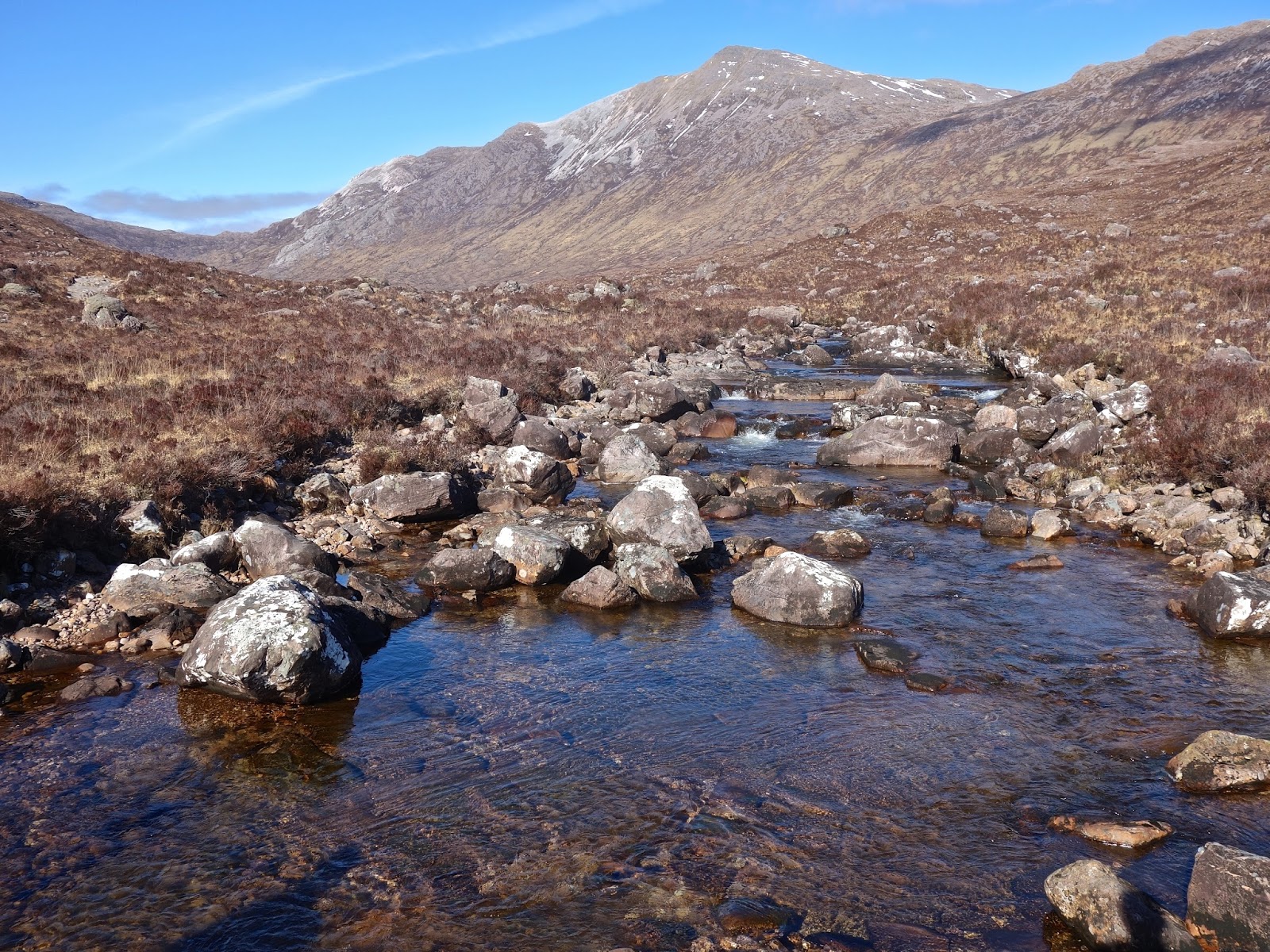
Fionn-abhainn


Sunday, 20 March 2016

Strathcarron

Tigh Braeintra
 
I have long had the view that three districts in Scotland provide the finest scenery. These are the north-west highlands north of Ullapool, the Torridons and the Ardnamurchan and Moidart areas between Mull and Mallaig. They have been my destinations of choice since I arrived in Scotland in the 1970's. Other areas come close, the Argyll coast south of Oban, but it lacks mountains and the Knoydart peninsula, which is too remote for regular visits. This week I spent a week in the Lochalsh area between Glen Shiel and Shielding, and I have to admit that it is now one of my favourite areas and only 45 minutes away from the Torridons and Skye.

We arranged to go at a few days' notice to my brother's cottage at Achmore, close to Plockton. It would be my birthday, and we invited John and Bridget to come along. We met them at Invergary for a light lunch, after which John and I  started as we meant to go on by climbing Meall Dubh, a shy Corbett amidst the Millennium Wind Farm and then went out for my birthday meal in Plockton. We would be able to climb some of our remaining Corbetts in the vicinity, whilst Aileen and Bridget visited Applecross, and other parts of Lochalsh, with all of us visiting Shieldaig and Raasay on other days. We were rewarded with 6 days of March sunshine. The views had a Leica-like clarity that was mesmerising.  We spent 4 days in the mountains, with the other days giving wonderful walks near Shieldaig and then Aileen, John, and I having a splendid day exploring Raasay.

View from the cottage

Winter is over

Loch Carron

Above Strathcarron

Hot Totty on wheels

Beinn Bhan, a sublime walk

Plockton Bay

Plockton sunset


Sgorr nan Lochan Uaine and Sgurr Dubh

Sgorr nan Lochan Uaine

Wednesday, 16 March 2016
Ascent:           1134 metres
Distance:         11 kilometres
Time:               6 hours 35 minutes

Sgorr nan Lochan Uaine         873m     2hrs 41mins
Sgurr Dubh                             782m     4hrs  55mins     

Another perfect day, so we decided to tackle the two Corbetts in the Coulin forest from the Glen Torridon road. We knew that these hills were capped by steep rocky summits, and we preferred not to tackle them in winter conditions; apart from anything else, it would mean lugging up crampons and ice axes, and I thought an SLR camera would be more useful on a day like this. Our walks earlier in the week had convinced us that conditions would be favourable, the snow had largely melted in the heatwave and only garlanded the northern slopes. We were less sure when we passed through Achnasheen and drove into low cloud, the Fannaichs and Fisherfield were invisible figments of our imagination.

Leaving Kinlochewe on the Loch Torridon road, we emerged from the clouds, and Glen Torridon was revealed in all its stupendous glory. The face of Liathach was fully made up in the winter sun, with the rocks highlighted in shadow and its summit ridge outlined in snow and contrasting with the impossibly azure skies. We parked by the path that leads to the triple buttress behind Beinn Eighe and took the path crossing the river and heading for the Ling hut. It was still cool, but half an hour later we were stripping down to shirts as we climbed the excellent path that heads towards Beinn Liath Mhor.

The path eventually ran out at 420 metres, so we made a beeline for the summit of Sgorr nan Lochan Uaine, its pointed peak overlooking the eponymous lochans below that shimmered in the strong sunlight. The lower slopes had been recently covered by snow that had tamped the grass and heather flat, and the ground was liberally littered with old red sandstone outcrops and blocks. I stopped for 15 minutes to catch up with an urgent e-mail and took the opportunity to tantalise friends confined to their workplaces by sending them a few photos. The final 50 metres of ascent was a steep haul up some shattered quartzite. We arrived at the magnificent summit with amazing views in all directions. The conditions were quite benign, so we had a good half hour in the sun, which is rare at any time of the year to be able to relax like this on the summits. Today was recompense for all those wind/rain/snow-lashed days when my hands were numb and my body was telling me to keep moving.

The next stage of the walk looked a bit complex as we observed the 3 kilometres of geological minefields over to Sgurr Dubh. There were dozens of small lochans dotted amongst the rock bands, and a direct route was as improbable as the OS contours giving us a true picture of terrain crafted by the last ice age. The start of the descent was down the quartzite blocks on a rough path, and then we followed our noses, passing around rock outcrops, down snow chutes and around the lochans. They were mainly frozen and provided the scintillating foreground for more shots of the Torridon peaks to the north.

As we started the climb, we were confronted by dozens of lochans nestling between the exposed sandstone pillows. We came across a stag who held his ground and provided more photo opportunities, posing beneath Liathach.  The final climb to Sgorr Dubh was a scramble along a quartzite ridge with massive fractured boulders before dropping to the final deep blue lochan and then finding another steep path rising to the summit peak. Despite the fact that we had been blessed with unrivalled views all day, there is something special about this summit overlooking Glen Torridon. Again, we relaxed, emptied our rucksacks of any food, took photographs and then began the descent. We had taken over an hour longer than we needed to walk these hills, but we had absorbed every aspect of some wonderful hills on a perfect day. It was after 4pm before we topped out.

The guidebooks had said the quickest descent was to head west towards the Ling hut, we did and had to turn a large crag to the left. There was then a steep ramp down to a wee lochan, and after that, it was a series of rock bands to negotiate by slithering and sliding down the rock outcrops. It required concentration and took longer than we had anticipated to cover the 3 kilometres back to the hut and then out to the car park. We had been granted an exquisite day for the walk. On the journey back to Lochcarron, we were eulogising about whether this had been our best walk ever.
  
Liathach from the Ling hut

Liathach, King of the Scottish Mountains

Beinn Eighe ridge

Liathach from the slopes of Sgurr nan Lochan Uaine

Liathach and Beinn Eighe from Sgurr nan Lochan Uaine

Guess

Summit of Sgorr nan Lochan Uaine with Liathach and Beinn Eighe behind

Moruisg and Maoile Lunndaidh to the southeast

Descent of Sgorr nan Lochan Uaine

Not a care

Liathach in Excelsis

Liathach and Beinn Eighe from the Lochans on the bealach

Stag holds its ground

Sgurr Dubh from below the summit

Beinn Eighe and Loch Claire from Sgurr Dubh


Saturday, 19 March 2016

Raasay

Approaching Raasay from the ferry

Thursday, 17 March 2016

After three days in the mountains we sought some respite by taking a trip to the island of Raasay off the east coast of Skye. We had made attempts in the past but were thwarted by lack of suitable ferries on Sunday or poor weather that would have given little scope for exploring the island. Today was another splendid March day with the high pressure making the north west highlands the sunniest and warmest part of the UK. The ferries run frequently and the 15 minute journey in the well maintained Cal Mac ferry was a treat with the ferry crew extending courtesy and sage advice on where to go.

We headed to the north end of the island and in the incomparable luck of the week we were entertained by a golden eagle circling us above Manish Mor. Our intention was a walk to the small offshore island of Fladday and to drive on Calum's road. This three kilometre section of road was built by hand with barrow, pick and spade by Calum MacLeod over a period of ten years and has been the subject of TV documentaries and books as well as a tune, Calum's Road.

Calum was one of the last remaining residents in the small settlement of Torran, 10 miles north of the ferry terminal and main settlement at Inverarish. He had been the postmaster and lighthouse boatman and his wife had taught at the small local school. He was frustrated by the failure of increasingly centralised organisations to understand and respond to the needs of remote communities so built the road that the Council refused to build. As a testament to willpower, bloody mindedness, public spiritness and sheer endeavour he has few peers. He died a couple of years after it opened in 1988 and one of the locals who had lived there until 1966 told me that he had left a hell of a legacy. There remain some cottages occupied mainly by the families of former residents. The area around the beautiful sea loch at Arnish were always isolated from the more populous south of the island by poor roads and they forged closer links with Portree just five miles away by boat.

Calum's road was no better maintained than the rest of the island. We returned to the south as the heathers were being burnt and passed through the forest plantations that were being felled following an outbreak of Phytophthora ramorum to larch trees above Raasay House. A new distillery has been built on the island and a Raasay 'While We Wait' bottle is available prior to the arrival of the finished product. The Hotel and Outdoor Centre provide some employment and the island seems well populated with sheep. Raasay had suffered greatly when owned by the London retired GP, Dr Green or Dr No as he became known. When the Scottish Office took over the ownership in 1995, the local population made heroic efforts to generate new businesses.

There are a number of community based initiatives and there is evidence that the steady population decline over many years has now been reversed. Work on the walled garden, a new ferry in 2013 and some community run enterprises as well as various cultural and outdoor activities suggest that the island could be on the cusp of  a sustainable regeneration.

We were told that the sea fishing in the Sound of Raasay by larger vessels bottom trawling has had damaging consequences for the seabed ecosystem. The number of rabbits on the island is much reduced since the arrival of mink, it is thought from the Uists. There are two pairs of golden eagles on the island as well as sea eagles, otters and a seal colony.

Sailing back on the evening ferry and enjoying the views of Skye we felt elated about our day on the island. At the same time the alleged criticisms of insensitive national organisations and the lack of support by the Scottish Government agencies and Highland Council compared to other smaller islands seemed to suggest that the potential of Raasay as a place of sustainable growth has yet to be realised.

Golden Eagle over north Raasay

Brochel beach
The start of Calum's Road
On Calum's Road
On the path to Fladday, also built by Calum and his brother
Fladday Path
The three remaining cottages on Fladday, access at low tide

Heading back toInverarish, Red Cuillin in distance

Red Cuillin from Suisnish

Looking west to Skye

Raasay House Hotel