Wednesday, 30 July 2025

Corfu @ 45°C

Albania from Agios Spiridon, the northern point of Corfu

The Med in July is not that cool. The crowds, temperatures, airline and accommodation prices are at their peak. School summer holidays were designed for milder British climes, not for the benefit of airlines and the rapacious tourist industry. The crowds at Edinburgh Airport at 3:30am were of Murrayfield proportions, the Wetherspoon breakfasts were creating bulging bellies, and even the champagne bar was bubbling with alcohol seekers. The queues for luggage drops extended outside the terminal buildings, and with most folk dressed for the heat of arrival, it was apparent that the tattoo parlours had had a bumper year.

EasyJet landed us ahead of schedule, and within half an hour, we had parked our modestly priced Nissan Micra at Lidl. Greek prices had escalated since the last visit ten years ago. Google Maps helped us escape Kerkyra, the main town, and reach the north coast. Our modern villa was grafted onto the limestone bedrock and gave us stunning views of the nearby coast and the Albanian Riviera. The pool was calling, and later we walked up to the nearby village of Kontokali for a fine Greek meal at Harry's Taverna before retiring to air-conditioned rooms that made sleep easy.

Corfu has changed since my first visit in 1970, when we picked up people on an emigrant's boat from Piraeus to Brindisi in Italy. We had blagged our way to a passage on the boat to complete a 4-week student holiday in Greece and Italy.  Our return flight to the UK had been booked from Milan so we had to hitch hike up Italy calling at Rome and Florence en route, my optimism was unregulated. The cost of the passage to Italy was 110 drachma or £1.50 for a 24-hour sail through the Corinth Canal, a stop in Corfu and a meal of pasta was included. We slept on the deck along with Greek families who were escaping the colonels and seeking work in the newly opened Alfa Sud factory in Naples. 

My next visit to Corfu was in 1981 with our 1-year-old daughter, our first holiday as a family abroad. We stayed at a large tourist hotel at Roda Beach, not far from where we stayed on this occasion. Aileen had wanted to bail out; the meals in the large canteen-like dining area made you nostalgic for school dinners. We hired a car and sought out the best beaches on the north west coast in friendly local villages with the odd taverna and an absence of tourist tat. It was an important lesson; we never had a holiday in a tourist hotel again. We next passed through Corfu on our way to Paxos and saw the sprawling development that had taken place. On this trip, I was careful to book a villa in the north of the island, close to the better beaches and away from the crowded holiday resorts. There are now 150,000 people living on Corfu; only Crete and Rhodes, both far bigger islands, are more populated.

The villa was modern, well-equipped with air conditioning and a pool that proved essential as temperatures were in the mid forties for much of the week. The record temperature was equalled on our last day, according to the driver of the mini bus that took us to the airport after the car drop. We made visits to Aghios Georgiou beach, where we had spent several days in 1981, when it was a gorgeous, long sandy beach with just a couple of tavernas. Today it is developed with many hotels and restaurants, the beach is littered with sun beds, but it is still beautifully located between two headlands. As is the nearby village of Afionas, where there is a wonderful walk down to Porto Timoni that we made after the afternoon heat receded. 

We made a couple of trips to the nearby village of Kassiopi with its picture book harbour, from where we rented a boat for a voyage along the coast and contemplated a quick trip over to Albania, a 3-mile voyage that had been achieved by two holidaymakers from Kilmarnock in a pedalo a few years ago. The young woman who hired us the boat thought that Greece had been at its best in the 1970s, when beaches were unadulterated with hotels and cafes, when transport was buses and scooters, and local tavernas provided simple meals. I agreed, having had the pleasure of four island-hopping holidays, travelling light with good companions; sleeping on deck or beaches, or in caves and whitewashed cottages that had no water or electricity. I visited 15 Greek islands in those halcyon days. reading novels like The Magus by John Fowles and exploring ancient sites when you were able to amble around them without tickets.

On other days, we visited the spectacular coast of Cape Drastis by Sidari and made an early morning climb up Corfu's highest mountain, Mount Pantokrator, from Old Perithia. Most of the time, the villa and the pool provided the most comfortable place in a week when the temperature was heading to new records. We ate out most evenings, the tavernas provided good Greek food, and the hospitality was always good. Would I go again? Not in July or August, and probably by train and boat or a tardis to go back to the 1970s. The queuing and waiting at airports and the sense of being packaged is contrary to the very essence of enjoying the uncertainty and delights of travelling.

Albanian view

A place in the Sun, Old Perithia

Mantis on arm chair

Logos, Sunset beach

Logos

Cape Drastis

In the Mountains

Arilas Bay from taverna

1970s Greece

Firecracker Plant

Path to Porto Timoni

Agiou Georgiou Bay

Bougainvillea

Kassiopi Harbour

Villa Arreti

Monday, 28 July 2025

Mount Pantokrator, Corfu

Mount Pantokrator on ascent

Friday, 25 July 2025

Ascent:      450 metres
Distance:  11 kilometres
Time:        2 hours 48minutes


Mount Pantokrator    909 m   1hr 28mins

At 909 metres, Corfu's highest mountain wouldn't quite qualify as a Munro, but it is nearby, and it is my tradition to climb the highest mountain on any island that is visited. It was to be the hottest day of the holiday, and the temperature was to rise to 42°C. We started at 6:30am for the 8-kilometre drive to Old Pethithia, the oldest and highest village, at 450metres, on the island. Gregor was to run it, and my intention was to walk up as far as the ridge at 650 metres, from where I could view the island and the nearby shores of the Albanian Riviera. I doubted that my groin strain and aching legs would take me any further.

It was still cool, and the morning breeze made ideal conditions for the walk as Gregor ran off in pursuit of the summit. I found the narrow marked path that twists its way through the limestone and burnt-bark olive trees; Gregor missed it and ended up on convoluted dusty trails for 13 kilometres to the summit. The path emerged on a higher trail road that took a more direct route to the summit.  I decided to head along, expecting to meet Gregor on his descent, at which stage I would turn back. I was walking more easily than expected, and unexpectedly met Gregor at a junction just 1.4 kilometres below the summit. He was still running his ascent but had done an extra 7 kilometres. I decided that the final section involving a climb of 220 metres along a metalled road was worth the effort. Two cyclists pedalled past on sections that made Mont Ventoux look easy; my shouts of 'Allez' were probably not appreciated.

The summit was a disappointment, with a collection of phone masts, a mini Eiffel Tower and fencing around the high point. Gregor was chatting to the cyclists and was ready to run down. There was no place selling drinks, contrary to the blurb about the summit. I scrounged a mouthful of water before beginning the 5 kilometres of descent as the morning heat began to intrude. I was down shortly after 9am. The car battery was flat from overuse of the air conditioning, but a friendly local from somewhere in the Midlands of England was on hand with some jump leads and advice on the restaurants in Old Perithia that we hope to return to this evening. We were back at the villa by 10am, desperate for a litre of water to revive our dehydrated bodies. It was already 38°C.

Path to Mount Pantokrator

Dried limestone vegetation

JCBs get everywhere

Memorial

What's wrong with a cairn?

G&K at summit

Digital Destruction

Looking over to Albania


Friday, 25 July 2025

David Hume

 David Hume Tribute, 15 August 2025


Comrades, we are here today to think about David. To understand his curiosity, revere his intellect, enjoy his zest for life and spiky humour and remember his glorious idiosyncrasies.


In 1980, David had just completed a Master’s degree at the University of Wales Institute, Swansea. He applied for posts in my team that was responsible for Strategic Planning in the Strathclyde Region. He was one of 70 or so applicants. His application was detailed and meticulous; I short-leeted him without hesitation. At the interview, he was smartly turned out, engagingly polite and articulate, and he was knowledgeable and positive about our work. He was wooing the Depute Director, who was nominally in charge, but also giving me vibes about his commitment to social justice. He was a shoo-in for a post; I felt I had won the jackpot. In a recent email from David reflecting on his appointment, he said, “I was appointed on a Graduate Trainee Grade; I never took much notice of the actual salary. I was just thrilled to bits to be working for Strathclyde, and eventually, I squirmed my way up the greasy pole to higher levels.” On reflection, “these were the most satisfying days of my career.” 


He had joined a team of radical baby boomers; we were all in our twenties and had been gifted the responsibility to shape the development policies of Strathclyde Region, then half of Scotland’s population. We were led by some outstanding politicians who had a vision and determination to tackle the industrial and social decline of Glasgow and its region. As a team, we were committed to social justice, an end to paternalistic public services, community engagement and real ale. We challenged hierarchies and departmental silos, and we ignored moribund administrative procedures. In turn, we were regarded as disrupters by the embedded Directors and Depute Directors. 


Our unique selling point was that we were also collaborators, and David was one of the best. His confidence acquired at Heriots, his sense of entitlement nurtured at St Andrew’s University, the fieriness of a Welsh dragon, along with his innate intelligence, allowed him to forge relationships with like-minded professionals across all departments as well as politicians. His desire and determination to tackle poverty and health improvement were as hardwired as his support for Hearts. 


David had many other qualities: an inner light, an intense curiosity, and a caustic wit that begat a wicked sense of humour. This could be brutal, but it was twinned with an infectious chuckling laugh that made you forgive him. Before David’s arrival, we had given politicians the evidence to abandon new town growth and focus on urban regeneration and to switch transport spending from roads to public transport. We had persuaded education and social work management to allocate resources according to need, not demand. David was passionate that we should now focus on poverty, health and well-being. He was fanatical about analysing and presenting empirical evidence to justify change; he was an influencer, like his famous namesake.  


He forged strong links with the Greater Glasgow Health Board to plot the distribution of GPs in relation to population and found there was little correlation. In the 1980s, Primary Care, like Pharmacies, Dentists, and Banks, was largely absent in the most deprived areas. We made a presentation to Greater Glasgow’s Chief Administrative Medical Officer, Sir Kenneth Calman. It resulted in a programme of new health centres that popped up in the housing schemes and inner-city regeneration areas. 


David researched variations in life expectancy across the Health Board area and found immense differences that directly correlated to the levels of deprivation. He compared Drumchapel and Bearsden, a mile apart, but with a 13-year gap in life expectancy. His presentation showcased his artistic bent; he created a horizontal bar chart with Drumchapel and Bearsden shown as two cigarettes. The short Drumchapel cigarette (short life) had a long ash to represent many years with a poor quality of life. Bearden was a far longer cigarette with a short ash. Life was good for far longer in Bearsden. David had nuanced the message that ‘adding life to years’ is probably more important than ‘adding years to life’. 


Next up, plumbo-solvency, David mapped where lead pipes existed in Glasgow - almost entirely in the areas of deprivation. It can harm mothers and unborn children and affect the mental development of children. We presented the findings to the Depute Director of Water, who was horrified. He immediately reprioritised the Water capital programme to eradicate the lead pipes in these areas. Along with the switch to public transport, this was another brick in the wall of infrastructure justice.


David had adapted to life in Glasgow; he had established a network of colleagues and friends from across the Council and other agencies – community workers, social workers, welfare rights officers, water engineers, accountants, health professionals, police officers and councillors. He had the advantage of coming from Edinburgh, so when asked who he supported, he replied Hearts. The weegies laughed; he was no threat to the old firm supporters. By this time, David had ingested another personality trait, the brutal humour of Glasgow. (David would have chuckled that Hearts were sitting on top of the league above the old firm on the day of his funeral.)  He bought a flat in the most deprived part of Glasgow, Bridgeton, handy for Glasgow Green, the Barras and the People's Palace. It gave him kudos with the social workers, teachers and doctors who may have shared his social conscience but lived in the West End and Shawlands. 


David’s analysis of public service provision showed the unintended consequences of Scotland’s post-war policies of New Towns and large housing schemes. The failure of the Scottish Office, Councils, Health Boards and other public bodies to shift resources to where they could eradicate poverty, increase opportunities, and improve the quality of life had resulted in the worst urban deprivation in the UK.  He took this knowledge and his diagnostic skills to Lothian Regional Council. 


I kept in regular touch with David as his career flourished in Lothian, Edinburgh and then as the Chief Executive of Scottish Borders. We both ended up as Chief Executives, and we arranged joint learning sessions between our Management Teams. We would phone each other and discuss wicked issues as they arose. David’s ambition was to make the Borders more Scandinavian. He admired that they had a far lower Gini coefficient (a measure of a country’s inequality) than the UK. He drove a Saab, read Henning Mankell’s novels and fantasised over Borgen and the Bridge; he holidayed in Denmark. I always expected him to erect a mermaid outside the Council Offices at St Boswells. 


David was a poly hobbyist, I’m not sure there is such a word, but it would fit. He was a high achiever, a walking thesaurus. His writing skills were exemplary, his reports could move opinions by his deft use of words that had a feeling, freshness, ambiguity and mischievous innuendo. Making a list of David’s eclectic hobbies is a smorgasbord of activities and interests. As well as motor bikes and small- bore rifle shooting, handy if you want to get on the Police Scotland Board, he was also into cycling, archery, jazz, folk music, bubble cars, opera, classical music, art, philosophy, geography, Edinburgh, France, good food, Welsh politics, winnebagos, podcasts, BBC Radio and Scandi everything, particularly that yellow Porsche in the Bridge. 


After retiring, David took on work including being on the Board of Police Scotland and a group commissioned by the Welsh Labour Party that produced a report on Radical Federalism published in 2021. He carried out assignments for other councils and performed performance appraisals of chief executives. He was involved in the Joseph Rowntree Foundation and an avid follower of politics. 


He became an active member of the Mercat Group of former Chief Executives. We bonded during COVID on Friday night Zoom meets. We wrote papers, produced videos of lessons and events from our careers. David can be seen and heard in full flow on the Knowledge Hub. We ranted about the government’s response to Covid, slipped the light fandango and had silly competitions. What was your favourite car? What would make a good national anthem for Scotland? David always liked to win and would submit exquisitely constructed entries. His best car was a Heinkel, a German bubble car that looked like the cockpit of a fighter plane but with three wheels instead of wings. David bought one in his final year at school and told us with the innocence of an ageing boomer that as he cruised past Gillespie’s girls’ school, he received cheers and lustful looks from the girls. This was Tinder for a baby boomer.


Our entries for a new National anthem included “a wee doch and dorit” by Harry Lauder, “Hermless” by Michael Marra, and Gerry Rafferty’s “Get it Right Next Time”. David was incandescent with rage. He sent us an email:

What a folly it would be to open up the selection of a new National Anthem to the suggestions from the lumpen proletariat. The choice of a new anthem should be made by people of taste and discernment. With that in mind, my proposal is that the concert overture ‘The Land of the Mountain and the Flood’ composed by Hamish McCunn, is adopted as the new National Anthem for Scotland. Gerry Rafferty won. “Get it Right Next Time” is an essential Scottish Idiom!


David’s love of music led him to be invited to join a choir by one of his former Strathclyde colleagues. The choir organised regular singing courses in France and the north of England. He found his singing voice and became a soloist during performances at these events. He became the darling of the women members who enjoyed his talent, his friendliness and wry sense of humour. It was a reprise of his bubble car days.


David helped organise twice-yearly reunions of the Strathclyde team; our last meeting had been the 50th anniversary of the team being formed. Ten of us turned up, nine with bus passes, and David came by car and got a parking ticket. Just before he left for France, he phoned to tell me the reunion for June was postponed. As always, our discussion drifted to current affairs, books we had read and podcasts worth a listen. Then on to the disruptions of Trump and how the centralised decision-making of Westminster and Holyrood not only lacked pace. It failed to tackle the wicked issues like taxation, devolving power and social care. They had strangled local democracy, ignored local knowledge and geographies and failed to harness the latent energy and innovation of our communities and businesses. 


Councils had been too docile in letting this happen. Our endorphins had kicked in, and we segued into reasons why taxation, benefits, housing and climate action needed some progressive disruption. A step change to eliminate the inordinate delays, short-termism, treasury rules and big corporate lobbying. Far more decisions must be devolved to the local level, where real knowledge, innovation and community energy would drive progress. Centralisation had been the modus operandi of Holyrood as well as Westminster and needed to be reversed. We were coasting along to an epiphany or overdosing on the euphoria of hope. We agreed to produce a paper on ‘disruption for revitalising local democracy’ when David returned. It appealed to our baby boomer instincts; we had been serial disrupters, and the fires of vision were still flickering.


David’s mission in life had been to gather evidence, challenge conventional thinking and collaborate with others to address poverty and achieve a more just and fair society. This required hard evidence, exemplars, collaboration, friendship, and a wee bit of humour. Perhaps we should gather David’s thoughts and draft a treatise that captures his vision for a more locally democratic, innovative and responsive way of delivering public services.


Claire, Katie and Lyndsey, we are celebrating the contribution your dad made to public services. We know he committed a lot of time to this, and we were responsible for exploiting his unfailing desire to improve outcomes for people and places. I must share with you that in recent conversations with him, he had immense love and pride in you all and what you had achieved. He dearly wished he had been able to spend more time with you. 


Friday, 18 July 2025

Pace, Disruption and Progress

Another Rabbit Hole for HS2

In recent weeks, we have begun to hear both severe criticism and praise for President Trump, the dealmaker and the great disruptor. The deals haven't worked out in Ukraine and Gaza, and the beautiful tariffs have spooked the markets, prompting a spiral of inflation and a loss of American soft power. The pace of announcements has been relentless, causing significant disruption in the financial markets. It has become one of the tools of populism, challenging the post-war consensus on international agreements and the role of the deep state.

Admittedly, some things are getting done, like tax breaks for the wealthy, the return of illegal immigrants, the slashing of international aid and the closure and sacking of staff in federal agencies. Trump, the autocrat, has created an oligarchy that is fulfilling its lust for extreme wealth and a studied disdain for the American Constitution that had ideals of democracy, rights, liberty and equality. Elon Musk has been axed from the oligarchy for challenging Trump for abandoning the liberty of free trade.  He is promising to fund a new political party to break up the binary politics of the Republican and Democratic Parties. 

The Big Beautiful Bill is upsetting the markets, and according to a CNN survey, it is opposed by 61% of the electorate. The MAGA core is becoming tetchy about the President's relationships with Putin and Epstein, and his reluctance to release documents. These disruptions are damaging to the poor and oppressed in America and cutting off funding for the third world. Government departments and Universities have been subject to severe cuts in funding as Trump seeks to settle his prejudices against what he perceives as liberal institutions. They cost the federal government too much, in his opinion, as he tries to cut wealth taxes and impose his oligarchic tendencies on an increasingly tribal America.

Despite these problems, some lessons can be learned from Trump's mode of operation. Things move at a pace, and some disruptions, such as the funding of  NATO, have led to a reset of the partnership with greater costs and responsibilities transferring to Europe. Efforts by previous U.S. presidents to achieve this rebalancing had fallen on deaf ears, but Trump's threat to withdraw funding has led to a shift in Europe's willingness to take greater responsibility. We may despise the outcomes of Trump's disruptive methods, but the rapidity of change is in stark contrast with the UK's plodding attempt at change. 

The UK's response to various crises, such as the infected blood scandal, the post office IT scandal, the Grenfell Tower Public Inquiry or the Covid Inquiry, has involved years and in some cases decades passing without any outcome for the victims. The government has specialised in creating rabbit holes to avoid paying compensation, whilst building structural rabbit holes by caving in to demands for land compensation and elaborate designs for HS2, Nuclear Power Stations and airport expansions. These national infrastructure projects have been a cash cow for financial and construction consortia, even further enhanced as they identify constraints, run behind schedule and inflate the costs. 

The failure to tackle social care has been a dereliction of governance by successive governments since Andy Burnham, as Health Minister, tried to obtain a cross-party agreement in 2009. The housing policies since the Thatcher years have been a bonanza of easy money for the house builders, the estate agents, surveyors and bank lenders who have escalated prices whilst reducing the completion and specification of new houses. They are the modern middlemen with greedy girths and little social conscience. The same could be said for the private landlords, often middle-class investors, who have exploited their tenants by ratcheting up rents and, in many cases, being tardy with repairs and maintenance. Their ability to make money has been greatly enhanced as the supply of social rented housing has been depleted by the government's doctrinaire diminishment of Council Housing.

In the UK, we seem unable to make anything happen because of our obsessively antiquated procedures, poor-performing regulators and our uncodified constitution. Together with our excessively centralised governments at Westminster and Holyrood that operate with short-term visions and long-term actions, we are locked in a cycle of chronic stagnation and a growing disillusionment with our government.

It requires governments to up their pace and indulge in some progressive disruption. Think about Rachel Reeves' ill-thought-out proposal to build an additional runway at Heathrow. Leaving aside the environmental, transport and financial objections, the supposed justification is growth. When do we need growth? Now. When will it produce results? More than ten years in the future. A short-term vision and long-term action with unspecified costs and huge disruption to local communities and the M25. It is the result of ministerial weakness in the face of corporate lobbying for the 'Big is Beautiful' movement that fills company coffers and leaves the treasury picking up the tab. Think HS2, the Water Companies, the Edinburgh Trams or the A9 improvement. All are costing much more than anticipated and taking decades to become a reality, if they ever will.

So, what is the alternative? The Labour Government has been in power for a year, and despite campaigning under the banner of 'Change', there has been far too little progress. This has been celebrated with glee by the press, as well as being obvious to the electorate. Starmer believes that things are not broken, and Rachel Reeves has succumbed to the Treasury orthodoxy and made several poor decisions. Repeating ad nauseam that the £22 million black hole left by the Tories had to be fixed is a turn-off for most voters. They have been over-cautious, and some radical changes should have been put in place. 

Perhaps some focused disruption, rather than the constant setting up of inquiries, would be helpful. Equally, there must be a willingness to simplify or streamline procedures by eradicating outdated legislation, speeding up enforcement by regulators and government agencies. There would be benefits from simplifying and devolving some taxation, cutting out the financial middlemen of housing and construction. The government needs to trust in localities to drive the agenda for change, but this is palpably beyond the mindset of distant government departments and their ministers.  

A new, simplified written constitution would help, as would simplifying the income tax and national insurance regime to make it more equitable between the young and old and equalising tax and national insurance for PAYE and the self-employed. It would make it more difficult for tax avoidance through the extensive use of clever accountancy. Income tax and national insurance should be integrated into a more progressive personal taxation regime. VAT needs to be simplified and extended to some activities that are hugely damaging to carbon emissions, like air travel, and to unhealthy food and drinks. 

The housing market could be loosened by reducing or eliminating stamp duty, and what about encouraging factory-built sustainable housing instead of supporting the cost-cutting, space-denying, profit-maximising offerings from the volume builders? And it is surely time to develop a land taxation system that can fund local infrastructure investment rather than allowing huge profits to be taken by land owners and developers by the simple expedient of obtaining planning permission for a change of land use. This should be a public resource, not a private profit, as the Land Commission of 1969 intended before it was abolished by Ted Heath's government. 

A little bit of disruption would go a long way to speed up progress and create a vibe of optimism and growth, but it needs the government to trust communities, businesses and local democracy if it is serious about change.

Monday, 7 July 2025

Favourite Places - 1 - Langdale

Above Cathedral Quarry looking over Little Langdale 

I was sitting on a hill above the Cathedral Quarry in Little Langdale, looking over the open jaws of the Cathedral to Langdale and beyond, the Helvellyn Range provided the horizon. I have been here many times before, and it always gives me a deep sense of belonging. As do so many locations within a couple of miles of Chapel Stile in Great Langdale. Slater's Bridge and the Cathdral in Little Langdale, High Close Youth Hostel, the circular walk to Skelwith Bridge and Elterwater via Colwith, the Britannia Inn, the Old and New Dungeon Ghyll pubs, Loughrigg Fell, Silver How, Elterwater Quarry and the Great Langdale Beck. It may be because I was conceived in the Langdales Hotel, when my parents honeymooned there. It is now Wainwright's Bar, part of the Langdale Estate where we have taken a week's holiday for the past 43 years.

As a young child, we visited Langdale a couple of times a year in a hired car. We had a family holiday when I was a 16-year-old at a nearby campsite on Neaum Crag. I swam in the River Brathy and made my first solo hillwalk from Silver How to Blea Rigg and the Langdale Pikes. I was down at the New Dungeon Ghyll to buy my first pint of beer in a pub before noon, and I was thirsty. 

The following year, on my first holiday with friends, we stayed at the High Close Youth Hostel. On a glorious July evening, we listened to records on the lawn where I was captivated by a girl from Leeds, and we arranged several rendezvous over the next week as we walked over the fells between hostels. 

During my university days, I visited Langdale to climb Gimmer Crag with two friends who had joined their university climbing clubs. We climbed most of the high fells, sailed in Windermere and spent a New Year at the Bowder Stone cottage and saw in the New Year with Beryl Burton. On moving to Glasgow, my journeys to Lancashire would usually involve a diversion through the Lakes, very often to Langdale to climb the fells. 

We bought a timeshare at Langdale in 1984, and on our first visit, when the children were 2 months, 2, and 3 years old, we took them on an ambitious walk up the Langdale Pikes. Gregor was strapped to Aileen, and I carried and cajoled our daughters; it was probably a bit ambitious. In the following years, they learnt to swim in the pool, climbed many of the Lakeland fells and visited all the sights as we swamped them with Beatrix Potter books and traipsed them up Wainwright hills. We have only missed two years, both owing to my work commitments. 

We watched our family grow and fledge, we walked almost every path, and visited most attractions and pubs. I climbed all the Wainwrights and hope to complete a second round soon. Aileen loved the annual week in Langdale, where we revisited favourite places like Blackwell House, Holehird Gardens, Littletown Farm in Newlands and the walks to Little Langdale and to Chesters at Skelwith Bridge. Langdale is a favourite place, where I started life; it is my all-weather playground and where my memories of life's journey tumble over each other. 

Langdales Hotel now Wainwrights

Langdale Beck by Langdales Hotel

High Close Youth Hostel

Lodge for 43 years

View from our Lodge

Happy days

Brtannia Inn

Family on Loughrigg Fell

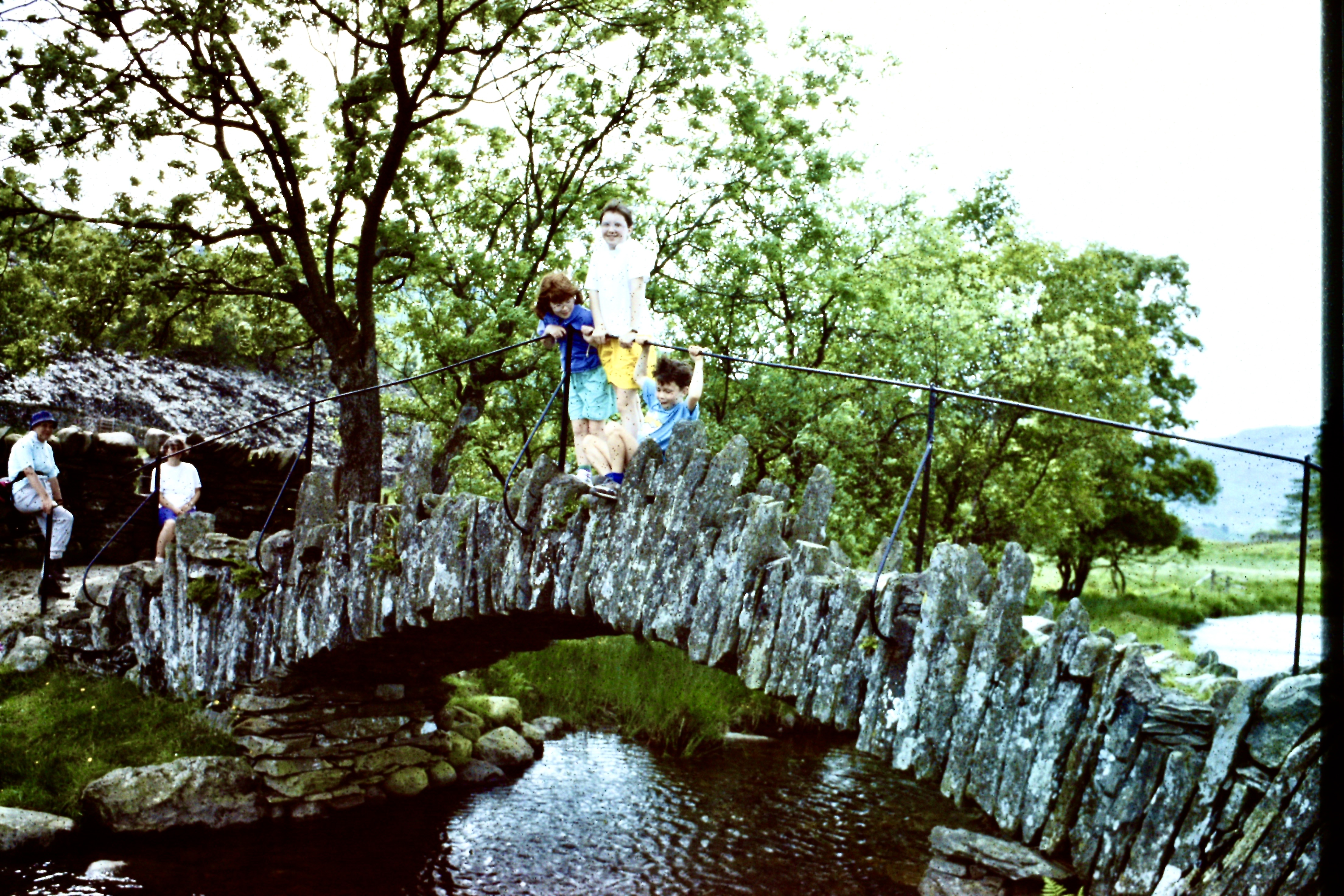
Slater's Bridge

Poo Sticks?

Aileen on Slater's Bridge


The gate to Rydal Terrace

Grasmere from Rydal Terrace

Langdale from Loughrigg Fell

Inside the Cathedral

Langdale Pikes from the Quarry

Aileen's photo of Gregor and me on the Colwith to Skelwith Trail

Sunday, 6 July 2025

Langdale Estate, Loughrigg Fell and the Amritt Museum

Langdale from Loughrigg Fell

I was making the best of my annual Lakes holiday despite being unable to attempt any longer hillwalks. I had planned to climb 20 Wainwrights earlier in the year, but things change. I walked on the first two days, but aggravated my groin strain, and my legs and hips were aching, something I had never known in the past. 

On day 3, I spent 4 hours on a tour of the Langdale site with Andy, the head of grounds maintenance, as he narrated a detailed and personal history of the Langdale Estate from its days as a gunpowder factory selling its products to the United States to the present day. The 35-acre estate was then bought by a local businessman, Richard Hall, who built the Pillar Hotel and converted former industrial buildings into cottages. He allowed two huts to be rented to rival climbing clubs from Lancashire and Yorkshire, and they competed to find new routes on Gimmer and other local Crags. He also made available an old barn to Kurt Schwitters, the German Dadaist, who was responsible for the Merz movement that was a precursor of Pop Art. In 1947, Schwitters began to create what became the Merz Barn, the slate wall of which has now become an exhibit at Newcastle University. Andy's talk was authentic and revealing and should be captured on YouTube. He told me he was cooperating on the production of a book, but it would never inspire the imagination in the way of Andy's oral presentation as we walked around the estate, firing questions that gave Andy the scope to produce real-life answers.
The next day, I agreed to meet with Mark for a gentle walk around Grasmere, no hills allowed. I met him on the Loughrigg Terrace overlooking Grasmere on the flank of Loughrigg Fell; we had walked in from opposite directions. I have been up Loughrigg on dozens of occasions. Wainwright devoted 16 pages to it in Book Three of his Pictorial Guide. Loughrigg Fell he wrote has "a bulk out of all proportion to its modest altitude: but no ascent is more repaying for the small labour involved in visiting its many cairns, for Loughrigg has delightful grassy paths, a series of pleasant surprises along the traverse of its summits, several charming vistas and magnificent views, fine contrasts of velvety turf, rich bracken and grey rock, a string of little tarns strung out like pearls in a necklace and a wealth of stately trees on the flanks." Wainwright could certainly string out a sentence.

Start of Loughrigg Terrace

Grasmere from Loughrigg Terrace

Needless to say, we climbed Loughrigg Fell up the steep, well-made path from the terrace. There were two others at the summit, a full-on fell walker who ranted on about how he had walked all the Lakeland hills in dire conditions. Mark was quiet, but I could tell he wanted to escape. I decided to put an end to the lecture by telling the walker that Mark had completed 23 Wainwright rounds. He stopped talking, aghast that he was a mere novice. We were able to have a friendly chat with the Indian lady who was standing nearby and wanted a picture taken at the summit. Mark then suggested returning to Ambleside by all the cairns that Wainwright had eulogised about. It took about two hours as we zig-zagged along the velvety turf, wallowing in the vistas and magnificent views.


Windermere from Loughrigg Fell

Velvety Turf

I had a notion to visit the Amritt museum in Ambleside to study the life of Kurt Schwitters, so we headed back in that direction. My groin and legs were giving me some distress by the time we reached Rothay Park. I was thirsty and hungry, so I dropped into the Apple Pie Cafe for lunch, washed down by a carafe of water. The Amritt was quiet with only a handful of visitors, despite two excellent exhibitions of Beatrix Potter and Wainwright. There were only a couple of Schwitter's paintings in the museum, but the other exhibitions held me for a couple of hours. A video of Wainwright was playing, and I found myself laughing aloud along with a lady who had entered the room. She was on a mission to complete the Wainwrights that her late husband had started but were unfinished.  She had her doubts about whether she had the endurance to do this, as she was born in the same year as me. She was in the Lakes to visit his ashes at Black Sail, and I sensed that she was looking for some company. I might have offered to help, but I doubted whether I would be able to walk in the next couple of days. Mark, not for the first time, had taken me to the limit.

Merz Barn Wall

Schwitter Painting of Bridge House, Ambleside

Schwitter Painting of Lakeland Farm

Schwitter Painting