|
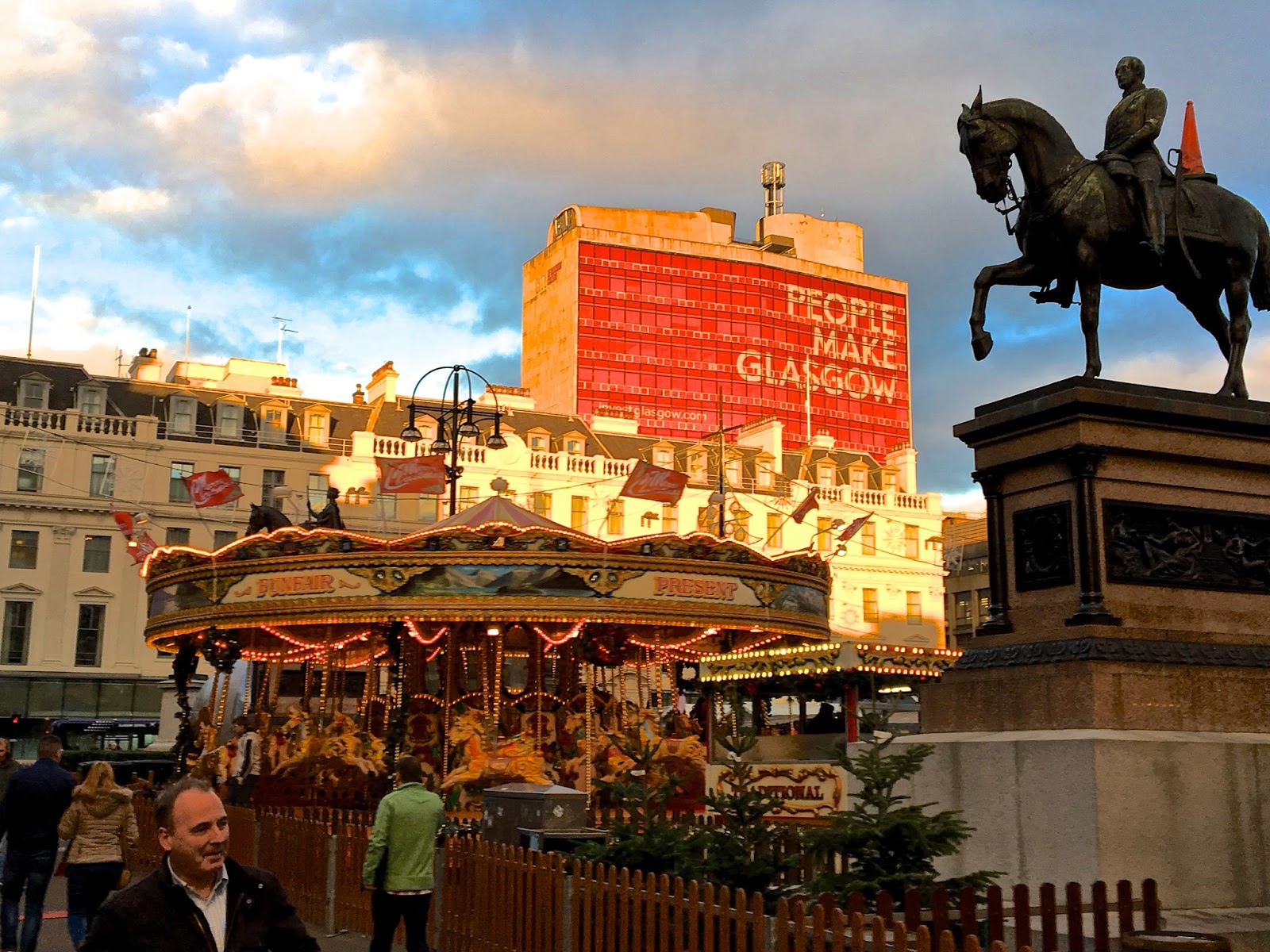
George Square, below the former College of Building and Printing
|
 |
India Street and the former Strathclyde Regional Council HQ, RIP
|
I first footed Glasgow for 2017 yesterday. It was a depressing experience with empty shops reaching parts of the city that previous recessions couldn't reach. Much of Sauchiehall Street is struggling as a prime retail street with another huge gap where BHS was located; the cancer of vacant units is spreading eastwards. The St Enoch Shopping Centre has lost its vitality with empty units, low-rental businesses and little foot traffic despite the sales continuing. Even Buchanan Street was bereft of people at lunchtime. More people were sitting on the pavement with dogs and blankets than there was footfall on many shopping streets. An older man was giving licks to his drum kit in Sauchiehall Street in the rain. He had an amplified backing tape that included a vocalist switched to full volume. He had created a no-walk zone for passing shoppers. If it were not Glasgow, it would have been incongruous.
I made a tour of old haunts: Argyll Street pedestrian area was empty, and Union Street is cluttered with charity shops and pound shops. The older specialist shops have mainly disappeared. The School of Art is still being rebuilt after the fire. The Glasgow Film Theatre seemed to be the only functioning business in what is now the fag end of Sauchiehall Street. Glasgow has closed its public toilets, so John Lewis proved useful. It was busy, maybe the toilets are the new marketing advantage in this former city of retailing.
My old offices in India Street, where I had spent 13 years, were demolished last year, and the gaping space is showing no signs of imminent development. The Scotrail train service was an almost defunct reminder of the blue trains. The old rolling stock was neither clean nor comfortable, and progressed at a crawl compared to city trains elsewhere in the UK. The alternative of driving into the city centre is no longer a realistic option. Glasgow's car parking charges are priced to deter both commuters and shoppers; the on-street parking contractor must pay a bonus for tickets issued, and even a few minutes' delay is guaranteed a fine. Most of the public conveniences have closed, and the back lanes are dotted with men staring at walls.
The sign on the now defunct College of Printing and Building is a large hoarding proclaiming that "People make Glasgow". January may be dank and dull, and not the best time to observe a city centre, but people will have a massive task to make Glasgow flourish again. The progress in the late 1970's and 1980's was groundbreaking and happened at a pace. There was another period around the millennium when things picked up before the Scottish Parliament began to control local matters through budgets and inspection. The decline since the 2008 banking crisis shows no signs of abating. Even the affluent suburbs of Bearsden, Bishopbriggs, and Giffnock are beginning to look tired, and prices are tumbling as the city continues to lose out to Edinburgh. Only the West End seems to be thriving with the university, museums and young entrepreneurs with independent businesses providing an oasis of growth.
The massive new Queen Elizabeth Hospital, which opened in 2015, costing £842m, with all the ongoing costs that result from PPP procurement, is one of the largest hospital complexes in Europe, but is in meltdown. The latest problems of waiting times and poor elderly care, the Red Cross recruited to take patients home, have now resulted in a squad of NHS staff from England being appointed to help resolve the 'super-sized but not very efficient or effective' dilemma.
Glasgow's obsession with size and the city centre has become an endemic problem in recent years. Big projects may make headlines, but they are often a false economy; they divert attention away from the real needs of communities. The ribbons of new housing developments along the river are trapped between the river and the expressway and have replicated the mistakes of the peripheral schemes, with few shops or facilities. Community involvement seems to have been given short shrift as the City Council and the Scottish Government have pursued iconic, expensive and symbolic buildings.
Developers are always willing to take the profit on these types of development without taking responsibility for the wider environment or facilities. It is a glaekit policy. The urban fabric is worn out and needs urgent attention, the city centre is too spread out for the era of online shopping, and it lacks the charm or facilities to encourage repeat visits. I say this with some despair, having lived and worked in Glasgow for twenty years and believing in the 1980's that the city had turned the corner. Yes, people make Glasgow, but there is a need for some leadership to create more integrated and hospitable buildings and neighbourhoods than have been apparent in the last decade. Glasgow has not only been neglected by the shift of public and private investment to Edinburgh but by its City Fathers, who are equally obsessed by Big Projects. Thinking big means going local.
 |
| Charing Cross Station - nae charm and freezing cold |