Thursday, 20 October 2016

Shalloch on Minnoch and Merrick

Start of the walk to Kirriereoch Hill and Merrick (in the cloud)
Wednesday, 19 October 2016
Ascent:       1189 metres
Distance:    22 kilometres
Time;          6 hours 25 minutes

c   Shalloch on Minnoch     775m    1hr  56mins
d   Tarfessock                     697m    2hrs 27mins
d   Kirriereoch Hill             786m     3hrs 25mins
c   Merrick                         843m     4hrs   5mins

c = corbett, d= donald


The Met Office forecast for individual hills has proved itself time and again this year. I had hoped to go to Glencoe but there was a hill mist forecast. I searched around and discovered the best forecast to be in Galloway so decided to climb Shalloch on Minnoch, a shy hill north of Glentrool. If I was feeling up to it I could walk to Merrick along the range of hills known as the 'Awful Hand' comprised of four hills (the knuckles) and four fingers (the west ridges). I had climbed Merrick three or four times in the past when preparing for or competing in mountain marathons, usually in atrocious weather. It would be good to climb it in more clement and relaxed conditions.

Leaving home at 8:30am I made good time through Glasgow and Ayrshire to Galloway and parked at Kirriereoch by 11am. The bigger hills were still capped in the cloud but the blue skies of Ayrshire were spreading south. The walk from Kirriereoch was along the good forestry tracks penetrating into the depths of the conifer plantations that have a forbidding stranglehold on the beautiful Galloway landscapes. I headed up the Pillow burn until I reached a clearing in the forest with a faint path that gave me access to the open hillside of Tarfessock. A 250-metre climb brought me to the ridgeline and I made a rising traverse through the long grass towards the Nick of Carclach. From here, it is a sharp 120-metre climb to the summit of Shalloch on Minnoch. The summit is a barely visible pile of stones 300 metres east of the far more visible and well-positioned trig point and shelter. I headed here for some lunch and to enjoy the views out to sea. Ailsa Craig was the focus behind an assembly of wind turbines that are so ubiquitous in this part of the world.

Just before I left, I was joined by an elderly couple from Kilmarnock who had recently taken up hillwalking and were clearly impressed by the wild beauty and the solitude; so much so that they displayed all the innocence and exuberance of youth. I returned to the Nick of Carclach and made the easy ascent to Tarfessock. The views across to Corserine and the Rhinns of Kells recalled a glorious morning I had spent on these hills early this summer. To the north, Loch Doon and the smaller Lochs glistened in the afternoon sunshine. The walk across from Tarfessock to Kirriereoch Hill is a fine undulating and twisting ridge interspersed with several tiny lochans of clear water. The climb up to Kirriereoch Hill is less enticing - a steep climb up scree and mosses on the north face of the hill. The summit is a grand rounded dome with a wall crossing it and several possible high points. I found a boulder to rest myself and finish my food whilst looking across to Merrick and the ridge that leads to it and goes under the splendid name of Little Spear. The descent and climb were quicker than anticipated and as I arrived at the summit of Merrick the sun was eclipsed in dark clouds with shafts of sunlight creating some wonderful views.

I started the descent enjoying the gentle slopes heading west to Ailsa Craig but lower down the ground conditions became tougher with no discernible path. I skirted to the north of the main ridge that leads up to Kirriemore Hill, a mere 40 metres of climbing to reach its summit. It was a grave mistake, the ground was waterlogged and feathered in long grasses. I headed for the fence at the edge of the conifer plantation ahead hoping that I could find a way to the forestry track. Alas, the trees had been felled and the ground was an impossible barrier of old tree roots, dead branches, and tussocks of grass perched on a bog with remnants of old wire fencing. I headed down to the burn hoping to find easier ground but even alongside the burn it took over 30 minutes to cover a kilometre along the boggy banks of the Kirshinnock burn. It was hemmed in by a fence and the route involved fighting through more bogs, trees, boulders and mantraps. The relief when I reached the forestry track was palpable, the remaining 3 kilometres of walkout were pure luxury.

I had forgotten how unforgiving the ground conditions are in this part of the world. The slopes to the west of the Awful Hand have been ravaged by man with distressed plantations, abandoned grazings and fences and consequent bogs. The hills themselves are fine once you reach them although access to and from them is an exercise in purgatory. I was back at Kirriereoch just before 6pm and, after a quick change, managed to drive over the unclassified single-track road to Crosshill before nightfall. The journey home took two and a half hours, no longer than to the corbetts that I had left to climb near Fort William. Despite the punishing descent, the outing in the Galloway hills had been an enjoyable walk on remote and neglected hills compared to many parts of the Scottish Highlands.

Kirriereoch Hill and Merrick from Kirriereoch Loch
Descending Shalloch towards Tarfessock and Kirriereoch
Loch Macaterick and Loch Doon
Lochan between Tarfessock and Kirriereoch Hill

Little Spear and Merrick from Kirriereoch
Loch Enoch below Merrick
Summit of Merrick looking east
Little Spear and Merrick
Kirreoch Hill from the descent of Merrick
Looking up the Kirshinnock burn to Merrick


Tuesday, 4 October 2016

Autumn Days

Autumn in Stereo

It is that time of the year again when morning mists and falling leaves make running so perfect. No humid heat to fuel perspiration nor the clammy cold of winter. Still in shorts but with gloves and a hat to fend off the morning chill. Yesterday I ran around the forest and was regaled by mirror images of the trees in the flat calm of the loch. Images that looked better than the real thing. Today I went out again with the camera to see if I could capture the subdued beauty of autumn. I had Aillen with me as a pacemaker on a bike, checking to see if my eulogies of yesterday were true.

The mists were still hovering over the loch, the leaves were turning, a red squirrel scooted across my path, and the river was back to normal flow after the rains of last week. I was running easily, seizing the chance to escape the bike on all the uphill sections and for the most part, keeping up on the flats. The end of summer always conjures a melancholy about the way that time and years ebb away. It reminds me of Who Knows Where the Time Goes by Sandy Denny, a favourite track that becomes more poignant with each passing year after retirement when you are able to observe the passing of time uncorked from the imagined urgency of the world of work.

I ran for over an hour and covered about 8 miles, my appetite for breakfast had been triggered and the feeling of achievement was real. A good foundation for all the other tasks that I had set myself from chopping wood, and cutting lawns to clearing mail.

Mountain ash

Bracken on the cusp of autumn

The mirror image is better

Reflections of a lochan

Keep up pacemaker

Placid autumn on Lochan Spling

Monday, 3 October 2016

Sgor na-h Ulaidh


Summit of Sgor na h-Ulaidh
Saturday 1 October 2016

Ascent:        1075 metres   
Distance:     13 kilometres
Time:            5 hours 11 minutes

Sgor na h-Ulaidh           994m      2hrs  37mins
Stob an Fhuarain           968m      3hrs  44mins

Events had conspired against hill walking in recent weeks: gale-force winds had scuppered a few days when I had arranged to go with a friend to climb the Cuillins and a couple of weeks had been spent visiting parts of England that were unfamiliar during a journey down to London. On returning home there was a week of rain and the prospect of a sunny weekend was lost because I was working on Friday and had no time to travel north to Inverness. I decided to finish my last Munro south of the Great Glen - Sgur na h-Ulaidh at the gates of Glencoe. If time permitted I would take in Stob Dubh in Glen Etive, my last Corbett in the south apart from three in the Borders.

It was a misty morning and I faffed about getting ready instead of packing the night before. Charging a phone, camera and altimeter is a chore I could do without. The visibility was less than 100 metres when I finally left home at 8:30am and it was slow progress up to Crianlarich, made slower by a couple of motorcyclists who, contrary to type on the A82, were riding well within themselves but accelerating on all the possible overtaking sections. The sun had appeared by Tyndrum and I was listening to Chicken Shack with Christine Perfect on vocals as I motored over the ever-inspiring Rannoch Moor before beginning the descent to Glencoe. Personally, I'd rather not go blind here. Iain Banks, the recently deceased writer, had released a CD of his favourite tracks and he recommended the Waterboys 'Don't Bang the Drum' as the perfect track for driving over Rannoch Moor. The lyrics fit the occasion perfectly as Buchaille Etive Mor hoves into view.

"Well here we are in a special place
What are you gonna do here?"

I was undecided whether to stop to garner yet another photo of this special place or to charge on. Buchaille Etive Mor was shrouded in a circle of cloud at the lower levels but a helicopter was circling the summit against the clear azure skies. My decision was overtaken by the appearance in the rear mirror of a posse of Aston Martin DB9 coupes. There were a dozen of them travelling at the speed of sound, or so it seemed as they flew past, engines screaming at what must have been 100mph. I was experiencing what it must be like at Le Mans. Should I be angry at the sheer waste of fuel, the conspicuous consumption of these ageing playboys, their vainglorious contempt for other road users; or should I enjoy the cavalcade of raw power and beautiful machinery? My instincts told me to just enjoy the spectacle.

Ten miles later they were still visible ahead as they were caught between the heavy commercial traffic and gangs of motorcyclists coming the other way. I parked at the foot of Glencoe and started to walk about half an hour later than I had intended. Sgor na h-Ulaidh is hidden from the road and the walk-in involves a mile to some houses that have to be avoided by a circuitous path that was oozing mud after the recent rains. A track continues to a locked gate and beyond a narrow path follows the Allt na Muidhe up the glen passing Meall Mor and then the Corbett, Meall Lighiche (hill of the Doctor). Beyond here it is possible to climb up 500 metres of grassy slopes to the ridge leading to Stob an Fhuarain and then on to Sgor na h-Ulaidh. I could see three walkers plodding up but decided to continue to the head of the glen where there is a bealach at 530 metres between Meall Lighiche and Sgur na h-Ulaidh. I had descended down the steep path from the summit to here on a previous visit and thought it might provide a better way up.

Perhaps it is, but not the way I did it. I followed the old fence posts until reaching the crags above and lost the path so I decided to take a rake to the left. I thought it would be quicker than the longer route to the right but I found myself negotiating slabs of wet rock amply greased with mosses and teaming with water. I had to attempt several routes before finally managing to reach the top of the crags. My hands were freezing from pulling up wet slippy steep rocks and I was exhausted by the dangerous exposure on the rock face as much as the climb. I continued at a gentler pace to the summit where I was surprised to arrive before others who had climbed to the ridge leading to Stob an Fhuarain.and then the summit

It was almost 1pm so I settled down to some lunch before others arrived. A couple from Aviemore was next up and we chatted for half an hour or so having discovered common acquaintances, my niece Alison, and experiences on different hills. A mountain leader emerged on his day off and he joined the happy band. When I related that I had bought a new Goretex jacket in January and never had to use it despite spending 26 days on the Scottish hills, he retorted that as a way of keeping the rain at bay this seemed like a pretty good investment.

The day had never become totally clear and now the clouds began to hide the sun and the skies turned grey. I descended over the outlying top meeting two more groups of three walkers on my descent. Bidean nam Bian was drifting in and out of cloud so I decided to drop down to the glen. It was easy going down the grassy slopes and I reached the glen just behind the mountain leader who had descended by my ascent route but had kept to the path and not deviated onto the crags. We walked out the last three kilometres together. He had been a civil engineer but retired early so he could pursue his hobby of mountaineering as a job. He seemed very content, spending time in the Lakes, Snowdonia and the Alps as well. He enjoyed guiding in Scotland the most but found the midges and weather too much in July and August. It was almost 4pm when we reached the cars after a mainly easy day on the hill. I was an hour too late to attempt Beinn Dubh so I was happy to arrive home early for once.

Aston Martin DB9

Aonach Eagach 

Descending to the Gleann leac an Muidhe

Loch Etive between Beinn Starav and Beinn Trilleachan

Bidean nam Bian

Looking west over Loch Linnhe to Mull

Beinn Beithir

Looking up Gleann leac na Muidhe to Sgor na h-Ulaidh


Wednesday, 28 September 2016

Coventry

Coventry Cathedral - old and new
Coventry was the epitome of modern Britain in the 1960s. The centre of the booming car industry with Triumph, Rover, Daimler, Hillman, Humber, Jaguar, Land Rover and Riley are just some of the local industries. It had been devastated by wartime bombing but had been redeveloped with panache. The new cathedral was celebrated across the UK as a distinctive symbol of regeneration and reconciliation. Francis Amos, the Director of Planning, guided the modernisation of the city and was regarded as the inspiration behind much of the redevelopment before moving to Liverpool.

Coventry had the best rugby team in England, a grammar school that would be classed as outstanding by Ofsted had it been operating then. In the late 1960's Lanchester College in Coventry was one of the top venues for bands, even the supergroup Cream played their first gig at Lanchester and most of the top artists played there during the era of progressive rock.

The collapse of the car industry in the late 1970s was the beginning of Coventry's long decline as one of Britain's coolest cities. Coventry was poleaxed by the economic policies of the Thatcher years and this was most famously captured in the sublime song Ghost Town by the two-tone group, the Specials. The lyrics by Gerry Dammers, educated at Lanchester College, summed up the devastation of industrial decline that afflicted much of urban Britain leading to copycat riots in the summer of 1981. The haunting trombone and reggae beat made it a number 1 hit and it was voted record of the year by all the musical journals.

This town (town) is coming like a ghost town
All the clubs have been closed down
This place (town) is coming like a ghost town
Bands won't play no more
Too much fighting on the dance floor

Do you remember the good old days before the ghost town?
We danced and sang, and the music played in a de boomtown

This town (town) is coming like a ghost town
Why must the youth fight against themselves?
Government leaving the youth on the shelf
This place (town) is coming like a ghost town
No job to be found in this country
Can't go on no more
The people getting angry


I hadn't visited Coventry until I met my wife who had been brought up there by her Scottish parents. I passed through it in the 1990's on regular trips to Warwick University but we have seldom been back since. On the drive back from London at the weekend we decided to pay our respects. We visited her old family home close to the War Memorial park and then drove to the centre where it was easy to find parking in the shopping centre, which was bustling with weekend shoppers.

Like so much else the centre had been redeveloped but the Lady Godiva statue remains in the centre of the square, a symbol of childhood shopping trips. We visited the Holy Trinity Parish church and the cathedral. The first time she was taken to the cathedral by her mother, she recalled looking through the great glass screen etched with angels; it brought tears for fondly remembered times. On our tour around the cathedral, we ran into the Canon and were greeted with kindness and enjoyed a lively conversation about the part that the cathedral had played in reconciliation, not only with Germany but with troubled communities around the world. She encouraged us to use the charitable cafe for a fine healthy lunch before continuing our journey north.

We had been pleased that there seemed to be a new energy around the University of Coventry, the latest incarnation of Lanchester College. It enjoys a growing reputation and Coventry seems to be on the mend; recent figures show that the West Midlands is beginning to enjoy a revival as jobs prospects have improved and Londoners search for affordable housing. We returned to the M6 and survived a journey home with no hold-ups until reaching the never-ending congestion on the M74 leading into Glasgow.

Lady Godiva in Broadgate

War memorial park

Born in 1948, a good year all round
Coventry Cathedral Tapestry
Angels on the great glass screen

Ruins of the old cathedral

Monday, 26 September 2016

Pop Brixton


Brixton - a strapline that works
Entrance to Pop Brixton, a business park in recycled containers
Pop Brixton - big screen outdoor events venue
Diverse, dynamic, digital businesses
With added beers
Celebrating Universal heroes
Challenging Network Rail over gentrification of the arches
Graffiti that wakes you up

My hero is in the buggy
We normally arrive in Brixton by tube and emerge to the sound of Caribbean drumming, the streets are chock full with people of all ages and ethnicities as they bustle their way to homes, shops and the huge range of venues, cafes, bars and businesses that abound in this vibrant epicentre of London's diversity. This time we had driven down by car to deliver a bike and other paraphernalia to our offspring. The next day we travelled by tube and came face to face with the massive statement over the underground concourse - "Not Them, Only Us". For once it was a tagline that seemed to bear some relevance to the reality of the place. Brixton is such a curious mixture of communities, buildings, cultures and money that conspires a creative street sure purpose amongst its residents.

It includes Papas Park, a children's playground on a bit of waste ground that is run by community volunteers (time philanthropists) and is usually alive with children, parents and grandparents seeking fun and friendship in the heart of Brixton. The Council have recently indicated that they will no longer be able to fund the park so a campaign to find alternative funding is starting up. The whole area is buzzing with new developments as it has become one of the sought after locations in London in recent years. Its position at the terminus of the Victoria underground line means there is a tube every 2 minutes to central London, which is reached in 15 minutes. There are big event venues like the O2, a stupendous array of eateries, good parks, outstanding schools, a thriving local cinema, library and bus services in all directions.

There are downsides too, like the main shopping street being the most polluted in London after Oxford Street, a high proportion of people on the breadline living in crowded or poor accommodation. It has a high profile police presence that creates tension with speeding cars and noisy sirens that are evident 24/7. It is on the flight path to Heathrow airport, and despite a night flight limit of 5800 landings and takeoffs a year is still enough to disturb sleep for hundreds of thousands of people in this corridor of south London. Network Rail has decided to cash in on the arches below the overground lines and dozens of small businesses are being evicted to allow upgrading the arches to generate a higher rental income. Some of the large murals made it clear how much this was despised by the existing community that has been nurtured in the dilapidated old buildings of Brixton. It is gratuitous urban gentrification in the beating heart of Brixton that focuses on the markets and independent shops that cluster around the underground station and Electric Avenue.

Nearby a new business park has been created by the simple expedient of stacking containers on two levels to create an intimate environment for new businesses to thrive. Being Brixton there are cafes offering cuisines from all parts of the world as well as local craft beers and a smattering of new technology businesses. A large space has been created between some containers for local concerts and an outdoor sports pitch doubles as a venue for big screen events. It had been the perfect place to watch European football and the Olympics in the summer. The whole place had a collective vibe that is multicultural, relaxed and edgy; just like Brixton village.

The streets are full of indigenous graffiti. Alongside Bob Marley painted on the shutters of a lock up street stall are dramatic cartoons of gaming characters. We ate at the Ritzy cinema, listened to the street musicians and observed the building of a new Council HQ being built along with lots of social housing next to the existing town hall. Lambeth will be closing all its other offices once the new building opens. I spent quite a bit of time wheeling our grandson round the streets and posed him as my hero in front of David Bowie, who had been just another celebrated Brixton resident.


Tuesday, 20 September 2016

Norfolk

Wells, there will always be an England

It has been a long time since I last visited Norfolk on a university field trip to Cromer in 1968 when the highlight was an afternoon spent sheltering in a haystack with my friend, Sue, during a thunderstorm. As a six-year-old during a holiday with my cousins in King's Lynn, my lasting memory was a day on the beach at Wells-next-the-sea. My Uncle Jack, a test pilot for the Canberra bomber, had raced away in his car with Auntie June and my four cousins. My Dad had mainly driven jeeps during the war and could not keep up in our hire car. Uncle Jack picked up yet another speeding ticket on his journey home, he could have papered the living room with them.

This trip was to visit a cousin of Aileen whom I never met but who had helped her with a family history project. We had made rapid progress down from Yorkshire through the flat farmlands of Lincolnshire to the Wash, the Brexit heartlands, and on to King's Lynn. The September heatwave in the south gave us a warm welcome and the entire population of eastern England seemed to be on the road to Hunstanton and the north Norfolk coast. It was nose-to-tail traffic and our hope of a late pub lunch faded as the clocks made faster progress than the vehicles. Hunstanton had lost its fabled charm and was another seaside resort with all the usual embellishments of fast food outlets, pleasure rides, continuous kerbside parking along the promenade and tawdry-looking guest houses. Despite the splendid sea cliffs, there was no temptation to stop in the town; the streets were crowded, a haar was hanging over the coast and the sea looked the colour of elephant's breath.

We continued along the coast road through attractive villages such as Titchwell and Brancaster. Well-maintained houses were built of flint and brick; a large percentage looked like retirement homes. The pubs had stopped serving food but the consequence was a chance encounter with the boat park at Brancaster Staithe, where we happened upon the Crab Hut, a local food outlet that sold fresh crab baguettes and a mug of tea for £4. What a bargain and then a chance to mosey around the sailing boats and observe the muddy banks draining towards Mow Creek. The haar was restricting visibility, creating a cool belt of weather next to the sea and giving the day an eerie feel.  The lady in the crab hut told me that the haar would stretch to Wells-next-the-sea, which was my intended destination for a stroll through the pine trees onto the beach.

I was tempted to stop at Holkham Hall until I figured out that it was a cash cow for the owners who seemed to have obtained first dibs at UK and European conservation grants, and topped up this income stream with car parking fees for access to the beaches as well as pricey entrance charges. They then claimed the credit for preserving and providing activities through renting buildings and land for various commercial ventures to entice yet more visitors. We continued to Wells and parked by the sea but even here the land was owned by Holkham Hall with parking charges so high that they would be an embarrassment to most city councils. We had little choice but to fill their coffers in order to walk through the pine trees to the wonderful Wells beach.

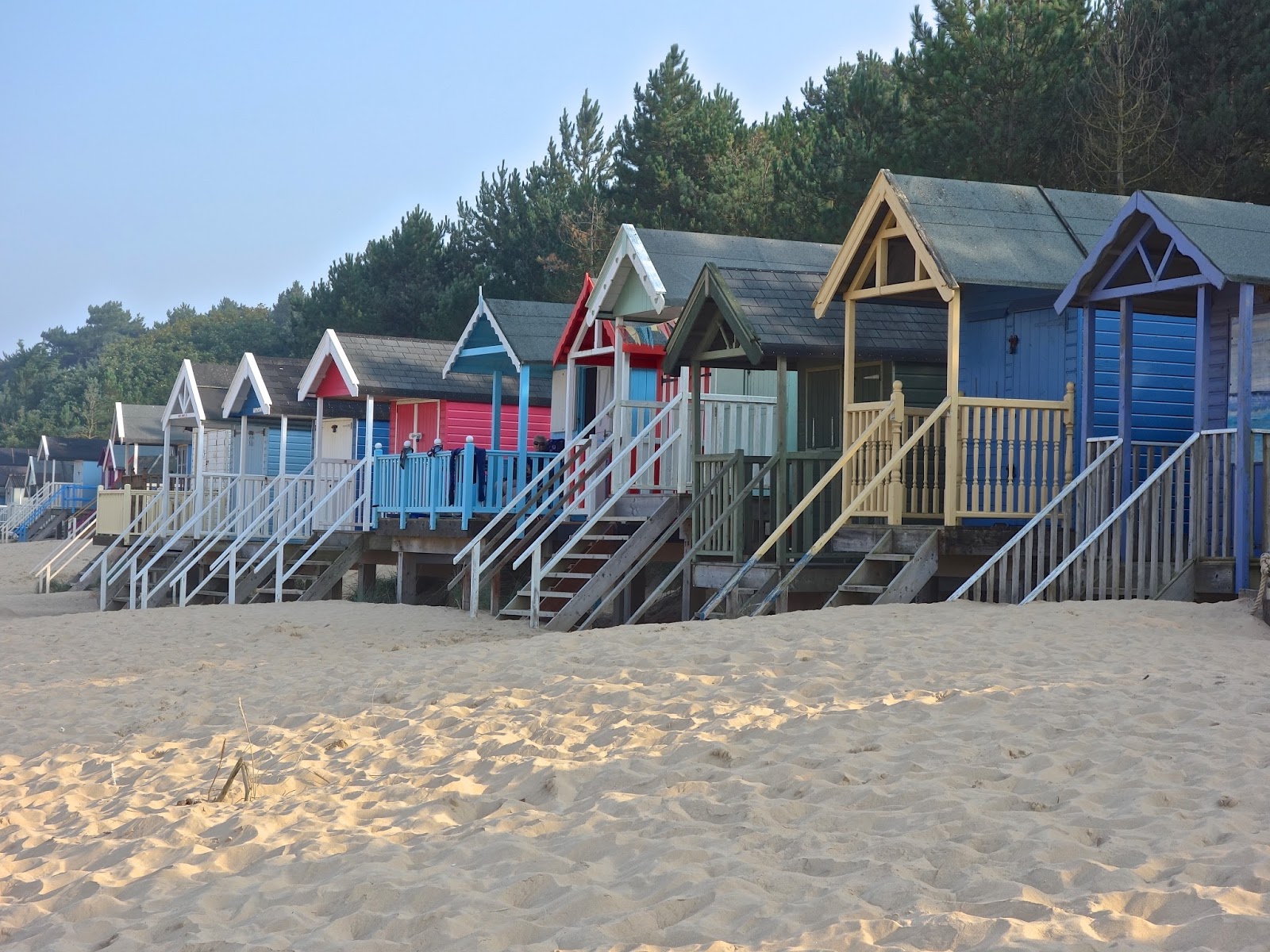
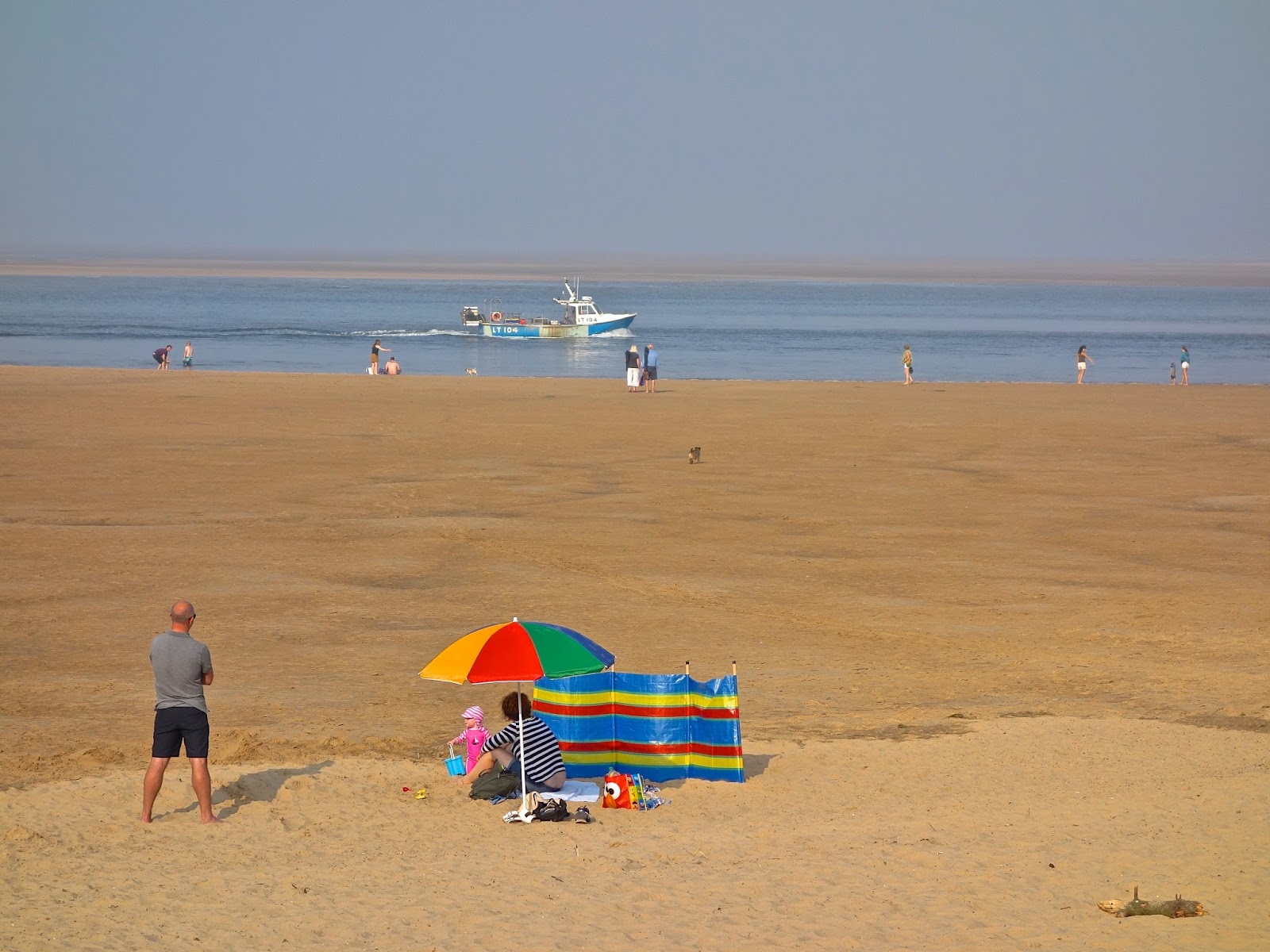
The sun had broken through the haar and the beach was buzzing in the way that English beaches buzzed. Dogs chasing balls, lines of beach huts, brightly coloured windbreaks, folding chairs, straw hats, children paddling, pensioners swimming with the current of the incoming tide, inflatable devices, artists, kites, frisbees, sand castles, flags, lifeguards but not an ice cream vendor or donkey in sight. Holkham Hall probably has the franchise on those activities and restricts them to its commercial honeypots. Nevertheless, it was a treat and we had a long walk along the beach that fronts the channel that leads to Wells. Later as the tide rushed in a few pleasure boats returned with their passengers, whilst sunbathers were retreating to their beach huts as we exited the beach.

Our last leg for the day took us south and into the searing evening heat, 26°C, as we drove through Fakenham and Swaffham to a B&B in the village of Great Cressingham. It was a tranquil village with a pub on the outskirts, a school, a community centre and little else. We indulged ourselves in the pub and cursed the dubious online reviews of the B&B that had few endearing features. Its low beams almost decapitated me on return from the pub and the owner had all the characteristics of a small businessman with a cravat and associated prejudices.

The next day was spent on the catch-up with Aileen's cousin Colin and his wife Viv. He was a retired policeman who had good values believing strongly in community policing and protecting wildlife against the poachers and gamekeepers. It was fascinating to watch and hear two cousins rediscover their common past and share their stories of the intervening years. We went for a pub lunch as the thunderstorms marked the end of the heatwave in Norfolk. Everyone seemed keen to tell us that it was the hottest September on record, given global warming this could be a warning for East Anglia as it slowly sinks into the North Sea.

We drove off to Suffolk in the afternoon to stay at the village of Lavenham. It had been on the radio a couple of times in recent weeks reminding me of a night out there as a student when staying with a flatmate who hailed from Sudbury. This was before Harry Potter arrived here. The houses in Lavenham are so quaint that they are obviously exempt from building control and many had been snapped up by wealthy outsiders.  The primary school could only provide for some of the villager's children owing to the iniquities of placing requests from incomers. The hotel only took the Telegraph and Daily Mail and the local worthies at the bar cursed the Council for trying to build social rented housing. We were indeed in the heartland of Mrs May's England.

Brancaster Staithe in the Haar
Brancaster Staithe Crab Hut
Wells-next-the -sea, an artist captures the beach huts
Tory government reveals new affordable housing initiative
Wells-next-the sea

Lavenham, unaffordable housing


Monday, 19 September 2016

Harrogate

Bettys establishment

Carved memorial to the stage finish of the Tour de France in Montpellier Park 
'Keith's Choice' Dahlia in Valley Gardens
Royal Pump museum
Shrinking in blue

This solid, sophisticated Yorkshire town was founded on the abundance of sulphur springs. My Yorkshire relatives who lived in the Huddersfield-Wakefield rhubarb triangle used to talk about Harrogate all the time; it was their day out of choice. Flower shows, parks, shopping and afternoon tea at Betty's. I had passed through a couple of times on the A59 on trips to Scarborough, but never stopped to explore its charms. We were en route to Norfolk and then London and decided to rectify the omission, arriving via the Yorkshire Dales and Blubberhouses Moor on a blissful early autumn evening as the skies turned from blue to pink to grey as the sun gave way to the moon.

Half an hour later, we were seated in Betty's Tea House, an institution opened in 1911 by a Swiss confectioner.  It occupies a substantial corner building at the foot of Parliament Street and has the ambience of a Viennese coffee house set in the 1930s. The food was good, and the clientele made us feel quite young; Harrogate is the preferred choice for retirement in Yorkshire and sells itself as the happiest town in Britain. It reminded me of a ditty that a friend recited at a Burns supper when he had been asked to toast the haggis. He was from Yorkshire and explained that "we don't talk to wer food where I come from and I can't pronounce Haggis cos it's got an aitch (H) in it. He then gave us a rendition of what the teacher had taught his class at school in a forlorn attempt to correct their pronunciation.

'Arry went to 'Arrogate,
'Arry lost his 'at
'Arry's mother said to 'Arry,
'Arry where's your 'at
'anging in the 'all mother,.
'anging on a 'ook'
'Arry's mother said to Arry,
Arry go and look.


He made a word-perfect presentation of the toast to a haggis, but it was "'Arry went to 'Arrogate" that brought the house down. He told us that a Yorkshireman who pronounces Harrogate correctly probably lives there, 'cos no one else in Yorkshire can.

Harrogate has long been a conference centre, most famously for the Lib Dems, being big enough to cater for Cyril Smith, but the large conference centre and still thriving grand hotels host a myriad of events; today it was 'Christians against Poverty' and balloons festooned the entrance stairway. We decided to tour the town centre and trooped around the Victorian buildings that remain impressive and well-preserved. The sumptuous gardens that encircle the centre were at the stage when the summer displays were wilting, but the level of planting and imagination was still evident. The Montpellier quarter, which is dripping with antique shops, cafes and high-end independent shops, had yet to come to life. The museums were still closed, so we walked through Valley Park, window-gazed at the furniture shops and galleries, before finding some good coffee in an Italian cafe. The pleasure of finding a non-franchised coffee chain always cheers me up.

The drive out from Harrogate was through parkland and roads lined with splendid Edwardian houses until we reached the outer suburbs that resembled any other town in England: brick boxes and a slew of modern warehouses. In no time, we were on the A1(M) and passing the massive power station at Ferrybridge. There are probably more pylons in this part of Yorkshire than words in the bible.

Despite the existing devastation to the environment around Ferrybridge. It is/was the largest power station in the UK, and I would have preferred to see the well-advanced carbon capture scheme implemented by SSE. The designs and pilot scheme for carbon capture had been completed, but Chancellor Osborne pulled the funding. The UK could have been at the forefront of carbon capture technology, which is essential as a retrofit for both coal and gas power stations; they will be the mainstay of electricity production for decades in many parts of the world before they close down their coal/oil and gas power stations. Carbon capture could be an important intermediate technology. Osborne had no such reluctance to fund the French and Chinese to design, build and operate the massively expensive and controversial nuclear plant at Hinkley Point that Mrs May has now endorsed, together with similar plants at Sizewell and Bradwell. Once again, the UK has jettisoned its technical expertise and reputation through its adherence to austerity that is even less sustainable than coal.

Ferrybridge Power station and pylon landscape