Sunday, 19 August 2018

Fifth and Final Round: Tarmachan

Compleat again

Saturday 18 August 2018

Ascent:      620 metres
Distance:   6 kilometres
Time:         3 hours 55 minutes

Meall nan Tarmachan     1045m     1hr 58mins

At last, the fifth round of Munros is compleat. Fourteen of us gathered for the final hill, Meall nan Tarmachan, overlooking Loch Tay. We began from the car park on the Glen Lyon road, which gives a flying start from a height of 460 metres. The party included Aileen and Gregor from the family; John and Keith whom I began the Munro game with twenty-nine years ago; Neil, a school friend whom I climbed and competed in Mountain Marathons with in younger days; Dave, an university friend and cartographer; Jim and Gavin, both outstanding work colleagues; Arthur, a piper from my village; Chris, the builder of our new house; Dave, a climbing friend and Ross with his eight-year-old son, John. Six others, including three women and two young girls, had to give late apologies when it became apparent that the weather was not what we wished for, nor had we become accustomed to during 2018.

The fifth round has taken ten years, the previous four were all done in less than five years with three years and ten months being the fastest. This round took 107 hill days, compared to an average of 93 hill days and a fastest of 80 hill days  This time with the benefit of retirement I have been able to select days with good visibility for most of the outings. I sacrificed my annual week's holiday in May/June when we engaged in some serious Munro bashing with John, Keith and/or Mark, usually climbing twenty or more Munros.

I lost 6 months with a back injury in 2010 and could not manage much hill-walking for most of 2011 whilst working in Shetland. I had also decided to climb all the Corbetts (hills that are between 2500 and 3000 feet) along with the Munros and, whilst I am still twenty-odd short of finishing the 224 Corbetts, they have taken up 69 days. They are often more time-consuming hills than the Munros as there is only one opportunity to rattle off 5 or more Corbetts in a day whereas it is possible to do this on at least 15 occasions during a Munro round. I camped out on 28 nights during the round although this allowed quite a few Corbetts to be climbed during these expeditions.

I had intended to finish in 2016 but that year and 2017 provided very few decent days to tackle the Skye ridge, I managed only two days in 2017 to climb 4 peaks with Dave including the most difficult summits, the In Pinn and Am Basteir. The remaining Munros in the far north also became less easy to access with the roads becoming more congested and accommodation and eating places difficult to find owing to the popularity of the North Coast 500. For the first time, I suffered what became a 'Munroists block'. It was not worth the hassle of driving up the A9 to Inverness or A82 to Fort William in slow tourist traffic and then to find that after a day in the hills, all the pubs and hotels were no longer serving food after the tourists had eaten.

2018 arrived with only ten Munros left to climb including eight on Skye, along with Beinn Sgriol and Mam nan Tarmachan, which I had saved as an easy local hill for the finish. The weather has been superb since late April but we were moving house and most of May and June were lost to packing, moving and then recovering with a lazy fortnight in France. I did manage five days on Skye during the balmy days of summer to clear the eight remaining Munros on Skye and Beinn Sgriol so I was ready to finish by mid-July.

It is always problematic deciding on a day to compleat. I could have gone in July but I wanted Gregor, John and Keith to come since during the ascent of just over 1500 Munros since 1989 I had walked over 600 hills with John, over 400 with Gregor and over 200 with Keith. Only Mark of my regular walking partners was unavailable. The result was to schedule a day in August when people had returned from holidays.

It proved to be a typical day in the Scottish hills with a cooling fresh wind and low clouds to prevent any view from the summit. Perhaps this was fitting after the quite exceptional conditions for most of the summer, and the fine days I had chosen for most of the outings during this round with the aid of the excellent Met Office mountain forecasts. There was an ethereal moody atmosphere at the summit with the blustery wind and clammy cold air competing with the haunting chords of Arthur's bagpipe playing.

As always on these occasions there was no rush on the ascent, people strolled up the ever-steepening path with rotating conversations as this eclectic band of friends renewed auld acquaintances or met for the first time. In keeping with tradition, I brought up the rear and as I neared the summit I had fond memories of the past ten years in the Scottish Mountains. I paused awhile with Aileen before the final section heading upwards towards the sound of Arthur's bagpipes echoing from the misty summit. Aileen was with me for the first time in my five compleations and was quite ecstatic and emotional about the moment after the relaxed and enjoyable camaraderie of the ascent. The biting wind meant it was no place for a celebration so we retreated below the ridge to a hollow sheltered from the wind to consume chocolate brownies and empty some bottles of prosecco.

I had a feeling of calm exhilaration. I would no longer need to force myself to make long early morning or late night drives, stagger ever upwards through drenched heather slopes,  tiptoe up or down slabs of wet scree, batter into gales on exposed ridges, thaw out my hands after taking photos or adding clothing on icy summits, erect my tent on rain-lashed hills, wade burns or rivers in spate,  fight the midges and remove the ticks in summer or route march the last 6 miles down a glen to the car at the end of a long day. But the call of the hills is difficult to resist and I am sure that I will soon be doing some or all of these things again but on my terms.

Although I had hoped that some of us could continue along the fine Tarmachan ridge, the conditions did not favour an extension to the walk so we made a leisurely descent as the wind abated. Arthur piped us back to the car park, where passing motorists had stopped to listen. We retreated to the Bridge of Lochay Hotel for compleation drinks before heading homeward. Yes, I will climb many Munros again but for the pleasure of visiting favourites or helping friends. Hills are where lifelong friendships are made. The discipline of a Munro round drives you on but also generates a pressure that I am happy to live without.

Aileen and Dave on the ascent
Aileen, Gregor and Keith
Lawers Dam from Tarmachan
Loch Tay and Killin
Clouds ahead
The last steps
Piper at the Gates of Done
Contemplating what's next.
Family trio
Ross and John

Lament for 107 hill days with Pipes and Wind 

Thursday, 16 August 2018

European Championships: the Hyperbole of Tourism and Events


Well, that was a week of fun despite the sacrifice made by Glaswegans to accommodate and fund the European Championships. Glasgow along with Berlin had hosted the European Championships with swimming, cycling and gymnastics in Glasgow and athletics in Berlin. I was living in Glasgow and had gone along to buy tickets but the cycling in the velodrome that I wanted to see was sold out. I watched the women's and men's road races by switching between Kelvigrove Park and Gibson Street for the descents that were too fast for some of the following cars that were scraping their rear ends on the change of gradients. There were  9 and 16 laps of a 14-kilometre circuit around the city centre for the women's and men's racesrespectively. 

I also managed a morning run alongside the women's time trial on a very wet Wednesday. City traffic was disrupted for three days and we couldn't watch the events on television because the communal TV aerial for the flat was broken and the repair company could not access the road because of the road closures. We had no broadband because a fire at a nightclub next to the telephone exchange has resulted in the Open Reach engineers being unable to access the exchange. It is symbolic of the state of the infrastructure in Glasgow: worn out and in dire need of upgrading like many of the services. Austerity, outsourcing and poor maintenance regimes are unpopular Glasgow vices with its residents. 

The road races passed along Woodlands Road at the end of our road and made a tough circuit around Park Circus. We had limited access to the flat because the roads were closed for two weeks for the road for the cycle race to be resurfaced. We'll have to wait for the next big event for any further repairs and the pavements, well! All the litter bins along the route were emptied several times a day during the event as opposed to rarely and only when overflowing onto the street. The pavements were swept more times in the week than the rest of the year and hundreds of marshalls were employed to secure the route. Road sweepers ran throughout the night before the races to clean the roads but there were still more punctures, according to the commentator, Chris Boardman, than ever seen before in a cycle race 

According to the organisers, the event was a huge success with over 500,000 spectators.  This included the best estimate of 140,000 people  lining the streets watching outdoor events, the rest were the paying spectators at the main venues. The total cost of the games cost the City Council and Scottish Government £90m. Meanwhile, libraries, pitches and sports facilities have been closed, The cost of using sports facilities has risen and many services have been vastly reduced. Sport it seems is for the elite not for all, making mockery of the strapline. Glasgow likes to complain about how it is not treated fairly in terms of resources and certainly it has lost out to Edinburgh since the arrival of the Scottish Parliament.. However, its obsessive desire to showcase major events could be argued as equally regressive for local residents as the way that the UK and Scottish governments treat their taxpayers.

Sunday, 5 August 2018

Monadh Liath Northern Corbetts


Carn na Saobhaidhe, Monadh Liath


Carn na Saobhaidhe

Ascent:        704 metres
Distance:     25 kilometres
Time:           4 hours 42 Mins

Carn na Saobhaidhe         811m      2 hrs 42mins (cycle 58mins, walk 1hr 43mins)
Descent                                           1 hr  59 mins (walk 1hr 31mins, cycle 29mins) 

Friday 3 August 2018

With the fifth round of munros almost in the bag, I thought it about time I went after the twenty odd remaining Corbetts. They are all more than 3 hours drive away and the nearest was a couple of singletons between Inverness and Fort Augustus located to the north of the massive Monadh Liath plateau. In recent years they have both been the location for significant wind farm developments and in the case of Carn Chuilinn, a huge hydro-electric scheme was opened in 1999 and then again in 2009 after a tunnel collapse. The upside is that hill tracks have been constructed that allow a bicycle to be used for the initial part of the long walk-ins. The downside is the ugly scars seared into the hillside with deep peat banks created.

The weather had broken after the summer of sun and there had been some much-needed rain. Friday promised reasonable conditions with some showers expected. I collected my mountain bike from the shipping container next to the new house and drove up to Aviemore on Thursday evening to stay with my niece. She is currently working as a Reindeer herder in the Cairngorms and recently bought a house with her boyfriend. They already had one friend staying with them but have erected a tepee in the garden to cope with passing visitors. We had a good evening and I was able to leave at 7:30am the next day. The heavy rain soaked me as I walked from the house to the car. It was about a 50-minute drive up the A9 and then along the single track B851 road towards Errogie.

I parked in the large entrance splay at the start of the road to Dunmaglass Lodge. It took 10 minutes or so to assemble the bike, which I had carried in the load area, stuff some food and what I thought may be appropriate clothing in my small rucksack. It had already rained and the grey skies were promising more of the same. I had allowed 5 to 6 hours for the trip but the first couple of miles were easy cycling and I began to think this was not as bad a hill as my friend Mark claimed when I suggested climbing it a few years ago. "Count me out" he said, "I have no intention of ever repeating that hill."

I made dozens of pheasants scatter as I cycled along the banks of the river before crossing it below the Lodge. I watched two red kites circling above Beinn Mheadhoin and just as I began to think that this is a doddle, the roads began to steepen and a sign indicated 3 miles at a gradient of 17%. It was enough to make me get out of the saddle and walk on the steepest sections as the sweat began to pour off me in the warm humid conditions. A road to the left went to a windfarm with 33 turbines, I kept right and cycled to an altitude of over 500 metres before I decided to abandon the bike just before a ford and a rickety bridge for land rovers.

There remained a 5-kilometre walk along a reasonable but meandering gravel track. After about 3 kilometres I attempted a shortcut to the summit by taking a more direct route over rough heather covered ground rather than following the track that involved a long switchback, it was a mistake and probably added 15 minutes. I was not helped by the need to don waterproofs for the first of several showers during the walk. The summit is a very flat plateau with a small cairn at the east end matched by a radio mast to the west. According to my altimeter, they are at exactly the same height. Just below the summit, a wind turbine was spinning with a metronomic rhythm as the clouds gathered for another shower.

I wisely decided to take the track down, what's an extra kilometre when you can avoid the bog and heathers. A recently built and incongruous grouse shooters shelter with double glazing was located at about 700 metres and empty cartridges were widely spread near the shooting butts. There were four burn crossings to make on the descent but with my feet already soaked I managed to skip over all of them without any mishap, wet feet always eliminate the fear of slipping.

Arriving back where I had dumped the bike, I took off waterproofs for the ride to the car. After a couple of uphill sections and stops for photos, I began a long and fast descent, the brakes kept my speed to about 30mph but only by a heavy squeeze on the levers. The Tesco delivery man stopped his van to let me through at a passing place, it is unlikely I could have stopped otherwise. Perhaps disc brakes would be a good investment. I took the wheel off the bike to load it into the car, changed out of my soaking shoes and top, ate some food and checked the map. It was just before 2 pm as I set off for the drive to Carn Chuilinn, the next hill of the day.

Dunmaglass private road
Dunmaglass Lodge from the ascent road
Pine roots on Aberchalder Burn

Track along the Aberchalder Burn
Grouse eggs
Summit Mast
Summit Cairn, same height as the mast


Grouse shooters shelter below Carn na Saobhaidhe
Dunmaglass wind farm - 33 turbines
Looking north to Dunmaglass Lodge on the descent

Carn Chuilinn

Ascent:      704 metres
Distance:   16 kilometres
Time:         3 hours 48 minutes

Carn Chuilinn          816m  2 hrs 20 mins  (cycle 45mins, walk 1hr 35mins)
Descent                 1 hr   28 min (walk 1hr 11mins, cycle 17 mins)

The drive from Carn a' Saobhaidhe to Glendoe at the start of the Carn Chuilinn walk is a pleasant 30 minutes along scenic roads past Errogie and Loch Tarf, the latter of which was hoaching with tourists. The massive construction depot at the foot of the Glendoe road forbids any parking so it is a half mile west down a steepish hill before parking is possible. It means an immediate steep climb on the bike and although there is a recently constructed bike trail parallel to the road, its gradient is too steep for riding. I had to push the bike for much of the way until I reached the private construction road to the Glendoe hydroelectric dam. It is a wide highway with a smooth surface from all the heavy vehicles involved in the hydroelectric traffic.

The second hill of the day is always a bit of a shock but the second cycle ride of the day even more so. The cadence was not fast up the Glendoe highway but I kept a steady pace until reaching a bridge where the road veered left with another 6 kilometres to the dam. I stashed my bike in the heather and followed a stalker's rough path along the burn to the right. The recent rains had not made conditions easy for walking and several more burns had to be crossed and the path occasionally disappeared in the heather.

Carn Chuilinn was not visible with the cloud level down to 600 metres. When the path eventually ran out I continued to head south climbing ever steepening slopes with the gurgling of underground burns amplified in the still damp air. Any visibility had gone so I relied on a downloaded map on my phone and ended up clambering up a chimney through some crags about 200 metres west of the summit. It was after 5pm when I spotted the large cairn above one of many small lochans. The cloud had turned to rain and, for the second time of the day, I was dripping wet with rain and perspiration. I soon cooled down at the summit as I refuelled with fruit and water.

My phone was out of juice so I took a compass bearing and headed northeast along the ridge for half a kilometre before dropping down the grass and heather slopes to the burn that I had ascended alongside. As I emerged from the cloud, a convoy of over twenty vehicles was returning along the construction highway from the dam. I reached the bridge by taking a direct route down the heather covered hillside rather than trying to follow the unreliable path by the burn. I collected my bike for what was a very rapid descent to the B862. I didn't bother using the hilly cycle path parallel to the road to get back to the car park, I doubt my brakes would have held me on the steep gradient. Instead I swept up to the checkpoint at the construction site and was waved through, it was a Friday evening. I reached the public road and descended the last half mile to the car park. I had loaded the bike and changed by 7pm.

All my clothes were thoroughly soaked, including both pairs of shoes. Gavin, an American friend, was to complete his Munros on Carn Mor Dearg tomorrow and I had asked if it was possible to go along since I had discussed his munro progress with him on many occasions since his arrival from Seattle. Then I weighed up the options: wet clothes, wet shoes, sore feet, an hour's drive to find a campsite within striking distance of Fort William. I had my tent with me but there would be nowhere to dry my gear. Then a wet day tomorrow with an 8am start for the ascent of Carn Mor Dearg from Achintee and then the arete to Ben Nevis. I have already been up Ben Nevis three times during this round and did not relish another slog down the tourist path. The rest of the compleation party had walked with Gavin for over twenty years and I had never walked with him although I knew what an achievement it would be. There again I could drive home in three hours. I was about to phone and give my apologies when Gavin's friend, Bob called. They were in a bunkhouse and about to go for a meal, would I manage along? I gave my apologies and said that I was on my way home.


Parking west of Glendoe
Carn Chuilinn in cloud
Summit lochan

Carn Chuilinn summit

Summit lochan
Glendoe construction compound
Day done at car park below Glendoe


Monday, 30 July 2018

A Grand Day Out in Argyll

Tobermory jetty

We started the day in the Morvern village of Lochaline on the Sound of Mull. It is in Highland rather than Argyll but after an early breakfast in the Manse, now an Airbnb run by a Glasgow herbalist, we caught the ferry to Fishnish on Mull. We were in Tobermory before 10 am to discover that all the ferries leaving Mull were full apart from the 1:30pm boat to Oban. It rather disrupted our plans to spend the day on the island. Apparently, campervans have inundated Mull this summer with the result that spontaneous travellers such as ourselves have been scared off. Much the same has happened in the rest of Scotland and a number of acquaintances have told me that they are giving up going north in summer because of the congested roads, slow traffic, full campsites, shortage of places to eat and general over-commercialisation of tourism. It is a sentiment that I share although the mountains are still largely ignored by the new wave of tourists in campervans, coaches and the self-drive visitors following the tourist board circuits.

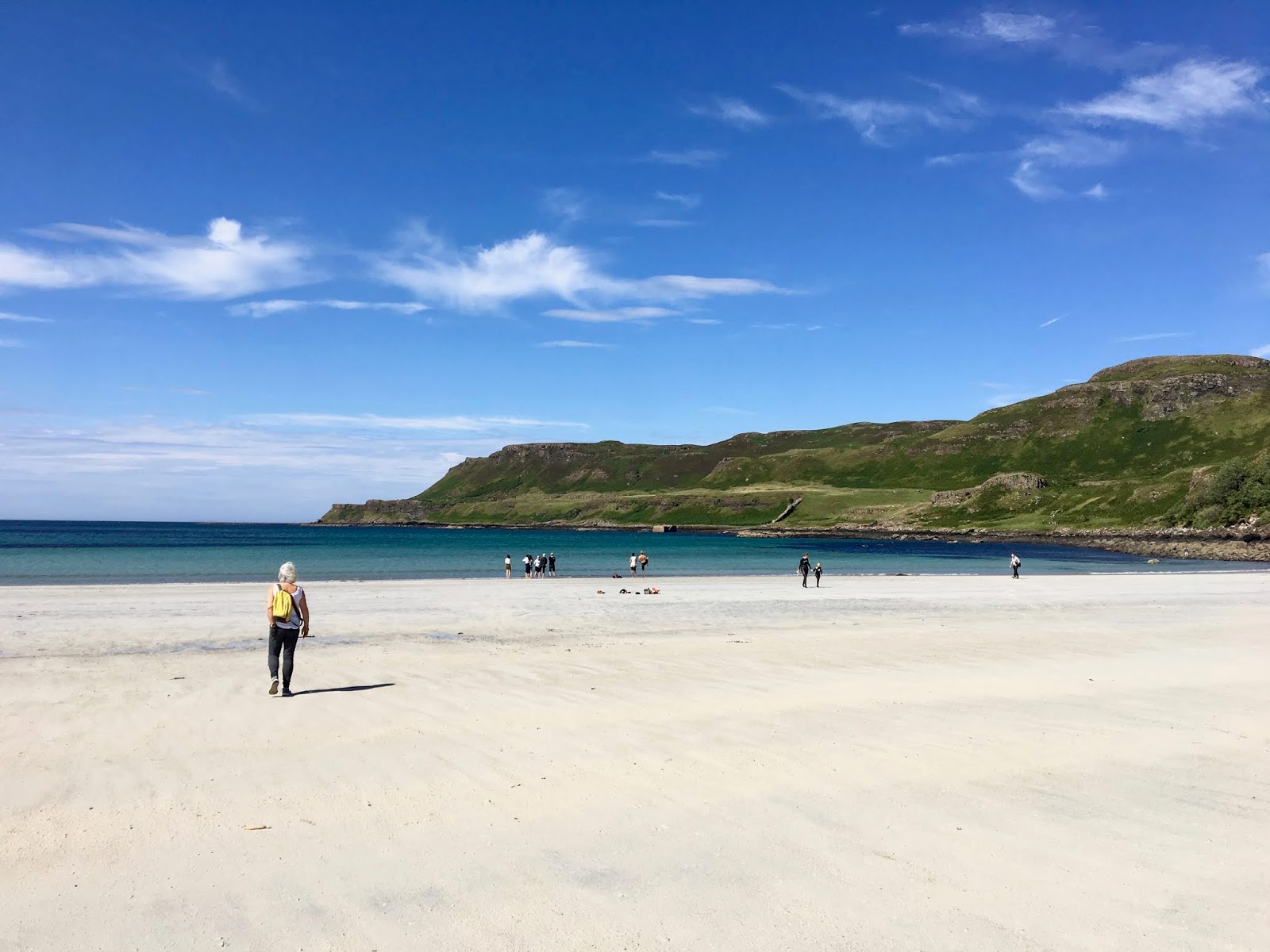
In the two and a half hours left we decided to drive over to Calgary and then journey down the north-west coast of Mull and try to catch the 1:30 ferry. It was a spectacular drive in perfect conditions. We stopped at the excellent cafe in Calgary and spent half an hour walking the beach before setting out with just an hour to make the final 35miles to Craignure. The narrow single track road was slow and we were held up by tourist traffic but made Craignure as the last car to arrive and get on the ferry. Worries over, the sail down the Sound of Mull was beautiful in the warm summer breeze. It is the place where our eldest learned to walk on the deck of a Calmac ferry so it has happy memories for us.

Disembarking at Oban we decided to make for Loch Melfort, the place where we stayed in exactly the same week 36 years ago when the summer was similar to this year. Our two daughters of 3 months and 2 years spent most of the week in a paddling pool. We tried to learn how to windsurf on the loch whilst grandparents held the fort.

We continued the excursion by driving on to Arduaine Gardens on the other side of Loch Melfort. They are one of the National Trust treasures with the gulf stream providing conditions for a vast array of trees and plants and enjoying spectacular views over to Jura and Mull. The journey back to Glasgow was via Loch Fyne where we stopped for an ice cream at Inverary and met an old neighbour. Loch Lomondside was chock-a-block with traffic returning from a grand day in Argyll. After the rain at the weekend, Glasgow was back in its high summer mode with the pavements alive with al fresco drinking.

Leaving Lochaline
Tobermory waterfront
Calgary coffee house
Midsummer crowds on Calgary beach
Calgary beach
Calgary beach cafe
Looking across Loch Na Keal to Ben More
Sound of Mull
Oban waterfront
Our holiday cottage of 1982 on Loch Melfort

Arduaine Gardens, Loch Melfort
Loch Melfort and Mull
Arduaine Gardens
Vital Spark at Inverary

Loch Melfort in 1982

The West Highlander


West Highlander at Fort William
We had vouchers from Gregor for the steam-hauled train to Mallaig and finally, after several attempts, managed to get a reservation on an afternoon trip. The train was full, the happy band of men on the footplate were enjoying themselves, and the Black Five locomotive was steamed up and raring to go. There had been 842 of these locomotives built to the design of Sir William A. Stanier for the London, Midland and Scottish Railway (LMS) between 1934 and 1951. They were the most numerous of all locomotives in the UK and the workhorse for both passenger and freight duties. Their design heavily influenced the BR-commissioned standard locomotives after nationalisation. 

Leaving Fort William and passing through Corpach, the locomotive was barely audible. However, as we began to climb, the familiar beat of the pistons reverberated in the glen, and the coaches clapped along. Sticking my head out of the window brought the smell of coal and particles of soot lodged in my hair. At Glenfinnan, there were crowds of spectators on the hillside as we crossed the famous concrete viaduct. Harry Potter has a lot to answer for. The train halted at the station so we could visit the museum, see the workings of the signal box and admire the locomotive. The driver and the fireman were in an animated conversation with the engineer. The steep incline up the glen to Cross had the locomotive rasping for breath. The spectacular scenery provided evidence of the immense difficulty of constructing the West Highland Line through some of the most complex and rocky landscapes. The seascapes and tunnels beyond merely confirmed this. The beaches of Arisaig and Morar made us wish that you didn't have to return on the same day, but tourism schedules seldom cater for spontaneity.

The only blight on the trip was the attempt by the company to sell cheap Chinese-produced souvenirs in the style of Ryanair stewards. The train was filled with tourists from most parts of Europe, with the inevitable groups of Americans making more noise and taking up more space than the average traveller. Souvenirs of local produce would be so much more in keeping with the trip, but the temptation to obtain high markups on tacky plastic goods always seems to win. Some smoked mackerel or slate coasters with an etching of the locomotive would have tempted me.

Mallaig is the end of the line and the port for ferry services to the small isles of Rum, Canna and Eigg and the Isle of Skye, as well as to Inverie in the Knoydart peninsula. Apart from fresh fish and chips, there isn't a lot to see or do in a couple of hours before the journey back. Fortunately, we shared a table with a young Dutch couple on a three-week holiday to Scotland. The conversation was non-stop as we exchanged ideas and information on the return. We arrived back slightly ahead of schedule and were able to make the Corran ferry before the last sailing and get to our Airbnb in Lochaline. Tomorrow would be a trip to Mull.

Why everyone wanted to be an engine driver

BR coaches were so much more comfortable than today's coaches 

Steaming up at Glenfinnan station

Mallaig, catch in

Fisherman's mural in Mallaig

Eigg
Rum
Glenfinnan viaduct