Saturday, 17 June 2023

Legend of the Commonwealth Games


Lackie Stewart beats Ron Clarke (Aus) for 1970 Commonwealth Games Gold

When working in Ross and Cromarty during the summer of 1970, I went to stay with a friend in Edinburgh on a July weekend and headed to the Meadowbank Stadium to watch the Commonwealth Games. Lackie Stewart, the slightly built Scot from Bonhill, Dumbarton had run the legs off the overwhelming favourite, Ron Clarke of Australia in the 10 kilometre race to win the Gold Medal. We were there the following weekend when Ian Stewart of Scotland won the 5000 metres. It was a glorious period of Scottish Athletics and Edinburgh became famed for the friendly games.

I was asked by Gregor to if I could drive him to Balloch for the Loch Lomond 10k. There were road closures and at one stage as we were jammed on the backroads near Gartocharn he got out of the car and began to run to make the start,. The traffic eventually began to move and I was able to pick him up and deliver him with 10 minutes to spare - not enough for his warm up. It made little difference as he galloped in the winner for the second year running. 

As we were waiting for the results to be announced we could see Lackie Stewart seated by himself near the winners enclosure so we approached him and enjoyed 10 minutes hearing stories of Athletics in the 1970s. Lackie often roomed with Ron Hill when on International duty and he regaled us with stories of Ron Hill's mischievous behaviour during marathons. Jim Alder was their other room mate. He told us that David Bedford, the hard training distance runner who claimed he ran 200 miles a week had only lasted for 6 weeks before his fabled training endurance collapsed. 

I asked Lackie about his training regime wondering what had enabled him to run 10 kilometres in 28 minutes11seconds when winning his Gold Medal. I expected him to have trained long miles in the Kilpatrick Hills and acquired his sprinting  speed on the track.but he said it was entirely on the streets of Bonhill and Dunbarton, although there one or two roads that were hilly. He is a legend because of this modesty, an epitome of the amateur athlete who took on the world and by sheer guts and determination became a winner. 

He was a content man as he watched and then presented prizes to the runners: female and male, age group winners, team winners and then posed for photos with them all. Almost a thousand had taken part on a fine summer morning in an event that epitomised all that is best about locally organised and run events. The local Co-op providing drinks and snacks, the local businesses funding T shirts and volunteers from many of the local groups providing the marshals, drinks, and ensuring a spirit of bonhomie 

 Presenting G with Vouchers for Loch Lomond 10k


Meeting a Legend

A few tips

Team Winners as well


Monday, 12 June 2023

Ring of Steall

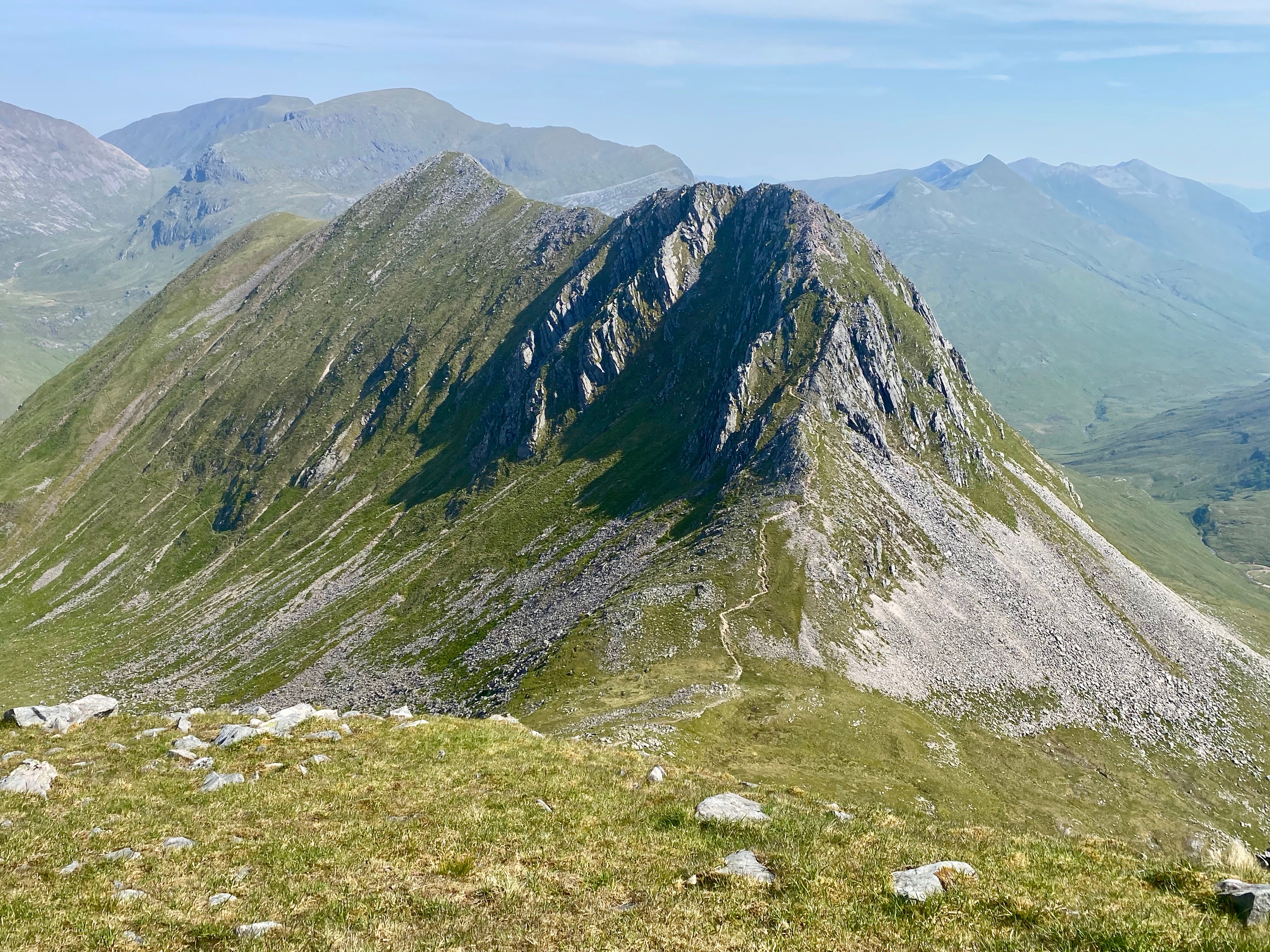
The Devil's Ridge from Sgurr a' Mhaim

Route - Ring of Steall

Saturday 10 June 2023

Ascent:       1610 metres
Distance:    20 kilometres
Time:          6 hours 41 minutes

An Gearanach            982m     2hrs  4mins
An Garbhanach          975m     2hrs 22mins
Stob Coire a' Chairn   981m     3hrs 2mins
Am Bodach              1032m     3hrs 37mins
Sgurr an Iubhair       1001m     4hrs  2mins
Stob Choire a' Mhail  990m     4hrs
Sgurr a' Mhaim        1099m     4hrs 53mins


John had been staying in Caol, near Fort William, for a week to tick off some of his remaining Munros. I had planned to go up for a couple of days, but an old friend arranged to visit for a couple of days, and then Gregor and his partner moved in with me for a few weeks after the entry date to their new house was delayed. I was only left with Saturday. I drove up on a Friday evening, witnessing Rannoch Moor and Glencoe in the glorious hues of early summer. I called in at the excellent new M&S food outlet in Fort William to buy a salad for my evening meal. Keith had also arrived for the walk, and he and John were debating the route for the next day. 

The Ring of Steall on the Mamores had been decided and, even though I had already climbed Sgurr a' Mhaim, I was pleased, and we agreed to do it clockwise. I parked my car at Achriabhach so we would have a lift to the Water of Nevis car park at the end of the walk, and continued in John's car. I had not been on the Ring of Steall since 1989, on a wintry March day when we had also climbed Mullach nan Coirean and Stob Ban. It was the first big walk on my first round of Munros, and we were hardly equipped for such a venture, but we were younger then. My next three outings on the Mamores had involved climbing all ten Munros on long days from either Kinlochleven or twice from Glen Nevis. From whichever starting point, it meant there was no need to ascend or descend Sgurr a' Mhaim and An Gearanach as part of the Ring of Steall.

I was castigated by the others for wanting to finish by 5pm, so I could drive home and watch the European Championship Final. Nevertheless, we decided to leave at 7am for a 7:30am start from the car park at the head of Glen Nevis. We were spot on the schedule, and the forecast was for perfect conditions with a south-easterly breeze to cool us during the heat of the day. Shorts and a T-shirt were all that was needed. My pullover, wind top and waterproof were merely passengers. 

It was cool on the well-used path through the gorge up to the meadow below the Steall waterfall. I always welcome a couple of kilometres to settle in before the grind of a climb. We crossed the river by the Steall suspension bridge and walked along to the Steall Falls. Even at the end of two weeks of unusually dry weather, it was still impressive, evidence of the abundance of water held in the Mamores. We then began the relentless but enjoyable climb up An Gearanach. It is over 800 metres of ascent by a twisting path with the backdrop of Ben Nevis and the Grey Corries. There were two or three other groups on the ascent despite the early hour. We made good time and were on the summit by 9:35 a.m. The views of Ben Nevis and the Aonachs were as clear as I have ever witnessed. Sgurr a' Mhaim was showing off its anticline of rock strata on its eastern face. 

The clarity of the views from An Gearanach of the more distant surrounding hills was equally stunning. After only a short stop for photos, we continued along the rocky ridge to the nearby top of An Garbhanach. We were passed by a runner attempting Ramsey's Round (24 Munros in 24 hours) and his pacer, who dropped off to gather some water below the ridge. Keith queried him about the schedule they were running and, when asked how he knew so much, Keith admitted that he had done it 30 years earlier. He earned kudos from the pacer for having beaten Ramsey's time by 3 minutes. 

The climb over to Stob Coire a' Chairn was the easy part of the round. We decided to take a break for some food and drink before the longer climb to Am Bodach (the Old Man). It was a bit of a tease with an initial climb to a 909-metre peak and then a drop and further climb of 200 metres on a rocky path that had been a rock scramble when we first passed along this way 34 years ago.  Am Bodach is a proper peak that you land on. It has no false summits or interminable convex slopes. Three women were about to leave; they had started on the Ring of Steall at 6:00 a.m. We had a friendly chat and took some photographs for them before another break; we were an hour ahead of the schedule that I had set for the walk.

A pleasant breeze had developed, and it made the long and easy descent towards Sgurr an Iubhair a pleasant amble. There were quite a few parties, including some runners coming the other way. A short, sharp climb takes you to the summit of Sgurr an Iubhair. It was classified as a Munro until the SMC relegated it although it has greater justification than quite a few Munros. We began the walk across the Devil's Ridge, not as difficult as it sounds at this time of the year, although the exposure in winter conditions is a different matter. It provided good sport with only a short section descending some ribbed rock requiring any scrambling. The final 120 metres climbing to Sgurr a' Mhaim was no problem; the psychological benefits of the final climb of the day made it seem easy. There were several other parties on the summit where we finished our food and soaked in the sunscapes before beginning the descent.

It should have been an easy end to a wonderful walk, but the steep, twisting path through scree and then grassy slopes along a path that was deeply scored into the hill was hard on the feet and legs. It took an hour and three-quarters to reach the road at Achriabhach, where a hill race had just finished. We spoke to the organisers, and it reignited the sense of excitement I always had when competing in hill races or mountain marathons. I drove John and Keith back to their car at the Water of Nevis car park. It was full beyond capacity, and I made a torturous seven-point turn that almost ended in reversing over the edge. I set off home just before 4pm. The going was slow in the glen, which was buzzing with visitors. After a stop for some drinks in Fort William, I was pleasantly surprised at a relatively quiet journey home. I had time for a shower, a beer and a meal before nodding off whilst watching Manchester City beat Iner Milan 1-0 in a tedious European Championship Final. 

Keith on Wire Bridge at Steall

Steall Falls on a very dry day

Keith and John on the ascent to An Gearanach

Sgurr a' Mhaim showing its curves

Ben Nevis, Carn Mor Dearg and Aonach Beag

Ben Nevis, CMD & Aonach Beag from An Gearanach

An Garbhanach, Stob a' Coire Chairn & Am Bodach from An Gearanach

An Gearanach & An Garbhanach from Stob a' Coire Chairn

Ben Nevis and An Gearanach from Am Bodach
Stob Ban from Sgurr an Iubhair

Sgurr a; Mhaim from Devil's Ridge

Sgurr a' Mhaim starting the descent


Saturday, 27 May 2023

Beinn Mhanach

Viaduct and Beinn Mhanach

Friday, 26 May 2023

Ascent:      808 metres
Distance:   21 kilometres
Time:         5 hours 4 minutes

Beinn Mhanach    952m     2hrs 49mins

After the longest walk of the year yesterday, John and I decided to tackle Beinn Mhanach, not one of my favourite Munros, but on John's to-do list for his fourth round. The narrow sliver of parking space at Auch along the A82 is no more accommodating than it was in 1990 when I first climbed this hill. On that occasion, the walk took in the four other Munros from Beinn a' Chreachain to Beinn Dorain. Today was supposed to be easy, but still required 8 kilometres of walking along the Allt Kinglass before facing the formidably steep 600 metre climb on the grassy slopes of Beinn Mhanach. It was my wedding anniversary, and this year it would have been 44 years. The walk gave me time to reflect on our happy years. I also realised that in the 1990s, the anniversary had coincided with the walking week when John and I would climb 20 or more Munros when our lungs and legs were in better fettle.

It was a hard slog in humid conditions with not even a breeze. A faint path eased its way through the steep slopes. The final hundred metres was a gentler gradient, but the concave slope made it seem never-ending. It led to a barren, featureless summit hosting a pile of rocks that vaguely resembled a cairn. The views were good, but the upturned saucer of a hill meant that adjacent hills were not seen to best effect. The forecast had been for overcast conditions, but we were regaled with patches of blue sky. Having decided that the adjacent top of Beinn Chuirn would add no advantage to the day, we retraced our steps to the track; my quads were burning from braking on the steep slopes.

The 8-kilometre walk out was easy going, involving about six crossings of the burn. What was surprising was the scale of major construction taking place at Auch on the land before the railway viaduct. New bridges, barns, and fencing, extensive work on the river beds, electricity and broadband cables being trenched by a panoply of earth-moving equipment and established contractors. I had assumed it was being driven by some hydro investments, but we were told it was the estate that was responsible for an investment that was obviously running into £millions. We presumed the estate must have been bought by a hedge fund or a company that had grand designs for some tourism venture.

We reached the car on the parking strip and were swayed by the passing commercial traffic before we dumped our sacks, swung the wing mirror out and joined the throng of traffic on the A82.  It was obviously the start of a bank holiday weekend and a good reason to escape the overcrowded highlands. 

Allt Kinglass and Beinn Mhanach

Beinn Dorain and Beinn an Dothaidh from Srath Tarabhan

Beinn Manach summit

Yesterday's hills: Sheasgarnaich & Creag Mhor

Summit towards Beinn an Dothaidh and Achaladair


Creag Mhor and Beinn Sheasgarnaich

Beinn Chaluim and Creag Mhor beyond EU Birch regeneration fencing

Thursday 25 May 2023

Ascent:       1410 metres
Distance:    27 kilometres
Time:          8 hours 2 minutes

Creag Mhor                 1032m     3hrs 12mins
Beinn Sheasgarnaich   1078m     5hrs 13mins

John had suggested a couple of days of hillwalking as the weather was fine and he was stepping up his drive to complete his fourth round of Munros. He arrived on Wednesday evening so we could make an early start, and we agreed to attempt Creag Mhor and Beinn Sheasgarnaich. It is a longish walk and whilst we would probably have added Beinn Challuim in the halycon days of yore, we knew that as seventy-year-olds, those days are sadly behind us.

The day proved the best of the week, a crisp sunny day with a breeze to keep us cool. It took slightly longer to drive up to Glen Lochay and then follow the glen, which was resplendent in its late Spring attire. The parking is now about a kilometre short of Kenknock. We were about to set off when John and Gayle, old friends and neighbours from Aberfoyle, arrived with their bikes for the 8-kilometre trek towards Creag Mhor. We chatted for a while before walking along to Kenknock and relishing the fine panorama of hills that enclose Glen Lochay. We took the old private road to Glen Lyon that is now closed for casual traffic and reached the start of the higher level track to the Allt Bad a' Mhaim, the impressive burn that provides an unpathed route to Creag Mhor. 

The track is like the ice age parallel roads elsewhere in the Highlands, remarkably level with sections of EU-funded regeneration plantings of Birch and Scots Pine protected by fencing and gates. What a travesty that these environmental schemes that were supported by the EU are now dependent on a UK government that gives as little priority to these schemes as it does to the EU regulations that made such a difference to beaches and air quality. We followed the burn, a steep climb of 650 metres through mainly long grasses dappled with wild flowers. It was worth it for the wonderful glen, and we spent 10 minutes just inhaling the remote beauty of the ravine before traversing up to the ridge of Sron nan Eun. We looked for John and Gayle as we began the final climb to Creag Mhor, but they had probably gained 45 minutes by the use of their bikes. They had continued on to Stop nan Clach and watched us from there as we spent 40 minutes having lunch and a break on Creag Mhor. Probably one of our longest stops on a summit; the conditions were mesmeric.

The descent to allow the ascent of Beinn Sheasgarnaich requires a significant detour to the north west to avoid the rocky ramparts to the north. There is then a 400 metre climb to Beinn Sheasgarnaich, up a steep ridge to the fine viewpoint of Sron Triabh and then a gentler climb to the summit. It was almost 5pm when we arrived, and again the conditions were sublime; we relaxed and took in the 360° skyline. Time was there for the taking, not the walking.

I had contemplated a more direct descent, but we elected to head to the track from Glen Lyon, which meant a 3-kilometre descent past tiny lochans, over the boggy ground, along the meandering burn and then climbing a few of the fences that protected the new tree plantations. The supposed prize was a 5-kilometre walk down the track to Kenknock and then back to the car. It was almost 8pm as we sauntered along to the car park, having enjoyed the perfect evening light but thoroughly exercised by a perfect day on some of Glen Lochay's fine hills.

Allt Bad a' Mhaim

Beinn Challuim from Creag Mhor

Beinn Sheasgarnaich from Creag Mhor

Ben More, Stob Binnen and Cruach Ardrain from Creag Mhor


Beinn Mhanach and Beinn a' Chreachain from Creag Mhor

Beinn Sheasgarnaich summit

Looking south from Sheasgarnaich

Lochan below summit of Beinn Sheasgarnaich

Saturday, 13 May 2023

An Stuc, Meall Garbh and Meall Greigh

Lochan nan Cat, An Stuc and Meall Garbh

Saturday, 13 May 2023

Ascent:        1278 metres
Distance:     20 kilometres
Time:           5 hours 29 minutes

Meall Greigh        1001m      1hr   58 mins
Meall Garbh         1123m      2hrs  57mins
An Stuc                1117m      3hrs  32mins


I had planned to walk the Lairig Ghru earlier in the week with John and Keith. My rucksack was packed the night before, and I planned to arrive in Aviemore by 9am. We would walk through the Lairig Ghru camp in Glen Derry and then return via Lairig an Laaoigh, the Fords of Avon and Ryvoan to Loch Morlich. Alas, an electrical fault on the car: no information readings or radio, meant I had to abandon the trip after 5 miles, it was 6:45am and a public holiday so no local garage would be open. It was Friday before the car was repaired.

Saturday was to be fine, so I planned to climb the three Munros at the eastern end of the Ben Lawers range, which contains 7 Munros. I had already climbed the other 4 on what would be a sixth round. I am not attempting another round, but old habits are difficult to dispel. I left at 7:15 a.m. and was walking an hour later from the Ben Lawers Hotel on Loch Tay.  Several new houses have been built where the road crosses the impressive Lawers Burn. We had parked on the waste ground of some derelict buildings on our first foray to Meall Greigh in 1991. It was now the splendid garden of a new stone-built cottage.

The initial walk starts at the back of the horn carver's cottage and climbs quite steeply alongside the burn. It was a dull morning but the cloud cover was expected to burn off by mid-morning, and it was good to climb in the cooler weather. The birch woods were sparkling with their neon green leaves, making you think you were in Finland. There are a couple of stiles to cross before you enter the Ben Lawers National Nature Reserve and open moorland. There was little to see initially; the hills were lost in the morning cloud cover. After the shielings, a path forks off to the right, and 15 minutes later, the cloud cover dissipated, and I was confronted by the challenge of the steep flank of Meall Greigh. I began to pick up some pace, having passed a couple on the early part of the climb and, as the cloud disappeared, I could see a walker reaching the top of the steep path that emerges on the top of Sron Mhor, the outlier of Meall Greigh.

The final kilometre to the summit of Meall Greigh is a pleasant walk on a well-defined path that rises at a more clement incline. The sun had burnt off the cloud across the Ben Lawers ridge, but there was a thin layer of cloud shrouding Loch Tay below. The skylarks were providing a soundtrack that would probably win the Eurovision if only they didn't have such drab-coloured feathers. A ptarmigan crossed my path and presumably made a diversion to distract me before returning to its nest. The summit cairn was a loose pile of stones that I tidied for a couple of minutes before sitting in the morning sun, taking a drink and sending some photographs. Life was good and as I was leaving, a young woman arrived at the summit asking if this was the real summit. There is another cairn a few hundred metres away but it is 8 metres lower and on the route across to Meall Garbh. She seemed reassured.

It is an easy and pleasant descent to the bealach, Lairig Innein. Just before I reached the start of the 290-metre climb to Meall Garbh, a couple of female hill runners passed me; they were talking incessantly on their descent. The air was so still that I had heard them approaching when they were half a kilometre away. I envied them as they began the climb but managed to lose not that much distance before they reached the ridge and galloped away. The lone walker ahead had arrived at the summit just ahead of me, and we chatted for ten minutes before setting off for An Stuc; it was to be his 70th Munro, a quarter of the way around. He had that infectious enthusiasm for the Munros that seems endemic when you reach this number of Munros and he shared his plans for the year ahead. He also had an enthusiasm for cycling and cricket, so our conversation was non-stop as we climbed the steep, loose gulley that defines An Stuc as a difficult hill. It had only just passed noon as we reached the summit and there were another dozen walkers scattered around the cairn. They had come across from Ben Lawers, the summit of which was heaving with walkers. The visibility was excellent, although clouds had begun to form in the west.

After a lunch break, I left my acquaintance who was going to take his time on the descent and descended to Bealach Dubh. I followed a winding and steep path down Ravens Gulley, and the final patches of snow were visibly melting in the midday sun. Three other walkers were using the same route that I passed on reaching the boggy path that meanders to the south of Lochan nan Cat. The views back to An Stuc and Meall Garbh were exceptional, the corrie is probably the wildest location on the Ben Lawers ridge. It is a couple of kilometres of extremely boggy conditions to the shielings from where a track contours below Ben Lawers. A few hundred metres along the track, an excellent grassy path is marked by a cairn and descends alongside the Lawers Burn. It eventually zig zags down to a footbridge and then you are on the final couple of kilometres, leaving the Nature Reserve and following the birch forest back to Lawers. It had been a good outing on a near-perfect day. I had felt lethargic at the start but picked up pace as the day progressed. I was home before 4 p.m. and celebrated with a beer and a bath before starting to watch Eurovision. After the first three efforts, I decided that writing up a blog post and an early night would be preferable.

Meall Greigh ascent

Ben Lawers, An Stuc and Meall Garbh from Meall Greigh

Loch Tay from Meall Greigh

Ben Lawers, An Stuc and Meall Garbh from Meall Greigh

Ben Lawers from An Stuc

An Stuc above Lochan nan Cat

Lawers Burn, An Stuc and Meall Garbh

The Shielings and East Mealour

Route: Anti-clockwise


Monday, 8 May 2023

A Coronation fit for History

As Ronnie Corbett would say, "I know my place". It felt like that over the Coronation weekend as we watched the magnificent or grotesque (you decide) processions to and from Westminster Abbey and the ceremony inside the Abbey. They were finely performed by a cast of thousands who had taken the King's shilling to become players in the pomp and circumstance of King Charles III's Coronation for a slowly evolving monarchy. Over the centuries the monarchy has transgressed from the embodiment of absolute power to a soap opera that keeps on giving. What has not changed is the embedded entitlement that filters down through society and is maintained today by the subtle inclusion of celebrities to ensure that it thrives through the lens of a largely supportive press and media. In reality, it is a marriage of inherited elitism with populist culture. 

I had not intended to watch the Coronation and assumed it would take place on Monday, a public holiday. But it was raining and Gregor, who was staying overnight, switched on the TV on Saturday morning. In the rain-filled streets of London, thousands of people were camping out along the Mall, and others were arriving on early morning trains and buses. The sultry voice of Kirsty Young was interviewing the said celebrities who had been courted by the monarch. It rained on the parade as thousands of relentlessly rehearsed soldiers, sailors, horses, and carriages infiltrated by Bentleys, and Range Rovers, all in uniform or sparkingly clean, clipped and clopped along the Mall and down Whitehall. Images were broadcast to the nation and the world of a happy and glorious country where the monarchy has been long to reign over us as well the other parts of the empire that have not yet seceded.

The seating arrangements inside Westminster Abbey reflected a pecking order that has stood the test of time. The Royal Family and their extended cast of grandees along with world leaders, the leaders of armed forces, the various religions, then a list of celebrities that have featured in recent editions of the Tatler or Vanity Fair or been cajoled in some of the King's charitable causes. And in the stalls the charity workers, community stalwarts and NHS staff as a reward for looking after the King's subjects.

The service itself was a jumble sale of centuries-old traditions and strange rituals with crowns, sceptres, orbs, oaths and holy oils that mingled with some superb musical interludes performed by orchestras and choirs. The service was supposed to last 90 minutes but with extra time lasted 2 hours. The invitees were to take their seats an hour or so before the King arrived and had to wait for twenty minutes or so after he was led out by the leader of the House of Commons, Penny Mordaunt, one of the very few key players not looking like an escapee from a pantomime. There was no half-time for a butter pie and a visit to the toilet and like most city centres nowadays, the Abbey has no public toilets so aged bladders were at bursting point.

I tried to reflect on what the Coronation had done to influence my perception of the monarchy. King Charles has in some ways exceeded my expectations since his arrival on the throne. Mainly by his focus on climate change, young people,  and his charitable works. However, despite the claims of a slimmed Coronation and invitations to the Great British public at the expense of MPs and their partners, it didn't feel like that. It was a hotchpotch of elaborately enacted customs, hand-held weaponry, and stilted readings whilst our multi-layers of leaders showed docile deference to the King. A costume drama that even Netflix couldn't afford to make. According to the Government, it is not possible to give the cost of the Coronation before the event but estimates of about £100m have been made. If its anything like the Covid Test and Trace estimates this could be massively exceeded and let's not forget that an extra public holiday reduces the GDP of the UK by 0.4%

In this respect, the monarchy is still a massive cost to the country and it is unwilling to be transparent about its wealth and how this is acquired or managed. Despite the efforts of the working Royals to generate goodwill by carrying out numerous engagements, they still seem stage-managed to show the status of the monarchy. A stark contrast with the Nordic and Dutch monarchies which are more informal and have a far lighter carbon footprint. They are more in keeping with an egalitarian culture that the UK only pretends to observe.

Spot the Orb competition


Tuesday, 2 May 2023

Wansfell

Lakeland scene at High Skelghyll

Monday, 1 May 2023

Ascent:      510 metres
Distance:   10.5 kilometres
Time:         2 hours 31mins

Wansfell Pike      482m              39mins
Wansfell              487m        1hr 05mins

It was the end of the May weekend. We left the Airbnb at Skelwith Fold at 10:00am and sauntered up the nearby hill of Latterbarrow that overlooks Windermere. I had arranged to meet my old walking friend Mark, who lives in Ambleside at lunchtime. He had already walked over Loughrigg and Silver Howe and it was his birthday. After a catch up we decided to walk up the nearby Wansfell from his house. It would give us a chance to chat about past walks, politics, families and assorted other topics including battery storage and podcasts.

Mark has climbed all 214 Wainwright hills 21 times and has walked on the Lakeland Fells almost every day since retiring to Ambleside 8 years ago. He knows every path so we could concentrate on talking, route finding was axiomatic. As we were discussing the Rory Stewart/Alistair Campbell podcast that interviewed Tony Blair, an aggressive walker close to us shouted that Blair was a terrible man as I would know if I had ever met him. I retorted that I had had lunch with him and that compared to the last five Prime Ministers, he was a genius. He hurled some more abuse at me before accelerating away on the climb as we continued to blether but kept him at a close distance. 

We reached Wansfell Pike shortly behind him, he hurried off for the Wainwright summit of Wansfell, 2 kilometres away and 7 metres higher. We followed as I was keen to climb the Wainwright and I was looking forward to extending the argument, not so much to praise Blair as to inveigh against subsequent prime ministers who have brought us to the present crisis. It was quite boggy, Mark had not anticipated taking in Wansfell as well.  He suggested an alternative route off the hill to avoid returning by the way we had come. Our adversary reached the summit slightly ahead but instead of returning and having to pass us, he diverted across a boggy section below the path. 

The weather had been improving so we took some time to scan the skyline towards the line of hills that were a Roman high street and culminate in the eponymous High Street. We took a circuitous route back to Ambleside dropping down above Troutbeck to High Skelghyll. It extended the walk and gave us more time to continue our perpetual conversation. It was after 4pm when I set off home, pleased to be travelling north and avoiding the exodus of bank holiday traffic heading back from the Lake District to the English cities.

Mark on a charge towards Wansfell

Looking northeast from Wansfell to High Street