Tuesday, 30 July 2019

Inchmahome

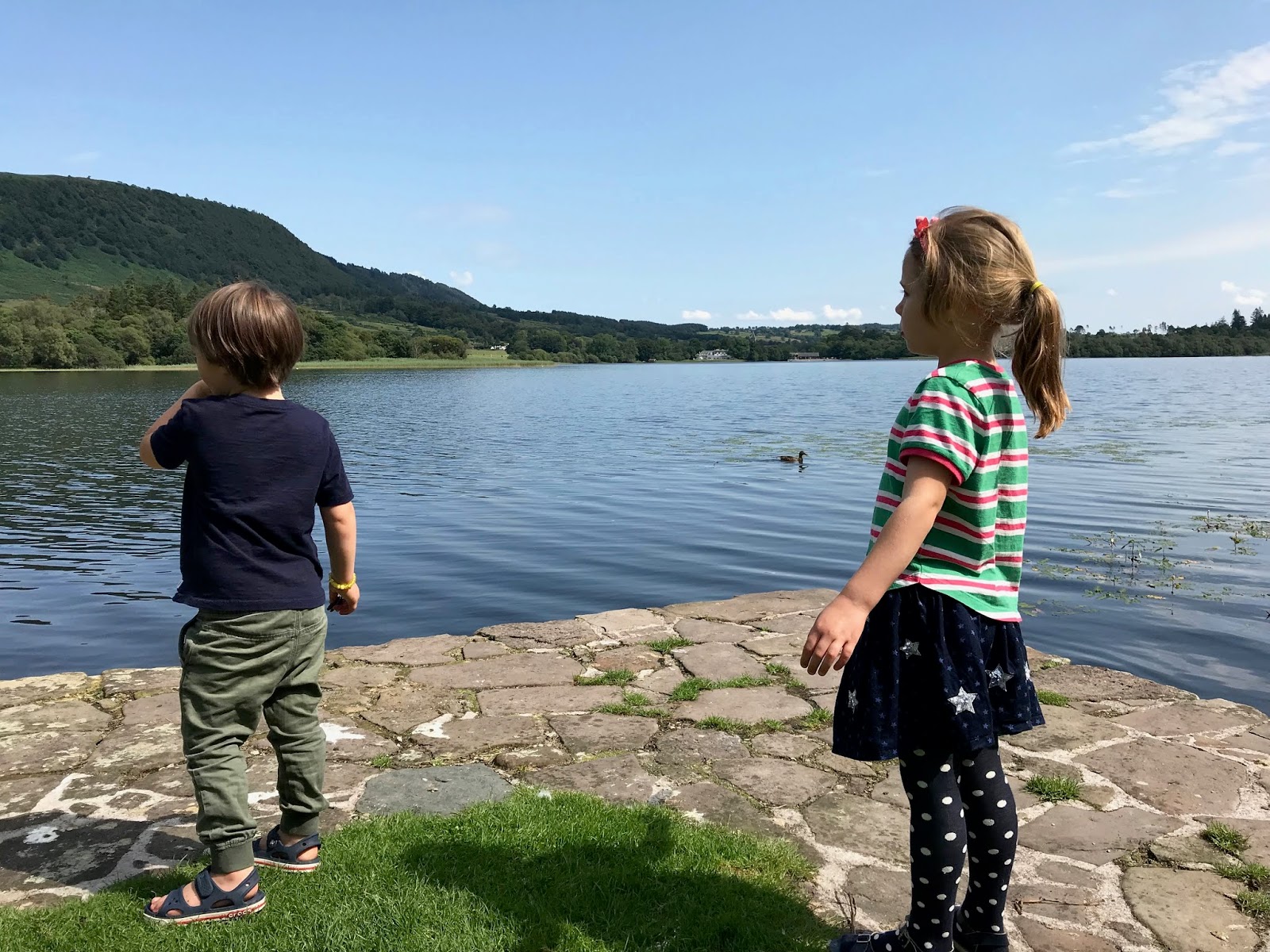
Looking east to the Lake Hotel and Port of Menteith church

Summer is the time to visit the island of Inchmahome on the Lake of Menteith. A priory was established on the island by Augustinian canons in 1238 and provided a secluded sanctuary for over 300 years. It was visited by Robert the Bruce and most famously by Mary, Queen of Scots when she was 4 years old. She stayed for three weeks when she fled from Stirling Castle to escape the 'Rough Wooing' by King Henry VIII's son, Edward. 

The Lake of Menteith became a tourist attraction to English gentry in the 19th century, this was partly attributed to the writings of Sir Walter Scott. This probably explains why it was renamed the Lake of Menteith, the only Lake in Scotland, rather than the Loch of Inchmahome, 

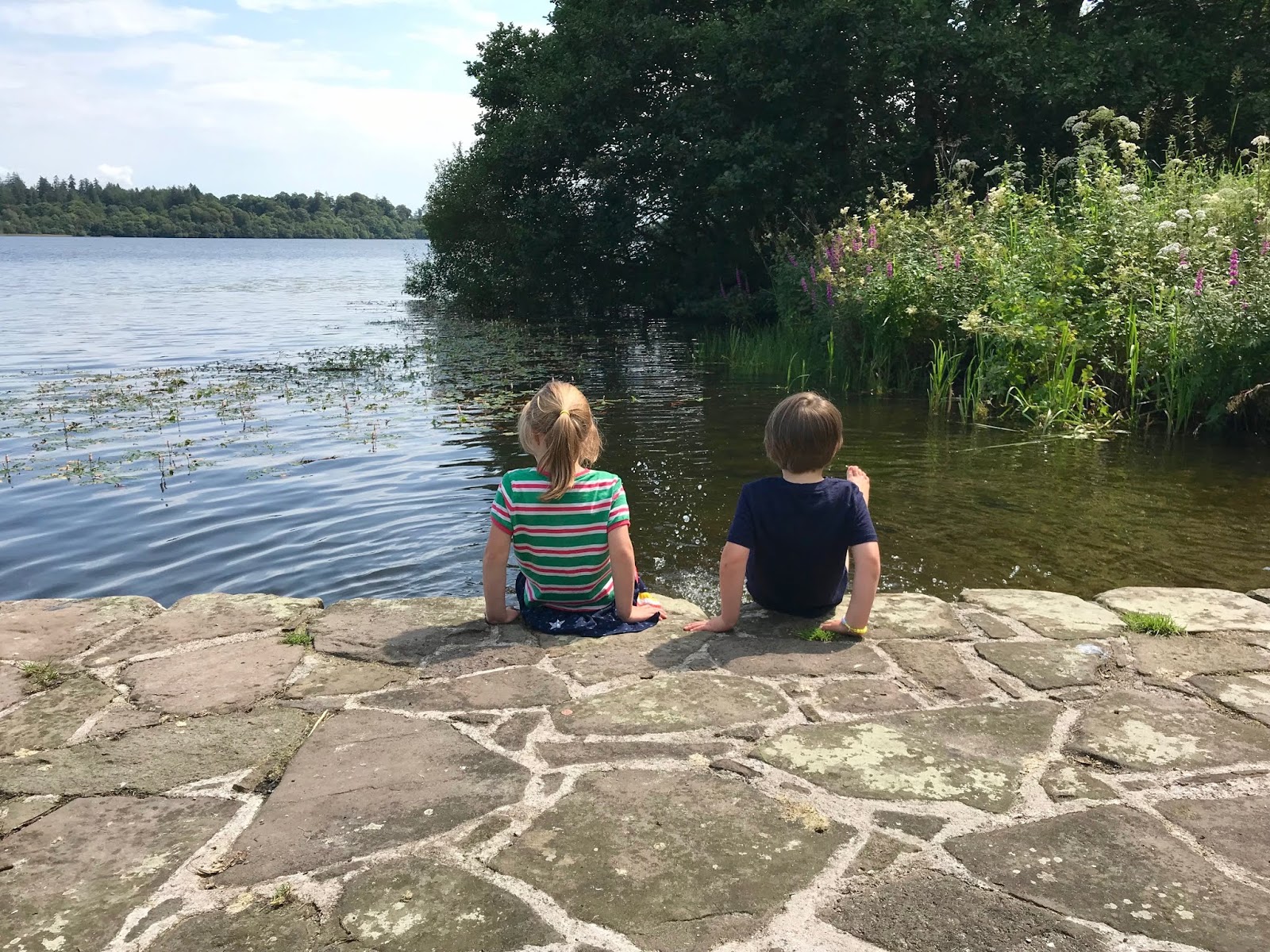
When our children were young it was a regular jaunt during the summer for the boat trip, the tranquillity and the chance to let them run free on the island. This year was a reprise with the grandchildren. Inchmahome is timeless, nothing has changed apart from the boatmen. We were entertained and educated by the current Historic Scotland boatman who took us across and regaled us with stories and facts about the lake and island. Such as the 1000 trout that are released each week, the 35 boats that are rented for £90 a day and the fact it was the European Young Fly Fishing championdship the next day. 

He also claimed that the UK's largest pike was caught in the Lake but subsequent research suggests that was in Loch Lomond. We walked around the priory and the island at a leisurely pace to the sound of birds and the occasional splutter of a boat engine as the fishermen looked for places to cast their flies. The children were captivated by the peaceful freedom, although wary of going too far into the water with giant pike praying on their minds.

Inchmhome Priory


Saturday, 20 July 2019

From Attlee to Boris Johnson, Integrity to post truth

PM delivers pies to the Northern Powerhouse

Oh, what a travesty of democracy. First, we are disenfranchised from the appointment of yet another new prime minister and now we are about to be disengaged from the emergence of new government policies after the spurious arrival of PM Boris Johnson. There can be few Prime Ministers who have been trashed by colleagues, editors, and past friends with such unanimity as Boris Johnson. When senior Tory Party figures like John Major, Michael Heseltine, Ken Clarke and Malcolm Rifkind are queuing up to give interviews to TV, radio and the press about how unsuitable he is to be PM, and this is echoed by some of his erstwhile colleagues from the present cabinet and junior ministers like Philip Hammond, David Gauke, Rory Stewart, Alan Duncan and Margot James, you know that there is trouble ahead. 

Even more devastating has been the critique of Johnson by his former editor at the Daily Telegraph, Max Hastings, who in 2012 wrote, "He is not a man to believe in, to trust or respect, save as a superlative exhibitionist. He is bereft of judgment, loyalty and discretion. Only in the star-crazed, frivolous Britain of the 21st century could such a man have risen so high, and he is utterly unfit to go higher still." He added that "If the day ever comes that Boris Johnson becomes tenant of Downing Street, I shall be among those packing my bags for a new life in Buenos Aires or suchlike because it means that Britain has abandoned its last pretensions to be a serious country."

Sonia Purnell, his journalist colleague during his days as the Brussels correspondent of the Daily Telegraph, was equally dismissive of his integrity. She had previously published Just Boris: A Tale of Blond Ambition in 2011, which offered a withering insight into his lassitude in dealing with detail and his probity with the truth. Even the BBC are exposing him to more rigorous scrutiny than is their normal practice when they are in fear of being accused of imbalanced reporting. This may be because he has refused almost all invitations to be interviewed, although he did get speared by Andrew Neil, not that he seemed to worry. Channel 4 News appears to be in no doubt that he is a loose cannon and takes delight in highlighting his habit of evading questions, responsibility, and evidence.

His record as the Mayor of London was lauded by his team of sycophantic supporters but forensically dissembled by those who worked for him. Routemaster buses that cost £321.6m but were unsuitable for commercial operations as well as being major pollutants, a garden bridge that was 'vanity in Excelsis' and wasted £53.5m. The Thames estuary airport study cost £5.6m but was never published because it did not support his desired objective. The Boris bike scheme has cost a total of £225m when it was supposed to wash its face. Then, the debacle about the £323m funding for the refitting of the Olympic stadium for West Ham football club and its dodgy owners. What does Boris Johnson stand for, well according to one of his rare recent interviews, freedom and the better use of public money. The man has some serious chutzpah and, to be fair, he would probably claim this as a positive attribute.

He has talked of his implied Promethean qualities, but whilst he may be rebellious, he is more destructive than creative, and his innovative instincts are largely focused on humour rather than tangible ideas. What a contrast to the UK's best but least well-known post-war PM, Clem Attlee. He had integrity and diligence in spades and a genuine commitment to social justice following his years of voluntary work in London's East End. Reading his excellent biography by John Bew helped me understand the true characteristics of public service. The absence of rancour and his understanding of the need for collaboration were in stark contrast to the antipathy of compromise by more recent PMs such as Brown and May. Attlee established policies and created institutions that his Tory successors accepted, and in the case of Harold McMillan, further enhanced because they were proven to improve the lives of citizens.

With Boris Johnson, we have no idea what will happen; it will depend on who he listens to and his bent on the day. As John Crace summed up Mrs May's premiership, he captured the fears of Boris Johnson with astute and probably prophetic humour: "Her real legacy is leaving the country in the hands of someone even more unfit to be prime minister than herself."

Tuesday, 9 July 2019

Ben Lomond, a summer stroll


Monday, 8 July 2019

Ascent:        976 metres
Distance:     11 kilometres
Time:           5 hours 55 minutes

Ben Lomond     974m   2hrs  52mins
Ptarmigan         731m    4hrs  29mins

John phoned me the previous evening and asked if I would like to join his daughter and family for a walk up Ben Lomond. The garden could wait and I arrived at Rowardennan at 10:30am. It was nearer 11:00am when the others arrived and then ten minutes for all the family including Loki, the new dog, to start the walk. It was already baking hot and quite humid with light cloud cover. Young John had already climbed Tarmachan on my last Munro but Mia and Loki were on their first Munro so it was a staccato pace with random food, water and rest stops. Nevertheless, we were keeping up with most of the other parties on the ascent and Ben Lomond as always was a busy hill. The climb is fairly unrelenting for the first 577 metres after which there is a gentler climb to 800 metres before the final steep climb to the summit ridge that follows the rocky edge of Coire a' Bhathaich.

John and I walked ahead during the final section and it was worth it to see the joy of achievement as the family were pulled to the trig point by the eager dog. Photos were taken, food and drink followed and like most others on such a warm day, we lingered far longer than is normal on a summit. I suggested that we return via the Ptarmigan ridge, it is a more scenic route down with views of Loch Lomond although there is a steep drop down a rough stony path for the first 200 metres of descent. I was worried that the children and dog might find it difficult but they coped better than the adults. After crossing Bealach Buidhe, it is a pleasant stroll along the undulating ridge to Ptarmigan and then 3 kilometres down a long sinuous path through the waist-high bracken and vegetation. Several parties were still making the climb up. We reached the West Highland Way for the final 500 metres back to the car park. We were home for 6pm and Aileen had prepared a welcome meal for everyone.

Halfway there

Summit ridge

Bateman family arrival


Looking east to Loch Ard

Ben Lomond from Ptarmigan
Descending the Ptarmigan ridge

Sunday, 7 July 2019

Langdale 2019

Hartsop
The annual week in the Lakes is part of the ritual that is home from home. My parent's honeymooned here and as a toddler and child, I was taken to Langdale and the Lakes three or four times a year. My first mountain walks were during a school run holiday in my final year at primary school at Stair in Newlands, my first beer was bought at the New Dungeon Ghyll after a morning climb of the Langdale Pikes and my first holiday with teenage friends was youth hostelling for 10 days walking most of the highest fells. I rock climbed, walked the fells and sailed in Windermere with friends during university vacations. I scattered the ashes of one of my best friends on Scafell Pike after he had died in his twenties and in later years competed in Mountain Marathons. 

For the last 35 years, we have returned to Langdale to familiar haunts and pristine landscapes. Every hill has been climbed, every lake visited and most pubs as well. The Lake District is embedded as a familiar baseboard for life, it is constant and largely unchanged but still throws up surprises that enhance its inherent charms.

This year it was the Theatre by the Lake in Keswick, where we saw an excellent production of My Mother Said I Never Should, a wonderfully acted tale of the trials and tribulations of four generations of women in the twentieth century. We found a slate workshop in a shed above Coniston that made practical household goods like cheeseboards with slate from the Elterwater quarry where we stay. My brother and sister visited for a day, the first time we all have been together for several years. Gregor and I had a couple of outings into the hills, we caught up with old friends and we finished the week with another perfect meal at Fellinis Vegeterranean Restaurant in Ambleside. 

It is always a relaxing but active week made easy in the early days of summer before the congestion and crowds arrive during the English school holidays. This year, as we walked favourite paths and climbed known hills, it prompted many memories of the happy years. It conjures up favourite images of people, places and events and allows time for reflections on life’s passages.


Derwentwater

Langdale, the Cumbria Way

Elterwater Quarry

Holehird Gardens

Fellinis Banana Strudel

High Street and Far Eastern Fells

Hartsop Dodd

For only the second time I started a walk in the Lakes from Hartsop. It was the perfect summer's day and Gregor had a bagatelle of smaller Wainwright hills east of Kirkstone to climb. It would involve a lot of zipping about so I suggested starting from Hartsop so that he could attempt them all. I could climb High Street and 7 adjacent Wainwright hills, I was 30% into my second round of Wainwrights and had greater scope to climb a group of hills. They were higher but closer together and had shorter ascents. Hopefully, we would meet back at Hartsop in 5 hours. Well, that was the plan.

Wednesday 3 July 2019

Ascent:      965 metres
Distance:   18 kilometres
Time:         4 hrs 58mins

Thornthwaite Crag      784m         1hr   50mins
Mardale Ill Bell           760m         2hrs 28mins
High Street                  828m         2hrs 48mins
Rampsgill Head          792m          3hrs 17mins
High Raise                  802m          3hrs 30mins
The Knott                    739m          3hrs 53mins

After a lazy breakfast and the drive to Hartsop, we struggled to find a parking place and had to settle for a crowded space on the A592 north of Brother's Water. It was 11:30am before we were ready to walk and we agreed to try and get back by 4:30pm. We walked to Hartsop village and then split up, Gregor to climb the steep north ridge of Hartsop Dodd and me to take the path alongside Hayeswater Gill to Hayeswater.

I had only visited Hayeswater once before during the Karrimor International Mountain Marathon (KIMM) when the overnight camp for over 200 tents was at 500 metres on a boggy hillside. We were awakened at 6am the next morning by the race controller with a megaphone and a cruel sense of humour. He took great pleasure in wishing us good morning and then telling us that there had been six-inches of snow overnight and that the male and female latrines had collapsed under the weight of snow. We would have to use a couple of open trenches for morning ablutions. The route that morning started with a lung-bursting 1000ft climb to Thornthwaite Crag before a long convoluted route back to Threlkeld near Keswick.

I had wrongly assumed there would be a good path alongside Hayeswater and then on the climb to Thornthwaite Crag but this was not the case, it was an intermittant sheep trail. Hayeswater must be the only sheet of water in the Lakes without a path around it, which explained why there were only sheep in the dale. It would have been far quicker and less tiring to go with Gregor up Hartsop Dodd but at least I was able to confirm that the awfulness of the climb in the KIMM was an accurate memory. In the heat of the midday sun and with the insects biting it was a summertime reprise of the agony. Thornthwaite Crag possesses one of the largest cairns in the Lakes and provided a suitable perch for some lunch. Gregor must have passed through here half an hour earlier.

I walked out to Mardale Ill Bell, a slight detour but I had already walked all the Wainwright's Far Eastern Fells south of here. It was a breeze with hardly any ascent. Then I completed the triangle by heading north-west along a good path to High Street. There were quite a few walkers about, mainly older couples and everyone had a smile on their face to celebrate the conditions. I have seldom had such clear visibility in the Lakes, the Helvellyn range seemed within touching distance and even Mickledore on Scafell was distinctly visible.

The long stone wall to High Street took away any sense of remoteness. I did not stop at the summit, there were two clusters of walkers in animated conversation and Gregor had texted me to say that he was heading to Place Fell, his last hill of the day. I scampered on to Rampsgill Head, remembering the last time I walked here in 2003 with my eldest daughter we had seen a golden eagle. The last pair in England were to be found here but they have since disappeared and England is now bereft of eagles, I blame the government.

It is only five minutes from Rampsgill Head to Kidsty Pike but I gave it a miss, having wrongly assumed it was just an outlying top and not a Wainwright. I had decided to go over to High Raise instead to avoid making a long detour in the future from Wether Hill. It was worth the extra distance to meet two Mancunians who were lunching there. We launched into a conversation that captured everything that is good about hillwalking: common experiences, getting slower, people, places, butterflies and beer. I wrenched myself away after a quarter of an hour knowing that I would need to speed up to get back to the car for Gregor who had texted again to say he had completed his seven hills and was only 30 minutes away from the car.

I returned via Rampsgill Head and dropped down to The Knott where I met a couple at the summit. The man had also competed in the 1992 KIMM and we shared our experience of trying to find the control points near The Knott. I would have gladly spent another couple of hours on the fells but time was up so I abandoned my plan to climb Rest Dodd and The Nab and found the path down to Hayeswater Gill and from there back along the track to Hartsop. The views up Pasture Bottom that separates Hartsop Dodd from Gray Crag were enticing and just like the last visit to the hills around Hartsop it had been a perfect day on the fells. Gregor's seven hills had taken him less than 4 hours including a four mile run back to the car and he had the chance to take a walk round Brother's Water whilst I was on my way down. My anguish was as much about having dragged him up so many Munros whist he was still at school as it was of the inevitable reversal of our relative speed on the hills.

Hayeswater
KIMM campsite south of Hayeswater
Helvellyn Range over Hartsop Dodd
Scafells over Caudale Moor
Thornthwaite Crag
Haweswater Reservoir from Mardale Ill Bell
Mardale Ill Bell looking towards High Street
High Street with Helvellyn Range on the skyline
High Street summit
Rampsgill Head
The Knott from Rampsgill Head
Gray Crag
Pasture Bottom between Gray Crag and Hartsop Dodd


Saturday, 6 July 2019

Arthur's Pike and Bonscale Pike

Looking back up Ullswater from Bonscale Pike
Tuesday, 2 July 2019

Ascent:        465 metres
Distance      6 klometres
Time:          1 hour 36 minutes

Arthur's Pike       532m     39 mins
Bonscale Pike     524m     56 mins

The annual pilgrimage to the Lake District usually results in two or three outings onto the fells. We collected Gregor from Penrith station, he had travelled down from Glasgow after work. The day had been dry but overcast and windy so Gregor and I decided to have a quick jaunt over Arthur's Pike and Bonscale Pike to the north-east of Ullswater on our drive back to Langdale.

These hills have no special qualities, they fail to make it into Bob Allen's Fifty Lower Lakeland Fells and Wainwright states that "there is little to excite" about them. We started at Roehead above Pooley Bridge and followed a good path that climbed at a gentle incline to Arthur's Pike. My last visit had been from the campsite at Seat Farm. It was a far steeper route and quite foreboding on a freezing late December day en route to visit my parents to deliver Christmas presents.

Gregor was itching to run but we kept to a steady walking pace instead. The path curved gracefully, with Ullswater opening up as it stretched south to the heart of the lake district. A lone runner passed us just before he reached the summit where we paused briefly before heading east to avoid Swarthbeck Gill and to cross by the sheepfold before making the short climb to Bonscale Pike.

Bonscale Pike gives better views down Ullswater with Hallin Fell prominent beyond Howtown. By heading due south from the summit at the edge of the steep slope to the west a good path is eventually discovered and provides a steep but easy descent to Mellguards where an impressive old slate footbridge leads to the track to Howtown. Aileen was waiting for us after a walk around Hallin Fell.

We drove around Ullswater, whilst Gregor ran the10 kilometres from Howtown along the Ullswater Way to Goldrill bridge, a section described by Wainwright as "the most beautiful and rewarding walk in Lakeland". Gregor was moving too fast to notice and collected a few Strava crowns instead. It gave us a chance to visit the serene hamlet of Rooking that nestles below Plaice Fell, as we waited for Gregor to arrive. Its houses and gardens looked idyllic in the late evening sun, it must be the most impressive hamlet in the Lakes but sadly lacks a pub. We collected Gregor and drove over the Kirkstone Pass and to the Britannia Inn in Langdale for a pie and a pint.

Path to Arthur's Pike

Bonscale Pike

Helvellyn Range beyond Bonscale Pike

Footbridge at Mellguards, Howtown
Britannia Inn

Thursday, 27 June 2019

Pedalling Again


Trusty steed
Summer in the Carse
People friendly roads
Campsie View

I managed a totally enjoyable cycle ride yesterday evening, completing a circuit on good quiet roads on the very best of summer evenings. I kept a good cadence and managed a reasonable pace of 16mph. I was finally enjoying my 20-odd-year-old Canondale racing bike that had been bought with the fees for being a returning officer at the 1997 General Election. It was a belated reward for never having the bike of my dreams as a youngster.  It was my first new bike since I was 7 years old

Cycling has always been a latent passion. I cycled every day as a 7 to 12-year-old on my first bike, a BSA bike with 24-inch wheels. It was too big for the first year or so but "he'll grow into it" was a common refrain when I was growing up. When I was 9 or 10 years old, I cycled 50 or more miles a day to visit far-flung towns like Lancaster and Carnforth to visit engine sheds although my parents were unaware. By the time I was 12, the bike was too small and had become an embarrassment in the bike sheds at school. Classmates were arriving on Dawes, Claud Butler or Falcon racing bikes with 10 Campagnolo gears and Weinmann brakes.

My father had been an amateur cyclist and, as money was tight, he promised me a racing bike for Christmas. He had an old 21-inch bike frame rusting in the attic. It had a slightly bent top tube and no name, although he claimed it was a GA. He stripped the rust off with emery cloth and painted it dark blue. He handbuilt two alloy 26-inch wheels, which were fine, and raided the attic to find an old Brookes saddle, a Resilion cantilever brake for the front wheel, and a chrome Williams chainset with 44 teeth. The final indignity was a 15-tooth sprocket for the fixed wheel. It would teach me to pedal with a better cadence he claimed. It also saved having to buy a rear brake.

The problems were two-fold, first, the bike had no street cred. It didn't have a name or any transfers, it was painted not enamelled, it had no gears and small flange hubs. Second, it was difficult to keep up with friends when going downhill on long rides in the Forest of Bowland, which has notoriously hilly roads and there is no freewheeling with a fixed gear. I survived and my legs were well exercised, which probably explained why I made the under 16 cross country team when only 13. The bike was never going to be nicked by anyone, so I would have to save up to buy the bike that I really wanted.

I took a paper round and cycled to school most days to save my bus fares An older boy nearby was emigrating and selling a Holdsworth bike with all the best components that cost £35 new, compared to £22 for a Claud Butler and £20 for a Raleigh Blue Streak. I asked my father if he would lend me £5 to put towards the £18 to buy it. He went to look at it, bought it and then sold it to one of his cycling friends. He had spent a lot of time making my bike and why would I want to waste money on another one? I was fairly disconsolate and my interest in cycling dipped from there on as other teenage interests took their toll.

In the summer of 1973 after arriving in Glasgow, I had to scrap my ageing Morris Minor when it failed its MoT so I bought a Mercian racing bike that I had seen advertised in the Evening Times. It had Simplex rather than Campagnolo gears but otherwise, it was well specced and I spent the fine summer evenings exploring all of Glasgow's outlying areas. There was little respect for cyclists on the road in the 1970s, they were a nuisance to the newly enfranchised car owners. It was also before the days of helmets and dayglo jackets but I survived with some near misses and my knowledge of all the areas within 25 miles of Glasgow was greatly increased. In the following years cycling suffered as football, cricket, rugby, skiing, climbing, sailing and hill running took up all my time and a car was needed to get to all the fixtures.

On moving to the Trossachs in 1987, I bought a second-hand Saracen mountain bike and for twenty years it was used regularly on the forest trails, for short trips in the vicinity and for hillwalking trips when it could save a long walk-in to the mountains. When the frame's rear chain stays finally collapsed with corrosion, I replaced it with a Trek mountain bike bought at an end-of-season clear out of stock at the local cycle hire shop. It has been used regularly for the same purpose ever since. I have buckled a couple of wheels on mountain trails and lost another but otherwise, it has performed remarkably well without any mishaps during dozens of hill walking expeditions.

Since I bought my first new bike, an eighteen-speed Cannondale with quality Shimano components, it has had little use. I was still running three or four times a week and climbing hills two or three times a month on my free days. The bike would get a trip over the Duke's Pass and around Loch Katrine a couple of times a year but the road surface was so poor that the ride was always a bit of a disappointment. In 2012 when Bradley Wiggins inspired us all with the Tour de France win and then the Olympics, I gave it a few more outings but since then it has largely languished in the garage.

Tonight was the first time it has been used with genuine pleasure as I pedalled it around the local roads, several of which had been resurfaced this year. For almost the first time I felt at one with the bike and even managed to keep a speed of 14 mph when ascending back from the carse to the village. As I am running far less this year as my feet and legs begin to object, perhaps it is time to get pedalling again in the way I have always intended.

Saracen days
Resilion brakes

Monday, 17 June 2019

Ten Blue Tories lying to be PM

'Ship of Twats' by Cold War Steve
There were eventually just ten blue Tories lying to become PM. Other wannabe PMs had failed to get the required number of Tory MPs to sponsor them. They are quite a gruesome bunch and perhaps this explains why Mrs. May had been able to hang on for so long, despite making no visible progress on Brexit, housing for Grenfell Tower tenants, housebuilding, NHS improvements, climate change, education, homelessness, community care, railways, universal credit, knife crime, drugs, or ever directly answering anyone's question at PM's question time.

The ten who went into the first round of the ballot of MPs included 5 present ministers, 4 ministers who had had to resign from Mrs May's cabinet and an ex-Chief Whip. Much to everyone's surprise Boris Johnson had a landslide victory in the first round ballot, attracting 114 votes with Jeremy Hunt second with 43 votes from the electorate of 313 Tory MPs. There were no surprises that Andrea Leadsom, Esther McVey and Mark Harvey had fallen at the first ballot and when Matt Hancock, a man who can change his opinion at the drop of a hat, withdrew so that he could join Boris's gang you began to realise that the game's a bogey.

The remaining five candidates proved in the Channel 4 debate that they had little to offer in terms of ideas or practical solutions to the Brexit conundrum. Rory Stewart won all the plaudits for being honest and speaking to the whole nation and not just the elderly and exceptionalist caucus of avarice and haughtiness that masquerades as the Tory party members. Unfortunately, they are the electorate and do not take kindly to  those suggesting that improving public services is just as important as tax reductions so Rory Stewart will be the next one of the six blue tories to accidentally fall.

Meanwhile, Boris is in hibernation, hidden from TV audiences and journalists by such luminaries as Gavin Williamson, Chris Grayling, Ian Duncan Smith, Jacob Rees-Mogg, Priti Patel, Sir Michael Fallon, Esther McVey and Liz Truss. Oh, my giddy aunt, could you ever wish the support from such a  distinguished elite of duplicitous MPs, only Michael Gove is missing. Most of them have form as Ministers who have had to resign and have ambitions to return as part of a Boris cabinet. If Boris succeeds in becoming PM and ever get himself into a pickle, he can be confident that his cabinet full of liberators will all want to be Brutus. Meantime the rush to jump aboard Boris's Brexit lifeboat is truly love in the time of Cholic.

For the rest of us, what a totally demeaning time to be British. One of the very few upsides is the humour provided by  Cold War Steve, who has produced a bizarre collection of collages to capture the machinations of Brexit with an angst-driven acuity.

October 31. Grayling's last stand and Bojo's finest moment

Wednesday, 12 June 2019

Blog reaches 100,000 hits

The number of hits on the blog passed 100,000 this week. Not many compared to the celebrities and bloggers who seek to maximise clicks, but a lot more than I ever expected for what is a diary of events, walks, holidays, places, people and politics. It is over 9 years since I started the blog. The purpose at the time was to post news from home so that our son could see what was happening as he travelled around the world. It was not open to wider circulation but limited to family, and most of those posts have been deleted.

It was only after a post on completing the GR20 walk on Corsica that I made the blog available so that friends from around Europe, whom we had met on the walk, could see photos of the adventure. It began to receive a lot of hits and still remains the second most-read post. I then decided to start logging my hill walks on the blog, people often asked me the best routes or the time required to climb the munros. I had already completed 4 rounds of the munros and I was starting a post-retirement round with the intention of finishing all the corbetts as well. I could have a complete record of all the the munros with photographs if I chose to walk on the better days. I had always kept a log of the walks, but with five or six notebooks, it was becoming increasingly difficult to sort through them to find things. And the photographs were kept  separately in boxes or albums on the days that I had taken photographs

I began to get some positive feedback, but I never intended the blog as a means of entering a dialogue. I became aware that the blog was a good way of capturing and saving memories so that they could be revisited when I was less active. I was getting 300-400 hits a month, and the fact that the posts were read by others made me take more care than I would have done in a written log. It also encouraged me to take a camera with me on all walks. Writing a blog was a way of being more organised, it made me search for information about places I had been, read research on other subjects and learn about things that interested me. I began to include some hyperlinks.  They are a more useful reference than bookmarks because they are set in context. I could not always remember why I had saved bookmarks.

In 2011, I was working for a Chief Executive in reshaping an organisation with over 2000 employees. I persuaded him to set up a blog to inform the organisation about progress. It usually fell to me to write the fortnightly blog for him. It was short, just 500 words, and captured the main events of his meetings on behalf of the Council and the changes taking place. It was slightly galling that the blog was getting more hits per month than my blog received in a year, and I was posting at least twice as often, but it was a captive audience. I eventually persuaded him to write it in one week, and he included in his post that he was getting a new puppy, a Border Terrier. It was a human interest story and went viral.

I came to the conclusion that what really mattered was what I wanted to have a record of, and I no longer had any compulsion to try to increase the number of hits. I generally post 4 or 5 times a month, and the number of hits has been fairly consistent over the past 4 or 5 years at 1000 to 1200 per month. I use it most days as a reference when I want to remember something, someone or someplace, so it works for me. There are now 624 posts published, including almost all the Munros and about 70% of the Corbetts. Another 30 or so drafts are waiting to be posted when I get around to scanning in old photos or finding relevant research. 

I heard recently that Hamish McInnes, the famous climber and doyen of mountain rescue, had been hospitalised after losing his memory. It is heartening that he has recovered by reading the 14 books that he had published by way of restocking his memory. It makes me think that it is a pity the blog does not go back to those crazy days of youth, but there again, maybe that would be too much for fading faculties to cope with.

Most posts seem to get 30 to 40 hits over the first month or so and then trickle along. The more specific ones, such as the walks usually carry on to the hundreds, particularly the more remote hills such as Monadh Liath Northern Corbetts that rank higher on the search engines because there are few other postings or the most popular climbs such as Inaccessible Pinnacle. The biggest hit has been the Top Forty Munros, based on an article I wrote for The Great Outdoors Magazine. Apart from the walks, it's Vienna that is the most read post. It is also consoling that some posts about people that I have known and respected are read regularly, presumably by family members. One post about my primary school teacher was used as the Eulogy in the Order of Service at his funeral.

I read a post some years ago by a former colleague in his polymath-like blog, The Bookish Explorer. He summarised the benefits of blogging with the critical eye and experience of a social scientist. These are captured below in one of his well-crafted and researched pieces.

1. You’ll become a better thinker. Because the process of writing includes recording thoughts on paper, the blogging process makes you question what you thought you knew. You will delve deeper into the matters of your life and the worldview that shapes them.

2. You’ll become a better writer. – once, that is, you start to reread your material or get feedback which shows your text was ambiguous...

3. You’ll live a more intentional life. Once you start writing about your life and the thoughts that shape it, you’ll begin thinking more intentionally about who you are, who you are becoming, and whether you like what you see or not. And that just may be reason enough to get started.

4. You’ll develop an eye for meaningful things. By necessity, blogging requires a filter. It’s
simply not possible to write about every event, every thought, and every happening in your life. Instead, blogging is a never-ending process of choosing to articulate the most meaningful events and the most important thoughts. This process of choice helps you develop an eye for meaningful things.

5. It’ll lead to healthier life habits (although my partner doesn’t agree!). Blogging requires time, devotion, commitment, and discipline. And just to be clear, those are all good things to embrace –they will help you get the most out of your days and life.

6. You’ll inspire others. Blogging not only changes your life, but it also changes the life of the reader. And because blogs are free for the audience and open to the public, on many levels, it is an act of giving. It is a selfless act of service to invest your time, energy, and worldview into a piece of writing and then offer it free to anybody who wants to read it. Others will find inspiration in your writing... and that’s a wonderful feeling.

7. You’ll become more well-rounded in your mindset. After all, blogging is an exercise in give-and-take. One of the greatest differences between blogging and traditional publishing is the opportunity for readers to offer input. As the blog’s writer, you introduce a topic that you feel is significant and meaningful. You take time to lay out a subject in the minds of your readers and offer your thoughts on the topic. Then, the readers get to respond. And oftentimes, their responses in the comment section challenge us to take a new, fresh look at the very topic we thought was so important in the first place.

8. It’ll serve as a personal journal. It trains our minds to track life and articulate the changes we
are experiencing. Your blog becomes a digital record of your life that is saved “in the cloud.” As a result, it can never be lost, stolen, or destroyed in a fire.

9. You’ll become more confident. Blogging will help you discover more confidence in your life. You will quickly realise that you do live an important life with a unique view and have something to offer others.


The sharpened critical faculty, regular blogging also brings to the reading of what others write. Henry James was spot on when he (apparently) said - “How can I know what I think until I read what I write?" You thought you knew something, but when you read back your own first effort at explanation, you immediately have questions– both of substance and style.

But this also conveys itself very quickly to changes in the way that you read other people's material – you learn more and faster from a critical dialogue (even with yourself) than from passive reading
.


It is a fairly comprehensive set of reasons, and not all of these will apply to most bloggers,  but it provides some cogent arguments to justify the time that blogging entails and sure beats trawling through a lot of dross on social media.

Wednesday, 5 June 2019

Strathconon Corbetts

Sgurr a' Mhullinn and Meallan nan Uan from Bac an Eich
Tuesday, 5 June 2019

After some miserable summer weather, Tuesday was the only day forecast to be half-reasonable in the week ahead, and I was keen to climb some more Corbetts. I figured that I could drive up to Strathconon near Contin on Monday evening and start early the next day to climb the three Corbetts located at the end of the glen. It would require two separate walks and, according to the guidebooks, would take a total of 11 hours. In the past, I could confidently take 3 hours off these guide times, but I was doubtful that my hill fitness was up to this, or even to attempt the two outings in a day. 

It was raining all Monday, and I didn't fancy camping with the midges in the wet before a long day on the hills. I found a cheap Airbnb in Strathpeffer, a room in the tower of a villa. It was a mere 7' x7' and accessed by a ladder that was optimistically described as a stair. It was drier than a tent but not a place from which to attempt any nocturnal visits to the bathroom on the floor below, so I restricted myself to a pint in the nearby golf club bar, where I had a reasonably priced meal. The breakfast was excellent, and I was on the move by 8am for the drive from Marybank along the Strathconon single-track road. Apparently, it is the longest 'strath' in Scotland at 17 miles. With folk heading for work and then the school run, I was going against the flow of traffic so it took almost an hour to reach Strathanmore, the start for the first two Corbetts of the day.

My Airbnb tower, a good value folly

Walk 1   Meallan nan Uan and Sgurr a' Mhuillinn

Ascent:       1034 metres
Distance:    10 kilometres
Time:          4 hours 28 minutes

c   Meallan nan Uan           838m    2hrs 10mins
c   Sgurr na Mhulinn         879m    3hrs 10mins

There is a parking place just beyond the forestry houses at Strathanmore. There was a car coming the other way that had pulled in to let me pass, so I continued instead of holding up the local by attempting to manoeuvre into the tight parking spot without reversing into the adjacent ditch. I had to turn round and use the drive of a newly converted house in a former church just up the road. The American owner came out to stop her dogs barking at me, and we had a friendly discussion; she seemed pleased to have a visitor to her remote abode, however fleeting or accidental. It is a beautiful glen with lots of well-maintained properties, but with a 45-minute drive to get to the main road at Marybank, it is far too remote for me. 

The walk begins at the car park, and a narrow boggy path snakes its way past a plantation before petering out. There is then another 200 metres of climbing through more boggy grass to a broad plateau at about 400 metres. It had started raining and continued for most of the morning; there was a cool breeze, so the waterproof jacket served a double purpose, and there was no overheating. It was the sort of slog that can put you off hill walking, and then there are another 250 metres of the same type of ascent but steeper to reach Creag Ruadh, the prominent outlier of the Corbett. From here on, it is a delightful grassy ridge towards the conical peak of Meallan nan Uan, although it was not visible in the clouds. It is not much of a cairn with a loose pile of stones marking its well-defined summit. Nothing was visible, and it was raining hard, so I had a quick drink before continuing the walk.

Sadly, most of the surrounding hills were in the cloud, so I abandoned any thoughts of continuing to the head of the horseshoe where the two tops, Sgurr a'  Choire-rainich and Sgurr a' Ghlas Leathaid,  are considered fine viewpoints towards the Fannaichs and Fisherfield. It was slippery descending on wet rock and boggy ground to the bealach at Coir' a' Mhuilinn, where I crossed the burn and began the steady climb to Sgurr a' Mhuilinn with little visibility. I was beginning to move more easily as I eased into a familiar rhythm, but there was little to see other than the cloud ahead. The Met Office forecast had predicted no more than 10% chance of rain and excellent visibility. It is very unusual for their forecasts for the hills to be so inaccurate.

It had cleared slightly by the time I reached the summit, but it was still raining. It was not worth stopping, so I began the descent down the south-easterly ridge. Although steep in parts, it was easy going. I crossed the raging burn at the bottom of the ridge by jumping onto a wet rock midstream and, by fully swinging my other leg, had the momentum to land on the other bank safely. It had been risky, but I had reached the stage where getting any wetter was only marginally possible, so what the hell. Surprisingly, despite the rain and boggy ground, my new Gore-Tex trainers had kept my feet dry. I was back to where I had started the climb to Meallan nan Uan and it was a quick but boggy descent to the car. I changed shoes and ate some lunch before making a ten-minute drive to Inverchoran in heavy rain for the second walk of the day.

Start of climb at Strathanmore
Strathconon from Creag Ruadh
Meallan nan Uan from the Creag Ruadh
Meallan nan Uan summit
Looking back to Creag Ruadh from Meallan nan Uan
The bealach between Meallan nan Uan and Sgurr a' Mhuillinn
Walk 2  Bac na Eich

Ascent:      776 metres
Distance:   14 kilometres
Time:         4 hours 57minutes

c   Bac na Eich      849m      2hrs 48mins

It was almost 2pm when I began the second walk of the day. I found a parking spot at the entrance of the private drive to Inverchoran Farm. There is a bridge across the impressively wide river Meig that was in full flow. The grounds of Inverchoran Farm are well kept, with a field of Clydesdale horses on one side of the drive and an enclosure full of deer at the other side. The road to the farm passes by the house, which has a no-entry sign that I observed to my cost. I diverted by way of the adjacent byre that is now a holiday let, but then had to ford a bloated burn to reach the track up the glen. I had wet feet, and I had not even completed the first kilometre. 

The track rises steeply through a gorge resplendent with birch trees that help hide the conifer plantations on the other side of the river. After a kilometre or so, the track drops to the river and another ford. I looked for easier crossings but my feet were already soaking, so I waded across and began the long walk along a path that follows the Allt Gleann Chorainn, crossing lots of smaller burns disgorging the runoff from Bac na Eich. It was raining for most of the ascent, and the mountain tops were in the clouds. I was walking on remote, tired from the morning walk but determined to complete the Strathconon Corbetts in the day. 

After 5 kilometres, the path climbs steeply up a vehicle track at the head of Gleann Chorainn, and a stalker's path joins to the right. It gains another 100 metres but is largely overgrown before it begins to drop down to the river Meig. There was a small cairn at the high point, and from here it was necessary to take a bearing and climb another 300 metres over mainly grass and lichens to the summit. Earlier in the day, I had found this sort of climb a struggle, but I found a steady pace, and the sight of the trig point at the summit reeled me in. At last, the rain had stopped, and for the first time all day, I took a rest at the summit, admiring the hills of the morning as a rainbow glided down Strathconon. White fluffy remnants of the clouds rolled across the summits and distant hills that had been invisible a few minutes earlier, and loomed as dark, wavy blue shapes lit up by shafts of sunlight.

I decided against returning by the same route, it had been tedious and contemplated either taking a direct descent to Loch Toll Lochain below or following the ridge down to Sgurr Toll Lochain. With the skies brightening, I chose the latter, and it was a reasonable route, although peat hags slowed things down along the ridge and the descent down the sharp eastern slope of Sgurr Toll Lochain tested the quads and knees. Thereafter, there was an easy traverse down to the glen. I forded the burn as the heavens opened and gave me a soaking during the final couple of kilometres back to the car. The rain was too heavy to strip down outside, so I stripped my entire clothing off inside the car and found some dry clothes before beginning the 200-mile journey home. I was pleased that I had managed the two walks in just over 9 hours. I thought I would struggle to stay awake on the drive home. On the contrary, the A9 was quiet, and it was one of the rare times that it was possible to put the car into cruise control and give my feet a rest. I made it home by 11pm, feeling pretty good considering the toil of the day.

Key for Munro and Corbett Posts

Looking across the river to Inverchoran Farm and Gleann Chorainn

Gleann Chorainn
Bac na Eich summit looking northeast
 Rainbow over Strathconon
Clouds dispersing at the summit
5 minutes later as the next shower approaches
Loch Toll Lochain from the summit
Sgurr a' Mhuillinn and Meallan nan Uan from Bac na Eich
Sgurr Toll Lochain (left) and Bac na Eichh
Strathfarrar hills finally emerge from cloud