Wednesday, 30 March 2022

London Post Covid

St Paul's from the Millenium Bridge
City of London from the South Bank

It is 28 months since we last visited London, where our daughters and grandchildren live. We followed the Covid rules and, like many, have been reluctant to travel by train or plane since the start of the pandemic. It was a big birthday for two of the family, so we booked train tickets to London and a series of events to celebrate Aileen's 70th. As the time approached, we became increasingly concerned. The rate of infections in Scotland had reached its highest ever level, one in eleven Scots had COVID-19, including our son, who had to delay his trip from Glasgow until he had tested negative for two days.

The trip on the nationalised LNER service was a complete success in comparison with many previous journeys on the appalling Virgin Trains, whose franchise was terminated before the pandemic. The new Azuma trains were both comfortable and kept to time. London was enjoying a spring heatwave, and it was uplifting on arrival to spend a couple of hours in the early evening soaking up the atmosphere as the streets were thronged with people socialising and shopping after work. 

We had booked to go to the theatre and walked from Covent Garden along the embankments to the Globe Theatre on the South Bank. It was a bit of a crush on the benches, but most of the audience were wearing masks, and it was the first live event we had attended since 2019. The walk back to the hotel in Covent Garden was over the Millennium Bridge, and we passed dozens of bars where people had cascaded outside to drink and enjoy the balmy evening. Rickshaws were cruising along the Strand with inebriated girls singing along to the amplified music. We had a late meal at Mildreds , and it was midnight before we made it back to the hotel.

The next day was a big one, and after breakfast in a nearby cafe, we sauntered through the streets of London to the British Museum. The queue for entry was over 30 minutes, so we abandoned that idea and enjoyed walking the streets, looking at some shops, having a coffee and then 30 minutes at the National Gallery. We had booked tickets for Swan Lake at the Opera House, so we met our daughter there for lunch and settled down for a 3-hour performance. I only fell asleep once. Then an Uber back to our daughter's to share a birthday cake with the grandchildren.

Saturday was a chance for a lazy walk around Brockwell Park. On the way back, we happened upon a vast motorbike rally where Hell's Angels and fellow hordes of bearded, tattooed motorcyclists revved their Harley-Davidsons and other heavy metal bikes through red traffic lights, ignoring the Met Police outriders who were attempting but totally failing to supervise the ride. The convoy of motorbikes held up the traffic and pedestrians for about 15 minutes,  during which several thousand motorbikes were giving two fingers to the fuel crisis and the local population. The horns were blaring and cars inching out, but were halted by a red-haired biker chick in her fifties who stood her ground and prevented anyone from crossing the convoy by hurling offensive language at them. What was needed was Cerys Matthews to assuage the road rage with some emollient advice like "You could be taking it easy on yourselves." As an act of collective crime, it was an illustration of why mob rule, whether by bikers or oligarchs, is part of the underlying culture in the Smoke. I could find no reporting of the event in the press or media the next day. Perhaps the London Fourth Estate are no more competent than the Met Police in coping with rampant self-indulgence.

We took the tube to Oxford Circus to reach the Rovi, Ottolenghi's latest restaurant in Fitzrovia, for a late lunch. The whole family was together for the first time in five years, and everyone seemed to enjoy the occasion. It was repeated the next day when we visited Richmond on another glorious March day and had lunch at our daughter's flat after a walk along the banks of the Thames. We took the grandchildren for a walk in Richmond Park, and all behaved like children; the release from Covid was infectious. 

The weather had stayed sunny and warm for the whole weekend and extended to the following day, when I took an opportunity to charge around Brixton to get a feel of what had changed during the past couple of years. New flats, new offices, new businesses, new street art and a new primary school confirmed that Brixton is still attracting investment and people. Gentrification was apparent with the railway arches undergoing the switch from starter businesses to trendy eateries. The journey home on the train later in the day was relaxing. It was what we needed after four days with more social activities with other people than we had managed in pretty well the entire two years of COVID.


National Gallery

Swan Lake at the Oprea House

Motobike rally in Brixton - "don't the **** try to cross"

This went on for 15 minutes

Thames at Richmond

Playing in Richmond Park

Brixton street art

Brixton brickwork respect for Chadwick Boseman

Gentrification of the Brixton railway arches


Tuesday, 22 March 2022

Wester Ross

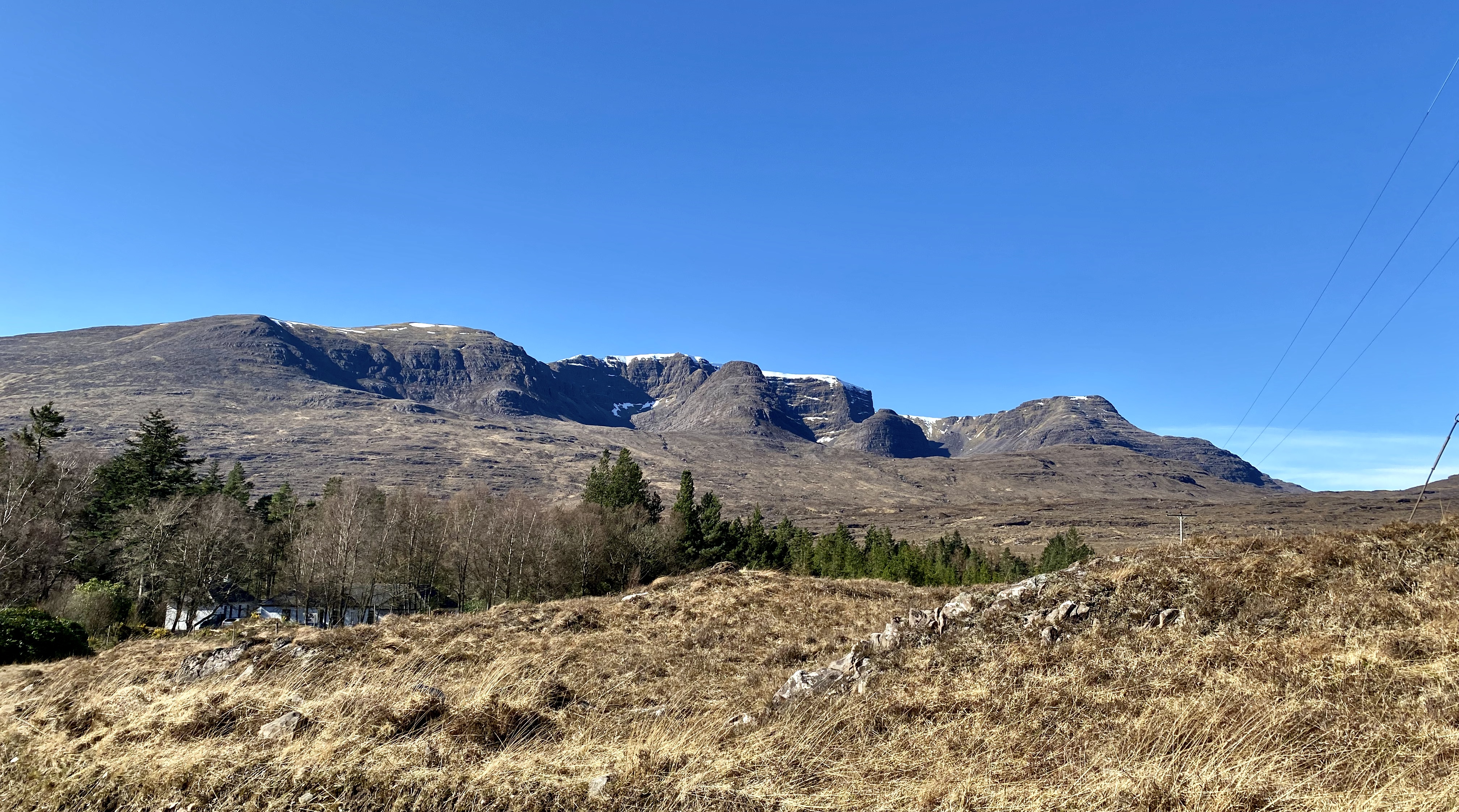
Beinn Eighe from Loch Clair

Sunday, 20 March 2022

Our weekend trip to Wester Ross was timed to perfection with the Met Office forecast. The news reported that Kinlochewe had been the warmest place in the UK yesterday, as we breakfasted in our room with a splendid view of Gairloch. Today would be a relaxed drive down the wonderful coastline of Wester Ross. We were away just after 8am. It was a sunny, cool morning with not a breath of wind or cloud to be seen. The traffic was almost non-existent, and this was the notorious North Coast 500, usually clogged with motorists drawn by all the marketing blurb from VisitScotland. 

Our first stop was to admire Slioch from the Scots Pine-lined shores of Loch Maree. We continued through the heatwave capital of Kinlochewe and along the Torridon road, 10 miles of single-track road offering the best views in the UK. We found a parking spot by Loch Claire and walked alongside the river to Loch Claire and on to Loch Coulin. The gorse was in flower, the photo opportunities were endless, and the walk was exquisite. The views to the Torridon mountains were sandwiched between the blue waters of Loch Claire and the equally blue, cloudless sky.

The drive to Shieldaig with a quick sortie into Aileen's favourite Torridon village to remember previous times was just stunning. As we left Glen Torridon,  Liathach and Beinn Alligin were mocking me through the rearview mirror. It is not often that I have driven past without paying them a visit. The cafe next to the Shieldaig hotel had opened at 11am, so we stopped for a coffee on the upstairs deck that overlooks the island. The village was also empty of visitors, but we wanted to absorb as much of the Wester Ross coast as possible. The coast road to Applecross was one possibility, but I suggested driving to Kishorn, where there is a seafood cafe. Unfortunately, the owner was painting the cafe, and it was not yet open for the season. We dropped down to Kishorn village on the shores of the Loch and gazed across to the massive oil rig that was overwhelmed by the massive bulk of the Applecross hills. Lunch was calling, so we drove to Lochcarron and skirted round the long sea loch that provides more vistas of sea and mountain before taking the narrow single track road to Plockton. 

Plockton was quiet despite the warmest of March days, and we walked along Harbour Road to the Plockton Hotel, a perfect place to enjoy the day with a crab salad and coffee in the outside garden. It was 2;30pm before we began the journey home. Glen Shiel gave us a chance to admire the shapely snow-capped Five Sisters and then back via Invergarry to Fort William. Ben Nevis, the Aonachs and Grey Corries were still wrapped in snow. The new M&S food store in Fort William is a useful development and offers us a ready meal as an alternative to cooking when we arrive home. 

In summer, the road from Fort William to Crianlarich is awash with all types of traffic, with motorcyclists, motorhomes, cyclists and trucks all demanding driver concentration and patience. On a warm March early evening, this was not required; the road was bereft of vehicles. Was it the price of fuel? We could enjoy the splendours of Glencoe and Rannoch Moor at our own pace, even though the heat of the day had resulted in a haze. The day had confirmed the splendour of Wester Ross, which remains in my mind's eye the very best of Scotland.

Room with a view - Beinn Alligin

Loch Maree and Slioch

Liathach

Beinn Eighe across Loch Claire

Beinn Dearg peeping behind Liathach

Shieldaig Island

Beinn Bhan

Kishorn and the Applecross hills

Sail Mhor


Sail Mhor

An Teallach from Destitution Road

Suddenly, after weeks of rain, there was the prospect of high pressure bringing clear skies and warmer days. In the last couple of weeks, lots of acquaintances had been getting COVID. An old friend who had visited last Sunday had gone down with it the next day so we had spent the week isolating but had not succumbed to the virus. We decided late on Friday to take advantage of the weather and escape from home for the first time since last August. We booked a B&B in Gairloch so that I could climb my penultimate Corbett, Sail Mhor, at Dundonnell and then spend the next day coasting down the spectacular scenery of Wester Ross.

Saturday, 19 March 2022

Ascent:       868 metres
Distance:    11 kilometres
Time:          3 hours 58 minutes

Sail Mhor              767m    1hr  48mins
Ruigh Mheallain     597m    2hrs 25mins

We left home shortly after 8am for the 205-mile journey to Ardessie by Dundonell. The early morning mist had been burnt off by Perth and the A9 was virtually empty until Dalwhinnie although the parking spots for the Drumochter Munros were full with hillwalker's cars. We were treated to the very best of views, even the Monadhliath Munros looked exciting with a lacing of snow etched against the blue skies. We stopped briefly in Inverness to top up on fuel at the highest price that I have ever paid, £1.77 per litre, a far cry from 42p per gallon during the fuel crisis of 1973.
 
The final leg of the journey across the Black Isle and through Contin was equally devoid of traffic. Ben Wyvis and then the Fannaichs were capped by snow. Then An Tealach came into view arousing the usual excitement that its crenulated ridge provides. Inevitably, I had to stop to take a photo before continuing to Ardessie at the foot of the Allt Airdeasaidh (River Ardessie). There is a parking place in front of a newish hydro plant a couple of hundred metres beyond the bridge. Boots and gaiters were required for the boggy ground and river crossing, I loaded the rucksack with too many items of clothing for what was a warm day on the hills. 

It was 12:30pm as I began the walk following a newly built path from the hydro plant that climbs at the west side of the river. The normal path is at the east side but is described as boggy and it requires a tricky river crossing higher up. The path meandered up the rock-strewn slope with well-constructed stone steps and climbed steeply to 150 metres where a water intake had been built. Beyond here a path continued through the grass and heathers alongside some spectacular waterfalls that had cut deep channels in the old red sandstone. It was warm work and my fleece jacket was jettisoned to the rucksack to join the unnecessary hat, gloves, waterproof jacket and trousers. There is a broad heather-clad flatter section at 350 metres from where the normal route would be to contour round and climb to the bealach south of Sail Mhor at 530 metres. I decided to make a direct climb up the steep east face instead. 

It was a good call, although I had my doubts as I slogged up through steep heather slopes and then a loose stone gulley. Just before reaching the broad plateau below the summit, there was a band of snow to cross. I kicked steps in the very steep crystalline snow but the steps were not holding so I used my hands as surrogate ice axes to haul myself up the 30 metres of snow. I was left with the final 80 metres of ascent on gentler slopes of Torridonian sandstone. There are two cairns, the one to the northeast has a well-built shelter and is a splendid viewpoint, this is where I had some lunch and gorged on the amazing views. To the northwest, the Summer Isles were visible over a sparkling Loch Broom, as was Mellon Udrigle on Gruinard Bay where Aileen had gone for a walk on the beach and headland, and to the south-east, An Teallach and the magical Fisherfield mountains were revealed from an angle that I had not seen before.
 
I walked over to the smaller cairn, which is probably slightly higher and then headed due south for the bealach. I had only walked a hundred metres or so when a golden eagle appeared 50 metres ahead of me and no more than 20 metres above the ground, I ripped off my gloves and grabbed the phone for a photo but the eagle was already a few hundred metres away and gliding upwards to another golden eagle. Within a minute they had disappeared towards An Teallach. Excitement over I dropped to the bealach and given that I was slightly ahead of schedule decided to climb Ruigh Mheallain, a hill that provides the perfect viewing spot for An Teallach and the two Beinn Dearg Corbetts. It was another good decision, it only requires 80 metres of climbing. The summit, littered with huge red sandstone blocks, allowed me to spend another ten minutes gazing into a wonderland of favourite mountains.
 
The diversion meant I had to put on my skates to return for my lift, it was an easy 2-kilometre descent to the river crossing. A Ring Ouzel was perched on a boulder in the river and grabbed my attention. With the aid of two walking poles, I managed to cross the river with dry feet although this was probably due to Goretex gaiters. The path at the other side was as boggy as had been described and after stopping to watch a Stonechat I came upon a recent landslip that had wiped out the path for a few hundred metres. The final descent alongside the impressive waterfalls was steep, boggy and twisty so I was 15 minutes late getting back to the car. 
 
So this was it, only one Corbett left to complete the 224 Scottish hills between 2500 and 3000 feet. I had climbed eighty or so during my previous Munro rounds but over the past few years, climbing the Corbetts has become the prime objective. Their comparative isolation, they are required to have a 500 feet drop between their summits, and the absence of paths on many of them make them possibly harder than the Munros to climb. I am left with just Beinn Dearg to climb. It is the highest Corbett at 2999 feet and is located at the heart of the Torridon mountains, a worthy final summit.

The final treat of the day was still ahead of us, an empty road past Gruinard Bay, Loch Ewe, Poolewe and on to Gairloch with blue skies and superb visibility to the Western Isles. And then the good fortune to discover that our B&B in a recently built croft overlooked Loch Gairloch with Beinn Alligin and Beinn Dearg visible from the bedroom. As an antidote to a miserable winter, this trip was exceeding all expectations.


Looking towards An Teallach on the ascent

Sail Mhor, head for the bands of snow

Sail Mhor from east

Sail Mhor summit

Fisherfield from Sail Mhor

Golden Eagle

Beinn Dearg- Mhor and Bheag
An Teallach from Ruigh Mheallain

Sail Mhor from Ruigh Mheallain

Sgurr Fiona and Lord Berkeley's Seat

Waterfalls on the Allt Airdeasaidh

Thursday, 17 March 2022

Triple Duplicity

Begging for Oil

It has been a good few weeks for the government and Prime Minister if not for humanity. The partygate allegations at 10 Downing Street have been kicked into touch courtesy of the Metropolitan Police taking over the investigation from Sue Gray. The Russian invasion of Ukraine had resulted in opposition parties supporting the government's condemnation of the invasion and the government has aligned itself with the position taken by the USA and Europe. In times of trouble, it is not a good idea to be going it alone in full Brexit camouflage.

But then on 16 March, we had a triple whammy of events that reminded us that Boris Johnson's government will always seize the chance to obfuscate, dither and then claim the kudos for anything that tickles the fancy of the British public.

First, in order to address the shortage of oil and gas and the consequent escalation of fuel and heating prices, Johnson was off to Saudi Arabia and the United Arab Republic to ask them to ramp up oil production. After all, they had been kind enough to buy our fighter planes, military equipment and weapons with which the Saudis had bombed Yemen. Their human rights record had been highlighted again by the execution of 81 people at the weekend but did not seem to bother the PM. 

Second, Nazanin Zaghari-Radcliffe was released after 6 years in an Iranian jail for alleged spying after Johnson had wrongly claimed she was training journalists. The release was always going to be conditional on repaying the debt for tanks that were never delivered. Five Foreign secretaries had failed to achieve her release. It should have been understood by this government, which has welcomed Russian money with open arms, that money makes the world go round, especially when dealing with autocratic or corrupt governments. However, the UK government had delayed paying the £400m debt since an arbitration by the International Court of Justice in the Hague in 2009. It is no surprise that after years of obstruction, the government now decided it was a good time to pay the debt so that the Iranians might also increase their oil production. Liz Truss claimed it was her diplomatic skills "wot done it" and will no doubt turn up for an Instagram photo to welcome Nazanin home. It will add to her impressive CV as the Foreign Secretary. She has already negotiated for Australia to import beef and lamb that fails UK food standards, mistakenly called the Black Sea the Baltic Sea and been summarily dismissed from a diplomatic meeting with Sergey Lavrov, the Russian Foreign Minister, who said that it was like talking to a deaf person.

Third, we had the claim from various ministers that the UK was leading the support for Ukraine by the PM providing more weapons than any other NATO country in Europe. The government then tried to ride the humanitarian offers by 100,000 UK people to take Ukrainian refugees, even though this was done by the people, not the government. The UK is the only country requiring visas for Ukrainian refugees and demands that these be completed in foreign embassies some of which have subsequently closed or online, whenever we get the software sorted out. It is no surprise that the UK has so far received fewer refugees than any other country and has been ridiculed by President Macron, the Finnish prime minister and numerous other European leaders.  

Is there no limit to the lengths that the government will go to claim kudos for their failures or their rapacious attempts to grab resources at the expense of other more needy nations?


Thursday, 10 March 2022

Cuban Missile Crisis 1962

Kennedy and Krushchev on the brink of destruction

As the standoff between Putin's Russian Federation and NATO deepens, we are reminded that the last time things were this tense was during the Cuban Missile Crisis in 1962. The USSR was installing nuclear weapons in America's backyard, Cuba, as retaliation for the USA and NATO doing the same in the backyard of the USSR. The prospect of a nuclear holocaust seemed more likely than ever. The USSR was a formidable power with President Nikita Krushchev having more nuclear weapons and a track record of winning, whether the Olympic games or the space race. Despite Khrushchev's decision to partly democratise the USSR after Stalin, he was unwavering in his control of the countries within the then Iron Curtain. When Hungary sought to leave the Warsaw Pact in 1956, the uprising was crushed by the Soviet army in a couple of days with 2500 citizens killed.

As a young teenager, the Cuban Missile Crisis left an indelible impression of the fragility of life. It was the end of the 'never had it so good' days of PM Harold MacMillan. But also the start of the revolution in our values, and lifestyles and the end of respect for authority that had underpinned the post-war years. My father had always been active politically and he helped CND organise an anti-nuclear war torchlight procession in the town. I was dispatched to collect empty syrup and treacle tins from all the neighbours. We screwed them onto broom handles that had been sawn in half, filled them with rags that were soaked in paraffin and about 400 of us trundled through the town centre on evening singing Pete Seeger songs like 'If I Had a Hammer and 'Where have all the Flowers gone'. It seemed to work and the Russians and Americans backed off. 

After the retrenchment by Kennedy and Khrushchev, the local CND group wrote a play about the Cuban Missile Crisis that was performed at the cooperative hall. It was produced by Janet Beard, a passionate pacifist and art and drama teacher at the local girl's grammar school. The lead role was taken by an abrasive trade unionist from Leyland Motors, Jack Balshaw. It nurtured his nascent charisma and he went on to become a principled and energetic Councillor. At the national level, the shock of the missile crisis influenced a new era when the UK's priority of amassing weapons of mass destruction gave way to applying the white heat of technology for civilian purposes, the growth of universities, and the granting of independence to many former colonies.

The aftermath of the crisis prompted me to read the collected works of Upton Sinclair that my father had acquired during his time in the Eighth Army. The 'World's End' series consisted of 11 books, a total of 7,340 pages, covering world events and sometimes claimed as "the greatest historical novel of the 20th century". It was written from the perspective of a multilingual pacifist and art collector, Lanny Budd, the son of an American arms manufacturer and French socialite. He became a translator for President Wilson during the creation of the League of Nations at the Paris Peace Conference in 1920 before witnessing the Great Depression of the 1930s in America and Europe. Through friends in Germany, he observed the rise of the National Socialists. His life was a travelogue through Europe in the 1920s and 1930s with the history of art as a backdrop.

Meanwhile, as adolescence kicked in, there was more than politics and CND to fire the imagination, I had discovered radio Luxembourg, pop music, jeans and grown sideburns. Our regular evening games of football on a triangle of grass lasted until dark. After the game finished a dozen young teenagers were joined by Jeanette, the attractive sister of one of the boys and we talked about music and whether the Cuban Missile Crisis was the end of civilisation. Our parents were stocking their larders with tins of corned beef, soups and biscuits; children and teenagers were not sleeping and going to school wondering whether this would be the last time. 

Dennis had been my best friend for six or seven years, he was a year and a half older than me and about to turn 15. He was leaving school at Christmas to join the navy, see the world and get his daily ration of free cigarettes. He had styled himself on James Dean, combing his quiff, chain-smoking cigarettes and posing in his leather jacket. He expected to boss things and attract all the girls. He missed out on Jeanette, he was into Elvis and Eddie Cochrane and they were for teddy boys; Jeanette and I favoured Let's Dance by Chris Montez, and Loco-motion by Little Eva. Jeanette bought me 'He's a Rebel' by the Crystals, my first record. Dennis and I drifted apart, he had signed up for the old order. 1962 had delivered not only the worst winter since 1947 but also a near-world war and brought about the advent of my teenage angst as well as a girlfriend. 

However, in 1962 there was no real disruption, no refugees, no damage to buildings or loss of work. Just a tipping point where the strict adherence to dress codes, social etiquette and class structure had been broken. As we watch the devastation in Ukraine, the hope is that there will be another tipping point, whereby autocratic regimes will be toppled by the advance of soft warfare through social media. economic sanctions. and global ethical support for a sovereign nation. The ultimate weapon would be a United Nations that harnessed these collective soft powers and provided the resources and collective authority to protect democracy and safeguard the peaceful coexistence between all nations. If only the League of Nations had not been rejected by President Harding, the Republican American President who succeeded Wilson, and the reparations imposed on Germany by France had not been so draconian and nurtured the rise of the National Socialists.

Thanks Sir Neil

Sir Neil McIntosh

Tuesday, 8 March 2022

It was my second trip to Edinburgh this year, things are returning to normal after Covid interruptus.  we were paying our respects to Sir Neil McIntosh, the doyen of Scottish Chief Executives. He had helped most of us as we began our time as Chief Executives and was always on hand to give his time and confidential advice when difficult decisions were required.  Neil retired in 1996 after a varied career as an operations and methods professional with various companies leading him to become a Director of Manpower (Human Resources) at Highland Council. His career was advanced by becoming Chief Executive of Dumfries & Galloway Regional Council where he dealt deftly with the Lockerbie air crash before taking the same position at  Strathclyde Regional Council until retiring in 1996. He was the returning officer for the referendum on the Scottish Parliament in 1997, and chair of the Commission on Local Government and the Scottish Parliament that reported in 1999. He was appointed as the Scottish representative on the newly established Electoral Commission in 2001.

After retiring as a Chief Executive, he has spent 26 years passing on his experience and fulfilling numerous important assignments with his customary honest and calm style. In recent years he has helped encourage half a dozen of us to capture the key events of our working lives from the 1970s onwards and record the lived experiences of some of its key players. We are still at the start of this project but with a dozen papers produced and published and over 30 videos in the can that can be found on the Knowledge Hub under the Mercat Group. The mission is to capture some of the key events and the knowledge from key players from the years before and during the parturition of the internet. 

He had decided earlier in the year that after a lifetime of devoted public service, it was time to focus more time to his many personal interests. We invited Neil for lunch at the La Garrigue restaurant in Edinburgh to thank him for his unstinting support and to hear how his egalitarian values had shaped his career. He was as friendly and knowledgeable as ever and after hearing of our latest efforts, he shared some of his thoughts about the future of democracy in Scotland. One that needed to evolve but respected subsidiarity as a key component of whatever happened to the future relationship between the nations of the United Kingdom. 

He spoke of his varied career and the importance of his time at the Moray Sea School, which was the event that taught him the most. He was in a group that brought together young people from all backgrounds, including offenders and treated them as equals. It taught him to recognise the abilities of all people and the importance of encouragement. We were all benefactors of this, after his retirement, he was always on call to be the fair-minded trusted custodian of democratic institutions from voluntary organisations to Councils and the Scottish Government. It also made me realise that many of Aileen's qualities were possibly acquired during her fortnight at the Moray Sea School as a young publishing editor with William Collins. I was attracted by her serene nature during her robust challenge to a white Rhodesian who was defending apartheid on the night we met.

As I left Edinburgh on the train, the Red Rebel Brigade made a startling appearance to demonstrate that we must pay more than lip service to Climate Change. I’ll buy that.

Red Rebel Brigade Campaign for Climate Justice

Edinburgh Council Offices and Calton Hill

View over Waverley Station to Princes Street.


Saturday, 26 February 2022

Thank God its almost March

Joan Eardley - Glasgow Children

Things change and never more than in the last couple of years. After retiring I found February one of the best of months: cold sunny days, no longer the annual nightmare of budget meetings, winter hillwalking and the prospect of Spring. This year has been the worst of months: climate change resulting in perpetual wet grey days, three named storms bringing gale-force winds, never-ending changes to COVID restrictions, a failed charlatan as PM and now the Russian invasion of Ukraine. The sense of pending doom has never been so apparent.

Apart from the odd visit to the supermarket, my first visit to a barber for 2 years and a dozen early morning jaunts up my local hill, nothing has happened. I have watched the daily litany of obfuscations from the PM, the dismissal of the Met Chief Constable, the unbelievable incompetence of Liz Truss and the inhumanity of Priti Patel with ever-increasing anger. Some good TV, notably 'This is going to hurt', the Winter Olympics and some football games have lifted the spirits. Wordle and a daily Sudoku exercise the grey matter. 

The last few days of February provided a dump of snow, a trip to Perth and then to Falkirk to watch Gregor compete in the National XC championships. Four inches of snow added 4 minutes to my regular walk-up Lime Craig. I was pleased that the ugly telephone mast erected at the exposed summit last autumn was felled by Storm Dudley, the mast is irreparable. The power for the mast was provided by two solar panels but as the sun became a reluctant source of energy a diesel generator had been installed. A 4x4 truck was driven up the track to refuel the generator a couple of times a week and in the process created a mudslide on the track. It resulted in a nasty fall as I was running down in December. I was sent for an X-ray on my arm, it was not broken but the rotator cuff tear has made sleeping a challenge for the past three months.

We went to Perth for an outing and visited the Joan Eardley exhibition in the excellent Museum and Art Gallery. Her portraits of children from Townhead in Glasgow captured the reality of child poverty in the 1950s. Her seascapes and landscapes of Catterline on the Angus coast were painted on board and the oils were mixed with mud, grass and ship's paint. There were a significant array of these impressionistic paintings on display, she had harvested the wild winter landscapes and seascapes with cold hands and stiff brushes giving the pictures a rustic reality.

Perth town centre was much the same as Stirling, largely empty of people although traffic volumes seemed back to normal. The loss of department stores like Debenhams in both towns has left physical and expenditure voids. Together with the loss of smaller shops, there is a sense that town centres will struggle to regain footfall although this has been amplified by a large proportion of office workers still working from home. Public transport has been reduced as there is a reluctance to use the bus by many folks. Car trips are taking precedence as people head to out of town retail parks and refrain from crowded transport modes.

It is over thirty years since I last competed in the National Cross Country championships. It was usually a slog in cold weather over muddy ground whether in Irvine or Falkirk. When I began to cut back on racing, cross country races were abandoned for hill races, the longer format and more relaxed atmosphere was far more enjoyable. However, the National is still a tremendous spectacle with 650 runners competing this year. The collective energy and competitive spirit between the clubs create an atmosphere that bonds the participants into the mutual friendship of the running community. 

Lime Craig - mast destroyed

What's On - Joan Eardley

Landscape Catterline - Joan Eardley

Start of the 2022 National XC Championships


Wednesday, 2 February 2022

Sue Gray's Update

Sue Gray's Update - Main Findings
  • Some behaviour at the gatherings is "difficult to justify" given the public was being asked to "accept far-reaching restrictions on their lives"
  • Some of the events represent a "serious failure to observe" standards for government and those expected of the public at the time
  • At times it seems there was "too little thought" given to what was going on in the country, the risk to public health, and how the events might appear to the public
  • There were "failures of leadership and judgement" by different parts of No 10 and the Cabinet Office at different times
  • Some of the events "should not have been allowed to take place". Other events "should not have been allowed to develop as they did" 
  • There should be "easier ways for staff to raise... concerns informally, outside of the line-management chain"
  • The "excessive consumption of alcohol is not appropriate in a professional workplace at any time" 

We had been waiting for weeks for Sue Gray's report into events in 10 Downing Street that had flouted the government's Covid guidelines. It had been delayed by the late intervention by the Met Police the week before when they saw the evidence that Sue Gray had uncovered, which could be a criminal offence. Why the Met had not instigated such an enquiry months ago is anyone's guess, they have many officers on duty at all times and enough CCTV footage to have copped the number 10 miscreants months ago. The Met is probably aware that most of its inquiries either result in cover-ups or self-inflicted evidence to add to its already rock-bottom reputation. 

Having looked at Sue Gray's draft report, they identified 12 occasions when events took place that could have breached regulations. Together with 500 pages of evidence and 300 photographs passed to them by the Cabinet Office, they realised that they had to act. In doing so they would not allow Sue Gray to submit her full report, all details of the 12 events had to be deleted so the report became an update of her investigation. Not to be denied some retribution on the PM, who seemed determined to delay, obfuscate and "inadvertently lie" to parliament about events, she highlighted some of the key conclusions of her findings that have been sufficiently caustic to prevent Johnson's claims of innocence having any traction. 

The PM, in an unusually contrite opening statement, made an apology and said he would be taking action to reform the number 10 culture, presumably by sacking civil servants and that he would Fix It like that bloke who used to be on TV. We were then treated to some House of Commons theatre that ultimately proved that the House of Commons is no more fit for purpose than the PM and his cabinet acolytes. Keir Starmer did not hold back in a forensic dismissal of the PM's ever-changing denials of being the principal party wallah. Theresa May and Andrew Mitchell showed their utter disdain for the PM and Ian Blackford, the SNP leader accused the PM of being a serial liar, refused a request by the Speaker to use the adjective 'inadvertent', and walked out before being dismissed from the chamber. 

The PM resorted to a series of unjustifiable attacks on Keir Starmer who he claimed had failed to nail Jimmy Saville when he was Director of Public Prosecutions. He summarily dismissed all questions from opposition members by saying that they would have to wait for the Met to report and smirked his way through question time by repeating many of his usual childish insults. He even refused to answer questions of whether he had been in his flat on the evening of one party that the Met was investigating. 

His defence that he was getting on with the things that mattered to the British public including the threat of a Russian invasion of Ukraine was another own goal when it was discovered that he had called off his phone call to President Putin following the publication of Sue Gray's report. He also claimed he was focusing on levelling up, another untruth that became apparent the next day when no extra resources were made available. How he has the nerve and impunity to deliver so many untruths and be allowed to continue as Prime Minister is a sad indictment of how far our democracy has been corrupted over the past decade. 

The fact that the Conservatives allowed him to undermine both David Cameron and Theresa May during their time as PM and then to hustle through a Brexit that is more 'raw' than 'well done' is a stain on the credibility of the Tory Party. It is also an indictment of the inept leadership of the Labour Party and the Lib Dems by conceding a General Election in 2019 when his hard Brexit negotiations were on the ropes and then performing lamentably in the said election. 

Despite the subsequent victory, Johnson performed no better than Theresa May had done in 2017, they both gained the votes of just 29% of the total electorate. The vicissitudes of the first past the post electoral system translated this into an 80-seat majority for Johnson whereas for Mrs May they gave a bare majority. The fact that less than 30% of the electorate voted for Johnson suggests that the public has always been aware of his foolishness and lack of gravitas; so have the Tory MPs, but they hide behind the fiction that he is a vote winner.


Saturday, 22 January 2022

On yer Bike, Pal


As we watch the daily shenanigans in the Tory Party after allegations that Number 10 is a party magnet and wait for Sue Gray, there is a sense that we may have A Very British Coup.  It will be the polar opposite of Chris Mullin's novel and subsequent TV series about the establishment taking out a Labour Prime Minister for seeking to deliver his manifesto. This time it will be for partying in Downing Street on numerous occasions whilst the rest of the nation suffered in lockdown. It is quite evident from all the opinion polls, the vox pops, and the internecine war in the Tory Party that parties are beyond the pale. 

Whilst it is easy to understand the public mood of anger at the PM's latest display of hubris, it has not come without warning, and it would rank quite far down the scale of his worst failings. Consider Boris Johnson's lifetime achievements in breaching the norms of honesty, decency, fairness, responsibility and diplomacy.

As a Journalist, Johnson was adept at faking articles, making up myths and was sacked from the Times. At the Daily Telegraph, he reported from Brussels and became a leading Eurosceptic whilst inventing myths about overzealous regulations. As editor of the Spectator, he opposed the banning of handguns after the Dunblane massacre. He has recently admitted that he is Guilty about his-Journalism.  This doesn't absolve him from the misogynistic and racist comments that frequently adorned articles, such as “It is said that the Queen has come to love the Commonwealth, partly because it supplies her with regular cheering crowds of flag-waving piccaninnies.” There are dozens of similar quotes that led his editor at the Telegraph to pronounce him totally unsuitable for any office of State

As Mayor of London and Prime Minister, he has shown a total disregard for financial probity and a tendency to reward supporters. His propensity to promote vanity projects such as a new airport on the Isle of Dogs, Garden Bridges over the Thames, a bridge to Northern Ireland, and a new Royal Yacht have all come to grief, but only after millions of £ had been wasted on feasibility studies. He overspent on new London buses, converting the Olympic stadium into a football stadium and wallpaper. Worst of all, he approved £37bn to be spent on a Test and Trace programme that never worked but was managed by one of his friends. Other friends were poured into the House of Lords or given the chance to win massive PPE contracts through a fast-track. 

His habit of ditching family, friends, colleagues and his lack of concern for the common good have been manifest throughout his career. Without commenting on his family travails, his willingness to provide details of a News of the World colleague to enable a physical attack in 1990 suggests that his moral compass is uncalibrated. His dismissal of Tory MPs who didn't accept his position on Brexit was a measure of his oligarchical ambitions. By disposing of MPs like David Gauke, Rory Stewart, Justine Greening, Heidi Allen, Alistair Burt and Dominic Grieve, some of whom were pushed and others jumped, the Tory Party has lost its most honest advocates for social justice, human rights and ethical foreign policies. The new intake of Brexit loyalists are now realising that loyalty is a one-way ticket with Boris Johnson. Already, one has switched to Labour and a dozen MPs have been blackmailed or threatened by the PM and his whips for failing to support controversial policies that adversely affect their constituencies or if they were likely to call for his resignation.

His tacit support of ex-President Trump, the appointment of ex-Australian Prime Minister, Tony Abbott as a Trade Advisor, his relationship and ennoblement of Russian Oligarchs, his implicit involvement in the imprisonment of Nazanin Zaghari-Radcliffe and his failure to negotiate her release illustrate his support for populist regimes and abstinence from ethical foreign policies. Soft power opportunities for the UK have been sacrificed by the cuts to International Aid and his minimal engagement in the COP26 Climate Change conference that he supposedly hosted, but with a social distance that he gleefully ignored when it came to Covid.

As one of the original Eurosceptics and the inventor of many fake defamation stories about the EU, it is no surprise that he has continued to show no inclination to collaborate with European leaders. The hard Brexit that he hustled through parliament has had a devastating impact on trade, inflation, UK businesses, Irish relations and travellers. As an entitled Eton and Oxford classical graduate, there is no sense of mea culpa; that sort of admission is for snowflakes or the woke tendency at the BBC. 

Lying is not parliamentary language, and accusations of the Prime Minister being a liar is unparliamentary. But it has ever been the case, as the article from Rory Stewart makes clear. “We should all have expected this. He’s been a very famous public figure for 30 years. The British public has spent 30 years focusing on the fact that he lies, that he is disorganised, that he betrays almost every personal commitment that he has." He has lied to Liverpool, to The Times newspaper, to the then Tory leader, Michael Howard, to the electorate on Brexit and much else, to the EU, to Lord Geidt and the Queen; so what makes anyone think he is not lying about Partygate. It is part of his DNA.

So, despite a lifetime of intended or unintended dire consequences from his time in public office, it will be the partying that seals the fate of our populist PM. After Sue Gray reports, we will watch another very British coup, with the eventual realisation by Tory MPs that they will go down the tubes with him. His exit could be captured in the words of populist TV programmes; his final chorus of 'Would I lie to you?'  will be 'Pointless', he is a Traitor and 'Big Brother' will hopefully evict him.

PM on offer, must pay well


Friday, 14 January 2022

Question Time for Britain


Andrew Windsor

Yesterday was a D-day for the UK. Boris Johnson was eviscerated by MPs, the press, and the electorate over his addiction to half-truths and failure to observe the principles of good governance: selflessness, integrity, objectivity, accountability, openness, honesty, and leadership.  Then the not-so-grand Duke of York was unfrocked and stripped of all royal privileges. Parliament and the monarchy, the two institutions that are the foundations of the UK constitution, have been found wanting.

Sympathy for Boris Johnson was noticeably lacking, apart from the insincere mumblings from weak-willed cabinet ministers who were dispatched to stem the tide, armed with only a few shibboleths that they repeated ad nauseam as they were ridiculed by journalists and commentators. Anyone watching the events of the last few weeks would come to the conclusion that we are led by a charlatan who has never had the temperament or gravitas, let alone the grasp of leadership to be elected to any level of governance. 

On Question Time from the safe Tory voting Shrewsbury, there was a wave of total anger and a near-unanimous belief that Johnson had no option but to resign. Even the former Daily Mail far-right columnist and Brexit worshipper, Isabel Oakeshott, called for the PM's resignation. The government stooge for the programme, the hesitant and rambling Simon Hart, must have wished he had told the PM to find someone else to defend the indefensible as he struggled to respond to the overwhelming condemnation of the PM. It is time the cabinet and junior ministers started a 'why me?' movement.

The total unsuitability of Boris Johnson as PM is hardly news, even Max Hastings, the former Daily Telegraph editor and boss of Boris Johnson, wrote an article three years ago that has proved almost word-perfect in its predictions.

"There is room for debate about whether he is a scoundrel or mere rogue, but not much about his moral bankruptcy, rooted in a contempt for truth. His premiership will almost certainly reveal a contempt for rules, precedent, order and stability.

Dignity still matters in public office, and Johnson will never have it. Yet his graver vice is cowardice, reflected in a willingness to tell any audience, whatever he thinks most likely to please, heedless of the inevitability of its contradiction an hour later.

Like many showy personalities, he is of weak character. I recently suggested to a radio audience that he supposes himself to be Winston Churchill, while in reality being closer to Alan Partridge." I have a hunch that Johnson will come to regret securing the prize for which he has struggled so long because the experience of the premiership will lay bare his absolute unfitness for it."

My disdain for the man goes back to 2004 when he cycled past an outdoor cafe in London and was harangued by some of the clients for lying about an affair that had him sacked as a minister, and he gave two fingers to the cafe. His performances on Have I Got News for You were most notable for his bumbling incompetence, but they gave him comedic notoriety. This was amplified during his stunts as Mayor of London like wafting about on zip wires and giving personal favours to friends. He wasted public money on iffy plans for airports and bridges as well as poor procurement of buses, bikes and water cannons.

It is very noticeable that the other political leaders in the UK: Keir Starmer, Ed Davey, Caroline Lucas, Nicola Sturgeon, and Mark Drakeford have all displayed gravitas and followed the principles of good governance during the pandemic. They may lack the populist instincts of Boris Johnson but they have put in the hard yards and shown a willingness to listen to the evidence and advice that Johnson has persistently avoided or delayed taking.

Prince Andrew has a no less toxic presence in the elite echelons of our constitution. He displays many of the flaws that have made Boris Johnson such an implausible prime minister: entitlement, lack of empathy, selfishness, extravagance, and failure in his duties. They were not qualities that endeared him to his subjects, nor was his obsession with titles, uniforms and playing golf. He is by some distance the least liked member of the Royal family, according to those who have had the misfortune to have had dealings with him. Unlike the prime minister, who was elected by his peers, Prince Andrew inherited his titles, gongs and wardrobe of uniforms. Unfortunately for him, the family decided his association with Epstein and Maxwell was damaging the monarchy, so they made it clear that when he was down, he was down. It is a lifetime achievement award.

The Tory party are being unusually slow to dismiss their man. They still have this belief, echoed by the press hacks, that he is an electoral asset after gaining an eighty-seat majority at the 2019 general election. This is a sad deception; it was achieved with only 29% of the electorate voting Conservative despite the dire performances and savage press attacks on both Jeremy Corbyn and Jo Swinson, Johnson's principal opponents. It was one of the lowest-ever percentage polls for the Tories, but the first-past-the-post electoral system gives strange results when there are multiple opposition parties. Theresa May also achieved 29% of the electorate's votes in the 2017 election but she was facing peak Corbyn in what was a two-party fight and barely obtained a majority of MPs. Perhaps the real reason the Tory MPs have not ditched Johnson is that in Rishi Sunak and Liz Truss, they would have to choose between the devil and the deep blue sea and they haven't figured out which is which yet. 

It is time for a written constitution; neither the Tory Party nor the House of Windsor should remain the custodians of our dysfunctional unwritten constitution. The likelihood of either of these institutions delivering any form of levelling up is mere fiction for little people.