Friday, 25 February 2011

A9


Almost a daily event on the A9
The A9 is Scotland's backbone, but has become the deformed spine of the nation.  For almost forty years, I have been travelling it 4 or 5  times a year to ski, climb the hills of the north, on family holidays or simply to make a meeting in Inverness. Today was for the latter reason, and it was a return trip. The experience was no better or quicker, owing to road works and heavy lorries, than it was in 1973 when it took three and a half hours during the Friday evening wagon train on the narrow twisting old A9 to reach Aviemore from Glasgow for a weekend on the ski slopes in the days when snow was more reliable.

The section of the A9 from Perth to Inverness is notorious for having more accidents than any other section of road in Scotland.  So bad that the Scottish Government has held back publishing the figures for the last two years. The reason for the unacceptable state of the road can be attributed to the lack of strategic decision-making by the Scottish Government, which has direct responsibility for trunk roads.  

There are sections of dual carriageway laced with single carriageway sections all the way; completing the job seems to be beyond the ken of successive governments.  Traffic is held up for 5 or 6 miles behind lorries, caravans and Nissan Micras travelling at 40 mph.  The dual carriageway section approaches, and it is like the grid of a grand prix as white vans, souped-up Vauxhall Corsas, empty lorries and executive saloons vie to get the outside lane for a quick dash down the next couple of miles of dual carriageway.  Not to be outdone, the holding lorry, or caravan, accelerates to 60mph, with the effect of reducing the number of vehicles that can pass.  More frustration builds up, and attempts are then made on the next single carriageway section to make the thwarted overtaking manoeuvre.

My hill running partner and hillwalking friend, Keith, with whom I have often driven up the A9, is a highway engineer.  He explained how, in the 1970's, the Scottish Office guidance for road design was to blend the new highways in with the landscape and construct sweeping curves.  This made for scenic journeys when traffic was far slower and lighter than today, but it has left a legacy of suicidal overtaking traps. On most trips, there are generally two or three incidents when speed-crazed drivers are travelling well beyond any speed limit to get in front of that lorry, caravan or slow-moving car ahead.  The oncoming victims are randomly engaged as they appear around the graceful bends into the speeding madmen. Any journey along the A9 induces several bouts of road rage, and keeping it bottled seems impossible for many drivers.  It explains why there has been an average of over 200 accidents and 15 fatalities a year along Scotland's backbone.

Even the Dutch/Australian author Michael Faber, who is domiciled in Scotland, did not achieve such butchery in his novel 'Under the Skin'. This novel, which was made into a film, was set on the A9 where an extraterrestrial female, Scarlett Johansson in the film, picks up male hitchhikers and returns their bodies to her planet as 'vodsel' - a tasty meat dish of human flesh. It might have been more believable if she had been the hitch-hiker who was picked up by sex- and speed-crazed male drivers, who she eliminated with capital punishment. More recently, Ian Rankin has set his latest Rebus novel, 'Standing in Another Man's Grave', on the A9 with another set of killings to accompany those arising from the annual cull of road fatalities.

In the context of this level of road kill, it is unbelievable to understand how Edinburgh trams at a cost of £776m and a second Forth Road Bridge costing £1.4bn have obtained priority over the A9. Both Edinburgh and Glasgow have superb bus links from their airports to their city centres, and the Forth Road Bridge generates much unsustainable commuter traffic, whilst at most times of the day it has more than enough capacity to cope with routine commercial and visitor traffic. Of course, it may be that the existing Forth Road Bridge has a limited life span, but no Minister is prepared to admit that, so we must assume that the A9 is a lower priority than making Scotland ever more Edinburgh-centric.

In the land of engineering legends - Sir William Arrol, John Dunlop, John McAdam, Sir Robert McAlpine and Thomas Telford - the lack of investment in the A9 is Scotland's greatest engineering tragedy.
Scarlett Johansson as A9 Film 'Under the Skin'

Thursday, 24 February 2011

Fitful Head

Fitful Head from Quendale

Sunday, 13 February 2011

Run  9 kilometres, 310 metres of ascent, 1 hr 0 mins 10secs

Fitful Head   283metres   32mins 

Fitful Head is the high point at the southern end of the Mainland and resembles a wedge of cheese leading to some massive cliffs that fall almost 1000 feet into the sea.  It is topped out by a giant golf ball that is a radar dome for Sumburgh airport and various transmission receivers for the coastguard and television.

All Sunday morning I had put off going out for a run in the lashing rain, there are many days like this and they are best summed up in this reflective posting from a friend, Diane, who captured the dark days of a Shetland winter with vernacular humour.  'Just spent 10 mins trying to scrub a dark rib fae around da bath - it wis da reflection o da venation blind! (Dat lang fae da sun shone dat I hidna noticed it afore!!!) Doh!'  

I had to go to the airport to pick up a colleague so I left just an hour to run up Fitful Head from Quendale Farm. It was blowing a gale but the rain had stopped as I headed eastwards from the farm along a track, crossing various fields and dodging the rabbits until I reached the Valley.  There was a long boggy section across some fields until I crossed some fences by a small dam and reached the track which climbed steeply until the Kame and Nev appeared as twin headlands trapping the sea between them. The coastline between them was shaped like a W and the energy of the waves was wasted destroying the headlands. The track veered south and steepened again there was another kilometre of climbing into a strong wind.

I arrived at the collection of communication paraphernalia and buildings in the midst of which I discovered a lonely trig point. I was wary of being frazzled by all the equipment so I quickly skipped over a fence and ran along the cliff edge heading towards Siggar Ness. Despite being downhill it was as hard as the ascent into the fierce wind. I decided to take a more direct route down Set Dale towards the Hill of Cleap. It would strengthen my ankles dodging through the clumps of grass.  I hadn't expected to land on a Woodcock but it made a safe escape, apparently, they are numerous in these parts and are shot by eminent Shetland folk musicians that I know as a delicacy.

When I reached the flatter grazing land I circuited clockwise round the Cleap and found the track that returned me to Quendale farm, arriving back just outside the hour.  I leapt into the car and texted my colleague, Nigel, who was due to land about now. The time to get off a plane, reclaim luggage and exit the airport is seldom more than 4 or 5 minutes at Sumburgh. This dream airport experience gives some compensation for the usually choppy descent and bumpy landing or if really windy a couple of aborted attempts before the final landing. 

Nigel was waiting at the door as I arrived at the airport and was slightly perplexed as I jogged past him into the terminal to reclaim a book that I had left in the seat pocket of the aircraft when coming up a week earlier.  The airport staff delivered it with a smile, I was by now a regular flyer and, as I knew a couple of the staff, we had some friendly banter.  I was covered in mud from my trip up Fitful Head. We returned back to Gulberwick for roast Shetland lamb and some black potatoes that I had been given when visiting Peter and his family in Brae yesterday. 

Sunday, 13 February 2011

Dalescord Button Hills - Run Rabbit Run

Button Hill Cairn
I had planned to climb Ronas Hill, but first light was blown in by a strong south westerly that had raged through the night, dislodging various outdoor accoutrements that had crashed past the house.  The rain was flying, not falling, so I languished about doing bits of work and waiting for an alternative plan to materialise. There was always the Button Hills, in the middle of nowhere, south of Sullom Voe, with no obvious merits and not even appearing in any guidebook book but a Marilyn nevertheless if I could find the summit.  I knew from years of Munro bashing that even the most tedious sounding hills can generate all sorts of unseen adventures even on foul days, and so it proved.

When I mentioned my plan to a local, she said that this area was where the first bombs of the Second World War had landed in November 1939 when the Luftwaffe tried to hit the seaplanes based in Sullom Voe but had only managed to kill two rabbits. This had led to an adaptation of the popular song Run_Rabbit_Run and it became a hit. 

So late morning, I set out for Voe and then along to Susetter, where I parked in a desolate wind wind-swept glen below a scarp slope that led to a great expanse of peat moorland.  I donned waterproofs and was sucked over the nearest fence by a vortex of rain-assisted wind. With it at my back, the ascent over steep wet slopes was no sweat.  I was soon on the cusp of the scarp and could see the finger of Dale Voe to the north east and a vast panorama of peat hags ahead. I knew that there was no obvious top or trig point, but thankfully, the cloud level had risen, so I could see the full extent of the rising hillocks.  

I made for what I thought was the high point of the convex slopes, but upon arrival, concluded that there was a slightly higher button to the north west.  I headed for it, and the high point of the Button Hills turned out to be a peat hag.  There were some stones scattered around, which I collected and fashioned into a cairn on a hill I called Marilyn's Buttons.  Building the cairn was a lot easier than the return trip; it may have been downhill, but slaloming down the peat hags was no fun in the wind.  But the walk had cleared my mind, and I stripped off my wet clothes and drove down to Brae to call on Peter and his family. 

I sat in a beautifully constructed timber frame house with a view that only nature could conspire.  I scanned across the voe, had the chance to hold and admire the smiles and tears of a 5-week-old baby, learnt more about community life, local football, and felt privileged to be welcomed into the abundant sharing that takes place across the Northern Isles. I am not surprised that life expectancy is so high, folk just "breathe in the air and aren't afraid to care" in Shetland.  I left with a bag of Shetland black potatoes,  Kenny Dalglish's biography and advice on where to buy a leg of Shetland lamb for tomorrow's evening mea that I was cooking for colleagues whom I would be collecting from the airport. 

I went out to an evening meal with other friends, four people had contributed to the different courses, and it was a fusion meal with a Czech starter,  lobster chowder and some dark chocolate brownies made from an iPad app recipe. I was given a bag of frozen rosemary to cook the leg of lamb, which will be served with black potatoes, parsnips and kale later today. I'm afraid I shall have no kitchen assistants so I will eke out the meal with the help of some wine and a Tesco apple crumble.  

Shetland Black Potatoes

I was reminded by Wiki that Run Rabbit Run was in the lyrics of Breathe in the Air, one of life's enduring soundtracks and the opening track on Dark Side of the Moon
Breathe, breathe in the air
Don't be afraid to care
Leave but don't leave me
Look around, choose your own ground
For long you live and high you fly
And smiles you'll give and tears you'll cry
And all your touch and all you see
Is all your life will ever be

Run rabbit run
Dig that hole, forget the sun
And when at last the work is done
Don't sit down, it's time to dig another one
For long you live and high you fly
But only if you ride the tide
And balanced on the biggest wave
You race towards an early grave


I didn't see any rabbits, which is unusual on Shetland, but in that weather, I think Pink Floyd had it right; they had run to dig another hole, and I just breathed in the air.

Sunday, 6 February 2011

Coalition isn't working

In the last couple of weeks, there have been some surprising displays of anger as the coalition policy decisions begin to be revealed to the public.  The Tories have upset their own traditionalists and conservationists by proposing to sell off the Forestry Commission, there is an upswell of opinion from celebrities and establishment figures to safeguard libraries, bus transport and Citizen Advice Bureaus.   The first tranche of Council budget cuts are being announced and are being met with shock and horror.  The headlines are about the number of jobs lost but the real impact will be noticed later once the staff have gone, buildings are closed, grants for the third sector are reduced and services that folk took for granted evaporate.

The well-rehearsed retort by ministers is that councils should determine their priorities for savings and that the government regrets the closure of libraries, reduction of grants and the removal of home care etc. is disingenuous in the extreme.  Tory and Lib Dem-controlled councils are already rejecting this script from the coalition in Whitehall and the emerging narrative is far more concerned with the impact on communities and the vulnerable.  Meanwhile, morale has dipped further in public services and in those companies that are dependent upon public sector contracts.  The uncertainty about jobs undermines the confidence of existing staff as well as diminishing opportunities for young people.   It has created a mood which is reminiscent of the recession in the early 1980s.

The latest wheeze by the PM to divert attention away from the meltdown of public services is to set up a new front on the need for a more muscular liberalism which appeals to the more xenophobic press and hard-hearted citizens.  Advisers who dare question policy decisions are sacked and, despite the long saga of Andy Coulson's departure, there is still a bullish air about the PM's utterings.  I have tried to triangulate what the government mean by the Big Society, muscular liberalism, and an economic model based on business investment and savings. I can only conclude that it is remarkably like Thatcherism but for real. No one may have understood the last government's 'Third Way' either but it didn't really matter because things were generally getting better. 

The problem of collapsing support for the coalition is magnified by the pyramidal effect of the internet with thousands of instant critics able to vent their frustrations.  The public knows how to play against the spin and the coalition briefings against councils and other public bodies are increasingly exposed as inept and brutal demonisations of the very organisations that deliver services but are blamed for having to axe them.  This form of defensive communication by the government has been banished by most progressive organisations who realise that customers need solutions not reasons for failure.  Customers also value honesty and acknowledgement when things go wrong.  It took six years for the last government's popularity to nosedive, the coalition is moving at such a pace that they have achieved this in eight months.

In Scotland, we have been spared the more brazen and ill-conceived attempts to reform schools and the NHS but the scale of cuts is still damaging confidence and what will happen after the Scottish elections in May creates a further layer of uncertainty.  Given that last year's cuts have been deferred I cannot believe that any of the big four political parties will be too upset if they are not part of the next Scottish Government. 

Monday, 31 January 2011

Mainland South

Tombolo at St Ninian's Isle from Ward of Scousburgh

Pot of Gold at Hoswick

Shag at Hamnavoe

Shetland Ponies on West Burra

West Burra

Shetland Museum
Bressay at Dawn
Cliffs at Noss - nesting for Gannets, Fulmars, Guillemots and Puffins

Jarlshof at Sumburgh

The last week of January in Shetland was dry with unseasonal light winds and some sunshine.  I was working for 13 days but managed to get out late Friday afternoon to collect Aileen from Sumburgh.  Her first impression of Shetland was sheer amazement as we watched the sunset over St Ninian's Isle.  The fresh fish served in the Scalloway Hotel confirmed that this is a very special place. Saturday dawned bright and after leaving our normal abode in Gulberwick that had been rented out for Up Helly Aa and transferring to a B&B, we explored Lerwick before heading north for Eshaness and a long walk along the cliff tops.

On Sunday we had a morning walk around Lerwick and in the afternoon visited West Burra, a long peninsula separated from the mainland by a voe and joined by a couple of bridges. It is a delight with beaches, cliffs, old crofts, seals basking along the shore, dozens of Shetland Ponies and a community-run museum that we were invited to view by some of the local residents.

On Monday, I worked and Aileen visited the wonderful museum in Lerwick before we had a farewell lunch for Kay at Monty's before she disappeared on maternity leave. Aileen was given a cookery lesson by Christine, our friendly landlady and bannocks were served for the evening meal. We were given a history of the Out Skerries by her husband, Peter, who had been brought up on the remote isles and spent his life at sea fishing before he retired and built himself a boat.

On Tuesday morning at first light, we enjoyed the first early morning boat excursion of the year around Bressay and Noss with Jonathan Wills, a gregarious and controversial councillor and environmentalist, along with a group of officials from visit scotland. The cliffs at Noss are home to 100,000 seabirds in spring - gannets were constructing nests already. We then managed to take part in all the Up Helly Aa activities that merit a separate posting.

Shetland was devoid of life on Wednesday morning after Up Helly Aa as I drove Aileen to Sumburgh airport to catch the morning flight. There was time for us to visit the Jarlshof settlement at Sumburgh, a neolithic site subsequently occupied by Norse invaders. After Aileen's flight left, I had a quick run up Scousburgh Hill which is another Marilyn and the site of the former Early Warning System but is a spectacular viewpoint to see the southern mainland. 

I was the only one working on Wednesday afternoon and as I returned home at 6pm there were still revellers staggering home in their squad costumes, a group of half a dozen men with beards and hangovers, still wearing dresses and high heels summed up the bizarre spectacle of Up Helly Aa. Lerwick was a ghost town with everything closed, even Tesco, as people recovered from the traumas of Up Helly Aa.

Wednesday, 26 January 2011

Up Helly Aa

Proclamation at Dawn
Da Galley on display at the harbour
Jarl being given freedom of the Town
Jarl Squad before drink
Mini Jarls
Torchlight - Galley approaches
Galley on the way to burning
Northern Lights!
Shetlanders like to dress up as birds!
Opening of Mareel or  White Elephant sketch
Northern Constabulary provide high profile protection for Lib Dem leader
Summer is coming or so they say on the last Tuesday of January in Lerwick as it doesn't get dark until after 4pm.  A 24-hour festival of fun starts at dawn with a Proclamation of what a squad of 'Vikings' would like to see done. This is a sort of shadow manifesto which has a bizarre satirical edge. After being given the freedom of the town, the newly appointed Jarl and the magnificently attired Jarl squad take charge and visit schools, the hospital and residential homes. Aileen had flown up to sample the event, we were turfed out of our rented house that had been let out well in advance to visitors and we stayed in the home of the parents of the rented house where we had spent much of the last three months,  They treated us like family. Aileen was shown how to cook Shetland specialities by Christine and we heard stories from Peter of his days as the captain of a fishing boat.

We attended the proclamation by the Jarl Squad at 7:30 a.am. and then joined Jonathan Wills, a Councillor and environmentalist who took us on a 2 hour boat trip to see the gannets and other seabirds on the cliffs of Noss. We attended the arrival of the Jarl Squad and greeting from the Council in the Town Hall and then watched the Jarl Squad and galley on its procession through Lerwick. In the evening they burn the galley, which they have lovingly built over many months, by towing it around the streets and then taking it into the children's play park and throwing almost a thousand torches into it. The Jarl squad were joined by forty-six other squads of up to fifty men (no women are allowed in Lerwick) who roam the streets dressed as White Elephants, Nuns, Puffins, Leprechauns, Nazis, Cheryl Cole or Baywatch Babes.  The women man the dozen or so community venues and provide refreshments and some sanity to the occasion.

The police are notable for their low profile, I saw only two police new recruits on duty and backup is 12 hours away in Inverness.  I suspect that some of the local police, like the firemen, are participants in the event.  If Up Helly Aa was proposed today as a new event it would be refused on fire regulations, processions through town centres, excessive drinking, health and safety and countless other of our overprotective regulations.  The fact is that it escapes by virtue of the whole event being self-regulated and having an impeccable safety record.  This despite 950 paraffin torches, equivalent to several million candles, being carried around a residential area in strong winds.

The procession resembles a giant conga, large men with axes followed by numerous squads of politically incorrect figures; the whole event is lubricated with good humour and bonhomie.  This makes it safer than a lot of professional sports and entertainment events or many business ventures in search of a quick profit.  And it is certainly a lot safer, as well as a lot more fun, than almost any town centre on a Friday night.

There is a rotating set of short performances in each of the 9 community halls performed by the 46 squads.  Many are sketches straight from the Monty Python school of silliness as can be seen in this sketch by Slantigirt Flabley in 2010.  This year, for example, one squad re-enacted the lady who put a cat in a wheelie bin in Bath but they put her in instead chased by a pack of dogs.  In a sketch about the new and spiringly expensive arts venue, the Mareel, a marquee was erected and then opened to reveal a herd of white elephants.  The Accounts Commission were portrayed as Dad's Army blustering their way around the Council and having about as much impact as Captain Mannering.

The halls stay open through the night until 9 a.m. the next day when the 950 revellers finish their visits to the halls and then have a few drinks. I took Aileen to Sumburgh the next morning, the roads were empty and the airport had the vibe of an institutional hangover. I went into the office and there were only a couple of people working. On my way back to the house ay 5:30pm I passed random Vikings, various animals and squads of buxom men in high heels stumbling home. Later in the evening, a series of hops allows a topping up of alcohol levels. It is Friday before Lerwick is back to normal, whatever that is.

To say this is the event of the year is an understatement - even Tesco is closed.

Sunday, 16 January 2011

Sandness Hill, West Mainland

Sandness with Papa Stour offshore
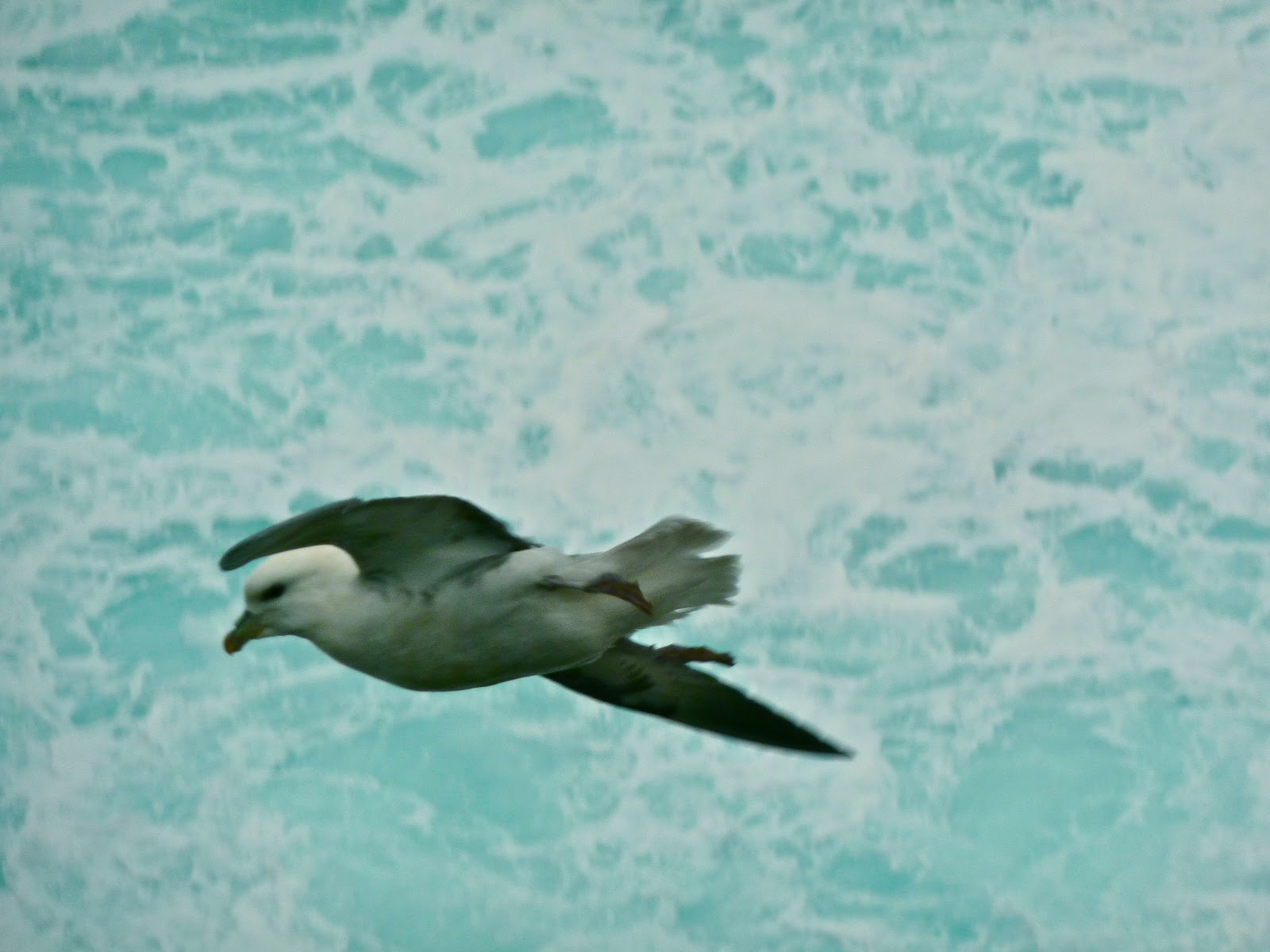
Fulmar from the cliff top
Bay of Deepdale
Hyper intelligent sheep
From Sandness Hill
Papa Stour Beyond Papa Sound
So come the storms of winter and then the birds of spring again. I do not fear the time.
Sandy Denny, Who knows where the time goes?

When I landed in Sumburgh on Tuesday evening it was the equivalent of the smack of hot air when arriving in the Med in summer. The moderate temperature of Shetland hit me after 3 weeks of Baltic conditions in Central Scotland over Christmas and the New Year. But winter storms were still rolling in over Shetland and I was eager to sample them over the coming weeks. I enjoyed solo walks on the wild side on weekends without any desire for an early arrival in spring. There was plenty of time for lots of work during the long hours of darkness.

Today was one of those grey wet windy days that justify staying indoors but I decided to visit the West Mainland. I drove through downpours in Walls and then down to Sandness, the most westerly point of the mainland which overlooks the island of Papa Stour. There was a coastal path hugging the shore and then curving and climbing to the cliffs overlooking Deepdale, what a great name, to the south. The path was waterlogged but the rain eased after the first ten minutes and I enjoyed 3 hours of lung-bursting activity breathing into the wind. The birdlife was abundant along the edge of the cliffs that reared higher as I headed south.  When I peered over the final rise and the Bay of Deepdale hove into view, there was no obvious way to continue the cliff walk.

Rather than heading back, I yielded to the temptation of climbing Sandness Hill, a Marilyn, so named by Alan Dawson from my old running club in Glasgow. He had the time and patience to list all of Scotland's and later the UK's hills which have a drop of at least 150 metres between them and any adjacent hill. It includes many smaller hills and he then had the temerity to call them Marilyns. This was a retort to the rest of us obsessed with climbing Munros at the time.  There are 19 Marilyns in Shetland and despite my initial cynicism about Marilyns, I concede that it is a useful list. I will attempt to climb all 19 over the next few months whilst I am privileged to spend time in Shetland.

Sandness Hill was a steady climb in windy conditions but the dividend was a summit that held a couple of small lochans, several cairns, a trig point, and views over to Papa Stour as it flitted in and out of low clouds but the rain kept off. A mountain hare zipped past as I started the descent and some sheep had been painted an unusual hue of blue. I sauntered into Sandness, pleased that I had made the effort to confront the wild weather, and decided to walk back via the coastline.  When strolling along the beach I saw a woman observing something in the sea. I stopped and followed her line of sight to see an otter playing in the breaking waves. It confirmed my determination to enjoy the wildness of Shetland in all weathers.

On a week when heavy weather had brought chaos to Queensland and Sri Lanka, it made me realise that Shetland is completely at one with heavy weather although I did find a carpet of sea shells about 30 metres above sea level, which confirmed that the Atlantic swells had been pretty huge and the wind mighty strong in recent weeks.

Sunday, 9 January 2011

First Runs

First footing was out of bounds this year following the big freeze, the garden and footpaths have been snow-covered for 44 consecutive days which must be the longest since 1962. We also had 11 days without any water although it finally spluttered back just before the bells and presaged my last bath of the year.   Ice has been welded onto the pavements by a freeze-thaw process which has made it almost impossible to negotiate the footpaths, they have become mini glaciers. Pedestrian movement has not been helped by snow ploughs piling the road snow onto the footpaths to confirm that vehicles are more important than people - and how sustainable is that.  Admittedly the pavements to the school have been scraped twice by diggers but, as well as ice, chunks of asphalt have been torn up at the same time.  Forget any ambitions of integrated transport it would be progress if only roads and footpaths could be managed as one. 

In fact, it was 4 days before I ventured out for my first run of the year. A thin veneer of snow had provided some footing on the hard frozen slush and I managed 4 miles without a single fall.  A neighbour, not known for her empathy, hollered me as I skidded past her to 'take care it's treacherous, you're not as young as you were although still as mad'.  I reflected as I continued the run whether I would have preferred  'young' and 'mad' the other way round but concluded that it was probably better to be still mad than still young. I will record it as a contender for my epitaph.

And now I have managed another two runs, yesterday on a 4cm layer of powder snow which made running seem like floating on air and then today on 10cm of wet snow which was like, well, wading through 10cm of wet snow.  The real beauty of running at this time of the year in these conditions is the intensity of this baltic winter: ice flows in the river, icicles drooping from roofs, sharp mountain silhouettes, birch saplings coming through for air, breath like a steam locomotive, tracks of animal movements.  The landscape is from Dr Zhivago - maybe that's why I am running - Lara may make an appearance. 

So I am back on my 2011 target for running at least, and reading is going well. I received a Kindle at Christmas and I am finding Blair's 'A Journey' an enjoyable read. It is reflective, surprisingly honest, down to earth, largely devoid of jargon, good on leadership and change but shallow on policy. He may have blown his reputation by supporting George Bush in the invasion of Iraq but his selling out of public services to private contractors seeking to extract profits from the public purse was an equally bad call. In the wider scheme of things and watching Cameron's austerity policies take effect, Blair will probably be remembered as one of the better post-war prime ministers.


Monday, 3 January 2011

2011 the year of reckoning

I have been an optimist for most of my life, with no real regrets apart from discovering that I could not fly and that my bones broke when landing at speed.  The last time my optimism waned was during Mrs Thatcher's experiment in monetary economics.  I was working in Glasgow and was responsible for programmes designed to help the most disadvantaged salvage some hope amid unemployment, poor housing, collapsing infrastructure, and a cycle of despair mitigated only by the indefatigable humour and family and community altruism.  But life was kind to me even during this deep recession.  I had a job that could make a difference to people's lives, and I was blessed by becoming a parent of three children. The joys of watching and nurturing young children are the greatest of all life's many episodes.

The recession in 2008 was deep and damaging, created not only by the corruption of international banking but in part by the then government's infatuation with the financial sector and Gordon Brown's self-portrayal as the British Gordon Gekko - 'it's not always the most popular man that gets the job done.'  The actions taken to rescue the banking sector by Brown and Alastair Darling, the Chancellor, were both brave and effective, so that by 2010, the recession seemed to be under control and most of the economic indicators from last year would bear this out, although the cost in terms of public sector borrowing was unsustainable. 

The new coalition government, anxious to attribute any blame for future economic failure to the outgoing government, displayed its lack of experience by speedily announcing a range of spending cuts and new policies that were neither politically sound nor well thought out. You can't govern on the back of a coalition agreement cobbled together in 3 days. They did not seem to understand that there is a decision lag of a year or more between the announcement of policies and when they take effect. Time should have been taken to look at the evidence and listen to the experienced advisers who would have identified the stumbling blocks and the real cost of the proposals. For an earlier rant on this, see Day 101.  2011 will be the year of reckoning as the coalition headline decisions from last year become the real frontline issues of this year.

The prime minister's bold belief that we are on the verge of economic growth and that the policies the coalition is introducing will repair the financial damage does not float in my reservoir of optimism.  I have real fears about the damage that will be inflicted on our economy and services in the not-too-distant future.  So here are the issues that might make or break the coalition but, more worryingly, wreak the greatest damage on the UK's future well-being.
  1. On the world stage, are we to be 'nationalistic' in supporting actions which ostensibly safeguard our narrow interests, or are we to be 'principled' in supporting international action which focuses on human rights and encourages trade and development which is both sustainable and egalitarian?
  2. Economic recovery in 2010 has been fragile and is in danger of petering out as public expenditure cuts and tax increases—including VAT and the fuel escalator—converge with rapidly rising commodity prices. This could severely restrict consumer spending, damage the service and retail sectors, particularly in our town centres, and, in turn, lead to a further hike in inflation.
  3. In Europe, will the scepticism of the Tories become ascendant over the Europhile tendencies of the Lib Dems?
  4. Will the referendum on the Single Transferable Vote be successful, or will Tory opposition and the electorate's anger at the Lib Dems over Student Tuition Fees kick it and other constitutional change into touch?  If so, what are the Lib Dems for?
  5. As Councils and other public services make staff redundant or give early retirement to tens of thousands, will there be a reaction about the cost of this, as well as the cost to public sector pensions? 
  6. Will there be a campaign by the right-wing media to replace anger with the bankers as the merchants of greed by shifting the attack to public services?
  7. Public services are a means of providing universal access to services from roads and transport to recycling, libraries, sport, arts, care and education, as well as the regulation of public health, buildings and the environment.  These are fundamental to the quality of life, but will be severely downsized and, in some instances, withdrawn; this will not play well with the public, as is becoming evident..
  8. Equally important, Councils are the custodians of local economic development and community well-being.  Whilst some services can be provided by both the public and private sectors, there is a need to guarantee access to services for all and to avoid the creation of two tiers of services dictated by purchasing power rather than the rights of all citizens.  Fairness is the watchword of the Lib Dems, but it is doubtful that this will happen by charging for many services which are currently universally available. 
  9. Whilst the protests about Education to date have been about student tuition fees, a far greater impact will arise from the reduction of pre-school provision.  Evidence shows that this is where achieving greater opportunities for the most disadvantaged and improved outcomes is most effective.  The coalition is removing funding from Sure Start, which will lead to many closures and accentuate inequalities in the vital early years.
  10.  Cameron's government, driven by the baleful influence of Michael Gove, seems far more interested in creating free schools and letting the market rip in the provision of universal education.  Even their preferred model for schools based on Canadian experience is essentially driven by strong provincial education authorities. This is not acknowledged by Michael Gove because this is at variance with his partisan political philosophy. 
  11. The current proposals to reform the NHS seem to have been dreamt up in a think-tank devoid of practitioners as well as thinkers. The NHS has improved dramatically over the past ten years, maybe at too high a cost owing to drugs and salary reviews, but patients have been impressed, and satisfaction levels are at an all-time high.  Asking GP practices to sort out the budget cuts as well as the PCT overspending is tantamount to creating turmoil even greater than when Aneurin Bevan introduced the NHS in 1948. Andrew Lansley is no Nye Bevan, and even his handling of flu jabs suggests he will not be immune from the epidemic of health scares ahead.  Little imagination is required to see what will happen when patients and health professionals pool their angst.
  12. Our infrastructure and transport systems were the victims of huge underinvestment in the latter part of the twentieth century.  There was a significant catch-up over the past decade, but governments in both the UK and Scotland are focusing on the headline projects. There will be a deterioration in the maintenance and investment of local infrastructure. Initially, this will be blamed on inefficient councils, but this will not wash with an ever more vigilant and information-savvy public.  The winter damage will amplify the scale of these issues. Bins and roads matter as the coalition will eventually find out.
  13. We have had a steady reduction in crime over the past decade and record policing levels.  I am not sure that the two are directly related, as various studies have shown that it is pre-school education, job opportunities for young people, better housing and income support that are stronger indicators of a falling crime rate.  However, as each of these services goes into decline, there will be an increased workload on the Police and the Justice system.
  14. Heritage and Culture may be lightweight issues in the minds of the Coalition Government, but a confident society (Big or Small) celebrates its achievements using a wide range of arts.  There are national and local institutions and bodies which are the custodians of our artistic and cultural endeavours and will struggle to survive. We cannot rely upon News International and its ilk, who have no sense of responsibility for nurturing the future of the arts or celebrating our heritage.
  15. Sport and Leisure might also seem peripheral, but wellbeing depends upon quality leisure time. Teamwork, collaboration, and community participation in sports are grounded at the local level.  If the Olympics are the measure of elite achievement, it is local provision and participation in sports and leisure activities that is the foundation for future excellence. And for most of us, local leisure activities are a key provider of well-being and enjoyment.  This seems to be little understood, and opportunities for future generations could be devastated as the coalition marginalises these activities or looks to the private sector to assume responsibility. 
  16. One of the growth industries of the past decade has been in lobbying, and this has been exploited by many quangos and voluntary organisations to secure central government funding.  Central government was always partial to gaining the kudos from providing grants, which kept local government out of the game, as they were too likely to set local priorities. This funding is now drying up, and the previous dependency on local government grants cannot be resurrected in the current financial climate.  There are mutual reasons for despair for the third sector, the quangos, professional associations and lobbyists.  It will be interesting to see how this plays.
  17. The final issue is around the curious incident of the 'Big Society'.  It is an ill-defined concept about something which really matters. The way that government relates to its citizens has changed totally through the internet and mobile communications, and the consumer is increasingly able to comment on and help improve the services or goods it receives.  Feedback is in real-time, and community engagement is swift when things go wrong or are threatened.  Communities can and will increasingly act collectively to find new ways of supporting the vulnerable and acting in concert on the wicked issues.  But not at the beck and call of central government.  We need strong 'peerie' communities to act as lightning conductors on the impact of changes and the instigators of improvements to services.
David Cameron, the PM, has set a different course for the UK that threatens universal public services and depends upon the altruism of commercial enterprises. Inequalities will multiply, and the optimism of economic growth may prove as elusive as it was in the days leading to Black Monday.

Sunday, 2 January 2011

2011 - Some targets

At this time of the year, I normally review what I have done in the previous year and set out some aims for the year ahead.  I started this 28 years ago when I realised that between family life and work, I had little time for pursuing other interests.  My reading was almost entirely work-related or reading Roald Dahl and other children's books to three young children; I had given up football, skiing and mountain marathons after breaking my leg in a parachuting accident, and travel was not easy or affordable with three young children and a hefty mortgage.

Over the years these aims became extended to a variety of activities.  In 1983 I set a target of running at least a hundred miles a month and managed it consecutively every month from 1984 to 1993, this target was dropped to 50 miles after 1995 when I became a CEO.  In 1987 I set a target to read at least 12 but ideally 20 or so novels or non-fiction books each year and have achieved it, often by an intensive spell of reading between Christmas and the New Year. Since 1990 I set out to climb fifty-plus Munros each year and usually made it with something to spare.  I have used every day of annual leave to go away with the family on holiday or to go on long walks in the Highlands.  I also had a rather sad objective of never missing a day at work which was achieved for all but three of the 38 years that I worked. In 1972 I contracted Dysentery in North Africa and spent a week in an isolation hospital, in 1977 I broke a leg and spent a fortnight in hospital and in 2001 I was laid low by Campylobacter after a First Minister's reception at the Glasgow Hilton causing me to miss two days.  All the targets were admittedly a bit obsessive but it worked well for me and I seldom missed the targets.

When I retired in June 2009, I chose not to do any work for the first six months, I needed to clear my brain and, as several good friends astutely observed, slow down to a normal pace.  I had a health scare in the two months before retiring and was unable to exercise for three months. I soon recovered over the summer so that I was running better than at any time over the past five years, I overdid the gardening and manual work and damaged my sciatic nerve so that I was unable to walk let alone run for the last two months of the year. I did not take on any work in 2009 despite several offers of lucrative employment - I knew I needed a sabbatical to recharge my batteries.

In 2010 I didn't set any targets as I was recovering from my back and leg problem and did not know how long it would be before I could run or make longer hill walks. It was May before I could run without any pain but I had set another objective to walk the GR20 in Corsica. I spent 32 days in the mountains, more than usual, but 13 of these were walking the GR20.  The remaining days gave only 14 days in Scotland for 33 Munros and 4 Corbetts - the lowest total since 1988, although I made good progress towards finishing the Wainwrights in the Lake District with 3 days walking and I managed two excellent days walking in the Tramuntana mountains in Mallorca.  I managed to run just less than 300 miles - the lowest total since 1982 - although I lost 5 months through back problems at the start of the year and was unable to run for much of the last couple of months through the darkness in Shetland and then deep snow and ice for the last five weeks.  Holidays featured less than I expected after retirement although 2 weeks in Corsica, 2 weeks in Mallorca, a week in the Lake District and short breaks in Orkney, Gigha, North Yorkshire and the Lake District were well spread out over the year.  I made new friends and renewed acquaintances with several others from 40 years ago.

But there were other exceptional events: we had a family wedding to arrange for one of our daughters; we carried out a lot of work on the house - re-slating the roof, a front porch, a new bathroom and the subsequent decoration of rooms was demanding on both time and cash.  I had decided in January when setting up a company that I should work for between 50 and 100 days a year including some voluntary work. My business plan was to pay for the wedding and the house repairs.  This was achieved as I worked 62 days, 11 of which were for voluntary projects.  Another outcome, which I had not anticipated, was 68 blogs with well over 3000 hits. All of the above meant that I read only 15 books.  So despite the lack of targets for 2010, there were some positives but it was not the best of years because I had not been as methodical as I should have in setting out my ambitions for the year.

I think on reflection that targets are worthwhile and provide a framework to assuage laziness and create the adventures that really spark the spirit. So I will return to setting some tough targets for the year ahead, and here they are - no pressure then! I will use traffic lights to show whether I am ahead of target (green), within 10% of target (orange) or falling behind (red).

At the year's end (31/12/2011) progress was mixed - the time for all the walking and travelling was curtailed by spending much of January to October in Shetland.

  • 24 books - exceeded
  • 72 blogs - an average of 6 per month - DONE
  • Set up a Munro website - done but only loaded a few walks
  • 500 miles of running - missed 4 months running June - October with Plantar Fisciitis. A good couple of months in November and December saw me reach 400 miles. 
  • 1000 miles of cycling - too much time away from home restricted this.
  • 50 Munros - only 20, the lowest total since 1988
  • 20 Corbetts - only 5
  • Complete the 226 Wainwright hills in the Lake District - only 10 to go at the start of the year - DONE June 2011 during Langdale week
  • 75 days work - DONE with a final total of 110 days meaning less time for many of the other activities
  • Finish either the Welsh (6 to go) or Irish (3 to go) 3000 foot mountains. 
  • A mountain trek in either Europe or the USA - Pyrenees, Alps, High Sierras?
  • Complete the 19 Marilyns (hills with at least a 500ft drop) in Shetland, 18 completed by July but three aborted flights to the Fair Isle prevented completion
  • Lose a stone in weight to get back to my 1990 racing weight of 75kg - lost 2kg
  • 6 weeks of holiday- DONE Andaluccia, Lakes (2), Paxos, London (2), Deeside
  • Three new European cities - DONE - Seville, Cordoba, Grenada

Thursday, 30 December 2010

Cracking Up


Ice flows from the Loch clog the Forth

After 12 days of snow and ice, it was beginning to thaw today.  We are still without water despite 3 promises from Scottish Water to get back to us, none of which were kept.  The pavements were glazed in ice, the bins have been emptied just once in 3 weeks and the recycling boxes once in four weeks - I could blame the coalition but  that would be a bit quixotic so I'll reserve those admonishments until next year when the cuts begin to bite. 

At least the river has shed itself of ice although not before becoming choked this morning with all the broken ice flows from the loch which jammed beneath the bridge and for an hour or so and gave a good impression of the compendium of coalition policies: fractured, not yet moving and looking ugly. 

The grey skies of the last four days gave way to winter sun again and a walk up the local hills was called for and my mood was soothed by the tantalising views from Lime Craig as the afternoon wore on.


Campsies and Forth Valley mists
 
Queen Elizabeth Forest from Lime Craig

John MacPherson

I attended a funeral today of an exceptional man.  John MacPherson had spent the last fifteen years of his life as a community activist in the beautiful village of Killin.  Driving up there this morning with a former Director who had worked closely with John allowed us to reflect on his achievements. It was a perfect winter's day, quite inspirational and befitting of John. The mercury was showing -10°C and the Scottish mountains were sculpted like fine lace as the low winter sun cast shadows on the snow covered landscapes.  Loch Lubnaig had a deep pan crust of ice and the Tarmachan ridge sparkled like a row of meringues against the clear blue skies. 

There must have been two hundred mourners gathered in the Killin Parish Church. A free church minister and friend of John helped us celebrate and understand more of John's full life as a farmer, policeman, businessman and community leader.  In all these roles he provided a service which met the needs of citizens and customers first and foremost.

John had been chair of the Community Council for seven years and had been the leading player when the community took over the local care home, located at the centre of the village.  He devoted time to this ensuring that it became a haven for older citizens who could continue to commune with their friends and neighbours.  He was active on a wider front in various groupings of communities in the Stirling area where he commanded respect from activists in regeneration areas as well as other rural communities for his achievements, support for others, gentle style and huge integrity.  John never let anyone down despite chronic health problems in his later years.

I had once asked John to make a presentation to chief executives at a conference without at the time realising how ill John had been. On being told this I apologised for asking but John phoned me a couple of days later and said he would like to do something so that chief executives could be encouraged to trust communities to carry out local services. He spoke at that conference in his quiet highland voice, no false claims or drama just an honest and heart warming story of a community that worked and was prepared to take the risk of running a care home that would otherwise have closed when an independent private provider had failed to sell the business. 

He inspired us all with his warmth and altruism and none more so than the following speaker, the highly respected Professor John Bennington from Warwick University. Before starting his presentation, Professor Bennington explained that John was the epitome of what a civil society was about and proceeded to reference John throughout his address. Colleagues spoke about John afterwards with the sort of reverence denied to their normal collaborators: politicians, civil servants, consultants and business partners. In short they instinctively trusted John as someone who was not seeking to win approval, contracts or influence but to deliver progress for the wider public good. John had shown us that it is small communities not big societies and dubious political whims that really make a difference.

Falls of Dochart, Killin