Saturday, 12 November 2016

Oh Vienna


Vienna skyline from the Leopold Museum
Vienna is probably my favourite city in Europe after a second visit this week. A tribute only accorded in the past to established favourites like Athens, Rome, Paris, Florence and Venice. Winter is a good time to go as the cold clear air sharpens the outline of the magnificent city buildings and makes walking the streets a bit like rediscovering the magic of childhood. We were there on the night that Donald Trump became President-elect so the melancholy of the flawedAmerican Democracy was offset by the extravagant and timeless beauty of Vienna.

Post-Brexit there are some remarkable deals for city breaks and despite the parlous state of the pound, it was possible to manage 5 days in Vienna, hotel included, for only slightly more than it would have cost for the rail fare down to London on Virgin Trains. It was also quicker than a trip to London with Vienna airport seamlessly linked by a fast train to the city centre and costing only a quarter of the price of the so-called Heathrow, Gatwick or Stansted expresses. Flight paths into Vienna sensibly avoid the city so that it remains a quiet city, even the trams have suppressed the sound of their bogies.

The hotel was on the edge of the city centre close to the museum quarter and had a level of comfort that was exceptional. The Austrian attention to detail and cleanliness is evident in buildings and the external environment. We found a local cafe so that I could fuel myself with apple strudel and coffee for the long days on our feet. Despite an excellent public transport network of underground and trams, we walked to almost all the attractions. The streets are spotlessly clean and, apart from the longish wait to cross the Ringstrasse, pedestrians more or less have the streets, gardens and squares to themselves.

Our previous trip to Vienna four years ago had allowed us a chance to visit just some of the many attractions. I had half read the 'World of Yesterday' by Stefan Zweig an autobiography of his life in Vienna from the turn of the twentieth century until his exile in London and New York. He covers the collapse of the Habsburg dynasty with references to all the leading artists, composers and philosophers who were part of Vienna's Cafe culture early in the twentieth century. I battled through more pages but as always on city visits I preferred gathering impressions by walking, observing, listening and visiting the endless range of attractions.

We spent a day in the Kunsthistorishes Museum, a monumental building opened in 1891 to display the impressive Habsburg collection of antiquities. The Italian and Dutch collection of paintings with Pieter Bruegel the elder prominent was the highlight and the cafe under the cupola was the epitome of elegance. The collection consumed most of the day leaving only time for a saunter around the historical centre with its parks, palaces and cafes. The city is going through a massive phase of refurbishment of its impressive array of buildings along the Ringstrasse. The parliament is to be moved to a temporary site for 3 years to allow the modernisation of the building. The streets in the centre are largely car-free apart from government limousines, horse and carriages and an occasional hybrid bus. The massive open car park by the Hofburg palace is the only blight on this people-friendly city.

Over the next couple of days, we visited the Albertina museum with its collection of Picasso and Monet together with an exhibition of Pointillism including a good range of Van Gogh and Seurat together with an inspiring collection of woodcuts of Viennese Art Nouveau from the secessionist period.  An evening at the Volk opera was a revelation with the comparatively low prices allowing hundreds of school children and young people to enjoy their Mozart heritage.

We had saved the Leopold museum for the last day having visited before. It is a modern building at the heart the museum quarter purposely designed to display the work of Egon Schiele and Gustav Klimt along with their contemporaries from the secessionist movement. It is one of the best curated museums and the exhibits are shown to best effect in the minimalist salons. On a quiet late November afternoon, I could think of no better use of time with Professor Leopold's widow providing a filmed explanation of the outstanding collection of Egon Schiele paintings.

On our last day, the Christmas markets were opening with tented bars, decorative baubles, fine local foods and a warmth of welcome that surprised us. Alas, our time was up but we had witnessed the peerless intimacy of Vienna, a place that is regularly voted as one of the best cities in the world to live in. As well as its magnificent buildings, green space, outstanding museums and pollution-free streets; the urban realm panders to people and the worst excesses of corporate retailing have failed to take hold. There is a palpable egalitarian feel about the city that would have been anathema during Habsburg dynasty. Representative democracy using the electoral college has shifted that sort of outmoded hegemony to the United States.


Traffic free roads
Michaelplatz

Secessionist Toilets on the Graben 
Stephansdom church
Winter street markets
Festive florists
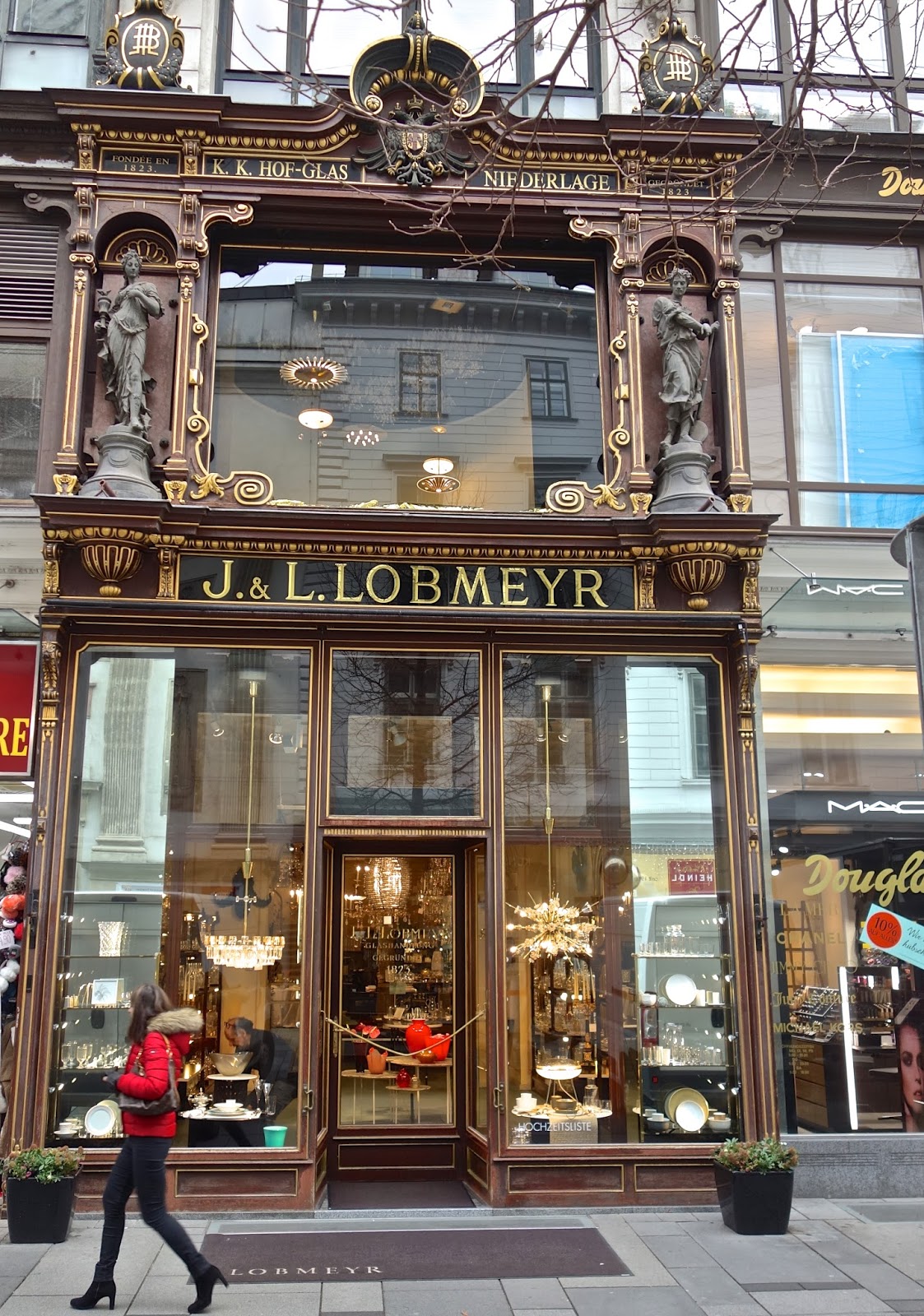
Shopping on the Graben
Rathaus from the Volksgarten
Hofburg 
Ceiling in the Freyung Passage
Parliament Building

Rathaus
Rathaus quadrant
Kunsthistorishes Museum
Cafe in the central concourse of the Kunsthistorishes Museum
Täufers -Salome. A lost parable on the day that Trump became President
Picasso line drawing
Picasso from there Batliner collection
Norwegian Blue, not dead just reproduced
The Leopold museum hosts Egon Shiele and Klimmt
Egon Schiele self portrait
Schiele -
Leopold window

Tuesday, 1 November 2016

Running the First Frost

In the forest
Morning awakens
Condensation on the windows
A sphere of breath as I step outside
The crackle of frosted leaves
Wispy white clouds
Reveal intense blue skies above
Still air, the sound of silence
Amplifies the cadence of my running
Through the forest, ears pricked for quiet sounds
Acorns falling onto the wooden bridge
Beech leaves rustling as they settle
A gaggle of geese going west
Tilted head to watch a buzzard patrol the sky
And the vapour trail of a transatlantic jet
Step aside for the calor gas lorry
And for mums with buggies returning from school runs
Welcomed home by a robin
It perches next to me on the bench
Gloves, hat and shoes come off
Exercise over and breakfast pangs
Endorphins released 
Enriched by running
The first frost on the first of November


Sunday, 30 October 2016

Mrs May's Mistakes

Theresa May had an easy route to becoming Prime Minister, easily beating the toxic threesome of Brexiteers: Liam Fox, Andrea Leadsom and Michael Gove, to win the nomination from Tory MPs without requiring the final vote from party members. She has continued to receive a largely favourable press, gained partly by having been a lukewarm remain supporter whilst now sounding like an enthusiastic Brexit campaigner, whatever that means.

Her utterances on gaining office were both surprising and promising following the elitist austerity policies of Cameron and Osborne.

Theresa May speaking after becoming Prime Minister
"The Government I lead will be driven not by the interests of the privileged few but by you.
We won't entrench advantages of the fortunate few. We will do everything to help you go as far as our talents can take you. We must fight the burning injustices. We must make Britain a country that works for everyone. We believe in a union not just between the nations of the UK but between all of our citizens - every one of us."


However, the promise of an era of egalitarian decision-making is now beginning to look threadbare. Her decision to appoint three ministers, David Davis, Liam Fox, and Boris Johnson to take collective charge of Brexit is seriously flawed. All of them have egos that trump their abilities and they seem unwilling or incapable of acting in concert. Brexit would be hard to do even without it being a hard Brexit.

She then installed or retained some of the least respected MPs as senior ministers. Jeremy Hunt and Andrea Leadsom have reputations that were already shredded before taking up, or in the case of Hunt retaining, key cabinet posts. Just watch the conspicuous disdain from their own backbenches when they speak in parliament.

She has managed to lose any goodwill from the three devolved governments in Northern Ireland, Scotland and Wales, who seem increasingly frustrated by the lack of any genuine consultation about their involvement in negotiations over Brexit.

Then she gave the go-ahead to three mega infrastructure projects: Hinkley Point, HS2 and Heathrow that defy economic, environmental and social evidence or sense. This was tersely summed up by Simon Jenkins in an article that questioned the capability of Mrs May's government to make rational decisions.

Meanwhile, in the real world, the PM has declared that the future of Education requires the rebirth of grammar schools as well as the continued growth of academies, the NHS continues to miss targets with Jeremy Hunt showing every sign of this being a softening up for more privatisation, and there is no sign of any attempt to increase the stock of social housing, although I did see an article that the government are contemplating the return of prefabs.

The majority of the right-wing press are in denial about any damage being incurred by the Brexit vote. This despite Mrs May being allowed to only attend the most recent EU leaders meeting after midnight to give a 5-minute speech, which was then ridiculed by some of her colleague national political leaders.

The £ has dropped to a 31-year low against other currencies, falling 22% from the day before the referendum. The government's refrain is that it will make it easier for the UK to export its goods and services, although so far the trade balance deficit has increased. The government and the press also claim that inflation hasn't increased significantly so far. It soon will. Inelastic items of expenditure like petrol, Marmite and Apple computers have all gone up by between 12% and 20% in recent days.

The Resolution Foundation chaired by ex-Tory Minister, David Willetts, has warned of the dire consequences of the deterioration of public finances since the referendum. This will impact those on the lowest incomes. The minimum wage will be reduced, benefits are already being cut and inflation is set to soar in the new year when the full impact of the falling pound will impact most on those whom Mrs May defined as 'just managing'.

Mrs May has displayed her talent for doing damage in triplicate so far. The consequences are dire in almost all areas. She has got away with it by virtue of the 'political honeymoon of new PMs' but as Gordon Brown could tell her it doesn't last long. Her party are in a flagrant civil war not only over Brexit but grammar schools, disability benefits, bankers, energy policy, immigration and now Heathrow with Zac Goldsmith carrying out his threat to resign and stand as an independent.

On occasions like this, it is usually the case that the official opposition provides alternative options but in these troubled times, the Labour Party is more intent on continuing with its own internal conflict. The Lib Dems are seizing their chance to regain some credibility following their disastrous coalition years and the Greens want to collaborate with the other alleged "progressive" parties but are drawing a blank. This is surely the time for an axis of enlightened politics from the other political parties after all the Tory vote was only 24% of the registered electorate in 2015, and that was a high water-mark before the disenchantment with Cameron and the irreconcilable split amongst the MPs.

In parliament this week Mrs May was showing signs of being rattled at PM questions by Jeremy Corbyn, not something that has worried either her or David Cameron in the past. I suspect that she knows that the months and years ahead are destined to be devilishly difficult with many unpopular decisions to be taken and some votes to be lost. I hope, but with little confidence, that her pledges about 'fighting the burning injustices' and 'making Britain work for everyone' will not be abandoned as she tries to triangulate the competing pressures from Europe, her party, a slowing economy and the aspirations of those just managing. 

Tuesday, 25 October 2016

Beinn na h-Uamha, Ardgour


Beinn na h-Uamha beyond Loch nan Gabhar
Monday, 24 October 2016
Ascent:        846 metres
Distance:     16 kilometres
Time:           5 hours 31 minutes

c    Beinn na h-Uamha      762m    2hrs 50mins

Route from Sallachan Bridge

Breakfast at the Ariundle Centre was a luxury for us but we had time on our side today for the comparatively easy walk up Glen Gour to the rock-girt summit of Beinn na h-Uamha. We parked by the old bridge at Sallachan and began the walk up the beautiful glen. The day was windless, and from the good track, the views were sublime towards the distant peaks. Reflections of the mountains in Loch nan Gabhar and the copper hues of the grasses made the views exquisite. Swans were cruising on the loch; a cormorant skimmed by. There was peaceful silence that allowed us to hear the birdsong in the birchwood. It is a 4-kilometre walk along the track with virtually no ascent. The river then had to be crossed, but it was in low flow and proved relatively easy, even in trail shoes; we emerged with dry feet.

We had decided to climb the south east ridge, crossing a meadow of long grass first before climbing steeply alongside a burn that cascades from the end of the ridge. It was warm work, and jackets were removed as we eased upwards to the top of the burn and then negotiated our way through the rock bands that provide two intermediate tops along the ridge. There is a flatter section from where a deeply incised burn cuts down to the glen, a drop of 550 metres. We decided that this would be a better route down. Thereafter, it was an enjoyable climb for the final 200 metres of ascent with the views into the Ardgour hills opening up.

We reached the summit just before 12:30pm. It was a perfect autumn day with excellent visibility, a warm sun, no wind and vistas to dream about. Westwards, we could see some of the small isles beyond Rois Bheinn, but the pride of place was Sgurr Dhomhnuill, a soaring peak just 3 kilometres away but probably a 2-hour walk with all the descents and ascents along the way. To the east, we could trace our route along Glen Gour and along the ridge to the summit and to the south, the massive flat summit of Garbh Bheinn looked like an anvil. As a place to eat lunch, this has few peers on a day like today; we were aware of the privilege. John reflected that we had earned it from all the wet, frozen, windy days when we had no view and stopping at the summit would guarantee getting cold, wet and miserable.

We spent 40 minutes enjoying this rare spectacle before beginning the descent. To my add to the pleasure, we found an easy route down the ramp at the side of the burn to the river about a mile upstream of where we had crossed on the ascent. There was a good sample of indigenous oaks and birch along the water courses and sprouting from erratic boulders. We crossed the river and found the track, which was waterlogged in places, but we had just 5 kilometres to cover to return to the car. As the afternoon sun began to sink, the length of our shadows and the walk seemed to extend. But this had been one of the most enjoyable outings on a hill that I had not known and will have trouble remembering by name. It means 'hill of the caves'.
.
Golden Days
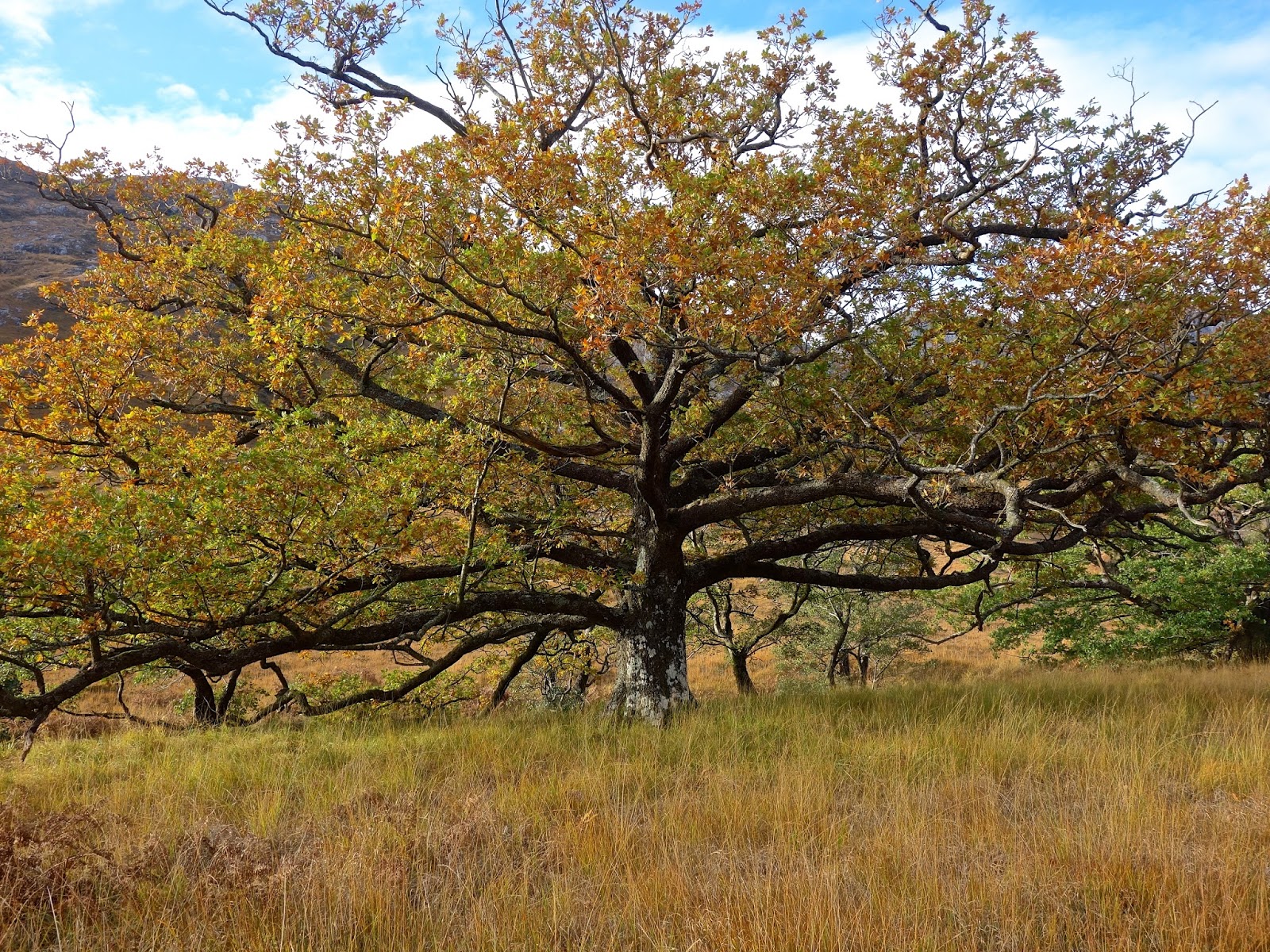
Old Oak tree at the river crossing
Looking east to A' Bheinn Bhan during the initial ascent
Pottering along the ridge
Sgurr Dhomhnuill from Beinn na h-Uamha
Looking north west to Roiss Bheinn
At the summit
Looking down Glen Gour to Loch Linnhe and Glencoe
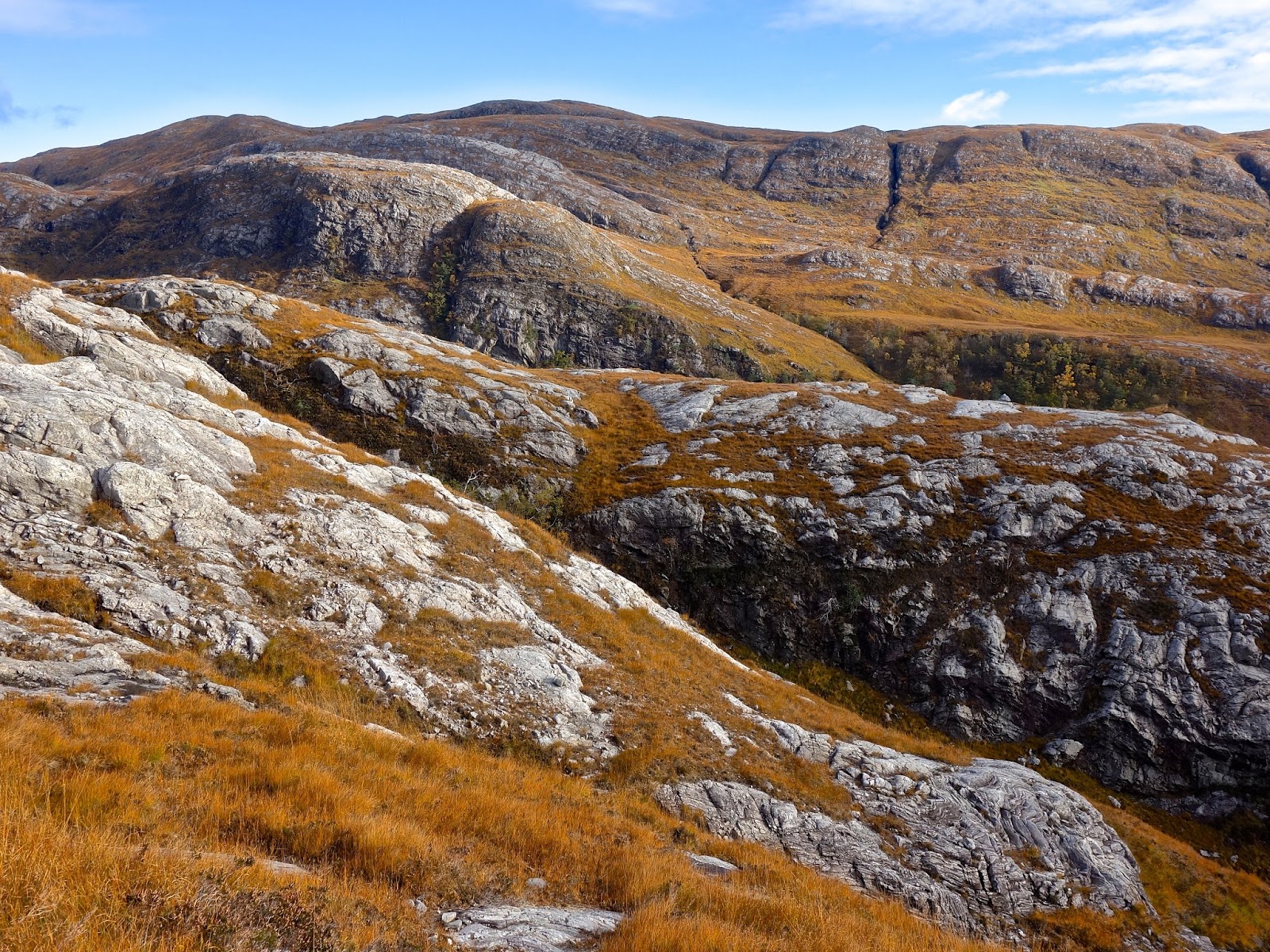
Birch on Psammite metamorphic outcrop
Loch nan Gabhar on the walk out

key-for-munro-and-corbett-postings

Monday, 24 October 2016

Fuar Bheinn and Creach Bheinn, Morven


Looking up Glen Galmardale towards Creach Bheinn
Sunday, 23 October 2016

Ascent:      1563 metres
Distance:   16 kilometres
Time:         6 hours 23 minutes

g    Beinn na Cille         652m     1hr   35mins
c    Fuar Bheinn            766m      2hrs 45mins
c    Creach Bheinn        853m      3hrs 52mins
t     Meall Odhar            794m      4hrs 32mins

The benign weather of the past week suggested a couple of sunny days in the west highlands. John and I agreed to make a two day trip to Morvern and Ardgour to climb the Kingairloch horseshoe with two Corbetts and a Graham and then to climb Beinn na h-Uamha in Ardgour. I booked the bunkhouse at Ariundle near Strontium. The Arundel Centre is run by an enthusiastic elderly woman who has created a local craft centre with workshops for wool spinning, dyeing and weaving. It also has a friendly restaurant serving good food with an emphasis on local produce.

We drove to the Corran ferry, the grey skies of central Scotland gradually giving way to bright skies. We descended from Rannoch Moor and the hills of Ardgour glinted in the shafts of morning sun. The drive from the ferry down the single-track road to Kingairloch is wonderful. The famous wild goats were not at home, but the views down Loch Linnhe were enough to create a mood of eager anticipation for the walk. We parked at Glengalmadale on some open land by the bridge and walked a kilometre along the road towards the headland overlooking Loch a' Choire with its fish farm. From here we began the steep ascent to the outlying Graham of Beinn na Cille. It was an uncompromising slog up steep slopes, with gravity working in harness with the long grass and heathers hindering progress. There was a cool easterly breeze but the day was becoming brighter and the views behind us over Loch Linnhe to Lismore and Loch Creran were stunning.

When we reached the summit of Beinn na Cille, we had some food; it was cool in the breeze, and hats and gloves were needed. We could hear the workings from the massive Glensanda quarry 3 or 4 miles to the south west, hidden behind the impressive-looking Beinn Mheadhoin. It made me examine the rocks beneath us, a pinkish granite that is part of the Strontian granodiorite group. There is a longish descent of over 200 metres down grassy slopes punctuated by granite boulders to a slightly boggy bealach before beginning the climb to Fuar Bheinn. It was easy going although the 320 metre climb up to Fuar Bheinn took longer than it should have as we absorbed the views and lost the impetus of the earlier climb.

There was no intention to stop again; it was quite cold so a glance at the views sufficed before we began the next descent, which involved skirting round some rock bands before reaching the next bealach and then heaving our way up another 300-metre climb to the summit of Creach Bheinn. We had spotted a lone walker ahead, and it gave us some incentive to keep moving at a reasonable pace. We arrived at the summit, an untidy stone circle,  about 5 minutes behind him.

He was from Perth and an experienced walker.  We began the descent together, all of us rambling on about cherished walks for the whole of the descent. We stopped at the 'camp' just below the summit, which various books describe as being a lookout place for Napoleon or a place where the Ordnance Survey camp was located when surveying this rugged part of the Highlands. Shelter was provided by two robust walls at either end of a rare area of flat land, and it looked as if the OS had constructed tent sites within stoned areas similar to the bivvy pods on Skye and other ridges. Despite having reached the high point of the round at Creach Bheinn, we still had quite a lot of climbing to complete. It is a 100 metre climb to the next top, Maol Odhar, and then another 80 metres to Meall nan Each, a summit that is perfectly perched on the delightful ridge back to Glengalmadale.

The afternoon had mellowed, the wind had dropped, and as the sun began to sink we enjoyed the spectacular coastal views down Loch Linnhe. The grass and heathers sparkled like gold in the angled sunlight, and we had clear views back to the horseshoe that we had almost completed. We stopped a couple of times to peer over the edge of the ridge towards the sea in the hope of seeing some goats, but they were absent friends today. We regaled each other with accounts of trips to other parts of Scotland: St Kilda, Fisherfield, Knoydart, Shetland, Foinaven and all the other memorable places that have 'floated our boats' as we criss-crossed the Scottish Highlands and Islands.

The final descent to the car park at Glengalmadale was unrelentingly steep and laced with drainage channels that provided me with a couple of unintended somersaults. We were down by 6pm, and after saying farewell to our friend, we drove round to Strontian in the fading light. We had booked in at the Ariundle bunkhouse, a recent find that serves good food and is well located for the exploration of the remote rough terrain of Ardgour, Morvern and Sunart.

Ascent of Beinn na Cille looking over Loch Linnhe
Fuar Bheinn and Creach Bheinn from Beinn na Cille
On Fuar Bheinn
Looking south down Loch Linnhe from Creach Bheinn
The OS camp below Creach Bheinn summit
Leaving the summit - Garbh Bheinn prominent in distance
Loch Linnhe and mainland from Meall nan Each 
 Descending the Druim na Maodalaich ridge - sheer bliss
Creach Bheinn from the south ridge
Almost down to Glengalmadale

Fuar Bheinn and Creach Bheinn from Druim na Maodalaich