Sunday, 31 May 2020

American Carnage


Twin City carnage
"This American carnage stops right here and stops right now." Donald Trump Inauguration Speech, 20 January 2017.

Fake news is what he would call it if delivered by any other commentator but as the stench of the fires and fury following the Minneapolis murder percolate through the United States, there is that moment when the citizens of America can finally say, "Gotcha".

Like many others, I had doubted that someone with such a loose understanding of ethics and so lacking in humanity or empathy as Donald Trump could survive more than two years. I also hoped that the damage he wreaked might be possible to rectify, although not by Vice President Mike Pence. The United States still had a reputation as "the land of the free", although its failure to address inequalities, the dominant force of its global corporations, its interference in foreign affairs, and the sale of weapons to autocratic regimes were all corroding the goodwill from many nations. Trump's time in office has simply turbo charged these characteristics and the increasingly dysfunctional constitution has made America not 'Great Again' but generated an antipathy from citizens around the world as well as undermining global institutions such as the United Nations, the World Health Organisation and the Intergovernmental Panel on Climate Change.

In the years since Trump's election, I have been gratified by that noblest of gestures by many Americans that I have met in the UK or when on holiday in France and Italy. They have apologised for their President and spoken with a refreshing frankness about the rancour that exists in their beloved country. I feel privileged to have enjoyed its remarkable landscapes and witnessed the scale of human endeavour in the States but it is not somewhere that I would contemplate visiting again as it trashes its environment, violates the dignity of many of its citizens, encourages more firearms and worships Mammon, whilst hiding behind a mask of Christianity.

As ever, the hope for some restitution lies in the good sense of many of its states, cities and counties when they are empowered to act independently from the behemoths of the American Constitution. Many of them have shown an understanding of Coronavirus that eludes the warped mindset of the President and his followers. In the past we have been assured that the American Constitution would provide the checks on the power of the President; that myth has been exploded by President Trump. It is time to eliminate the stranglehold of Corporate America and their lobbyists who have furloughed democracy by bankrolling the elections of the President, Congress and Senate. This charade of sponsored federal elections demeans and diminishes the democratic rights of its citizens.

Apocalypse Now in Minneapolis

Thursday, 21 May 2020

Islands Peak Race 1990

Captain Eric

In 1990, I had arranged for the annual UK Council NALGO-sponsored cross-country championship to come to Scotland for the first time. I was the chair of Strathclyde Runners, a Council club for the 100,000 employees, and we organised half a dozen events each year. The UK Council championship was held in Strathclyde Park with the reception and prize-giving at the Strathclyde Offices in Hamilton. The Council Convenor, Bill Perry, was to provide some hospitality, and as always, he was delighted to support the Running Club in its ventures. 

We surprised ourselves by winning the team prize against several hundred runners from Councils all over the UK. Keith Adams, a roads engineer who had recently joined SRC, had been in the team and approached me afterwards to ask if I would be interested in competing in the Island Three Peaks race with him. Keith was a committed hill runner and had competed in the event on three previous occasions. He lent me a video to explain the nature of the event, which was pretty full-on.

The race involves yachts with 3 sailors and 2 runners. It starts in Oban with a 5-mile run before a Le Mans-style dinghy race from the north beach to the yachts, a sail down the Sound of Mull to Salen, a 19-mile run to Ben More and back, followed by a long overnight sail to Jura past the Corrievreckin to Craighouse, the start for an 18-mile run around the Paps of Jura. This is followed by a long sail down and around the Mull of Kintyre to the Isle of Arran, where a final 20-mile run to Brodick and Goat Fell and back before the final sprint by the yachts across the Firth of Clyde to Troon. It normally takes two to three days, depending on the winds and tides, as well as the navigation of the yachts and the masochism of the runners. It involves about 12 hours of running over 60 miles of running and 10,000 feet of ascent.

I watched the video with growing anxiety. I had run five marathons and four mountain marathons and had recently started climbing the munros so I had some experience, but this was at a different level. I explained to Keith that he would be better supported if he could find another victim, but he was fairly insistent that I could manage it. Never being one to refuse a challenge, I signed up. I was in reasonable shape, but arranged a few longer hill runs with Keith and Matt Ogston, another hill running friend, who was also competing in the race. We had an 18-mile run from Aberfoyle to Ben Lomond and back one evening after work, and I also managed a PB and what would have been a Strava Crown for my regular run up Lime Craig. Two weekends before the race, John and I caught an evening train from Crianlarich to Fersit and did an overnight walk to Fort William over the Easains and Grey Corries to build up my hill stamina and get some experience of night navigation.

The weekend of the race saw Keith, Matt, and me board the Oban train on Friday afternoon. Keith and I stayed at the house of Eric Chapman, the skipper of Seasmoke of Lorne, a 27-foot yacht that was one of the smallest in the race. Eric was the Commodore of the Oban Yacht Club and had competed in the race before and knew the sea conditions well. The two other crew members were from Edinburgh and had sailed with Keith on his previous Island Peaks races.

It was a grey Friday as the race began at midday on the sound of a gun for a 5-mile road run along the Sound of Kerrera and back. Keith and I were reasonably well-matched. I was the faster road runner; we climbed at a similar pace, but he was faster on the descents and over rougher ground, when I was more cautious because of a broken leg held together by titanium screws. We finished the leg at Oban's north beach, where we jumped into our dinghy to be rowed out to the yacht. We had made good time and were in the first ten out of the 56 starting teams. I had paced Keith; we wanted to make a decent time to gain clean air for the yacht, but not to tire us too much, given that we had 19 miles of running on Mull ahead of us.

We lost quite a few places to the larger yachts and catamarans sailing up the Sound in a steady breeze and berthed at Salen just after 5pm. We were straight into the run behind Jack Maitland and Alan Farningham, who were to win the race. We also had Christine Menhennet and Helen Diamantides for company, two formidable hill runners who Keith knew from his hill running club. We made a good pace along the 6 kilometres of road from Salen pier to Loch Ba. We stopped here to change into hill running shoes, which lost us a couple of minutes, and the girls had almost caught us as we set off again. It was a slog up the east ridge of A' Chioch, and we contoured below the top to find the steep rocky ridge to the summit of Ben More.

After checking in at the summit, we started the 4-kilometre descent to Dhiseig on Loch na Keal. It was turning into a lovely summer evening with spectacular views. We lost some time to other runners and at the burn by the road as we changed back to road shoes and took some water and food before beginning the long 9 miles back to Salen Pier. Helen and Christine had overtaken us whilst we were changing shoes; they were relentless. I took over the pacing, and by Scarisdale Wood, we had caught and passed them. We were back in Salen in under 4 hours, twenty minutes faster than Keith's previous best time. As we climbed aboard the yacht, we were told that a curry was awaiting us and there were cans of lager if we wanted. I did, and after a feed and some rehydration, we settled down in the bunks for the long sail back down the Sound of Mull and the Firth of Lorne. The wind had died somewhat, so there was little keeling over to disturb our sleep.

We awoke with the yacht becalmed, and for most of Saturday, we made slow progress down to the jetty in Jura. There was some movement passing the Gulf of Corryvreckan. At first, we thought the slow progress would help in that we would have an afternoon run up the Paps of Jura and then be able to sleep as the yacht sailed down and round the Mull of Kintyre. We then began to realise that we may end up in the dark on the Paps. The good news was that it was dry and a reasonably pleasant day. We eventually arrived at Craighouse at about 7pm.

The evening was benign, and although this was the shortest leg at 18 miles, it involved the most climbing over some pretty rough ground with little in the way of paths to help. We ran the first couple of miles from Craighouse and then changed into hill shoes for the climb up the three Paps. The evening just got better and better. By the time we reached the first summit, Beinn a' Chaolais, we were treated to scintillating sea views. We had made good time, and both of us seemed to be going well as we descended 300 metres and then began another 350-metre climb to Beinn an Oir. The official photographer was posed halfway up the craggy ridge, and as we passed him and looked out to sea, I remember thinking that this was probably one of the best moments in my life. I was as fit as I had ever been, travelling fast over tough terrain in the most beautiful wild landscape with a spectacular sunset over the sea.

There was no time for admiring the views from the summit, just another 300-metre descent and climb to the final Pap, Beinn Shiantaidh. The light was fading fast as we headed off the summit to the south and dark for the 6-kilometre run back to the road. We changed shoes and began the final twenty minutes of running back to the jetty at Craighouse. We hollered across to the yacht so they could send a dinghy over to collect us. It was after 11pm and had taken over 4 hours, but it had been a successful run, and the welcome we got from the crew on the yacht was positive;  we had performed better than they had ever expected. 

A night breeze had struck up, so as we fell into the bunks, the yacht was making good progress.  We expected to have sailed around the Mull of Kintyre by the morning. However, it is a 60-kilometre sail, and we were still approaching the point in the morning as the wind began to fade again. By late morning, we were becalmed, and the oars came out. We made a valiant effort, all of us doing spells rowing. As we were one of the smaller boats, it was relatively easier to row than on the catamarans and larger yachts. Keith and I took our turns and spent much of the afternoon rowing. We overtook Helen and Christine, who were in a speedy catamaran and had got a long way ahead of us on the previous sailing leg to Jura.

It was almost dark when we arrived in Lamlash, and before we began the path up Goatfell, there were a good 7 miles of running to Brodick. This was my sort of running, and we overhauled two other teams of runners on the way through Brodick. The good path meant that there were no real navigation problems on the ascent of Goat Fell, but the descent in the dark on a steep rocky path had me struggling to keep pace with Keith. On reaching the lower slopes, I took over, and I hammered it all back to the boat, overtaking another two sets of runners, one with three runners. It was just coming light as we reached the yacht to the absolute delight of the crew. We had cranked our way up to seventh place. Eric was ecstatic and had the yacht flying across the Firth of Clyde with all sails fully tightened. We sailed into Troon Harbour at about 7am in sixth place in one of the smallest boats. 

We had exceeded all our expectations and were afflicted by that magical feeling of knowing that, as a team, we had performed to the very maximum. The best small boat, and Keith and I had beaten some very good hill runners in the process. I won the best newcomer prize. We had some breakfast and bade farewell to the sailors before Keith and I caught the train back to Glasgow. I made it to the office for 9:00am after a fairly tough weekend. My colleagues in the office were not impressed when I took a wash in the toilets to refresh myself after the weekend's sweat and aches, and then carried on as if it was a normal day.

That afternoon, I did something quite unusual: I sneaked off at 4pm; flexitime allowed this, and I was home for 5 pm for some food and an early night. The children had made a card for me. I really did feel invincible but truly knackered.

Leaving Oban Bay

Keith is doing his morning exercises in the Sound of Luing

Becalmed approaching Jura

Eight hours of rowing in shifts

Rowing up to Arran

Passing Ailsa Craig

Monday, 18 May 2020

What Now after Covid?

Who knows how or when this will end? Badly, yes and Bigly too. I have been working with some former colleagues producing a paper on the need for mutuality and localism to be the key values as we try to rebuild, or more likely, reinvent our communities. The prospects are grim for the economy. Millions of people have lost their jobs and thousands of businesses have lost their customers or are left with obsolete products or services. But like the banking crisis of a decade ago, there is the danger that government will put the protection of its funders and their lobbyists first.

As well as the devolved governments of Scotland, Wales and Northern Ireland setting their own timetable for how and when lockdown should be eased, the northern cities and towns are beginning to challenge the confusing proposals emerging from the government. There is also a clamour from workers and businesses to be engaged in drawing up proposals so that they have a stake in how to safeguard workers as the economy reopens. The lack of transparency of decision making so far has been mendacious and has destroyed the trust in the government. Simply saying that "we are following the science" no longer convinces a sceptical public who are reading and hearing the said scientists challenging the government's blandishments.

Leaving aside the issue of easing lockdown, there are some far more significant issues that will need to be tackled as the estimated deficit in the UK is now running at over £337bn for the year. It is estimated that the GDP could collapse by as much as 25%, which is ten times higher than ever previously recorded. Already the debate has begun about the possibility of further public expenditure cuts or tax increases across the board. Promises of "we will do whatever it takes to beat the pandemic" are beginning to sound like unfulfilled pledges as many businesses and councils are now discovering.

At the same time there is a realisation by people that the improvement in air quality, a reduction in noise levels, the elimination of traffic congestion, kindness and mutual aid in local communities and more friendly, caring and respectful personal relationships are worth keeping. This is one of those rare epoch moments when massive change in how we live is possible. There is a strong desire to avoid reverting to 'normal ways' and to reap the harvest of new ways of working, learning, travelling and socialising that have been sown during the lockdown. Putting the quality of life, health and wellbeing above the pursuit of money, material possessions and status, aspirations that have dominated groupthink in recent decades, could be the long term prize in the search for a happier and less fretful society.

The Prize
Commuting without vehicle pollution
Another main cause of pollution

There have been a number of developments during lockdown that will hopefully survive and thrive in a post Covid epoch.
  • Working from home or a local hub that provides workspaces and the tools of conviviality.
  • Communicating and meetings online, saving unnecessary journeys and time.
  • Commuting less often and at more flexible times.
  • Learning online for children and students as part of a wider syllabus that requires face to face contact.
  • More engagement, management and mutual aid by communities.
  • Greater health awareness.
  • Online shopping and deliveries.
  • Less dependency on fossil fuels through commuting and travel reductions and a switch to e-bikes and e-vehicles and that should include buses and delivery vans
  • Production and consumption of more locally produced food through local delivery networks
  • The kindness of strangers
  • Debasing of money as the currency for success or happiness.

Euston, we have a problem - social distancing

Meetings, quicker and cheaper

But there are difficult decisions that will need to be taken to safeguard some of the benefits of lockdown and to source the funding for the cost of furloughing the workforce, cancelling business rates and paying for the health and care costs of the pandemic. There are already a number of academic papers evaluating the options with the Oxford Smith School.of Enterprise and the Environment bringing together many of the findings. Translating some of these findings into policies will require a far more rigorous analysis by academia but here are a some things I would start with; the aim being for greener, fairer and more equal outcomes.
  1. Abandon the Heathrow expansion, air travel will be greatly reduced by travel restrictions, higher fares and customer confidence. Featherbedding the air industries according to the academic studies is the least sustainable of all policies.
  2. Cancel HS2, there will be less long-distance commuting with home working and online meetings. What is needed is a railway network with modernised signalling, new rolling stock and a more rapid upgrading of lines in the north.
  3. Increase the carbon tax on fuels for vehicles and planes to offset the reduced fuel tax revenues resulting from the reduction in travel. The collapse of oil prices should ensure that there will be minimal inflation costs.
  4. Introduce an online shopping tax to give some protection to local shops
  5. Create carbon-free vehicle only zones in town and city centres to consolidate the environmental benefits achieved during lockdown.
  6. Reduce journey to work peaks by encouraging 4-day working weeks.
  7. Re-introduce renewable energy subsidies to revive investment in sustainable technologies.
  8. Legislate for a living wage and workers rights including holiday and sick pay.
  9. Engineer a more progressive tax regime to address the inequalities that have been magnified by the COVID crisis
  10. Protect local and UK businesses from acquisition by overseas corporations and hedge funds at meltdown prices during the pending economic recession.
I am sure that Michael Gove and the rest of the mythical ministers responsible for government would find reason to dismiss all of these suggestions, which would be an endorsement in itself.


Friday, 8 May 2020

Gargunnock Hills


Gargunnock Hills on left
Wednesday 6 May 2020

Thornhill to Ballochleam by bike, return     22 kilometres
Ballochleam to Gargunnock Hills walk       11 kilometres

It was the best day of the year so far and too good for gardening. The Gargunnock hills are visible from the house although too distant for even a long walk. I took the bike, crossing the carse to the A811. There was a significant increase in the traffic on the roads from my previous cycle rides in recent weeks, obviously there was less staying at home and a lot more people exercising their vehicles. The road from the Inch of Leckie to Fintry is the best of rural routes, climbing steadily alongside the Boquan Burn that is deeply incised into the soft red sandstone and hosts a beautiful mixed woodland that echoed with birdsong. It was a hard pedal to Ballochleam where the track to the Gargunnock Hills begins.

I ditched the bike and began the 3 kilometre walk up to the Spout of Ballochleam. The gorse was at its most decorative and the fields full of lambs, buzzards were patrolling the cloudless skies. I briefly thought about climbing more directly to Lees Hill but Standmilane Craig looked difficult to penetrate and why torture myself with a steep slog up through newly planted forest to save 3 kilometres when I could follow a path to the summit.

From the Spout of Ballochleam a gravel track heads south east towards the Earlsburn Wind Farm and after 300 metres a grass spur heads north to Lees Hill. The views north were sparklingly clear and the bird life was in full flutter. Every few minutes there was a bang like gunfire but there was nobody about. I thought at first it may be the distant wind turbines starting up in the gentle breeze but it was too close. Whether it was a recorded noise to keep the birds away from the wind turbines I am not sure but the noise seemed to emanate from a position on the moorland about 500 metres south of Lees Hill. Veering from the path to establish what was the source of the sound was not an option in lockdown. I continued north eastward from Lees Hill until the track began to peter out before stopping for some drink and to admire the views towards the mountains to the north and west.

The return was by the same route and as I descended the track from the Spout of Ballochleam a mountain biker was pedalling up the track.  We had a five minute conversation. It was friendly and respectful, similar to all other conversations that I have had in the period of lockdown. We kept a good distance apart, shared our thoughts on what was happening, appreciated  the peace and calmness that prevailed and talked of the positive vibes of living in such a tranquil and beautiful environment. He was a joiner who normally lived in Glasgow but was staying with his parents during the lockdown. He had never had the chance to explore the area in such depth before and was considering moving out of the  city once this was over.

I reached the bike and there was no need to pedal as I descended the 4 kilometres back to the main road. During the mile or so back to the roundabout I was passed by over 40 vehicles travelling at speed, Nicola's message to only make essential journeys had been lost in the translation of the word "essential". There again it had taken me a lot longer than an hour for my daily exercise and I was not sure whether I could carry forward my unused exercise allowance from a couple of days in the previous week. The guidelines on lockdown are capable of many interpretations but the key ones to my mind are to stay local and observe social distancing if by chance you do pass anyone or engage in conversation.

Road above Boquhan Glen
Boquhan Bridge
Track to Ballochleam, Lees Hill beyond
Earlburn Wind Farm
Looking north from Lees Hill
Ballochleam skyline
Easter Glinns, Ben Ledi and Ben Vorlich
Snow on Stob Binnein and Ben More
Back to the bike


Saturday, 2 May 2020

Running or is that Jogging Again

Ben Ledi and Highland cow

The last couple of years has seen my running collapse from 50miles a month to averaging only 3 or 4 runs per month and this dropped even further this year with only a handful of runs before and during lockdown. There are several reasons, fewer off road routes in the immediate vicinity of the new house, sore feet, back ache from too much heavy garden work, and just the slowness that comes with age.

I have managed to walk and cycle most days during lockdown including several excursions up local hills but until yesterday I had not found the motivation to run. I had to visit the pharmacy in Aberfoyle so took the opportunity to take my daily exercise round one of my old regular routes, about eight kilometres. It was a slow start but after a mile or so I found a comfortable pace and kept going without too much difficulty. It lifted my spirits to such an extent that I was up early today to run an easy 4 kilometres along local track in the clear morning light. Even such a modest outing sharpens the appetite and the mind but do I have the determination to keep going?

The Goodie Water

Agricultural views

The track to Moss-side

Tuesday, 21 April 2020

Day 28, Thornhill to Muir Dam

Muir Dam with Ben Ledi beyond
Monday 20 April 2020, Day 28 of Lockdown

We were served another bright spring day with strong easterly winds, clear skies and extra clear visibility. After 10 days of not going out apart from daily exercise I had three places to visit in Stirling to collect essentials including some materials for house and garden DIY tasks. The traffic was almost non existent, the click and collect procedures of the stores I visited were excellent with a far quicker turnaround than in normal circumstances. The professionalism, care and friendliness of the assistants was quite exceptional. I returned for an afternoon of hard work in the garden before Gregor and I set out for our daily exercise, a walk to the Muir Dam. It was only the second day Gregor had not run all year and he relished the relaxation of a walk to hidden places.

We passed a couple of people I know trailing their dogs around the North Common before crossing the fields and beginning the walk up the Cessintully burn. The evening light was exceptional, the only particulates being the tree pollen and ammonia brought over in the strong easterly winds from farming activity in Eastern Europe. In the 4 weeks since my last visit, conditions had changed remarkably. The ground was rock hard after 10 days of dry weather and strong moisture extracting winds. The fields had been sown, the leaves were budding and the colour palate was splashed with the vivid yellows of the gorse bushes and the white blossom of the blackthorn. 

After clambering over the four or five crumbling stiles that need replacing, a job when lockdown eases, and crossing a wobbly two plank bridge over a burn that had now become a bog, we made our way over the hill and far away to a place that looks like teletubby land, all green and gentle. After enjoying the spectacular 360° panorama of views, we headed down towards the Muir Dam. There was a tall stile to climb to reach a splendid birch wood that extends down to the reed encircled bird haven that is the Muir Dam..

It is about a kilometre from the dam along forest paths and eventually a track to the road. We passed the several fields of Christmas trees and the large modern Scandinavian looking house that is hidden in the estate and found our way to the road. It was traffic free and therefore a pleasant walk back to the village; all downhill with hedgerow birds, lambs and distant tractors the only sounds apart from a game of croquet that was taking place in the garden of one of the farmhouses. It was the perfect spring evening bereft of all the intrusions of modern life.

Crop drills
Blackthorn, Hawthorn and Gorse
Gorse time
Towards the Ochils and Stirling
Thornhill and Campsies
Stuc a' Chroin and Ben Vorlich
Braes of Doune Windfarm
Muir Dam
Lambing time
Campsies from Braes of Boquhapple
Tree of Life and the tip of Ben Ledi

Monday, 20 April 2020

Flanders Moss - Raised Bog


Flanders Moss
Sunday 19 April, 2020

On another glorious day, I had to find a way of escaping the confines of the house for some exercise. The spell of weather that was forecast for the next four or five days would normally have me packing a tent and disappearing to the far north of Scotland to climb some of the remoter hills that I have still to climb. It would have been extreme social isolation with only myself for company.

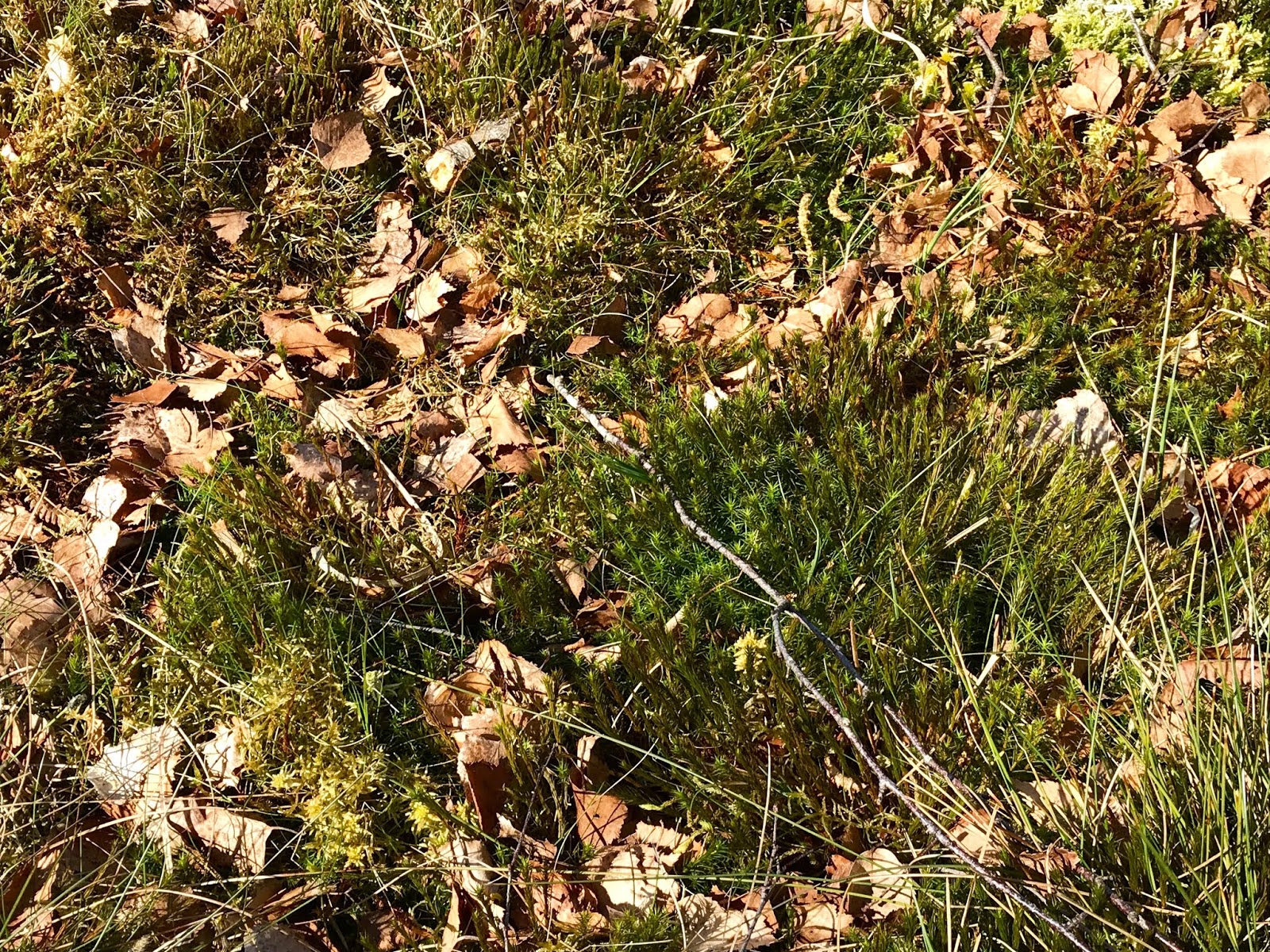
As compensation, I decided to explore some more of Flanders Moss. The visitor area has been closed off by SNH but it only gives a 700-metre walk on a boardwalk. Instead, I cycled to the south of the Moss and followed the road to the airfield at Easter Poldar and then walked westwards alongside the meandering river Forth before entering the raised bog through some gates and sampling a walk across part of the Moss. The ground had been sun-dried, the straw-coloured grasses and mosses cushioned my footfall and allowed me to walk across a section of the Moss.

The raised bog sits about 4 metres higher than the surrounding agricultural land. There are copses of birch trees that punctuate the edge of the Moss and then just the humps of grass and spaghnum moss stretching to the agricultural land north of the Goodie Water. My hour of exercise was almost up so I returned to the bike and pedalled home, serenaded by the birdsong in the April sunshine. We are fortunate to have good air quality in this part of the world but the clarity of light has been exceptiional and the night skies are quite inspirational during these dark days of coronavirus.

The raised bog

And Quietly flows the Forth

Looking east from South Flanders

Invasive Birch at the edge of the Moss

Sphagnum mosses 

Looking west across the Moss to Ben Lomond

Bonsai Birch

Thursday, 16 April 2020

Our Fantastic Response to Covid-19


"Let’s not forget – we already have a fantastic NHS, fantastic testing systems and fantastic surveillance of the spread of disease.

We will make sure the NHS gets all the support it needs to continue their brilliant response to the virus so far.

Our country remains extremely well prepared, as it has been since the outbreak began in Wuhan several months ago.

Finally, crucially, we must not forget what we can all do to fight this virus, which is to wash your hands with soap and hot water for the length of time it takes to sing Happy Birthday twice."


Boris Johnson, Statement on Coronavirus Action Plan, 3 March 2020


I should have known better when the PM and government ministers repeatedly stated that they were being guided by scientific experts in combating the coronavirus pandemic. It is what they do, introduce the designated scapegoats early when faced with wicked issues.

Neighbours who had booked a cruise to South East Asia had seen the spread of coronavirus and cancelled their holiday by mid-January. In early February we decided not to make a trip to London when the first UK cases were announced. By March we had battened down the hatches and were not eating out and only shopping at quiet times. Our son's employers closed their offices and asked everyone to work from home almost two weeks before the government finally announced the lockdown on 23 March.

Like others, I could not understand why the UK was going into lockdown a couple of weeks behind many European countries. If this is taking back control it does not auger well. Europe is usually ahead of us in most things as it is with time zones. France and Spain have the same longitudes as the UK but they prefer being included in the Central Europe consolidated time zone along with the other European countries. 

I had hoped that given the superlatives that the government were lavishing on the NHS and their "world-leading scientific experts" they had procurement of equipment and testing well in hand. I also assumed that it was self-evident that the population most in danger would be those in care, both in residential homes and receiving daily visits from carers. There are over a million people in care in the UK and any rudimentary study of demography indicates that this is where the highest proportion of deaths would occur.

I was wrong on all counts. The medical and scientific advisers had been part of a wider group where behavioural scientists had pointed out the frustrations that could occur with an early lockdown. This played into Boris Johnson's unwillingness to make decisions, he was too concerned not to close down businesses and put the already Brexit-damaged economy into freefall. His government were playing Footsie with the pandemic and displaying their true laissez-faire credentials.

When the PM began his daily briefings, he was supported by his wingmen - the Chief Medical Officer and Chief Scientific Adviser. They watched his back and gave some gravitas to the briefings, much needed given the PM's tendency to wing it, as illustrated by his briefing statement above. It is only in the last week that the government has admitted that the slow response had cost lives and that testing wasn't ramped up fast enough. But the PM had already strapped his wingmen into the box seats for the blame.

Whether they were culpable for the equally disastrous failure to focus attention on those in care is uncertain. The daily announcement of the numbers who have contracted Covid-19 and the number of deaths were presented as an absolute total for England although the figures only related to deaths in hospitals. The statistics from other countries that are further ahead of the UK in their response to COVID-19 show that up to 50% of deaths have occurred in community settings. The Scottish figures are showing that 30% of deaths have been in care homes.

Surely the government advisers and demographers must have known this and yet until the past few days, these statistics have been knowingly, or unknowingly, ignored. The ignominy that goes with this is a result of a criminal failure to ensure that personal protective equipment and testing have been a priority in the care sector. This has included the dereliction of duty to test patients who have been released from hospitals to care homes. Does the Health and Care Minister, Matt Hancock, really care about Care?. His propensity to change his mind, make idle promises and fudge issues is the stuff of legend?

We are now hoping for some advice from the government on when and how lockdown will be scaled back. In Germany, the Chancellor has had meetings with the heads of the 16 German state premiers and there has been an announcement of an easing of lockdown based upon genuine scientific reasoning with an App to assist with social distancing. In Denmark, Austria, Italy, and Spain there has been some loosening of the lockdown and more transparent discussions. In the UK, there is merely an announcement that we don't want people being diverted from staying inside, complying with the guidance, and thus intensifying their anxieties. This lack of trust in its citizens to observe lockdown together with its fundamental laissez-faire attitude suggests the government is hopelessly out of its depth. What a bunch of charlatans in charge of our over-centralised ship of state.


Tuesday, 14 April 2020

A Quiet Ride on Easter Monday

What a day for a bike ride
Easter Monday was always a busy time as folk visited the countryside on the first public holiday of springtime, whatever the weather. This year was a very different proposition: the roads were empty, the weather was perfect and visibility even better. I took the bike out for my daily exercise and only five cars and a bus passed me as I cycled a loop around Flanders Moss taking in the Lake of Menteith. I stopped briefly by the Lake to take some photos, took a long dead end track to check its suitability for a long distance cycle route, and met some old friends who were cycling on the car empty roads, we kept a good 4 metres away as we reprised life in lockdown and what we were missing most.

The distant views of locked down hills were tantalising, especially at this best time of the year for escaping to the mountains but the garden will have to be my gymnasium for the next couple of months. Even the smaller hills that are well within an hour's walk are now taped off. I managed 30 kilometre of pedalling, there were a few short hills but it was mainly pleasurable at an easy cadence.  There were a dozen or so cyclists all enjoying the empty roads and the cycle friendly conditions: sun, a cool gentle breeze and no exhaust fumes. As a restorative against lockdown, a bike ride in this part of the country eclipses any of the alternative options being advanced on social media.

It made me think of the traumas being suffered by all the children, families and single people trapped in flats and houses in our towns and cities. Overcrowding and lack of privacy for some, loneliness and desolation for others. The lockdown has, if anything, further exacerbated the inequalities that are endemic in the UK. Those in poor or overcrowded housing, dependent on universal credit, minimum wage jobs or zero hours contracts are suffering the most with risks to mental health escalating through the uncertainty, reduced incomes and minimal opportunities for physical exercise. The damage will be long term and recent talk by some government ministers of bouncing back with a rapid return to economic growth  smacks of the lazy optimism that defines their modus operandi. It is in marked contrast to the stoical altruism of the essential workers from care assistants, bus drivers, cleaners, refuse collectors, shop staff and health workers who are displaying both kindness and fortitude as they perform their duties.

We will live in a different era after the pandemic subsides. Home-working has been fast tracked and established in many businesses, many jobs in the service sector will have disappeared along with the small businesses and restaurants that are wiped out, there will be fears about both work and holiday travel. There will be a greater desire to eliminate the noise and air pollution to levels that we have enjoyed during the lockdown.

Many of the attractions of the cities will be less enticing with restrictions on many forms of social interaction from events to crowded bars and clubs. Will these factors reverse the centuries long flight to the towns and cities as people begin to value the simpler, less hectic, and less hedonistic lifestyles? Communities in smaller towns and villages could be re-energised as commuters jettison the unloved jobs in offices and call centres and the casual acquaintances of city life. There will be a lingering fear of more future events like this and a desire by many to escape the less dubious benefits of city living.

Overlooking Flanders Moss at Ruskie
Not a person or vehicle
Lake of Menteith
Ben Lomond if you look closely
A track into Flanders Moss
River Forth from Cardross Bridge
Ben Ledi from Arnprior
The Carse of Stirling
Jim's cottage