Monday, 31 October 2011

Time on the Thames


Clock at Royal Observatory, Greenwich
The established skyline
Boris's Bubble and the Shard
The Gherkin looms over Thames riverside redevelopment
Millenium Dome
North by South East
At the Observatory
Canary Wharf behind Greenwich from the Royal Observatory
Honest Jon's Chop Up at the Barbican

My trips to London have mainly been for business in the past, with visits to Docklands when I had responsibility for regeneration, and maybe the occasional run around Hyde Park or visits to the galleries if I was staying overnight. In recent years, I have made time to explore the city. There has been a remarkable transformation over the past twenty years. In the 1980's it exhibited all the characteristics of a dumbed-down capital:  poor housing, dilapidated transport, traffic congestion, and a public realm that was in need of renewal.  It seems a different place now, reinvigorated, full of energy, diverse, and offering a staggering range of activities and places to visit.

It is easy to identify reasons for this from the radical plans of the old GLC, the over centralisation of government activities in the UK, London's emergence as the world's financial centre, rampant entrepreneurial activity, free museums and the cultural explosion under the last government, and the arrival of talented people from the rest of the UK and the rest of the world.  It is undoubtedly also influenced by the high level of public expenditure, which was 17% higher than the UK average in 2008, similar to that in Scotland, according to HM Treasury, despite having all the economies of scale and without any remote rural communities.

This weekend we boxed the compass of its splendours, starting at St Martin's in the Field for lunch and to meet an old friend and then travelling west to the museums and the V&A in particular. We went east to Greenwich on Saturday, north for Sunday lunch with family, and we stayed south with our daughters in Brixton, which is not only one of the most cosmopolitan villages but also boasts eating places that are both excellent and good value.

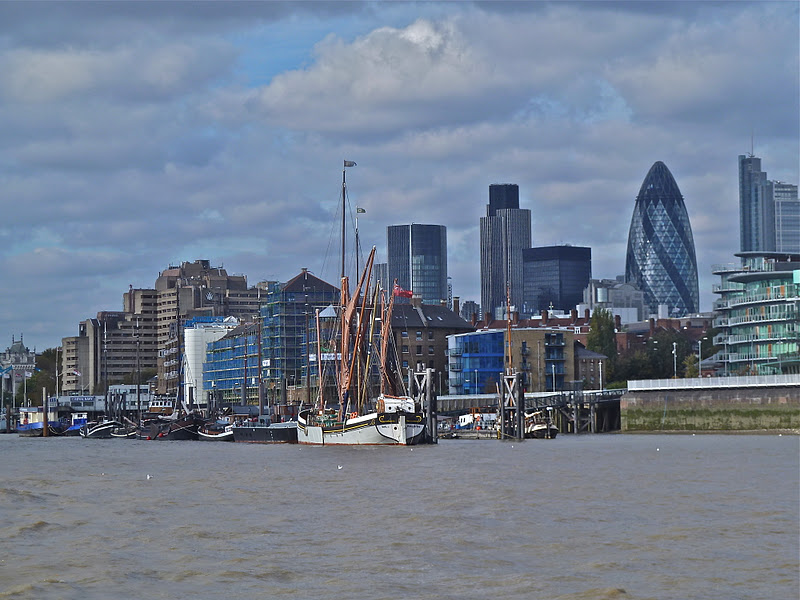
We took a trip along the river on the Thames Clipper from London Bridge to Greenwich. I had never made time for Greenwich in the past, but it seemed worth a visit on the day the clocks were to go back.  The fast boat from London Bridge stitched together a series of stops on both sides of the river and gave superb views of the London skyline.  London was buzzing at the end of the school holidays, and the number of French visitors was very evident everywhere. The largest building in London, the Shard at London Bridge, which will be over 1000 feet tall, was nearing completion, the Gherkin invaded every skyline, and ironically, St Paul's was mainly hidden from view, but Canary Wharf was very evident and testimony to the scale and brutal imposition of the financial sector.

The Thames was busier than ever with real working public transport as well as barges and pleasure craft, including ribs which were being driven with fairground aplomb for screaming kids.  We alighted at the Greenwich museums and walked up the hill to the Royal Observatory, from where new vistas appeared in all directions.  The history of time was well set out, with Harrison's clocks particularly impressive.  Blackheath was in autumn colours and, like every other park in London, was full of joggers, cyclists, children, dogs and fast food vendors.

In the evening, we made a first visit to the Barbican to see Honest Jon's chop up.  African vocalists, a rapper and a brass ensemble were fused with a Nigerian drummer, Damon Albarn from Gorillaz, and, to give some Californication, the bassist from Red Hot Chilli Peppers.    On the journey home, the tube was overflowing with Halloween characters and among the usual melange of witches, ghosts, vampires, devils and nuns, there were also many young men heavily bandaged and covered in dried blood: it looked like the banker's Armageddon.

Thursday, 27 October 2011

Ben Donich and The Brack

Rest and Be Thankful and Loch Restil

The Brack in Cloud from Ben Donich

Beinn Luibhean, Beinn Ime and The Cobbler from The Brack

The Brack
Wednesday 26 October, 2011
1135m ascent, 13 km, 4hrs 53m

Ben Donich     847m      1hr   18mins
The Brack        787m      3hrs 28mins

Some days, you just do it because you need to get into the hills. Today was such a day, the odd flicker of blue was more than had been seen for a week and the Corbetts in Glen Croe had been niggling me for a while. I had gone over the top of the Brack in the Karrimor Mountain Marathon (KIMM) in 1991 but I had no recall whether that included the summit; we were close to the finish line at Ardgarten and I was not collecting Corbetts at the time.  These hills to the southwest of the Rest and Be Thankful are in the Loch Lomond and Trossachs National Park, which to my mind was and remains a mistake. I had argued this in a paper in 2001 just before the national park was established. I persuaded the Scottish Government to include Killin in the National Park but the Argyll part was added for political reasons. Argyll has an abundance of splendid coastal and mountain scenery but this is not the finest. It has created a National Park which is imbalanced with the intrinsic qualities of Loch Lomond and the Trossachs diluted by the western extension of the park.

I had decided to start at the Rest and Be Thankful, which would mean a long walk back up Glen Croe after climbing the Brack but the ridge up to Ben Donich looked like a good route.   I parked next to a sprightly-looking 80-year-old who was just off to climb Ben Donich, he still walked the hills three times a week and had that glow of satisfaction that comes from being fit and mentally alert.  He had also done the 1991 KIMM when sixty which meant he must have been a tough competitor, most folk tend to give it up by the time they are in their forties by which time two days of running around wet hills and camping overnight are thought as a discomfort, not an adventure. He had seven or eight minutes start on me and I never did catch him although he was not far ahead when he disappeared into the mist.  It was a beautiful walk up the ridge although views were limited as the clouds rolled in.  I found the trig point had a break for some fruit and to reflect on the circularity of life. I hoped that I would still be doing this sort of thing in twenty years.

Ben Donich is a massive hill skirted by forestry plantations that make it difficult to access.  There are four ridges to all parts of the compass, and some steep cliffs to the northwest that I happened upon when looking for the summit in the mist.  There is also a tricky rocky crevasse to cross about a hundred metres in height below the summit.  I took a compass bearing on leaving the summit and descended down the east ridge, there were quite a few rock outcrops to circumnavigate. The ground conditions were not easy: saturated with water, slippy rocks and that feeling you get when an OS map is randomly generated - the contours must have been cut and pasted from somewhere else. Eventually, the forestry plantations along the Donich Water came into view and the sound of chainsaws and a helicopter moving equipment convinced me I was in the right location.

I arrived at the Bealach Dubh-lic, climbed a fence and then started on the viciously steep slope to The Brack by its northwest ridge.  It was another 400 metres of climbing with no compensating features although the view north to the Arrochar Alps appeared briefly before a heavy downpour turned out the light. 45 minutes later I came upon the trig point, which on days like this is a relief but also a vast disappointment; had I really knocked my pan in to see another of these contraptions? During this ascent all my waterproofs were donned and, on the descent by more or less the same route, I was entertained by the complete range of precipitation: rain, sleet and hail. By the time I had dropped to 500 metres a shaft of sunlight lit up Glen Croe. I crossed the bealach and followed some white sticks across a quagmire until they reached the top of the aforestation and a path took me down to the track.  After that, there were just 3 kilometres of walking up the forestry track to the top of the Rest and Be Thankful. The dense forestation of spruce trees made me reflect that Glen Croe definitely should not be in the National Park.

Wednesday, 19 October 2011

First Snow


Ben Lomond: the first snow

Oak woodland path

Behind the David Marshall Lodge

Go Ape

Ben Lomond behind Creag Mhor

Crianlarich Munros

Ben Ledi from Lime Craig

Descent from Lime Craig


After a couple of days finishing off some work projects, I went out and bought some new trail running shoes yesterday. I had planned a longer walk on some Corbetts today to test them out. The forecast was not inviting with gale force winds on the summits and sleet threatened so I did some more work instead until I was tempted out by the blue skies. Winter had arrived and, as I climbed the hill behind the house, Ben Lomond hove into view wearing a shawl of snow. It had been cold overnight with storms blowing in from the north west and plastering the upper slopes of the Scottish hills. I returned to my favourite local walk up Lime Craig with the contrasting terrain of oak woods, Forestry Commission plantings, open hillside, waterfalls, steep paths and glorious views. It was the first time for several months but I always prefer this walk in winter when conditions can change so quickly.

The new goretex trail shoes were comfortable and the exercise was vigorous. I even ran about a mile to add to the mile or so on the running machine yesterday when my running gait was analysed to determine the most appropriate shoes. It turned out that I had been buying the right sort of shoes for the last twenty five years which perhaps explains the lack of injuries over most of that period. Apparently I just need a bit more cushioning to protect the soles of my feet which have been hammered through running, hill walking, football, skiing and many other sports. I will be attempting my first run for a couple of months tomorrow now that the plantar fasciitis in my right foot seems to be healing. It is three months since I have been able to run although I was able to walk good distances whilst in Shetland. Now that my work there is almost finished and I am home it has made me realise how important and calming running has been since it became an almost daily form of exercise in 1983.

Sunday, 9 October 2011

Shetland Reflections and St Ninian's Isle

St Ninian's Isles from Bigton

Looking back across the Tombolo to Bigton

Twelve months ago, I set foot on Shetland for the first time, and since then I have spent about 25 weeks there, particularly during the depths of the winter, the spring and mid-summer.  I have managed to walk on most parts of the Isles and have recently taken to repeating walks to favourite haunts, although as the nights draw in, that is no longer possible apart from at weekends. Most mornings in Lerwick, I walked or ran around the Knab, which is one of the best short-town walks anywhere.

I have tried and failed to get to Fair Isles to complete all 19 Marilyn hills in Shetland on four occasions, the latest being yesterday, when I could get a flight there but not back. Instead, I managed to get a seat on the extra flight to Glasgow for the school holidays. I may have to leave Fair Isles for future years, as there are no more Saturday flights this year, and my work is almost done; I doubt that I will need to return.

After watching the World Cup rugby quarter-finals early in the morning, I had 45 minutes to spare on the way to the airport. It gave me the chance to visit one of my favourite places: St Ninian's Isle.  I have walked around the isle on 5 or 6 occasions in all seasons and most weathers and made a dozen or so excursions across the tombolo, some at midnight in midsummer, but usually on days like today when I am travelling to or from Sumburgh airport. This was the first decent day in the week and it was a relief to escape the winds and rains that had hurtled themselves at Shetland all week. There were more exploration vessels harboured in Lerwick on Wednesday than I have ever seen before, presumably, they were seeking some respite from the gales.

Several folk have asked me for my favourite walks or locations, so here goes from north to south.
  • Hermaness, Unst , for the bird life and coastal scenery up to Muckle Flugga
  • Fethaland for the splendid coastal walk and sense of being as far as you can go
  • Uyea for the wildness and remoteness
  • Da-lang-ayre for its red sands, big cliffs and inaccessibility
  • Eshaness for the cliffs, the Geos and the seascapes
  • Nibbon for a serene Sunday evening
  • Muckle Roe as a whole, with the Hams as the highlight 
  • Sandness Hill and Deepdale for the sea views and rolling landscapes
  • Eswick and Lingness for early morning seascapes and good company
  • The Knab in Lerwick, the perfect start or finish to any day
  • Noss, a glorious excursion during the nesting season
  • Foula for its brutal beauty on the edge of the world
  • West Burra beyond Papil, beaches, cliffs, seals and views
  • St Ninian's Isle
And given just two or three hours, well, I guess I would do the full circuit of St. Ninian's Isle. It has it all, including fond memories of hospitality from the Budge family who farm the isle. When I asked some Shetlanders for their favourites, the list was endless, including some of the above, and someone even suggested Montys, Lerwick's vaguely bohemian restaurant. Shetland has been a life-affirming experience, and the people I have met and worked with have shown me amazing friendship as well as the importance of community living in a harsh but inspiring environment. Shetland is a caring and wildsome place.


St Ninian's Isle Chapel

Friday, 7 October 2011

Preston Bus Station

Preston Bus Station
I was woken this morning to the news that Preston Bus Station has been added to the World Monument List as an outstanding example of Britain's brutal architecture of the era. It was the world's largest bus station when it opened in 1970. The structure was built entirely of concrete which was mixed on site by a huge concrete mixer.  The mixer was the responsibility of Paddy, a massive Irishman from Sligo, who worked every hour possible. He refused to allow anyone else to work on his mixer and if extra hours were needed then he would be there. I had the good fortune to be employed as his labourer for the summer of 1969. My responsibilities were to feed the mixer with vast quantities of gravel and sand using a massive electric shovel while Paddy measured the cement and watched carefully over the mixing.  We had to manage the daily deliveries of sand and gravel, 4 or 5 truckloads, and produce a sample of every mix.

The concrete was delivered to the nearby compound by dumper trucks where it was poured into moulds with steel reinforcement to provide the long beams and the distinctively curved ends of the car park as seen above. They were taken out of the moulds each morning and stored until the samples had passed muster. By one of those strange coincidences, it was one of my former classmates who had just graduated in civil engineering who carried out the tests. Paddy abhorred the testers and there was a daily fandango over the test results. He had pride in his concrete and to him, the engineers were just lazy useless hangers-on, although I think he probably said, wankers. I sided with Paddy, I knew how meticulous he was and on one occasion when our samples were challenged, I was able to spot a flaw in my former classmate's calculations.  We won the argument and I became Paddy's trusted accomplice which meant I always got to the front of the queue for the morning egg and bacon rolls because no one could start until Paddy, or Dennis as I was now allowed to call him, had delivered his first batch of concrete.

I was paid 6s 8d an hour, but together with overtime and a weekly bonus based on production I was taking home £50 - £60 a week. I gave my mother £30 a week for upkeep which was quite a bit more than she received from my father and it caused a bit of family tension at the time.  I ended the summer with sufficient funds to travel to Australia where I had obtained a place to do a post-graduate degree in Sydney.  I also had something concrete on my CV to go along with my recent degree. I had learned the survival techniques of a building site. Hit all your production targets, make sure there is self-imposed quality control, support the wider team and, if asked, cover for your colleagues. And take no time off no matter how much you have drunk the previous night. My graduation came when Dennis decided to take a week's holiday to go home, which was unheard of, and he insisted with the foreman that I was to be his deputy and responsible for mixing the concrete. He knew that I would be leaving a few weeks later and he wanted to come back to a functioning mixer.   I have never been so careful with any machinery - this was Dennis's pride and joy and his total commitment to the job and his machinery was a lesson for life.

I have watched with interest in recent years as the debate about the future of the bus station has oscillated between demolition or designating it a listed structure. The City Council see it as a prime site for the redevelopment of the city centre and dismiss it as a dysfunctional building.  The defenders see it not just as an iconic symbol of municipal pride but as a building capable of transformation into a more user-friendly transport and social hub.

I agree that the bus station in its present format is not a pleasant place, despite the superb materials used in its construction. The hard internal detailing eschews the creation of attractive social meeting places and the subways to exit the bus station and car park add time and perceived danger. Catching a bus from outside Millar Arcade was always a more sociable experience, juxtaposed between newsstands, florists, tobacconists and just across from the Odeon, which was the social epicentre of the then town. But the bus station is close to Preston's markets, the Guild Hall and the municipal offices in the city centre, but it feels like an island in a sea of asphalt.

It is capable of becoming more of a hub if only some of the vast apron of tarmac on the west side were used to provide space for city centre activities (stalls for charities, craft and local produce) and the subways were replaced by a ground level pedestrian way through the stalls. This could be easily achieved by rerouting access by the buses. A John Lewis Store, which seems to be a key objective of the City Council, could be erected on the apron or even more exciting if the structure could take it, on the top floors of the bus station - it is big enough to provide 100,000 sq. ft. of floor space. This would also allow the largely empty car parking spaces to be fully utilised. I understand why John Lewis store is an objective, it is one of the few guaranteed retail attractions but when  I had discussions with their agents a couple of years ago, they informed me that they would not be developing very many new stores over the next few years.

Let's face it if a new centre was ever built some of the existing stores from the existing centres would just relocate taking advantage of the rent-free units that a developer would have to offer as inducements, Owen Owens would not reappear.  Like most other city centres Preston is over-endowed with existing retail space and to believe that the bus station site would be transmuted by developers into a new retail centre shows a naivety by the City Council that beggars belief. Even before the recession and fast approaching double dip that was unlikely; online shopping has finally put paid to the perpetual expansion of retail floorspace.

So the better option is redesigning the bus station so that it becomes a bold brutal beauty of a business/community centre in a building that will last far longer than the canopies being erected today. There is scope for making space for business units and aiming for a critical mass of innovative products and services or creating some meeting spaces or a touchdown centre in a central location. Linking the bus station with safer ground level routes to the markets would benefit the many thousands of citizens who are financially stretched and depend upon the locally produced fruit and vegetables and the keen prices of the markets. There is also a need to ensure the quality control of stallholders in Preston market, there were far too many rogue traders last time I visited, but this is something that Bury has done through strong self-management of its market.

The City Council should invest time and involve the users and providers of city centre shopping in redesigning the bus station and its links to the centre. This would be a far better way of respecting Dennis's legacy in concrete than chasing the rainbows of false hope that retail developers try on with every major town and city authority. I have been there on more than one occasion and it is like dancing with wolves. The Councillors and their advisers have been duped by developers into believing that they can create a new retail mecca on the back of demolition the very transport hub that it would depend on. Demolition would simply produce a hole, more than big enough to fill the Albert Hall and that is Blackburn's business.


Tuesday, 27 September 2011

Ben Cruachan

Ben Cruachan summit

Loch Etive to the north

Ben Cruachan still in cloud from Drochaid Ghlas

Looking down to the dam from the ridge between Cruachan and Drochaid Ghlas

Ben Cruachan from Stob Diamh

Twenty press ups for the last one down

Monday 26 September 2011

1410m of ascent, 14km, 5hrs 35mins

m  Ben Cruachan           1128m          2hrs 40mins
t    Drochaid Ghlas         1009m          3hrs 34mins
m  Stob Diamh                 998m          4hrs   3mins
t    Stob Garbh                  980m          4hrs 20mins

It was the Glasgow September Holiday Monday and Gregor suggested a walk. There are only a few munros in our current rounds left for either of us south of Fort William.  The Cruachan horseshoe had the advantage of being near enough to allow Gregor to get back to Glasgow to play football afterwards. We went via Balloch, Loch Lomond and Loch Fyne, it was dry but rain was threatened and the hills were in the clouds above 600 metres.  On the drive to Loch Awe from Inverary, Ben Cruachan loomed into view beneath the wide brim of dark cloud.

We parked by the power station and cut under the railway line by a tunnel at the halt.  This was a mistake for we soon lost any path and began a 300-metre ascent through chest-high bracken, brambles and wet grasses.  The air was still and sweat soon added to the damp conditions. Eventually, we reached the pylons leading to the dam, climbed a precarious 2-metre high fence and found the private road which allowed us to gather some pace up to the dam. We crossed the dam whilst speculating whether it was low enough to jump into the water on one side or too steep to run down the ribs on the other side. The answers were yes and yes. There is a good track around the west side of the reservoir until the burn from Coire Dearg is reached at the end of the reservoir.

From here a good path ascends by the side of the burn although today it was a bit of a quagmire after recent heavy rains.  We climbed to 800 metres where we stopped for a drink and sandwich just before we ascended into the clouds.  This is where I had bivouacked 6 years ago with John and Mark so that we could do all 4 munros the next morning and be home by early afternoon.  We climbed to the bealach between the top, Meall Cuinail, and Ben Cruachan and then began the long climb up the perched boulders to Ben Cruachan.  The wind was not as strong as we had expected but still chilled us as we reached the broken trig point. A flask of coffee was an unusual treat for us. It compensated for the lack of views, we were enclosed by clouds so grey it could have been an art gallery.

I had to take a compass bearing to be sure of our way off the summit and along the splendid ridge that is the highlight of the Cruachan horseshoe.  We reached the section where it falls steeply and a party of three were inching their way down the slippery rocks. By the time we reached Drochaid Ghlas, the clouds were beginning to lift and we could see the rest of the ridge leading to Stob Diamh.  A couple of walkers were starting the climb to Stob Diamh ahead and they gave us an extra incentive to chase our time of 5hrs 55mins for the same walk of 12 years ago when Gregor was in his early teens and I was not in my early sixties.

At the summit we stopped for a final drink and an orange and then there was just the easy saunter over to the top of Stob Garbh before descending to the Cruachan reservoir.  It was very boggy and a great relief to reach the dam, we had passed all the other walkers and were moving at a 'get back in time for football' pace.  We dropped down and found the path below the pylons and raced each other down to the railway line.  It was steep, wet, slippy and overgrown with prickly and wet vegetation making for a very uncomfortable descent.  By a simple twist of fate, he started in front of me, Gregor made it down first and insisted on a photograph of me posing on the rail line for a 'Blood on the Tracks' photo.


Sunday, 25 September 2011

Balcony Politicians


Osborne and Cameron in economic crisis mode

It has been a strange week with Western economies flirting with economic meltdown yet again.  Watching our politicians cavort on the world stage is not a pretty sight with David Cameron and George Osborne both preferring to sit in the gods as if Statler and Waldorf - heckling their European partners in the financial crisis rather than making any serious attempt to become part of the solution.

Cameron signed a round-robin letter to President Sarkozy urging the eurozone countries to act swiftly.  We might expect this sort of open letter to be sent by an 'angry resident of Tunbridge Wells' but not the Prime Minister. He has relegated himself to one of the crowd, not one of the players in Europe, which will no doubt satisfy the anglophiles in the party.

George Osborne said the Europeans had made no progress in saving the euro over the past six weeks and needed a fund of at least €400bn to safeguard the euro. He added that the UK was ahead of the curve and had credibility, moreover, he had no intention of changing his policies.  Britain's problem as we are frequently told by the coalition was all the fault of Gordon Brown who created the mess in the first place, but as I recall he was instrumental in bringing the G20 together in London to agree on policies to rescue the banks and diminish the recession. It is finding solutions that matter not stoking a culture of blame.

We could do with some truth about the economy, not another bout of being 'economic with the truth' from our two leading politicians.  But then I am perhaps making the fundamental mistake of believing that our politicians are leaders when they have never served an apprenticeship as managers let alone leaders in any form of business. They seem to act as if running the country is just another jape.

This sort of disassembling and disavowing responsibility destroys any trust I had in the coalition's ability to make progress on the economy.  I had understood Osborne's obduracy about the need to reduce the deficit but his obsession with slashing public expenditure was always going to damage the economy. He should remember that obdurate politicians over the past thirty years such as Thatcher, Scargill,  Rumsfeld, and Brown have eventually suffered demeaning exits.

We should also observe that the IMF has proved on dozens of occasions that forcing fragile economies from Argentina to Iraq and most of Central America to swallow tough monetary policies and forcing them to sell off public assets to the multinational bottom feeders like Haliburton merely wrecks their economies and causes massive long term unemployment and poverty.

So, if all the problems are in the eurozone and the UK has credibility in the financial markets according to Osborne, what are we to make of the following stories that have emerged in the press this week?
  • a fall of 5.6% in the equity markets, the largest drop since March 2009 during the depths of the recession
  • Unemployment was up last month by 80,000, the largest rise for 2 years taking unemployment to 2.51m
  • Youth unemployment up to 973,000 - a million by Christmas?
  • a drop in sports participation in the UK of 7% this year as people can no longer afford to use private facilities and local authorities close sports centres and swimming pools and increase charges. Much of the lottery money has been diverted into the Olympic facilities, which will be London's legacy but the rest of the country has paid for it by losing support for local sports organisations and facilities.  
  • Our monthly borrowing has reached record levels of £16.4bn as the tax receipts decrease and higher benefit payments are required as unemployment rises. 
  • Strikes are threatened by teachers, police and other public sector workers in response to pensions being delayed and contributions increased.
  • the Health Minister, Andrew Lansley, blamed the cost of PFI for NHS funding problems and attributed this to the Labour government.  Yet it was John Major's Tory government that made it clear to Councils, the NHS and other public bodies that the only method to get investments or schools, hospitals or large capital projects was to go down the PFI route. 

    The biggest crisis of all is the accelerating inequalities of income, health, education and job opportunities that the government have bestowed on its citizens. True that the income inequalities stemmed from what Thatcher introduced and Major, Blair and Brown implicitly endorsed. This is becoming chronic and more evident every day. When Tesco claim that they will drop prices by £500m or between 15% and 50% on popular items you know we are in deep shit.
    Pretending that our problems stem from the collapse of the eurozone or the legacy of Gordon Brown won't wash for very long, so grow up boys and start acting as if you could make a difference, this is not the Bullingdon club.

Saturday, 24 September 2011

Sunday Weathers

Looking back from the Nab

Lerwick, Commercial St.

Muckle Roe from Vementry

Nibbon

Nibbon Delight

Foula at Sunset from Whiteness

Whiteness Sunset
Near Night Colours
Sunday 18 September 2011

Another day with threatening weather after a night of wind and clattering rain.  It was still stormy and the trick for the day would be to seek out the best of the weather.  I wanted Aileen to see the best of Shetland during her short stay and my work was almost finished so there would be no opportunity for further visits. The dark clouds were congregating over South Mainland.  So after the rains stopped we made a circuit of Lerwick starting with a walk to the Knab as I had done every day this week and then to the harbour to see the Norwegian fishing boats that were here for the mackerel season. As the winds dropped at lunchtime we headed for the brighter skies in the west and ended up having a coastal walk overlooking the island of Vementry beyond Aith with its splendid views over Swarbacks Minn to Muckle Roe.

The best blue skies were in the north so we drove to Brae and stopped for an afternoon tea of mussels and Victoria sponge at Frankie's.  It was the early evening but I had heard a lot about Nibbon from friends and the evening looked perfect for the short trip from Brae.  It was tranquil and a perfect place to amble about and absorb the seascapes and gentle wildness. We were slightly surprised when a canoe paddled past in this most remote of locations trailing a mackerel line, this looked the perfect antidote to fears of a collapsing economy.

We headed south and decided to divert via Weisdale and Whiteness in the hope of catching a sunset and we were rewarded with the most spectacular light show looking out to Foula in the west.  As the sun dipped below the horizon the blue sky became tinged in pink and then took on hues of orange and red that were reflected in a canopy of cloud.  It was the best 15 minutes of sunset I have ever witnessed and in complete contrast to the miserable daybreak that had lowered the spirits. In Shetland, despite the predominant grey skies, blues and reds are never far away. 

Unst Blue Skies

Yell bound

Hermanness

Muckle Flugga

Viking longship

Belmont House


Saturday, 17 September, 2011

The weekend weather forecast was dire and the drumming of rain on the windows and horizontal washing on the lines next door suggested that it was probably accurate.  I figured that the only possibility to get any decent weather was to go as far north as possible to the edge of the depression but even that was a long shot.  The Yell ferry, normally as steady as a billiard table, was rolling a bit during the crossing and the seascapes were a study in grey.  We wasted no time driving north across Yell and as we landed on Unst the rain and wind abated. Unst welcomed us with blue skies and it became possible to plan a walk at Hermaness so that Aileen could get to Muckle Flugga.

As we walked across the boardwalk from the lighthouse station to the west coast the sun warmed us which was a worthy prize given that dark clouds covered all places south.  The ground was boggy after recent rains but we walked along the cliff tops in company with the sheep, the rabbits and the remaining sea birds.  The sea stacks were still home to thousands of gannets, the puffins had gone and the Bonxies were fewer than before and had none of the territorial attitudes that give them a Hitchcockian presence during the breeding season.  We walked to the far north and the sheep posed as we admired the views to Muckle Flugga.

On the return, we stopped to visit the Viking longship by Harold's Wick and we were joined by one of the men who was working on the restoration.  He explained the project and life on Unst with the wisdom and serenity that his 80 years had equipped him with.  It had been doors open day but we were too late to visit Belmont House which sits above the ferry terminal.  I was told by someone on the ferry that it was a star exhibit since its recent renovation and that it had been furnished lavishly and included some Hepplewhite chairs donated by Historic Scotland.

We returned to Yell and revived ourselves with some tea and cakes in the friendly Wild Dog cafe at Gutcher and managed to get back to the car before we were spotted and chased by the famous geese.  The journey back to Lerwick was into double darkness as the black clouds and nightfall competed to extinguish the joy of the day.  In Lerwick, the horizontal rain told us that we had made a good call and escaped the inclement weather system. 

Wednesday, 7 September 2011

Paxos


Sunset at Erimitis
Kipos Beach 

Lunch at Gaios

Anti Paxos

Loggos 

Blue forgotten seas

Loggos Harbourfront

Greece as it was in my Youth

Blue Caves
Greek islands are timeless and seem to conjure the most vivid and relaxed holidays. In the 1970s, I spent four summers travelling around the Greek Islands. I would take a cheap flight to Athens and then select a ferry to one of the islands, usually in the Aegean or Dodecanese, and stay in a room or sleep on the beach, or occasionally in lemon groves.  The food was simple yet good, and even Retsina was better than the cheap wines available in the UK at the time.  I bought a book: 'Greece for $10 a day', and I wondered why the Americans found it that expensive. The Greeks were always hospitable, the seas were aquamarine and the swimming totally invigorating.

We decided that a relaxing holiday would be to go to one of the Ionian islands which I had not visited and had been recommended by my sister. Paxos was too small to have been ruined by the giants of the travel industry and seemed to be run by mainly local family businesses. We could bolster the Greek economy without it being siphoned off to the multinationals or booking.com. Paxos industries are olive oil, cement and tourism and its clientele is Greek, Italian, German and British.

It was a good choice and arriving by hydrofoil from Corfu meant that a hire car was instantly available and we were at our accommodation within 30 minutes of arriving.  Paxos is in the Ionian Sea and looks across to the mainland. It is the hub of sailing for many Italians and had a fair share of Brits, including several Cayman Island registered gin palaces that make you ashamed of being British. They are a good reason to tighten up on offshore tax havens to reduce the deficit.  Far more sustainable were the flotillas of yachts for sailing holidays.

And relax we did, 2 weeks of reading, swimming, eating minimally but well and having the occasional trip to the various small villages, beaches and the beach-perfect adjacent island of Anti Paxos.  Food was simple and much the same as it had been in the 1970s: honey and yoghurt for breakfast; tomatoes, olives, feta cheese and bread for lunch and fish or chicken or lamb with rice or potatoes and salad for the evening.  It agreed with us perfectly.  But best of all was the accommodation for the second week, a new villa built of indigenous limestone by the owner of the local cement works with a view and an infinity pool that would let us dream through the autumn and winter months ahead.

Our Infinity Pool - Relax

Double Dip Economies and Riots

We have been told by the government that there is no connection between the continued collapse of our economy this week and the riots and looting that have taken place in many cities.  They are right in some ways; it has been a wave of copycat vandalism and crime, marshalled by the use of social network sites and BlackBerry messaging. However, there is also a common factor between the two events, let's call it wealth and inequality.

For at least the last twenty years western economies have been running on fiscal deficits and have used their democratic stability and the fact that they host most international institutions to create a credit rating which belies the harsh economic facts of their static economies and mounting trade deficits.  The workshops of Asia have provided not only cheap consumer goods for the West but also created surpluses to bail out the Western economies which are heavily in debt.  The tide is beginning to turn and low-tide economies like Greece, Ireland and Portugal are already drowning in debt.  The newly developed economies are taking off and beginning to spend some of their wealth, the call for a new global currency to replace the dollar will continue and the euro is no longer a contender.

Meanwhile, in England the vast distortion in wealth started under Thatcher, encouraged by Blair and tolerated by Brown has created a nation where conspicuous consumption lives cheek by jowl with poverty of opportunity and, increasingly, real financial poverty.  The desire by people to have a greater stake in the national prosperity that surrounds them in affluent lifestyles and consumer goods stems from the same aspirations and greed that flatlining developed nations like the UK seek to achieve by tapping into global wealth creation.  Credit debt is both local and global. Riots are local, and there will be need need for global resolution on trade debt, many western economies, including the UK and USA are becoming sclerotic in their growing debts.