Tuesday, 11 March 2014

Beinn Trilleachan

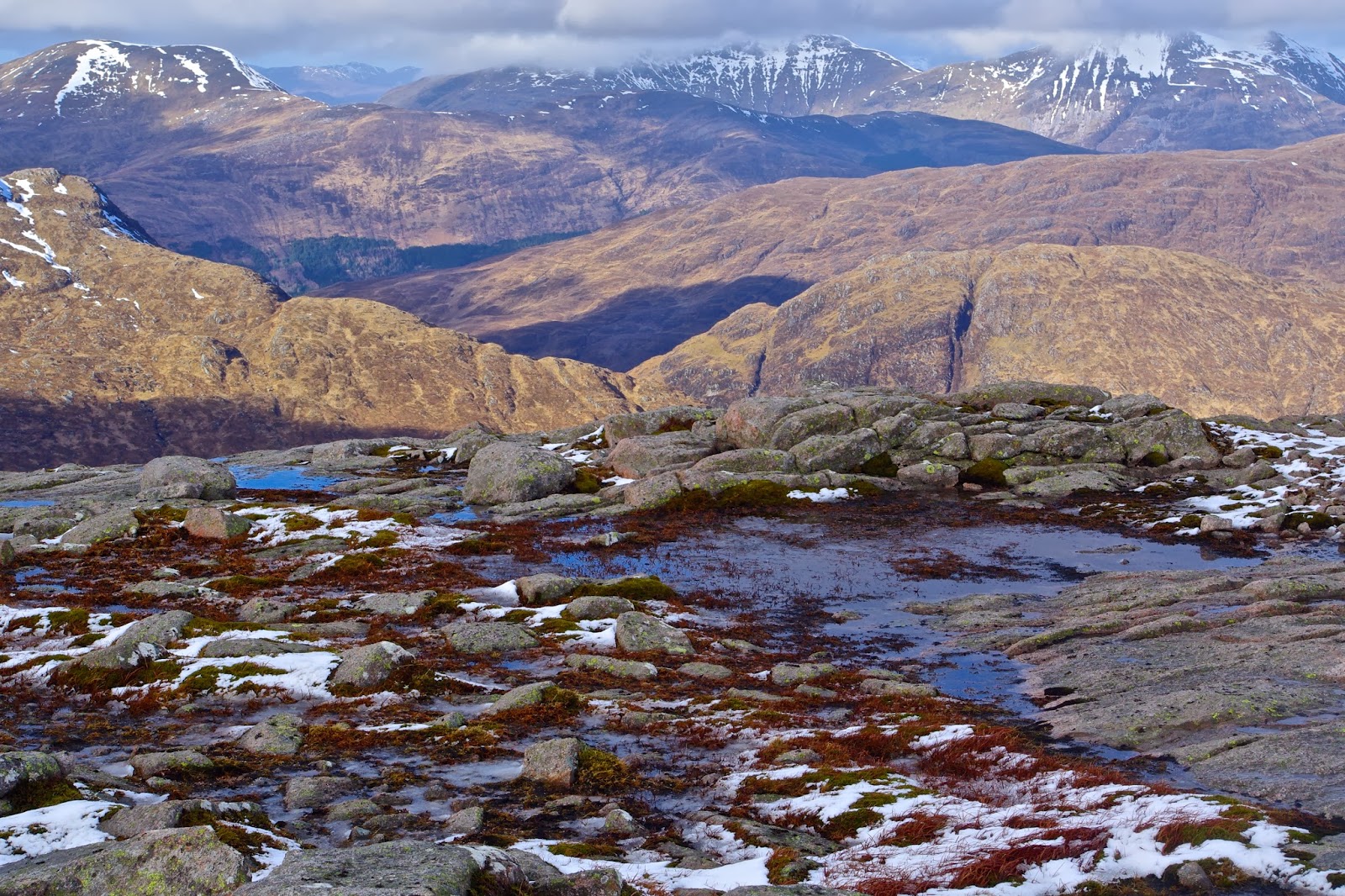
Snow-capped summit of Beinn Trilleachan

Ascent:      1035 metres
Distance:   9 kilometres
Time:        5 hours 6 minutes

c  Beinn Trilleachan    839m    2hrs 52mins

At last, the weather was changing and on the first day of the high pressure I headed for Glen Etive and the massive primeval-looking mountain of Beinn Trilleachan. I had admired it on numerous occasions from Ben Starav or Beinn Sgulaird but it is a long way to drive down Glen Etive for a single corbett. This was my first mountain walk of the year so it seemed appropriate to collect the nearest unclimbed corbett. Despite the forecast of high pressure and a dry day, it was no brighter than most of the others over the last three months and there was a clammy damp warmth in the air.

Keith arrived at 8:30am and I drove to Glen Etive which took almost 2 hours, it was 11:00am by the time we had parked at the small car park at the the foot of the Glen and had changed into boots, gaiters and then assembled and filled our rucksacks with crampons, ice axes and other winter walking gear. They were mostly unneeded and there were times on the ascent when a wet suit would have been more appropriate.

From the car park, we crossed the forestry track that climbs northwards and kept to the outside of a forestry fence that climbs at a reasonable gradient to 170 metres. The ground was sodden and unforgiving. It did not change all day. When we reached the flattened section we turned towards the massive bulk of Beinn Trilleachan and started a steep ascent through wet grasses seamed with slabs of moss veneered granite.

Although I was reasonably fit from regular running, it was no moonwalk and, although I kept going, my legs were leaden from competing against both gravity and suction from the ground. The compensations of the views back up Glen Etive and across to Ben Starav were a scant consolation. Above 600 metres the gradient lessened and we began to traverse patches of wet snow.  It was reasonably stable but with each step, we would sink into a foot or so of the wet stuff. It was with some relief that we reached the long ridge of granite slabs that define this fine mountain.

The sun was trying to breach the clouds but was unsuccessful during the ascent. There was an easy section across the slabs to the top at 767 metres. From here the views down Loch Etive came into view and we could see back to the nearby munros of Beinn Sgulaird and Beinn Fhionnlaidh. Across the glen, Ben Starav remained obstinately in the cloud. The descent from this top in the cloudy conditions was trickier than it should have been. We veered to the right to avoid the steep slabs overlooking the loch. We ended up having to negotiate rock bands which would have been easier on a direct route as we discovered on the return. The final climb of 150 metres was up a long snow slope but the snow was in better condition and it made for an easier climb. We took 15 minutes at the summit hoping that the sun would arrive, it didn't but the tranquillity of a winter view towards Glencoe was splendid and the luxury was a flask of coffee and some jam butties.

The descent was glorious, the views opened up, the sun arrived and warmed the still air and we schussed down the snow fields. We climbed directly up to the 767m top and after joyously taking photos and admiring the superb setting we squelched our way back down the grass and slabs to the car. It had taken longer than we had anticipated but that feeling of smug tiredness from a day well walked lifted our spirits. The deer were grazing along the road all the way up the glen, the waterfalls were sparkling and a vanload of kayakers had arrived to take advantage of a spectacular evening. Let another year of mountain walking begin.


Initial ascent up the boggy path

Climbing towards the 767m top

Looking back to the 767m top - take the direct route

View over the slabs to Fraochaidh and Beinn Bheithir

Keith as the sun comes out

Looking up Glen Etive

Looking down Loch Etive towards Ben Cruachan

Beinn Fhionnlaidh from the slabs


Ben Starav and Loch Etive  from Trilleachan Slabs

Glen Etive with the Buchailles showing their snow caps

Walk over - looking down Loch Etive

Monday, 3 March 2014

Ard Spring and Crimea

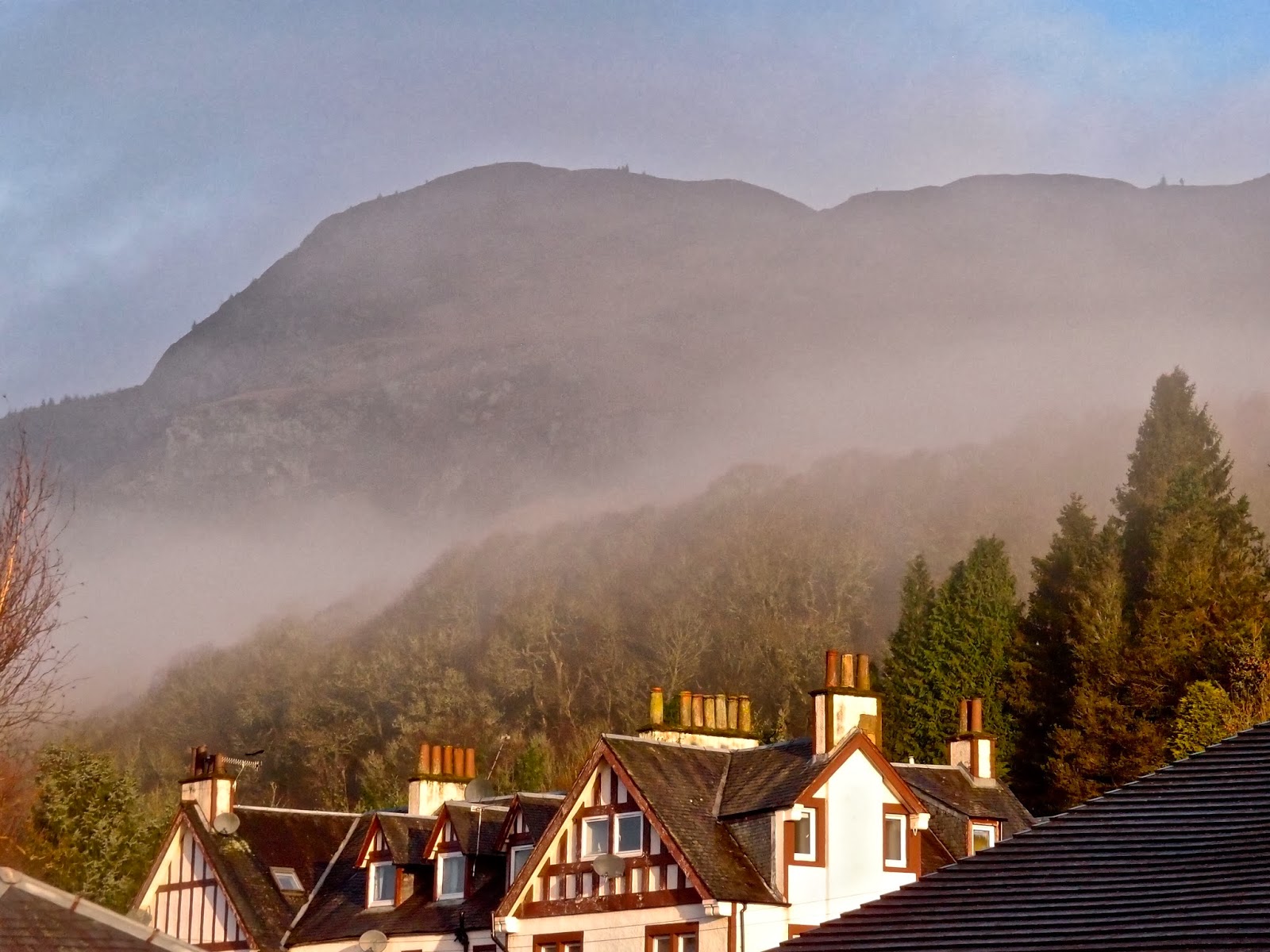
Ben Lomond in the clouds

Morning mist rising

Loch exit


I missed my early morning run this morning as I became absorbed in the emerging events in Ukraine and decided to have breakfast instead. Listening to William Hague obfuscate over Ukraine was not very reassuring. To describe the Russian occupation of Crimea as the "biggest crisis" facing Europe in the 21st Century and then to fail to offer any response was diplomatic jiggery-pokery. Crimea is an autonomous republic transferred to Ukraine in 1954 but has a Russian-speaking majority. It was occupied by Russia with no resistance from Ukraine and no military engagement. It would seem that the chessboard of nations in east-central Europe has still many moves left before a stalemate is reached.
Maybe I am naive, but the reaction of the United States and the UK government, as well as the United Nations, sounded quite bellicose compared to their continued failure to respond to genocide in Syria and the Central African Republic. I am sure that the threat of losing Russian gas for much of Europe and the prospect of facing up to the Red Army will make them think again.

During my search for information, I discovered that Russia has military bases in five countries, including Ukraine, which shares a border with Russia. This is well short of the UK, with military bases in 10 countries including Gibraltar, Cyprus and the Falklands.  The USA has bases in 30 countries, including Kyrgyzstan, Turkey and Bulgaria, which are all quite close to Russia. Diplomacy seems to be little more than nuanced hypocrisy.

As I listened to the radio and perused the maps of Eastern Europe, I was rewarded by the arrival of the sun, and I decided on a walk instead of the usual run. The morning light was the best of the year, so I took the camera and walked along the shores of Loch Ard. I was rewarded with glorious views and wet feet. The months of wet weather had soaked all the paths and the Loch level was at maximum height with the fast current just skimming the underside of the wooden footbridge at the exit of the Loch. By 10:00am, I was home and fencing the garden to keep out the herd of feral goats. I suspect it is a forlorn hope - I am making a lot of noise that will have little effect, a bit like trying to get Russia out of Crimea.

Friday, 28 February 2014

And Quietly Flows the Forth


Forth flowing in its bed
Aorora Borealis over Menteith Hills
After three months of persistent rain and a perpetually waterlogged flood plain, the River Forth was contained within its banks today. The sky was a watery blue this morning as it recuperated from last night's aurora borealis. The cold air was a relief after all those damp dark days that had confined us to winter wallowing.

And there were signs of plant life stirring with vibrant greens and yellows poking through the grey/brown carnage of winter hues. In the forest the trails were gilded by golden mossy pools and decorated by blobs of frogspawn. The Lemmahamish buzzard had found a partner and they were circling above the river Forth with no malice intended. I would have had a spring in my step as I jogged round had I not being nursing a sprained hamstring.

Spring ahoy
Willow warming
 A real skyline visible at last
Floods in retreat


Sunday, 23 February 2014

Corporation Buses

Leyland Tiger single-decker in Preston Corporation Livery

Childhood memories are deeply imprinted and when I happened to see the above bus on 'Call the Midwife' tonight, it immediately brought back fond memories of catching it on Deepdale Road when I was a toddler. Its terminus was at Blackpool Road next to Deepdale football ground and close to my grandparent's house. I usually managed to persuade my mum and grandma to skip the double-deckers and wait for this bus when going into town. It was one of only three single-deckers in the fleet of brown and cream corporation buses. In those days the timetable was to the nearest half minute and buses kept to schedule because the work hooters and school bells were unforgiving of latecomers.

The bus ended its days as the free bus to Preston's first supermarket, Fame, which opened in an old cotton mill in Dundonald Street in the 1960s. Its endearing feature, the back platform, was like those on the double-deckers and was an invitation to run after the bus and jump on by grabbing the pole as the bus accelerated away but had to de-clutch whilst going through the gears. I contrived to do this most mornings by leaving home late, it was one of the highlights of going to school although my schoolmate disagreed. He seldom managed to make the platform and had to wait seven and a half minutes for the next bus. It also guaranteed the ire of the bus conductor but the attention of the girls from Larkhill Convent.

Seeing the bus again was a powerful reminder of how cheap, punctual, and reliable the bus service was when the Corporation ran the buses. Municipal enterprises provided efficient transport services before their forced disposal by the Thatcher government in the 1980's. They provide a quality service compared to the bus services today which are delayed by traffic and are, despite hefty subsidies, too expensive for many dependent young passengers. And with closing doors you can't contemplate chasing them down, let alone knowing when the next one will arrive. 


Thursday, 20 February 2014

Flooding again, where's the PM?

Flood Plain does its job

Horses in retreat, visit from PM imminent?

A bund here would stop 95% of the flooding events
Flooding is a way of life in the village with at least three or four floods a year when the road is blocked, the sandbags are stacked up and the school gets closed. But not today, it is only a minor flood, although it might be classified differently had it been in Oxfordshire, the PM would make a visit for sure.

Every couple of years the river trespasses over the thresholds of the houses and the hotel on the main street but not a penny of compensation or investment is forthcoming. The cost of a stretch of bunding, where the field that hosts the flood as flood plains should(see above), but spills onto the road. It would be a lot cheaper than dredging a few metres of a Somerset dyke or waiting for the Scottish Government to pay consultants to come up with an unaffordable scheme. Today, the horses in the field had to hunker down on the last triangle of the field above the waterline next to the minister's house but there was no visit from the PM.

Perhaps the PM thinks it is up to the First Minister, but he would probably say: "No it's no(t)"! He is too intoxicated with controlling expenditure from Holyrood rather than allowing democratic decisions to be taken at a level which understands the importance and relevance of making decisions that are usually far quicker and far less likely to be encumbered with the excessive bureaucracy and indulgence of consultants reports.

Saturday, 15 February 2014

Tom Finney


Chelsea v PNE at Stamford Bridge 1956 - The splash
The news of Tom Finney's death this morning was not unexpected at 91 years of age. It marked the end of a football legend who has been a dominant presence throughout my life. I had last met him five years ago at my father's funeral, they had been lifelong friends. They had grown up together in Daisy Lane, Holme Slack, a five-minute walk away from Preston North End's ground at Deepdale. My father had never been a footballer, his sport was cycling but they had the bond of growing up in the Depression of the 1930s. Tales of their boyhood escapades were endless: looking after the cars of football supporters for a few pennies and then driving them around wasteland behind Manor House Lane during PNE home matches, getting sacked from their paper rounds after arriving back late from fishing at Hesketh Bank, and being forced to eat a bucket of apples after being caught sapping for apples in a local orchard were just some of the many stories they shared when together.

They kept up their friendship in the war whilst on leave from the Eighth Army by meeting up in Alexandria in Egypt during the African campaign as in the photograph below. In later life, they kept in touch regularly through their local business associations. Tom Finney had a plumbing business during his professional footballing days, players in the top league teams were lucky to be paid the average wage. Dad never had anything but praise for Tom as a friend and a good citizen, sentiments that were echoed by everyone else commenting today,.


I knew that Tom Finney was a legend even before I went to school. We lived at my grandparent's house at the time and shortly after 5pm on the Saturday of every North End home game at Deepdale, my grandad would waltz in with my Uncle Jack and their friend Ernie Rigby. They would recreate North End's goals in the front room. This was before televised games or action replays so they would direct their own version of the highlights. I would hear "Finney beats one, beats two, feints inside and left foot lob into the top right of the net. GOAL...." as the three fifty-something men dribbled around the chairs and kicked cushions. I grew up thinking that this was men behaving normally although my grandma didn't agree. She would shoo the visitors out of the house before they decided to extend the analysis of the game by sending out for a jug of ale from the Acregate Arms.

I was taken to my first game at Deepdale for the Easter morning 11:00am kick-off against Tottenham Hotspur by my grandad as a six-year-old. From the age of eight, I watched virtually every home game until Finney's retiral in a 2-0 victory over Luton Town. My banner saying 'Goodbye Tom' was featured on Match of the Day, which was unfortunate because my mother then realised that I had taken and ruined one of the sheets as well as getting paint on my clothes.

Tom Finney was a one-club player who rejected the overtures of the Italian clubs to stay in his home town for £14 a week. His total earnings throughout his career were £15,000. Updating this to today's value of the £, this is about what Wayne Rooney earns in a fortnight, not counting his sponsorship deals, during which he often doesn't play a single game. Finney, on the other hand. played 473 games for North End and 76 for England for his £15,000 over 14 years.

His skills were mesmerising, he would beat opposing defenders by feinting one way and going the other with the ball. He was a very direct advancing player and could send over tantalising crosses or cut inside and score goals with both feet. He could play on either wing or centre-forward, he was good in the air and scored goals for PNE and England at a rate that compared with the very best centre-forwards like Nat Lofthouse of Bolton Wanderers. Although he was regularly and ruthlessly chopped down by opposing full-backs, he played almost all games, often carrying minor injuries. This was at a time when there were no substitutes and medical support came from a sponge man with a bucket of cold water and aided by the roars of the crowd.

Amongst PNE's best games were the derby matches against neighbouring Blackpool. They were both good first-division teams in the 1950s. Stanley Mathews, 'the wizard of the dribble', was the other great England winger. It was the chance to compare and contrast the two outstanding players of their generation. Mathews was a two-dimensional player; he kept the ball on the ground and his mazy dribbles could turn a full-back inside out. Finney could do that as well but he was good in the air with a prodigious leap and he had a fourth dimension to his play in the way he timed his runs or passes into space. He practised total football long before the Dutch maestros - Neeskens and Cruyff - were winning plaudits and World Cup matches.

I probably saw him play 60 or so games and the one that stands out was the 8-0 demolition of Birmingham City on a sunny Saturday in February 1958. Finney scored two goals in the first half, one by dribbling past three players as he carved his way to goal from the halfway line and released an unstoppable shot past Gil Merrick, Birmingham's England international goalkeeper. He went on to set up hat tricks for Tommy Thomson and Sammy Taylor in the second half. It was poetry on bare earth and North End went on to finish second in the league to the then-mighty Wolves.

Finney's sportsmanship was exemplary and the respect from fans across the country was universal. It included the knowledgeable Scottish fans who watched him take them apart in the home internationals at Hampden. Uncle Jack used to go to these games, Glasgow was as near Preston as London, and he always claimed that Hampden had a far better atmosphere than Wembley. He would wear his PNE scarf and be bought drinks before the game because he could regale Glaswegians with his tales of Finney.

When I was seven my father got Tom to come round to the house and present my birthday presents: a complete PNE strip with a number 7 stitched and a PNE badge press studded onto the shirt. Tom Finney boots completed the kit, they were made of stiff brown leather that required a lot of dubbin before they became bearable, come to think of it they never did become bearable because we mainly played in the street and studs weren't much good on the asphalt. Tom gave me a copy of his book "Instructions for Young Footballers" which included the famous photograph of him slaloming through the water at Stamford Bridge when football pitches were decorated with puddles and less well-drained than today. At the home games, I used to sit on the cinders by the right-wing corner flag at the Kop end. On a couple of occasions as the ball was thrown back to the pitch by the crowd I caught it and handed it to Tom to take a corner. He would thank me by name and ask how was I doing. It was a no-brainer that I played right wing until I was 16 when wingers went out of fashion.

As I heard the tributes to Sir Tom this morning I became nostalgic for the days when I would walk to the ground, watch the top teams for 1s 9p and become part of the thirty-odd thousand faithful fans at one with their team. The walk home after the game in the midst of the streaming crowds along Skeffington Road was part of the entertainment, we could dissect the game and eulogise about Finney's performance. I have seen about 300 first-class games in my lifetime with about half of those at Deepdale, I never went as often after Finney retired and PNE were relegated from the top flight the following season.  Most of the games I watched were in the 1950s, 1960s and 1970s when it was easy to get into games, no advance tickets were required and admission charges were a whole lot cheaper than today's extravagant prices.

No player since those glory days of PNE in the 1950s has matched Finney for consistent excellence, he was a game-changer. Only Franz Beckenbauer, Gunther Netzer, Colin Bell and Kenny Dalgleish of the players that I have watched could emulate Finney: they were all team players who could nevertheless swing a game by themselves.

But then I have fallen out with football and not seen more than 40 games in the last 20 years. These have been mainly Scottish Internationals, or games at Deepdale when visiting my parents; neither providing games with great players. Despite the huge hype about the premiership, I have only attended a couple of premiership games at Blackburn when Shearer was in his pomp. Sky has funded an organisation, the Premier League, that has made fans secondary to sponsors, and TV schedules. This has allowed clubs to hype up salaries to top players that are unjustifiable and unsustainable as many clubs are finding out. I doubt that the premiership has thrown up many Finney comparators, Ryan Giggs and Thierry Henry come nearest and Louis Suarez is having a similar impact this year but he is no gentleman.

All-seater stadiums, high ticket prices, overpaid payers and Sky taking over TV coverage have all diminished my attachment to the game. The game may be faster and on better pitches but the joy of spectating came from standing on the terracing. The camaraderie, the sense of local pride and being able to spontaneously go to matches without hunting for overpriced tickets. I have never enjoyed sitting to watch a live football game, it destroys the involvement and emotions that are so buoyant in a swaying crowd when you are on your toes through all the turmoil of a game. I admire how the Germans have retained the atmosphere, and the crowds and kept realistic pricing by building safe terracing.

Tom Finney was the standard for all that was honest, skilful and courteous to opponents and fans. He displayed a loyalty that has sadly all but disappeared from the game today. Finney epitomised what football should be all about empathy with the fans, a deep commitment to his team and respect for all his opponents. He played locally but won respect globally. As they say in Glasgow: Finney - Pure Dead Brilliant and so he was.


Thursday, 13 February 2014

St Paul's, 378 steps to heaven

St Paul's

Quire
Any trip to distant world cities is dominated by visits to buildings and museums that are the roots of the city's foundation and culture. London has never fallen into this category; it is a place to pass through or to do business, and my only regular visits have been to the National Gallery or the Tate. Last week was different; we had a couple of free days, and we happened to be walking past St Paul's Cathedral as we alighted from a bus during the underground strike. We decided to take a tour of St Paul's as the morning showers graduated to afternoon sunshine. We bought tickets for the well-produced multimedia guided tour and thoroughly enjoyed a couple of hours in the spectacular interior of St Paul's.

The unexpected highlight was the ascent of 259 steps to the Whispering Gallery, which runs around the interior of the Dome. It gets its name from a quirk in its construction, which makes a whisper against its walls audible on the opposite side. We continued upwards to the Stone Gallery, the first of two galleries above the Whispering Gallery that encircle the outside of the dome. The Stone Gallery stands at 173 ft (53.4 metres) from ground-level and can be reached by 378 steps. The clouds were in retreat, and the clarity of the views was perfect. The entry fee was worth it for the view alone.
View to the South West from the Stone Gallery

Shard to the south east

The city from the Stone Gallery

Tuesday, 11 February 2014

Green shoots and Loving Food

Loving Food Truck
In the week that the economy has been given the green light for growth by the Chancellor I stumbled on a lively new business in the city: Loving Food. The mobile food van was tucked into an incongruous parking space by the John Player building and served an excellent range of lunchtime snacks that completely contravened the normal fare associated with mobile food vendors. It was fresh and healthy world influenced food served from a fetchingly painted Citroen truck. The operator was a intelligent young immigrant with a real flair for customer relations. He told me that they were negotiating for a stance at the railway station, which given Network Rail's normal tardiness might mean they will not get there before the summer. From the quality of food I bought today I cannot see it failing to succeed.

However it will need to be operated with flexible long hours, early starts, and it will provide no job security or the underpinning of a secure business base. But this seems the model for growth that the government are happy to hang their hat on to emerge from the recession, which they unwittingly spun out by imposing a level of austerity that Keynes would have choked on. On prime minister's questions the PM said that retaining a 50p tax rate will stymie the green shoots of growth and make us uncompetitive. My guess is that small businesses like this will be lucky to achieve a turnover £70k a year which might generate an income of £25k after the costs of food produce, the vehicle and fuel have been taken into account.

PS The business finally moved to the station in June 2014 after 18 months of seeking permission from the Council and Network Rail for obtaining an agreement for a stance outside the railway station. Apparently the van would contravene the hot mobile food policy, unlike all those burger and breakfast bars that operate in the lay byes around the city. The Loving Food truck now provides a range of fresh, homemade food including flatbreads, stews, soups, grilled halloumi, quesadillas, savoury filled brioche, tacos, burritos and freshly made cakes with a changing menu every day. Just a great pity that it took 18 months to negotiate all the regulatory policies.

Friday, 7 February 2014

Feral Goats and Heil Gove


Right to roam stops at the wall 
The chase
As I returned from my morning run I was surprised to find 8 feral goats nibbling away in the garden. Fortunately, they seemed averse to snowdrops and there was not much else to sate their appetites. I have always enjoyed watching feral goats although they have usually turned up near the summit of remote mountains and they quickly make themselves scarce. This was different, they had invaded my space, stared me out and threatened the garden. Their right to roam was getting personal.

I retrieved my camera from the house and returned to find them disappearing into the next garden over a wall I had rebuilt last year to keep out the wildlife. I followed them into the woods as they herded along with no particular hurry but always managing to keep 20 metres ahead of me. Their oversized horns made me think that this was about the right distance. I eventually gave up the pursuit as they went to inspect the primary school grounds. I returned to check the damage in the garden, it seemed minimal and the heathers that they had been grazing on had needed a trim anyway.

But thinking about why the goats had gone along to the primary school prompted a thought about another feral fiend, the inexplicable Minister of Education, Michael Gove. His activities are indeed feral and he also sports a set of horns, in the form of glasses. He has been invading state schools recently trying to make them more like public schools, by which he means private schools. He was not content with ditching the building or rebuilding of 700 state schools that were in the capital programmes of education authorities and ready to roll. Shortly after being installed he offered bribes for schools to become academies, which is no more than a dastardly form of privatisation and, incidentally, a way of opting out of the national curriculum. He has castigated the performance of state schools, got rid of his independent inspector and offended the majority of teachers as this Heil Gove video implies. And still, the more populist national press humour him, this parody provides a bit of balance.

Do not trust this feral politician

Thursday, 23 January 2014

Ranking Prime Ministers


I recently received an email asking me to rank the post-war prime ministers. It prompted a lot of thought. I had read biographies of most British Prime Ministers but struggled to rate them against each other. I recalled that I had met four of them and had lunch with two of them. I looked at what had happened to the economy during their period of office, what major new initiatives they had introduced, their international exploits but most of all how happy I felt at the time.

I was born during Attlee's post-war government and although I have no memories of Attlee, I can recall watching Churchill and Eden on BBC newsreels after my parents won a TV in a competition in 1952. From Harold Macmillan onwards the PM of the day became part of everyday conversation. My father was a political activist and we had a steady stream of politicians visiting the house during my school years. Every weekend as a 15 and 16-year-old I had to give up my bedroom for a parliamentary candidate who travelled up from London, he lost the 1964 election by 14 votes. A Panorama programme was filmed in our living room the night I was revising for my 'O' level French. I was responsible for reading through and correcting the spelling in my father's letters to the local paper on most mornings before leaving for school.

I began rating PMs by looking at developments during their time in office but realised that global events that are often outwith their control shaped progress. These events as well as the cost of living, employment, public services and incomes all influence turnouts at elections and the popularity of a PM. I decided that I should rank the PMs intuitively from my sense of whether they improved the quality of life of people from all walks of life. Did they display good governance, were they fair and did they win and retain trust?

Although I have never belonged to a political party I do have left-of-centre sympathies on most issues. I have worked closely with politicians of all persuasions for 40 years and observed the good, the bad and sometimes ugly traits of politicians. I am generally impressed by their commitment to serving their electorate and communities although their craving for power and recognition is not always matched by their ability to take objective and rational decisions. Groupthink and party discipline see to that.

I have had an interest in the main political events from the mid-1950s and watched and heard news broadcasts from all of the post-war prime ministers apart from Attlee. He was the man who introduced me to cod liver oil and rationing but I forgive him because he made some good calls on the important things that have influenced my life. I lived in a new council house, attended a new school, my family benefited from the free health service, and obtained grants to give me a higher education. Attlee created a more egalitarian society at the end of the war, putting the well-being of the many above the wealth of the few; and he started the dismantling of the empire. A man whose vision was clear and unencumbered by the necessity of being a performer for the media, which he certainly wasn't.

Mrs Thatcher was the antidote to the welfare state that he created. She has done the most damage to the lives of ordinary folk with high unemployment, the sell-off of council housing, mortgages of 15%, underinvestment in schools and the NHS, deregulation of the markets, privatisation of public services and the creation of a culture of greed with rampant income inequalities.

Post-war prime ministers could be divided into three groups: those who managed radical change and were electorally successful - Attlee, MacMillan, Wilson, Thatcher and Blair. Those who won an election but struggled to make an impact or endear themselves to the wider public: Churchill (in his 1951 -1955 guise), Eden, Heath, Major and Cameron; and those who never won an election - Douglas-Home, Callaghan, and Brown.

Undoubtedly the PM who made the most significant changes that have lasted the test of time was Attlee. He was not a great communicator but someone who managed a team of talented and strong-willed politicians. He encouraged them to radically reform the role of government, to create the welfare state and to eradicate the pre-war perils of poverty and inequality. He was a champion of the United Nations, the Marshall Plan and the independence of India.

MacMillan was a one-nation Tory who embedded the post-war settlement of the welfare state introduced by Attlee. He invested heavily in public infrastructure: rail modernisation, motorways, public sector housing and schools. He was brave enough to bring down the curtains on the British Empire in Africa. My sense during the late 1950s is that it was a period of relative happiness as prosperity was spread across all sections of society and unemployment was very low.

Wilson led the expansion of higher education, made technology a priority and carried out significant social and economic reforms during his first six years as PM. He was a lot less innovative in his second spell although he ended the miner's strike that had brought down Heath. He then let inflation rip and his period in office was punctuated by more industrial relations crises that could have been averted had he stood by Barbara Castle's proposals - 'In Place of Strife' in 1969.

Margaret Thatcher abandoned the post-war consensus about the role of the state and adopted neo-liberal policies that created a market-driven economy and privatised or reduced many public services. John Major was seen as a failure by many Tories but he did rescue them from a collapse of confidence as Mrs Thatcher lost credibility even amongst her own MPs. He surprisingly won the 1992 General Election. He started the process of peace negotiations in Northern Ireland and the recovery from Black Monday.

Tony Blair inherited a strong hand and a massive majority as the Tories became increasingly mired in corruption scandals after 18 years in power. Blair played it well in many ways and won three elections with the economy booming and huge investment in Education and Health. But the way he courted the city, celebrities, the press and media and adopted many of the Thatcher reforms including rail nationalisation were already damaging his reputation before his ill-considered invasion of Iraq. He did carry out significant social reforms such as the minimum wage, and international aid, created devolved governments in the UK, a partial reform of the House of Lords and brought the Good Friday agreement to Northern Ireland.

Then there are the men who don't quite fit in like Ted Heath, Jim Callaghan and Gordon Brown. Heath took the UK into the European Union but made some serial mistakes in his handling of local government reform in 1971, industrial relations and his back benches. Jim Callaghan was a calming influence after Wilson's sudden resignation in 1976 but it is hard to say what he achieved other than to herald the onset of Mrs Thatcher. This inevitably followed his failure to tackle either the industrial relations or monetary crisis of the late 1970s.

Brown's famed intellect could never get the better of his morose brooding personality that had damaged both himself and Blair as he plotted his succession. As Chancellor, he crafted an image of being prudent and iron-fisted but the sell-off of gold in 1999, his irritable determination to push PFI and obsequious pandering to the financial sector did not play well. Nor did the ordering of two aircraft carriers to be built in his backyard. Having said that he did a remarkable job bringing together world leaders to stave off a global meltdown after the financial crisis of 2008.

It would seem that David Cameron is about to join this club of men who don't fit in. I would not have expected this in 2010. He seemed to have taken the Conservative Party into a new era and had progressive views on environmental and social issues. Unfortunately, these good intentions have been stumped by the traditional views of the party. His introduction of austerity measures has been hugely damaging to public services and damaged recovery from the banking crisis. His attempts to stave off the UKIP advance by conceding a European referendum to keep his right-wingers onside smacked of weakness in adversity. He appears to cherish popularity much more than his predecessors, all of whom seemed to be more principled than Cameron who lived by the soundbite.

And at the bottom of the ratings. Anthony Eden was a terrible failure during Suez despite his considerable experience and aristocratic charm and resigned within the year. Sir Alec Douglas-Home was a gentleman but suffered from the undemocratic nature of his appointment and the jibes of the opposition and media at a turgid time for the Tories. But these two did not inflict the damage and inequalities of Mrs Thatcher. David Cameron is well on the way to managing that.

So my ranking of Prime Ministers for the impact they have made on the wider electorate and the economic and social progress of the UK goes as follows.


1.  1945-1951   Clement Attlee               Labour
2.  1957-1962   Harold Macmillan           Conservative
3.  1997-2007   Tony Blair                       Labour
4.  1964-1970   Harold Wilson                Labour
5.  1990-1997   John Major                     Conservative
6.  1974-1976   Harold Wilson                Labour
7.  1951-1955   Winston Churchill          Conservative 
8.  1976-1979   James Callaghan           Labour
9.   2007-2010  Gordon Brown                Labour
10. 1970-1974   Edward Heath              Conservative
11. 1963-1964  Sir Alec Douglas-Home Conservative
12. 1955-1957  Sir Anthony Eden          Conservative
13. 2010-2015  David Cameron             Conservative
14. 1979-1990  Margaret Thatcher         Conservative

Post Script 
By 2024, there have been another four prime ministers.
I would adjust the list as follows:

10.   2016 -2019  Theresa May
11.   1970 -1974  Edward Heath
12.   2022- 2024  Rishi Sunak
13.   1963-1964.  Sir Alex Douglas-Hume
13.   1955- 1956. Sir Anthony Eden
14.   1979- 1990   Margaret Thatcher
15.   2010-2016.   David Cameron
16.   2022-2022    Liz Truss
17.   2019- 2022    Boris Johnson


Saturday, 11 January 2014

Winter Conditions at last

Loch Ard reflections
The last couple of months have been smothered with cloudy, wet, windy and comparatively warm days for mid winter. At last we seem to be heading for more interesting weather. In London yesterday I ran round the parks, dodging dogs, toddlers, new year resolutionists padding along in box bright trainers and a rolling assembly of new age babies in hi tech prams. Today I was home so I would be devoid of company in the vast expanse of the forest. First light brought icy winter conditions with a thick fog at daybreak. I figured that it would probably clear so took my camera and headed for a run round the three nearest lochs. The pavements were lethal with black ice and the roads not much better; the gritter passed me spraying an austerity scatter of salted grit, a pea shooter would probably have been just as effective and a lot greener. I was glad to get off the public roads and onto the forest tracks which gave a good footing. There was a short spell of sunshine as I ran along Loch Ard and the vistas opened up to give stunning reflections in the mirrored surface of the loch.

I headed out on my favourite shoreline loop past Rob Roy's cave and was relieved that the footpath had been cleared of the fallen trees from the December gales. A rainbow appeared and arced its spectra into the Glassert grounds at the other side of the loch. I completed the loop as it started sleeting and then snowing. The trails had deteriorated into linear peat bogs. I reached the junction from where there is a steady climb to the top track which shusses down to Loch Ghleannain and then found an easy rhythm on the long descent to Milton. I was surprised to discover a Land Rover following behind me which raised my pace a little more.

I decided to return by crossing the Duchray Water by the new wooden bridge and to take the trail round Lochan Spling. It was bleak in the flat grey light that had now settled over the forest. I had met no-one despite running for an hour until I reached the junction to the Covenanters. Three large transit vans were parked and had disgorged their teams of barking huskies for their morning run. This is quite a common occurrence on winter weekends and I have had to dive into the ditches on several occasions as they race past, they didn't today.

Reaching Manse Road I was confronted with more black ice, a lone dog was treading ice with some trepidation and people were walking gingerly on the grass bank to avoid the ice and cursing me for the lack of gritting. As I reached the village emergency vehicles sirened their way through on the way to a crash on the icy roads. The sun finally arrived and Ben Lomond looked ready to shed its cap of cloud. The morning run had provided exercise, an adventure, a soaking and chance to take photos as the winter had at last  displayed its full repertoire of conditions. Altogether far more interesting than those wet and windy days that had regaled us for the past couple of months.

Foggy icy start
Near Rob Roy's cave
Pot of Gold
Loch Ard inlet
Lochan Ghleannain

Duchray Water
Rusty dragonfly
Lochan Spling in bleak mid winter
Ben Lomond finally appears

Monday, 6 January 2014

Key for Munro and Corbett postings

Celebrating the completion of the 4th Round on Schiehallion

When I started this blog it was not intended to be a record of hill walks but a diary of things that captured my attention after retirement. In practice it has become more of an online diary and a key feature of retirement has been the chance to indulge in a more relaxed round of Munros, complete the Corbetts, and enjoy some longer-distance walks. It seemed more sensible to write them up, include photographs, and post them on the blog rather than just fill another notebook for each outing as I had done for my four previous Munro rounds. A blog is easier to access and can be tapped into by companions and others looking for photos of the hills. It also provides information that might be useful for other walkers. In particular, the timings, length of the route, and the ascent of each walk are something most of us look for when planning a walk. This is the case with the Munro postings each post typically has received between 40 to 400 hits depending on the popularity of the hill. The rare remote hills also receive a disproportionate number of hits because there are few other postings about them.

There are over a hundred or so walks now on the blog and several people have asked for an explanation of the timings, ascent, and classification of the hills. They have also asked how realistic the timings are. Well, that depends on the individual, the conditions, and the amount of gear being carried, see timings below. The Key to Abbreviations is provided to give some insight into the information provided. My intention at present (2014) is to try and complete my current Munro round and the Corbetts by 2018.

Key to Abbreviations

The date is given for each walk, and the posting is often made a few days later.
Ascent:      is the total height climbed on the day as measured in metres by a Suunto altimeter                                   
Distance:   is the cumulative length of the walk, measured in kilometres, on 1:50,000 OS sheets or, more recently, using the excellent OS Maps Online, a bargain at £21 per annum
Time:         is the walking time and includes short stops for drinks, food, and photos. If I have a substantial break of more than, say, 10 minutes for lunch then this is not included in the time.

m   refers to Munros - there are presently 282 in Scotland. They are hills over 3000 feet (914metres)
t     refers to Tops - these are adjoined to Munros and also over 3000 feet. there are currently 500 tops
c    refers to Corbetts - hills between 2500 and 3000 feet which have a 500-foot drop all around. there are presently 224 Corbetts

Each Munro, Top, or Corbett is given its height in metres(m), and the cumulative time to reach it from the start of the walk (*hrs *mins).

The description of the walk is intended to describe the conditions, the main features, and the memorable events including wildlife sightings. I am still trying to find a way of including route maps on the blog.

Timings

I have been asked to explain my timings for various walks on the Munros, and Corbetts, as well as longer distance trails to give people an idea of how they should use them. I am aware that books such as the Scottish Mountaineering Club Guide to The Munros and Irvine Butterfield's excellent The High Mountains of Britain and Ireland give times based on either Naismith's rule or Eric Langmuir's
formula. The former is quite generous and should be easily possible for a reasonably fit walker and the latter are quite demanding but take no cognisance of ground conditions, which can be hugely significant.

I have listed my cumulative times for each walk. These are usually close to the lowest times in the range quoted by Irvine Butterfield or about 25% quicker than Naismith. However, they will vary according to terrain, weather, whether I am travelling light or carrying a tent and overnight gear, and also how well I am going on the day. They also depend on my companions. I have walked about a third of the outings on my own but I also have four strong walking companions: Keith, my former mountain marathon partner who still competes in hill races, John, my brother-in-law who is a keen cyclist and walker, Mark, a former work colleague who is an obsessive hill walker with a relentless pace and my son, Gregor, who is exceptionally quick on the hills. Between the five of us, we have climbed at 2014 over 9,000 Munros and completed 14  rounds of Munros so there is a wealth of experience and knowledge of the Scottish hills.

The times are mine, someone in his sixties, reasonably fit and still running regularly at sub-8-minute mile pace. I am an experienced hill walker having completed four rounds of the Munros. These posts are of my most recent outings of a more relaxed attempt on a fifth round of Munros and to complete the Corbetts. My times are on average about 15 - 20% slower than they were twenty years ago when I was hill-fit and fairly driven to take advantage of the rare days when I was not working.

Photographs

Wherever possible I take photographs on all walks unless the conditions are too atrocious or I forget my camera, which is very seldom although the battery has sometimes given up. Normally I carry a small digital camera: Panasonic TZ8 until it died, an Olympus ZX1(waterproof) now also defunct, currently a Sony RX100, and occasionally an SLR - Pentax K5 also waterproof.

Previous Munro Rounds

Round 1    1989 to 1993      92 days over 4 years 8 months start on Bidean name Bian and finish on Liathach
Round 2    1994 to 1998    107 days over 4 years 8 months start on Ben Vorlich and finish on Ben Lomond
Round 3    1999 to 2004    105 days over 5 years 2 months start on Ben Ime and finish on Buchaille Etive Mor
Round 4    2004 to 2008      80 days over 3 years 9 months start on Meall nan Aighean and finish on Schiehallion